Daily Digest
UPSC · Civil Services Examination
Current Affairs · Saturday, 29 August 2026
Current affairs curated and edited by Anantam IAS faculty — pulled from The Hindu, PIB, IDSA, Foreign Affairs and the ministries. Read, annotate, revise.
Old Rajinder Nagar · Delhi 110005 · anantamias.com
FSSAI’s Red Front-of-Pack Warning Proposal
Why in News?
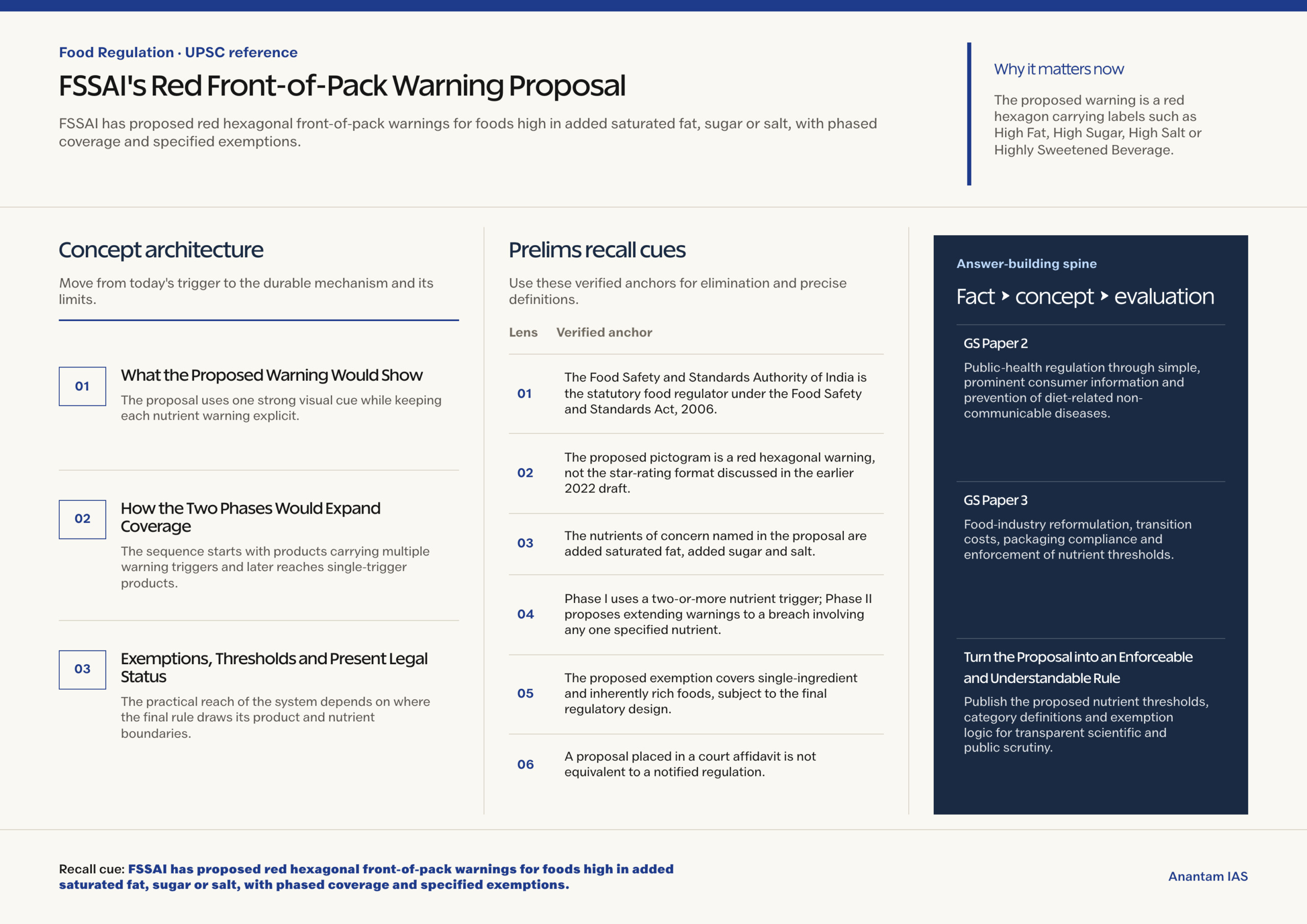
On August 28, 2026, FSSAI submitted an affidavit in the Supreme Court proposing red pictorial front-of-pack warnings for foods high in specified nutrients of concern.
- The proposed warning is a red hexagon carrying labels such as High Fat, High Sugar, High Salt or Highly Sweetened Beverage.
- Phase I would cover foods high in two or more specified nutrients and specified sweetened beverages; Phase II would extend coverage to one-nutrient breaches.
- The proposal links classification to thresholds derived from the Dietary Guidelines for Indians 2024, covering added saturated fat, added sugar and salt.
- Single-ingredient foods and inherently nutrient-rich products such as ghee, edible oil, jaggery and honey are proposed for exemption.
- The affidavit is before the Court; the design has not yet become a notified binding regulation.
- The proposal converts a technical nutrient table into a quick risk signal visible at the point of purchase.
- Phasing seeks to balance consumer comprehension with time for manufacturers to reformulate products and adjust packaging.
- Threshold design and exemptions will determine whether the label captures comparable risks without treating inherently nutrient-rich single foods as formulated products.
UPSC Relevance
Prelims Relevance
- The Food Safety and Standards Authority of India is the statutory food regulator under the Food Safety and Standards Act, 2006.
- The proposed pictogram is a red hexagonal warning, not the star-rating format discussed in the earlier 2022 draft.
- The nutrients of concern named in the proposal are added saturated fat, added sugar and salt.
- Phase I uses a two-or-more nutrient trigger; Phase II proposes extending warnings to a breach involving any one specified nutrient.
- The proposed exemption covers single-ingredient and inherently rich foods, subject to the final regulatory design.
- A proposal placed in a court affidavit is not equivalent to a notified regulation.
Mains Relevance
GS Paper 2
- Public-health regulation through simple, prominent consumer information and prevention of diet-related non-communicable diseases.
- Judicial oversight, regulatory accountability and the difference between a policy proposal and an enforceable rule.
GS Paper 3
- Food-industry reformulation, transition costs, packaging compliance and enforcement of nutrient thresholds.
- Designing exemptions that distinguish single-ingredient foods from formulated packaged products without creating loopholes.
Essay
- Consumer choice becomes meaningful only when technical information is converted into a visible and understandable signal.
Background and Context
What the Proposed Warning Would Show
The proposal uses one strong visual cue while keeping each nutrient warning explicit.
- A red hexagonal pictogram would appear on the principal display panel, making the warning visible at the point of purchase before a buyer turns the package over.
- The words would identify the breached concern directly: High Fat, High Sugar, High Salt or Highly Sweetened Beverage, rather than providing one overall health score.
- FSSAI proposes the warning text at one font point larger than the nutrition-information table printed on the back, making the front signal more prominent.
- The threshold test concerns added saturated fat, added sugar and salt; the proposal anchors those limits in the ICMR-NIN Dietary Guidelines for Indians 2024.
- The design links a nutrient threshold to a named consequence on the pack, reducing the mental calculation required from shoppers reading quantities and serving information.
How the Two Phases Would Expand Coverage
The sequence starts with products carrying multiple warning triggers and later reaches single-trigger products.
- Under Phase I, the warning would apply when a product is high in two or more specified nutrients of concern under the proposed thresholds.
- The first phase would also cover specified sweetened beverages, allowing the Highly Sweetened Beverage warning to identify that product class directly.
- Under Phase II, coverage would extend to products high in any one specified nutrient, widening coverage without requiring a multiple-nutrient breach.
- FSSAI says phased implementation would support consumer acceptability and give manufacturers time to change formulations, labels and compliance systems.
- A phased rule needs declared transition dates and stable testing methods; without them, similar products could face inconsistent classification during the changeover.
Exemptions, Thresholds and Present Legal Status
The practical reach of the system depends on where the final rule draws its product and nutrient boundaries.
- FSSAI proposes exempting single-ingredient foods and items inherently rich in fat, sugar or salt, including ghee, edible oil, jaggery and honey.
- The rationale is categorical: an ingredient’s inherent composition differs from a formulated product to which specified nutrients have been added or combined into a recipe.
- Exempt does not mean risk-free or unregulated; these foods remain subject to other food-safety, composition, nutrition-declaration and labelling requirements.
- The threshold basis must be translated into precise regulatory text covering measurement units, product categories, laboratory methods, treatment of serving size and verification by regulators.
- FSSAI has placed a compliance affidavit and proposal before the Supreme Court. Until due rule-making and notification occur, manufacturers do not face this warning as a final binding mandate.
Way Forward
Turn the Proposal into an Enforceable and Understandable Rule
- Publish the proposed nutrient thresholds, category definitions and exemption logic for transparent scientific and public scrutiny.
- Test the red pictograms across languages, package sizes and digital grocery thumbnails for comprehension, not merely visual preference.
- Set a clear notification, transition and enforcement calendar with validated laboratory methods and guidance for food businesses.
- Review exemptions after implementation to detect loopholes, misleading reformulation and substitution between sugar, salt and fat.
Conclusion
- The new proposal’s importance lies in its specific warning architecture: named red pictograms, phased triggers, Dietary Guidelines-based thresholds and defined exemptions.
- An answer should distinguish this design from an enforceable rule and evaluate whether its thresholds, exemptions and implementation sequence deliver a clear, consistent public-health signal.
- The final test is not the colour alone, but whether buyers can identify a nutrient concern quickly and comparable products are treated by the same transparent standard.
UPSC Practice Questions
Prelims MCQ 1
With reference to FSSAI’s 2026 front-of-pack warning proposal, consider the following statements:
- The proposed warning uses a red hexagonal pictogram.
- Phase I would cover products high in two or more specified nutrients and specified sweetened beverages.
- The proposal has already been notified as a binding regulation.
How many of the above statements are correct?
(a) Only one (b) Only two (c) All three (d) None
Answer: (b) Only two
Explanation:
Statements 1 and 2 describe the affidavit proposal. Statement 3 is incorrect because the proposal remains before the Supreme Court and is not yet a notified binding regulation.
Prelims MCQ 2
Which one of the following best describes the proposed second phase of FSSAI’s front-of-pack warning mechanism?
(a) Warnings only for products breaching all three nutrient thresholds (b) A voluntary star rating for single-ingredient foods (c) Warnings for products high in any one specified nutrient (d) Removal of nutrition information from the back of the pack
Answer: (c) Warnings for products high in any one specified nutrient
Explanation:
Phase II would extend the warning mechanism to products high in any one specified nutrient of concern, following the narrower multiple-trigger first phase.
UPSC Mains Questions
- FSSAI’s proposed front-of-pack warning system combines nutrient thresholds, phased coverage and product exemptions. Evaluate how these design choices affect clarity, fairness and enforceability. (250 words)
- A policy proposal filed before a court is not the same as a notified regulation. Discuss this distinction in the context of regulatory accountability and public-health protection. (250 words)
Sources: The Hindu and ICMR-National Institute of Nutrition, Dietary Guidelines for Indians 2024.
Frequently Asked Questions
What has FSSAI proposed for the front of packaged foods?
FSSAI has proposed red hexagonal pictograms naming High Fat, High Sugar, High Salt or Highly Sweetened Beverage when products meet the specified nutrient-warning conditions.
How would the two implementation phases differ?
Phase I would cover products high in two or more specified nutrients and specified sweetened beverages. Phase II would extend warnings to products high in any one nutrient.
Which foods are proposed to be exempt?
The proposed exemption covers single-ingredient foods and products inherently rich in fat, sugar or salt, with ghee, edible oil, jaggery and honey cited as examples.
Are the red warning labels legally mandatory now?
No. FSSAI placed the design in a compliance affidavit before the Supreme Court. It remains a proposal unless completed rule-making produces a notified, enforceable regulation.
What is the proposed basis for nutrient thresholds?
The affidavit links thresholds for added saturated fat, added sugar and salt to the ICMR-NIN Dietary Guidelines for Indians 2024; final regulatory text must specify their application.
Source: https://anantamias.com/current-affairs/fssai-front-of-pack-warning-proposal/
CISF Counter-Drone Capacity: Securing Critical Infrastructure
Why in News?
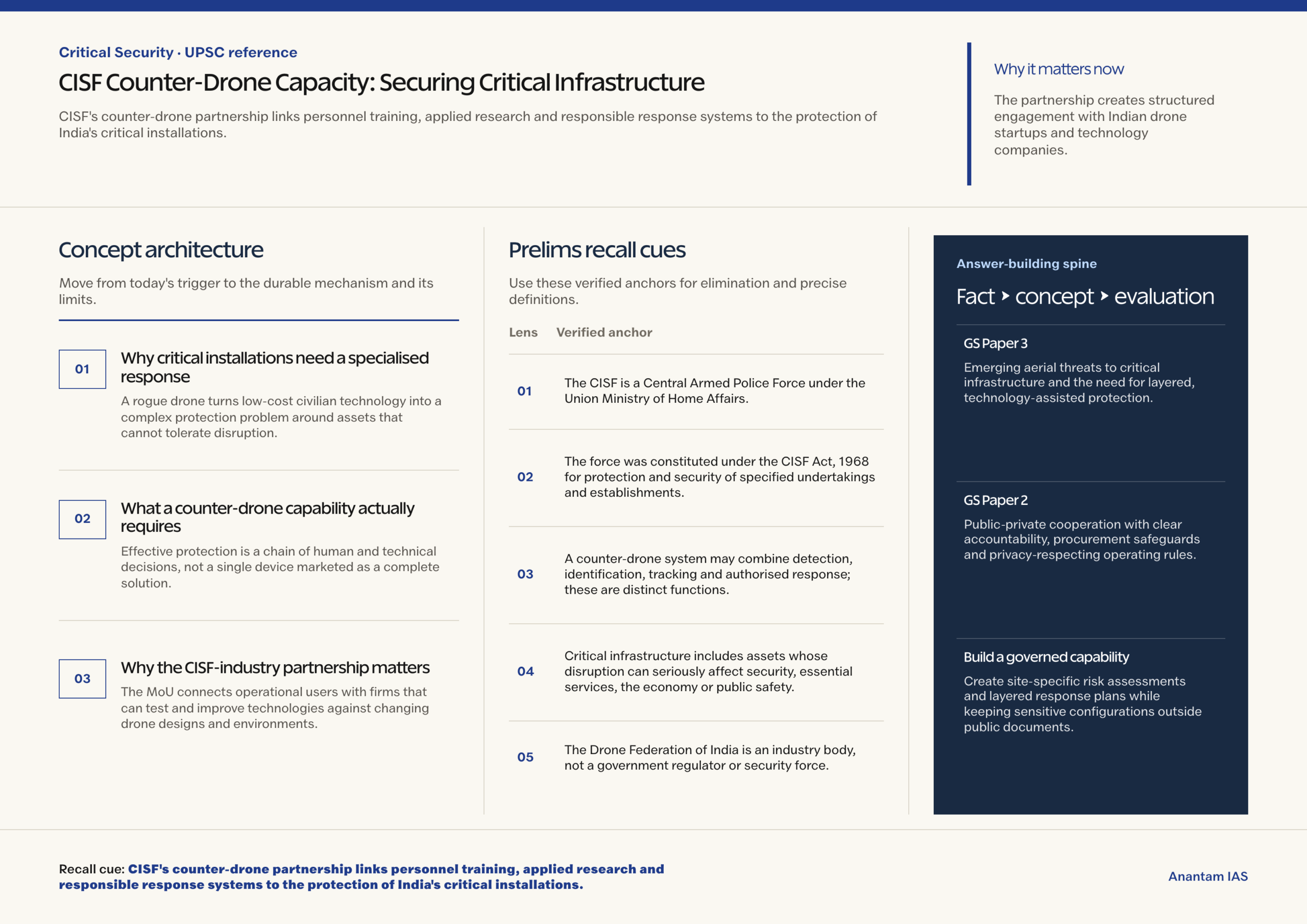
On August 28, the CISF signed an MoU with the Drone Federation of India to strengthen personnel training, applied research and preparedness against rogue drones at critical installations.
- The partnership creates structured engagement with Indian drone startups and technology companies.
- Its stated purposes are capacity building, applied research and operational preparedness.
- The CISF guards installations across aviation, nuclear power, space, refineries and other sensitive sectors.
- The force reported trained personnel and specialist teams, showing that the MoU extends an existing capability rather than starting from zero.
- Cheap, capable unmanned aircraft can create surveillance, disruption and safety risks around densely networked installations.
- Critical-infrastructure protection requires trained judgment and lawful response, not merely the purchase of detection equipment.
- Industry collaboration can shorten the path from an identified operational need to tested, locally supported technology.
UPSC Relevance
Prelims Relevance
- The CISF is a Central Armed Police Force under the Union Ministry of Home Affairs.
- The force was constituted under the CISF Act, 1968 for protection and security of specified undertakings and establishments.
- A counter-drone system may combine detection, identification, tracking and authorised response; these are distinct functions.
- Critical infrastructure includes assets whose disruption can seriously affect security, essential services, the economy or public safety.
- The Drone Federation of India is an industry body, not a government regulator or security force.
Mains Relevance
GS Paper 3
- Emerging aerial threats to critical infrastructure and the need for layered, technology-assisted protection.
- Role of domestic innovation, applied research and trained personnel in internal-security capacity.
GS Paper 2
- Public-private cooperation with clear accountability, procurement safeguards and privacy-respecting operating rules.
Essay
- Technology improves security only when institutions combine it with judgment, law, training and public accountability.
Background and Context
Why critical installations need a specialised response
A rogue drone turns low-cost civilian technology into a complex protection problem around assets that cannot tolerate disruption.
- Small unmanned aircraft can approach from above conventional perimeter barriers, creating a distinct low-altitude threat that ground-only security arrangements may not fully address.
- The concern is broader than a physical strike: unauthorised platforms may enable observation, payload delivery, interference or operational disruption near sensitive facilities.
- Consequences vary by site. An incident near an airport raises aviation-safety risks, while one near an energy or nuclear facility may threaten continuity and public confidence.
- Critical installations operate within civilian surroundings, so false alarms or unsafe countermeasures can themselves create harm. Proportionality and positive identification matter.
- This is installation security, not border surveillance. The relevant frame is protection of specified facilities, their airspace surroundings and continuity of essential functions.
What a counter-drone capability actually requires
Effective protection is a chain of human and technical decisions, not a single device marketed as a complete solution.
- Detection asks whether an object is present; identification and classification ask what it is and whether its behaviour warrants concern.
- Tracking maintains a reliable operational picture, while assessment combines sensor information, site context and authorised procedures before any response decision is taken.
- Response can include alerts, coordination and other measures permitted by law and site protocols. Public discussion should avoid publishing deployment patterns or tactical thresholds.
- Personnel need repeated training to interpret imperfect signals, distinguish authorised activity, escalate correctly and coordinate with aviation, police and facility authorities.
- Resilience also requires maintenance, secure data handling, communication redundancy, incident recording and after-action learning. Equipment without this institutional layer can produce fragile capability.
Why the CISF-industry partnership matters
The MoU connects operational users with firms that can test and improve technologies against changing drone designs and environments.
- The CISF’s installation-security experience can translate field problems into testable requirements, helping developers focus on reliability, interoperability and conditions found at protected facilities.
- Startups and technology companies can support rapid prototyping and applied research, but adoption still needs independent evaluation rather than vendor claims alone.
- Training should be role-based: operators need system proficiency, supervisors need decision protocols, and leaders need governance, procurement and risk-assessment capacity.
- Common testing standards can reduce dependence on isolated products and help different sensors, control rooms and reporting systems exchange usable information.
- Domestic capability can improve maintenance and adaptation, but security procurement must still protect competition, cybersecurity, auditability and lifecycle support. Indigenisation is not a substitute for verification.
Way Forward
Build a governed capability
- Create site-specific risk assessments and layered response plans while keeping sensitive configurations outside public documents.
- Use controlled trials, red-team exercises and measurable acceptance criteria before scaling any technology across installations.
- Institutionalise recurrent training, certification and joint drills with relevant civil aviation, police, emergency and facility authorities.
- Require cybersecurity testing, access controls, audit logs, privacy safeguards and clear human responsibility for consequential decisions.
Conclusion
- The durable lesson is that counter-drone security is a system: sensors, trained people, authorised procedures, inter-agency coordination and continuous learning must work together.
- In a Mains answer, connect the CISF’s critical-installation mandate with applied R&D, capability testing and safeguards against false alarms, unsafe response and vendor dependence.
- The MoU is a capacity-building step. Its value should ultimately be judged by tested readiness, safe incident handling and resilient institutions, not by equipment acquisition or vendor demonstrations alone.
UPSC Practice Questions
Prelims MCQ 1
With reference to counter-drone protection of critical infrastructure, consider the following statements:
- Detection and identification are distinct functions in a counter-drone chain.
- Every detected drone must necessarily be neutralised immediately.
- The CISF functions under the Union Ministry of Home Affairs.
How many of the above statements are correct?
(a) Only one (b) Only two (c) All three (d) None
Answer: (b) Only two
Explanation:
Statements 1 and 3 are correct. Detection does not by itself establish hostile intent; identification, assessment, lawful authority and site protocols shape the response.
Prelims MCQ 2
Which one of the following best describes the purpose of the CISF-Drone Federation of India MoU reported in August 2026?
(a) Regulating all civilian drone registrations in India (b) Managing surveillance along India’s international borders (c) Supporting training, applied research and preparedness for critical-installation security (d) Transferring airport ownership to a security agency
Answer: (c) Supporting training, applied research and preparedness for critical-installation security
Explanation:
The agreement provides structured engagement with drone startups and technology companies for capacity building, applied research and operational preparedness.
UPSC Mains Questions
- Counter-drone protection of critical infrastructure is an institutional capacity problem as much as a technology problem. Discuss.
- How can public-private collaboration strengthen emerging-technology security while preserving accountability, cybersecurity and operational safety?
Sources: The Hindu and Central Industrial Security Force.
Frequently Asked Questions
What is counter-drone capability?
It is the organised ability to detect, identify, track, assess and lawfully respond to unauthorised drones through suitable technology, trained personnel, protocols and coordination.
Why is the CISF relevant to critical infrastructure security?
The CISF is mandated to protect specified industrial and sensitive establishments, including installations in aviation, nuclear, space and energy sectors.
What does the new MoU seek to do?
It seeks structured engagement with Indian drone startups and technology companies for personnel capacity building, applied research and operational preparedness.
Why is detection alone insufficient?
A detected object must be identified, tracked and assessed in context. Response also requires lawful authority, proportionate action and coordination to avoid creating additional risk.
What is the main governance challenge?
India must combine rapid technological adaptation with testing, cybersecurity, privacy, auditability, procurement integrity and clear human responsibility for consequential security decisions.
Source: https://anantamias.com/current-affairs/cisf-counter-drone-critical-infrastructure/
Malaria Elimination: District Targeting and Reliable Surveillance
Why in News?
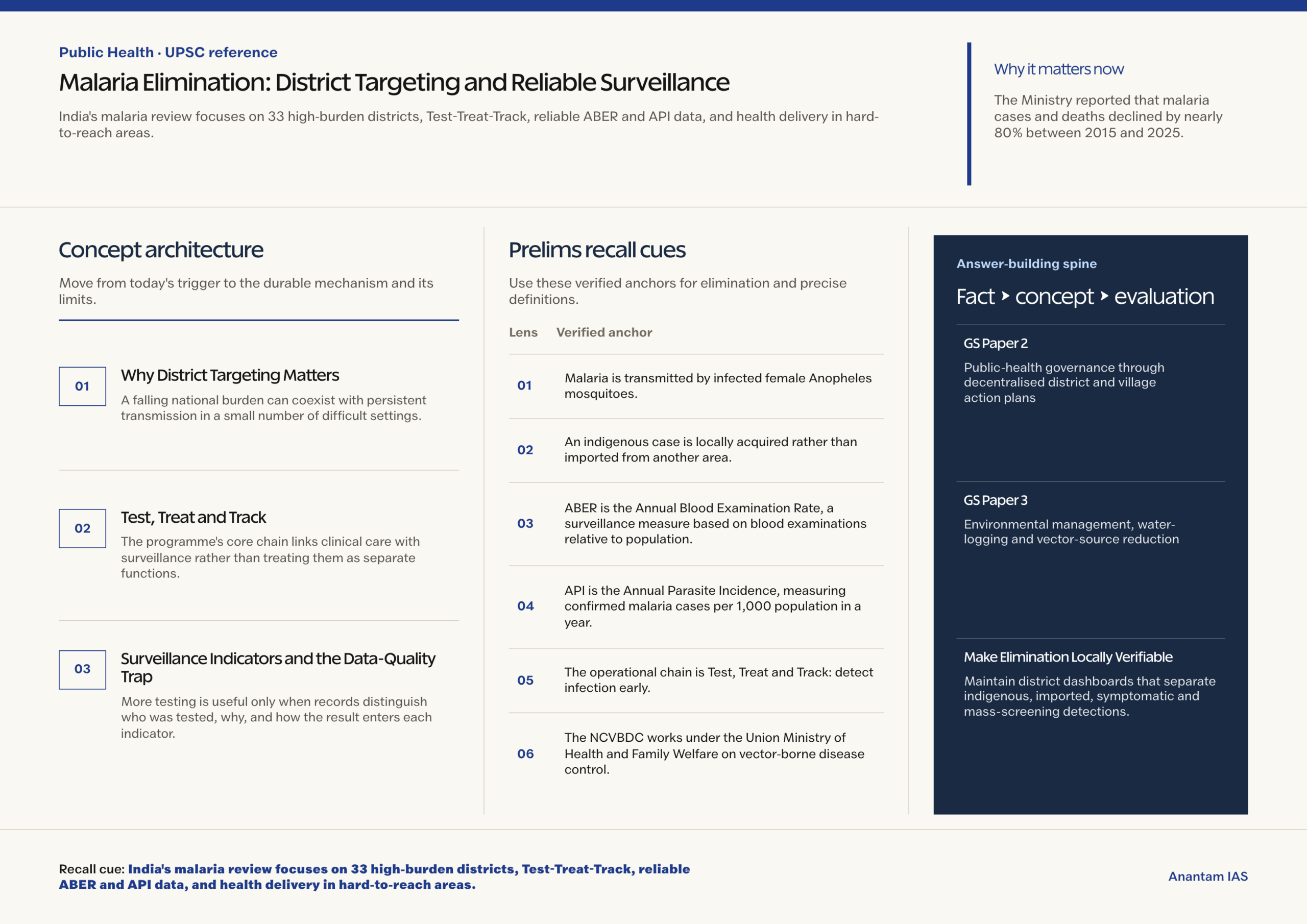
On 28 August, the Union Health Ministry reviewed malaria elimination efforts, prioritising 33 high-burden districts and stronger surveillance, diagnosis, treatment and local action plans.
- The Ministry reported that malaria cases and deaths declined by nearly 80% between 2015 and 2025.
- The number of high-burden districts reportedly fell from 155 to 33 over the same period.
- These 33 districts accounted for 64% of reported cases and 54% of reported deaths in 2025.
- The review said 160 districts recorded zero indigenous cases continuously during 2022–2025.
- Malaria elimination requires interrupting local transmission, not merely reducing the national case total.
- Concentrated burden makes the district and village the practical units for surveillance, planning and delivery.
- The progress figures are programme-reported; they describe administrative surveillance and are not, by themselves, an independent impact evaluation.
UPSC Relevance
Prelims Relevance
- Malaria is transmitted by infected female Anopheles mosquitoes.
- An indigenous case is locally acquired rather than imported from another area.
- ABER is the Annual Blood Examination Rate, a surveillance measure based on blood examinations relative to population.
- API is the Annual Parasite Incidence, measuring confirmed malaria cases per 1,000 population in a year.
- The operational chain is Test, Treat and Track: detect infection early, complete appropriate treatment and follow transmission through surveillance.
- The NCVBDC works under the Union Ministry of Health and Family Welfare on vector-borne disease control.
Mains Relevance
GS Paper 2
- Public-health governance through decentralised district and village action plans
- Last-mile access, health equity and data quality in disease elimination
GS Paper 3
- Environmental management, water-logging and vector-source reduction
- Intersectoral coordination for climate-sensitive and vector-borne diseases
Essay
- A national average can conceal the last-mile geography where public systems either eliminate disease or allow transmission to persist.
Background and Context
Why District Targeting Matters
A falling national burden can coexist with persistent transmission in a small number of difficult settings.
- The 33 priority districts form a concentrated transmission cluster, so equal distribution of resources across districts would ignore where reported cases and deaths are accumulating.
- District Action Plans can match staffing, testing, medicine stocks and vector control to local epidemiology rather than applying a uniform national package.
- Village Action Plans sharpen this approach within districts by identifying high-burden settlements, recurring fever patterns, breeding sites and barriers to reaching care.
- Zero indigenous cases must be sustained through surveillance because an imported infection can restart local transmission where competent vectors and vulnerable populations remain.
- Elimination is consequently a subnational operational task: national decline matters, but district-level interruption and prevention of re-establishment decide durability.
Test, Treat and Track
The programme’s core chain links clinical care with surveillance rather than treating them as separate functions.
- Test means detecting suspected cases promptly through accessible diagnostics, including active surveillance where people may not reach facilities on their own.
- Treat means beginning appropriate therapy quickly and ensuring completion; diagnostic or treatment delay increases the risk of severe disease, death and continuing transmission.
- Track means recording confirmed cases, locating transmission, investigating clusters and following responses so teams can distinguish persistent local spread from imported cases.
- Hard-to-reach areas need dependable diagnostic kits, medicines and outreach; a technically sound protocol fails when distance, terrain or stock-outs break any link in the chain.
- Community volunteers, Self-Help Groups and Panchayati Raj representatives can support early fever reporting, referral and identification of breeding conditions without replacing trained health workers.
Surveillance Indicators and the Data-Quality Trap
More testing is useful only when records distinguish who was tested, why, and how the result enters each indicator.
- A high ABER can suggest active case-finding, but an unusual value may also reflect duplicate tests, repeated entries or mixing routine testing with mass screening.
- API depends on confirmed cases and the population denominator; inconsistent case classification can distort comparisons across districts or across time.
- The review directed that asymptomatic infections found through mass screening be reported separately and excluded from API and ABER calculations to preserve indicator consistency.
- Cleaning an indicator is not the same as hiding infections: separately reported asymptomatic cases remain important for understanding a possible silent parasite reservoir.
- Administrative numbers show programme performance and reported disease patterns, but independent surveys, audits or evaluations may still be needed to assess missed cases and causal impact.
Way Forward
Make Elimination Locally Verifiable
- Maintain district dashboards that separate indigenous, imported, symptomatic and mass-screening detections, with routine checks for duplicates and inconsistent denominators.
- Pre-position diagnostics and anti-malarial medicines in hard-to-reach areas, and monitor the time from fever reporting to testing and treatment completion.
- Link health teams with rural development, urban bodies and Panchayats for water-logging removal, source reduction and environmental management.
- Use independent data-quality audits and targeted prevalence studies to test whether reported decline reflects real transmission reduction rather than only reporting practices.
Conclusion
- India’s reported progress is substantial, but the elimination challenge has narrowed into a last-mile district problem requiring precise surveillance and uninterrupted care.
- A strong Mains answer should connect Test-Treat-Track, clean ABER/API data, hard-to-reach delivery and intersectoral vector control while treating programme claims with appropriate evidentiary caution.
- Success should be judged by sustained interruption of indigenous transmission, rapid detection of imported cases and independently credible evidence that no vulnerable community is systematically missed.
UPSC Practice Questions
Prelims MCQ 1
With reference to malaria surveillance, consider the following statements:
- Annual Blood Examination Rate relates blood examinations for malaria to the population.
- Annual Parasite Incidence expresses confirmed malaria cases per 1,000 population in a year.
- An indigenous malaria case is necessarily acquired outside the reporting area.
How many of the above statements are correct?
(a) Only one (b) Only two (c) All three (d) None
Answer: (b) Only two
Explanation:
Statements 1 and 2 are correct. An indigenous case is locally acquired; a case acquired outside the area is classified as imported.
Prelims MCQ 2
Which one best explains the public-health logic of the Test, Treat and Track strategy for malaria?
(a) It replaces vector control with hospital-based treatment (b) It limits surveillance to patients who reach tertiary hospitals (c) It links early diagnosis and complete treatment with follow-up of cases and transmission (d) It counts all blood examinations as confirmed malaria cases
Answer: (c) It links early diagnosis and complete treatment with follow-up of cases and transmission
Explanation:
The strategy joins prompt detection, appropriate complete treatment and surveillance-based tracking. It complements, rather than replaces, vector and environmental control.
UPSC Mains Questions
- Why must malaria elimination be planned at district and village levels even when national cases are declining? Discuss with reference to surveillance and last-mile health delivery.
- Reliable indicators are as important as intensive testing in a disease-elimination programme. Explain with reference to ABER, API and malaria data quality.
Source: PIB, Ministry of Health and Family Welfare.
Frequently Asked Questions
What is the Test, Treat and Track strategy?
It links prompt malaria diagnosis, appropriate complete treatment and surveillance follow-up so health teams can reduce illness while identifying where local transmission persists.
Why are 33 high-burden districts receiving special attention?
According to the Ministry’s 2025 programme data, they accounted for 64% of reported malaria cases and 54% of reported deaths, making targeted action operationally important.
What is the difference between ABER and API?
ABER measures the extent of blood examination relative to population, while API measures confirmed malaria cases per 1,000 population in a year.
Why can an unusually high ABER be misleading?
It may reflect strong surveillance, but duplicate tests, repeated entries or the inclusion of mass-screening records can inflate it and weaken comparisons.
Do the reported declines independently prove programme impact?
No. They are important programme-reported trends, but independent surveys, audits or evaluations may still be needed to assess missed infections and causal impact.
Source: https://anantamias.com/current-affairs/malaria-elimination-high-burden-districts/
Aditya-L1 Solar Flare Precursors: From Small Brightenings to Space-Weather Warning
Why in News?
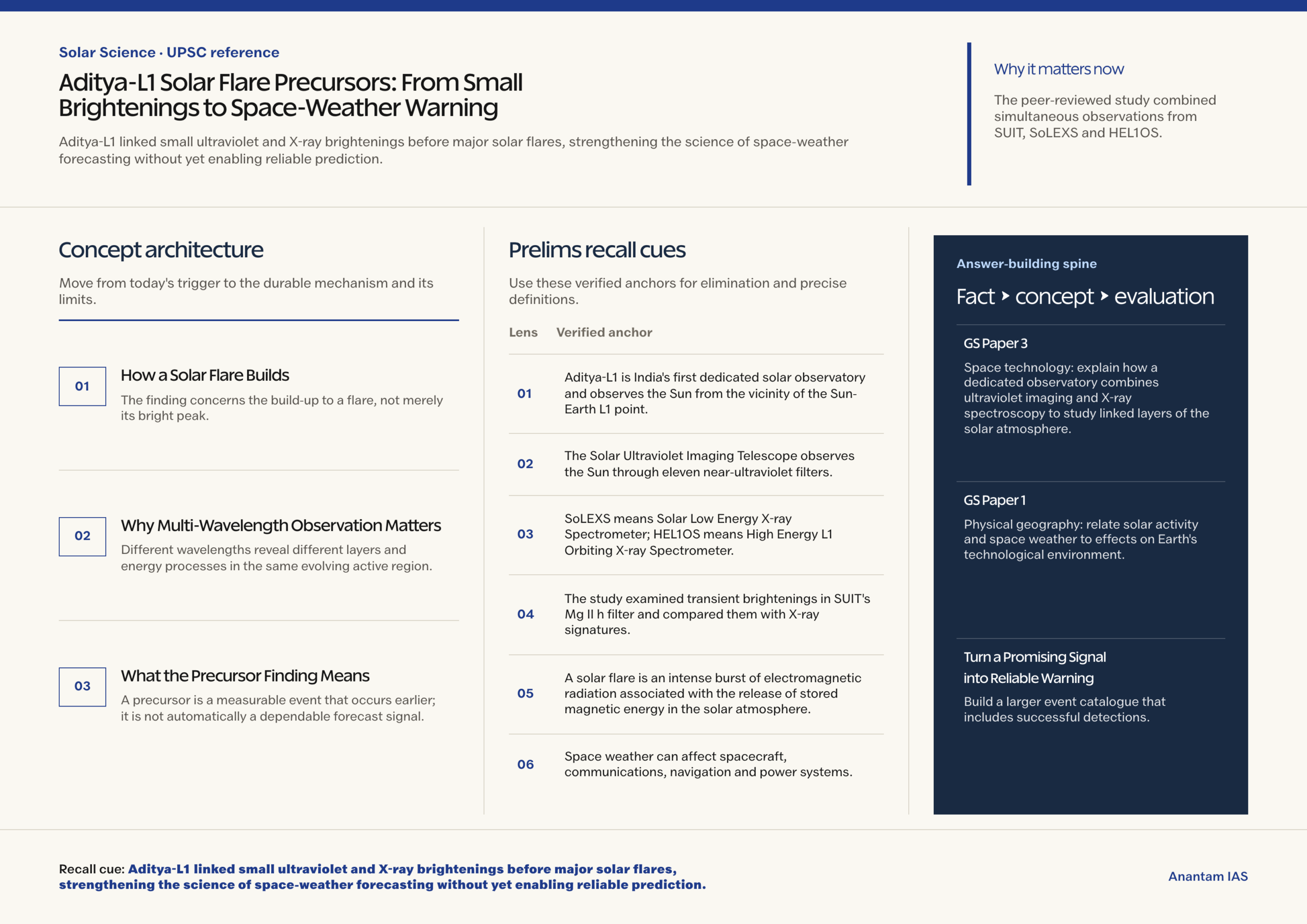
On 28 August 2026, ISRO reported that Aditya-L1 observations linked clustered ultraviolet brightenings, some with X-ray signatures, to locations where major solar flares later erupted.
- The peer-reviewed study combined simultaneous observations from SUIT, SoLEXS and HEL1OS, connecting activity in the lower solar atmosphere with energetic processes in the corona.
- Researchers identified numerous small, short-lived pre-flare transient brightenings in active regions during the hours before several major flares.
- Some ultraviolet transients had corresponding X-ray signatures, supporting the interpretation that they involved small releases of magnetic energy.
- The events clustered around the locations where larger flares subsequently occurred, making their spatial pattern scientifically relevant for precursor studies.
- The finding improves the physical basis for forecasting, but it is not an operationally reliable prediction service and does not guarantee that a flare will follow every brightening.
- Solar flares can disturb radio communication and navigation, affect satellites and increase radiation exposure for astronauts and spacecraft, making warning capability an infrastructure-resilience issue.
- Multi-wavelength observation matters because flare build-up links different atmospheric layers and energy ranges; one instrument alone reveals only part of that evolving system.
- For exam answers, separate a scientific precursor from a validated forecast: a useful association still needs testing for reliability, lead time and false alarms.
UPSC Relevance
Prelims Relevance
- Aditya-L1 is India’s first dedicated solar observatory and observes the Sun from the vicinity of the Sun-Earth L1 point.
- The Solar Ultraviolet Imaging Telescope observes the Sun through eleven near-ultraviolet filters, sampling layers from the upper photosphere to the chromosphere.
- SoLEXS means Solar Low Energy X-ray Spectrometer; HEL1OS means High Energy L1 Orbiting X-ray Spectrometer.
- The study examined transient brightenings in SUIT’s Mg II h filter and compared them with X-ray signatures.
- A solar flare is an intense burst of electromagnetic radiation associated with the release of stored magnetic energy in the solar atmosphere.
- Space weather refers to solar and near-Earth conditions that can affect spacecraft, communications, navigation and other technological systems.
Mains Relevance
GS Paper 3
- Space technology: explain how a dedicated observatory combines ultraviolet imaging and X-ray spectroscopy to study linked layers of the solar atmosphere.
- Infrastructure resilience: connect better warning science with protection of satellites, communication, navigation and human spaceflight.
- Scientific method: distinguish a physically plausible precursor from a forecast model validated for operational decisions.
GS Paper 1
- Physical geography: relate solar activity and space weather to effects on Earth’s technological environment.
Essay
- Early warning becomes trustworthy when observation, mechanism and uncertainty are communicated together rather than converted prematurely into certainty.
Background and Context
How a Solar Flare Builds
The finding concerns the build-up to a flare, not merely its bright peak. Earlier small releases may expose the magnetic path toward instability.
- Active regions contain complex magnetic fields. As magnetic stress accumulates, stored energy may be released rapidly, producing a solar flare and intense electromagnetic radiation.
- The chromosphere lies above the photosphere, while the corona is the Sun’s outer atmosphere; flare development can couple changes across these different layers.
- Small transient brightenings may mark repeated, localised energy release before the main eruption, offering clues about how an active region approaches an unstable state.
- Large flares can affect radio links and navigation and can create hazards for satellites, astronauts and spacecraft, although each impact depends on the event and affected environment.
Why Multi-Wavelength Observation Matters
Different wavelengths reveal different layers and energy processes in the same evolving active region. Together, they trace energy across atmospheric height and emission regimes.
- SUIT images near-ultraviolet emission in eleven filters, including Mg II h, helping scientists track activity from the upper photosphere to the chromosphere.
- Most near-ultraviolet radiation is absorbed by Earth’s atmosphere, so a space-based telescope provides observations that are largely inaccessible to ground observatories.
- SoLEXS and HEL1OS measure X-ray emission associated with energetic processes in the corona, complementing SUIT’s view of lower-atmosphere brightenings.
- Simultaneous measurements reduce ambiguity: an ultraviolet brightening accompanied by X-rays offers stronger evidence of magnetic energy release than its appearance in one band alone.
- Continuous solar viewing near the Sun-Earth L1 point lets Aditya-L1 follow evolving activity without the regular Earth occultations faced by many Earth-orbiting observatories.
What the Precursor Finding Means
A precursor is a measurable event that occurs earlier; it is not automatically a dependable forecast signal. Reliability depends on successful warnings, misses and false alarms.
- Researchers found multiple short-lived brightenings before major flares and observed that they clustered near the later eruption site rather than appearing as unrelated activity across the solar disc.
- The pattern supports a hypothesis that repeated small releases can contribute to, or reveal, progressive destabilisation of the magnetic field before a much larger release.
- Forecasting requires more than association: scientists must test how consistently the signal precedes flares, how often it appears without a flare and how useful its lead time is.
- The present result is a forecasting advance because it identifies a promising observable mechanism; ISRO did not announce a deployed public warning service or guaranteed flare prediction.
- Operational space-weather systems would combine precursor observations with magnetic-field data, other solar measurements, validated models and clear uncertainty thresholds for users.
Way Forward
Turn a Promising Signal into Reliable Warning
The next task is to test the precursor across more events and decision settings.
- Build a larger event catalogue that includes successful detections, missed flares and false alarms across different active-region conditions.
- Quantify lead time and reliability, then compare the signal’s added value against existing magnetic and X-ray indicators.
- Integrate validated indicators into ensemble forecasts rather than relying on one brightening pattern as a deterministic trigger.
- Translate forecast uncertainty into sector-specific alerts for satellite operators, communication services and human-spaceflight missions.
Conclusion
- Aditya-L1’s simultaneous ultraviolet and X-ray observations connect small pre-flare energy releases with the later eruption site, sharpening understanding of how major flares develop across linked layers of the solar atmosphere.
- A strong Mains answer should present this as progress from observation to mechanism, while reserving operational prediction for signals tested against misses, false alarms, usable lead time and clearly defined decision thresholds.
UPSC Practice Questions
Prelims MCQ 1
With reference to instruments aboard Aditya-L1, consider the following statements:
- SUIT observes the Sun in near-ultraviolet filters.
- SoLEXS and HEL1OS measure X-ray emission associated with energetic solar processes.
- The three instruments together enable simultaneous ultraviolet and X-ray study of flare evolution.
How many of the above statements are correct?
(a) Only one (b) Only two (c) All three (d) None
Answer: (c) All three
Explanation:
All three statements are correct. SUIT supplies near-ultraviolet imaging, while SoLEXS and HEL1OS provide complementary X-ray measurements of energetic solar activity.
Prelims MCQ 2
Why are pre-flare transient brightenings scientifically useful but not yet equivalent to reliable flare predictions?
(a) They can be observed only after a flare ends (b) Their reliability, false-alarm rate and usable lead time still require broader validation (c) Ultraviolet radiation cannot be observed from space (d) Solar flares have no effect on technological systems
Answer: (b) Their reliability, false-alarm rate and usable lead time still require broader validation
Explanation:
The study identifies a promising precursor pattern and physical mechanism. Operational forecasting also requires evidence across many events, including misses, false alarms and decision-relevant lead times.
UPSC Mains Questions
- How do simultaneous multi-wavelength observations by Aditya-L1 improve understanding of solar-flare development? Explain their significance for space-weather forecasting.
- A scientific precursor is not the same as an operational prediction. Discuss this distinction with reference to Aditya-L1’s observations of pre-flare transient brightenings.
Source: Indian Space Research Organisation.
Frequently Asked Questions
What did Aditya-L1 detect before major solar flares?
It detected small, short-lived near-ultraviolet brightenings in active regions. Some had X-ray signatures, and the events clustered near locations where major flares later occurred.
Which Aditya-L1 instruments were used in the study?
The study combined SUIT near-ultraviolet imaging with X-ray measurements from SoLEXS and HEL1OS, allowing activity in lower solar layers and the corona to be examined together.
Why is the Sun-Earth L1 point useful for solar observation?
A spacecraft near L1 can maintain a continuous view of the Sun, helping instruments monitor evolving active regions without the regular Earth occultations experienced in many Earth orbits.
Can Aditya-L1 now predict solar flares reliably?
No. The finding advances the scientific basis for forecasting, but operational reliability needs broader testing of detection consistency, false alarms, missed events and usable warning time.
Why does space-weather forecasting matter?
Better forecasts can support protective decisions for satellites, navigation, radio communication, astronauts and spacecraft when major solar events threaten technological systems or increase radiation hazards.
Source: https://anantamias.com/current-affairs/aditya-l1-solar-flare-precursors/
Optical Network Testbed: From Indigenous R&D to Market Readiness
Why in News?
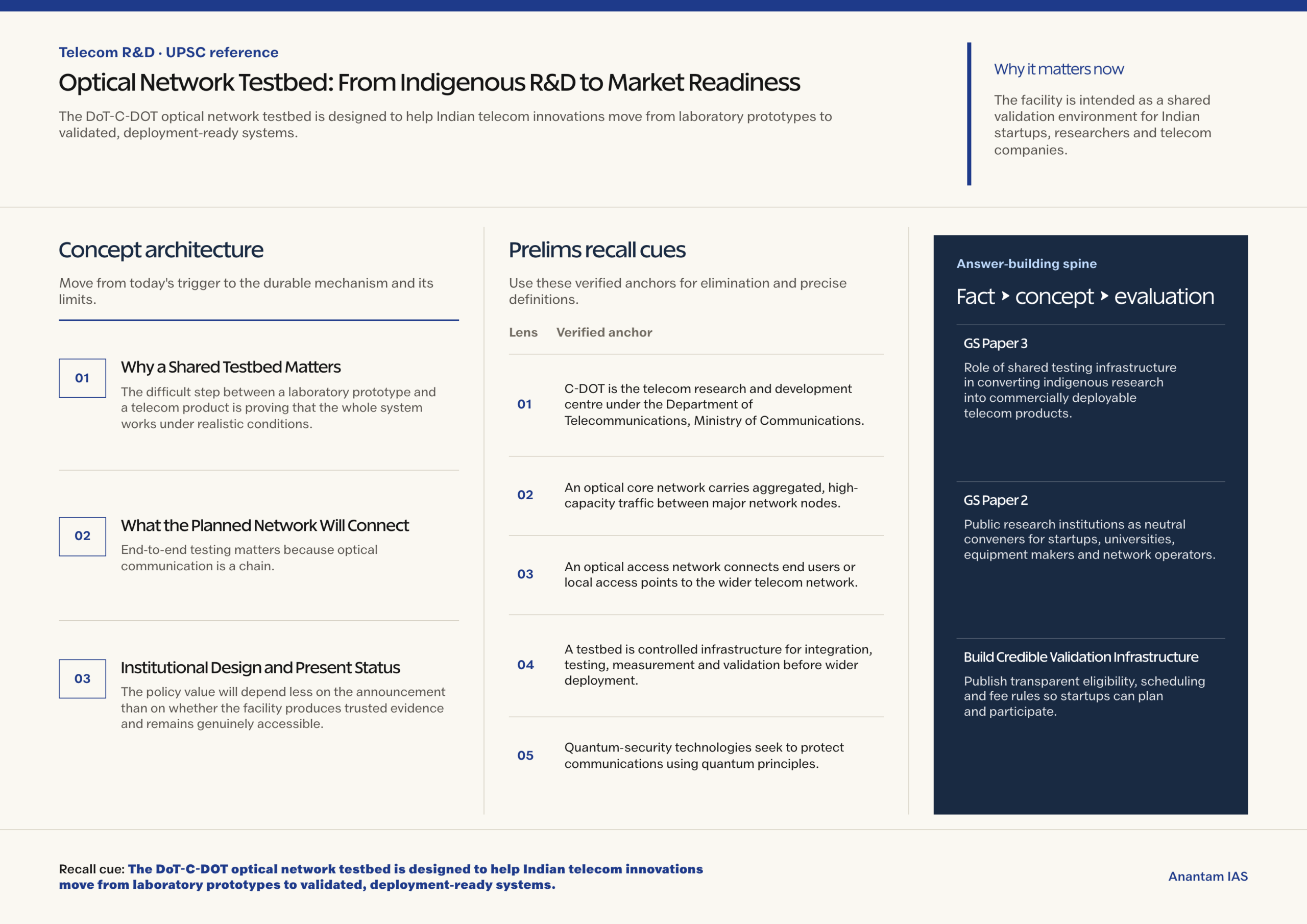
The Department of Telecommunications and C-DOT signed a five-year agreement on 27 August 2026 to establish an end-to-end optical network testbed at C-DOT’s New Delhi campus.
- The facility is intended as a shared validation environment for Indian startups, researchers and telecom companies.
- Its planned technical scope joins optical core, optical access and quantum-security technologies in one end-to-end setting.
- The first two years are for setup; the following three years are planned for operations, maintenance and user support.
- The agreement and design are confirmed, but the testbed is not yet operational.
- Telecom products must work across interconnected layers, equipment and real traffic conditions; a component that succeeds in isolation may fail during integration or scaling.
- Shared test infrastructure can lower the validation barrier for smaller innovators while creating comparable evidence for operators deciding whether a technology is deployment-ready.
- For strategic communications, domestic testing capacity supports both industrial learning and scrutiny of security, interoperability and resilience before field deployment.
UPSC Relevance
Prelims Relevance
- C-DOT is the telecom research and development centre under the Department of Telecommunications, Ministry of Communications.
- An optical core network carries aggregated, high-capacity traffic between major network nodes.
- An optical access network connects end users or local access points to the wider telecom network.
- A testbed is controlled infrastructure for integration, testing, measurement and validation before wider deployment.
- Quantum-security technologies seek to protect communications using quantum principles; inclusion in a testbed does not by itself certify a product as secure.
Mains Relevance
GS Paper 3
- Role of shared testing infrastructure in converting indigenous research into commercially deployable telecom products.
- Need for interoperability, performance, security and reliability evidence in strategic digital infrastructure.
GS Paper 2
- Public research institutions as neutral conveners for startups, universities, equipment makers and network operators.
- Governance safeguards needed for fair access, transparent testing and credible validation.
Essay
- Technological self-reliance depends not only on invention, but also on institutions that can test, validate and improve inventions before society depends on them.
Background and Context
Why a Shared Testbed Matters
The difficult step between a laboratory prototype and a telecom product is proving that the whole system works under realistic conditions.
- A laboratory can demonstrate a device or protocol, while a testbed checks integration with other equipment, software, network layers and measurement tools.
- Repeated tests can expose failures in interoperability, traffic handling, latency, resilience or security that may remain invisible in a narrow demonstration, especially when multiple vendors’ components must operate together.
- Startups often cannot build an end-to-end network solely for validation; shared infrastructure can reduce duplication and give them access to advanced measurement capability.
- Operators need credible evidence before field trials or procurement because failures in communication networks can affect service continuity, data security and public confidence.
- A public testbed should bridge the R&D-to-market gap, but it cannot replace standards compliance, independent certification, field trials or commercial judgment.
What the Planned Network Will Connect
End-to-end testing matters because optical communication is a chain, and weakness at one layer can affect the service experienced at another.
- The optical core is the high-capacity backbone that aggregates and transports traffic between major nodes, demanding reliability, scale and efficient traffic management.
- The optical access segment links homes, enterprises or local network points with the broader system, where cost, reach and varied deployment conditions matter.
- Combining core and access allows testers to observe how a technology behaves across interfaces instead of treating each segment as an isolated product environment with idealised assumptions about upstream or downstream performance.
- The quantum-security component enables controlled examination of security technologies alongside the communications network they are meant to protect, including integration and operational constraints.
- Third-party test and measurement tools provide observable performance evidence, but the credibility of results depends on documented methods, calibrated instruments and reproducible conditions.
Institutional Design and Present Status
The policy value will depend less on the announcement than on whether the facility produces trusted evidence and remains genuinely accessible.
- C-DOT is the Department of Telecommunications’ research and development centre, giving it a convening role across public policy, engineering capability and the domestic telecom ecosystem.
- The official blueprint assigns years one and two to infrastructure setup and formal rollout; years three to five cover maintenance, technical support and educational outreach.
- As of the announcement, only the agreement, location and planned architecture are confirmed; no operational facility or completed technology validation should be inferred.
- Open access rules, published test protocols and conflict-of-interest safeguards would help prevent a shared national resource from favouring particular vendors or producing opaque endorsements.
- Useful performance indicators should track tested technologies, repeatability, standards alignment, field-trial progression and user access, not just events, training sessions or equipment installed, because activity counts do not prove readiness.
Way Forward
Build Credible Validation Infrastructure
- Publish transparent eligibility, scheduling and fee rules so startups, universities and established firms can obtain fair access.
- Align test protocols with relevant domestic and international standards while keeping security-sensitive details appropriately protected.
- Separate technical test results from procurement approval, certification and commercial endorsement to avoid false claims of readiness.
- Create pathways from testbed findings to redesign, repeat testing, field trials and operator feedback so failure becomes structured learning.
Conclusion
- The testbed’s durable significance lies in treating validation infrastructure as part of innovation policy, not as an afterthought between invention and procurement.
- In a Mains answer, connect shared facilities with lower entry barriers, stronger interoperability evidence and secure infrastructure, while stressing that the announced facility is still in its setup stage.
UPSC Practice Questions
Prelims MCQ 1
With reference to the proposed DoT-C-DOT optical network testbed, consider the following statements:
- It is planned to cover optical core, optical access and quantum-security technologies.
- It is already operational and has begun certifying commercial telecom products.
- C-DOT functions under the Department of Telecommunications.
How many of the above statements are correct?
(a) Only one (b) Only two (c) All three (d) None
Answer: (b) Only two
Explanation:
Statements 1 and 3 are correct. The agreement and planned architecture are confirmed, but the testbed is not yet operational and the announcement does not establish a certification function.
Prelims MCQ 2
Which one of the following best describes the main function of a technology testbed?
(a) It automatically grants market approval to every tested product (b) It replaces field trials and standards certification (c) It provides a controlled environment for integration, measurement and validation (d) It restricts research infrastructure to a single equipment vendor
Answer: (c) It provides a controlled environment for integration, measurement and validation
Explanation:
A testbed helps evaluate technologies under controlled, realistic conditions. Its results can inform later steps, but testing does not automatically equal certification, procurement approval or market success.
UPSC Mains Questions
- Shared technology testbeds can be as important as research grants in building indigenous strategic capability. Discuss with reference to optical communication networks. (150 words)
- What governance safeguards are necessary for a public telecom testbed to produce credible and widely usable evidence? (150 words)
Source: PIB, Department of Telecommunications.
Frequently Asked Questions
What is an optical network testbed?
It is controlled infrastructure where optical communication equipment, software and protocols can be integrated, measured and validated under realistic network conditions before wider field deployment.
What parts of the network will the proposed facility cover?
The planned scope combines optical core, optical access and quantum-security technologies, supported by advanced third-party testing and measurement tools.
Is the DoT-C-DOT testbed already operational?
No. The five-year agreement and technical design are confirmed, but the first two years are assigned to setup and formal rollout.
Why is shared validation infrastructure useful for startups?
It can provide access to costly end-to-end network and measurement facilities, helping smaller innovators identify integration failures and build evidence for later field trials.
Does successful testbed performance guarantee market approval?
No. Testbed evidence can support product improvement and readiness assessment, but it does not replace standards compliance, independent certification, field trials, procurement checks or commercial evaluation.
Source: https://anantamias.com/current-affairs/optical-network-testbed-cdot/
India’s Central Asia Visit: Uzbekistan Agenda and SCO Priorities
Why in News?
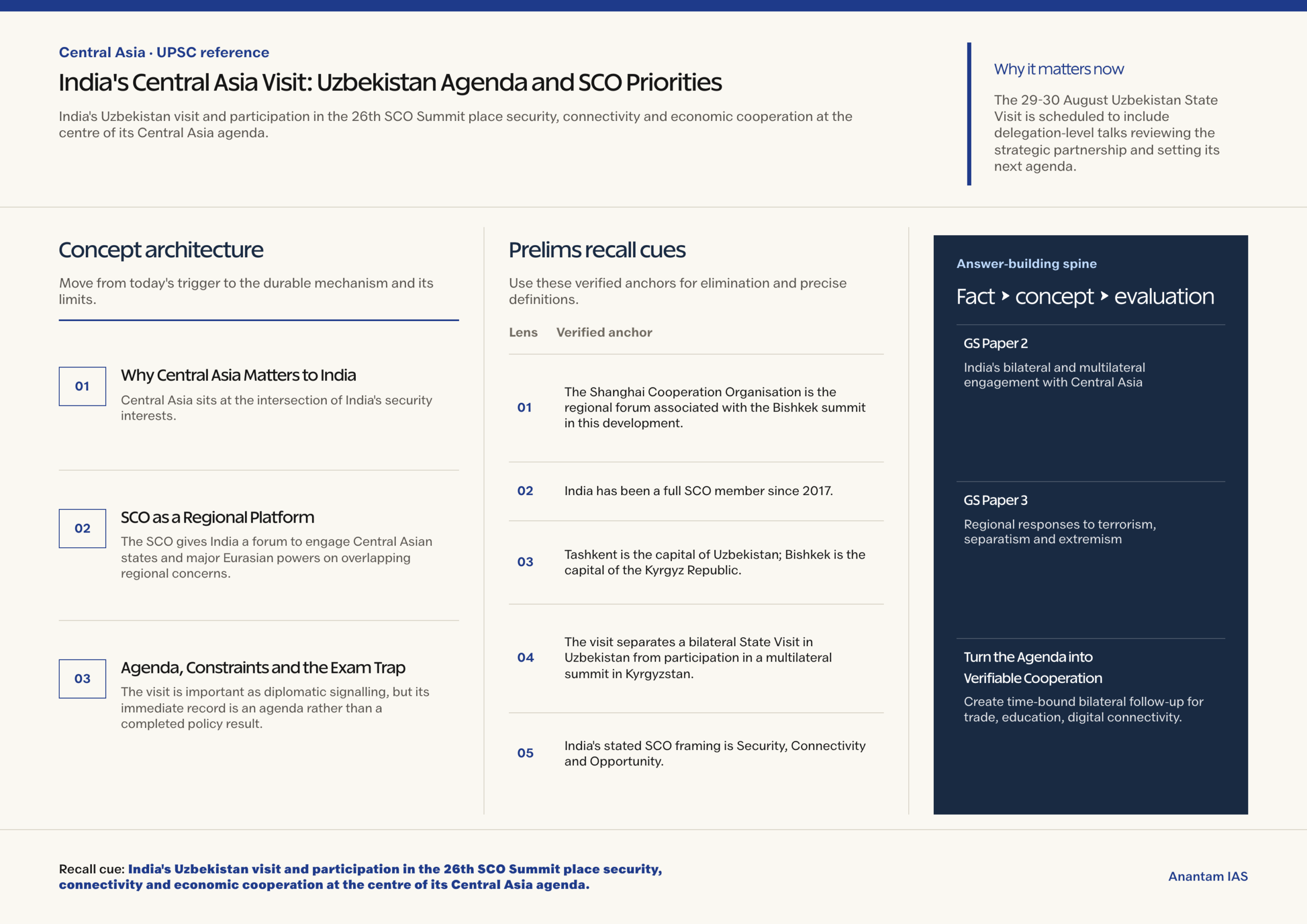
The Prime Minister began a 29 August-1 September visit to Uzbekistan and Kyrgyzstan for bilateral talks in Tashkent and the Shanghai Cooperation Organisation Summit in Bishkek.
- The 29-30 August Uzbekistan State Visit is scheduled to include delegation-level talks reviewing the strategic partnership and setting its next agenda.
- The stated bilateral agenda covers trade and investment, defence, digital connectivity, energy, education and people-to-people relations.
- The 31 August-1 September SCO Summit is expected to feature India’s priorities of Security, Connectivity and Opportunity.
- The official releases describe planned talks and expected meetings; they do not establish any concluded agreement, declaration or implementation outcome.
- The itinerary links a focused bilateral partnership with India’s wider Central Asia engagement through a regional organisation.
- For India, the agenda brings together security concerns, trade access, digital links and cultural relations rather than treating them as separate policy tracks.
- The visit also tests how India can support regional connectivity without compromising sovereignty, territorial integrity or strategic autonomy.
UPSC Relevance
Prelims Relevance
- The Shanghai Cooperation Organisation is the regional forum associated with the Bishkek summit in this development.
- India has been a full SCO member since 2017.
- Tashkent is the capital of Uzbekistan; Bishkek is the capital of the Kyrgyz Republic.
- The visit separates a bilateral State Visit in Uzbekistan from participation in a multilateral summit in Kyrgyzstan.
- India’s stated SCO framing is Security, Connectivity and Opportunity.
Mains Relevance
GS Paper 2
- India’s bilateral and multilateral engagement with Central Asia
- Role and limits of the SCO in regional cooperation
- Strategic autonomy while working with diverse regional powers
GS Paper 3
- Regional responses to terrorism, separatism and extremism
- Connectivity and trade access as components of economic security
Essay
- Connectivity creates strategic value only when it combines physical access, political trust and respect for sovereignty.
Background and Context
Why Central Asia Matters to India
Central Asia sits at the intersection of India’s security interests, continental trade ambitions and long civilisational engagement.
- The region’s location connects South Asia with Eurasia, making access and transit central to trade, diplomacy, crisis response and route diversification during disruption.
- India has no direct land access to Central Asia, so practical connectivity depends on reliable multimodal routes, cooperation with transit partners and predictable border procedures for commercial users.
- Uzbekistan matters because of its population, central location and ability to support regional cooperation in commerce, education, digital systems and security across the wider region.
- The agenda’s inclusion of energy and defence shows that the partnership is broader than trade and includes resilience, capability and long-term strategic trust.
- Cultural institutions and educational links can strengthen public familiarity, but they should complement measurable economic and institutional cooperation rather than substitute for it.
SCO as a Regional Platform
The SCO gives India a forum to engage Central Asian states and major Eurasian powers on overlapping regional concerns.
- India became a full SCO member in 2017, giving it a seat in discussions that extend beyond purely bilateral relationships.
- The 26th summit marks 25 years of the organisation, making institutional direction and regional relevance part of the political context.
- India’s Security priority addresses terrorism, separatism and extremism, which the departure statement identifies as continuing threats to regional peace and stability.
- The Connectivity priority concerns movement of goods, people and digital services, but credible projects must remain transparent, economically viable and respectful of sovereignty.
- The Opportunity priority can translate dialogue into trade, investment, education, technology and energy partnerships, provided follow-up mechanisms assign responsibilities and convert announced intent into implementable projects.
Agenda, Constraints and the Exam Trap
The visit is important as diplomatic signalling, but its immediate record is an agenda rather than a completed policy result.
- The PIB releases say leaders would review cooperation and set the road ahead; they do not report a signed agreement, adopted declaration or delivered project.
- SCO participation and the Uzbekistan State Visit serve different purposes: one is multilateral agenda-setting, while the other deepens a specific strategic partnership.
- India must pursue continental access while managing route constraints, competing power interests, changing regional conditions and its commitment to strategic autonomy.
- Security cooperation is useful when it supports information exchange and common threat assessment, but India must preserve independent positions on regional disputes.
- A strong answer should evaluate later outcomes against the announced agenda instead of presenting expected meetings as proof that cooperation has already advanced.
Way Forward
Turn the Agenda into Verifiable Cooperation
- Create time-bound bilateral follow-up for trade, education, digital connectivity, energy and defence cooperation after the Uzbekistan talks.
- Prioritise interoperable multimodal corridors with transparent financing, predictable customs procedures and respect for sovereignty.
- Use the SCO for practical counter-terrorism dialogue while retaining India’s independent threat assessment and diplomatic choices.
- Measure progress through completed projects, sustained exchanges and reduced transaction barriers rather than summit language alone.
Conclusion
- India’s Central Asia policy works best when security, connectivity and opportunity reinforce one another: safety enables exchange, access enables commerce, and economic stakes support durable political ties.
- In an answer, distinguish today’s announced agenda from future outcomes, then assess success through implemented connectivity, deeper bilateral cooperation and credible regional security coordination.
UPSC Practice Questions
Prelims MCQ 1
With reference to the 2026 India-Central Asia visit, consider the following statements:
- The bilateral State Visit was scheduled in Uzbekistan.
- The 26th SCO Summit was scheduled in the Kyrgyz Republic.
- India became a full member of the SCO in 2017.
How many of the above statements are correct?
(a) Only one (b) Only two (c) All three (d) None
Answer: (c) All three
Explanation:
The State Visit was scheduled in Tashkent, Uzbekistan; the summit in Bishkek, Kyrgyzstan; and India has been a full SCO member since 2017.
Prelims MCQ 2
Which of the following best describes India’s stated priorities for the 26th SCO Summit?
(a) Security, Connectivity and Opportunity (b) Trade, Tourism and Technology (c) Sovereignty, Sustainability and Solidarity (d) Energy, Education and Environment
Answer: (a) Security, Connectivity and Opportunity
Explanation:
The official departure statement identifies Security, Connectivity and Opportunity as India’s vision for regional engagement at the summit.
UPSC Mains Questions
- India’s engagement with Central Asia must combine bilateral depth with effective multilateralism. Discuss with reference to Uzbekistan and the Shanghai Cooperation Organisation.
- How can India pursue connectivity and counter-terrorism cooperation in Eurasia while protecting sovereignty and strategic autonomy?
Sources: PIB, Prime Minister's Office and PIB, Prime Minister's Office.
Frequently Asked Questions
What was the purpose of India’s Uzbekistan visit?
The scheduled State Visit aimed to review and deepen cooperation in trade, investment, defence, digital connectivity, energy, education and people-to-people relations, while setting a future bilateral agenda.
What were India’s stated priorities at the 26th SCO Summit?
India framed its approach around Security, Connectivity and Opportunity, linking regional stability with practical access, economic cooperation and resistance to terrorism, separatism and extremism.
Did the official releases announce completed agreements?
No. They described scheduled talks, expected meetings and intended priorities. Any agreement, summit declaration or implemented project requires confirmation from subsequent official outcome documents.
Why is connectivity difficult for India in Central Asia?
India lacks direct land access to Central Asia. Effective trade consequently depends on dependable multimodal corridors, transit cooperation, transparent financing, efficient customs systems and respect for sovereignty.
How should UPSC answers evaluate this visit?
Separate the bilateral Uzbekistan agenda from the SCO’s multilateral role, preserve the agenda-versus-outcome distinction, and assess future progress through completed projects and sustained institutional cooperation.
Source: https://anantamias.com/current-affairs/india-central-asia-sco-visit/
Public Examination Reform: Scope of the High-Powered Task Force
Why in News?
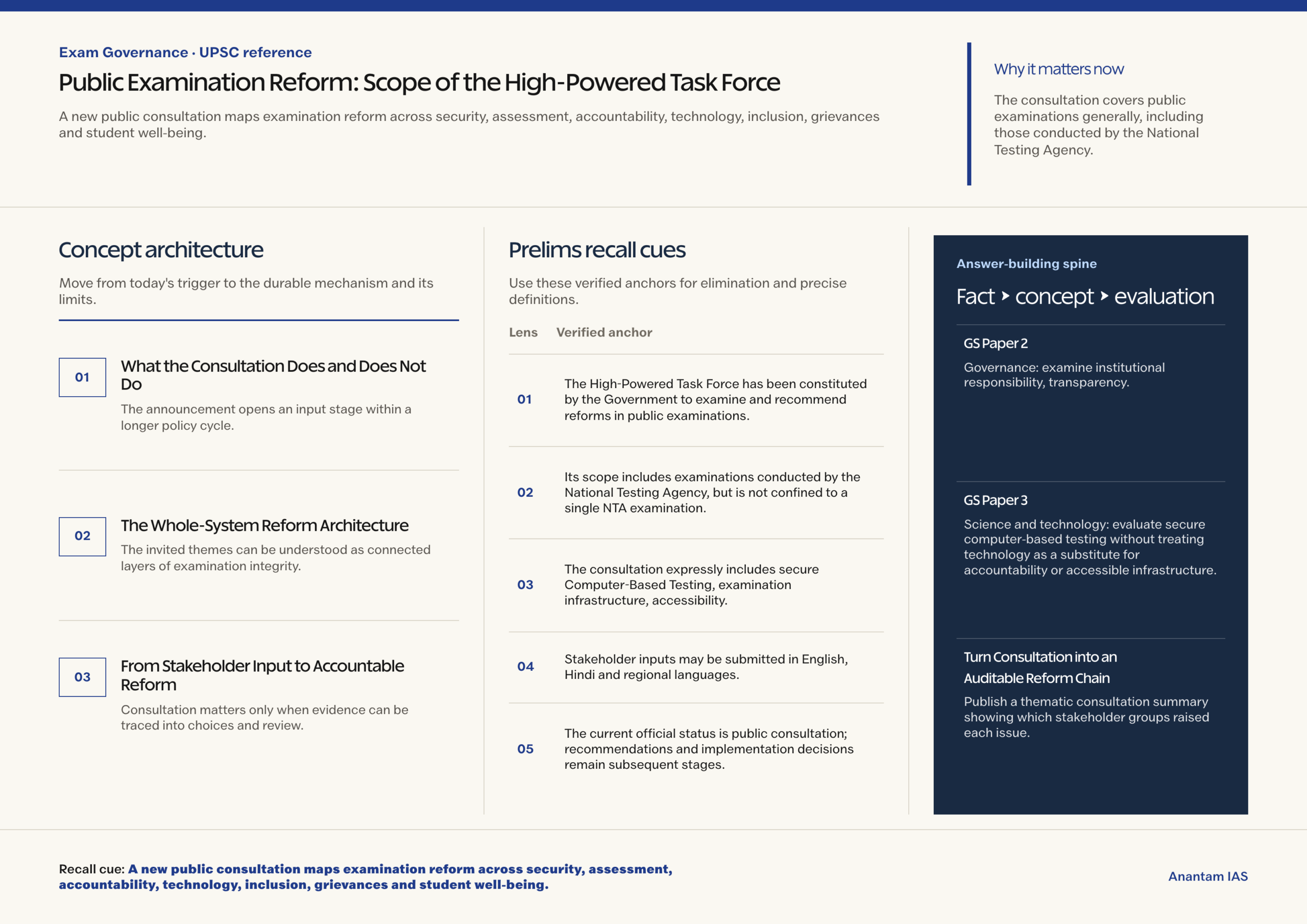
On 28 August 2026, the Government’s High-Powered Task Force invited multilingual stakeholder suggestions on comprehensive reform of the conduct, security, design and governance of public examinations.
- The consultation covers public examinations generally, including those conducted by the National Testing Agency, rather than one examination or one operational failure.
- Students, parents, teachers, institutions, examination bodies, experts, industry and civil society are among the groups invited to participate.
- Submissions may be made in English, Hindi and regional languages, widening the channels through which access and assessment problems can enter the policy process.
- The invited themes span security, assessment methodology, institutional accountability, malpractice redress, secure computer-based testing, infrastructure, inclusion, communication and student well-being.
- The deadline is 13 September 2026; the inputs will assist recommendations, but no recommendation or final reform has yet been adopted.
- Public examinations allocate access to education and public opportunities, so their legitimacy depends on both secure administration and credible, equitable assessment.
- The consultation treats examination integrity as a whole-system problem: institutions, test design, infrastructure, technology, accessibility, grievance channels and candidate welfare interact.
- For answers, distinguish consultation, recommendation, government decision and implementation; each is a separate stage with a different evidentiary status.
UPSC Relevance
Prelims Relevance
- The High-Powered Task Force has been constituted by the Government to examine and recommend reforms in public examinations.
- Its scope includes examinations conducted by the National Testing Agency, but is not confined to a single NTA examination.
- The consultation expressly includes secure Computer-Based Testing, examination infrastructure, accessibility, grievance redress and student well-being.
- Stakeholder inputs may be submitted in English, Hindi and regional languages.
- The current official status is public consultation; recommendations and implementation decisions remain subsequent stages.
Mains Relevance
GS Paper 2
- Governance: examine institutional responsibility, transparency, grievance redress and public participation in high-stakes examination reform.
- Social justice: connect linguistic, regional, social and economic access with equality of opportunity.
- Education governance: assess how examination design and candidate well-being affect trust in public institutions.
GS Paper 3
- Science and technology: evaluate secure computer-based testing without treating technology as a substitute for accountability or accessible infrastructure.
- Internal security: distinguish prevention and detection of malpractice from assessment quality and administrative fairness.
Essay
- Public trust grows when institutions combine secure systems with fair design, accessible participation and reasoned remedies.
Background and Context
What the Consultation Does and Does Not Do
The announcement opens an input stage within a longer policy cycle.
- The Task Force is examining reforms concerning conduct, security, design and governance, placing operational controls and assessment quality inside one mandate rather than treating them as separate policy silos.
- Its stated objective is a system that is secure, transparent, equitable and future-ready, but these remain objectives for examination rather than approved policy standards or enforceable entitlements.
- The consultation collects experience from candidates, families, educators, examination bodies, experts, industry and civil society before the Task Force formulates recommendations for government consideration.
- Multilingual submission can reveal problems hidden by aggregate reporting, including unclear translations, inaccessible interfaces, distant centres and uneven communication across regions and examination modes.
- The official release does not announce a completed report, accepted recommendation, implementation timetable or binding rule; answers must preserve that consultative status at every analytical step.
The Whole-System Reform Architecture
The invited themes can be understood as connected layers of examination integrity.
- The security layer covers conduct, prevention and detection of malpractice, secure computer-based testing and the physical and digital infrastructure needed to protect examination operations end to end.
- The assessment layer covers examination design and methodology: what is measured, how performance is compared and whether the process is suitable for its stated public purpose.
- The institutional layer asks who owns decisions, how examination bodies are governed and how accountability is traced across agencies, experts, centres and technology providers when responsibilities overlap.
- The access layer considers social, economic, regional and linguistic barriers, linking formal eligibility with the practical ability to register, travel, test, obtain accommodations and seek support.
- The trust layer joins transparency, stakeholder communication, grievance redress and student well-being because opaque or delayed remedies can deepen candidate burdens after an examination problem.
From Stakeholder Input to Accountable Reform
Consultation matters only when evidence can be traced into choices and review.
- Inputs should be classified by system layer and examination stage so that recurring problems across bodies are not reduced to isolated complaints or averaged away in headline counts.
- Participation needs diversity as well as volume; otherwise digitally confident groups may dominate while remote, disabled, low-income or non-English-speaking candidates remain underrepresented in the final evidence base.
- Technology proposals require joint tests of security, reliability, privacy, accessibility and fallback capacity; a secure platform may still exclude candidates or fail during network and power disruption.
- Recommendations should separate minimum common safeguards from context-specific choices because examination scale, purpose, language mix, mode and candidate profile differ across bodies and regions.
- A credible reform chain needs published reasoning, assigned institutional ownership, measurable service standards, phased testing and review after implementation, not consultation counts or platform adoption alone.
Way Forward
Turn Consultation into an Auditable Reform Chain
The next stages should preserve participation while making trade-offs visible.
- Publish a thematic consultation summary showing which stakeholder groups raised each issue, while protecting personal and examination-security information.
- Explain which proposals were accepted, modified or rejected and identify the evidence and trade-offs behind each recommendation.
- Pilot major technology and assessment changes across varied regions and candidate groups before scaling them nationally.
- Assign owners, timelines, grievance standards and review indicators only after government decisions are made, keeping proposals distinct from implemented reform.
Conclusion
- The consultation’s value lies in treating public-examination integrity as a connected governance system, not as security technology alone.
- A strong Mains answer should trace the policy chain from inclusive evidence gathering to reasoned recommendations, government decision, implementation ownership and independent review.
UPSC Practice Questions
Prelims MCQ 1
With reference to the High-Powered Task Force consultation on public examinations, consider the following statements:
- Its scope includes examinations conducted by the National Testing Agency.
- It invites suggestions on assessment methodology, accessibility and student well-being.
- The consultation announcement itself brings the proposed reforms into legal force.
How many of the above statements are correct?
(a) Only one (b) Only two (c) All three (d) None
Answer: (b) Only two
Explanation:
Statements 1 and 2 are correct. The Task Force is gathering inputs to formulate recommendations; the announcement does not adopt or legally implement reforms.
Prelims MCQ 2
Which one of the following best describes the present official status of the public-examination reform exercise?
(a) A notified statutory code already in force (b) A final Task Force report accepted by the Government (c) A public consultation to assist the Task Force’s recommendations (d) A judicially mandated replacement of all examination bodies
Answer: (c) A public consultation to assist the Task Force's recommendations
Explanation:
PIB states that stakeholder inputs will assist the High-Powered Task Force in formulating recommendations to the Government. No final recommendation or implementation decision was announced.
UPSC Mains Questions
- Public-examination integrity is a governance architecture, not merely a question of preventing paper leaks. Discuss with reference to the scope of the High-Powered Task Force consultation.
- How can stakeholder consultation be converted into accountable and inclusive reform of India’s public-examination system? Suggest institutional safeguards.
Source: PIB, Department of Personnel and Training.
Frequently Asked Questions
What is the High-Powered Task Force examining?
It is examining reforms in the conduct, security, design and governance of public examinations, including institutional processes, technology, infrastructure, accessibility, grievance redress and student well-being.
Who can participate in the consultation?
The invitation includes students, parents, teachers, academic institutions, examination bodies, subject experts, technology professionals, industry organisations, civil society and other interested stakeholders.
Have the examination reforms already been adopted?
No. The current exercise collects public inputs to assist the Task Force in formulating recommendations to the Government. Recommendations, government decisions and implementation are later stages.
Why is this consultation broader than examination security?
Its scope combines security with assessment design, governance, infrastructure, inclusion, communication, grievances and well-being. This recognises that a secure examination can still be inaccessible, opaque or poorly designed.
Why are multilingual submissions important?
They can bring regional and linguistic access problems into the evidence base and reduce the risk that policy reflects only English-speaking or digitally confident participants.
Source: https://anantamias.com/current-affairs/public-examination-reform-consultation/
Sugar Supply Reform: Fortnightly Quotas and Seven-Day Dispatch
Why in News?
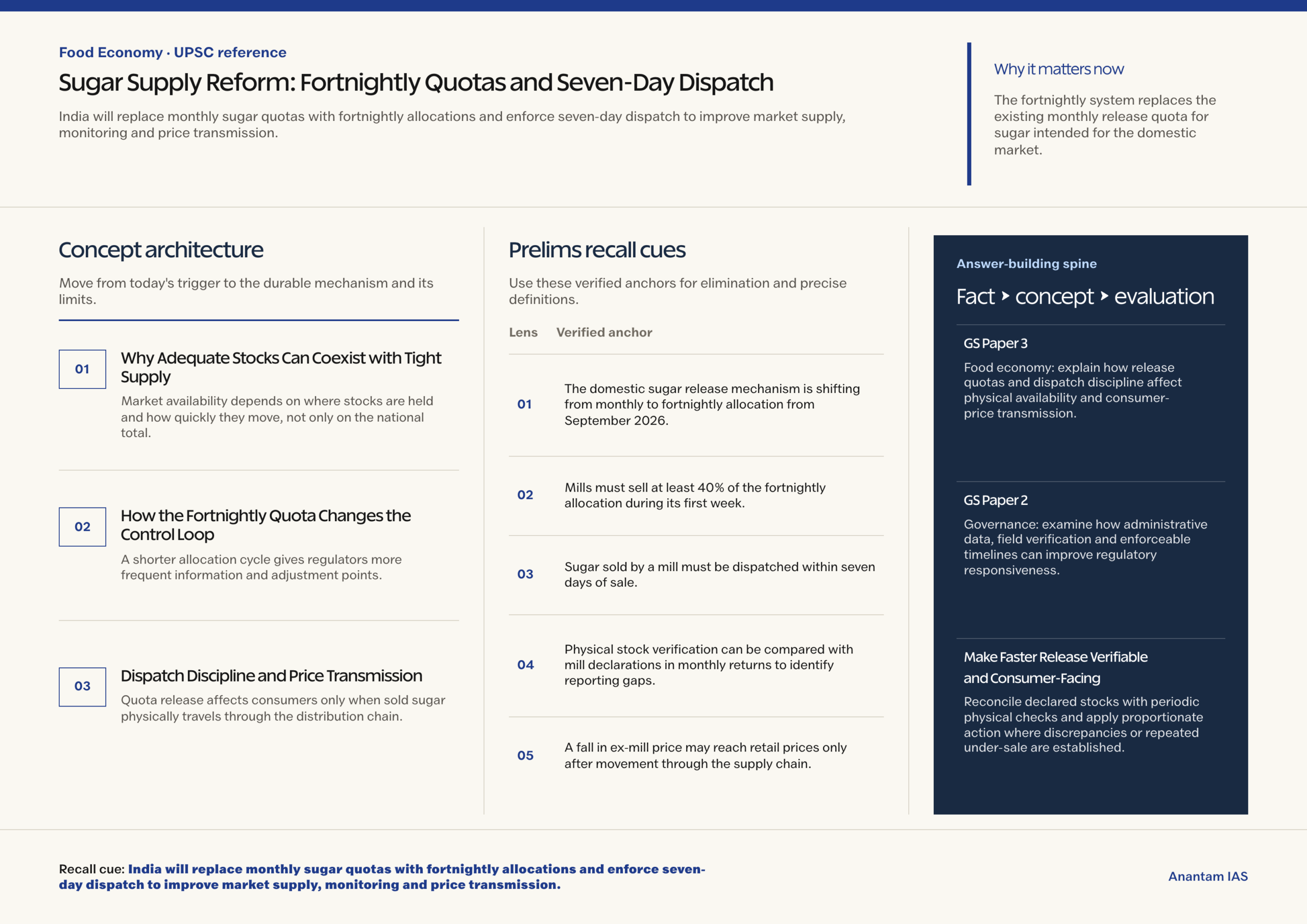
On 28 August 2026, the Government announced fortnightly sugar allocations from September and reiterated that sugar sold by mills must be dispatched within seven days.
- The fortnightly system replaces the existing monthly release quota for sugar intended for the domestic market.
- Mills must sell at least 40% of each fortnight’s allocation in the first week and the remaining quantity in the succeeding week.
- A nationwide physical-verification drive found that several mills held more sugar than they had declared in their monthly returns.
- The Government also identified short selling, defined in the release as mills selling less sugar than their allocated monthly quantity.
- Ex-mill sugar prices had fallen by around 20%, while retail prices had begun declining; complete retail transmission was still expected to take time.
- Adequate national stocks do not automatically ensure market availability when declarations, sales, lifting and dispatch occur at different times.
- The reform combines information verification, shorter quota intervals and a movement deadline to reduce artificial tightening without treating production alone as the supply problem.
- For Mains answers, distinguish an ex-mill price change from its later transmission through dealers and retailers to the consumer price.
UPSC Relevance
Prelims Relevance
- The domestic sugar release mechanism is shifting from monthly to fortnightly allocation from September 2026.
- Mills must sell at least 40% of the fortnightly allocation during its first week.
- Sugar sold by a mill must be dispatched within seven days of sale.
- Physical stock verification can be compared with mill declarations in monthly returns to identify reporting gaps.
- A fall in ex-mill price may reach retail prices only after movement through the supply chain.
Mains Relevance
GS Paper 3
- Food economy: explain how release quotas and dispatch discipline affect physical availability and consumer-price transmission.
- Market regulation: assess stock verification, shorter monitoring intervals and flexible additional releases as responses to hoarding and artificial scarcity.
- Supply chains: distinguish production, mill stocks, sale, dispatch, dealer movement and retail availability.
GS Paper 2
- Governance: examine how administrative data, field verification and enforceable timelines can improve regulatory responsiveness.
- Accountability: consider the need for accurate mill declarations and transparent, proportionate enforcement.
Essay
- Markets depend not only on aggregate abundance but also on trustworthy information and timely movement of goods.
Background and Context
Why Adequate Stocks Can Coexist with Tight Supply
Market availability depends on where stocks are held and how quickly they move, not only on the national total.
- The nationwide physical-verification drive compared sugar actually held at mills with quantities declared in monthly returns, testing whether the administrative picture accurately matched stocks on the ground.
- Several mills were found holding more than their declared stocks, weakening any inference that recent tightness necessarily reflected an economy-wide physical shortage.
- Some mills were also selling below their monthly allocation, so authorised supply was not fully entering the market even when physical sugar remained available at the mill.
- A sale recorded early in a month did not guarantee immediate supply: dispatch or buyer lifting could be delayed until month-end, compressing availability during the intervening period.
- The policy diagnosis links recent tightness to hoarding, speculation and delayed movement; this is the Government’s assessment, not an independently established finding in the release.
How the Fortnightly Quota Changes the Control Loop
A shorter allocation cycle gives regulators more frequent information and adjustment points.
- Under the monthly system, sales and movement could cluster late in the period, leaving a long interval before authorities could observe the full outcome and adjust the next release.
- The new system divides domestic release into fortnightly allocations, narrowing the window in which under-sale or delayed movement can constrain supplies without a policy response.
- The first-week requirement makes at least 40% of the allocation enter the sales channel early, while the remainder must be sold during the succeeding week.
- More frequent monitoring can reveal mismatches between demand, allocated quantity, actual sale and physical movement before they persist through an entire month.
- The Government may release an additional quota when required, making the mechanism responsive to observed availability rather than mechanically fixed for the whole month.
Dispatch Discipline and Price Transmission
Quota release affects consumers only when sold sugar physically travels through the distribution chain.
- The seven-day dispatch rule links a commercial sale to a time-bound physical movement from the mill, reducing scope for sold stock to remain accumulated at origin.
- Fortnightly allocation governs how much enters the sales channel; dispatch discipline governs how quickly that sale becomes downstream availability for dealers and bulk or retail buyers.
- Ex-mill prices are prices at the mill gate, while retail prices include later transactions, transport, inventories and margins; transmission can be directional without being immediate or equal.
- The reported 20% ex-mill decline is the headline comparison, but it does not prove that every consumer location or retail outlet experienced the same fall.
- Effective enforcement requires matching allocation, sale invoices, dispatch records, transport evidence and physical stocks so that compliance is measured as movement rather than paperwork alone.
Way Forward
Make Faster Release Verifiable and Consumer-Facing
The reform should be judged by timely movement and retail availability, not quota orders alone.
- Reconcile declared stocks with periodic physical checks and apply proportionate action where discrepancies or repeated under-sale are established.
- Track each fortnight from allocation to sale and dispatch, using exception alerts for missed first-week or seven-day requirements.
- Publish concise aggregate indicators on allocation, sale, dispatch and regional retail movement without exposing commercially sensitive mill-level data unnecessarily.
- Assess whether retail prices and availability improve across regions before attributing outcomes solely to the quota change.
Conclusion
- The reform addresses a movement-and-information failure: verified abundance at mills cannot protect consumers when sales are withheld or dispatch is delayed.
- A strong Mains answer should trace the chain from stock verification to fortnightly release, early sale, seven-day dispatch and evidence of retail price transmission.
UPSC Practice Questions
Prelims MCQ 1
With reference to the sugar supply measures announced in August 2026, consider the following statements:
- Fortnightly sugar allocation will replace the monthly quota system from September.
- Mills must sell at least 40% of a fortnightly allocation in its first week.
- Sugar sold by a mill must be dispatched within seven days of sale.
How many of the above statements are correct?
(a) Only one (b) Only two (c) All three (d) None
Answer: (c) All three
Explanation:
All three statements reproduce the announced mechanism: fortnightly allocation from September, a minimum 40% first-week sale and dispatch within seven days of sale.
Prelims MCQ 2
Which one of the following best explains why a fall in ex-mill sugar prices may not immediately produce an equal fall in retail prices?
(a) Ex-mill and retail prices refer to the same transaction (b) Retail transmission passes through movement, inventories, dealers and retail margins (c) Fortnightly quotas legally fix every retail price (d) Physical stock verification determines the retail margin
Answer: (b) Retail transmission passes through movement, inventories, dealers and retail margins
Explanation:
Ex-mill price is observed at the mill gate. Retail price emerges later in the distribution chain, so movement, existing inventory and intermediary transactions affect timing and magnitude.
UPSC Mains Questions
- Adequate aggregate stocks do not necessarily ensure adequate market availability. Explain with reference to India’s fortnightly sugar quota and seven-day dispatch measures.
- How can stock verification, shorter regulatory cycles and dispatch tracking improve food-price transmission? Discuss the safeguards needed for accountable implementation.
Source: PIB, Department of Food and Public Distribution.
Frequently Asked Questions
What changed in the domestic sugar quota system?
From September 2026, fortnightly allocation replaces the monthly quota. Mills must sell at least 40% during the first week and the remaining quantity in the succeeding week.
Why did the Government conduct physical stock verification?
It checked whether sugar held at mills matched monthly declarations. Several mills reportedly had stocks above declared quantities, indicating that apparent tightness did not reflect a national shortage.
What is the seven-day dispatch requirement?
Sugar sold by a mill must leave the mill within seven days. The rule targets the gap between recording a sale and physically moving sugar into downstream distribution.
How can fortnightly allocation reduce artificial scarcity?
It creates more frequent monitoring and adjustment points, requires early-period sales and allows additional quota when needed, reducing the time that under-sale or delayed movement can tighten supply.
Does a 20% fall in ex-mill prices mean retail prices must fall equally?
No. The release reported an approximately 20% ex-mill decline and an emerging retail fall, but distribution time, inventories and margins can alter retail transmission across places.
Source: https://anantamias.com/current-affairs/sugar-fortnightly-quota-dispatch-reform/
Bangladesh weighs joining the Mecca Defence Pact
Why in News?
Bangladesh has indicated it would be open to joining the Mecca Joint Defence Agreement if formally invited. The reported pact, signed by Saudi Arabia, Türkiye and Pakistan on August 7, 2026, seeks to strengthen collective deterrence and defence cooperation.
However, Bangladesh has clarified that it has received no formal proposal and that any decision would be based on its national interest.
| UPSC Relevance: GS-2 International Relations: India and its Neighbourhood Mains: Emerging security alignments in West Asia and their implications for India |

What is the Mecca Pact?
- According to the publicly reported joint statement, the agreement:
- treats an armed attack on one signatory as an attack on all three
- seeks to strengthen collective deterrence; and
- promotes wider defence cooperation.
- Its complete text and operational provisions have not been made public. Therefore, it remains unclear whether the mutual-defence clause requires an automatic military response or merely consultations and assistance.
- Unlike NATO, the pact lacks an established integrated command, common military planning system, or clearly disclosed response mechanism.
Strategic Drivers:
- Saudi Arabia: Saudi Arabia seeks to diversify its security partnerships amid regional instability and concerns regarding excessive dependence on the United States. Cooperation with Türkiye and Pakistan could support domestic arms production, technology transfer, missile defence and advanced military capabilities.
- Türkiye: Türkiye possesses a growing defence-industrial base, particularly in drones, missiles, naval systems and the development of the KAAN fifth-generation fighter aircraft. The pact may expand Ankara’s strategic influence in West Asia and strengthen defence exports.
- Pakistan: Pakistan contributes military experience, strategic geography and nuclear-deterrence credentials. The agreement could deepen its defence and economic relationship with Saudi Arabia while institutionalising its long-standing military partnership with Türkiye.
Limits to its credibility:
The pact’s deterrent value will depend on implementation:
- The absence of a publicly available treaty creates uncertainty about obligations.
- The three countries have different threat perceptions and foreign policy priorities.
- Mutual defence clauses do not necessarily guarantee automatic military intervention.
- Saudi Arabia is also a member of the Gulf Cooperation Council’s Joint Defence Agreement, whose operational effectiveness has remained limited.
- Pakistan’s relations with Iran and Türkiye’s NATO commitments could constrain coordinated action.
Thus, the pact presently appears more credible as a framework for defence-industrial cooperation, intelligence sharing, training and technology transfer than as a fully developed military alliance.
Bangladesh’s Possible Entry:
Bangladesh’s participation could strengthen its defence technology access and political ties with major Muslim countries. However, Dhaka must assess:
- impact on its traditional non-aligned foreign policy
- compatibility with relations with India, China and Western countries
- financial and military obligations
- risks of involvement in West Asian conflicts; and
- whether membership serves long-term national interests rather than short-term political calculations.
Implications for India:
The agreement may bring Saudi Arabia closer to the existing Pakistan-Türkiye defence partnership, with China potentially remaining an important technology supplier in the background.
India should monitor:
- possible intelligence and defence-technology transfers to Pakistan
- increased Türkiye-Pakistan military interoperability
- the pact’s position during future India-Pakistan tensions
- Saudi Arabia’s evolving strategic dependence on Pakistan; and
- consequences of Bangladesh or other regional countries joining the framework.
Nevertheless, Saudi Arabia has developed substantial economic, energy and strategic ties with India. The pact should therefore not automatically be viewed as an anti-India alliance.
Way Forward for India:
India should:
- Maintain high-level engagement with Riyadh.
- Expand defence and technology cooperation with Gulf countries,
- Deepen partnerships with the UAE, France and the United States
- Closely monitor military transfers benefiting Pakistan.
- Pursue issue-based strategic engagement without forcing West Asian partners into binary choices.
The Mecca Pact reflects the emergence of a more multipolar West Asian security order and the growing importance of defence-industrial partnerships. Its actual significance will depend on its operational provisions and implementation.
For India, calibrated diplomacy and stronger bilateral relationships will be more effective than viewing the arrangement solely through the Pakistan prism.
Practice Question:
Q. The Mecca Joint Defence Agreement signals a changing security architecture in West Asia. Examine its strategic drivers and implications for India. (10 marks/150 words)
Source: https://anantamias.com/current-affairs/bangladesh-weighs-joining-the-mecca-defence-pact/
India signs Javelin procurement deal with U.S.
Why in News?
India has signed a Letter of Offer and Acceptance (LOA) with the United States to procure a limited number of Javelin anti-tank guided missile (ATGM) systems through the Foreign Military Sales route. The emergency procurement seeks to strengthen the Army’s anti-armour capabilities following Operation Sindoor.
| UPSC Relevance: GS-3 Science and Technology: Defence Technology Prelims: Javelin Anti-tank Guided Missile |
Javelin Anti-Tank Guided Missile:
- The FGM-148 Javelin is a man-portable, shoulder-fired, medium-range ATGM manufactured by the Javelin Joint Venture of RTX and Lockheed Martin.
- Guidance: Imaging infrared seeker with lock-on-before-launch capability.
- Fire-and-forget: The missile guides itself after launch, enabling the operator to immediately relocate.
- Attack Modes:
- Top attack against tanks and armoured vehicles
- Direct attack against bunkers, buildings and low-flying helicopters
- Warhead: Tandem high-explosive anti-tank warhead designed to defeat explosive reactive armour.
- Range: Older variants have an operational range of about 65 metres to 2.5 km; newer configurations can engage targets at around 4 km.
- Weight: The complete system (missile round and command launch unit) weighs approximately 22 kg.
- Soft-launch system: Allows firing from enclosed or concealed positions with reduced backblast.
- Deployment: Operated by a two-person infantry team, though it can be fired by a single trained soldier.
- Day-and-night capability: Its reusable Command Launch Unit provides thermal imaging for surveillance and target acquisition.
Significance for India:
- Improved tank-killing capability: Top attack trajectory targets the relatively thinner upper armour of tanks.
- Greater infantry survivability: Fire-and-forget technology enables shoot-and-scoot operations, reducing exposure to retaliatory fire.
- Suitable for difficult terrain: Its portability makes it valuable along mountainous and contested land borders.
- Multi-target utility: It can engage armour, fortified positions and other battlefield targets.
- Immediate capability augmentation: The limited purchase can bridge operational gaps while India develops and inducts its indigenous Man-Portable Anti-Tank Guided Missile (MPATGM).
- Defence cooperation: The agreement may facilitate future discussions on co-production and strengthen India-U.S. defence-industrial ties.
The Javelin will provide Indian infantry with a highly mobile, precise and survivable anti-armour capability. However, the emergency purchase should remain complementary to the development and large-scale induction of indigenous ATGM systems.
Source: https://anantamias.com/current-affairs/india-signs-javelin-procurement-deal-with-u-s/
PARIVARTAN Scheme: Replacing Polluting Vehicles in Delhi-NCR
Why in News?
The Union government plans to replace over two lakh trucks and buses in Delhi-NCR with BS-VI-compliant or electric vehicles within a year. This advances the two-year implementation period originally approved for the PARIVARTAN Scheme.
According to government estimates, trucks and buses constitute only 3.1% of NCR’s vehicle fleet but contribute around 36% of its vehicular PM2.5 emissions.
| UPSC Relevance: GS-3 Environment: Air Pollution; Environmental Governance Prelims: PARIVARTAN Scheme |
About PARIVARTAN Scheme:
PARIVARTAN stands for Programme for Accelerated Renewal and Incentivization of Vehicle Assets for Reducing Transport Air Pollution and Network Emissions.
- Launched in July 2026.
- Covers eligible trucks and buses registered in Delhi and NCR districts of Haryana, Rajasthan and Uttar Pradesh.
- Targets vehicles conforming to BS-IV or older emission norms.
- Funded through the National Capital Region Planning Board under the Ministry of Housing and Urban Affairs.
- Implemented by the Ministry of Road Transport and Highways.
- Total outlay: ₹9585 crore, including ₹5041 crore in Central budgetary support.
Incentives Offered:
Eligible vehicle owners receive:
- 5% interest subvention on vehicle loans for five years
- complete road-tax waiver for 10 years
- exemption from registration fees
- at least 8% manufacturer discount on the ex-showroom price
- monthly fuel vouchers of ₹1,200-₹4,800 for five years for eligible BS-VI diesel or CNG vehicles; and
- one-time incentives of ₹64,000-₹2.56 lakh for electric vehicles.
Owners must scrap BS-III or older vehicles. BS-IV vehicles may either be scrapped or sold outside the NCR.
Significance:
- High-impact targeting: Replacing a relatively small number of high-emitting commercial vehicles can produce disproportionate reductions in particulate matter and nitrogen oxide emissions.
- Cleaner urban transport: Electric buses and trucks eliminate tailpipe emissions, while BS-VI vehicles use cleaner fuel and advanced emission-control systems.
- Health benefits: Lower vehicular pollution can reduce respiratory and cardiovascular illnesses.
- Fleet modernisation: Interest support and tax waivers reduce the cost of replacing ageing commercial vehicles.
- Regional approach: Coverage across the NCR recognises that Delhi’s air pollution transcends administrative boundaries.
Implementation Concerns:
- High upfront costs and limited heavy-vehicle charging infrastructure may constrain electric-vehicle adoption.
- Selling BS-IV vehicles outside the NCR may merely shift pollution to other regions.
- BS-VI diesel vehicles still generate carbon emissions and may create long-term fossil-fuel lock-in.
- Real-world emission reductions depend on proper maintenance, clean fuel and effective pollution-under-control testing.
- Transparent scrappage, recycling and beneficiary verification will be essential.
The scheme should prioritise zero-emission buses and urban freight vehicles, establish heavy-duty charging corridors and strengthen remote-sensing-based emission monitoring.
Vehicle replacement must be integrated with cleaner fuels, public transport expansion, freight rationalisation and strict enforcement against end-of-life vehicles.
Source: https://anantamias.com/current-affairs/parivartan-scheme-replacing-polluting-vehicles-in-delhi-ncr/
Five Years of Taliban Rule: Afghanistan at Crossroads
Why in News?
August 15, 2026 marked five years since the Taliban re-established the Islamic Emirate of Afghanistan (IEA). Its record has been binary: greater internal stability accompanied by severe socio-political regression and continuing economic fragility.
| UPSC Relevance: GS-2 International Relations: India and its Neighbourhood; Effect of foreign policies on India’s interests Prelims: UNSC Resolution 2593, Doha Agreement Mains: Afghanistan’s stability, Taliban recognition and India’s strategic interests |
Afghanistan: Stable but Repressive State
- Afghanistan has experienced a marked decline in large-scale armed conflict since 2021. Taliban avoided widespread retributive violence and managed the return of nearly six million Afghans from Iran and Pakistan, despite the pressure on employment, housing and public services.
- Threats from Islamic State-Khorasan Province, al-Qaeda and Tehrik-e-Taliban Pakistan persist. Taliban’s claim that Afghan territory is no longer used by terrorist groups remains contested.
- Politically, the Islamic Emirate of Afghanistan (IEA) is an uncodified, centralised theocracy headed by Supreme Leader Hibatullah Akhundzada. Its narrow power structure excludes women and provides limited representation to non-Pashtuns and minorities.
- Women’s Rights: The sharpest regression concerns women’s rights-
- Girls cannot pursue formal education beyond Class VI
- Women are barred from universities and most employment
- Their movement and participation in public life are severely restricted; and
- Gender segregation and risks of child marriage have increased.
Afghanistan remains the only country where secondary and higher education are effectively closed to girls and women. These restrictions violate the spirit of the 2020 Doha Agreement and UNSC Resolution 2593, which calls for counter-terrorism, human rights and an inclusive political settlement.
Fragile Economic Recovery:
- The economy has recovered modestly after contracting by nearly 20% following the Taliban takeover. Better revenue collection, a relatively stable currency and activity in agriculture, mining and services have supported growth.
- The World Bank estimated growth at about 4.8% in 2025, but rapid population expansion caused per-capita income to decline by around 5.6%. Poverty, food insecurity, weak banking, declining foreign aid and restrictions on women’s economic participation remain major constraints.
- Foreign trade reached nearly $13.9 billion in 2025, but exports financed only around 15% of imports. Limited investment and inaccessible foreign reserves leave the regime with little fiscal capacity for welfare and infrastructure.
Erosion of International Isolation:
- Taliban have sought legitimacy without undertaking meaningful domestic reforms. Nevertheless, realpolitik has weakened their diplomatic isolation.
- Russia remains the only country formally recognising the Taliban government, while China, Iran, Central Asian states, Türkiye and Gulf countries have expanded engagement.
- Relations with Pakistan have deteriorated over border tensions and Islamabad’s allegations that Afghanistan shelters TTP militants.
India’s Pragmatic Engagement:
- India has moved from initial caution to substantive engagement without formally recognising the Taliban. Following Afghan Foreign Minister Amir Khan Muttaqi’s 2025 visit, India upgraded its Kabul Technical Mission to an embassy.
- India-Afghanistan trade remains around $1 billion, while India has supplied foodgrains, medicines and disaster-relief material. Afghanistan is strategically important for India because of:
- terrorism and regional security
- Pakistan’s influence
- China’s growing economic presence
- access to Central Asia through Iran’s Chabahar Port; and
- India’s longstanding goodwill among the Afghan people
Way Forward:
- India and the international community should adopt conditional engagement, linking economic assistance and gradual normalisation to girls’ education, inclusive governance, minority protection and verifiable counter-terrorism commitments.
- A multilateral donors’ initiative could support reconstruction while ensuring that assistance directly benefits Afghan citizens.
Taliban have delivered an absence of large-scale war, but not inclusive governance or sustainable peace. Five years on, Afghanistan remains at a fork between continued isolation and a gradual transition towards moderation and international acceptance.
Source: https://anantamias.com/current-affairs/five-years-of-taliban-rule-afghanistan-at-crossroads/
Shared Disaster beyond Borders and Geopolitics
Why in News?
Recently, a massive ice-rock avalanche and glacial collapse near the Nepal-China border generated destructive debris flows and flash floods across Nepal and Tibet, while creating downstream risks for India.
| UPSC Relevance: GS-2: India and its Neighbourhood; GS-3: Climate Change and Disaster Management Prelims: GLOF, ICIMOD Mains: Transboundary disaster management and India-Nepal-China cooperation |
How did the Disaster unfold?
- The event was initially recorded as a magnitude-4.4 earthquake. Subsequent analysis indicated that the seismic signal was generated by the collapse of bedrock and a huge glacial mass rather than tectonic activity.
- Ice, rock and debris plunged into the valley and entered the Lhende Khola-Bhote Koshi-Trishuli river system, producing a high-velocity flood that travelled nearly 100 kilometres.
The precise trigger remains under investigation. While a direct climate attribution requires further study, rising temperatures, glacier retreat and permafrost thaw are making Himalayan slopes increasingly unstable.
Scale of Destruction:
- Over 600 deaths had been reported across Nepal and Tibet, while over 2000 people remained missing.
- Entire settlements, roads and bridges were swept away, while damage to hydropower projects reportedly affected over 12% of Nepal’s hydropower generating capacity. Reconstruction costs could reach $4-$5 billion, almost one-tenth of Nepal’s economy.
- China’s Gyirong Port, the principal land-trade gateway between Nepal and Tibet, was buried under sediment and debris. Roads, electricity and communication links on the Chinese side were also disrupted.
Flood Fallout for India:
- Floodwaters moving through Nepal’s interconnected river systems increased levels in the Gandak, Kosi, Burhi Gandak and Ganga, placing Bihar and eastern Uttar Pradesh on high alert.
- Authorities monitored the Valmikinagar Barrage and vulnerable embankments, evacuated riverside communities and placed NDRF and State response teams on standby.
- India also activated humanitarian assistance, reflecting its Neighbourhood First policy and traditional first-responder role.
Why Trilateral Cooperation is Necessary?
The disaster demonstrates that the Himalayas constitute a shared ecological system. Geopolitical boundaries cannot contain glacial collapses, landslides, earthquakes or transboundary floods. Yet India, Nepal and China lack a comprehensive trilateral mechanism for managing such hazards.
Cooperation is constrained by:
- India-China strategic mistrust
- inadequate sharing of hydrological and glacial data
- incompatible early-warning systems
- weak last-mile communication; and
- infrastructure development in ecologically fragile valleys without adequate cumulative-risk assessment.
Way Forward:
- Establish a Nepal-India-China Himalayan Disaster Coordination Mechanism insulated from wider political differences.
- Share real-time seismic, weather and river-flow data.
- Jointly map glaciers, glacial lakes, permafrost and unstable mountain slopes.
- Develop interoperable early-warning and evacuation protocols.
- Conduct joint humanitarian-assistance and disaster-relief exercises.
- Use International Centre for Integrated Mountain Development’s (ICIMOD) scientific expertise and the Coalition for Disaster Resilient Infrastructure to build resilient roads, bridges and hydropower projects.
- Introduce basin-wide environmental assessments rather than evaluating projects individually.
- Involve local communities, pilgrims and tourism operators in multilingual last-mile warning systems.
The disaster is a reminder of nature’s fury, the fragility of Himalayan infrastructure and the physical interdependence of Nepal, India and China.
The three countries must compartmentalise geopolitical disputes and create a protected space for climate and disaster cooperation, because natural hazards do not recognise political borders.
Source: https://anantamias.com/current-affairs/shared-disaster-beyond-borders-and-geopolitics/