Why in News?
On 28 August 2026, ISRO reported that Aditya-L1 observations linked clustered ultraviolet brightenings, some with X-ray signatures, to locations where major solar flares later erupted.
- The peer-reviewed study combined simultaneous observations from SUIT, SoLEXS and HEL1OS, connecting activity in the lower solar atmosphere with energetic processes in the corona.
- Researchers identified numerous small, short-lived pre-flare transient brightenings in active regions during the hours before several major flares.
- Some ultraviolet transients had corresponding X-ray signatures, supporting the interpretation that they involved small releases of magnetic energy.
- The events clustered around the locations where larger flares subsequently occurred, making their spatial pattern scientifically relevant for precursor studies.
- The finding improves the physical basis for forecasting, but it is not an operationally reliable prediction service and does not guarantee that a flare will follow every brightening.
- Solar flares can disturb radio communication and navigation, affect satellites and increase radiation exposure for astronauts and spacecraft, making warning capability an infrastructure-resilience issue.
- Multi-wavelength observation matters because flare build-up links different atmospheric layers and energy ranges; one instrument alone reveals only part of that evolving system.
- For exam answers, separate a scientific precursor from a validated forecast: a useful association still needs testing for reliability, lead time and false alarms.
UPSC Relevance
Prelims Relevance
- Aditya-L1 is India’s first dedicated solar observatory and observes the Sun from the vicinity of the Sun-Earth L1 point.
- The Solar Ultraviolet Imaging Telescope observes the Sun through eleven near-ultraviolet filters, sampling layers from the upper photosphere to the chromosphere.
- SoLEXS means Solar Low Energy X-ray Spectrometer; HEL1OS means High Energy L1 Orbiting X-ray Spectrometer.
- The study examined transient brightenings in SUIT’s Mg II h filter and compared them with X-ray signatures.
- A solar flare is an intense burst of electromagnetic radiation associated with the release of stored magnetic energy in the solar atmosphere.
- Space weather refers to solar and near-Earth conditions that can affect spacecraft, communications, navigation and other technological systems.
Mains Relevance
GS Paper 3
- Space technology: explain how a dedicated observatory combines ultraviolet imaging and X-ray spectroscopy to study linked layers of the solar atmosphere.
- Infrastructure resilience: connect better warning science with protection of satellites, communication, navigation and human spaceflight.
- Scientific method: distinguish a physically plausible precursor from a forecast model validated for operational decisions.
GS Paper 1
- Physical geography: relate solar activity and space weather to effects on Earth’s technological environment.
Essay
- Early warning becomes trustworthy when observation, mechanism and uncertainty are communicated together rather than converted prematurely into certainty.
Background and Context
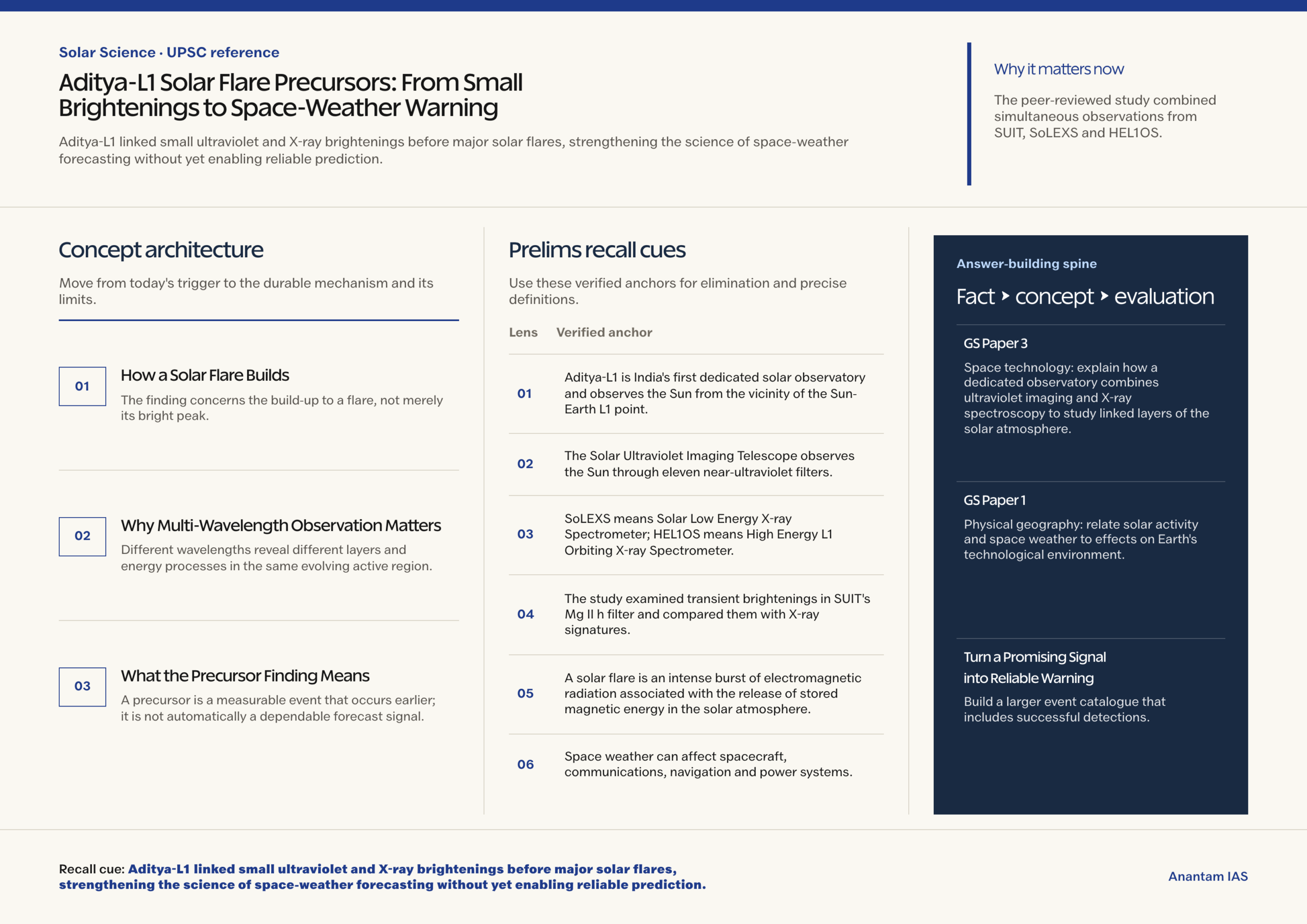
How a Solar Flare Builds
The finding concerns the build-up to a flare, not merely its bright peak. Earlier small releases may expose the magnetic path toward instability.
- Active regions contain complex magnetic fields. As magnetic stress accumulates, stored energy may be released rapidly, producing a solar flare and intense electromagnetic radiation.
- The chromosphere lies above the photosphere, while the corona is the Sun’s outer atmosphere; flare development can couple changes across these different layers.
- Small transient brightenings may mark repeated, localised energy release before the main eruption, offering clues about how an active region approaches an unstable state.
- Large flares can affect radio links and navigation and can create hazards for satellites, astronauts and spacecraft, although each impact depends on the event and affected environment.
Why Multi-Wavelength Observation Matters
Different wavelengths reveal different layers and energy processes in the same evolving active region. Together, they trace energy across atmospheric height and emission regimes.
- SUIT images near-ultraviolet emission in eleven filters, including Mg II h, helping scientists track activity from the upper photosphere to the chromosphere.
- Most near-ultraviolet radiation is absorbed by Earth’s atmosphere, so a space-based telescope provides observations that are largely inaccessible to ground observatories.
- SoLEXS and HEL1OS measure X-ray emission associated with energetic processes in the corona, complementing SUIT’s view of lower-atmosphere brightenings.
- Simultaneous measurements reduce ambiguity: an ultraviolet brightening accompanied by X-rays offers stronger evidence of magnetic energy release than its appearance in one band alone.
- Continuous solar viewing near the Sun-Earth L1 point lets Aditya-L1 follow evolving activity without the regular Earth occultations faced by many Earth-orbiting observatories.
What the Precursor Finding Means
A precursor is a measurable event that occurs earlier; it is not automatically a dependable forecast signal. Reliability depends on successful warnings, misses and false alarms.
- Researchers found multiple short-lived brightenings before major flares and observed that they clustered near the later eruption site rather than appearing as unrelated activity across the solar disc.
- The pattern supports a hypothesis that repeated small releases can contribute to, or reveal, progressive destabilisation of the magnetic field before a much larger release.
- Forecasting requires more than association: scientists must test how consistently the signal precedes flares, how often it appears without a flare and how useful its lead time is.
- The present result is a forecasting advance because it identifies a promising observable mechanism; ISRO did not announce a deployed public warning service or guaranteed flare prediction.
- Operational space-weather systems would combine precursor observations with magnetic-field data, other solar measurements, validated models and clear uncertainty thresholds for users.
Way Forward
Turn a Promising Signal into Reliable Warning
The next task is to test the precursor across more events and decision settings.
- Build a larger event catalogue that includes successful detections, missed flares and false alarms across different active-region conditions.
- Quantify lead time and reliability, then compare the signal’s added value against existing magnetic and X-ray indicators.
- Integrate validated indicators into ensemble forecasts rather than relying on one brightening pattern as a deterministic trigger.
- Translate forecast uncertainty into sector-specific alerts for satellite operators, communication services and human-spaceflight missions.
Conclusion
- Aditya-L1’s simultaneous ultraviolet and X-ray observations connect small pre-flare energy releases with the later eruption site, sharpening understanding of how major flares develop across linked layers of the solar atmosphere.
- A strong Mains answer should present this as progress from observation to mechanism, while reserving operational prediction for signals tested against misses, false alarms, usable lead time and clearly defined decision thresholds.
UPSC Practice Questions
Prelims MCQ 1
With reference to instruments aboard Aditya-L1, consider the following statements:
- SUIT observes the Sun in near-ultraviolet filters.
- SoLEXS and HEL1OS measure X-ray emission associated with energetic solar processes.
- The three instruments together enable simultaneous ultraviolet and X-ray study of flare evolution.
How many of the above statements are correct?
(a) Only one (b) Only two (c) All three (d) None
Answer: (c) All three
Explanation:
All three statements are correct. SUIT supplies near-ultraviolet imaging, while SoLEXS and HEL1OS provide complementary X-ray measurements of energetic solar activity.
Prelims MCQ 2
Why are pre-flare transient brightenings scientifically useful but not yet equivalent to reliable flare predictions?
(a) They can be observed only after a flare ends (b) Their reliability, false-alarm rate and usable lead time still require broader validation (c) Ultraviolet radiation cannot be observed from space (d) Solar flares have no effect on technological systems
Answer: (b) Their reliability, false-alarm rate and usable lead time still require broader validation
Explanation:
The study identifies a promising precursor pattern and physical mechanism. Operational forecasting also requires evidence across many events, including misses, false alarms and decision-relevant lead times.
UPSC Mains Questions
- How do simultaneous multi-wavelength observations by Aditya-L1 improve understanding of solar-flare development? Explain their significance for space-weather forecasting.
- A scientific precursor is not the same as an operational prediction. Discuss this distinction with reference to Aditya-L1’s observations of pre-flare transient brightenings.
Source: Indian Space Research Organisation.
Frequently Asked Questions
What did Aditya-L1 detect before major solar flares?
It detected small, short-lived near-ultraviolet brightenings in active regions. Some had X-ray signatures, and the events clustered near locations where major flares later occurred.
Which Aditya-L1 instruments were used in the study?
The study combined SUIT near-ultraviolet imaging with X-ray measurements from SoLEXS and HEL1OS, allowing activity in lower solar layers and the corona to be examined together.
Why is the Sun-Earth L1 point useful for solar observation?
A spacecraft near L1 can maintain a continuous view of the Sun, helping instruments monitor evolving active regions without the regular Earth occultations experienced in many Earth orbits.
Can Aditya-L1 now predict solar flares reliably?
No. The finding advances the scientific basis for forecasting, but operational reliability needs broader testing of detection consistency, false alarms, missed events and usable warning time.
Why does space-weather forecasting matter?
Better forecasts can support protective decisions for satellites, navigation, radio communication, astronauts and spacecraft when major solar events threaten technological systems or increase radiation hazards.
Tell Google you want more of this.
Add Anantam IAS as a preferred sourceOne tap, and this site shows up more often in your own Top Stories, AI Overviews and AI Mode. Remove it any time.