Why in News?
On 28 August 2026, the Government’s High-Powered Task Force invited multilingual stakeholder suggestions on comprehensive reform of the conduct, security, design and governance of public examinations.
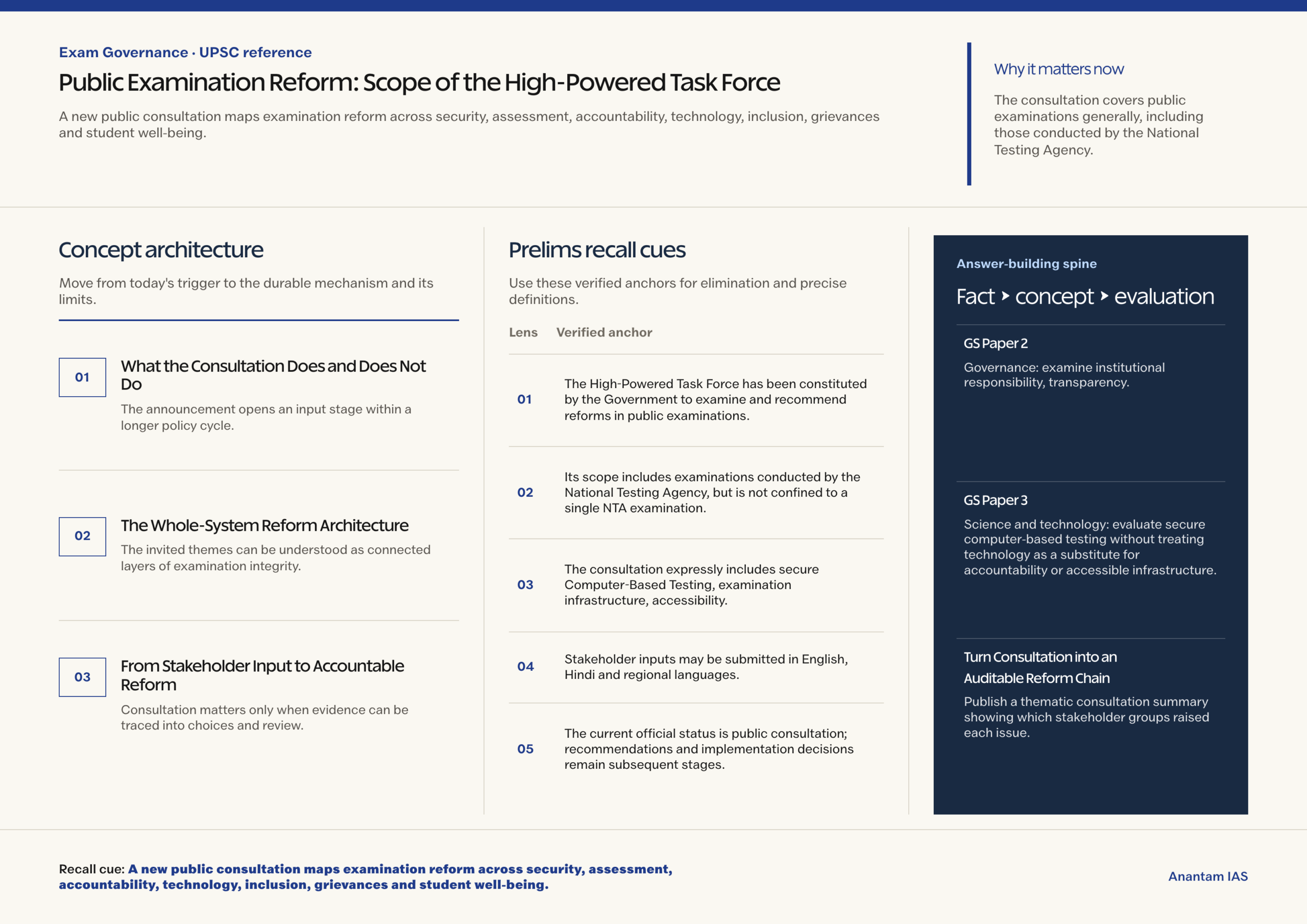
- The consultation covers public examinations generally, including those conducted by the National Testing Agency, rather than one examination or one operational failure.
- Students, parents, teachers, institutions, examination bodies, experts, industry and civil society are among the groups invited to participate.
- Submissions may be made in English, Hindi and regional languages, widening the channels through which access and assessment problems can enter the policy process.
- The invited themes span security, assessment methodology, institutional accountability, malpractice redress, secure computer-based testing, infrastructure, inclusion, communication and student well-being.
- The deadline is 13 September 2026; the inputs will assist recommendations, but no recommendation or final reform has yet been adopted.
- Public examinations allocate access to education and public opportunities, so their legitimacy depends on both secure administration and credible, equitable assessment.
- The consultation treats examination integrity as a whole-system problem: institutions, test design, infrastructure, technology, accessibility, grievance channels and candidate welfare interact.
- For answers, distinguish consultation, recommendation, government decision and implementation; each is a separate stage with a different evidentiary status.
UPSC Relevance
Prelims Relevance
- The High-Powered Task Force has been constituted by the Government to examine and recommend reforms in public examinations.
- Its scope includes examinations conducted by the National Testing Agency, but is not confined to a single NTA examination.
- The consultation expressly includes secure Computer-Based Testing, examination infrastructure, accessibility, grievance redress and student well-being.
- Stakeholder inputs may be submitted in English, Hindi and regional languages.
- The current official status is public consultation; recommendations and implementation decisions remain subsequent stages.
Mains Relevance
GS Paper 2
- Governance: examine institutional responsibility, transparency, grievance redress and public participation in high-stakes examination reform.
- Social justice: connect linguistic, regional, social and economic access with equality of opportunity.
- Education governance: assess how examination design and candidate well-being affect trust in public institutions.
GS Paper 3
- Science and technology: evaluate secure computer-based testing without treating technology as a substitute for accountability or accessible infrastructure.
- Internal security: distinguish prevention and detection of malpractice from assessment quality and administrative fairness.
Essay
- Public trust grows when institutions combine secure systems with fair design, accessible participation and reasoned remedies.
Background and Context
What the Consultation Does and Does Not Do
The announcement opens an input stage within a longer policy cycle.
- The Task Force is examining reforms concerning conduct, security, design and governance, placing operational controls and assessment quality inside one mandate rather than treating them as separate policy silos.
- Its stated objective is a system that is secure, transparent, equitable and future-ready, but these remain objectives for examination rather than approved policy standards or enforceable entitlements.
- The consultation collects experience from candidates, families, educators, examination bodies, experts, industry and civil society before the Task Force formulates recommendations for government consideration.
- Multilingual submission can reveal problems hidden by aggregate reporting, including unclear translations, inaccessible interfaces, distant centres and uneven communication across regions and examination modes.
- The official release does not announce a completed report, accepted recommendation, implementation timetable or binding rule; answers must preserve that consultative status at every analytical step.
The Whole-System Reform Architecture
The invited themes can be understood as connected layers of examination integrity.
- The security layer covers conduct, prevention and detection of malpractice, secure computer-based testing and the physical and digital infrastructure needed to protect examination operations end to end.
- The assessment layer covers examination design and methodology: what is measured, how performance is compared and whether the process is suitable for its stated public purpose.
- The institutional layer asks who owns decisions, how examination bodies are governed and how accountability is traced across agencies, experts, centres and technology providers when responsibilities overlap.
- The access layer considers social, economic, regional and linguistic barriers, linking formal eligibility with the practical ability to register, travel, test, obtain accommodations and seek support.
- The trust layer joins transparency, stakeholder communication, grievance redress and student well-being because opaque or delayed remedies can deepen candidate burdens after an examination problem.
From Stakeholder Input to Accountable Reform
Consultation matters only when evidence can be traced into choices and review.
- Inputs should be classified by system layer and examination stage so that recurring problems across bodies are not reduced to isolated complaints or averaged away in headline counts.
- Participation needs diversity as well as volume; otherwise digitally confident groups may dominate while remote, disabled, low-income or non-English-speaking candidates remain underrepresented in the final evidence base.
- Technology proposals require joint tests of security, reliability, privacy, accessibility and fallback capacity; a secure platform may still exclude candidates or fail during network and power disruption.
- Recommendations should separate minimum common safeguards from context-specific choices because examination scale, purpose, language mix, mode and candidate profile differ across bodies and regions.
- A credible reform chain needs published reasoning, assigned institutional ownership, measurable service standards, phased testing and review after implementation, not consultation counts or platform adoption alone.
Way Forward
Turn Consultation into an Auditable Reform Chain
The next stages should preserve participation while making trade-offs visible.
- Publish a thematic consultation summary showing which stakeholder groups raised each issue, while protecting personal and examination-security information.
- Explain which proposals were accepted, modified or rejected and identify the evidence and trade-offs behind each recommendation.
- Pilot major technology and assessment changes across varied regions and candidate groups before scaling them nationally.
- Assign owners, timelines, grievance standards and review indicators only after government decisions are made, keeping proposals distinct from implemented reform.
Conclusion
- The consultation’s value lies in treating public-examination integrity as a connected governance system, not as security technology alone.
- A strong Mains answer should trace the policy chain from inclusive evidence gathering to reasoned recommendations, government decision, implementation ownership and independent review.
UPSC Practice Questions
Prelims MCQ 1
With reference to the High-Powered Task Force consultation on public examinations, consider the following statements:
- Its scope includes examinations conducted by the National Testing Agency.
- It invites suggestions on assessment methodology, accessibility and student well-being.
- The consultation announcement itself brings the proposed reforms into legal force.
How many of the above statements are correct?
(a) Only one (b) Only two (c) All three (d) None
Answer: (b) Only two
Explanation:
Statements 1 and 2 are correct. The Task Force is gathering inputs to formulate recommendations; the announcement does not adopt or legally implement reforms.
Prelims MCQ 2
Which one of the following best describes the present official status of the public-examination reform exercise?
(a) A notified statutory code already in force (b) A final Task Force report accepted by the Government (c) A public consultation to assist the Task Force’s recommendations (d) A judicially mandated replacement of all examination bodies
Answer: (c) A public consultation to assist the Task Force's recommendations
Explanation:
PIB states that stakeholder inputs will assist the High-Powered Task Force in formulating recommendations to the Government. No final recommendation or implementation decision was announced.
UPSC Mains Questions
- Public-examination integrity is a governance architecture, not merely a question of preventing paper leaks. Discuss with reference to the scope of the High-Powered Task Force consultation.
- How can stakeholder consultation be converted into accountable and inclusive reform of India’s public-examination system? Suggest institutional safeguards.
Source: PIB, Department of Personnel and Training.
Frequently Asked Questions
What is the High-Powered Task Force examining?
It is examining reforms in the conduct, security, design and governance of public examinations, including institutional processes, technology, infrastructure, accessibility, grievance redress and student well-being.
Who can participate in the consultation?
The invitation includes students, parents, teachers, academic institutions, examination bodies, subject experts, technology professionals, industry organisations, civil society and other interested stakeholders.
Have the examination reforms already been adopted?
No. The current exercise collects public inputs to assist the Task Force in formulating recommendations to the Government. Recommendations, government decisions and implementation are later stages.
Why is this consultation broader than examination security?
Its scope combines security with assessment design, governance, infrastructure, inclusion, communication, grievances and well-being. This recognises that a secure examination can still be inaccessible, opaque or poorly designed.
Why are multilingual submissions important?
They can bring regional and linguistic access problems into the evidence base and reduce the risk that policy reflects only English-speaking or digitally confident participants.
Tell Google you want more of this.
Add Anantam IAS as a preferred sourceOne tap, and this site shows up more often in your own Top Stories, AI Overviews and AI Mode. Remove it any time.