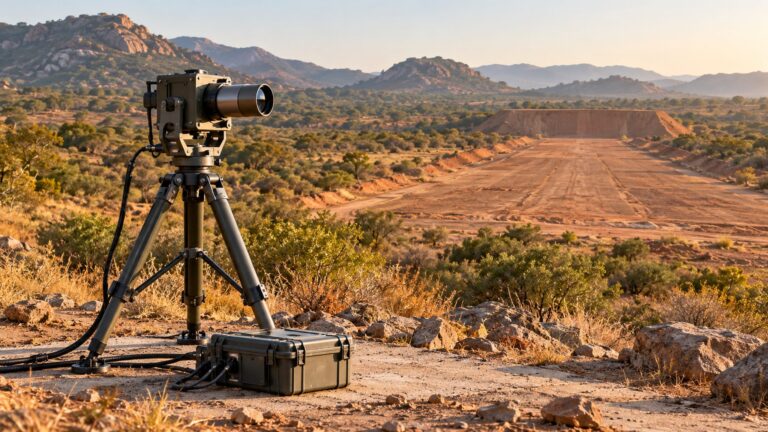
Why in News?
On August 28, the CISF signed an MoU with the Drone Federation of India to strengthen personnel training, applied research and preparedness against rogue drones at critical installations.
- The partnership creates structured engagement with Indian drone startups and technology companies.
- Its stated purposes are capacity building, applied research and operational preparedness.
- The CISF guards installations across aviation, nuclear power, space, refineries and other sensitive sectors.
- The force reported trained personnel and specialist teams, showing that the MoU extends an existing capability rather than starting from zero.
- Cheap, capable unmanned aircraft can create surveillance, disruption and safety risks around densely networked installations.
- Critical-infrastructure protection requires trained judgment and lawful response, not merely the purchase of detection equipment.
- Industry collaboration can shorten the path from an identified operational need to tested, locally supported technology.
UPSC Relevance
Prelims Relevance
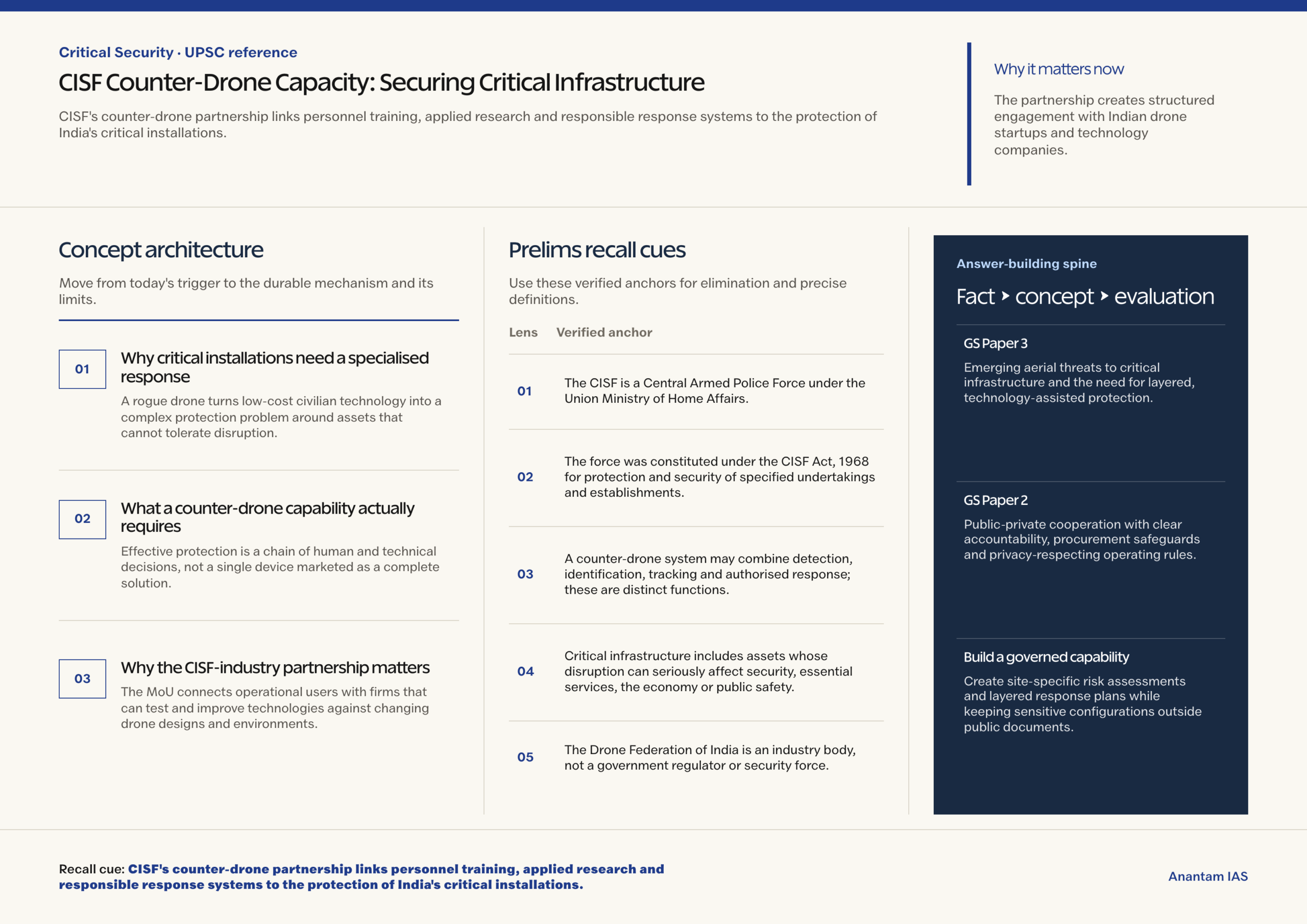
- The CISF is a Central Armed Police Force under the Union Ministry of Home Affairs.
- The force was constituted under the CISF Act, 1968 for protection and security of specified undertakings and establishments.
- A counter-drone system may combine detection, identification, tracking and authorised response; these are distinct functions.
- Critical infrastructure includes assets whose disruption can seriously affect security, essential services, the economy or public safety.
- The Drone Federation of India is an industry body, not a government regulator or security force.
Mains Relevance
GS Paper 3
- Emerging aerial threats to critical infrastructure and the need for layered, technology-assisted protection.
- Role of domestic innovation, applied research and trained personnel in internal-security capacity.
GS Paper 2
- Public-private cooperation with clear accountability, procurement safeguards and privacy-respecting operating rules.
Essay
- Technology improves security only when institutions combine it with judgment, law, training and public accountability.
Background and Context
Why critical installations need a specialised response
A rogue drone turns low-cost civilian technology into a complex protection problem around assets that cannot tolerate disruption.
- Small unmanned aircraft can approach from above conventional perimeter barriers, creating a distinct low-altitude threat that ground-only security arrangements may not fully address.
- The concern is broader than a physical strike: unauthorised platforms may enable observation, payload delivery, interference or operational disruption near sensitive facilities.
- Consequences vary by site. An incident near an airport raises aviation-safety risks, while one near an energy or nuclear facility may threaten continuity and public confidence.
- Critical installations operate within civilian surroundings, so false alarms or unsafe countermeasures can themselves create harm. Proportionality and positive identification matter.
- This is installation security, not border surveillance. The relevant frame is protection of specified facilities, their airspace surroundings and continuity of essential functions.
What a counter-drone capability actually requires
Effective protection is a chain of human and technical decisions, not a single device marketed as a complete solution.
- Detection asks whether an object is present; identification and classification ask what it is and whether its behaviour warrants concern.
- Tracking maintains a reliable operational picture, while assessment combines sensor information, site context and authorised procedures before any response decision is taken.
- Response can include alerts, coordination and other measures permitted by law and site protocols. Public discussion should avoid publishing deployment patterns or tactical thresholds.
- Personnel need repeated training to interpret imperfect signals, distinguish authorised activity, escalate correctly and coordinate with aviation, police and facility authorities.
- Resilience also requires maintenance, secure data handling, communication redundancy, incident recording and after-action learning. Equipment without this institutional layer can produce fragile capability.
Why the CISF-industry partnership matters
The MoU connects operational users with firms that can test and improve technologies against changing drone designs and environments.
- The CISF’s installation-security experience can translate field problems into testable requirements, helping developers focus on reliability, interoperability and conditions found at protected facilities.
- Startups and technology companies can support rapid prototyping and applied research, but adoption still needs independent evaluation rather than vendor claims alone.
- Training should be role-based: operators need system proficiency, supervisors need decision protocols, and leaders need governance, procurement and risk-assessment capacity.
- Common testing standards can reduce dependence on isolated products and help different sensors, control rooms and reporting systems exchange usable information.
- Domestic capability can improve maintenance and adaptation, but security procurement must still protect competition, cybersecurity, auditability and lifecycle support. Indigenisation is not a substitute for verification.
Way Forward
Build a governed capability
- Create site-specific risk assessments and layered response plans while keeping sensitive configurations outside public documents.
- Use controlled trials, red-team exercises and measurable acceptance criteria before scaling any technology across installations.
- Institutionalise recurrent training, certification and joint drills with relevant civil aviation, police, emergency and facility authorities.
- Require cybersecurity testing, access controls, audit logs, privacy safeguards and clear human responsibility for consequential decisions.
Conclusion
- The durable lesson is that counter-drone security is a system: sensors, trained people, authorised procedures, inter-agency coordination and continuous learning must work together.
- In a Mains answer, connect the CISF’s critical-installation mandate with applied R&D, capability testing and safeguards against false alarms, unsafe response and vendor dependence.
- The MoU is a capacity-building step. Its value should ultimately be judged by tested readiness, safe incident handling and resilient institutions, not by equipment acquisition or vendor demonstrations alone.
UPSC Practice Questions
Prelims MCQ 1
With reference to counter-drone protection of critical infrastructure, consider the following statements:
- Detection and identification are distinct functions in a counter-drone chain.
- Every detected drone must necessarily be neutralised immediately.
- The CISF functions under the Union Ministry of Home Affairs.
How many of the above statements are correct?
(a) Only one (b) Only two (c) All three (d) None
Answer: (b) Only two
Explanation:
Statements 1 and 3 are correct. Detection does not by itself establish hostile intent; identification, assessment, lawful authority and site protocols shape the response.
Prelims MCQ 2
Which one of the following best describes the purpose of the CISF-Drone Federation of India MoU reported in August 2026?
(a) Regulating all civilian drone registrations in India (b) Managing surveillance along India’s international borders (c) Supporting training, applied research and preparedness for critical-installation security (d) Transferring airport ownership to a security agency
Answer: (c) Supporting training, applied research and preparedness for critical-installation security
Explanation:
The agreement provides structured engagement with drone startups and technology companies for capacity building, applied research and operational preparedness.
UPSC Mains Questions
- Counter-drone protection of critical infrastructure is an institutional capacity problem as much as a technology problem. Discuss.
- How can public-private collaboration strengthen emerging-technology security while preserving accountability, cybersecurity and operational safety?
Sources: The Hindu and Central Industrial Security Force.
Frequently Asked Questions
What is counter-drone capability?
It is the organised ability to detect, identify, track, assess and lawfully respond to unauthorised drones through suitable technology, trained personnel, protocols and coordination.
Why is the CISF relevant to critical infrastructure security?
The CISF is mandated to protect specified industrial and sensitive establishments, including installations in aviation, nuclear, space and energy sectors.
What does the new MoU seek to do?
It seeks structured engagement with Indian drone startups and technology companies for personnel capacity building, applied research and operational preparedness.
Why is detection alone insufficient?
A detected object must be identified, tracked and assessed in context. Response also requires lawful authority, proportionate action and coordination to avoid creating additional risk.
What is the main governance challenge?
India must combine rapid technological adaptation with testing, cybersecurity, privacy, auditability, procurement integrity and clear human responsibility for consequential security decisions.
Tell Google you want more of this.
Add Anantam IAS as a preferred sourceOne tap, and this site shows up more often in your own Top Stories, AI Overviews and AI Mode. Remove it any time.