Daily Digest
UPSC · Civil Services Examination
Current Affairs · Tuesday, 4 August 2026
Current affairs curated and edited by Anantam IAS faculty — pulled from The Hindu, PIB, IDSA, Foreign Affairs and the ministries. Read, annotate, revise.
Old Rajinder Nagar · Delhi 110005 · anantamias.com
Gyan Bharatam Survey Reports More Than 1.19 Crore Manuscripts
Why in News?
The Ministry of Culture informed the Lok Sabha that the National Manuscript Survey under the Gyan Bharatam Mission has reported more than 1.19 crore manuscripts across India.
- The survey was launched in March 2026 across all States and Union Territories to identify manuscript holdings, repositories and custodians in diverse languages and scripts.
- The government said no district-wise target had been set for the survey or for physical registration. The reported total is an aggregate of holdings identified by the exercise, not a district quota achieved.
- By 19 March 2026, more than 12.97 lakh manuscripts had been reported. The later figure of more than 1.19 crore shows the rapid expansion of survey returns, but it does not by itself establish that.
- The official reply said that more than eight lakh digitised manuscripts existed across the country and more than 4.40 lakh were available on the Gyan Bharatam portal for public access in view mode.
- The mission uses a network of Cluster Centres and Independent Centres, State and Union Territory nodal authorities, repositories, private custodians and technical partners rather than relying on one central archive.
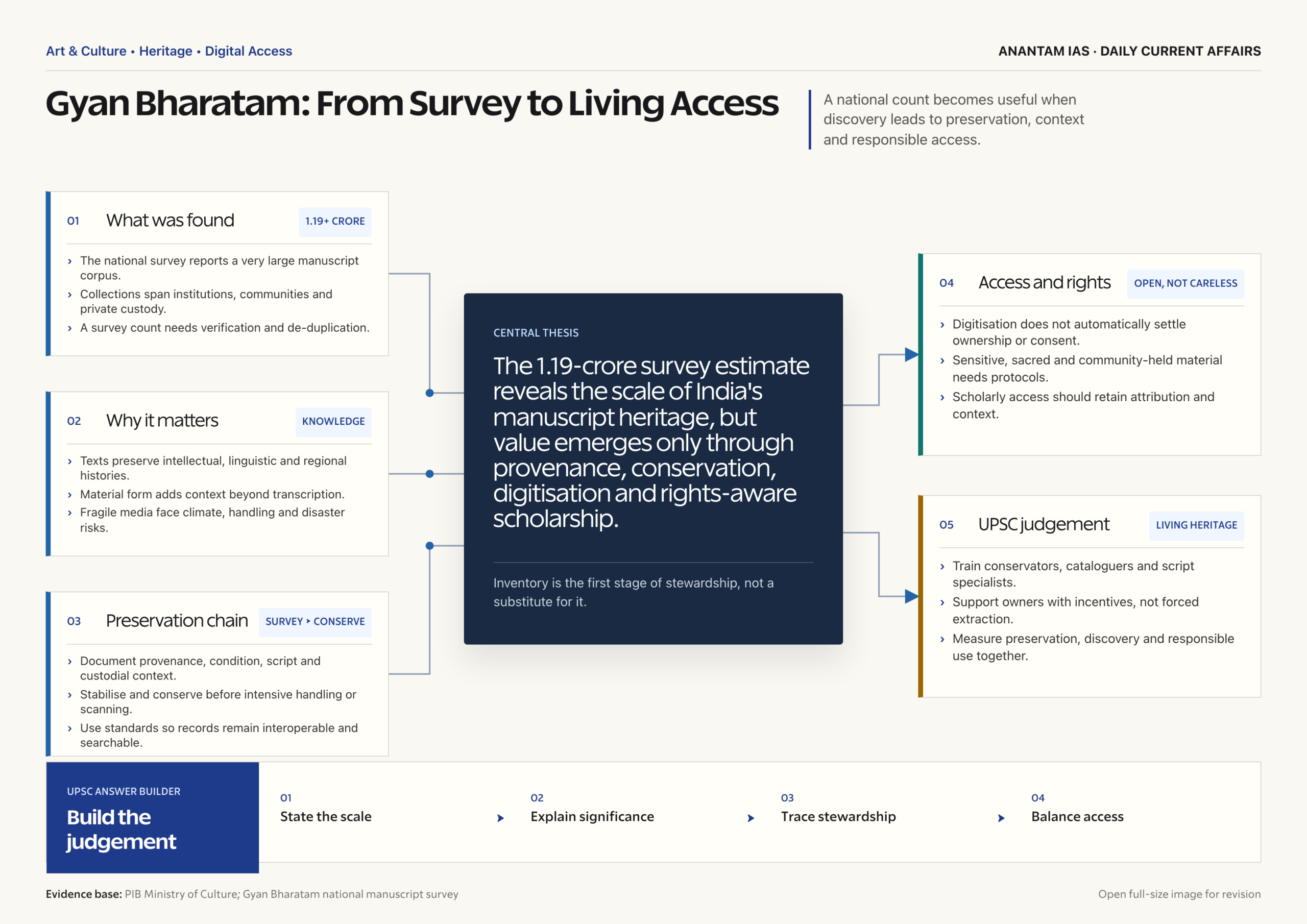
- The 1.19-crore figure measures discovery and reporting. It creates a national baseline from which duplicate records, physical condition, ownership, language, script and conservation priority can be assessed.
- Manuscript policy is not only about scanning old pages. It combines survey, cataloguing, preventive conservation, digitisation, metadata, translation, research and lawful dissemination.
- The survey can reveal holdings in temples, mutts, libraries, universities and private homes that were previously absent from national catalogues, but participation depends on trust with custodians.
UPSC Relevance
Prelims Relevance
- The Gyan Bharatam Mission is a Ministry of Culture initiative announced in the Union Budget 2025-26.
- The National Mission for Manuscripts, established in 2003, was restructured and expanded under the Gyan Bharatam framework.
- The National Manuscript Survey was launched on 16 March 2026 and covers all States and Union Territories.
- An official National Mission for Manuscripts definition treats a manuscript as a handwritten composition at least 75 years old, on paper, bark, cloth, metal, palm leaf or another material, with scientific, historical or aesthetic value.
- Lithographs and printed volumes are not manuscripts under that definition. Manuscripts are also distinct from epigraphs, firmans and routine revenue records because their defining feature is knowledge content.
- A language and a script are not the same: one language may be written in several scripts. Sanskrit manuscripts, for example, can appear in Devanagari, Grantha, Odia and other scripts.
Mains Relevance
GS Paper 1
- Use the survey as evidence of the scale and diversity of India’s manuscript heritage, including material traditions, languages, scripts and knowledge systems.
- Discuss preservation as a chain from identification and documentation to scientific conservation, digitisation, interpretation and public engagement.
GS Paper 2
- Assess the mission as a case of networked cultural governance involving the Union, States, institutions, private custodians, scholars and technology partners.
- Examine how public value must be balanced with ownership, copyright, privacy, ritual sensitivity, community authority and restrictions placed by custodians or rights holders.
Essay
- A civilisation preserves knowledge not by locking it away, but by combining care, context and responsible access.
Background and Context
What the 1.19-Crore Survey Result Actually Means
The new number is best read as an expanded national inventory, not as proof that 1.19 crore manuscripts are already preserved online.
- The survey seeks to identify and document holdings, repositories and custodians. A reported item may still require verification, detailed cataloguing, condition assessment and rights documentation before digitisation begins.
- The government’s earlier goal was to cover more than one crore manuscripts. Reporting more than 1.19 crore indicates that known returns have crossed that planning estimate; it does not impose a ceiling on future discoveries.
- A survey record, a catalogued object, a digitised manuscript and a publicly accessible copy are different administrative states. Collapsing them into one statistic exaggerates implementation progress.
- The count can include institutional and private holdings across multiple repositories. Robust de-duplication is needed because the same text may exist in many physical copies, and the same object may appear in legacy and new databases.
- The earlier Anantam IAS guide on the Gyan Bharatam Mission explains the scheme’s general design. The present development is narrower: it examines the March 2026 survey result and the governance questions created by the newly.
What Qualifies as a Manuscript
A clear definition prevents the survey from becoming a loose count of all old books and records.
- The National Mission for Manuscripts defines a manuscript as a handwritten composition at least 75 years old with significant scientific, historical or aesthetic value.
- The writing surface may be paper, palm leaf, birch bark, cloth, metal or another material. Material diversity changes storage needs: humidity, insects, acidity, light and handling can affect each support differently.
- Lithographs and printed books are excluded from this manuscript definition. Historical records such as inscriptions, royal orders and revenue files also form different documentary categories, though they may be important heritage objects in their own right.
- Manuscripts preserve knowledge in hundreds of languages and scripts. Cataloguing must separately record the work’s language, the script used, title variants, author or scribe where known, physical material, folio count, condition and provenance.
- The number of physical manuscripts is not the same as the number of unique works. Multiple recensions, commentaries, translations and copied versions can show how knowledge travelled and changed across regions.
Mission Scope and Institutional Design
Gyan Bharatam extends beyond a one-time census by creating a distributed preservation and research system.
- The mission covers identification, documentation, conservation, digitisation, research, publication and dissemination, irrespective of script, language, dialect, tradition, community or geographical location.
- Its five verticals connect inventory work with conservation skills, digital infrastructure, language access and scholarship. This reduces the risk that scanning becomes an isolated activity without physical preservation or intellectual description.
- Cluster Centres coordinate activity and capacity across a region or group of institutions, while Independent Centres undertake mission work based on their collections, infrastructure and expertise.
- Partner selection considers collection size and significance, institutional capacity, qualified personnel, infrastructure, regional representation and experience in manuscript work.
- State and Union Territory nodal authorities can coordinate surveys and local institutions, while technical partners support metadata, equipment, AI-enabled platforms and long-term data storage.
From Discovery to Preservation and Digitisation
The responsible workflow begins before a camera is switched on and continues long after an image file is created.
- Survey and registration establish the location, custodian, broad identity and condition of an item. Prioritisation should then consider fragility, uniqueness, research value and disaster risk.
- Preventive conservation controls storage, light, humidity, pests and handling. Curative conservation addresses damage through trained professionals; aggressive cleaning or flattening can destroy evidence embedded in the object.
- Official standards call for non-destructive face-up overhead scanners using cold light, a minimum of 400 DPI in 24-bit colour and 600 DPI where needed.
- Post-processing can include de-skewing, cropping and light equalisation, but colour integrity and the material record must be protected. Manual quality verification remains important even when automated tools assist.
- Preservation masters use TIFF v6.0 with LZW compression; JPEG files serve access needs and PDF/A copies support search. Separating master and access formats prevents convenience copies from replacing archival-quality files.
Way Forward
Audit the Survey Baseline
- Publish methodology notes defining a reported manuscript, verification status, duplicate-handling rules and the difference between physical copies and unique works.
- Use stable identifiers and authority files for repositories, works, authors, languages and scripts so legacy databases can be reconciled without deleting variant knowledge.
- Release aggregate progress dashboards by State, material, language, condition and workflow stage while withholding precise locations of vulnerable private collections where security requires it.
Conclusion
- The report of more than 1.19 crore manuscripts changes the scale of India’s preservation challenge.
- Gyan Bharatam will succeed when each stage remains visible: discovery, verification, conservation, digitisation, metadata, rights clearance, interpretation and access.
UPSC Practice Questions
Prelims MCQ 1
With reference to the Gyan Bharatam Mission, consider the following statements:
- It is an initiative of the Ministry of Culture announced in the Union Budget 2025-26.
- Its National Manuscript Survey covers institutional repositories but excludes manuscripts held by private individuals.
- Survey reporting, digitisation and public availability refer to distinct stages of the manuscript workflow.
How many of the above statements are correct?
(a) Only one (b) Only two (c) All three (d) None
Answer: (b) Only two
Explanation:
Statements 1 and 3 are correct. The survey seeks manuscripts held by institutions, private individuals, scholars, mutts, temples, libraries and other repositories, so Statement 2 is incorrect.
Prelims MCQ 2
Which one of the following best describes a manuscript under the National Mission for Manuscripts definition?
(a) Any printed book more than 75 years old (b) Any inscription on rock that records an event (c) A handwritten composition at least 75 years old with significant scientific, historical or aesthetic value (d) Only a Sanskrit work handwritten on palm leaf
Answer: (c) A handwritten composition at least 75 years old with significant scientific, historical or aesthetic value
Explanation:
The definition is material- and language-inclusive but requires a handwritten composition, a minimum age of 75 years and significant value. Printed volumes and lithographs are excluded.
UPSC Mains Questions
- The Gyan Bharatam survey’s report of more than 1.19 crore manuscripts is a beginning, not a completion metric. Discuss the institutional and technical steps required to convert a national inventory into a durable knowledge resource. (250 words)
- How can India widen digital access to manuscript heritage while respecting custodianship, rights and culturally sensitive knowledge? Suggest a rights-aware governance framework. (250 words)
Sources: PIB, Ministry of Culture and National Mission for Manuscripts, Ministry of Culture.
Frequently Asked Questions
What did the Gyan Bharatam National Manuscript Survey report?
The Ministry of Culture told the Lok Sabha that more than 1.19 crore manuscripts had been reported in the nationwide survey. This is an inventory-stage figure covering identified holdings, repositories and custodians. It does not mean that all reported manuscripts.
When was the National Manuscript Survey launched?
The survey was launched on 16 March 2026 across all States and Union Territories. It aims to identify and document manuscript holdings with institutions, libraries, museums, temples, mutts, scholars, private individuals and other custodians. The government did not set district-wise.
What counts as a manuscript for the mission?
The National Mission for Manuscripts defines it as a handwritten composition at least 75 years old, on paper, bark, cloth, metal, palm leaf or another material, with significant scientific, historical or aesthetic value. Lithographs and printed volumes do not qualify.
Does the 1.19-crore figure mean all manuscripts are online?
No. Survey reporting, detailed cataloguing, conservation, digitisation and public access are different stages. In August 2026, the government reported more than eight lakh digitised manuscripts across the country and more than 4.40 lakh available on the Gyan Bharatam portal.
Who implements the Gyan Bharatam Mission?
The Ministry of Culture leads the mission through a distributed network of Cluster Centres, Independent Centres, State and Union Territory nodal coordinating authorities, participating repositories and technical partners. Centres are selected for factors such as collection significance, capacity, infrastructure, regional.
Source: https://anantamias.com/current-affairs/gyan-bharatam-manuscript-survey/
Urban Heat Action Plans in India: Coverage, Responsibilities and Implementation Gaps
Why in News?
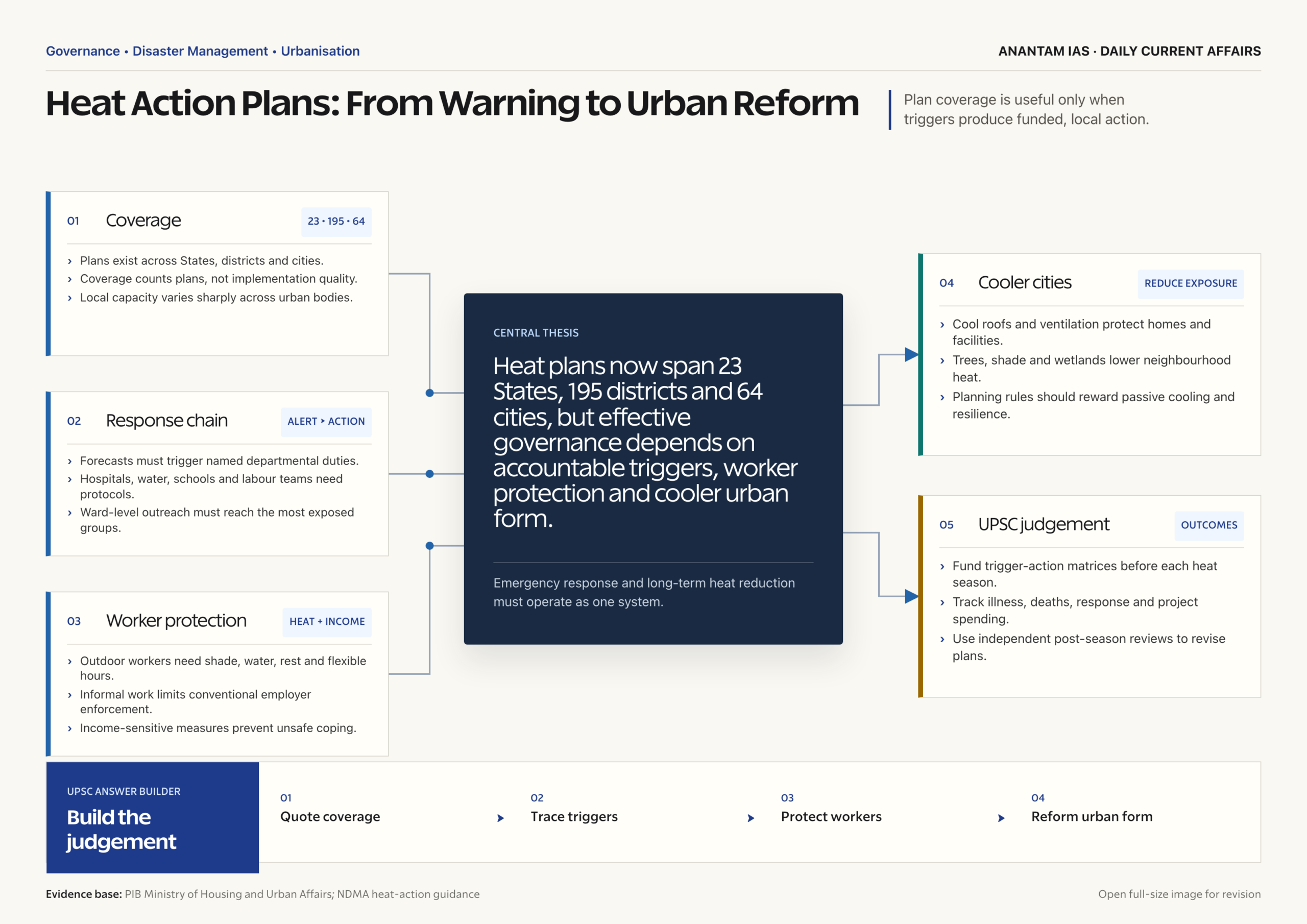
A July 20, 2026 reply by the Ministry of Housing and Urban Affairs stated that Heat Action Plans have been prepared by 23 States, 195 districts and 64 cities in India.
- The coverage numbers are three reported administrative categories: 23 States, 195 districts and 64 cities. They should not be read as a single count of mutually exclusive plans because city and district jurisdictions can overlap.
- The NDMA’s 2019 national guidelines ask cities to assess vulnerability, identify factors driving urban heat islands and include suitable mitigation measures in their Heat Action Plans.
- The NDMA advisory on informal workers asks States and Union Territories to include street vendors and outdoor workers through shaded vending areas, drinking-water access, cooling centres, flexible working hours and timely heat alerts.
- MoHUA has linked urban heat mitigation with green and blue infrastructure, cool roofs, passive cooling, water-sensitive planning and climate-responsive urban design.
- Under AMRUT 2.0, a strategic pilot is assessing heat drivers and priority vulnerable areas in 12 cities and preparing city-specific recommendations.
- A Heat Action Plan is not only a weather-warning document. It is an inter-departmental operating plan for forecasts, public communication, health-system readiness, protection of exposed groups and longer-term risk reduction.
- The central governance question is whether formal coverage becomes ward-level delivery: shaded public space, water, hospital protocols, worker safeguards, cooler housing and measurable reductions in illness and death.
- Urban heat is an equity issue. People in poorly ventilated housing and those who cannot avoid outdoor work face greater exposure while often having the least access to cooling.
UPSC Relevance
Prelims Relevance
- Heat Action Plan: a locally adapted plan combining early warning, preparedness, response and heat-risk mitigation.
- National Disaster Management Authority: established under the Disaster Management Act, 2005; it issues national guidance and advisories for disaster-risk management.
- India Meteorological Department: supplies forecasts, warnings and meteorological inputs used by local authorities to trigger heat-response actions.
- Twelfth Schedule: lists municipal functions under Article 243W; urban planning, land-use regulation, water supply, public health and urban forestry are relevant to heat resilience.
- Urban Heat Island: a condition in which built-up areas remain warmer than surrounding areas because of heat-absorbing materials, reduced vegetation, waste heat and altered air flow.
- India Cooling Action Plan: provides an integrated approach to sustainable cooling and thermal comfort while reducing cooling demand and improving efficiency.
Mains Relevance
GS Paper 3
- Heatwaves as a disaster-management and climate-adaptation challenge requiring early warning, vulnerability mapping and public-health preparedness.
- Urban heat-island mitigation through cool roofs, passive design, tree canopy, water bodies, shaded streets and heat-sensitive land-use planning.
GS Paper 2
- Division of responsibility among the Union government, NDMA, IMD, States, district authorities and ULBs in a decentralised governance system.
- Protection of informal workers and low-income households as questions of public health, social justice and accountable service delivery.
Essay
- A resilient city is measured not by the number of plans it writes, but by how safely its most exposed resident can work, travel and sleep during extreme.
Background and Context
What a Heat Action Plan Must Do
A credible HAP links an official forecast to pre-agreed local action before, during and after dangerous heat.
- The plan begins with a heat-risk and vulnerability assessment. It should identify exposed wards, dense built-up surfaces, low-green-cover areas, poorly ventilated settlements, high-risk occupations and people with health or mobility constraints.
- It defines heat-alert thresholds and communication chains so IMD information reaches departments, hospitals, schools, employers, markets and the public in time for preventive action.
- It assigns tasks for health preparedness: training staff, recognising heat illness, ensuring emergency cooling and supplies, preparing ambulances and monitoring cases and deaths.
- It provides for public protection through drinking water, shade, cooling spaces, modified school or work schedules, outreach in accessible languages and checks on high-exposure sites.
- A mature plan also contains long-term mitigation, such as cool roofs, tree canopy, shaded mobility routes, water-sensitive design, better building envelopes and preservation of water bodies.
Institutional Responsibilities from National Guidance to Ward Delivery
Heat governance is decentralised, but its institutions do not have interchangeable roles.
- The NDMA supplies national guidelines, advisories and a common disaster-risk framework. Its guidance supports State and local plans, but it does not replace local vulnerability assessment or city implementation.
- The IMD provides seasonal, extended-range and short-range forecasts, heatwave warnings and meteorological information. Local agencies use these inputs to activate response measures.
- Under the constitutional scheme and the Twelfth Schedule, urban planning is primarily a State and municipal domain. States provide legal, policy and financial backing; ULBs and urban development authorities translate it into land-use, building, water.
- District disaster-management authorities coordinate line departments across urban and peri-urban areas, align emergency response and ensure that warnings reach local institutions.
- Municipal health teams, public-health departments and hospitals handle surveillance, clinical preparedness and community outreach; labour, market, transport, water, education and power agencies act on sector-specific exposure.
Urban Heat Island, Housing and the Built Environment
Urban form can amplify heat exposure even when two places receive the same regional weather warning.
- Dark roofs and paving absorb solar radiation; dense construction can restrict air flow; loss of vegetation reduces shade and evapotranspiration; vehicles, industry and air conditioners add anthropogenic heat.
- Housing quality determines indoor exposure. A household may remain dangerously hot after sunset when a concrete or metal roof stores daytime heat and the dwelling lacks cross-ventilation, insulation or safe night-time cooling.
- MoHUA’s cooling guidance follows an avoid-shift-improve logic: reduce cooling demand through climate-responsive design, meet remaining demand with lower-carbon systems, and improve the efficiency of conventional cooling.
- Cool-roof options include reflective coatings, membranes, high-albedo tiles and context-appropriate alternatives. The choice must account for roof type, maintenance, water needs, affordability and local skills rather than impose one technology everywhere.
- For low-income households, cooler roofs and better ventilation are not merely energy measures. They can improve sleep, health and home-based work conditions while lowering dependence on unaffordable mechanical cooling.
Informal Workers and the Unequal Geography of Exposure
Heat risk is shaped by the ability to stop work, find shade, drink safe water and recover in a cool home.
- Street vendors, construction workers, sanitation workers, delivery workers, transport workers and other outdoor earners face direct solar exposure and physical exertion, often without secure rest breaks or nearby water.
- The NDMA advisory calls for shaded vending zones, hydration facilities, cooling centres, flexible working hours and timely alerts for street vendors and other outdoor workers.
- A gender-sensitive plan must examine differential access to water, sanitation, safe rest space, health care and income security. Pregnant workers and people with caregiving responsibilities can face compounded heat stress.
- Changing work hours without wage protection can shift risk rather than reduce it. Local plans should pair schedules and breaks with income-sensitive enforcement, employer duties and accessible grievance channels.
- Worker protection must extend beyond registered establishments. ULB databases, vendor associations, contractors, resident groups and community health networks can help reach people in informal and mobile occupations.
Way Forward
Turn Every Plan into a Funded Operating Protocol
- Publish a department-wise trigger-action matrix for each warning level, with named nodal officers, backup contacts, deadlines and proof-of-action fields.
- Create a dedicated budget line or clearly tagged expenditure for heat preparedness and mitigation, linked to annual municipal and district planning.
- Run pre-season simulation exercises for hospitals, schools, markets, water teams and emergency services; disclose gaps and corrective action.
Conclusion
- India’s spread of Heat Action Plans across 23 States, 195 districts and 64 cities is an important institutional base.
- The strongest heat policy joins early warning with public health, worker protection, cooler housing and climate-responsive urban design.
UPSC Practice Questions
Prelims MCQ 1
With reference to urban heat governance in India, consider the following statements:
- Urban planning is among the municipal functions associated with the Twelfth Schedule of the Constitution.
- The India Meteorological Department provides forecast and warning inputs used in Heat Action Plans.
- The National Disaster Management Authority directly performs all municipal land-use planning in heat-prone cities.
How many of the above statements are correct?
(a) Only one (b) Only two (c) All three (d) None
Answer: (b) Only two
Explanation:
Statements 1 and 2 are correct. Urban planning is a municipal function associated with the Twelfth Schedule, and IMD supplies meteorological forecasts and warnings. NDMA issues guidelines and advisories; it does not take over municipal land-use planning.
Prelims MCQ 2
Which one of the following best describes an urban heat-island mitigation measure?
(a) Replacing permeable ground with dark asphalt (b) Removing tree canopy to increase road width (c) Combining cool roofs, shaded streets and restored water bodies (d) Restricting heat alerts to hospital administrators
Answer: (c) Combining cool roofs, shaded streets and restored water bodies
Explanation:
Cool roofs reduce solar heat gain, shade lowers direct exposure, and water bodies can support evaporative cooling and local climate resilience. The other choices increase heat absorption or restrict protective communication.
UPSC Mains Questions
- Heat Action Plans must evolve from seasonal advisory documents into instruments of urban governance. Discuss with reference to institutional responsibility, public health and long-term heat mitigation. (250 words)
- Extreme urban heat exposes the intersection of climate risk, informal work and inadequate housing. Examine the measures needed to make Indian cities heat-resilient and socially just. (250 words)
Sources: PIB, Ministry of Housing and Urban Affairs and National Disaster Management Authority.
Frequently Asked Questions
What is a Heat Action Plan?
A Heat Action Plan is a locally adapted framework that connects heat forecasts with vulnerability mapping, public warnings, health-system readiness, protection of exposed groups and longer-term mitigation. A useful plan specifies triggers, responsible departments, resources, target populations and measurable actions.
How many States, districts and cities have Heat Action Plans in India?
A Ministry of Housing and Urban Affairs reply dated July 20, 2026 reported plans prepared by 23 States, 195 districts and 64 cities. These are administrative categories, not necessarily mutually exclusive units, and the figures do not by themselves measure.
Who is responsible for implementing urban Heat Action Plans?
States, district authorities and Urban Local Bodies carry the main implementation responsibility. NDMA provides national guidelines and advisories, IMD provides forecasts and warnings, MoHUA supports planning and urban programmes, and local departments translate alerts into health, water, labour, education and.
Why are informal workers central to heat planning?
Many informal workers face direct sun, physical exertion, limited rest, insecure wages and poor access to water or cooling. NDMA’s advisory recommends shaded vending zones, hydration facilities, cooling centres, flexible work hours and timely alerts, with health, safety and gender.
How do cool roofs help low-income households?
Cool roofs reduce solar heat absorbed by the roof and can lower indoor heat gain. In low-income housing, this can improve thermal comfort, sleep and conditions for home-based work while reducing cooling demand. Material, roof condition, maintenance, cost and local.
Source: https://anantamias.com/current-affairs/urban-heat-action-plans-india/
Extreme Heat During Pregnancy and Adverse Birth Outcomes in India
Why in News?
A nationwide analysis highlighted by The Hindu has linked extreme heat during pregnancy with modest increases in the odds of low birth weight and preterm birth during specific exposure windows in India.
- The researchers studied births recorded for 2015–2020 among women aged 15–49 in the National Family Health Survey-5, whose fieldwork was conducted in 2019–2021.
- They linked daily, gridded heat estimates to survey clusters and counted runs of at least three consecutive sweltering days, when the local India Heat Index exceeded its 90th percentile.
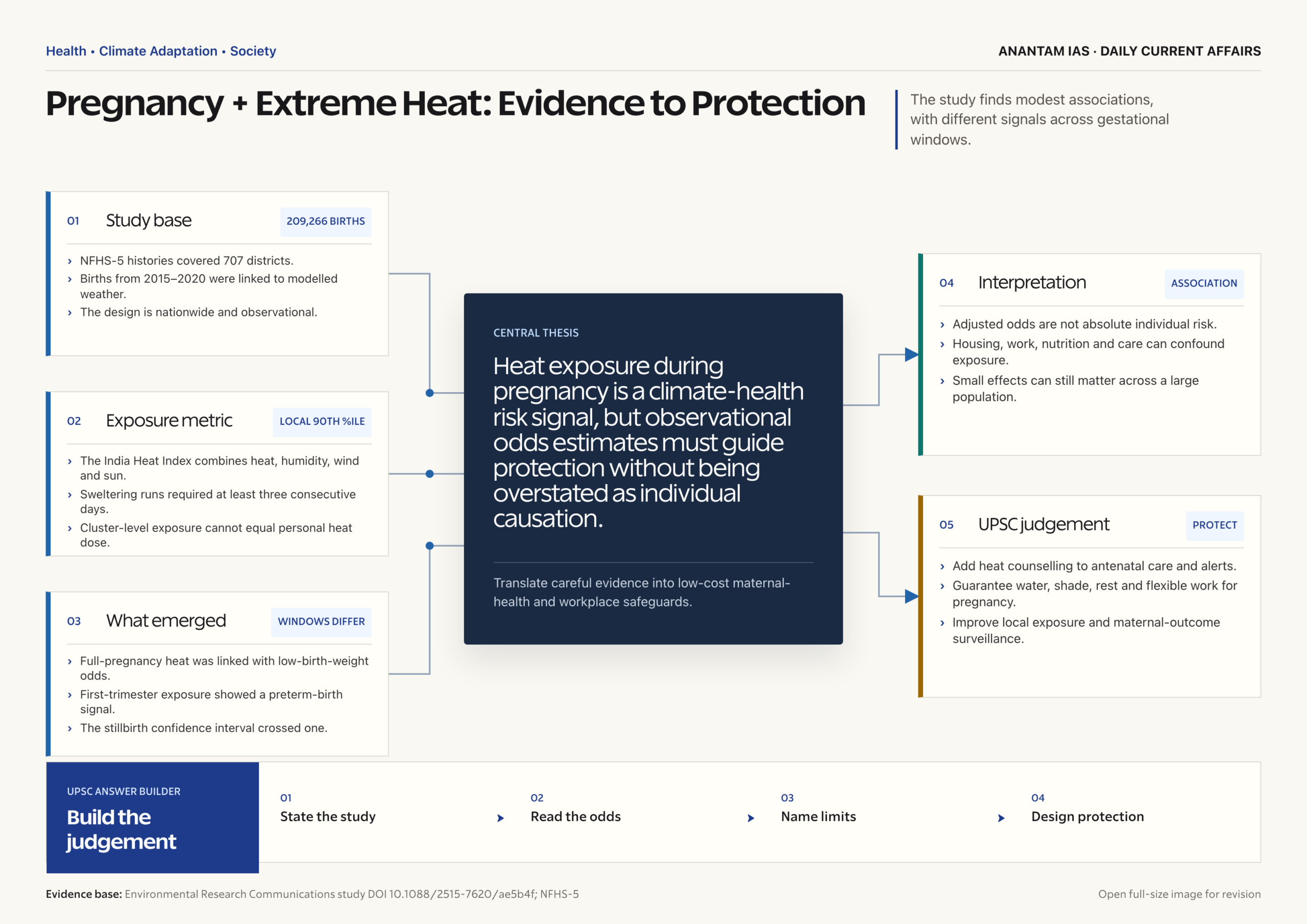
- For the full pregnancy, each additional consecutive sweltering day was associated with about 1% higher adjusted odds of low birth weight (aOR 1.010; 95% CI 1.001–1.018).
- The clearest trimester-specific associations were with preterm birth in the first trimester (aOR 1.036; 95% CI 1.009–1.064) and low birth weight in the second trimester (aOR 1.010; 95% CI 1.002–1.018).
- The third-trimester estimate for stillbirth was elevated (aOR 1.029), but its 95% confidence interval of 0.998–1.060 included 1; it should not be presented as a statistically established effect.
- Pregnancy increases metabolic and cardiovascular demands while the mother also dissipates heat generated by the foetal-placental unit. Prolonged hot and humid conditions can narrow the body’s margin for safe thermoregulation.
- Low birth weight, preterm birth and stillbirth are not interchangeable outcomes. Their definitions, mechanisms and policy responses differ, even when they share maternal, environmental and health-system risk factors.
- The study’s value lies in its national geographical coverage and its use of a multi-variable heat-stress index, not in a claim that one national temperature threshold fits every district.
UPSC Relevance
Prelims Relevance
- The National Family Health Survey is India’s Demographic and Health Survey and provides nationally representative information on population, health and nutrition.
- NFHS-5 fieldwork was conducted during 2019–2021; this study reconstructed pregnancy exposure for births occurring from 2015 to 2020.
- The survey uses a two-stage design stratified by rural and urban areas. A village segment is the primary sampling unit in rural areas, while a census enumeration block performs that role in urban areas.
- The India Heat Index combines air temperature, relative humidity, wind speed and downward short-wave solar radiation rather than using air temperature alone.
- In this study, a sweltering day had a daily mean India Heat Index above the cluster-specific 90th percentile for the study period; a consecutive event required at least three such days.
- The researchers defined low birth weight as reported birth weight below 2,500 grams and preterm birth as delivery before 37 completed weeks.
Mains Relevance
GS Paper 2
- Evaluate whether maternal and child health services treat extreme heat as an antenatal risk alongside anaemia, nutrition, hypertension, infection and access barriers.
- Discuss the role of ASHAs, ANMs, primary health centres and district health authorities in heat-risk communication, early identification and continuity of antenatal care.
GS Paper 3
- Use the study as evidence for integrating climate projections, heat-health surveillance and local vulnerability into district Heat Action Plans.
- Explain why humidity, wind and solar radiation matter for physiological heat stress and why climate-zone-specific thresholds can complement conventional temperature alerts.
Essay
- Climate change is experienced through the body before it appears in an economic balance sheet.
Background and Context
How the NFHS-5 study was designed
The researchers combined retrospective birth histories with modelled meteorological exposure; they did not follow pregnancies prospectively in real time.
- NFHS-5 collected household and individual data from women aged 15–49 through a nationally representative, cross-sectional survey. The birth-history records covered dates, reported gestation, birth weight and vital status for recent births.
- The initial dataset contained 232,920 births across 707 districts. The researchers excluded 23,654 records missing cluster geolocation, delivery date, birth weight, pregnancy duration or live-birth information, leaving 209,266 births.
- The analytical sample included 166,001 rural births and 43,265 urban births. The reported outcomes comprised 29,873 low-birth-weight births, 2,341 preterm births and 1,740 stillbirths.
- Separate extended generalised linear mixed models with a logit link estimated associations for each outcome. Individual survey weights were applied and cluster structure was included in the modelling.
- The adjusted models included maternal BMI, age, education, anaemia, smoking, birth order and foetal sex, alongside wealth, residence, cooking fuel, climate zone and ambient PM2.5. Adjustment reduces measured confounding but cannot eliminate unmeasured or poorly measured.
How extreme heat exposure was reconstructed
The exposure metric was designed to represent physiological heat stress under diverse Indian climates, not just a high thermometer reading.
- Hourly meteorological fields came from the National Centre for Medium-Range Weather Forecasting at about 0.1° spatial resolution, roughly 10 kilometres: air temperature, relative humidity, wind speed and downward solar radiation.
- The study calculated an hourly India Heat Index, averaged it to a daily mean and assigned it to each rural or urban survey cluster using the cluster’s geocode.
- For each participant, researchers estimated the period from conception to birth and the three trimester windows. A day was labelled sweltering when daily mean IHI exceeded the cluster-specific 90th percentile.
- The principal metric counted days in runs of at least three consecutive sweltering days. The local percentile makes the threshold responsive to climate-zone differences, but it also means sweltering exposure is relative to local conditions.
- Exposure was assigned by residential cluster. It does not directly reveal the woman’s indoor temperature, occupation, time outdoors, access to shade or cooling, hydration, mobility during pregnancy or personal heat strain.
What the trimester results actually show
The strongest defensible reading is that different gestational windows showed different statistical signals, with generally small effect estimates.
- Across the complete gestation, each extra consecutive sweltering day was associated with 1% higher adjusted odds of low birth weight. Odds are not the same as absolute risk and the estimate should not be multiplied.
- First-trimester exposure was associated with 3.6% higher odds of preterm birth per additional day (aOR 1.036; 95% CI 1.009–1.064). The confidence interval stayed above 1.
- Second-trimester exposure was associated with 1% higher odds of low birth weight per additional day (aOR 1.010; 95% CI 1.002–1.018). This supports a possible foetal-growth vulnerability window, not a proven mechanism.
- The third-trimester stillbirth estimate was 1.029, but the interval extended from 0.998 to 1.060. Calling this a confirmed rise in stillbirth would overstate the statistical evidence.
- In a duration sensitivity analysis, 3–4 consecutive sweltering days were associated with higher low-birth-weight odds (OR 1.044; 95% CI 1.002–1.087), while the 5–6 and seven-or-more-day categories were not statistically significant. The absence of a.
Plausible climate-health pathways
The paper discusses biologically plausible pathways, but it did not measure placental biomarkers or prove that any one pathway produced the observed outcomes.
- Pregnancy raises metabolic heat production and cardiac demand. When ambient heat and humidity limit heat loss, the mother may experience greater thermoregulatory and cardiovascular strain.
- Dehydration can reduce plasma volume and may affect uteroplacental blood flow. Heat strain may also alter uterine activity and hormonal signalling, providing a plausible link with preterm delivery.
- Reduced uteroplacental perfusion can constrain oxygen and nutrient delivery to the foetus. Heat-related oxidative stress and inflammation may also disrupt placental function, offering possible pathways to restricted foetal growth and low birth weight.
- Risk is shaped by exposure and adaptive capacity together. Heavy work, poor ventilation, unreliable drinking water, undernutrition, anaemia and limited healthcare access can compound physiological stress.
- These pathways are hypotheses supported by wider literature. Prospective cohorts with individual heat monitors, clinical records and maternal, placental and foetal biomarkers are needed to test them directly in India.
Way Forward
Make antenatal care heat-responsive
- Train ASHAs, ANMs and facility staff to recognise heat exhaustion, dehydration and warning signs in pregnancy and to communicate practical steps in local languages.
- Use forecast-triggered calls or visits for high-risk pregnancies, protect continuity of check-ups during heatwaves and keep antenatal waiting areas shaded, ventilated and supplied with safe water.
- Avoid rigid universal advice: clinical risk, trimester, work intensity, travel, comorbidities and household cooling capacity should shape counselling and referral.
Conclusion
- The study provides important population-scale evidence that prolonged extreme heat during pregnancy is associated with adverse birth outcomes in India, with the clearest statistical signals appearing in different trimesters for preterm birth and low birth weight.
- The evidence also demands restraint.
UPSC Practice Questions
Prelims MCQ 1
With reference to the study on extreme heat and pregnancy outcomes in India, consider the following statements:
- The India Heat Index used in the study incorporated air temperature, humidity, wind speed and solar radiation.
- A sweltering day was defined using a cluster-specific percentile rather than one absolute national temperature threshold.
- The third-trimester stillbirth estimate had a 95% confidence interval entirely above 1.
How many of the above statements are correct?
(a) Only one (b) Only two (c) All three (d) None
Answer: (b) Only two
Explanation:
Statements 1 and 2 are correct. The study used a multi-variable India Heat Index and a local 90th-percentile threshold. Statement 3 is incorrect because the third-trimester stillbirth interval was 0.998–1.060, which includes 1.
Prelims MCQ 2
Which one of the following is the most accurate interpretation of the study’s finding for low birth weight across the full pregnancy?
(a) Every sweltering day caused a 1% fall in birth weight (b) Each additional consecutive sweltering day was associated with about 1% higher adjusted odds of low birth weight (c) Exposure raised the absolute probability of low birth weight by exactly one percentage point (d) All women exposed to three sweltering days delivered a low-birth-weight baby
Answer: (b) Each additional consecutive sweltering day was associated with about 1% higher adjusted odds of low birth weight
Explanation:
The adjusted odds ratio was 1.010 with a 95% confidence interval of 1.001–1.018. This is an observational association in odds, not proof of causation, an exact absolute-risk change or a deterministic outcome.
UPSC Mains Questions
- Extreme heat during pregnancy is both a climate-adaptation problem and a maternal-health equity problem. Discuss with reference to recent Indian evidence. (250 words)
- What does the NFHS-5 study on heat and adverse birth outcomes establish, and what does it not establish? Explain how its findings should shape district Heat Action Plans. (250 words)
Sources: Environmental Research Communications and The Hindu.
Frequently Asked Questions
What did the India-wide extreme heat and pregnancy study find?
Among 209,266 births, each additional consecutive sweltering day across pregnancy was associated with about 1% higher adjusted odds of low birth weight. First-trimester exposure was associated with preterm birth, while second-trimester exposure was associated with low birth weight. These are.
How did the researchers define extreme heat?
They calculated the India Heat Index from temperature, relative humidity, wind speed and solar radiation. A sweltering day exceeded the survey cluster’s 90th-percentile daily mean IHI, and a consecutive event required at least three such days. The threshold was locally.
Why can the study not prove that heat caused adverse births?
It combined retrospective NFHS birth histories with modelled cluster-level outdoor exposure. It did not directly measure each woman’s personal heat, indoor conditions, hydration or biomarkers. Recall error, exposure misclassification and unmeasured factors such as occupation, disease, nutrition and healthcare use.
Which trimester appeared most sensitive to heat?
The statistical signal depended on the outcome. First-trimester exposure was associated with higher preterm-birth odds, and second-trimester exposure with higher low-birth-weight odds. The third-trimester stillbirth estimate was elevated, but its confidence interval included 1, so it was not conventionally statistically.
What are the possible biological pathways between heat and pregnancy outcomes?
Plausible pathways include thermoregulatory and cardiovascular strain, dehydration, altered uteroplacental blood flow, uterine activity, inflammation, oxidative stress and impaired placental function. The study discussed these pathways but did not measure them directly; prospective biomarker studies are needed to test them.
Source: https://anantamias.com/current-affairs/extreme-heat-pregnancy-outcomes-india/
Universal Banking Access: 99.92% of Inhabited Villages Covered
Why in News?
The Ministry of Finance told the Lok Sabha on 3 August 2026 that 600,868 of 601,328 inhabited villages had a banking outlet within a 5 km radius, equivalent to 99.92% coverage.
- The reported denominator is 601,328 inhabited villages; 600,868 were covered and 460 remained outside the stated 5 km threshold.
- A village counts as covered when a bank branch, Business Correspondent or India Post Payments Bank centre is available within 5 km. The claim does not mean each village has a full-service branch.
- The figures were based on data uploaded by banks to the Jan Dhan Darshak App, a geographic-information platform used to map banking infrastructure.
- As on 17 July 2026, the supporting network included over 1.81 lakh bank branches, 17.36 lakh Business Correspondents and 1.65 lakh IPPB centres.
- On the same date, India had 58.77 crore PMJDY accounts with a total balance of ₹3,12,414 crore.
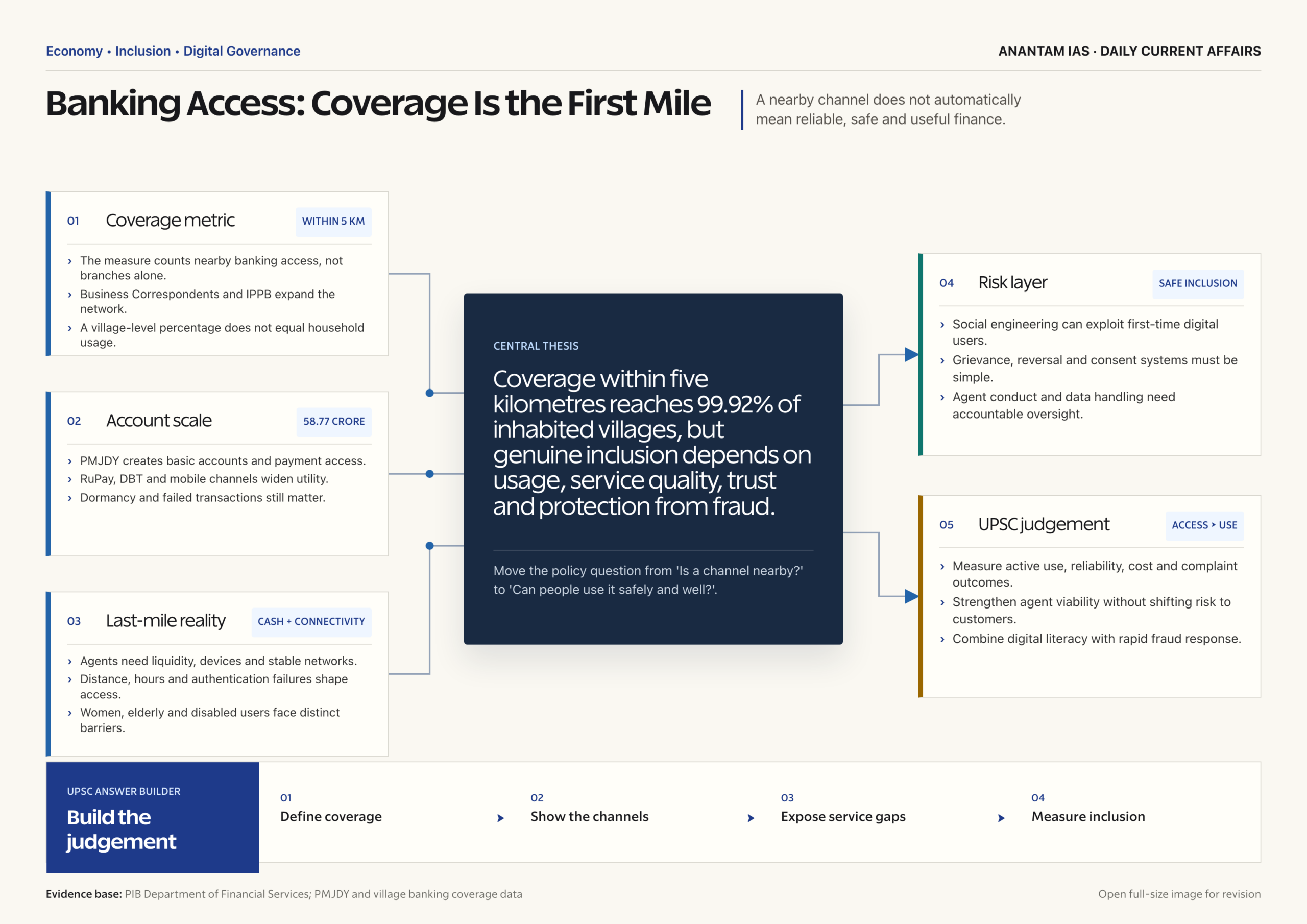
- The 99.92% figure measures geographic access. It does not directly measure outlet uptime, cash availability, transaction failure, waiting time, account dormancy, credit received, customer protection or user confidence.
- Financial inclusion has moved through three linked stages: opening accounts, building last-mile access channels, and encouraging meaningful use. The hardest stage is now quality with trust.
- For wider conceptual grounding, read the Anantam IAS notes on financial inclusion in India, Pradhan Mantri Jan Dhan Yojana and the RBI Financial Inclusion Index.
UPSC Relevance
Prelims Relevance
- Pradhan Mantri Jan Dhan Yojana was launched in August 2014 as the National Mission for Financial Inclusion.
- PMJDY seeks access to basic savings and deposit accounts, remittance, credit, insurance and pension in an affordable manner; it is not limited to opening a zero-balance account.
- A Business Correspondent is a bank-authorised intermediary that provides specified services closer to customers; a BC outlet is not the same as a brick-and-mortar bank branch.
- India Post Payments Bank is a payments bank and forms part of the last-mile network counted in the 5 km coverage measure.
- The Jan Dhan Darshak App maps service points such as branches, ATMs, Bank Mitras and other banking infrastructure and supports identification of coverage gaps.
- The RBI’s FI-Index is a composite index on a scale of 0 to 100; it captures access, usage and quality without a base year.
Mains Relevance
GS Paper 3
- Distinguish physical banking access from effective inclusion in savings, formal credit, insurance, pensions and digital payments.
- Assess how branches, Business Correspondents, IPPB, PMJDY and digital public infrastructure combine to reduce last-mile costs.
GS Paper 2
- Evaluate financial inclusion as a governance tool for direct benefit transfer, social protection and accountable service delivery.
- Discuss customer protection, accessible grievance redress and Centre-state-bank coordination for remote and vulnerable populations.
Essay
- Access becomes inclusion only when a citizen can use a service with dignity and trust.
Background and Context
What the 99.92% coverage figure actually measures
The figure is impressive, but its unit and denominator must remain precise.
- The Ministry’s statement covers inhabited villages, not the total population and not every household. Of 601,328 villages in the dataset, 600,868 had a qualifying outlet within 5 km.
- The calculation leaves 460 villages outside the threshold. Near-universal coverage is accurate; universal coverage would require the remaining locations to be served and the data to stay current.
- Coverage can come through a bank branch, a Business Correspondent or an IPPB centre. These channels differ in staffing, operating hours, cash capacity, product range and ability to resolve a complex problem.
- The data are uploaded by banks to Jan Dhan Darshak. A sound monitoring system should audit location accuracy, operational status and duplications, because a mapped point that is closed or frequently offline does not deliver practical.
- Distance is only one barrier. Terrain, transport cost, disability, working hours, network connectivity, language and social constraints can make a nominally nearby outlet hard to use.
The channel architecture behind near-universal access
India expanded reach through a layered model instead of relying only on conventional branches.
- Over 1.81 lakh bank branches provide the deepest service range, including account servicing, deposits, withdrawals, credit appraisal and grievance support, subject to the institution and branch mandate.
- The network of 17.36 lakh Business Correspondents brings services closer through bank-authorised agents. Typical last-mile functions include account opening support, deposits, withdrawals, remittances and Aadhaar Enabled Payment System transactions.
- Over 1.65 lakh IPPB centres add the postal network’s physical reach. Payments banks can accept deposits and facilitate payments and remittances, but their regulatory model is different from that of a universal commercial bank.
- RBI allows Commercial Banks, Small Finance Banks, Payments Banks, Local Area Banks and Regional Rural Banks to open branches without prior approval, subject to the requirement cited by the Ministry that 25% of new outlets be.
- SLBCs and UTLBCs review uncovered places with state or Union Territory governments and member banks. Banks also consider regulation, business plans and commercial viability, so public coordination remains necessary where private returns are weak.
PMJDY turned reach into an account platform
An outlet matters more when citizens have an account through which multiple services can flow.
- PMJDY was launched in August 2014 to provide universal access to banking services for unbanked households under the broader National Mission for Financial Inclusion.
- As on 17 July 2026, the official total was 58.77 crore accounts carrying ₹3,12,414 crore. These are accounts, not a count of unique persons, and the aggregate balance does not show the distribution across.
- The account layer supports deposits, remittances, Direct Benefit Transfer, RuPay-enabled payments and links to eligible credit, insurance and pension products. It forms the account component of the Jan Dhan-Aadhaar-Mobile architecture.
- A high account count can coexist with low or uneven use. Outcome tracking should examine active transactions, regular savings, failed payments, overdraft access, insurance continuity, pension participation and whether customers rely on informal credit despite having.
- The policy question has shifted from Can a person open an account? to Can the person use suitable services repeatedly, safely and at a reasonable cost?
Access, usage and quality are separate dimensions
The RBI framework prevents outlet counts from becoming the sole measure of success.
- The FI-Index combines Access, Usage and Quality. Their weights are 35%, 45% and 20%, which gives meaningful use more weight than physical access alone.
- The index reached 70.0 in March 2026, up from 67.0 a year earlier. RBI said all sub-indices improved and that the latest rise came mainly from usage.
- Access asks whether services and touchpoints exist. Usage asks whether people actually save, borrow, insure, invest or transact. Quality covers customer experience, financial literacy, consumer protection and inequality or deficiency in service.
- A BC point may be close yet unreliable because of poor connectivity, inadequate cash or biometric failure. An account may be active only because benefits arrive, while the customer still lacks formal productive credit. Such cases.
- Good district dashboards should track service uptime, transaction success, average grievance time, product use by gender and social group, and the share of customers using more than one suitable financial service.
Way Forward
Move from outlet mapping to service-level monitoring
- Add outlet uptime, cash availability, transaction-success rate, service range, accessibility and complaint contacts to Jan Dhan Darshak, with periodic field verification.
- Publish district-level access, usage and quality indicators instead of presenting one national proximity number as the complete result.
- Time-bound plans for the remaining 460 villages should identify terrain, connectivity, premises or viability barriers and the channel best suited to each location.
Conclusion
- India’s 99.92% village-coverage figure shows how branches, Business Correspondents and the postal network can close a vast physical-access gap.
- The strongest UPSC judgement is conditional: proximity is a necessary achievement, not the final definition of inclusion.
UPSC Practice Questions
Prelims MCQ 1
With reference to the recent official measure of banking coverage in inhabited villages, consider the following statements:
- A village is counted as covered only when it has a brick-and-mortar commercial-bank branch within its boundary.
- Business Correspondent and India Post Payments Bank outlets can satisfy the stated coverage measure when available within a 5 km radius.
- The reported 99.92% coverage was based on data uploaded by banks to the Jan Dhan Darshak App.
How many of the above statements are correct?
(a) Only one (b) Only two (c) All three (d) None
Answer: (b) Only two
Explanation:
Statements 2 and 3 are correct. The measure includes a branch, Business Correspondent or IPPB outlet within 5 km and uses bank-uploaded Jan Dhan Darshak data. It does not require a full branch inside every village.
Prelims MCQ 2
Which one of the following correctly describes the RBI’s Financial Inclusion Index?
(a) It measures only the number of bank accounts opened during a financial year (b) It gives equal weight to access, usage and quality (c) It combines access, usage and quality on a scale of 0 to 100 (d) It is compiled by the Ministry of Rural Development for inhabited villages only
Answer: (c) It combines access, usage and quality on a scale of 0 to 100
Explanation:
The RBI FI-Index is a composite measure on a 0-to-100 scale. Access, Usage and Quality carry weights of 35%, 45% and 20%, respectively; it covers the wider financial-inclusion system rather than inhabited villages alone.
UPSC Mains Questions
- India has nearly achieved universal geographic banking coverage, but proximity is not equivalent to meaningful financial inclusion. Examine. (250 words)
- Business Correspondents are central to rural banking access but remain a potential point of operational and consumer-protection weakness. Discuss the reforms needed in the BC model. (250 words)
Sources: PIB, Ministry of Finance and Reserve Bank of India.
Frequently Asked Questions
What does 99.92% village banking coverage mean?
It means 600,868 of 601,328 inhabited villages in the official dataset had a bank branch, Business Correspondent or India Post Payments Bank outlet within a 5 km radius. It does not mean every village has a full-service branch or that.
How many villages remained outside the 5 km coverage threshold?
The official figures leave 460 inhabited villages outside the stated threshold as of the reported date. These may include difficult locations facing connectivity, infrastructure, suitable-premises or commercial-viability constraints, which require location-specific solutions.
What is a Business Correspondent in banking?
A Business Correspondent is an intermediary authorised by a bank to deliver specified services closer to customers. Depending on the arrangement, a BC can support account opening, deposits, withdrawals, remittances and digital transactions. It is not automatically equivalent to a.
How large was PMJDY by July 2026?
The Ministry of Finance reported 58.77 crore PMJDY accounts with a total balance of ₹3,12,414 crore as on 17 July 2026. The figure counts accounts, not unique individuals, and the total balance does not show how deposits or account activity.
Why is access alone an incomplete measure of financial inclusion?
A nearby outlet may be offline, short of cash or unable to provide credit and grievance support. Meaningful inclusion also requires regular use, suitable products, affordable service, financial literacy, consumer protection and confidence that errors or fraud will be resolved.
Source: https://anantamias.com/current-affairs/universal-banking-coverage-rural-india/
KCC-MISS Assessment: What ₹2.30 Farm Value per ₹1 Support Means
Why in News?
The Ministry of Finance told the Lok Sabha on 3 August 2026 that a third-party assessment by the Institute for Social and Economic Change, Bengaluru, had examined KCC-MISS across India’s diverse agro-regions.
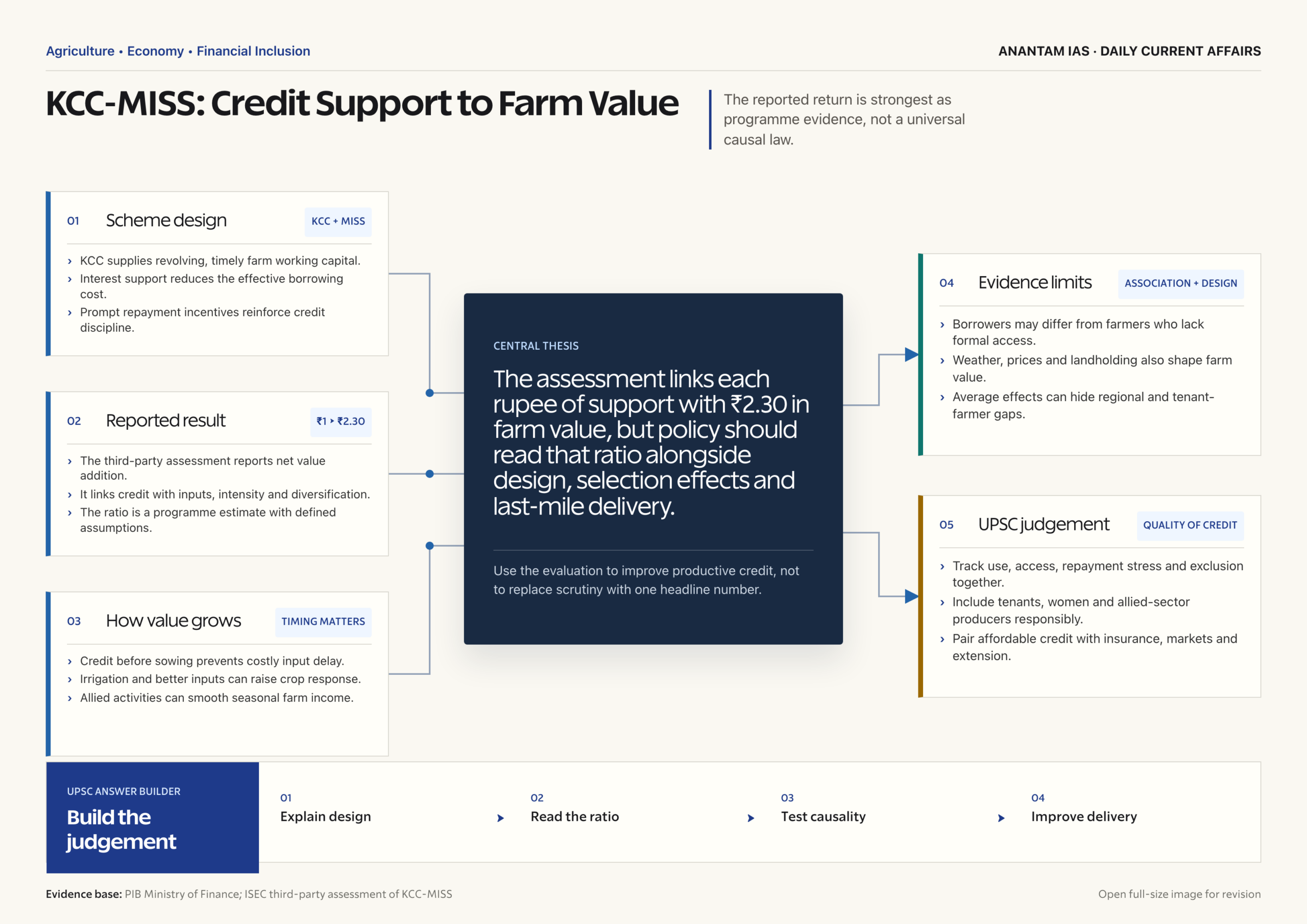
- The reported benefit is net value addition in agriculture and allied activities. It is not ₹2.30 deposited into a farmer’s account and not a guaranteed private return for every borrower.
- ISEC found higher cultivated area, cropping intensity, multi-season cultivation and more diversified crop portfolios among KCC-MISS farmers, supported by reliable irrigation and concessional credit.
- Adequate working capital improved the timeliness of input use, while recipients of the Prompt Repayment Incentive showed better credit discipline and strengthened lenders’ confidence.
- The assessment linked the scheme with dairy and livestock expansion, crop-income supplementation and working capital for inland fisheries, including a diversification role in the North-Eastern Region.
- The government reported an estimated ₹1.87 lakh crore subsidy outlay from inception through 2024-25. This is a cumulative fiscal figure, not the annual cost of the current version of MISS.
- Agriculture is seasonal, input-intensive and exposed to weather and price shocks. A farmer who receives credit after the sowing window may have a sanctioned loan but still lose the productive purpose of that loan.
- KCC is the credit-delivery instrument; MISS is the fiscal mechanism that lowers the price of eligible short-term KCC borrowing. Keeping the two distinct prevents a common Prelims error.
- The finding strengthens the case for affordable institutional credit, but the policy test is not aggregate disbursement alone. It is whether smallholders, tenants, women farmers and allied-activity producers obtain timely, adequately sized and usable credit.
UPSC Relevance
Prelims Relevance
- Kisan Credit Card was introduced in 1998 as a flexible single-window credit facility for cultivation and associated farm needs.
- KCC covers short-term crop production, post-harvest expenses, produce marketing, limited household consumption, maintenance of farm assets and investment credit for agriculture and allied activities.
- Eligible borrowers include owner cultivators, joint borrowers, tenant farmers, oral lessees and sharecroppers, as well as farmer SHGs and JLGs under the RBI framework.
- Commercial banks, Regional Rural Banks, Small Finance Banks and cooperative institutions implement the KCC scheme under the applicable regulatory framework.
- MISS subsidises eligible short-term agricultural loans routed through KCC; KCC itself can also contain components outside the subsidised short-term portion.
- Under the current design described by official sources, eligible short-term KCC loans carry a concessional rate of 7% per annum, supported by a 1.5% interest subvention to lending institutions.
Mains Relevance
GS Paper 3
- Assess the role of timely institutional working capital in raising cropping intensity, input productivity, diversification and agricultural value addition.
- Evaluate interest subvention against alternative uses of public money such as irrigation, extension, storage, insurance and long-term agricultural investment.
GS Paper 2
- Examine inclusion and accountability in digital farm-credit delivery through the Kisan Rin Portal, Jan Samarth, e-KCC and KRISHIKA.
- Discuss Centre-state-bank coordination, grievance redress and the risks of excluding tenants or farmers with incomplete land and identity records.
Essay
- Cheap credit creates value only when it arrives before the productive decision.
Background and Context
KCC and MISS perform different jobs
The policy architecture becomes clear once the credit product is separated from the interest subsidy.
- The Kisan Credit Card is a revolving and flexible bank-credit arrangement. The sanctioned limit is based on the crop’s scale of finance, cultivated area, post-harvest and household needs, farm-asset maintenance, insurance and any approved term-loan component.
- The RBI framework allows one window to combine a short-term credit limit for recurring needs with a longer-term component for agricultural and allied investment. The repayment pattern should reflect harvest or income-generation cycles.
- The Interest Subvention Scheme began in 2006-07; the Modified Interest Subvention Scheme version was introduced in 2022 with a 1.5% subvention to lenders and a 3% Prompt Repayment Incentive for eligible farmers.
- MISS does not turn every KCC withdrawal into a 4% loan. The concessional benefit applies to the eligible short-term amount and the 4% effective rate depends on prompt repayment.
- A useful answer phrase is: KCC improves the availability and flexibility of formal credit, while MISS improves its affordability and rewards repayment discipline.
Who can access KCC and what can it finance?
KCC is broader than a landowner’s seasonal crop loan, though access on the ground can still depend heavily on documents and bank appraisal.
- The RBI master circular lists individual or joint owner cultivators, tenant farmers, oral lessees, sharecroppers, farmer Self Help Groups and Joint Liability Groups as eligible categories.
- The short-term portion can finance seeds, fertiliser, pesticides, labour and other crop costs, as well as approved post-harvest, marketing, consumption and farm-maintenance needs.
- For fisheries, eligible working capital may include seed, feed, fertiliser, fuel, ice, labour, lease rent and landing charges. For animal husbandry, it may include feed, veterinary support, labour, water and electricity.
- KCC for allied activities matters because dairy, livestock and fisheries generate cash flows on a schedule different from a crop harvest. The credit limit and repayment design should match the activity’s production cycle.
- Formal eligibility does not automatically produce inclusion. Tenants, oral lessees and women cultivators may lack recorded land rights or activity documentation, while remote borrowers may face branch distance, digital friction and weak awareness.
How the subsidy changes the farmer's cost of credit
The scheme uses both a lender-side subsidy and a borrower-side repayment incentive.
- On an eligible short-term KCC loan, the farmer is charged a concessional 7% annual rate. The Union government supports participating lending institutions through a 1.5% interest subvention.
- A borrower who repays within the prescribed period can receive the 3% Prompt Repayment Incentive, reducing the effective cost on the eligible amount to 4% per annum.
- The PRI creates a behavioural incentive: timely repayment lowers the farmer’s cost and may preserve the bank’s willingness to renew or expand working capital.
- The 2025-26 policy change raised the MISS-linked limit from ₹3 lakh to ₹5 lakh. A larger nominal ceiling can help when input costs have risen, but sanction size still depends on assessed need.
- The collateral-free limit of ₹2 lakh is a separate threshold. Collateral-free does not mean interest-free, documentation-free or appraisal-free, and a higher KCC limit does not remove bank credit assessment.
What the ISEC assessment reports
The assessment connects affordable working capital with both farm production and repayment behaviour.
- The headline estimate says every ₹1 invested under KCC-MISS contributes ₹2.30 to net value addition in agriculture and allied activities. The denominator should be read as scheme support or investment, not as.
- Beneficiary farmers reportedly cultivated larger areas, achieved higher cropping intensity and adopted more diversified crop portfolios across seasons. Reliable irrigation and concessional credit worked as complementary conditions.
- Timely working capital allowed inputs to be purchased and applied closer to the agronomic window. This channel matters because late seed, fertiliser, feed or veterinary expenditure can reduce output even when finance eventually arrives.
- PRI beneficiaries showed better credit discipline, which may improve lender confidence and subsequent credit access. This is an institutional benefit as well as a private borrowing benefit.
- The scheme supported dairy and livestock expansion and inland-fisheries working capital, helping households diversify away from complete dependence on one seasonal crop.
Way Forward
Publish an auditable evaluation package
- Release the ISEC report with the sampling frame, agro-regional coverage, beneficiary and comparison groups, survey instruments, definition of net value addition and sensitivity checks.
- Report outcomes by landholding, tenancy status, gender, social group, irrigation access, state, bank type and crop or allied activity so the average does not hide exclusion.
- Separate correlation from estimated causal impact and attach confidence intervals or robustness ranges to the headline return figure.
Conclusion
- The ISEC assessment offers a strong policy signal: affordable and timely KCC working capital can support cropping intensity, diversification, allied livelihoods and repayment discipline.
- A balanced UPSC judgement should add two conditions.
UPSC Practice Questions
Prelims MCQ 1
With reference to the Kisan Credit Card (KCC) and Modified Interest Subvention Scheme (MISS), consider the following statements:
- Tenant farmers, oral lessees and sharecroppers can be eligible under the KCC framework.
- The Prompt Repayment Incentive can reduce the effective interest rate on the eligible short-term loan to 4% per annum.
- Every loan component sanctioned under a KCC automatically receives MISS benefit and requires no credit appraisal.
How many of the above statements are correct?
(a) Only one (b) Only two (c) All three (d) None
Answer: (b) Only two
Explanation:
Statements 1 and 2 are correct. RBI’s KCC framework includes tenants, oral lessees and sharecroppers, and prompt repayment can lower the effective rate on the eligible short-term amount to 4%. MISS does not automatically cover every KCC component, and normal documentation and appraisal rules still apply.
Prelims MCQ 2
Which one of the following best describes the ₹2.30 figure reported in the ISEC assessment of KCC-MISS?
(a) A guaranteed ₹2.30 cash transfer to each farmer for every ₹1 borrowed (b) A uniform 230% profit earned by every KCC account holder (c) Reported net value addition in agriculture and allied activities per ₹1 invested under KCC-MISS (d) The interest paid by banks to the Union government on each subsidised loan
Answer: (c) Reported net value addition in agriculture and allied activities per ₹1 invested under KCC-MISS
Explanation:
The Ministry of Finance reported ISEC’s estimate as ₹2.30 in net value addition per ₹1 invested under KCC-MISS. It is an evaluation estimate at the sector or programme level, not an individual cash transfer, universal profit rate or interest payment.
UPSC Mains Questions
- The success of agricultural credit depends as much on timing and inclusion as on the volume disbursed. Discuss in the light of the third-party assessment of KCC-MISS. (250 words)
- Every ₹1 invested under KCC-MISS reportedly contributes ₹2.30 to agricultural net value addition. Evaluate the evidentiary value and methodological limits of using this estimate to justify farm-credit subsidy. (250 words)
Sources: PIB, Ministry of Finance and Reserve Bank of India.
Frequently Asked Questions
What did the KCC-MISS third-party assessment find?
The Institute for Social and Economic Change reported that every ₹1 invested under KCC-MISS contributes ₹2.30 to net value addition in agriculture and allied activities. It also found positive effects on cropping intensity, multi-season cultivation, input timing, diversification, allied livelihoods.
Does ₹2.30 mean every farmer receives that amount in cash?
No. The figure is a reported estimate of net value addition associated with programme investment. It is not a cash transfer, a guaranteed farmer-level profit or the amount returned by a bank. The public release does not provide the full.
What is the difference between KCC and MISS?
KCC is the bank-credit product that provides flexible finance for crop, post-harvest, household, asset-maintenance and allied needs. MISS is the government subsidy mechanism that lowers the interest cost of an eligible short-term KCC loan and rewards prompt repayment.
Who is eligible for a Kisan Credit Card?
RBI’s framework includes individual or joint owner cultivators, tenant farmers, oral lessees, sharecroppers, and farmer SHGs or JLGs. Separate activity rules cover animal husbandry and fisheries. Actual sanction still depends on documentation, assessed need and the lending institution’s appraisal.
How does the Prompt Repayment Incentive work?
Eligible short-term KCC borrowing is offered at a concessional 7% annual rate. A farmer who repays within the prescribed period can receive a 3% Prompt Repayment Incentive, reducing the effective interest cost on the eligible amount to 4% per annum.
Source: https://anantamias.com/current-affairs/kcc-miss-third-party-assessment/
Glaw Lake Becomes India’s 101st Ramsar Site
Why in News?
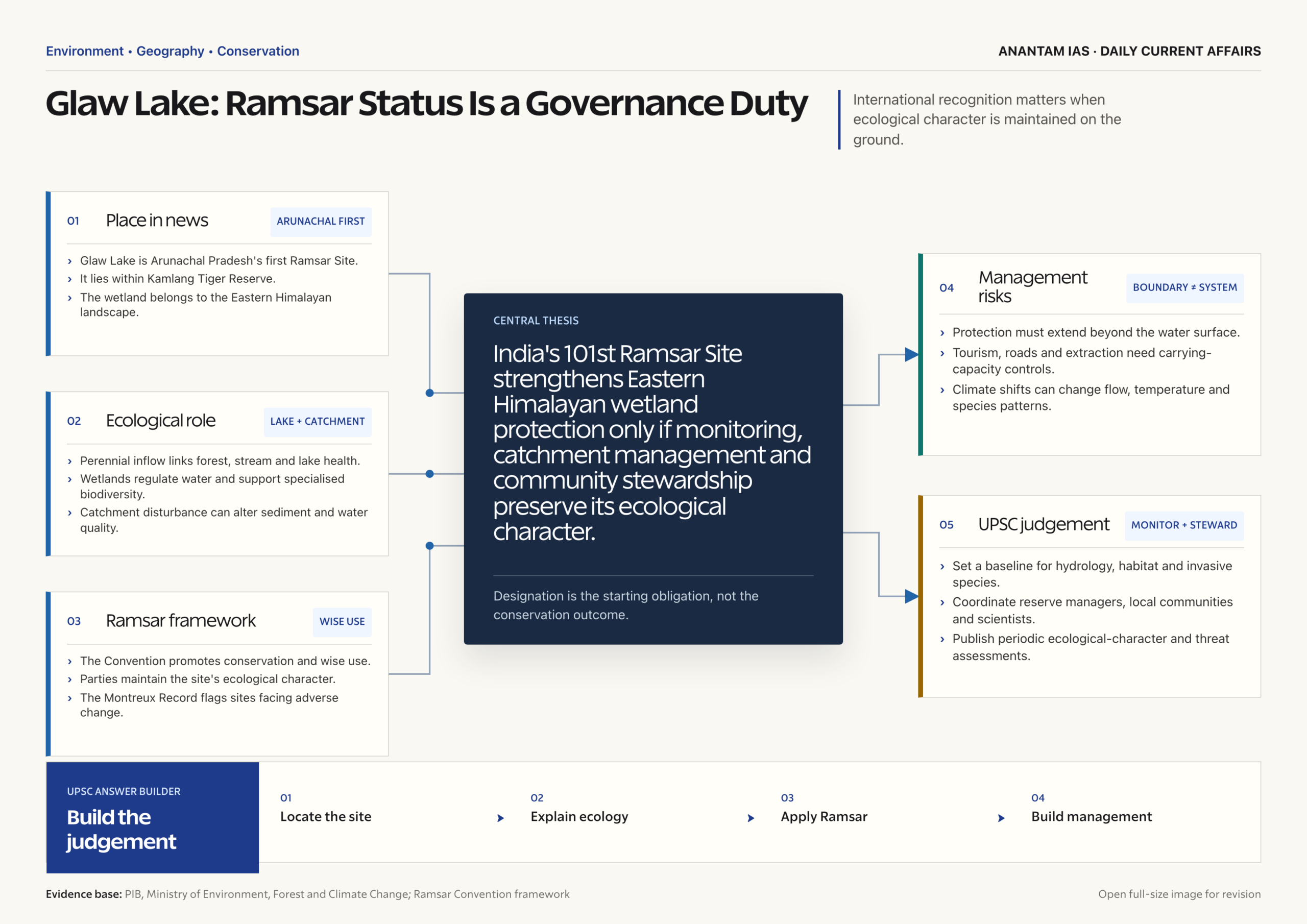
On August 3, 2026, the Union Environment Minister announced the designation of Glaw Lake in Arunachal Pradesh as India’s 101st Ramsar Site .
- The Press Information Bureau identified Glaw Lake as a freshwater lake in the Eastern Himalayas, fed by perennial mountain streams and surrounded by dense vegetation.
- The lake lies within Kamlang Tiger Reserve and Kamlang Wildlife Sanctuary in Lohit district, so its management sits within an already protected forest and wildlife landscape.
- The Government of Arunachal Pradesh describes the lake as spread over about 82 hectares and situated at an elevation of about 1,168 metres near Wakro. These are descriptions of the lake; the PIB announcement did not.
- PIB reported more than 150 tree species and 49 orchid species within the site and its catchment, showing that the wetland’s value extends beyond open water to the surrounding forested catchment.
- India’s official tally rose from 26 Ramsar Sites in 2014 to 101 after this addition, according to the Union Environment Ministry’s announcement.
- For Prelims, connect Glaw Lake, Arunachal Pradesh, Lohit district, Kamlang Tiger Reserve and the Eastern Himalayas rather than memorising the national tally alone.
- For Mains, the case shows why a wetland must be managed as a lake-catchment-landscape system: changes in streams, slopes, vegetation or visitor pressure can alter water quality and ecological character even when the waterbody itself.
- The analytical test is implementation. Ramsar recognition can improve attention and coordination, but conservation outcomes still depend on a credible baseline, hydrological monitoring, protected-area management and local stewardship.
UPSC Relevance
Prelims Relevance
- Glaw Lake is in Arunachal Pradesh’s Lohit district, within Kamlang Wildlife Sanctuary and Tiger Reserve.
- It is a freshwater lake in the Eastern Himalayas, fed by perennial mountain streams.
- It became India’s 101st Ramsar Site and Arunachal Pradesh’s first Ramsar Site in August 2026.
- The state forest department records the lake at about 82 hectares and roughly 1,168 metres above sea level; this should not be confused with the formally delimited Ramsar-site area unless the Ramsar Information Sheet confirms the.
- Kamlang was notified as a tiger reserve in 2017. The National Tiger Conservation Authority lists its total area as 783 square kilometres.
- The Convention on Wetlands, commonly called the Ramsar Convention, was adopted at Ramsar in Iran in 1971 and entered into force in 1975.
Mains Relevance
GS Paper 3
- Explain wetland conservation through ecological character, catchment integrity, biodiversity and climate resilience.
- Assess how Ramsar recognition can strengthen inventories, monitoring, management plans and public accountability without treating designation as the final conservation outcome.
GS Paper 2
- Examine institutional coordination among the Union Environment Ministry, State Wetland Authority, protected-area administration, scientific bodies and local communities.
- Discuss how international environmental commitments are implemented through domestic laws, site plans, funding, monitoring and transparent reporting.
Essay
- A conservation label matters only when institutions protect the ecological processes that made the place valuable.
Background and Context
Glaw Lake and Its Eastern Himalayan Setting
Glaw Lake is best understood as a freshwater wetland embedded in a forested mountain catchment, not as an isolated patch of water.
- The lake lies in the south-eastern part of Lohit district in Arunachal Pradesh, within the Kamlang protected landscape near Wakro.
- The state forest department places it about 18 to 20 kilometres south-east of Wakro and at an elevation of approximately 1,168 metres.
- Perennial mountain streams feed the lake. This hydrological connection makes stream flow, slope stability, vegetation cover and sediment movement central to its ecological health.
- Kamlang Tiger Reserve forms part of a larger forested landscape adjoining Namdapha Tiger Reserve and other forests. The lake adds an aquatic habitat dimension to a landscape usually discussed through large mammals and forest cover.
- The reserve is also a catchment for the Kamlang, Lang and Lati rivers, which are tributaries of the Lohit. The setting links local wetland conservation to the wider Brahmaputra river system.
Ecological Importance of the Lake and Catchment
The designation draws attention to the combined value of open water, perennial inflows and the surrounding Eastern Himalayan vegetation.
- PIB reported more than 150 tree species and 49 orchid species within the wetland site and its catchment. The wording is important because much of the biodiversity value belongs to the lake-catchment complex.
- A perennial freshwater body can provide habitat, refuge, feeding space and breeding conditions for aquatic organisms, wetland-dependent birds and other fauna; site-specific population claims should come from the official Ramsar Information Sheet or field surveys.
- Forested slopes regulate runoff, trap sediment and help moderate the movement of nutrients into the lake. Loss of vegetation can change water clarity, depth and seasonal flow even without direct construction along the shoreline.
- Wetlands also store water, support nutrient cycling and create microhabitats. These services depend on maintaining the site’s ecological character, meaning its ecosystem components, processes and services at a given point in time.
- The PIB release did not publish the Ramsar Criteria under which Glaw Lake qualified. Candidates should avoid assigning a criterion from general biodiversity descriptions until the official Ramsar Information Sheet provides that evidence.
How a Wetland Becomes a Ramsar Site
Ramsar status follows a national nomination and an evidence-based assessment against internationally agreed criteria.
- The national Administrative Authority prepares a Ramsar Information Sheet describing the wetland’s ecological character, boundaries, values, threats and the criteria it meets.
- A site may enter the List of Wetlands of International Importance if it meets at least one of nine criteria. These cover representative wetland types and the support of threatened species, biological diversity, critical life stages.
- The site boundary must be precisely described and delimited. That is why a general estimate for the lake’s surface should not automatically be treated as the Ramsar boundary area.
- The Convention Secretariat checks whether the information and map meet adopted standards before the information is published through the Ramsar Sites Information Service.
- Designation creates an international conservation commitment, but the site remains under national sovereignty and is managed through the country’s legal and administrative system.
Wise Use and Ecological Character
The core Ramsar idea is wise use, not an assumption that every listed wetland must be closed to all human activity.
- The Convention defines wise use as maintaining ecological character through ecosystem approaches within the context of sustainable development.
- Contracting Parties commit to wise use across all wetlands in their territory, not only the sites placed on the Ramsar List.
- For a listed site, management should identify the ecological features to be maintained, establish a baseline, monitor change and respond before degradation becomes difficult to reverse.
- Article 3.1 asks Parties to plan for the conservation of listed wetlands while promoting wise use of wetlands generally. Site management plans and indicators translate that broad duty into local action.
- If a listed site’s ecological character has changed, is changing or is likely to change because of human interference, the Convention provides reporting and advisory mechanisms. The first defence remains reliable domestic monitoring and early corrective.
Way Forward
Publish the Complete Evidence Baseline
- Publish the Ramsar Information Sheet, precise site boundary, qualifying criteria, ecological-character description and source methods in an accessible format.
- Separate verified field records from broad landscape descriptions so that tree, orchid, bird, fish and other species claims remain traceable.
- Create a seasonal baseline for lake level, inflows, water quality, sediment and key biological indicators, with thresholds that trigger management action.
Conclusion
- Glaw Lake’s designation is important because it brings Arunachal Pradesh into India’s Ramsar network and recognises a freshwater ecosystem within the Eastern Himalayan Kamlang landscape.
- The next test is practical: establish the site’s ecological baseline, protect its catchment, coordinate overlapping institutions and monitor change .
UPSC Practice Questions
Prelims MCQ 1
With reference to Glaw Lake, consider the following statements:
- It is a freshwater lake located within Kamlang Tiger Reserve in Arunachal Pradesh.
- It became Arunachal Pradesh’s first Ramsar Site in 2026.
- It is situated in the Western Ghats and drains into the Godavari basin.
How many of the above statements are correct?
(a) Only one (b) Only two (c) All three (d) None
Answer: (b) Only two
Explanation:
Statements 1 and 2 are correct. Glaw Lake is an Eastern Himalayan freshwater lake in Kamlang Tiger Reserve, Lohit district, and became Arunachal Pradesh’s first Ramsar Site. It is not in the Western Ghats or the Godavari basin; the Kamlang landscape is connected to tributaries of the Lohit and the Brahmaputra system.
Prelims MCQ 2
Which one of the following best describes the Ramsar Convention’s principle of wise use?
(a) Complete exclusion of all human activity from every listed wetland (b) Maintenance of wetland ecological character through ecosystem approaches within sustainable development (c) Automatic conversion of every Ramsar Site into a national park (d) Management of listed wetlands exclusively by the Convention Secretariat
Answer: (b) Maintenance of wetland ecological character through ecosystem approaches within sustainable development
Explanation:
Wise use means maintaining ecological character through ecosystem approaches in the context of sustainable development. Ramsar listing does not automatically create a national park, transfer sovereignty or require a universal ban on human activity. National authorities remain responsible for effective site management.
UPSC Mains Questions
- Ramsar designation should be treated as the beginning of accountable wetland management, not the end of conservation action. Discuss with reference to Glaw Lake. (250 words)
- Mountain wetlands must be governed as lake-catchment-landscape systems. Explain the ecological and institutional implications of this approach for Glaw Lake in Kamlang Tiger Reserve. (250 words)
Sources: PIB, Ministry of Environment, Forest and Climate Change and Department of Environment, Forest and Climate Change, Government of Arunachal Pradesh.
Frequently Asked Questions
Where is Glaw Lake located?
Glaw Lake is a freshwater mountain lake in Lohit district of Arunachal Pradesh. It lies within Kamlang Wildlife Sanctuary and Kamlang Tiger Reserve near Wakro in the Eastern Himalayas. The state forest department places it at about 1,168 metres elevation.
Why was Glaw Lake in the news?
On August 3, 2026, the Union Environment Minister announced Glaw Lake’s designation as India’s 101st Ramsar Site. It is Arunachal Pradesh’s first site on the Ramsar List. The announcement highlighted its freshwater ecology, perennial mountain-stream inflows and rich plant diversity.
How large is Glaw Lake?
The Arunachal Pradesh forest department describes Glaw Lake as spread over about 82 hectares. This figure describes the lake and should not automatically be treated as the formally delimited Ramsar-site area. The precise international-site boundary and area should be taken.
What is the ecological importance of Glaw Lake?
Glaw Lake adds a perennial freshwater habitat to the forested Kamlang protected landscape. PIB reported more than 150 tree species and 49 orchid species within the site and its catchment. Its streams, waterbody and vegetation work together, so catchment stability.
Does Ramsar status automatically ban all human activity?
No. The Convention’s organising idea is wise use, which means maintaining ecological character through ecosystem approaches within sustainable development. Site-specific domestic protections and management rules still apply. Because Glaw Lake lies inside a wildlife sanctuary and tiger reserve, its use.
Source: https://anantamias.com/current-affairs/glaw-lake-india-101st-ramsar-site/
India’s Draft V2V Rules and the Proposed 2028 Mandate
Why in News?
The Ministry of Road Transport and Highways has issued a draft notification to amend the Central Motor Vehicles Rules, 1989 for phased implementation of Vehicle-to-Vehicle communication in motor vehicles.
- Vehicles in categories L, M and N manufactured on or after 1 October 2027 would have to comply with AIS-230 whenever they are fitted with a V2V communication system.
- Vehicles in the same categories manufactured on or after 1 October 2028 would be required to be fitted with a V2V system conforming to AIS-230. The PIB release does not announce a retrofit deadline for vehicles.
- AIS-230 covers factory-installed On-Board Units using Cellular Vehicle-to-Everything technology and specifies radio, receiver, positioning, power, environmental, electromagnetic-compatibility, security and road-safety performance requirements.
- Named safety use cases include Emergency Brake Alert, Forward Collision Warning, Wrong-way Driving and Emergency Vehicle Alert.
- The Central Motor Vehicles Rules-Technical Standing Committee considered AIS-230 at its 56th meeting on 7 May 2026. A MoRTH task force had separately recommended a 5.9 GHz ITS/V2X approach and phased pilots.
- V2V allows nearby vehicles to share position, speed, direction and acceleration data. A receiving vehicle can warn its driver before a danger becomes visible through a windscreen or onboard camera.
- The technology can complement Advanced Driver Assistance Systems: radar, camera or lidar observes the local environment, while cooperative messages can reveal sudden braking or a wrong-way vehicle beyond direct line of sight.
- The policy is not only an automotive rule. It also depends on telecom spectrum, interoperable message formats, trusted digital certificates, equipment testing, secure software and coordination between the Union, states, road agencies and manufacturers.
UPSC Relevance
Prelims Relevance
- V2X is the umbrella for Vehicle-to-Vehicle, Vehicle-to-Infrastructure, Vehicle-to-Pedestrian and Vehicle-to-Network communication; V2V is one component, not a synonym for the entire system.
- C-V2X is the 3GPP cellular technology family for V2X. Direct V2V and V2I messages can use the PC5 sidelink without travelling through a mobile network; V2N uses the cellular Uu interface.
- LTE-V2X began with 3GPP Release 14; NR-V2X was introduced from Release 16 for more advanced use cases. Equipment interoperability cannot be assumed merely because two devices are both called C-V2X.
- Category L broadly covers powered two- and three-wheelers and quadricycles; category M covers passenger vehicles; category N covers goods vehicles.
- The draft creates two phases: AIS-230 conformity for systems fitted in vehicles manufactured from 1 October 2027, followed by required fitment for vehicles manufactured from 1 October 2028.
- DoT’s G.S.R. 466(E) of 10 June 2026 applies to C-V2X On-Board Units in 5875-5905 MHz and permits qualifying use without individual frequency assignment or possession licensing.
Mains Relevance
GS Paper 3
- Application of C-V2X, GNSS, intelligent transport systems and cooperative safety to road-accident prevention.
- Cybersecurity, spectrum management, technical standards, testing infrastructure and indigenous automotive electronics.
GS Paper 2
- Regulatory coordination among MoRTH, DoT, TRAI, BIS or technical agencies, states and road-owning authorities.
- Consultative rule-making, privacy safeguards, liability for false safety messages and public accountability for connected infrastructure.
Essay
- A safer machine is not only one that senses its surroundings; it is one that can cooperate without surrendering trust, privacy or human responsibility.
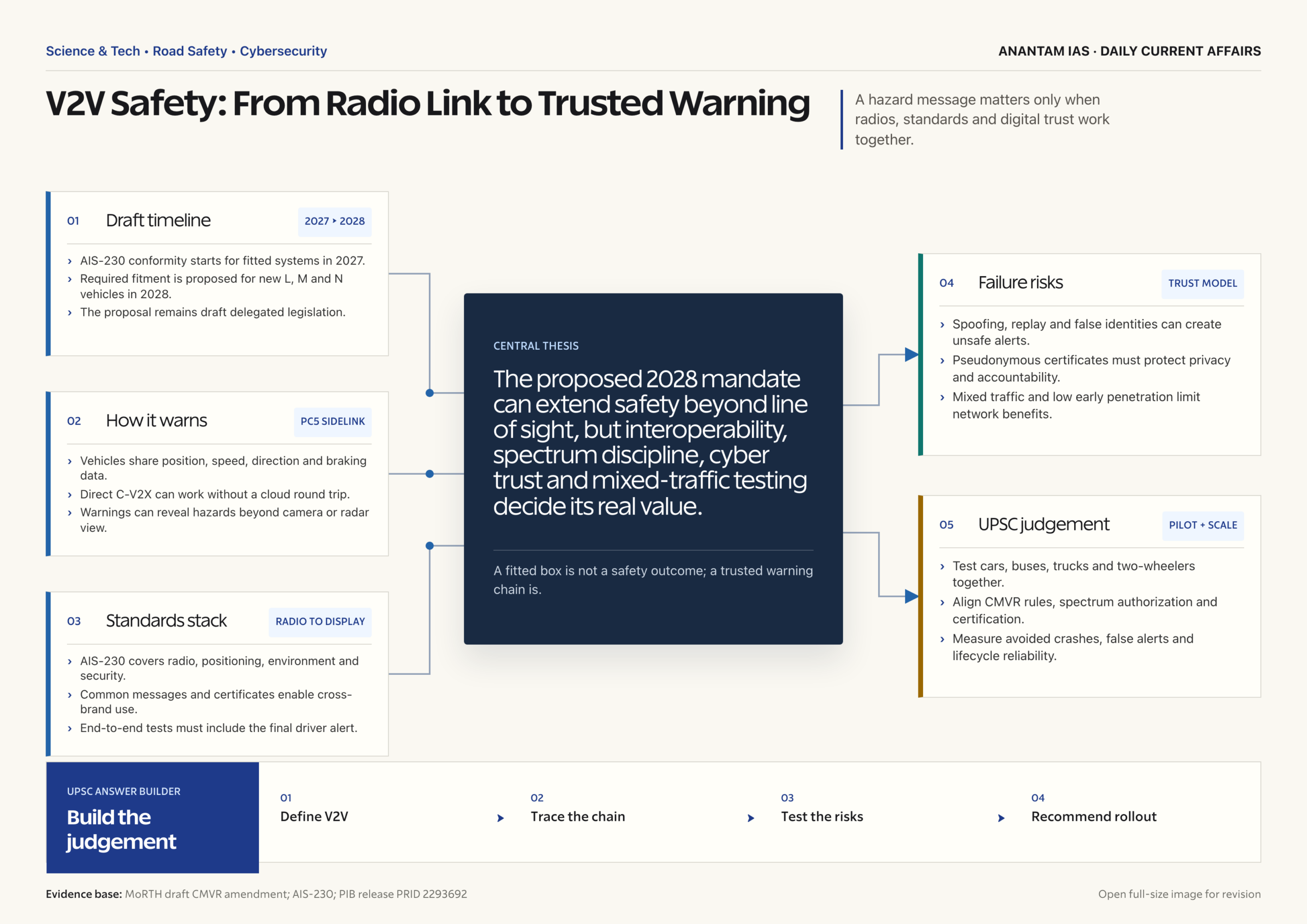
Background and Context
What the Draft Would Legally Change
The proposal separates an initial conformity phase from a later fitment mandate.
- From 1 October 2027, a newly manufactured L, M or N category vehicle would not necessarily have to carry V2V solely because of this phase. If a system is fitted, however, it would have to conform.
- From 1 October 2028, vehicles in those categories manufactured on or after the date would be required to carry a compliant V2V system. This shifts the policy from regulating an optional feature to proposing a standard.
- The formulation uses the vehicle’s manufacture date rather than announcing an immediate obligation for the existing fleet. Any future retrofit requirement would need a clear legal basis, technical feasibility assessment and treatment of old electrical architectures.
- The thirty-day comment period allows manufacturers, component suppliers, telecom bodies, testing agencies and road-user groups to challenge costs, dates or technical assumptions before final rules are issued.
- A strong UPSC answer must preserve the distinction between draft rule, final notification and implementation. A press release explaining a proposal does not by itself complete delegated legislation.
How V2V Communication Works
V2V creates cooperative awareness by letting vehicles broadcast compact safety information to nearby road users.
- An On-Board Unit combines a radio, antenna, computing and security functions with inputs such as GNSS position, speed, direction and acceleration. Nearby units interpret the message against their own movement.
- Direct C-V2X communication uses the PC5 sidelink. A warning can pass directly between vehicles without first reaching a telecom base station or remote cloud, which is important for time-sensitive and coverage-poor situations.
- The Uu interface serves network-linked uses such as cloud services, fleet information and broader traffic coordination. V2V’s direct safety link should not be confused with ordinary mobile-data connectivity or infotainment.
- A car braking sharply over a crest can alert following vehicles before their cameras see it. An approaching ambulance can send an early warning. A wrong-way warning can reach vehicles even when road curvature blocks line.
- V2V does not make a vehicle autonomous. The system may warn a driver or feed an assistance function, while control logic, human factors and liability rules determine whether the vehicle takes any automated action.
AIS-230 and the Standards Stack
Reliable cooperative safety requires far more than assigning a radio band.
- The PIB description says AIS-230 sets minimum technical, functional, performance, environmental and security requirements for V2V systems on Indian roads.
- Radio-performance checks cover output power, frequency stability, receiver sensitivity and selectivity. These limits reduce the risk that a weak receiver misses a warning or a transmitter disrupts another user of the band.
- GNSS and positioning requirements matter because a message is useful only when its time, location and movement data are accurate enough for the receiving vehicle to judge collision risk.
- Electrical, power-supply and electromagnetic-compatibility tests must account for vibration, temperature, voltage changes and the noisy electronic environment inside a vehicle.
- Interoperability needs common radio profiles, message sets, congestion control, certificate formats and compliance tests across brands. A proprietary island would reduce the network effect on which V2V safety depends.
The 5.9 GHz Spectrum Architecture
Two related policy documents describe different parts of the 50 MHz ITS range and should not be merged carelessly.
- The PIB release says AIS-230 covers factory-installed C-V2X units in 5875-5925 MHz, a 50 MHz span considered for V2V and other intelligent-transport applications.
- DoT’s operative G.S.R. 466(E) gives licence-exempt treatment to On-Board Units only in 5875-5905 MHz, a 30 MHz span, subject to technical limits, standards and equipment-type approval.
- TRAI’s April 2026 consultation records the policy approach of using the lower 30 MHz for initial C-V2X deployment and reserving 5905-5925 MHz for future ITS applications and evolving standards.
- Licence exemption lowers deployment friction, but it is not unregulated spectrum. Non-interference and non-protection conditions mean devices cannot demand protection from every other lawful allocation and may be directed to cure harmful interference.
- The remaining policy work includes roadside-unit authorization, interference management, geographical coordination and the relationship between vehicle-only V2V deployment and later V2I infrastructure.
Way Forward
Align the Legal and Technical Layers
- Publish the final CMVR amendment, AIS-230 text, test procedures, approved 3GPP profiles and channel plan as a coherent compliance package.
- Explain how the 50 MHz AIS scope relates to the 30 MHz licence-exempt OBU band and any future use of 5905-5925 MHz.
- Provide transition rules for model approvals, imported vehicles, software updates, component replacement and small-volume manufacturers.
Conclusion
- The draft V2V rules mark a shift from vehicles acting as isolated machines to vehicles participating in a cooperative safety network.
- The 2028 fitment proposal will succeed only if India aligns automotive standards, spectrum rules, cybersecurity and field evidence .
UPSC Practice Questions
Prelims MCQ 1
With reference to India’s proposed Vehicle-to-Vehicle communication framework, consider the following statements:
- The proposal requires L, M and N category vehicles manufactured on or after 1 October 2028 to be fitted with V2V systems conforming to AIS-230.
- DoT’s G.S.R. 466(E) provides licence-exempt use for qualifying C-V2X On-Board Units in the 5875-5905 MHz band.
- The licence exemption gives each approved On-Board Unit exclusive and interference-protected use of the band.
How many of the above statements are correct?
(a) Only one (b) Only two (c) All three (d) None
Answer: (b) Only two
Explanation:
Statements 1 and 2 are correct. G.S.R. 466(E) permits qualifying OBU use on a non-interference, non-protection and non-exclusive basis, so Statement 3 is incorrect. The 2028 requirement is still part of a draft proposal pending final notification.
Prelims MCQ 2
Which one of the following correctly describes the PC5 interface in C-V2X?
(a) A satellite-only link used to update navigation maps (b) A direct sidelink that can carry nearby V2V or V2I communication without routing it through a cellular network (c) A legal portal for granting equipment-type approval (d) A radar band reserved only for autonomous braking
Answer: (b) A direct sidelink that can carry nearby V2V or V2I communication without routing it through a cellular network
Explanation:
PC5 is the 3GPP direct sidelink used by C-V2X for nearby communication, including V2V and V2I. The Uu interface connects a vehicle through the cellular network for V2N and cloud-linked services.
UPSC Mains Questions
- India’s proposed V2V mandate is as much a governance and cybersecurity project as it is an automotive-safety rule. Discuss. (250 words)
- Explain how C-V2X can complement onboard vehicle sensors in reducing road-accident risk. What limitations should guide its phased deployment in India? (250 words)
Sources: PIB, Ministry of Road Transport and Highways and Telecom Regulatory Authority of India.
Frequently Asked Questions
Has India already made V2V communication mandatory?
No. MoRTH has issued draft amendments. The proposal sets AIS-230 conformity from 1 October 2027 for systems that are fitted and mandatory fitment from 1 October 2028 for L, M and N category vehicles manufactured from that date. Comments must.
What is the difference between V2V, V2X and C-V2X?
V2V describes communication between nearby vehicles. V2X is the broader set covering vehicles, infrastructure, pedestrians and networks. C-V2X is the 3GPP cellular technology family used to support those links, including direct PC5 communication and network-linked Uu communication.
What is AIS-230?
AIS-230 is the proposed Automotive Industry Standard for factory-installed V2V systems on Indian roads. PIB says it covers radio performance, positioning, electrical supply, environmental performance, electromagnetic compatibility, cybersecurity, communication security and road-safety applications such as emergency-brake and wrong-way warnings.
Which spectrum is available for C-V2X On-Board Units?
DoT’s G.S.R. 466(E) permits qualifying licence-exempt OBU operation in 5875-5905 MHz under technical and equipment-approval conditions. The wider policy and AIS discussion covers 5875-5925 MHz, with the upper 20 MHz retained for future ITS requirements in the approach recorded by.
Can V2V work without mobile-network coverage?
Yes, direct C-V2X communication can use the PC5 sidelink between nearby vehicles without routing the message through a telecom base station. Network-linked V2N services use the Uu interface. Reliable operation still depends on compatible radios, spectrum conditions, positioning, certificates and.
Source: https://anantamias.com/current-affairs/vehicle-to-vehicle-communication-draft-rules/
Supreme Court Judge Strength Bill Raises Sanctioned Capacity to 38
Why in News?
On 3 August 2026 , the Lok Sabha passed the Supreme Court (Number of Judges) Amendment Bill, 2026, which amends the 1956 Act and retains a ceiling of 37 judges other than the Chief Justice of India .
- The Bill was introduced in the Lok Sabha on 20 July 2026 and passed by that House on 3 August 2026.
- Clause 2 substitutes “thirty-seven” for “thirty-three” in Section 2 of the Supreme Court (Number of Judges) Act, 1956. Both figures exclude the Chief Justice of India.
- The change raises the statutory ceiling from 34 to 38 in total, an addition of four possible judgeships.
- The Bill is deemed to have come into force on 16 May 2026, the date on which the President promulgated the corresponding Ordinance under Article 123.
- Its repeal-and-savings clause repeals the 2026 Ordinance but preserves actions already taken under the Act as amended by that Ordinance.
- The Bill’s Statement of Objects and Reasons records 92,101 pending cases in the Supreme Court on 1 January 2026.
- In 2025, the Court received 75,410 fresh matters and disposed of 65,615, leaving a gap of 9,795 matters for that year despite operating near its then-sanctioned capacity.
- A larger bench can improve listing capacity and allow the Chief Justice of India to constitute Constitution Benches more regularly, but sanctioned posts are not the same as filled posts.
UPSC Relevance
Prelims Relevance
- Article 124(1) establishes the Supreme Court and allows Parliament by law to prescribe a larger number of judges besides the Chief Justice of India.
- The Supreme Court (Number of Judges) Act, 1956 fixes the maximum number of judges other than the Chief Justice of India.
- The 2026 Bill changes the statutory figure from 33 to 37 excluding the CJI; the corresponding total is 38 including the CJI.
- Article 123 empowers the President to promulgate an Ordinance except when both Houses of Parliament are in session, if immediate action is considered necessary.
- An Ordinance must be laid before both Houses and, unless replaced or otherwise ended, ceases after the constitutionally prescribed period following Parliament’s reassembly.
- The Bill’s commencement clause is retrospective to 16 May 2026, while its savings clause validates continuity of action under the Ordinance.
Mains Relevance
GS Paper 2
- Structure, organisation and functioning of the judiciary, especially Parliament’s role in fixing Supreme Court strength under Article 124(1).
- Separation of powers: the legislature authorises capacity, the executive participates in appointment and infrastructure, and the judiciary controls roster and adjudication.
GS Paper 2 Governance
- Institutional capacity should combine filled vacancies, registry reform, case-flow management, digital systems, government litigation reform and transparent performance data.
- Use the 2025 institution-disposal gap to show why increasing inputs must be paired with procedural reform and measurable outcomes.
Essay
- Justice delayed is justice denied: institutional capacity is a constitutional governance issue, not merely an administrative statistic.
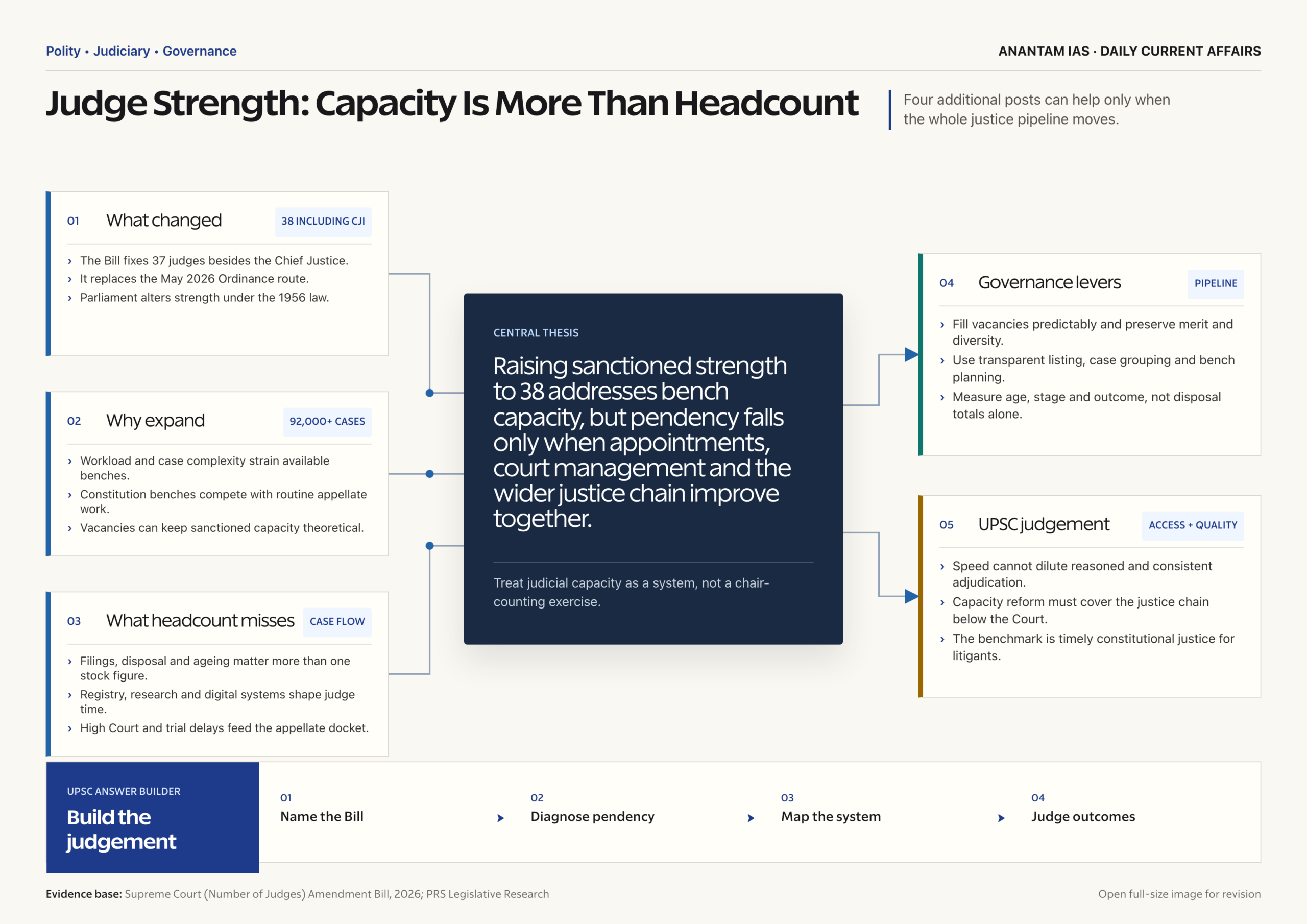
Background and Context
What the Bill changes and what it does not
The amendment is short in text but its arithmetic is often reported in two different ways.
- Section 2 of the 1956 Act counts only judges other than the Chief Justice of India. Replacing 33 with 37 raises the total authorised bench from 34 to 38 when the CJI is included.
- The Bill creates four additional posts, not five. A report saying “37 judges” may be referring to puisne judges only, while a report saying “38 judges” is counting the entire Court.
- The May 2026 Ordinance had already made the same substitution. The May Ordinance background note explains the immediate executive measure; the present Bill supplies the parliamentary replacement route.
- The Bill does not change judicial qualifications, tenure, retirement age, removal procedure or the appointments mechanism. It changes only the maximum statutory number under the 1956 Act.
- It also does not guarantee that all 38 positions will remain occupied. Each vacancy still requires a separate appointment, and retirements can reduce working strength even when the sanctioned ceiling stays unchanged.
Constitutional route: Parliament, Ordinance and appointment
Three distinct constitutional acts must not be collapsed into one: fixing capacity, temporarily legislating through an Ordinance and appointing individual judges.
- Article 124(1) permits Parliament to prescribe by law the number of Supreme Court judges in addition to the CJI. An ordinary amendment to the 1956 Act is sufficient; a constitutional amendment is not required merely.
- The President promulgated the Ordinance on 16 May 2026 under Article 123 because Parliament was not in session. The Gazette text substituted 37 for 33 and brought the change into force at once.
- The Bill is deemed effective from that same date, repeals the Ordinance and saves actions taken under it. This design prevents a legal break between the temporary ordinance regime and the eventual Act.
- Passing the Bill in the Lok Sabha is one stage, not final enactment. It must pass the Rajya Sabha and receive presidential assent before it becomes law in the ordinary legislative process.
- Article 124(2) concerns appointment to an authorised post. The judicial appointments explainer covers the collegium, executive processing and the distinction between institutional independence and administrative delay.
Why the government sought four more posts
The Bill’s own statement presents a capacity problem measured through pendency, filings, disposal and larger-bench requirements.
- The official baseline is 92,101 pending cases on 1 January 2026. This dated figure is preferable in an exam answer to an undated live-dashboard number, because NJDG totals change continuously.
- During 2025, 75,410 fresh matters were instituted and 65,615 were disposed of. The resulting 9,795-matter gap shows that a near-full bench did not stop the docket from growing that year.
- The Statement of Objects and Reasons specifically identifies older cases and matters requiring larger Benches as pressure points.
- Article 145(3) requires a bench of at least five judges for a substantial constitutional-interpretation question or an Article 143 presidential reference. Additional capacity can make it easier to run such benches while regular division benches continue.
- The financial memorandum estimates about ₹10.57 crore in recurring annual expenditure and ₹3.47 crore in non-recurring expenditure for four judges, staff, residences, vehicles, furnishing and security, around ₹14.04 crore in the initial stated package.
Why more judges may help but cannot be the whole reform
Judge strength is a necessary capacity input; disposal also depends on how cases enter, move through and leave the Court.
- More filled posts can create additional benches, distribute workload and protect time for Constitution Benches. That is the clearest direct benefit of the amendment.
- A seat on paper produces no hearing capacity until it is filled. Appointment timelines, retirement planning and administrative support must keep working strength close to sanctioned strength.
- The institution-disposal gap also reflects case-flow design: listing practices, repeated adjournments, incomplete filings, batch management, judgment writing time and registry processes influence output.
- Government is a major litigant. Better screening of appeals, acceptance of settled legal positions and accountable litigation officers can prevent avoidable cases from reaching the apex court.
- The judicial pendency analysis places Supreme Court capacity within the much larger court system. Reform at the apex cannot substitute for filling vacancies and improving processes in High Courts and district courts.
Way Forward
Fill and support the authorised posts
- Use advance vacancy calendars and timely collegium-executive processing so retirements do not reopen a persistent gap.
- Provide the four posts with adequate judicial clerks, research support, registry staff, courtrooms, secure digital infrastructure and administrative services.
- Publish age-wise and stage-wise pendency, identify cases awaiting only a narrow procedural step and list old matters through stable cause-list plans.
- Use grouping for cases governed by the same legal issue, stricter adjournment norms and early defect curing without compromising fair hearing.
Conclusion
- The Supreme Court (Number of Judges) Amendment Bill, 2026 gives Parliament’s backing to a four-post expansion first made through the May Ordinance.
- The expansion responds to real docket pressure and can support more benches, including Constitution Benches.
UPSC Practice Questions
Prelims MCQ 1
With reference to the constitutional and statutory framework governing the strength of the Supreme Court of India, consider the following statements:
- Article 124(1) permits Parliament by law to prescribe a larger number of Supreme Court judges besides the Chief Justice of India.
- The number specified in Section 2 of the Supreme Court (Number of Judges) Act, 1956 includes the Chief Justice of India.
- An increase in sanctioned strength automatically appoints judges to every newly authorised post.
How many of the above statements are correct?
(a) Only one (b) Only two (c) All three (d) None
Answer: (a) Only one
Explanation:
Statement 1 is correct. Section 2 fixes the number of judges excluding the CJI, so Statement 2 is incorrect. The statutory ceiling only authorises posts; each judge still requires appointment under Article 124(2), making Statement 3 incorrect.
Prelims MCQ 2
What is the most accurate description of the Supreme Court (Number of Judges) Amendment Bill, 2026 as passed by the Lok Sabha?
(a) It raises the Court from 37 total judges to 38 total judges for the first time (b) It replaces the May 2026 Ordinance, retains 37 judges excluding the CJI and saves actions taken under the Ordinance (c) It amends the Constitution to create a permanent seven-judge Constitution Bench (d) It directly appoints four named judges to the Supreme Court
Answer: (b) It replaces the May 2026 Ordinance, retains 37 judges excluding the CJI and saves actions taken under the Ordinance
Explanation:
The Bill substitutes 37 for 33 in the 1956 Act, with the statutory number excluding the CJI. It is deemed effective from 16 May 2026, repeals the Ordinance and contains a savings clause. It neither amends the Constitution nor appoints individual judges.
UPSC Mains Questions
- Increasing the sanctioned strength of the Supreme Court is necessary but insufficient to resolve judicial pendency. Discuss with reference to the Supreme Court (Number of Judges) Amendment Bill, 2026.
- Explain the distinct constitutional roles of Parliament, the President and the judiciary in expanding and filling the Supreme Court’s sanctioned strength. Why does this distinction matter for separation of powers?
Sources: PRS Legislative Research and Lok Sabha Bill text and The Hindu.
Frequently Asked Questions
Does the 2026 Bill set the Supreme Court’s strength at 37 or 38?
Both numbers describe different counts. The Bill fixes a maximum of 37 judges excluding the Chief Justice of India under Section 2 of the 1956 Act. Adding the CJI produces a total sanctioned strength of 38. The amendment creates four.
Did the August Bill add another judge after the May Ordinance?
No. The May 2026 Ordinance had already substituted 37 for 33 in the Act, excluding the CJI. The Bill replaces that temporary Ordinance through Parliament and preserves actions taken under it. It maintains the same four-post increase and does not.
Which constitutional provision lets Parliament change Supreme Court strength?
Article 124(1) establishes the Court and allows Parliament by law to prescribe a larger number of judges besides the CJI. Parliament exercises that power through the Supreme Court (Number of Judges) Act, 1956 and its amendments. A constitutional amendment is.
Why was an Ordinance used before the Bill?
Article 123 permits the President to promulgate an Ordinance except when both Houses are in session, if circumstances require immediate action. The 16 May 2026 Ordinance brought the four-seat increase into force at once. The later Bill follows the parliamentary.
Will four additional posts automatically reduce Supreme Court pendency?
They can create more benches and protect time for larger constitutional benches, but only after appointments and support systems are in place. Pendency also depends on filings, adjournments, registry processes, case grouping, government appeals and disposal rates. The Bill adds.
Source: https://anantamias.com/current-affairs/supreme-court-judge-strength-bill-2026/
Birth and Death Registration Bill: Stricter Scrutiny for Delayed Records
Why in News?
The Lok Sabha passed the Registration of Births and Deaths (Amendment) Bill, 2026 , which amends Section 13(3) of the Registration of Births and Deaths Act, 1969.
- For a birth or death reported after one year but within two years, registration will require an order of the District Magistrate, Sub-Divisional Magistrate, or an Executive Magistrate authorised by the District Magistrate.
- For a delay of more than two years, registration will require an order of a Judicial Magistrate of the First Class after verification of the event and payment of the prescribed fee.
- The existing law places all delays beyond one year before a District Magistrate, Sub-Divisional Magistrate, or authorised Executive Magistrate; the Bill adds judicial scrutiny only for the older cases.
- The government presents the change as a way to encourage timely reporting and strengthen scrutiny of delayed entries, which can affect identity-linked public records.
- The Hindu editorial noted that the Lok Sabha passage occurred without substantive debate and urged the Rajya Sabha to examine whether the added burden is supported by evidence and adequate safeguards.
- A birth or death certificate is not a routine receipt. It records a vital event and can become foundational evidence for age, place of birth, family claims, public-health statistics, and access to services.
- The policy problem has two sides: fabricated delayed entries can corrupt identity systems, while a costly court process can exclude people whose records are missing because of remoteness, migration, disaster, poverty, or weak administrative reach.
- The UPSC answer-building lens is assurance with accessibility: improve verification without making the absence of old paperwork a permanent barrier to legal identity.
UPSC Relevance
Prelims Relevance
- The parent law is the Registration of Births and Deaths Act, 1969, a central law for compulsory civil registration and vital statistics.
- Registration of births and deaths falls in the Concurrent List under Entry 30: vital statistics, including registration of births and deaths.
- Under Section 13(1), an event reported after the prescribed period but within 30 days may be registered on payment of the prescribed late fee.
- Under Section 13(2), a delay beyond 30 days but within one year requires written permission of the District Registrar or another prescribed authority, a prescribed fee, and a self-attested document in the prescribed form and manner.
- The 2026 Bill changes the authority under Section 13(3) for registrations delayed beyond two years; it does not replace the ordinary local Registrar.
- The Registrar General of India functions under the Union framework, while Chief Registrars, District Registrars, and local Registrars form the registration establishment in States and Union Territories.
Mains Relevance
GS Paper 2
- Assess the Bill through governance, due process, access to documentation, and Centre-State administrative capacity.
- Examine whether judicial scrutiny is a proportionate response to fraud risk when the government has not publicly established why the risk sharply changes after two years.
GS Paper 2: Social Justice
- Discuss the disproportionate burden on people in remote areas, migrants, homeless persons, disaster-affected families, older persons, and communities with historically weak documentation.
- Use the principle that procedural assurance must not become substantive exclusion, especially when one certificate unlocks several public and private services.
Essay
- A state gains legitimacy not only by preventing false inclusion, but also by ensuring that genuine people are not made invisible by missing paperwork.
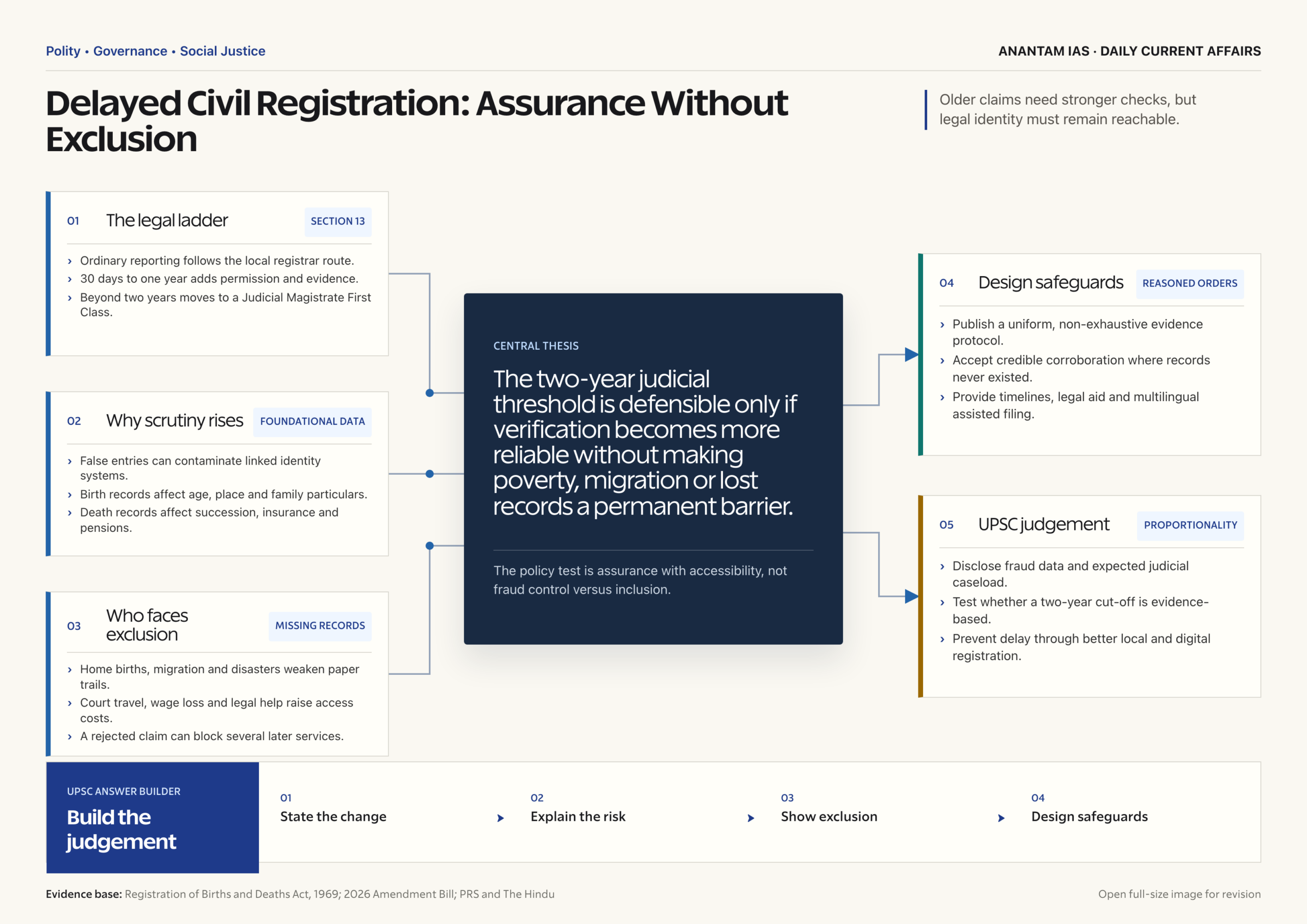
Background and Context
How Civil Registration Works
Civil registration continuously records vital events, while the statistical system converts those records into evidence for public policy.
- The 1969 Act creates a hierarchy led by the Registrar General of India, followed by State-level Chief Registrars, District Registrars, and Registrars for local registration areas.
- Persons responsible for reporting vary with the place of occurrence: for example, the head of a household, the person in charge of an institution, or another legally specified informant may carry the duty.
- Registration establishes an official record of the event. Certificates extracted from that record support proof of facts such as date and place of birth or the recorded death.
- Complete and timely records improve denominators and trends used for fertility, mortality, maternal and infant health, local planning, and emergency response.
The Existing Ladder for Delayed Registration
Section 13 already applies progressively stronger checks as the delay grows.
- The ordinary reporting period is prescribed through rules; the widely used civil-registration framework expects reporting within 21 days of occurrence.
- After the ordinary period but within 30 days, the Registrar may record the event on payment of the prescribed late fee.
- After 30 days but within one year, written permission of the District Registrar or prescribed authority is required along with the prescribed fee and self-attested supporting document.
- Under the law currently reflected in India Code, every case delayed beyond one year goes to the District Magistrate, Sub-Divisional Magistrate, or an authorised Executive Magistrate with territorial jurisdiction, who must verify the event before ordering.
What the 2026 Bill Changes
The amendment divides the existing beyond-one-year category into two bands.
- The one-to-two-year band remains with the District Magistrate, Sub-Divisional Magistrate, or authorised Executive Magistrate.
- The beyond-two-year band moves to a Judicial Magistrate of the First Class, creating an independent judicial checkpoint before the Registrar can make the entry.
- The competent authority must verify the correctness of the asserted birth or death, and the applicant must pay the prescribed fee.
- The Bill targets the approval authority and threshold. Reports on the text do not identify a new statutory schedule of evidence for proving an old event, which makes implementation rules and reasoned orders especially important.
Why Delayed Records Need Careful Verification
A false civil-registry entry can travel across multiple systems because later documents may rely on it.
- A fabricated birth entry may distort age, parentage, or place-of-birth claims and can affect school records, identity documents, recruitment eligibility, electoral databases, or inheritance disputes.
- A fabricated or inaccurate death entry can affect succession, insurance, pensions, property claims, criminal inquiries, and population statistics.
- The 2023 amendment increased the operational importance of the birth certificate for people born after its commencement and strengthened digital data exchange, raising the cost of an erroneous foundational entry.
- Judicial scrutiny can add independence and a formal evidentiary process, but its value depends on clear standards, speaking orders, record preservation, and protection against forged supporting documents.
Way Forward
Publish an Evidence-Based Justification
- Release anonymised data on delayed applications, detected fraud, rejection grounds, geographic concentration, and the expected judicial caseload.
- Compare the chosen design with less burdensome options such as specialist verification units, risk-based audits, stronger document authentication, or mandatory reasoned executive orders.
- List acceptable contemporaneous and corroborative material, including health, vaccination, school, burial, family, local-body, disaster-relief, and institutional records, subject to authenticity checks.
- Permit credible witness evidence and cross-verification where conventional documents never existed, while imposing penalties for forged evidence or false testimony.
Conclusion
- The 2026 Bill addresses a real governance concern: a delayed and false foundational record can contaminate several connected systems.
- A durable reform should combine accurate verification, accessible procedure, reasoned decisions, and prevention of delay .
UPSC Practice Questions
Prelims MCQ 1
With reference to delayed registration under the Registration of Births and Deaths Act, 1969 and the 2026 Amendment Bill, consider the following statements:
- A delay beyond 30 days but within one year requires written permission of the District Registrar or another prescribed authority.
- The 2026 Bill requires every delayed registration, including a delay of less than 30 days, to be approved by a Judicial Magistrate of the First Class.
- The 2026 Bill places registrations delayed beyond two years before a Judicial Magistrate of the First Class.
How many of the above statements are correct?
(a) Only one (b) Only two (c) All three (d) None
Answer: (b) Only two
Explanation:
Statements 1 and 3 are correct. The judicial route applies to registrations delayed beyond two years, not to every late report. The earlier bands continue to use the Registrar or designated administrative authority subject to the statutory conditions.
Prelims MCQ 2
Which one of the following is the most accurate statement about a birth certificate issued under the Registration of Births and Deaths Act, 1969?
(a) It is by itself conclusive proof of Indian citizenship in every case. (b) It proves only parentage and has no relevance to date or place of birth. (c) It records a vital event and may prove date and place of birth for specified purposes, but citizenship is governed separately. (d) It may be issued only by the Registrar General of India.
Answer: (c) It records a vital event and may prove date and place of birth for specified purposes, but citizenship is governed separately.
Explanation:
The civil-registration certificate records the registered event and its particulars. The 2023 amendment assigns the birth certificate a specified proof function for persons born after its commencement, but the certificate does not independently determine citizenship.
UPSC Mains Questions
- The credibility of civil registration and the accessibility of legal identity are complementary governance goals, not competing choices. Discuss in the context of the Registration of Births and Deaths (Amendment) Bill, 2026. (250 words)
- Judicialising delayed birth and death registration may improve scrutiny, but it can also deepen exclusion unless supported by clear evidence standards and accessible procedure. Critically examine. (250 words)
Sources: The Hindu and India Code, Registration of Births and Deaths Act, 1969.
Frequently Asked Questions
What does the Registration of Births and Deaths (Amendment) Bill, 2026 change?
It divides registrations delayed beyond one year into two bands. Delays from one to two years remain with the District Magistrate, Sub-Divisional Magistrate, or authorised Executive Magistrate. A delay beyond two years requires verification and an order from a Judicial.
Has the 2026 Bill become law?
As of August 4, 2026, the Bill had passed the Lok Sabha and still required consideration and passage by the Rajya Sabha, followed by presidential assent, before becoming an Act. Its provisions should be described as proposed law until those.
Why does the government want stricter scrutiny of delayed records?
The stated aims are to encourage timely reporting and strengthen the reliability of delayed registrations. A false foundational entry can affect connected records and claims. The key scrutiny question is whether a two-year threshold and mandatory judicial route are supported.
Can a birth certificate alone prove Indian citizenship?
No. A birth certificate records the fact, date, and place of a registered birth and serves as proof for specified purposes under the 1969 Act. Citizenship depends on the Constitution and the Citizenship Act, 1955, including the law applicable on.
Who may be disadvantaged by a court-based delayed-registration process?
People with the weakest documentation may face the highest burden: remote and migrant families, homeless persons, older people, home-born persons, and communities affected by disaster or conflict. Travel, legal assistance, wage loss, language barriers, and uncertainty can turn a verification.
Source: https://anantamias.com/current-affairs/birth-death-delayed-registration-bill-2026/