The Gyan Bharatam Mission is a flagship central scheme announced in the Union Budget 2025–26, aimed at the survey, documentation, digitisation, and conservation of India’s manuscript heritage. The Finance Minister estimated that the country holds more than 1 crore (10 million) manuscripts — the largest repository of handwritten knowledge in the world — covering subjects from astronomy and medicine to grammar, philosophy, logic, and literature, written in languages ranging from Sanskrit and Prakrit to Tamil, Pali, Persian, Arabic, and regional scripts. The mission aims to transform these scattered archives into a searchable national digital corpus under the Ministry of Culture, working with academic and institutional partners. For UPSC aspirants, Gyan Bharatam sits at the intersection of governance, culture, and Indian Knowledge Systems (IKS) — a recurring theme in recent Mains papers.
Announcement and Institutional Framing
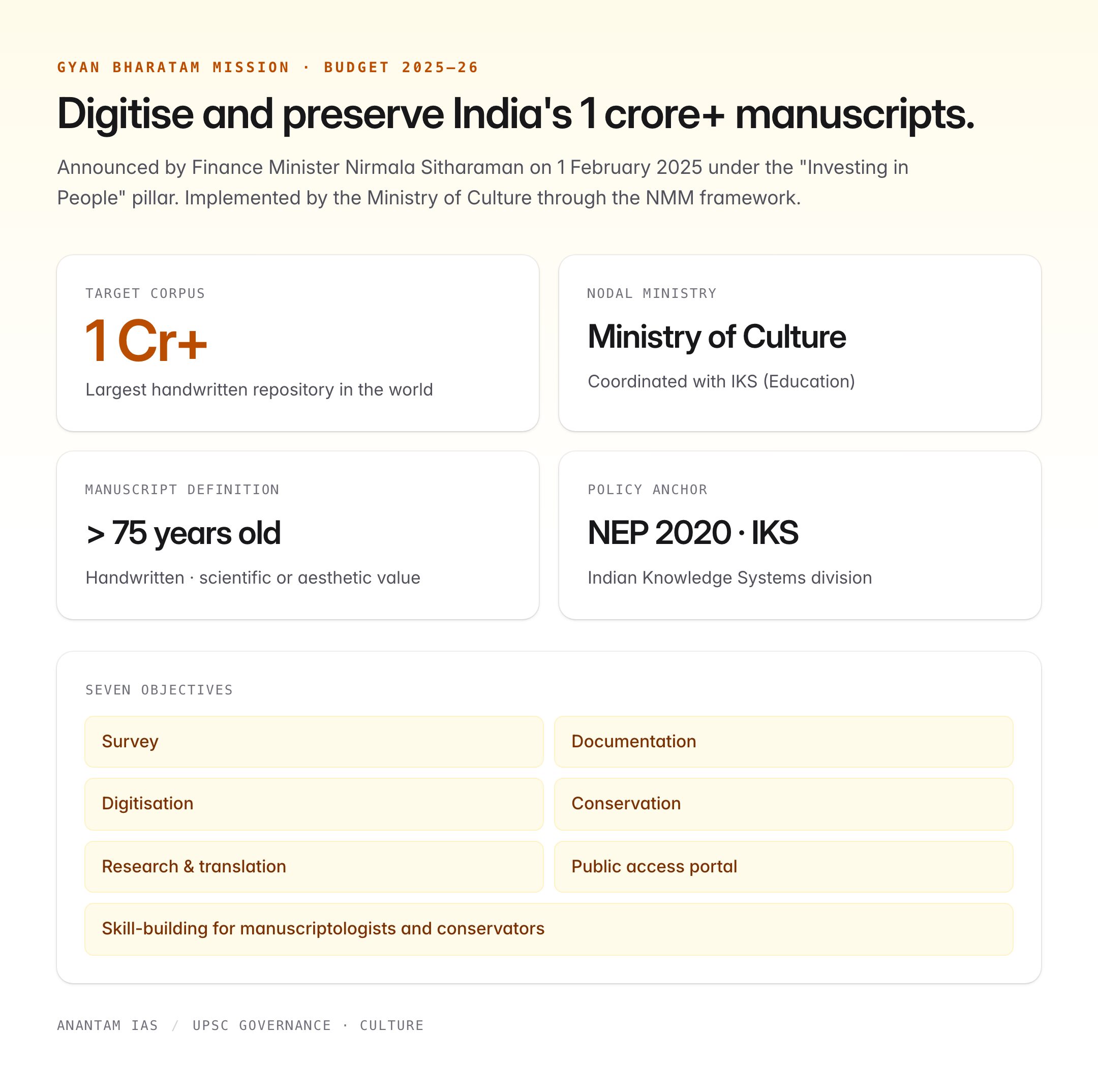
The mission was announced by Finance Minister Nirmala Sitharaman in her Union Budget 2025–26 speech on 1 February 2025 under the "Investing in People" pillar. It builds upon — and substantially upgrades — the earlier National Mission for Manuscripts (NMM) established in 2003. The 2025 announcement commits budgetary support for:
- Academic and conservation partnerships with museums, universities, libraries, and private collectors.
- A National Digital Repository for manuscripts.
- Capacity building of manuscriptologists and conservators.
- Outreach through Indian Knowledge Systems (IKS) in higher education.
The mission is implemented by the Ministry of Culture through the National Mission for Manuscripts (NMM) framework, and in coordination with the Indian Knowledge Systems (IKS) division of the Ministry of Education under NEP 2020.
Key Objectives
| Objective | Intended Outcome |
|---|---|
| Survey | Identify manuscripts in private and institutional custody |
| Documentation | Create a national-level inventory and metadata catalogue |
| Digitisation | Produce high-resolution digital scans of 1 crore+ manuscripts |
| Conservation | Physical preservation through climate-controlled facilities |
| Research & translation | Support critical editions, translations, and scholarly use |
| Public access | Open-access digital portal for scholars, institutions, citizens |
| Skill-building | Train manuscriptologists, palaeographers, conservators |
What Is a Manuscript?
As per the NMM guidelines, a manuscript is defined as a handwritten document in any script, of significant scientific, historical, or aesthetic value, that is more than 75 years old. Printed material, government records, and epigraphs are excluded. Manuscripts survive in India on palm leaf, birch bark, paper, cloth, copper, and agarwood — with palm leaf and paper being dominant.
India's Manuscript Wealth: Scale and Spread
Estimates range between 50 lakh and 1 crore manuscripts within India, with additional several lakhs in foreign collections (British Library, Berlin State Library, Kyoto, Paris BnF, Oxford's Bodleian, among others). India's manuscripts are distributed across:
- Institutional collections: Asiatic Society (Kolkata), Bhandarkar Oriental Research Institute (Pune), Oriental Research Institute Mysuru, Adyar Library (Chennai), Kerala University Manuscripts Library, Rampur Raza Library, Khuda Bakhsh Library (Patna), Jain and Buddhist monastic archives.
- Private custody: Brahmin families, Jain bhandars, Sikh gurdwaras, Sufi khanqahs, temple treasuries.
- Regional languages: Tamil palm-leaf Sangam corpus, Oriya palm leaves, Bengali puthi, Kashmiri Sharada script manuscripts.
Gyan Bharatam Mission vs National Mission for Manuscripts 2003
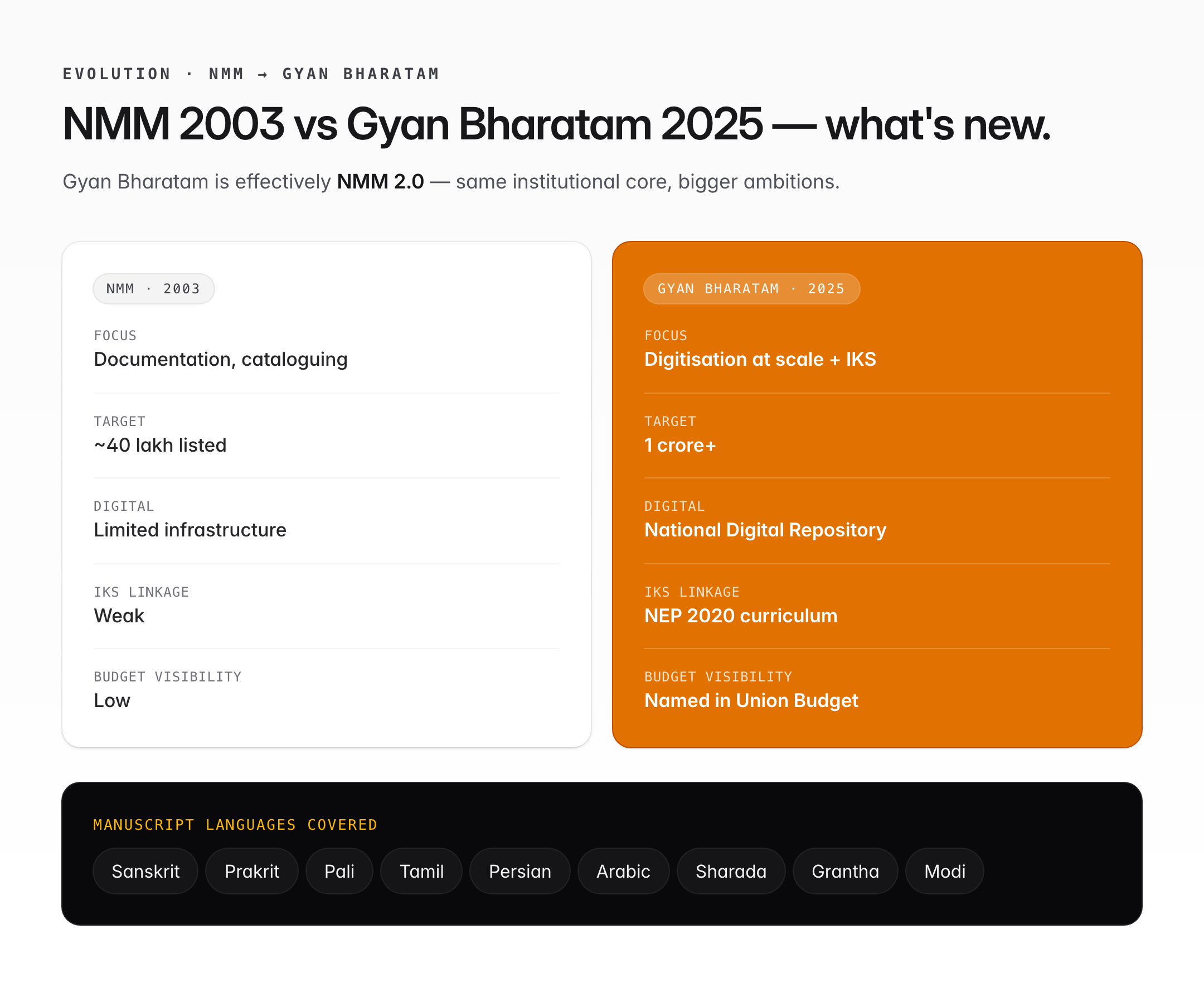
| Feature | NMM (2003) | Gyan Bharatam Mission (2025) |
|---|---|---|
| Launch | 2003 | 2025 |
| Parent | Ministry of Culture | Ministry of Culture |
| Focus | Documentation, cataloguing | Digitisation at scale + IKS integration |
| Target | ~40 lakh listed | 1 crore+ |
| Digital infrastructure | Limited | National Digital Repository |
| Collaboration | Government | Government + academia + private |
| IKS linkage | Weak | NEP 2020 / IKS curriculum |
| Translation/research | Secondary | Primary |
| Budgetary visibility | Low | Named in Union Budget 2025–26 |
Gyan Bharatam is effectively NMM 2.0 — retaining the 2003 institutional core but expanding it in scale, digital ambition, and policy linkage to the New Education Policy 2020.
Indian Knowledge Systems (IKS) Linkage
The Indian Knowledge Systems division, established in 2020 under the Ministry of Education, promotes traditional Indian knowledge in modern academia. Gyan Bharatam feeds IKS by:
- Making primary sources in Sanskrit, Tamil, Pali, Prakrit, Persian accessible.
- Supporting critical editions for university curricula.
- Funding translation projects into English and Indian languages.
- Building open-access datasets for AI and linguistic research on Indic languages.
This aligns Gyan Bharatam with parallel schemes such as Bhasha Sangam, Project SHAKTI (Sanskrit computational linguistics), PM-USHA in higher education, and the Central Sanskrit Universities Act, 2020.
Technology and Methodology
Manuscript digitisation follows a multi-step protocol:
- Survey: On-site identification by regional centres.
- Condition reporting: Damage, insect infestation, acidification.
- Pre-conservation: Cleaning, de-acidification, stabilisation.
- Digitisation: High-resolution flatbed or book scanners (300–600 dpi colour).
- Metadata creation: Title, author, language, script, subject, date estimate.
- Storage: TIFF master files + derivative PDFs; triple-redundancy backup.
- Online catalogue: Portal with faceted search.
- Physical conservation: Acid-free folders, controlled humidity, UV filtering.
Emerging techniques include multispectral imaging (to read palimpsests), OCR for Indic scripts, and AI-driven script recognition for Grantha, Sharada, Modi, and Bhujimol.
Challenges
| Challenge | Detail |
|---|---|
| Access to private collections | Legal and trust barriers with families, monasteries |
| Fragility | Palm leaf manuscripts degrade rapidly without care |
| Language expertise | Shortage of trained palaeographers, epigraphists |
| Coordination | Overlap between NMM, IGNCA, state archives |
| IP and ethics | Ownership, custodianship, repatriation from foreign holdings |
| Digital standards | Long-term preservation beyond current formats |
| Funding continuity | Multi-year commitment vs annual budgets |
Related Institutions and Schemes
- National Mission for Manuscripts (NMM) — 2003, implementing arm.
- Indira Gandhi National Centre for the Arts (IGNCA) — cultural archive repository.
- National Archives of India (NAI) — official government records (separate from NMM).
- National Mission on Libraries (NML) — 2014, library modernisation.
- Project Mausam — cultural diplomacy with Indian Ocean rim.
- Indian Knowledge Systems (IKS) division — NEP 2020 implementation.
- Central Sanskrit Universities — academic consumers of manuscripts.
International Parallels
Gyan Bharatam can be compared to:
- World Digital Library (UNESCO) — now part of the Library of Congress.
- Europeana — European Union's digital heritage platform.
- Endangered Archives Programme (British Library).
- Digital Hindi Buddhist Canon (DHBC) — Sanskrit Buddhist manuscripts.
- Shuimoge Initiative (China) — bamboo and silk manuscripts.
Such global frameworks provide templates for metadata standards and licensing models (Creative Commons, rights-holder agreements).
UPSC Relevance
Gyan Bharatam Mission is a high-probability current-affairs topic with deep static linkages. For Prelims, remember: announced in Union Budget 2025–26, implemented by the Ministry of Culture through the National Mission for Manuscripts (2003), targeting over 1 crore manuscripts. A probable MCQ distinguishes between the 2003 NMM and the 2025 Gyan Bharatam — they are related, not identical. For GS Paper I (Culture), the mission connects to Indian literary heritage in Sanskrit, Tamil, Pali, Prakrit, and Persian; palm-leaf and birch-bark traditions; and regional schools of philosophy and science (Nalanda, Vikramashila, Kanchi, Madurai, Kashmir Shaivism). For GS Paper II (Governance), it is an example of a centrally sponsored cultural scheme with multi-ministry coordination (Culture + Education + MeitY). For GS Paper III (Science & Technology), it connects to digital preservation, AI-enabled OCR for Indic scripts, and open knowledge commons. In Mains answer-writing, pair Gyan Bharatam with NEP 2020 IKS, PM-USHA, and Bhasha Sangam to demonstrate a unified cultural-education-technology narrative. For Essay, the mission exemplifies how heritage conservation and national capacity building converge — a standard examiner hook.
Tell Google you want more of this.
Add Anantam IAS as a preferred sourceOne tap, and this site shows up more often in your own Top Stories, AI Overviews and AI Mode. Remove it any time.