Why in News?
The Ministry of Culture informed the Lok Sabha that the National Manuscript Survey under the Gyan Bharatam Mission has reported more than 1.19 crore manuscripts across India.
- The survey was launched in March 2026 across all States and Union Territories to identify manuscript holdings, repositories and custodians in diverse languages and scripts.
- The government said no district-wise target had been set for the survey or for physical registration. The reported total is an aggregate of holdings identified by the exercise, not a district quota achieved.
- By 19 March 2026, more than 12.97 lakh manuscripts had been reported. The later figure of more than 1.19 crore shows the rapid expansion of survey returns, but it does not by itself establish that.
- The official reply said that more than eight lakh digitised manuscripts existed across the country and more than 4.40 lakh were available on the Gyan Bharatam portal for public access in view mode.
- The mission uses a network of Cluster Centres and Independent Centres, State and Union Territory nodal authorities, repositories, private custodians and technical partners rather than relying on one central archive.
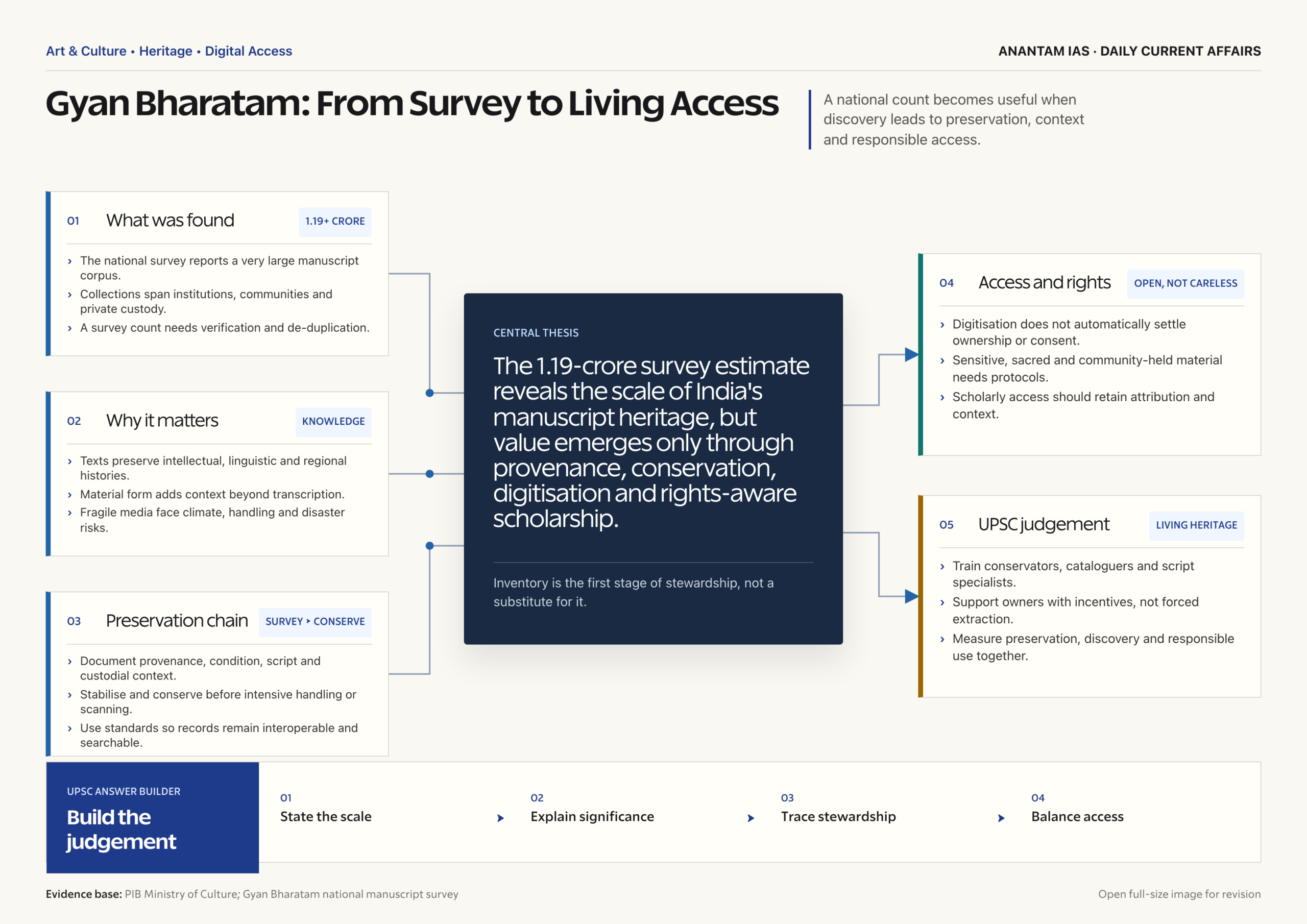
- The 1.19-crore figure measures discovery and reporting. It creates a national baseline from which duplicate records, physical condition, ownership, language, script and conservation priority can be assessed.
- Manuscript policy is not only about scanning old pages. It combines survey, cataloguing, preventive conservation, digitisation, metadata, translation, research and lawful dissemination.
- The survey can reveal holdings in temples, mutts, libraries, universities and private homes that were previously absent from national catalogues, but participation depends on trust with custodians.
UPSC Relevance
Prelims Relevance
- The Gyan Bharatam Mission is a Ministry of Culture initiative announced in the Union Budget 2025-26.
- The National Mission for Manuscripts, established in 2003, was restructured and expanded under the Gyan Bharatam framework.
- The National Manuscript Survey was launched on 16 March 2026 and covers all States and Union Territories.
- An official National Mission for Manuscripts definition treats a manuscript as a handwritten composition at least 75 years old, on paper, bark, cloth, metal, palm leaf or another material, with scientific, historical or aesthetic value.
- Lithographs and printed volumes are not manuscripts under that definition. Manuscripts are also distinct from epigraphs, firmans and routine revenue records because their defining feature is knowledge content.
- A language and a script are not the same: one language may be written in several scripts. Sanskrit manuscripts, for example, can appear in Devanagari, Grantha, Odia and other scripts.
Mains Relevance
GS Paper 1
- Use the survey as evidence of the scale and diversity of India’s manuscript heritage, including material traditions, languages, scripts and knowledge systems.
- Discuss preservation as a chain from identification and documentation to scientific conservation, digitisation, interpretation and public engagement.
GS Paper 2
- Assess the mission as a case of networked cultural governance involving the Union, States, institutions, private custodians, scholars and technology partners.
- Examine how public value must be balanced with ownership, copyright, privacy, ritual sensitivity, community authority and restrictions placed by custodians or rights holders.
Essay
- A civilisation preserves knowledge not by locking it away, but by combining care, context and responsible access.
Background and Context
What the 1.19-Crore Survey Result Actually Means
The new number is best read as an expanded national inventory, not as proof that 1.19 crore manuscripts are already preserved online.
- The survey seeks to identify and document holdings, repositories and custodians. A reported item may still require verification, detailed cataloguing, condition assessment and rights documentation before digitisation begins.
- The government’s earlier goal was to cover more than one crore manuscripts. Reporting more than 1.19 crore indicates that known returns have crossed that planning estimate; it does not impose a ceiling on future discoveries.
- A survey record, a catalogued object, a digitised manuscript and a publicly accessible copy are different administrative states. Collapsing them into one statistic exaggerates implementation progress.
- The count can include institutional and private holdings across multiple repositories. Robust de-duplication is needed because the same text may exist in many physical copies, and the same object may appear in legacy and new databases.
- The earlier Anantam IAS guide on the Gyan Bharatam Mission explains the scheme’s general design. The present development is narrower: it examines the March 2026 survey result and the governance questions created by the newly.
What Qualifies as a Manuscript
A clear definition prevents the survey from becoming a loose count of all old books and records.
- The National Mission for Manuscripts defines a manuscript as a handwritten composition at least 75 years old with significant scientific, historical or aesthetic value.
- The writing surface may be paper, palm leaf, birch bark, cloth, metal or another material. Material diversity changes storage needs: humidity, insects, acidity, light and handling can affect each support differently.
- Lithographs and printed books are excluded from this manuscript definition. Historical records such as inscriptions, royal orders and revenue files also form different documentary categories, though they may be important heritage objects in their own right.
- Manuscripts preserve knowledge in hundreds of languages and scripts. Cataloguing must separately record the work’s language, the script used, title variants, author or scribe where known, physical material, folio count, condition and provenance.
- The number of physical manuscripts is not the same as the number of unique works. Multiple recensions, commentaries, translations and copied versions can show how knowledge travelled and changed across regions.
Mission Scope and Institutional Design
Gyan Bharatam extends beyond a one-time census by creating a distributed preservation and research system.
- The mission covers identification, documentation, conservation, digitisation, research, publication and dissemination, irrespective of script, language, dialect, tradition, community or geographical location.
- Its five verticals connect inventory work with conservation skills, digital infrastructure, language access and scholarship. This reduces the risk that scanning becomes an isolated activity without physical preservation or intellectual description.
- Cluster Centres coordinate activity and capacity across a region or group of institutions, while Independent Centres undertake mission work based on their collections, infrastructure and expertise.
- Partner selection considers collection size and significance, institutional capacity, qualified personnel, infrastructure, regional representation and experience in manuscript work.
- State and Union Territory nodal authorities can coordinate surveys and local institutions, while technical partners support metadata, equipment, AI-enabled platforms and long-term data storage.
From Discovery to Preservation and Digitisation
The responsible workflow begins before a camera is switched on and continues long after an image file is created.
- Survey and registration establish the location, custodian, broad identity and condition of an item. Prioritisation should then consider fragility, uniqueness, research value and disaster risk.
- Preventive conservation controls storage, light, humidity, pests and handling. Curative conservation addresses damage through trained professionals; aggressive cleaning or flattening can destroy evidence embedded in the object.
- Official standards call for non-destructive face-up overhead scanners using cold light, a minimum of 400 DPI in 24-bit colour and 600 DPI where needed.
- Post-processing can include de-skewing, cropping and light equalisation, but colour integrity and the material record must be protected. Manual quality verification remains important even when automated tools assist.
- Preservation masters use TIFF v6.0 with LZW compression; JPEG files serve access needs and PDF/A copies support search. Separating master and access formats prevents convenience copies from replacing archival-quality files.
Way Forward
Audit the Survey Baseline
- Publish methodology notes defining a reported manuscript, verification status, duplicate-handling rules and the difference between physical copies and unique works.
- Use stable identifiers and authority files for repositories, works, authors, languages and scripts so legacy databases can be reconciled without deleting variant knowledge.
- Release aggregate progress dashboards by State, material, language, condition and workflow stage while withholding precise locations of vulnerable private collections where security requires it.
Conclusion
- The report of more than 1.19 crore manuscripts changes the scale of India’s preservation challenge.
- Gyan Bharatam will succeed when each stage remains visible: discovery, verification, conservation, digitisation, metadata, rights clearance, interpretation and access.
UPSC Practice Questions
Prelims MCQ 1
With reference to the Gyan Bharatam Mission, consider the following statements:
- It is an initiative of the Ministry of Culture announced in the Union Budget 2025-26.
- Its National Manuscript Survey covers institutional repositories but excludes manuscripts held by private individuals.
- Survey reporting, digitisation and public availability refer to distinct stages of the manuscript workflow.
How many of the above statements are correct?
(a) Only one (b) Only two (c) All three (d) None
Answer: (b) Only two
Explanation:
Statements 1 and 3 are correct. The survey seeks manuscripts held by institutions, private individuals, scholars, mutts, temples, libraries and other repositories, so Statement 2 is incorrect.
Prelims MCQ 2
Which one of the following best describes a manuscript under the National Mission for Manuscripts definition?
(a) Any printed book more than 75 years old (b) Any inscription on rock that records an event (c) A handwritten composition at least 75 years old with significant scientific, historical or aesthetic value (d) Only a Sanskrit work handwritten on palm leaf
Answer: (c) A handwritten composition at least 75 years old with significant scientific, historical or aesthetic value
Explanation:
The definition is material- and language-inclusive but requires a handwritten composition, a minimum age of 75 years and significant value. Printed volumes and lithographs are excluded.
UPSC Mains Questions
- The Gyan Bharatam survey’s report of more than 1.19 crore manuscripts is a beginning, not a completion metric. Discuss the institutional and technical steps required to convert a national inventory into a durable knowledge resource. (250 words)
- How can India widen digital access to manuscript heritage while respecting custodianship, rights and culturally sensitive knowledge? Suggest a rights-aware governance framework. (250 words)
Sources: PIB, Ministry of Culture and National Mission for Manuscripts, Ministry of Culture.
Frequently Asked Questions
What did the Gyan Bharatam National Manuscript Survey report?
The Ministry of Culture told the Lok Sabha that more than 1.19 crore manuscripts had been reported in the nationwide survey. This is an inventory-stage figure covering identified holdings, repositories and custodians. It does not mean that all reported manuscripts.
When was the National Manuscript Survey launched?
The survey was launched on 16 March 2026 across all States and Union Territories. It aims to identify and document manuscript holdings with institutions, libraries, museums, temples, mutts, scholars, private individuals and other custodians. The government did not set district-wise.
What counts as a manuscript for the mission?
The National Mission for Manuscripts defines it as a handwritten composition at least 75 years old, on paper, bark, cloth, metal, palm leaf or another material, with significant scientific, historical or aesthetic value. Lithographs and printed volumes do not qualify.
Does the 1.19-crore figure mean all manuscripts are online?
No. Survey reporting, detailed cataloguing, conservation, digitisation and public access are different stages. In August 2026, the government reported more than eight lakh digitised manuscripts across the country and more than 4.40 lakh available on the Gyan Bharatam portal.
Who implements the Gyan Bharatam Mission?
The Ministry of Culture leads the mission through a distributed network of Cluster Centres, Independent Centres, State and Union Territory nodal coordinating authorities, participating repositories and technical partners. Centres are selected for factors such as collection significance, capacity, infrastructure, regional.
Tell Google you want more of this.
Add Anantam IAS as a preferred sourceOne tap, and this site shows up more often in your own Top Stories, AI Overviews and AI Mode. Remove it any time.