

Why in News?
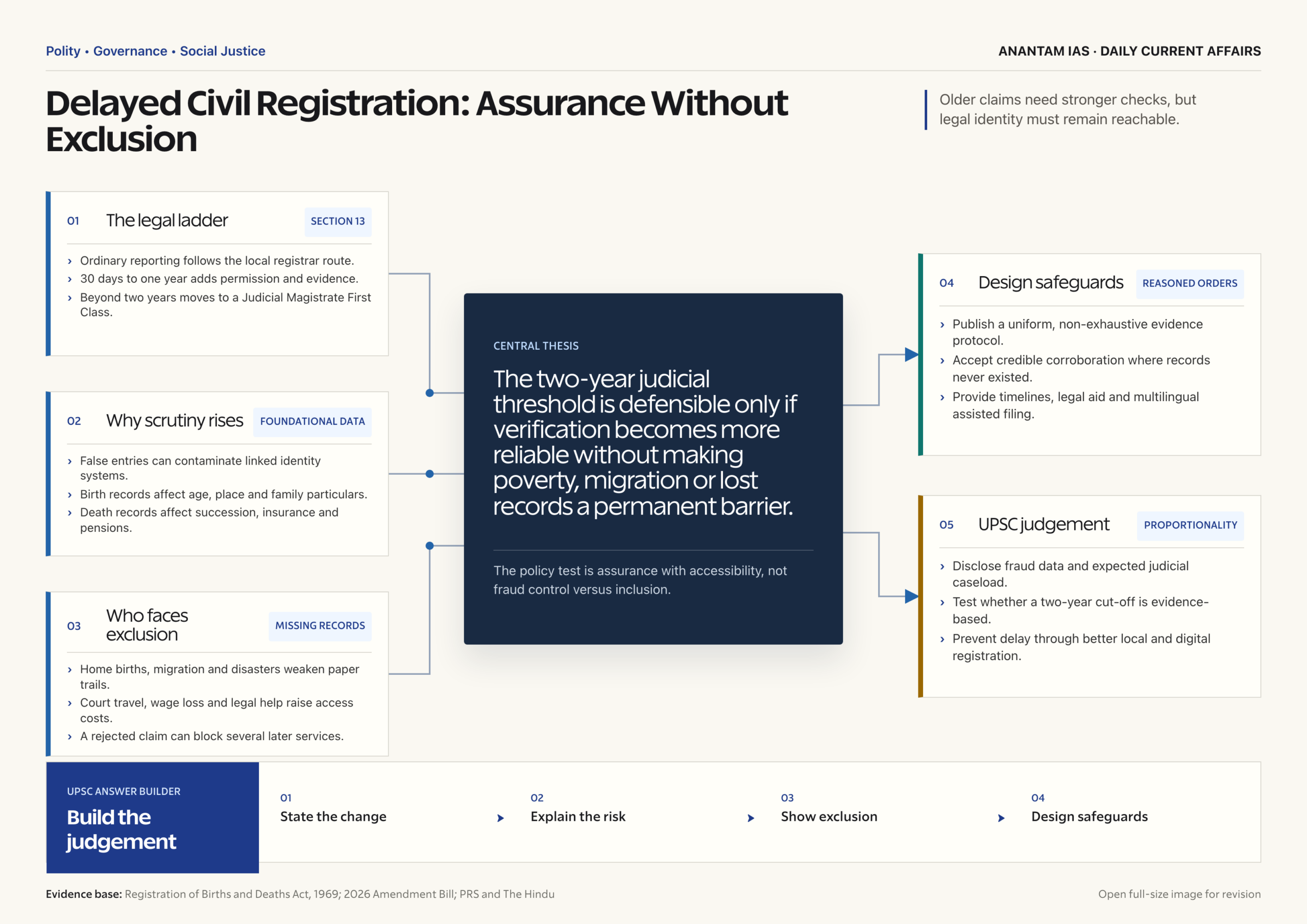
The Lok Sabha passed the Registration of Births and Deaths (Amendment) Bill, 2026 , which amends Section 13(3) of the Registration of Births and Deaths Act, 1969.
- For a birth or death reported after one year but within two years, registration will require an order of the District Magistrate, Sub-Divisional Magistrate, or an Executive Magistrate authorised by the District Magistrate.
- For a delay of more than two years, registration will require an order of a Judicial Magistrate of the First Class after verification of the event and payment of the prescribed fee.
- The existing law places all delays beyond one year before a District Magistrate, Sub-Divisional Magistrate, or authorised Executive Magistrate; the Bill adds judicial scrutiny only for the older cases.
- The government presents the change as a way to encourage timely reporting and strengthen scrutiny of delayed entries, which can affect identity-linked public records.
- The Hindu editorial noted that the Lok Sabha passage occurred without substantive debate and urged the Rajya Sabha to examine whether the added burden is supported by evidence and adequate safeguards.
- A birth or death certificate is not a routine receipt. It records a vital event and can become foundational evidence for age, place of birth, family claims, public-health statistics, and access to services.
- The policy problem has two sides: fabricated delayed entries can corrupt identity systems, while a costly court process can exclude people whose records are missing because of remoteness, migration, disaster, poverty, or weak administrative reach.
- The UPSC answer-building lens is assurance with accessibility: improve verification without making the absence of old paperwork a permanent barrier to legal identity.
UPSC Relevance
Prelims Relevance
- The parent law is the Registration of Births and Deaths Act, 1969, a central law for compulsory civil registration and vital statistics.
- Registration of births and deaths falls in the Concurrent List under Entry 30: vital statistics, including registration of births and deaths.
- Under Section 13(1), an event reported after the prescribed period but within 30 days may be registered on payment of the prescribed late fee.
- Under Section 13(2), a delay beyond 30 days but within one year requires written permission of the District Registrar or another prescribed authority, a prescribed fee, and a self-attested document in the prescribed form and manner.
- The 2026 Bill changes the authority under Section 13(3) for registrations delayed beyond two years; it does not replace the ordinary local Registrar.
- The Registrar General of India functions under the Union framework, while Chief Registrars, District Registrars, and local Registrars form the registration establishment in States and Union Territories.
Mains Relevance
GS Paper 2
- Assess the Bill through governance, due process, access to documentation, and Centre-State administrative capacity.
- Examine whether judicial scrutiny is a proportionate response to fraud risk when the government has not publicly established why the risk sharply changes after two years.
GS Paper 2: Social Justice
- Discuss the disproportionate burden on people in remote areas, migrants, homeless persons, disaster-affected families, older persons, and communities with historically weak documentation.
- Use the principle that procedural assurance must not become substantive exclusion, especially when one certificate unlocks several public and private services.
Essay
- A state gains legitimacy not only by preventing false inclusion, but also by ensuring that genuine people are not made invisible by missing paperwork.
Background and Context
How Civil Registration Works
Civil registration continuously records vital events, while the statistical system converts those records into evidence for public policy.
- The 1969 Act creates a hierarchy led by the Registrar General of India, followed by State-level Chief Registrars, District Registrars, and Registrars for local registration areas.
- Persons responsible for reporting vary with the place of occurrence: for example, the head of a household, the person in charge of an institution, or another legally specified informant may carry the duty.
- Registration establishes an official record of the event. Certificates extracted from that record support proof of facts such as date and place of birth or the recorded death.
- Complete and timely records improve denominators and trends used for fertility, mortality, maternal and infant health, local planning, and emergency response.
The Existing Ladder for Delayed Registration
Section 13 already applies progressively stronger checks as the delay grows.
- The ordinary reporting period is prescribed through rules; the widely used civil-registration framework expects reporting within 21 days of occurrence.
- After the ordinary period but within 30 days, the Registrar may record the event on payment of the prescribed late fee.
- After 30 days but within one year, written permission of the District Registrar or prescribed authority is required along with the prescribed fee and self-attested supporting document.
- Under the law currently reflected in India Code, every case delayed beyond one year goes to the District Magistrate, Sub-Divisional Magistrate, or an authorised Executive Magistrate with territorial jurisdiction, who must verify the event before ordering.
What the 2026 Bill Changes
The amendment divides the existing beyond-one-year category into two bands.
- The one-to-two-year band remains with the District Magistrate, Sub-Divisional Magistrate, or authorised Executive Magistrate.
- The beyond-two-year band moves to a Judicial Magistrate of the First Class, creating an independent judicial checkpoint before the Registrar can make the entry.
- The competent authority must verify the correctness of the asserted birth or death, and the applicant must pay the prescribed fee.
- The Bill targets the approval authority and threshold. Reports on the text do not identify a new statutory schedule of evidence for proving an old event, which makes implementation rules and reasoned orders especially important.
Why Delayed Records Need Careful Verification
A false civil-registry entry can travel across multiple systems because later documents may rely on it.
- A fabricated birth entry may distort age, parentage, or place-of-birth claims and can affect school records, identity documents, recruitment eligibility, electoral databases, or inheritance disputes.
- A fabricated or inaccurate death entry can affect succession, insurance, pensions, property claims, criminal inquiries, and population statistics.
- The 2023 amendment increased the operational importance of the birth certificate for people born after its commencement and strengthened digital data exchange, raising the cost of an erroneous foundational entry.
- Judicial scrutiny can add independence and a formal evidentiary process, but its value depends on clear standards, speaking orders, record preservation, and protection against forged supporting documents.
Way Forward
Publish an Evidence-Based Justification
- Release anonymised data on delayed applications, detected fraud, rejection grounds, geographic concentration, and the expected judicial caseload.
- Compare the chosen design with less burdensome options such as specialist verification units, risk-based audits, stronger document authentication, or mandatory reasoned executive orders.
- List acceptable contemporaneous and corroborative material, including health, vaccination, school, burial, family, local-body, disaster-relief, and institutional records, subject to authenticity checks.
- Permit credible witness evidence and cross-verification where conventional documents never existed, while imposing penalties for forged evidence or false testimony.
Conclusion
- The 2026 Bill addresses a real governance concern: a delayed and false foundational record can contaminate several connected systems.
- A durable reform should combine accurate verification, accessible procedure, reasoned decisions, and prevention of delay .
UPSC Practice Questions
Prelims MCQ 1
With reference to delayed registration under the Registration of Births and Deaths Act, 1969 and the 2026 Amendment Bill, consider the following statements:
- A delay beyond 30 days but within one year requires written permission of the District Registrar or another prescribed authority.
- The 2026 Bill requires every delayed registration, including a delay of less than 30 days, to be approved by a Judicial Magistrate of the First Class.
- The 2026 Bill places registrations delayed beyond two years before a Judicial Magistrate of the First Class.
How many of the above statements are correct?
(a) Only one (b) Only two (c) All three (d) None
Answer: (b) Only two
Explanation:
Statements 1 and 3 are correct. The judicial route applies to registrations delayed beyond two years, not to every late report. The earlier bands continue to use the Registrar or designated administrative authority subject to the statutory conditions.
Prelims MCQ 2
Which one of the following is the most accurate statement about a birth certificate issued under the Registration of Births and Deaths Act, 1969?
(a) It is by itself conclusive proof of Indian citizenship in every case. (b) It proves only parentage and has no relevance to date or place of birth. (c) It records a vital event and may prove date and place of birth for specified purposes, but citizenship is governed separately. (d) It may be issued only by the Registrar General of India.
Answer: (c) It records a vital event and may prove date and place of birth for specified purposes, but citizenship is governed separately.
Explanation:
The civil-registration certificate records the registered event and its particulars. The 2023 amendment assigns the birth certificate a specified proof function for persons born after its commencement, but the certificate does not independently determine citizenship.
UPSC Mains Questions
- The credibility of civil registration and the accessibility of legal identity are complementary governance goals, not competing choices. Discuss in the context of the Registration of Births and Deaths (Amendment) Bill, 2026. (250 words)
- Judicialising delayed birth and death registration may improve scrutiny, but it can also deepen exclusion unless supported by clear evidence standards and accessible procedure. Critically examine. (250 words)
Sources: The Hindu and India Code, Registration of Births and Deaths Act, 1969.
Frequently Asked Questions
What does the Registration of Births and Deaths (Amendment) Bill, 2026 change?
It divides registrations delayed beyond one year into two bands. Delays from one to two years remain with the District Magistrate, Sub-Divisional Magistrate, or authorised Executive Magistrate. A delay beyond two years requires verification and an order from a Judicial.
Has the 2026 Bill become law?
As of August 4, 2026, the Bill had passed the Lok Sabha and still required consideration and passage by the Rajya Sabha, followed by presidential assent, before becoming an Act. Its provisions should be described as proposed law until those.
Why does the government want stricter scrutiny of delayed records?
The stated aims are to encourage timely reporting and strengthen the reliability of delayed registrations. A false foundational entry can affect connected records and claims. The key scrutiny question is whether a two-year threshold and mandatory judicial route are supported.
Can a birth certificate alone prove Indian citizenship?
No. A birth certificate records the fact, date, and place of a registered birth and serves as proof for specified purposes under the 1969 Act. Citizenship depends on the Constitution and the Citizenship Act, 1955, including the law applicable on.
Who may be disadvantaged by a court-based delayed-registration process?
People with the weakest documentation may face the highest burden: remote and migrant families, homeless persons, older people, home-born persons, and communities affected by disaster or conflict. Travel, legal assistance, wage loss, language barriers, and uncertainty can turn a verification.
Tell Google you want more of this.
Add Anantam IAS as a preferred sourceOne tap, and this site shows up more often in your own Top Stories, AI Overviews and AI Mode. Remove it any time.






