Why in News?
The Ministry of Road Transport and Highways has issued a draft notification to amend the Central Motor Vehicles Rules, 1989 for phased implementation of Vehicle-to-Vehicle communication in motor vehicles.
- Vehicles in categories L, M and N manufactured on or after 1 October 2027 would have to comply with AIS-230 whenever they are fitted with a V2V communication system.
- Vehicles in the same categories manufactured on or after 1 October 2028 would be required to be fitted with a V2V system conforming to AIS-230. The PIB release does not announce a retrofit deadline for vehicles.
- AIS-230 covers factory-installed On-Board Units using Cellular Vehicle-to-Everything technology and specifies radio, receiver, positioning, power, environmental, electromagnetic-compatibility, security and road-safety performance requirements.
- Named safety use cases include Emergency Brake Alert, Forward Collision Warning, Wrong-way Driving and Emergency Vehicle Alert.
- The Central Motor Vehicles Rules-Technical Standing Committee considered AIS-230 at its 56th meeting on 7 May 2026. A MoRTH task force had separately recommended a 5.9 GHz ITS/V2X approach and phased pilots.
- V2V allows nearby vehicles to share position, speed, direction and acceleration data. A receiving vehicle can warn its driver before a danger becomes visible through a windscreen or onboard camera.
- The technology can complement Advanced Driver Assistance Systems: radar, camera or lidar observes the local environment, while cooperative messages can reveal sudden braking or a wrong-way vehicle beyond direct line of sight.
- The policy is not only an automotive rule. It also depends on telecom spectrum, interoperable message formats, trusted digital certificates, equipment testing, secure software and coordination between the Union, states, road agencies and manufacturers.
UPSC Relevance
Prelims Relevance
- V2X is the umbrella for Vehicle-to-Vehicle, Vehicle-to-Infrastructure, Vehicle-to-Pedestrian and Vehicle-to-Network communication; V2V is one component, not a synonym for the entire system.
- C-V2X is the 3GPP cellular technology family for V2X. Direct V2V and V2I messages can use the PC5 sidelink without travelling through a mobile network; V2N uses the cellular Uu interface.
- LTE-V2X began with 3GPP Release 14; NR-V2X was introduced from Release 16 for more advanced use cases. Equipment interoperability cannot be assumed merely because two devices are both called C-V2X.
- Category L broadly covers powered two- and three-wheelers and quadricycles; category M covers passenger vehicles; category N covers goods vehicles.
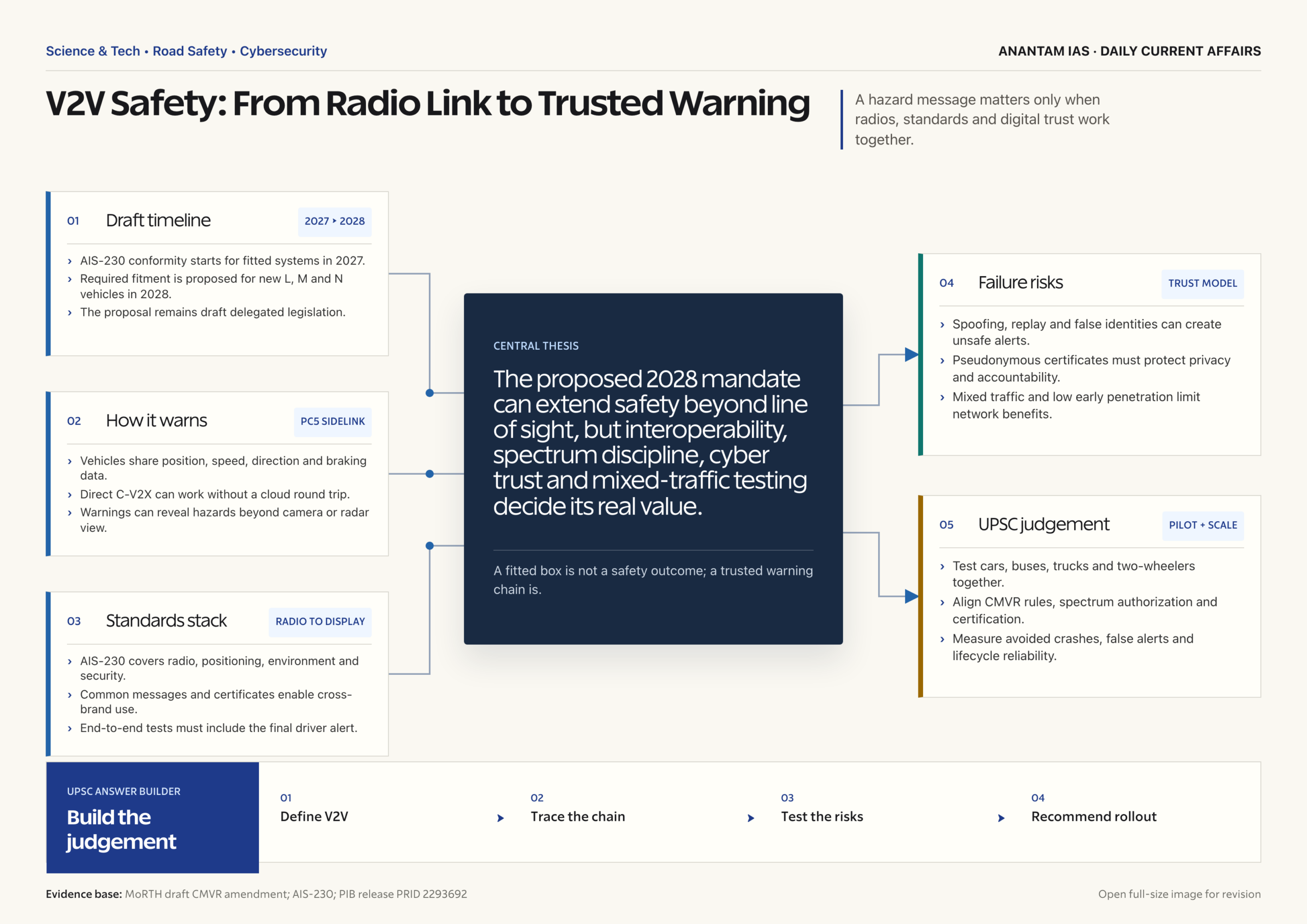
- The draft creates two phases: AIS-230 conformity for systems fitted in vehicles manufactured from 1 October 2027, followed by required fitment for vehicles manufactured from 1 October 2028.
- DoT’s G.S.R. 466(E) of 10 June 2026 applies to C-V2X On-Board Units in 5875-5905 MHz and permits qualifying use without individual frequency assignment or possession licensing.
Mains Relevance
GS Paper 3
- Application of C-V2X, GNSS, intelligent transport systems and cooperative safety to road-accident prevention.
- Cybersecurity, spectrum management, technical standards, testing infrastructure and indigenous automotive electronics.
GS Paper 2
- Regulatory coordination among MoRTH, DoT, TRAI, BIS or technical agencies, states and road-owning authorities.
- Consultative rule-making, privacy safeguards, liability for false safety messages and public accountability for connected infrastructure.
Essay
- A safer machine is not only one that senses its surroundings; it is one that can cooperate without surrendering trust, privacy or human responsibility.
Background and Context
What the Draft Would Legally Change
The proposal separates an initial conformity phase from a later fitment mandate.
- From 1 October 2027, a newly manufactured L, M or N category vehicle would not necessarily have to carry V2V solely because of this phase. If a system is fitted, however, it would have to conform.
- From 1 October 2028, vehicles in those categories manufactured on or after the date would be required to carry a compliant V2V system. This shifts the policy from regulating an optional feature to proposing a standard.
- The formulation uses the vehicle’s manufacture date rather than announcing an immediate obligation for the existing fleet. Any future retrofit requirement would need a clear legal basis, technical feasibility assessment and treatment of old electrical architectures.
- The thirty-day comment period allows manufacturers, component suppliers, telecom bodies, testing agencies and road-user groups to challenge costs, dates or technical assumptions before final rules are issued.
- A strong UPSC answer must preserve the distinction between draft rule, final notification and implementation. A press release explaining a proposal does not by itself complete delegated legislation.
How V2V Communication Works
V2V creates cooperative awareness by letting vehicles broadcast compact safety information to nearby road users.
- An On-Board Unit combines a radio, antenna, computing and security functions with inputs such as GNSS position, speed, direction and acceleration. Nearby units interpret the message against their own movement.
- Direct C-V2X communication uses the PC5 sidelink. A warning can pass directly between vehicles without first reaching a telecom base station or remote cloud, which is important for time-sensitive and coverage-poor situations.
- The Uu interface serves network-linked uses such as cloud services, fleet information and broader traffic coordination. V2V’s direct safety link should not be confused with ordinary mobile-data connectivity or infotainment.
- A car braking sharply over a crest can alert following vehicles before their cameras see it. An approaching ambulance can send an early warning. A wrong-way warning can reach vehicles even when road curvature blocks line.
- V2V does not make a vehicle autonomous. The system may warn a driver or feed an assistance function, while control logic, human factors and liability rules determine whether the vehicle takes any automated action.
AIS-230 and the Standards Stack
Reliable cooperative safety requires far more than assigning a radio band.
- The PIB description says AIS-230 sets minimum technical, functional, performance, environmental and security requirements for V2V systems on Indian roads.
- Radio-performance checks cover output power, frequency stability, receiver sensitivity and selectivity. These limits reduce the risk that a weak receiver misses a warning or a transmitter disrupts another user of the band.
- GNSS and positioning requirements matter because a message is useful only when its time, location and movement data are accurate enough for the receiving vehicle to judge collision risk.
- Electrical, power-supply and electromagnetic-compatibility tests must account for vibration, temperature, voltage changes and the noisy electronic environment inside a vehicle.
- Interoperability needs common radio profiles, message sets, congestion control, certificate formats and compliance tests across brands. A proprietary island would reduce the network effect on which V2V safety depends.
The 5.9 GHz Spectrum Architecture
Two related policy documents describe different parts of the 50 MHz ITS range and should not be merged carelessly.
- The PIB release says AIS-230 covers factory-installed C-V2X units in 5875-5925 MHz, a 50 MHz span considered for V2V and other intelligent-transport applications.
- DoT’s operative G.S.R. 466(E) gives licence-exempt treatment to On-Board Units only in 5875-5905 MHz, a 30 MHz span, subject to technical limits, standards and equipment-type approval.
- TRAI’s April 2026 consultation records the policy approach of using the lower 30 MHz for initial C-V2X deployment and reserving 5905-5925 MHz for future ITS applications and evolving standards.
- Licence exemption lowers deployment friction, but it is not unregulated spectrum. Non-interference and non-protection conditions mean devices cannot demand protection from every other lawful allocation and may be directed to cure harmful interference.
- The remaining policy work includes roadside-unit authorization, interference management, geographical coordination and the relationship between vehicle-only V2V deployment and later V2I infrastructure.
Way Forward
Align the Legal and Technical Layers
- Publish the final CMVR amendment, AIS-230 text, test procedures, approved 3GPP profiles and channel plan as a coherent compliance package.
- Explain how the 50 MHz AIS scope relates to the 30 MHz licence-exempt OBU band and any future use of 5905-5925 MHz.
- Provide transition rules for model approvals, imported vehicles, software updates, component replacement and small-volume manufacturers.
Conclusion
- The draft V2V rules mark a shift from vehicles acting as isolated machines to vehicles participating in a cooperative safety network.
- The 2028 fitment proposal will succeed only if India aligns automotive standards, spectrum rules, cybersecurity and field evidence .
UPSC Practice Questions
Prelims MCQ 1
With reference to India’s proposed Vehicle-to-Vehicle communication framework, consider the following statements:
- The proposal requires L, M and N category vehicles manufactured on or after 1 October 2028 to be fitted with V2V systems conforming to AIS-230.
- DoT’s G.S.R. 466(E) provides licence-exempt use for qualifying C-V2X On-Board Units in the 5875-5905 MHz band.
- The licence exemption gives each approved On-Board Unit exclusive and interference-protected use of the band.
How many of the above statements are correct?
(a) Only one (b) Only two (c) All three (d) None
Answer: (b) Only two
Explanation:
Statements 1 and 2 are correct. G.S.R. 466(E) permits qualifying OBU use on a non-interference, non-protection and non-exclusive basis, so Statement 3 is incorrect. The 2028 requirement is still part of a draft proposal pending final notification.
Prelims MCQ 2
Which one of the following correctly describes the PC5 interface in C-V2X?
(a) A satellite-only link used to update navigation maps (b) A direct sidelink that can carry nearby V2V or V2I communication without routing it through a cellular network (c) A legal portal for granting equipment-type approval (d) A radar band reserved only for autonomous braking
Answer: (b) A direct sidelink that can carry nearby V2V or V2I communication without routing it through a cellular network
Explanation:
PC5 is the 3GPP direct sidelink used by C-V2X for nearby communication, including V2V and V2I. The Uu interface connects a vehicle through the cellular network for V2N and cloud-linked services.
UPSC Mains Questions
- India’s proposed V2V mandate is as much a governance and cybersecurity project as it is an automotive-safety rule. Discuss. (250 words)
- Explain how C-V2X can complement onboard vehicle sensors in reducing road-accident risk. What limitations should guide its phased deployment in India? (250 words)
Sources: PIB, Ministry of Road Transport and Highways and Telecom Regulatory Authority of India.
Frequently Asked Questions
Has India already made V2V communication mandatory?
No. MoRTH has issued draft amendments. The proposal sets AIS-230 conformity from 1 October 2027 for systems that are fitted and mandatory fitment from 1 October 2028 for L, M and N category vehicles manufactured from that date. Comments must.
What is the difference between V2V, V2X and C-V2X?
V2V describes communication between nearby vehicles. V2X is the broader set covering vehicles, infrastructure, pedestrians and networks. C-V2X is the 3GPP cellular technology family used to support those links, including direct PC5 communication and network-linked Uu communication.
What is AIS-230?
AIS-230 is the proposed Automotive Industry Standard for factory-installed V2V systems on Indian roads. PIB says it covers radio performance, positioning, electrical supply, environmental performance, electromagnetic compatibility, cybersecurity, communication security and road-safety applications such as emergency-brake and wrong-way warnings.
Which spectrum is available for C-V2X On-Board Units?
DoT’s G.S.R. 466(E) permits qualifying licence-exempt OBU operation in 5875-5905 MHz under technical and equipment-approval conditions. The wider policy and AIS discussion covers 5875-5925 MHz, with the upper 20 MHz retained for future ITS requirements in the approach recorded by.
Can V2V work without mobile-network coverage?
Yes, direct C-V2X communication can use the PC5 sidelink between nearby vehicles without routing the message through a telecom base station. Network-linked V2N services use the Uu interface. Reliable operation still depends on compatible radios, spectrum conditions, positioning, certificates and.
Tell Google you want more of this.
Add Anantam IAS as a preferred sourceOne tap, and this site shows up more often in your own Top Stories, AI Overviews and AI Mode. Remove it any time.