Daily Digest
UPSC · Civil Services Examination
Current Affairs · Sunday, 6 September 2026
Current affairs curated and edited by Anantam IAS faculty — pulled from The Hindu, PIB, IDSA, Foreign Affairs and the ministries. Read, annotate, revise.
Old Rajinder Nagar · Delhi 110005 · anantamias.com
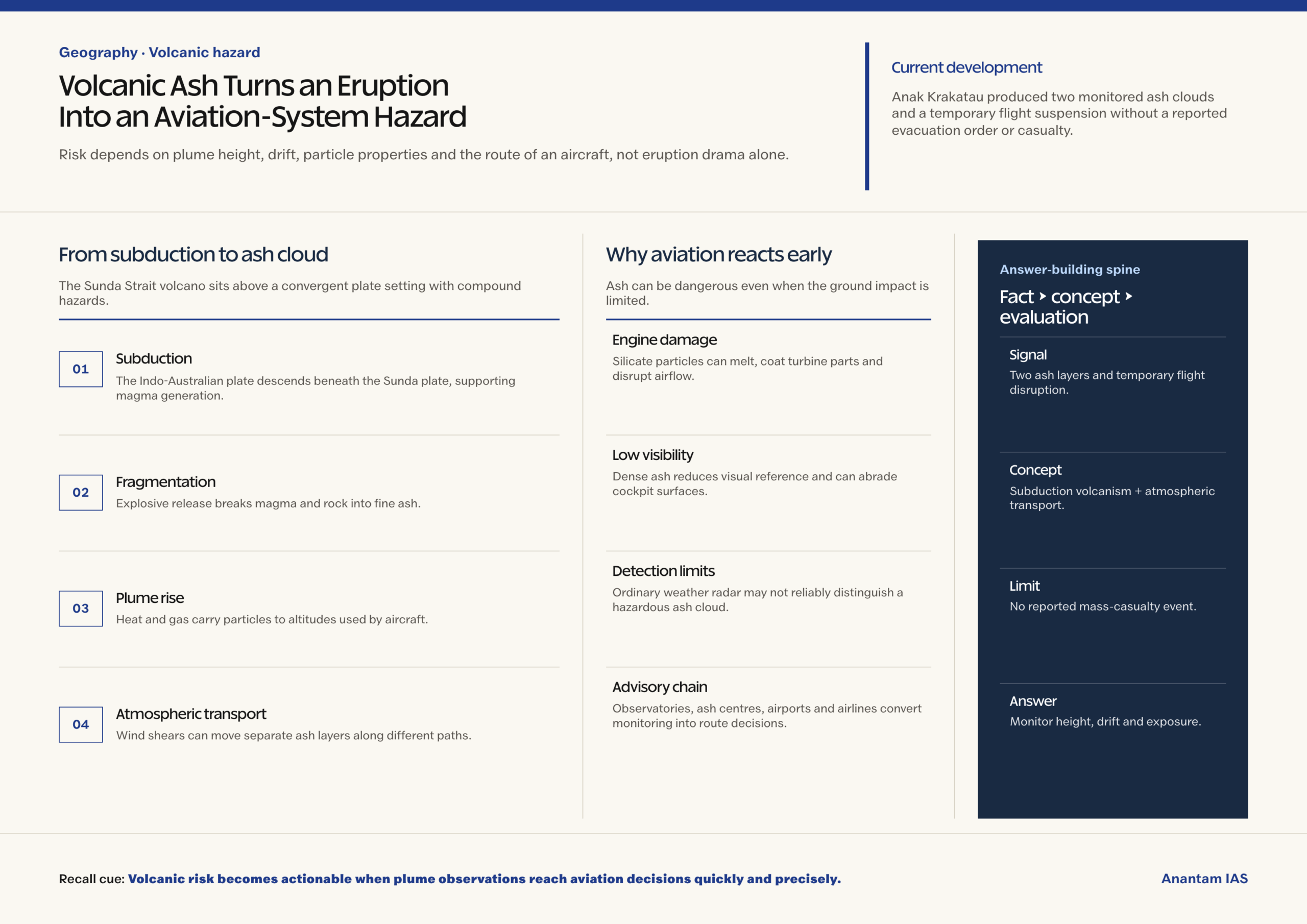
Anak Krakatau Eruption: Volcanic Ash, Aviation and Sunda Strait Risk
Why in News?
Indonesia’s Anak Krakatau erupted early on September 6, sending ash across western Indonesia and prompting a temporary suspension of flight operations at Jakarta’s Soekarno-Hatta International Airport.
- Indonesia’s volcanology agency and the Darwin Volcanic Ash Advisory Centre identified two ash clouds through satellite imagery.
- The lower cloud reached 20,000 feet and drifted northeast, while the higher cloud reached 50,000 feet and moved west to northwest.
- The airport temporarily suspended all flight operations as a precaution against ash exposure; cancellations and passenger disruption followed.
- Authorities reported no casualties and issued no evacuation order. People were still told to remain outside the active-crater exclusion zone.
- An ash cloud can threaten aircraft far from a crater, so eruption monitoring must connect volcanology, satellite meteorology, air-traffic services and airport decisions.
- The present report did not describe a tsunami. The Sunda Strait’s earlier volcano-generated tsunamis explain why compound-hazard readiness remains necessary.
UPSC Relevance
Prelims Relevance
- Anak Krakatau lies in the Sunda Strait between Java and Sumatra.
- It belongs to a subduction-zone volcanic arc, not a divergent plate boundary.
- Volcanic ash consists of fine, angular fragments of rock, minerals and volcanic glass.
- A Volcanic Ash Advisory Centre tracks and forecasts ash-cloud position and movement for aviation users.
- A volcanic flank collapse can displace seawater and generate a tsunami without a large tectonic earthquake.
Mains Relevance
GS Paper 1
- Subduction-zone volcanism and the formation of island arcs
- Interaction among eruptions, slope failure and tsunami generation
GS Paper 3
- Multi-hazard early warning for island volcanoes and exposed coasts
- Coordination between scientific advisories, civil aviation and local disaster management
Essay
- Invisible risks test institutions: effective safety depends on turning scientific uncertainty into timely, proportionate public action.
Background and Context
Why Anak Krakatau Is Volcanically Active
Anak Krakatau is part of an island-arc system powered by convergence beneath Indonesia.
- At the Sunda subduction zone, dense Indo-Australian oceanic lithosphere descends beneath the Sunda margin, carrying water-rich minerals into depth beneath the volcanic arc.
- Heat and pressure release water from the sinking slab. These fluids lower the melting temperature of the overlying mantle wedge and promote partial melting without the plates pulling apart.
- Buoyant magma rises through fractures and may collect in crustal reservoirs. Dissolved gases expand as pressure falls, helping drive explosive fragmentation near the surface.
- Explosive eruptions break magma and older rock into tephra. The finest fragments become volcanic ash that convection and high-altitude winds can transport widely.
- Anak Krakatau, meaning Child of Krakatau, grew within the older Krakatau caldera after the catastrophic eruption. Repeated construction and collapse shape this young volcanic island.
Why Volcanic Ash Disrupts Aviation
Ash is a mechanical and thermal hazard, not the soft residue associated with an ordinary fire.
- Its angular particles can abrade windscreens, leading edges and compressor blades. Ash can also contaminate sensors, reduce pilots’ external visibility and erode protective surfaces.
- Silicate particles entering a jet engine may melt in the hottest section, then re-solidify on cooler components, disturbing airflow and reducing thrust.
- Even where an aircraft avoids immediate engine failure, low concentrations can accelerate wear. Avoidance is safer than treating an ash cloud as normal weather.
- The two observed clouds travelled in different directions at different heights. This shows why plume altitude and winds aloft matter as much as distance from the crater.
- The Darwin VAAC converts satellite, observatory and meteorological evidence into ash advisories. Operators and aviation authorities use that guidance for rerouting, suspension and reopening decisions.
The Sunda Strait's Compound-Hazard History
Krakatau demonstrates how one volcanic system can produce several hazards with very different footprints.
- Local hazards include ballistic fragments, lava, hot pyroclastic material, gases and ashfall. Airborne ash creates a separate, downwind hazard corridor for settlements and aviation.
- The Krakatau eruption and caldera collapse in the nineteenth century generated destructive tsunamis around the Sunda Strait, reshaped the volcanic complex and showed that hazards can cross land-sea boundaries.
- In 2018, a major eruption and flank collapse at Anak Krakatau displaced seawater and produced a deadly tsunami along parts of Java and Sumatra.
- A flank-collapse tsunami may arrive without the strong tectonic shaking people associate with earthquake-generated waves. Coastal warning systems must account for this short-lead-time problem.
- Today’s ash episode should not be equated with a new collapse or tsunami. Its lesson is to maintain linked monitoring for eruption, slope instability, ocean response and ash transport.
Way Forward
Link Monitoring to Clear Decisions
- Combine seismic, deformation, gas, visual and satellite observations to distinguish routine unrest from rapid changes in eruption or slope stability.
- Integrate volcano observatories, VAAC advisories, meteorological offices, air-traffic control and airlines through tested communication protocols and decision thresholds.
- Maintain tide gauges and other sea-level monitoring around the Sunda Strait, with coastal warnings designed for volcanic tsunamis that may offer little lead time.
- Reopen affected airspace through updated plume observations and risk assessment, while communicating uncertainty and passenger implications clearly.
Conclusion
- Anak Krakatau connects plate tectonics to practical risk governance: subduction supplies magma, explosive fragmentation produces ash, and atmospheric transport can interrupt aviation far from the vent.
- A strong answer should separate the current ash emergency from historical tsunami events, then show why the Sunda Strait needs integrated, multi-hazard monitoring rather than a single-warning system.
UPSC Practice Questions
Prelims MCQ 1
With reference to Anak Krakatau and volcanic-ash monitoring, consider the following statements:
- Anak Krakatau is situated in the Sunda Strait between Java and Sumatra.
- It is associated with a divergent plate boundary.
- Volcanic Ash Advisory Centres provide information on observed and forecast ash-cloud movement for aviation.
How many of the above statements are correct?
(a) Only one (b) Only two (c) All three (d) None
Answer: (b) Only two
Explanation:
Statements 1 and 3 are correct. Anak Krakatau lies in the Sunda Strait and VAACs support aviation with ash advisories. It is linked to subduction-zone volcanism, not divergence.
Prelims MCQ 2
Why can volcanic ash cause a serious loss of jet-engine performance?
(a) It always freezes the aviation fuel inside the wing tanks (b) Silicate particles can melt in hot engine sections and re-solidify on cooler components (c) It removes atmospheric oxygen from the entire flight corridor (d) Its magnetic field disables all navigation satellites
Answer: (b) Silicate particles can melt in hot engine sections and re-solidify on cooler components
Explanation:
Volcanic ash contains silicate material. Ingested particles may melt, deposit on cooler engine components, disrupt airflow and reduce thrust; abrasive particles also damage exposed surfaces.
UPSC Mains Questions
- Explain the tectonic processes that sustain volcanism in the Sunda Arc. How can an explosive eruption affect aviation far beyond the immediate crater zone?
- The Sunda Strait requires a compound-hazard approach to disaster management. Discuss with reference to volcanic ash, flank collapse and tsunami warning.
Sources: The Hindu (Associated Press) and U.S. Geological Survey.
Frequently Asked Questions
Where is Anak Krakatau located?
Anak Krakatau is an active volcanic island in Indonesia’s Sunda Strait, between Java and Sumatra. It grew within the Krakatau caldera after the earlier volcanic edifice collapsed.
Why was Jakarta’s main airport temporarily closed?
Authorities suspended flights because drifting volcanic ash can damage aircraft surfaces, contaminate instruments and impair jet engines. The closure was precautionary while the ash hazard was assessed.
What does a Volcanic Ash Advisory Centre do?
A VAAC analyses observatory, satellite and weather information to describe and forecast volcanic-ash clouds. Its advisories support pilots, airlines, meteorological offices and air-traffic managers.
Did the September 6 eruption cause a tsunami?
The report described ash clouds and aviation disruption, not a tsunami. The tsunami risk belongs to the volcano’s compound-hazard history and should not be presented as a current impact.
How did Anak Krakatau generate a tsunami in 2018?
An eruption accompanied a major flank collapse. Material entering the sea displaced water and generated a tsunami, illustrating why volcanic tsunamis can occur without a large tectonic earthquake.
Source: https://anantamias.com/current-affairs/anak-krakatau-volcanic-ash-aviation/
Jammu Heroin Routes: Interstate and Cross-Border Trafficking Networks
Why in News?
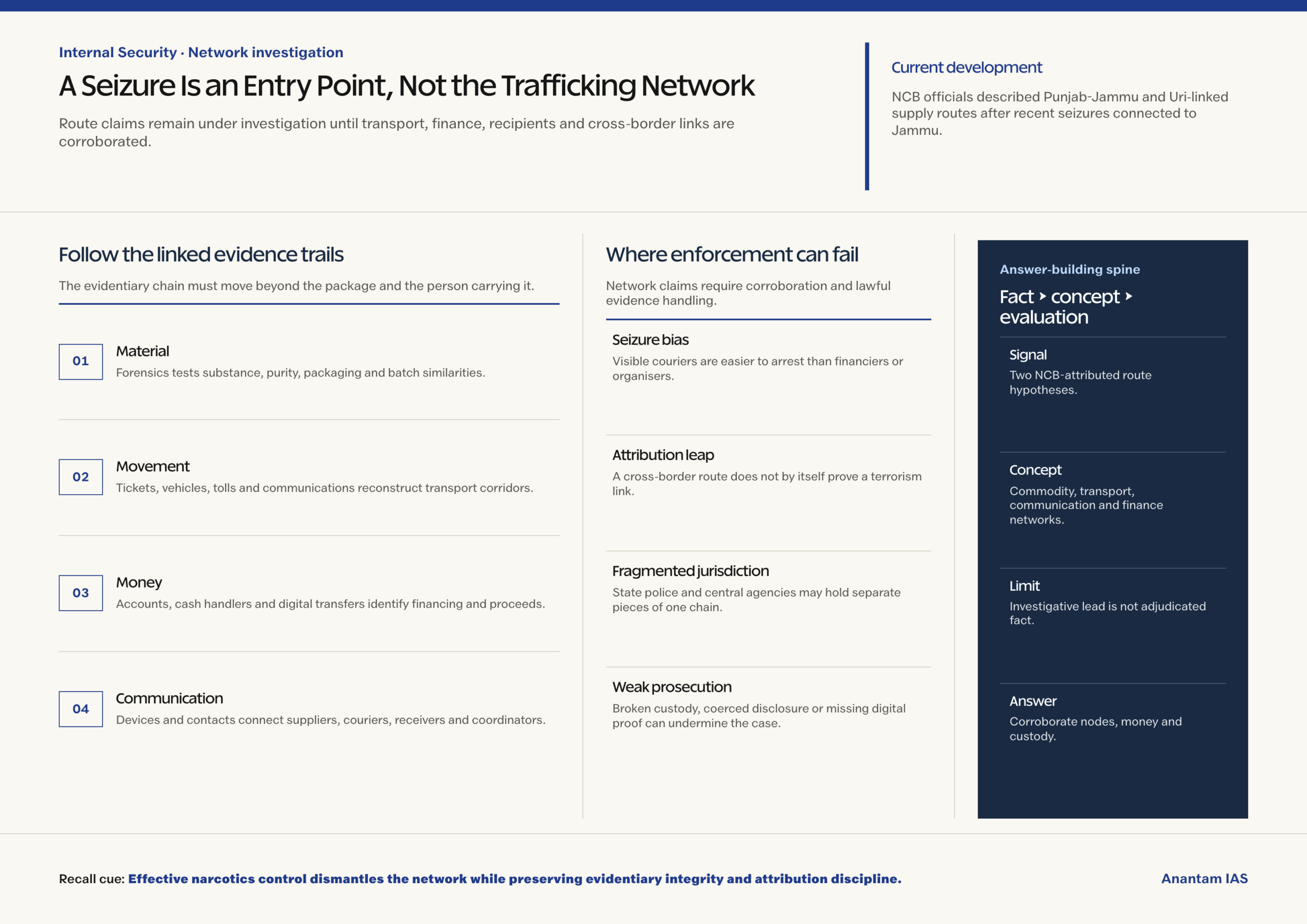
The Indian Express reported on September 6 that NCB officials had identified two suspected heroin routes into Jammu, one through the Punjab-Jammu corridor and another linked to Uri in North Kashmir.
- NCB officials said a September 3 bus interception near Samba yielded 522 grams of heroin and generated a follow-up lead to Ludhiana.
- Investigators separately attributed an August 22 seizure of 5.160 kg in Jammu to a consignment allegedly routed through the Uri sector.
- Officials placed the cumulative recovery from the connected operations at 6.920 kg, but seizure weight alone does not establish every network link.
- The alleged source, intended recipients, financiers, associates and wider interstate or cross-border connections remain under investigation.
- The reported routes connect border management with ordinary interstate transport, showing how illicit supply chains can combine separate entry, transit and distribution stages.
- Network disruption requires investigators to move from possession evidence toward communications, money flows, logistics and legally sustainable attribution.
UPSC Relevance
Prelims Relevance
- Narcotic Drugs and Psychotropic Substances Act, 1985
- Narcotics Control Bureau as the Central coordinating agency
- Small, intermediate and commercial quantity thresholds
- Section 27A: financing illicit traffic and harbouring offenders
- Section 50 safeguards for personal search
- Interstate and cross-border trafficking routes
Mains Relevance
GS Paper 3
- Border, transport and financial dimensions of narcotics trafficking
- Intelligence-led investigation and inter-agency coordination
GS Paper 2
- Due process, evidentiary integrity and Centre-State coordination in drug-law enforcement
Essay
- Security institutions become more effective when they follow networks and incentives while preserving the evidentiary discipline needed for fair prosecution.
Background and Context
From Seizure Point to Trafficking Chain
A consignment is a visible node; the trafficking system extends before and after the point of interception.
- Investigators must distinguish the entry route, transit corridor, storage point, courier movement and final distribution layer instead of treating them as one continuous journey with a single controller.
- A Punjab-origin passenger movement and a separately alleged Uri-linked consignment may reach the same market while involving different suppliers, handlers and financing arrangements.
- A courier’s possession can support an individual case, but it does not automatically identify the organiser, intended recipient or person who financed and expected to profit from the shipment.
- Follow-up searches, device analysis, travel records and communications can connect nodes, provided collection and authentication comply with criminal-procedure and evidence requirements.
- Financial trails matter because payments, cash couriers, informal transfers and asset acquisition can reveal controllers who remain distant from the physical drug movement and insulate themselves through intermediaries.
NDPS Enforcement Architecture
India’s framework combines strict drug-control offences with shared enforcement and procedural safeguards.
- The NDPS Act, 1985 regulates narcotic drugs and psychotropic substances and penalises unauthorised production, possession, transport, interstate movement and related conduct.
- Punishment for several offences depends on whether the recovered substance falls within the notified small, intermediate or commercial quantity category, making accurate weighing and chemical identification legally consequential.
- For heroin, the officially notified commercial quantity is 250 grams; each reported principal seizure exceeded that threshold, subject to laboratory confirmation and proof at trial.
- Section 27A separately addresses financing illicit traffic and harbouring offenders, making the money trail central when evidence supports such an allegation.
- The NCB acts as the Central coordinating and enforcement agency, working with State police, Customs, border forces and other drug-law enforcement bodies across territorial and institutional boundaries.
Attribution, Evidence and Enforcement Limits
Strong enforcement depends on proving each link, not converting an investigative theory into a settled conclusion.
- The Punjab-Jammu and Uri descriptions are NCB-attributed investigative claims reported by the newspaper; they are not judicial findings about a complete network.
- The alleged Pakistan origin of the Uri-linked consignment also remains an investigators’ claim and requires corroboration through admissible evidence and cross-agency intelligence.
- Search and seizure documentation, representative sampling, laboratory examination and secure custody protect the identity and integrity of the substance produced before a court, reducing contamination and substitution disputes.
- Investigators must separate possession, knowledge, conspiracy and financing evidence because different participants may perform limited roles without knowing the network’s entire structure, source or ultimate destination.
- Public communication should identify what was seized and what is alleged while avoiding labels that outrun the evidence or prejudice an ongoing investigation.
Way Forward
Disrupt the Network, Preserve the Case
- Create a joint route-intelligence picture linking seizures, vehicles, devices, recurring contact points and financial indicators across Punjab, Jammu and Kashmir, and Ladakh.
- Use risk-based checks on transport corridors without turning routine passenger movement into indiscriminate profiling or weakening lawful search safeguards.
- Trace suspected proceeds and beneficial control in parallel with the physical consignment, using financial intelligence only where evidence establishes a defensible connection.
- Audit chain-of-custody, sampling and digital-evidence procedures early so that operational success can survive scrutiny during prosecution.
Conclusion
- The Jammu cases show why route detection is only the first stage: durable disruption requires proof connecting entry, transport, receipt, finance and control across jurisdictions, followed by prosecution that survives evidentiary scrutiny.
- A strong Mains answer should combine coordinated border and interstate intelligence with financial investigation, forensic custody and careful attribution, while stating clearly that the wider network remains under investigation.
UPSC Practice Questions
Prelims MCQ 1
With reference to India’s narcotics-control framework, consider the following statements:
- The Narcotics Control Bureau is the Central coordinating agency for drug-law enforcement.
- The NDPS Act prescribes the same punishment for every quantity of a narcotic drug.
- Section 27A addresses financing illicit traffic and harbouring offenders.
How many of the above statements are correct?
(a) Only one (b) Only two (c) All three (d) None
Answer: (b) Only two
Explanation:
Statements 1 and 3 are correct. For several NDPS offences, punishment varies according to the notified small, intermediate and commercial quantity categories.
Prelims MCQ 2
Which investigative approach best targets a trafficking network beyond the seizure of a drug consignment?
(a) Treating seizure weight as proof of every alleged cross-border link (b) Examining only the courier’s statement and closing the financial inquiry (c) Linking transport, communications, recipients and financial trails through admissible evidence (d) Publicly assigning every suspect the same role before investigation concludes
Answer: (c) Linking transport, communications, recipients and financial trails through admissible evidence
Explanation:
Network investigation follows the physical and financial chain while preserving evidence and proving each participant’s role instead of relying on inference from one seizure.
UPSC Mains Questions
- Narcotics interdiction must move from consignment seizure to network disruption. Discuss with reference to transport corridors, financial investigation and inter-agency coordination.
- How can drug-law enforcement balance intelligence-led operations with procedural safeguards and careful attribution during an ongoing cross-jurisdictional investigation?
Sources: Indian Express and Narcotics Control Bureau, Government of India.
Frequently Asked Questions
What routes has the NCB claimed to identify into Jammu?
NCB officials reportedly identified one suspected route through the Punjab-Jammu corridor and another linked to Uri in North Kashmir. These remain investigative claims, not final judicial findings.
What remains under investigation in the Jammu heroin cases?
Investigators are still examining the source, intended recipients, financiers, associates and wider interstate or cross-border links. The presently reported seizures do not settle those questions.
Why is a seizure alone insufficient to dismantle a trafficking network?
A seizure may establish possession of a consignment, but investigators must separately connect suppliers, couriers, receivers, financiers and controllers through admissible communications, financial and logistical evidence.
What is the NCB’s role in narcotics enforcement?
The NCB is the Central coordinating agency for drug-law enforcement and also conducts operations through its field units in cooperation with State police, Customs and other agencies.
Why does the financial trail matter in a narcotics case?
Payments and assets may identify organisers who never handle the drugs. A lawful financial inquiry can help prove financing, control and benefit beyond the courier level.
Source: https://anantamias.com/current-affairs/jammu-heroin-routes-trafficking-networks/
India Valve Registry: Building Patient-Level Evidence for Heart Care
Why in News?
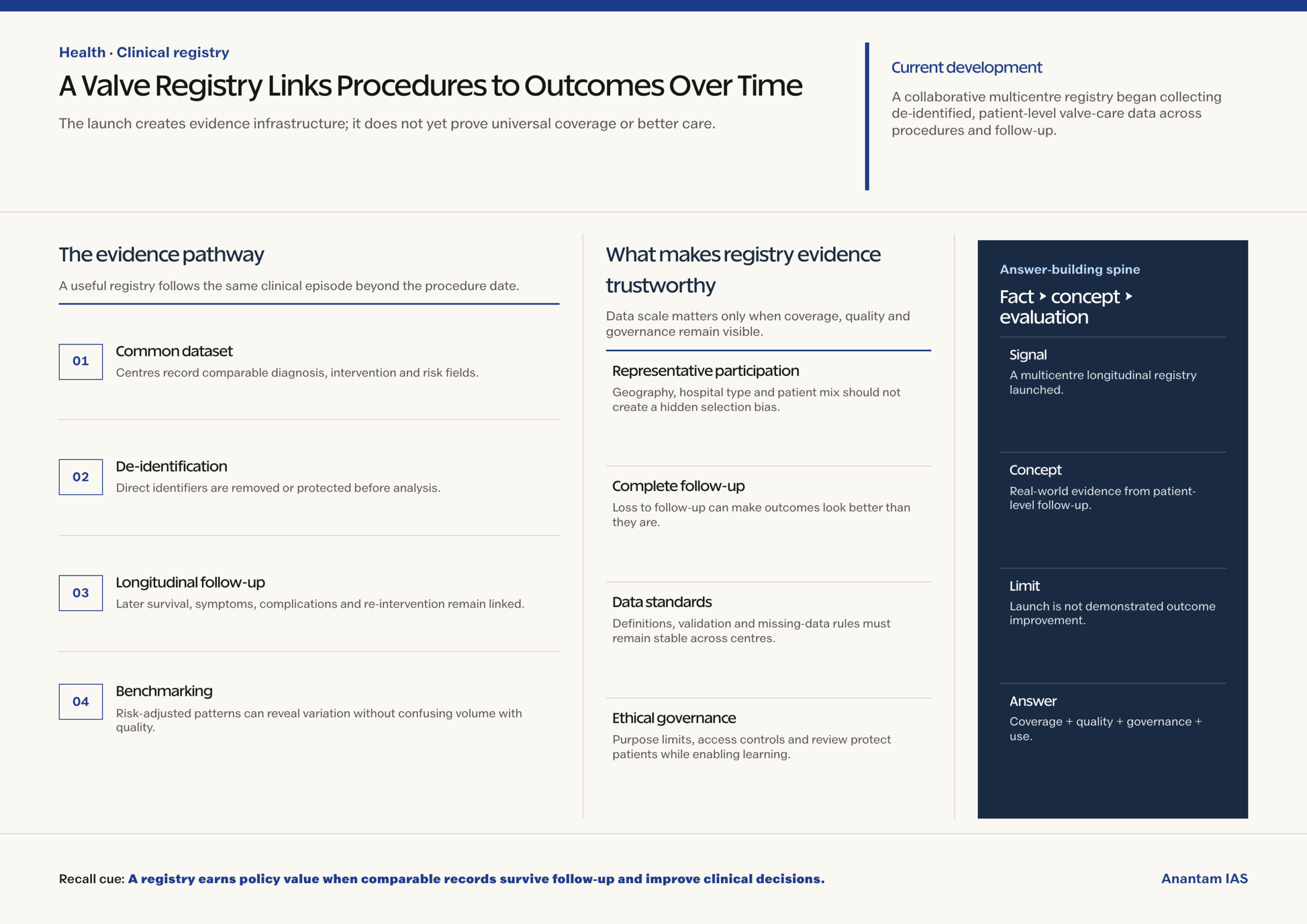
The India Valve Registry was launched in Chennai on September 5 as a clinician-led, multicentre platform for de-identified, patient-level and longitudinal evidence on valve disease and interventions.
- The registry is designed to collect real-world data on transcatheter valve interventions across participating centres.
- Its intended record follows treatment beyond the procedure, including complications, discharge outcomes, rehospitalisation, functional recovery and survival during follow-up.
- The development is a new evidence infrastructure; it is not a statutory programme or proof that clinical outcomes have already improved.
- The initiative seeks to convert distributed clinical experience into comparable, India-specific evidence for research and care decisions.
- Valve-care evidence from other populations may not fully reflect India’s patient profiles, disease severity, referral pathways or follow-up conditions.
- A registry can reveal patterns in routine care, but its conclusions depend on representative participation, consistent definitions, complete follow-up and sound data governance.
UPSC Relevance
Prelims Relevance
- Clinical registry and real-world evidence
- Patient-level and longitudinal data
- De-identification and data privacy
- Valvular and structural heart disease
- Transcatheter valve intervention
- Registry versus randomised controlled trial
Mains Relevance
GS Paper 2
- Public-health value of India-specific clinical evidence
- Privacy, representativeness and accountability in health-data infrastructure
GS Paper 3
- Use of longitudinal real-world data in medical research and technology assessment
Essay
- Health systems learn when individual clinical encounters become trustworthy collective evidence without sacrificing patient privacy.
Background and Context
What the Registry Is Designed to Record
A clinical registry follows routine care, creating a structured record across patients, centres and time for later comparison and quality review.
- The India Valve Registry focuses on valve diseases and interventions, with the official release specifically describing real-world data on transcatheter valve procedures.
- Its intended baseline record includes clinical profile, disease severity, imaging, anatomy, treatment selection and planning. These fields can support risk adjustment when comparing unlike patient groups.
- The procedural layer can document devices and techniques, immediate results and complications, enabling practice comparisons and helping centres examine where approaches or results differ.
- The longitudinal layer extends observation after discharge to rehospitalisation, functional recovery and survival. This matters because clinically important effects may emerge only over time.
- Because records are patient-level, researchers can study how characteristics, treatment choices and follow-up outcomes relate; aggregated hospital totals cannot support the same analysis.
How Patient-Level Data Become Clinical Evidence
The registry’s value lies in comparable observations and in whether the dataset reflects diverse patients and care settings, not merely in accumulating records.
- A multicentre design can capture variation in patients, referral settings and treatment practices better than a record maintained by one institution alone.
- Common data definitions enable like-for-like analysis and periodic quality audits; inconsistent descriptions of severity, complications or recovery can produce misleading comparisons.
- Longitudinal linkage helps distinguish an immediate technical result from later patient experience, including repeat admission, functional recovery and survival during follow-up.
- Registry analysis can generate hypotheses, identify care gaps and support quality review. Results still require adjustment for case-mix differences, and observational associations do not prove causation.
- India-specific evidence can complement international studies when clinicians and policymakers assess whether findings transfer to local disease patterns and delivery conditions.
Safeguards, Limits and the Key Exam Distinction
A newly launched registry is a capacity to learn; its coverage, data quality and effects remain unproven, preventing premature claims about national performance.
- De-identification reduces direct identifiability, but it does not remove every privacy risk when detailed health records are combined or linked.
- Governance should specify lawful collection, access controls, permitted research uses, retention, security, accountability and procedures for responding to a data breach.
- Voluntary or uneven centre participation can create selection bias; findings may overrepresent hospitals with stronger infrastructure, specialised teams or better follow-up capacity and exclude underserved settings.
- Missing follow-up can distort survival, recovery and rehospitalisation patterns, especially if patients who disappear from records differ systematically from those retained.
- Do not equate a registry with a randomised trial: registries observe real-world care, while randomisation is designed to balance confounding factors when testing causal effects.
Way Forward
Build Trustworthy and Usable Evidence
- Publish a transparent data dictionary, participation criteria and outcome definitions so that centres record the same clinical events in comparable ways.
- Use privacy-by-design safeguards, role-based access, audit trails and independent oversight for de-identified patient-level data and approved research use.
- Track missingness, follow-up completeness and centre diversity, and state these limitations whenever registry findings are reported or used in policy.
- Translate mature findings into peer-reviewed research, quality-improvement feedback and carefully evaluated standards without treating early associations as settled causal evidence.
Conclusion
- The India Valve Registry matters because it can connect multicentre, de-identified and longitudinal observations into India-specific evidence. Its value requires consistent, representative, complete data and transparent limits before findings guide standards or financing decisions.
- In a Mains answer, separate launch from impact: explain the evidence opportunity, then examine representation, standardisation, follow-up, privacy and the limits of observational inference before recommending policy use.
UPSC Practice Questions
Prelims MCQ 1
With reference to clinical registries, consider the following statements:
- Longitudinal data can connect a patient’s baseline characteristics with outcomes recorded during later follow-up.
- De-identification eliminates every possibility of privacy risk in detailed health datasets.
- A multicentre registry can document variations in real-world clinical practice across participating institutions.
How many of the above statements are correct?
(a) Only one (b) Only two (c) All three (d) None
Answer: (b) Only two
Explanation:
Statements 1 and 3 are correct. De-identification reduces direct identifiability but cannot guarantee zero privacy risk, particularly when rich records are linked with other data.
Prelims MCQ 2
Which feature best distinguishes an observational clinical registry from a randomised controlled trial?
(a) A registry can include patient outcomes, while a trial cannot (b) A registry observes care delivered in practice, while a trial randomly assigns interventions under a study protocol (c) A registry always represents every hospital in a country (d) A registry proves that an observed treatment caused an outcome
Answer: (b) A registry observes care delivered in practice, while a trial randomly assigns interventions under a study protocol
Explanation:
Registries are valuable for real-world patterns and longitudinal outcomes, but non-random treatment selection can leave confounding. Randomised trials are structured to test causal effects more directly.
UPSC Mains Questions
- How can a multicentre, longitudinal clinical registry strengthen evidence-based healthcare in India? Discuss the India Valve Registry as an example.
- Clinical registries expand the capacity to learn from routine care, but data volume alone does not create trustworthy evidence. Examine the necessary safeguards and methodological limits.
Sources: PIB, Vice President's Secretariat and The Hindu.
Frequently Asked Questions
What is the India Valve Registry?
It is a clinician-led, multicentre research platform intended to collect de-identified, patient-level and longitudinal real-world data on valve disease and transcatheter valve interventions across participating Indian centres.
What does longitudinal patient-level data mean?
Patient-level data connect observations to an individual record, while longitudinal data follow that record over time from clinical profile and treatment through discharge and later outcomes.
Does de-identification make health data completely risk-free?
No. It removes or transforms direct identifiers to reduce risk, but detailed records may remain vulnerable to re-identification or misuse without access controls, security and accountable governance.
Has the registry already improved patient outcomes?
No such result has yet been established. The reported development is the launch of an evidence platform; coverage, data quality, findings and effects on care require future evaluation.
Is participation in the registry a statutory national requirement?
The cited reports describe a collaborative multicentre initiative, not a statutory or universal mandate. Its representativeness will depend on which centres participate and how completely they submit follow-up data.
Source: https://anantamias.com/current-affairs/india-valve-registry-clinical-evidence/
Brahmaputra Mega Dam: Transboundary Risks at the Great Bend
Why in News?
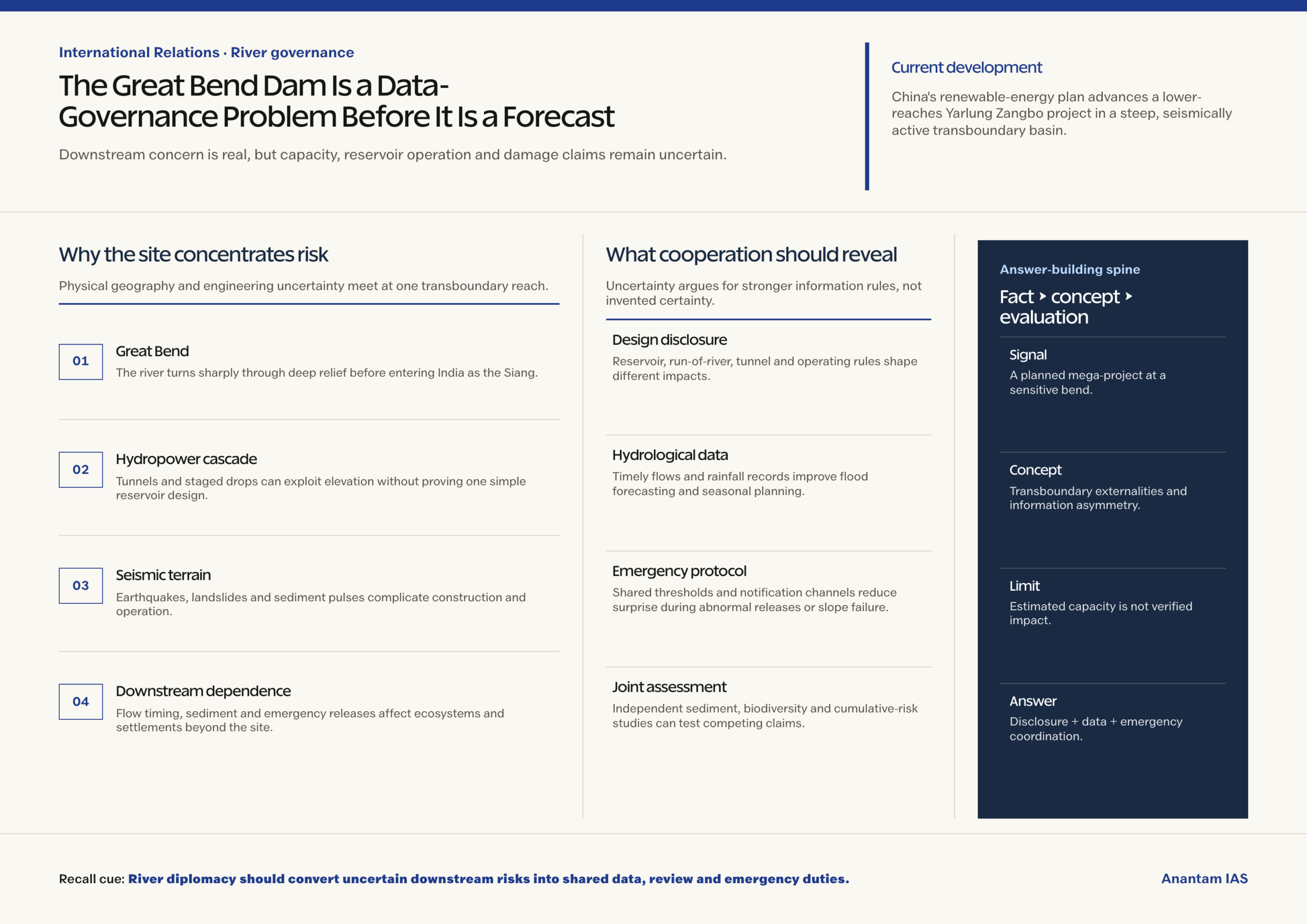
China’s renewable-energy plan calls for advancing the lower-reaches Yarlung Zangbo hydropower project near the Great Bend, renewing Indian concerns about uncertain downstream effects and limited project information.
- China’s official plan confirms continued construction priority, while a 2025 government announcement describes five cascade hydropower stations rather than publishing a complete operating design.
- The Hindu reports that a September meeting of the India-China Expert-Level Mechanism on trans-border rivers is expected to discuss cooperation.
- Analysts cited by the newspaper project about 60 GW of capacity, but China has not officially published the project’s final capacity, reservoir size or tunnel configuration.
- Claims about water diversion, altered flows or downstream harm remain risk scenarios; they cannot be treated as established outcomes without design and operating data.
- The project sits where a transboundary river, a high-relief Himalayan landscape and a major energy intervention meet, making uncertainty itself a governance problem.
- For India and Bangladesh, timely flow data, sediment information and emergency warnings matter alongside any debate about annual water availability.
UPSC Relevance
Prelims Relevance
- Yarlung Zangbo, Siang or Dihang, and Brahmaputra
- Great Bend and Namcha Barwa region
- Run-of-the-river hydropower
- Cascade hydropower stations
- India-China Expert-Level Mechanism on trans-border rivers
- Flood-season hydrological data
Mains Relevance
GS Paper 2
- India-China river diplomacy, transparency and confidence-building
- Interests of lower-riparian States and cooperative transboundary governance
GS Paper 3
- Hydropower, environmental flows, sediment continuity and disaster-risk reduction
- Infrastructure assessment in a seismically active Himalayan region
Essay
- Infrastructure becomes a shared-security issue when decisions taken upstream redistribute uncertainty across borders.
Background and Context
Why the Great Bend Matters
The site’s strategic value comes from the river’s geography, not merely the scale attached to the proposed project.
- The river flows east across Tibet as the Yarlung Zangbo, turns sharply around the Namcha Barwa region, cuts through deep relief and then enters Arunachal Pradesh.
- In Arunachal Pradesh it is commonly called the Siang or Dihang; after meeting the Dibang and Lohit, it flows across Assam as the Brahmaputra and later enters Bangladesh.
- The Great Bend combines a steep fall and concentrated river energy. That makes hydropower attractive, but also places tunnels, slopes, access works and powerhouses in difficult terrain.
- China’s 2025 announcement confirmed five cascade stations and the start of construction. The later renewable-energy plan makes continuation a policy commitment rather than a speculative proposal.
- Analyst descriptions of a long diversion tunnel and roughly 60 GW remain estimates. Publicly available official material does not establish final reservoir storage or operating rules.
How a Hydropower Project Can Change a River
Downstream effects depend on engineering choices and operations, so the correct frame is conditional rather than alarmist.
- A run-of-the-river label does not mean zero impact. Intake structures, pondage, tunnels and peaking operations can alter flow timing even when long-term diversion is limited.
- Reservoir size and release rules determine whether water is mainly passed through, stored across seasons or released in short pulses. Those details have not been publicly settled for this project.
- Dams and tunnels can interrupt sediment continuity, affect fish movement and change channel-forming flows. Magnitude depends on design, environmental-flow rules and coordinated cascade operation.
- The Eastern Himalayan Syntaxis is highly seismically active. Assessment must cover ground shaking, slope instability, tunnel safety and cascading failure pathways without assuming that failure is inevitable.
- Construction footprints, spoil disposal, roads and transmission corridors may create ecological pressure beyond the dam site. A basin-scale cumulative assessment is more useful than a structure-only review.
The Cooperation Gap
India-China river cooperation exists, but its data-sharing arrangements have been narrower and less dependable than the risks now being debated.
- The Expert-Level Mechanism, established in 2006, provides an official channel for flood-season data, emergency management and discussion of other trans-border river issues.
- A 2013 memorandum extended Brahmaputra data provision from May 15 to October 15 and recognised the value of cooperation to riparian countries.
- An official parliamentary reply states that the Brahmaputra data MoU expired in June 2023 and data sharing was suspended from that month.
- Flood-season gauge readings alone cannot resolve project uncertainty. Downstream assessment also needs reservoir levels, planned outages, sediment data, operating rules and prompt notification of unusual releases.
- Cooperation should include India and Bangladesh as lower-riparian stakeholders. Shared models and verified data can distinguish manageable impacts from unsupported worst-case claims.
Way Forward
Move from Assurance to Verifiable Cooperation
Confidence will depend on information that downstream agencies can independently use, not on competing political claims.
- Seek disclosure of the project layout, reservoir characteristics, tunnel alignment, environmental-flow commitments, sediment-management plan and operating rules through the Expert-Level Mechanism.
- Restore continuous hydrological exchange with common data standards, real-time transmission, quality checks and automatic warnings for abnormal releases, landslides or infrastructure emergencies.
- Create a joint scientific review covering seismic hazards, slope stability, ecology and cumulative cascade effects, with periodic publication of methods, assumptions and monitoring results.
- Strengthen India’s own upstream gauges, satellite monitoring, flood forecasting and community warning systems so that preparedness does not depend on a single external data stream.
Conclusion
- The lower-reaches project is a major planned hydropower intervention, but its capacity, storage, tunnel effects and downstream consequences remain partly undisclosed or analyst-estimated rather than established facts.
- A sound answer should connect Great Bend geography with conditional environmental and seismic risks, then argue for transparent design disclosure, restored hydrological data and basin-wide emergency cooperation.
UPSC Practice Questions
Prelims MCQ 1
With reference to the Brahmaputra river system, consider the following statements:
- The river is known as the Yarlung Zangbo in Tibet.
- It enters India in Arunachal Pradesh, where it is commonly called the Siang or Dihang.
- It is called the Brahmaputra before meeting the Dibang and Lohit rivers.
How many of the above statements are correct?
(a) Only one (b) Only two (c) All three (d) None
Answer: (b) Only two
Explanation:
Statements 1 and 2 are correct. The name Brahmaputra is used after the Siang or Dihang meets major tributaries including the Dibang and Lohit in the Assam plains.
Prelims MCQ 2
What is the most accurate function of the India-China Expert-Level Mechanism on trans-border rivers?
(a) It allocates fixed shares of Brahmaputra water between the two countries. (b) It approves every hydropower project proposed by either country. (c) It provides a channel for hydrological data, emergency management and discussion of trans-border river issues. (d) It adjudicates disputes through binding awards.
Answer: (c) It provides a channel for hydrological data, emergency management and discussion of trans-border river issues.
Explanation:
The mechanism is a cooperation and discussion channel. It is not a water-allocation treaty, a project-clearance authority or a binding international tribunal.
UPSC Mains Questions
- The uncertainty surrounding the lower-reaches Yarlung Zangbo hydropower project is itself a transboundary governance risk. Discuss.
- Explain how Great Bend geography, seismic conditions and cascade hydropower operations shape India’s concerns over the Brahmaputra. Suggest practical confidence-building measures.
Sources: The Hindu and National Development and Reform Commission, China.
Frequently Asked Questions
Where is the proposed Brahmaputra mega dam located?
The project is on the lower reaches of the Yarlung Zangbo in Tibet, near the Great Bend where the river turns around the Namcha Barwa region before entering Arunachal Pradesh.
Is the project’s 60 GW capacity officially confirmed?
No. The figure is an analyst projection cited in reporting. Official Chinese announcements confirm five cascade stations and major investment, but do not publicly establish a final installed capacity.
Does run-of-the-river hydropower have no downstream impact?
No. Pondage, intake structures, tunnels and peaking releases can alter flow timing, sediment movement and ecology. The actual effect depends on design, storage and operating rules.
What is the India-China Expert-Level Mechanism?
Created in 2006, it is the bilateral channel for cooperation on flood-season hydrological data, emergency management and other trans-border river issues. It is not a water-sharing treaty.
Why is hydrological data sharing important for India?
Timely, reliable upstream data improves flood forecasting and emergency warnings. Project-specific reservoir, release and sediment information would also help agencies assess risks instead of relying on competing claims.
Source: https://anantamias.com/current-affairs/brahmaputra-mega-dam-transboundary-risk/
Bihar Sets Qualified Consent Rule for CBI Probes
Why in News?
Bihar’s Home Department issued a September 3 notification requiring prior State consent for CBI action involving Bihar public servants while continuing consent for cases involving Central government employees.
- The order covers investigation, search, interrogation, arrest and related CBI action against public servants serving under the Bihar government.
- Consent continues for notified offences involving Central government employees, Central public-sector undertakings and private individuals under direct Central control.
- For covered Bihar public servants and State-controlled bodies, the CBI must send a proposal and obtain case-specific prior consent.
- The notification supersedes earlier State notifications on the subject but does not amount to a total withdrawal of CBI consent.
- The order demonstrates how federalism shapes the territorial reach of a Central investigative agency within a State.
- Its exam value lies in distinguishing general consent, case-specific consent and court-directed investigation.
UPSC Relevance
Prelims Relevance
- Delhi Special Police Establishment Act, 1946
- Section 3: offences investigated by the DSPE
- Section 5: territorial extension of powers
- Section 6: State consent requirement
- General consent and case-specific consent
- CBI and State police jurisdiction
Mains Relevance
GS Paper 2
- Federal distribution of policing powers and the statutory reach of Central investigation
- Accountability, impartial investigation and Centre-State trust
GS Paper 3
- Institutional coordination in corruption and cybercrime investigations
Essay
- Federal checks can protect autonomy, but they work best when accompanied by transparent and time-bound institutional cooperation.
Background and Context
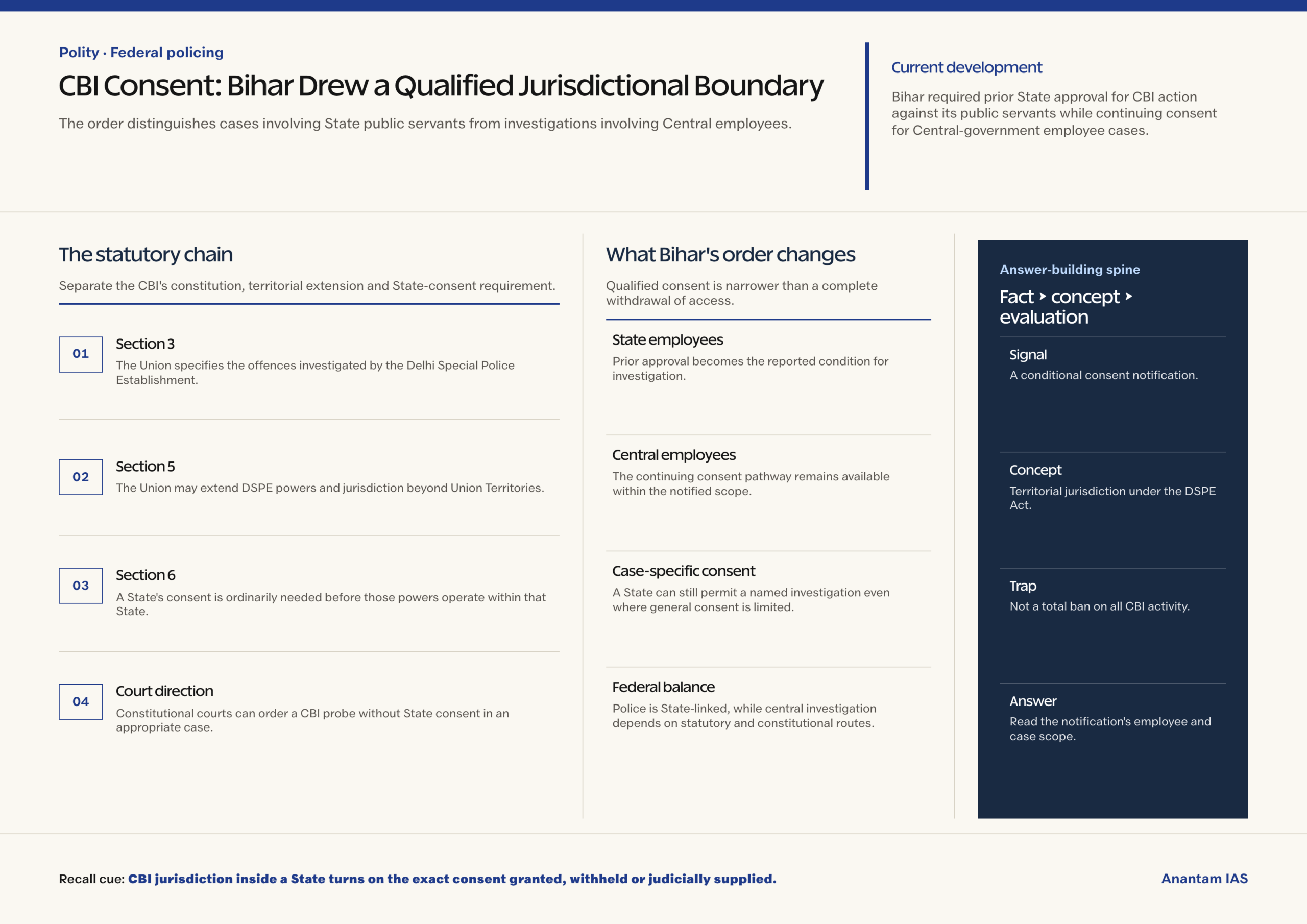
How Sections 3, 5 and 6 Work Together
The consent rule makes sense only when the three-step statutory chain is read together.
- The CBI is not a constitutionally created police force; its investigative police powers operate through the Delhi Special Police Establishment Act, 1946.
- Under Section 3, the Central government specifies the offences or classes of offences that members of the Delhi Special Police Establishment may investigate.
- Under Section 5, the Central government may extend DSPE powers and jurisdiction to an area in a State for those specified offences.
- Section 6 qualifies that extension: DSPE personnel cannot exercise Section 5 powers in a State, outside a Union territory or railway area, without that State government’s consent.
- Consent is consequently a territorial federal boundary. It determines when DSPE officers may use police powers inside the State; it does not abolish the agency itself.
What Bihar's Notification Changes
Bihar has redrawn its consent by category of personnel rather than closing the State entirely to the CBI.
- The notification preserves consent for notified offences involving employees of the Union government, Central public-sector undertakings and private persons under direct Central control.
- It includes offences under the new criminal codes, the Information Technology Act, cybercrime matters and the Prevention of Corruption Act within that retained Central-employee scope.
- When allegations involve Bihar public servants, State-owned or State-controlled entities, or State-funded institutions, the CBI must first obtain Bihar’s prior consent.
- The State will consider a CBI proposal case by case, allowing approval for a particular investigation without granting unrestricted advance authority across the protected category.
- The accurate description is qualified general consent: one personnel category remains covered, while another moves behind a prior-approval gate.
Federal Significance and Exam Traps
Consent balances State control over policing with the demand for credible investigation across jurisdictions.
- Police and public order largely fall within the State List, while Parliament’s DSPE framework supplies the statutory route for extending Central investigative police powers.
- A State consent condition may strengthen democratic control over policing, but slow or selective decisions can delay investigations and create perceptions of political shielding.
- General consent avoids repeated approvals for every covered case; case-specific consent lets a State examine each proposal before DSPE officers exercise powers within its territory.
- Do not confuse Section 6 consent with sanction or approval required under other criminal laws for investigating or prosecuting an individual public servant; they answer different legal questions.
- Constitutional court directions are a separate route: the Supreme Court and High Courts may order a CBI investigation under their constitutional powers without first securing State consent.
Way Forward
Make Consent Decisions Rule-Based
A qualified system needs safeguards against both investigative overreach and politically convenient delay.
- Publish clear criteria and a reasonable timeline for deciding case-specific CBI proposals involving Bihar public servants.
- Record reasons for approval or refusal, subject to legal confidentiality, so that decisions can withstand administrative and judicial scrutiny.
- Create a coordination protocol for evidence preservation, inter-State offences and cases involving both Central and State personnel.
- Review the consent arrangement periodically against investigation delays, jurisdictional disputes and outcomes rather than treating either unrestricted or withheld consent as permanent.
Conclusion
- Bihar’s order is a calibrated use of Section 6: it preserves CBI access for Central-employee cases but requires prior State approval when Bihar public servants are involved.
- In a Mains answer, frame consent as a federal jurisdictional safeguard, then weigh State autonomy against impartial investigation, delay risks and the need for reasoned, time-bound decisions and transparent intergovernmental coordination.
UPSC Practice Questions
Prelims MCQ 1
With reference to the Delhi Special Police Establishment Act, 1946, consider the following statements:
- Section 3 enables the Central government to specify offences or classes of offences for DSPE investigation.
- An order under Section 5 by itself permits DSPE officers to exercise jurisdiction in every State without State consent.
- Section 6’s State-consent restriction excludes Union territories and railway areas.
How many of the above statements are correct?
(a) Only one (b) Only two (c) All three (d) None
Answer: (b) Only two
Explanation:
Statements 1 and 3 are correct. Section 5 permits territorial extension, but Section 6 conditions its exercise in a State on that State government’s consent.
Prelims MCQ 2
Which description most accurately captures Bihar’s September 2026 CBI consent notification?
(a) It abolished the CBI’s jurisdiction throughout Bihar in every category of case. (b) It retained consent for cases involving Central employees but required prior State consent for cases involving Bihar public servants. (c) It transferred all corruption investigations in Bihar to the Union government. (d) It made State consent unnecessary whenever the Prevention of Corruption Act is invoked.
Answer: (b) It retained consent for cases involving Central employees but required prior State consent for cases involving Bihar public servants.
Explanation:
The notification draws a personnel-based boundary. It continues consent within the specified Central sphere and introduces case-specific prior consent for the Bihar public-servant sphere.
UPSC Mains Questions
- Explain how Sections 3, 5 and 6 of the Delhi Special Police Establishment Act structure the CBI’s jurisdiction within a State.
- State consent for CBI investigations is both a federal safeguard and a possible source of investigative delay. Discuss with reference to Bihar’s qualified consent order.
Sources: The Hindu and India Code, Ministry of Law and Justice.
Frequently Asked Questions
Has Bihar completely withdrawn consent for CBI investigations?
No. Bihar retained consent for specified cases involving Central employees and related Central entities, while requiring prior State approval when Bihar public servants or covered State bodies are involved.
What does Section 6 of the DSPE Act require?
It prevents DSPE personnel from exercising powers extended under Section 5 in a State, excluding a Union territory or railway area, unless that State’s government has consented.
What is the difference between general and case-specific consent?
General consent permits CBI action within defined categories without repeated approval. Case-specific consent requires the agency to seek State permission for the particular investigation before exercising powers there.
Can a constitutional court order a CBI investigation without State consent?
Yes. The Supreme Court has held that the Supreme Court and High Courts may use their constitutional powers to direct a CBI investigation without obtaining State consent.
Why is the Bihar notification important for federalism?
It shows that a Central agency’s police powers within a State depend on a statutory consent boundary, allowing State autonomy while preserving defined space for Central investigations.
Source: https://anantamias.com/current-affairs/bihar-cbi-consent-state-employees/
RBI Surplus Liquidity: Overnight Rates, VRRR and Monetary Transmission
Why in News?
Indian Express reported banking-system liquidity at a four-year high, while the Reserve Bank of India announced a 30-day VRRR auction for September 7 to absorb surplus funds temporarily.
- Banking-system liquidity reached about ₹9.7 lakh crore on September 2, its highest level since May 2022, according to Indian Express.
- The daily average surplus in August was reported at more than three times its July level, showing that the excess was persistent rather than a one-day fluctuation.
- RBI officially notified a 30-day VRRR auction with a ₹7 lakh crore amount and an October 7 reversal date.
- Foreign-currency inflows were one source of rupee creation, but the policy problem is domestic: abundant bank reserves can pull overnight rates away from the repo rate.
- Liquidity management implements the monetary-policy stance by keeping the overnight operating rate aligned with the policy rate; it is not a substitute for the Monetary Policy Committee’s rate decision.
- A surplus is not automatically beneficial: its effect depends on whether banks can deploy funds productively without weakening rate signals, asset-market stability or inflation control.
UPSC Relevance
Prelims Relevance
- The policy repo rate is the centre of RBI’s liquidity corridor and signals the monetary-policy stance.
- The Standing Deposit Facility absorbs overnight funds without collateral and forms the corridor’s lower bound.
- The Marginal Standing Facility supplies overnight funds against eligible securities and forms the upper bound.
- A Variable Rate Reverse Repo absorbs liquidity for a specified tenor through competitive bidding at a market-determined rate.
- OMO sales absorb durable liquidity by selling government securities, while CRR changes immobilise a share of bank deposits with RBI.
Mains Relevance
GS Paper 3
- Explain how surplus reserves can weaken the transmission of the policy repo rate to money-market, deposit and lending rates.
- Compare temporary VRRR absorption with durable tools such as CRR changes and OMO sales.
Essay
- Effective economic governance depends not only on choosing a policy signal but also on maintaining the operating conditions through which that signal reaches markets.
Background and Context
From Surplus Reserves to Overnight Rates
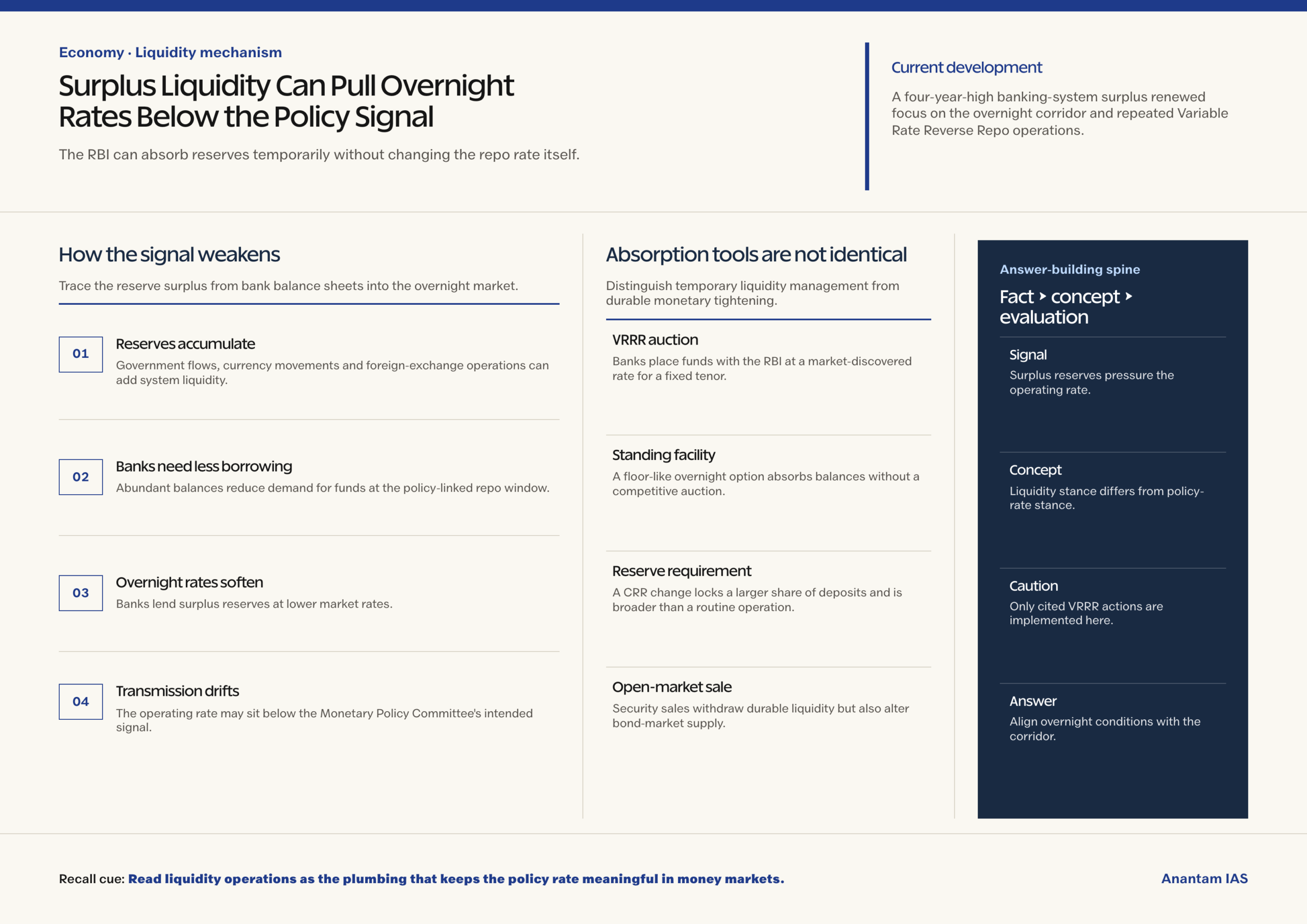
System liquidity describes the net short-term funds banks hold relative to their immediate reserve and payment needs.
- In a liquidity surplus, banks collectively seek safe places for excess reserves; in a deficit, they seek short-term funds from RBI or the money market.
- Competition to lend abundant funds pushes the weighted average call rate and other overnight rates downward, even when the policy repo rate itself is unchanged.
- The repo rate is the policy signal, while the overnight call rate is the main operating target through which RBI observes whether that signal is taking hold.
- The SDF floor gives eligible banks an overnight absorption option, while the MSF ceiling limits the cost of emergency overnight borrowing against eligible securities.
- Market rates can still stray because participants, collateral and timing differ, so RBI evaluates persistent misalignment rather than treating every isolated print as policy failure.
How VRRR Absorbs Liquidity
A VRRR auction removes surplus reserves for a chosen period without changing the Monetary Policy Committee’s repo-rate decision.
- Banks submit the rates at which they will place funds with RBI, and accepted bids determine a variable auction rate rather than a universal fixed return.
- Settlement transfers accepted funds from banks to RBI for the auction tenor, reducing reserves available for immediate overnight deployment and easing downward pressure on money-market rates.
- At maturity, RBI returns principal with accrued interest, so the absorption normally reverses unless another operation replaces it or underlying liquidity conditions change.
- Tenor choice matters: an overnight auction manages a brief surplus, while a 30-day operation can lock away funds across several reserve-maintenance and payment cycles.
- The September 4 release announced the operation and allowed premature reversal under stated conditions; it did not announce a CRR increase, incremental CRR or OMO sale.
Why Monetary Transmission Weakens
Transmission begins when the policy rate influences overnight funding costs and then spreads through the financial system.
- The intended chain runs from the repo signal to overnight rates, treasury and bond yields, bank funding costs, deposit rates, lending rates, spending and inflation.
- When overnight rates remain below the repo rate, effective short-term financing conditions become easier than the announced stance, weakening the first link in that transmission chain.
- Banks with ample low-cost funds may feel less pressure to raise deposit or lending rates after a policy-rate increase, delaying or diluting transmission to borrowers and savers.
- Excess liquidity does not mechanically cause inflation; the outcome also depends on credit demand, bank risk assessment, fiscal flows, currency demand and the economy’s unused capacity.
- Foreign inflows can create rupee liquidity when RBI buys foreign currency, but government balances, currency withdrawals and RBI’s domestic operations can add or remove liquidity independently.
Way Forward
Match the Tool to Persistence
RBI should separate temporary liquidity management from any change in the monetary-policy stance.
- Use calibrated VRRR tenors and amounts when the surplus is temporary, publishing auction results and monitoring whether the overnight operating rate returns near the repo signal.
- Consider OMO sales only when durable absorption is needed, because selling government securities can also influence bond yields, portfolio values and government borrowing conditions.
- Reserve CRR or incremental CRR changes for persistent, system-wide excess because they absorb funds forcefully but can raise intermediation costs and affect banks unevenly.
- Communicate the distinction clearly: liquidity absorption supports transmission, while any repo-rate change remains a separate decision based on inflation and growth.
Conclusion
- Surplus liquidity becomes a monetary-policy problem when it persistently pulls the overnight operating rate below the repo signal and loosens financing conditions beyond the intended stance.
- A strong answer should trace the transmission chain, identify VRRR as temporary absorption, and present CRR, incremental CRR and OMO sales only as trade-off-heavy options, not implemented measures.
UPSC Practice Questions
Prelims MCQ 1
With reference to RBI’s liquidity corridor, consider the following statements:
- The Standing Deposit Facility forms the lower bound of the corridor.
- The Marginal Standing Facility supplies overnight funds against eligible securities.
- A VRRR auction necessarily changes the policy repo rate.
How many of the above statements are correct?
(a) Only one (b) Only two (c) All three (d) None
Answer: (b) Only two
Explanation:
Statements 1 and 2 are correct. A VRRR auction absorbs liquidity at a variable auction rate but does not itself change the policy repo rate.
Prelims MCQ 2
Which option best describes the immediate effect of a successful VRRR auction?
(a) RBI permanently cancels bank reserves (b) Banks place funds with RBI for the auction tenor (c) The Monetary Policy Committee automatically raises the repo rate (d) RBI purchases government securities from banks
Answer: (b) Banks place funds with RBI for the auction tenor
Explanation:
Accepted VRRR bids temporarily transfer surplus funds to RBI. Principal and interest return at maturity unless liquidity is absorbed again through another operation.
UPSC Mains Questions
- Explain how persistent surplus banking-system liquidity can weaken monetary transmission even when the policy repo rate remains unchanged.
- Compare VRRR auctions, CRR changes and OMO sales as liquidity-absorption tools. Why must their use remain distinct from a change in the monetary-policy stance?
Sources: Reserve Bank of India and Indian Express Explained.
Frequently Asked Questions
What is surplus banking-system liquidity?
It means banks collectively hold short-term funds beyond immediate reserve and payment needs. They then compete to place those funds, usually pushing overnight market rates downward.
Why can overnight rates fall below the repo rate?
When lendable funds are abundant relative to borrowing demand, banks accept lower overnight returns. Persistent softness indicates that short-term financing conditions are easier than RBI’s central policy signal.
How does a VRRR auction absorb liquidity?
Banks bid to place surplus funds with RBI for a specified tenor at a variable rate. The funds return with interest at maturity, making the absorption temporary.
Did RBI announce a CRR increase or OMO sale?
No. The cited official release announced a 30-day VRRR auction. CRR, incremental CRR and OMO sales were discussed as possible tools, not confirmed measures.
Does excess liquidity automatically create inflation?
No. It may weaken rate transmission and enable easier credit, but inflation also depends on credit demand, spending, supply conditions, expectations and the economy’s available capacity.
Source: https://anantamias.com/current-affairs/rbi-surplus-liquidity-monetary-transmission/
Phase-3 SIR Draft Rolls: Scale and Grounds of Deletions
Why in News?
Phase-3 Special Intensive Revision draft rolls published across 17 States and Union Territories showed a 15.7% aggregate fall in electors compared with the 2024 Lok Sabha rolls.
- The combined count fell from about 355.05 million electors in the 2024 Lok Sabha rolls to 299.30 million in the published drafts.
- Against the higher rolls immediately before enumeration, the reported draft-stage deletions totalled about 61.5 million electors.
- The report classified about 11.1 million deletions as deceased and 45.2 million as absent, while its remaining category line was internally inconsistent.
- These are draft-roll figures, not final electoral rolls or a settled count of people finally excluded from voting.
- The national aggregate matters because a large stock change can reveal both genuine roll cleaning and weaknesses in classification, reconciliation or communication.
- UPSC answers should separate the scale of revision from claims about its correctness; aggregate deletion alone cannot identify whether each entry was validly removed.
UPSC Relevance
Prelims Relevance
- A draft electoral roll is provisional and may differ from the roll finally used after the revision cycle is completed.
- Deletion grounds such as death, absence and duplicate enrolment describe different administrative problems and should be reported separately.
- A fall measured from the 2024 Lok Sabha roll differs from deletions measured against a later pre-revision roll that included subsequent additions.
- The Election Commission of India supervises electoral-roll revision, while local electoral machinery verifies and updates entries.
- A national percentage can conceal major variation among States and Union Territories, so the denominator and reference date are essential.
Mains Relevance
GS Paper 2
- Electoral integrity requires both removal of invalid entries and protection of eligible citizens from erroneous exclusion.
- Transparent, reconcilable deletion categories strengthen accountability in a mass administrative exercise.
GS Paper 3
- Large public datasets need common definitions, comparable baselines, validation rules and an auditable trail.
- Data-quality failures can distort policy debate even when the underlying administrative exercise is legitimate.
Essay
- Democratic legitimacy depends not only on accurate institutions but also on public data that makes institutional action intelligible and verifiable.
Background and Context
Reading the National Aggregate
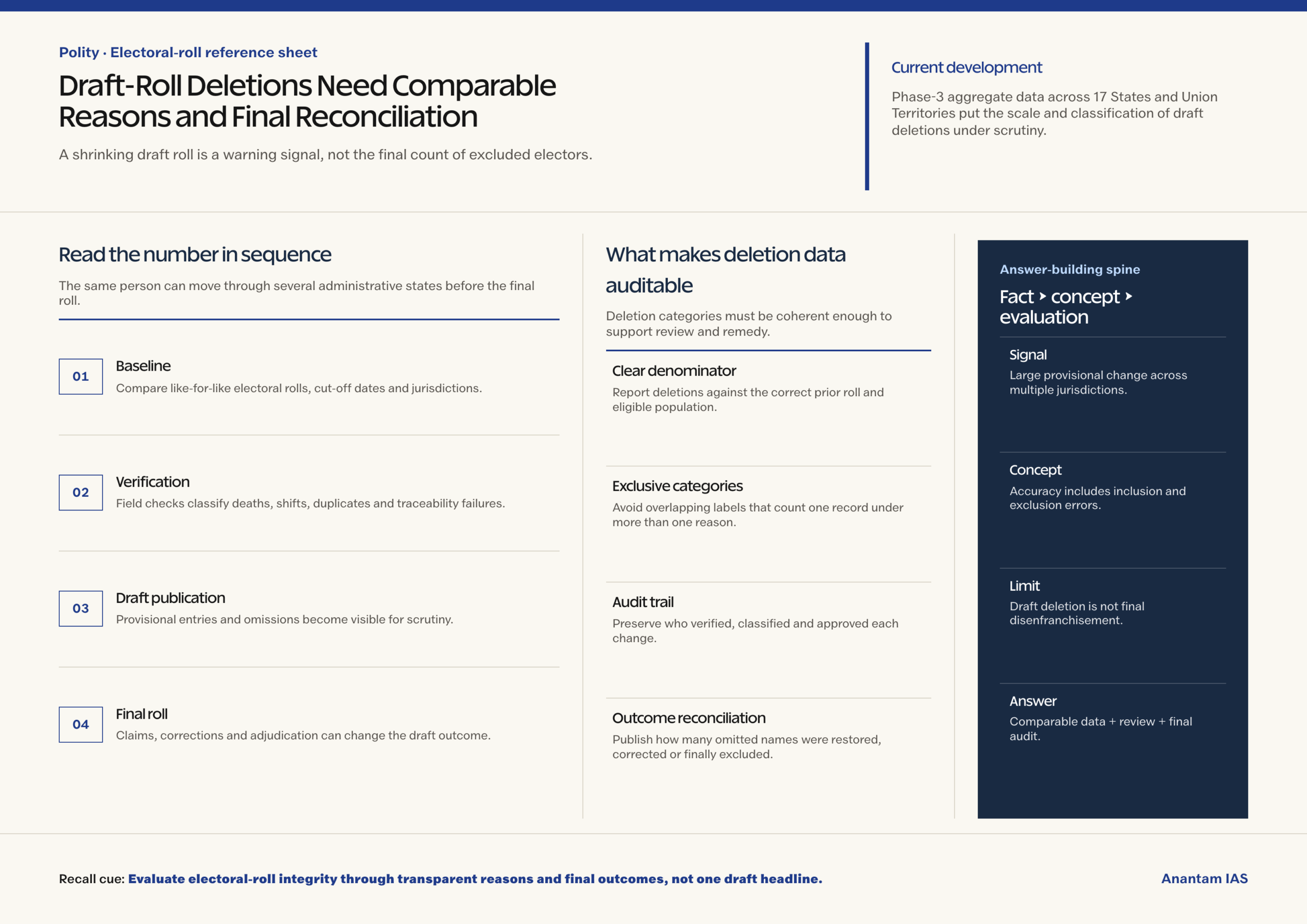
The headline decline is meaningful only when its geography, date and comparison base remain attached to it.
- The published drafts cover 17 States and Union Territories, while the wider third phase spans additional jurisdictions whose drafts were still awaited when the report appeared.
- The 15.7% decline compares the published draft stock with the 2024 Lok Sabha roll; it is a change between two snapshots, not a count of adjudicated errors.
- A separate deletion total uses the larger pre-enumeration stock, which had grown after 2024 through additions; mixing these denominators produces apparently conflicting numbers.
- The aggregate identifies scale, but it does not show whether the same verification conditions, migration patterns or roll-cleaning intensity operated in every jurisdiction.
- State-level variation should be examined before attributing the national fall to one cause, because an aggregate can be driven by a few large electorates.
What Deletion Categories Can and Cannot Show
Administrative labels are evidence only when their definitions are clear, mutually exclusive and arithmetically reconcilable.
- A deceased classification concerns an entry that should no longer remain active; an absent classification records a different verification outcome and should not be treated as death.
- Absence during verification does not by itself explain whether a person moved, was temporarily unavailable, was recorded at another address or remains otherwise eligible.
- Multiple enrolment is a roll-quality problem because one elector should not retain duplicate active entries, but the reported category figure was internally inconsistent and cannot support analysis.
- When category values fail to reconcile with the total, the sound response is to flag the discrepancy and await corrected official data, not invent a residual category.
- A useful audit table should publish definitions, source dates, category totals and a reconciliation check, allowing observers to reproduce the aggregate from its components.
Draft Roll Versus Final Inclusion
A draft is an intermediate administrative output; it indicates possible exclusion, not the final electorate.
- The published figures capture the roll at the draft stage, so later corrections and registrations can raise or otherwise change the final count.
- Draft deletion data should be used to target scrutiny, identify unusual patterns and test record quality rather than announce a settled number of disenfranchised citizens.
- The final roll must be compared with the draft using the same jurisdiction set and reference date; otherwise improvement or deterioration cannot be measured reliably.
- Public reporting should distinguish entries deleted during verification, entries restored later and new registrations, because each movement answers a different governance question.
- For examination answers, balance roll purity with electoral inclusion: accuracy requires removing invalid entries without converting weak data or temporary absence into permanent exclusion.
Way Forward
Make Revision Data Auditable
Better publication standards can convert a contested headline into evidence that administrators, courts, parties and citizens can assess.
- Release machine-readable State-wise tables with one denominator, a fixed cut-off date and category definitions that remain consistent across jurisdictions.
- Publish arithmetic reconciliation checks and corrected versions when totals or category values conflict, while retaining a visible correction history.
- Track the transition from draft to final rolls through additions, restorations and confirmed deletions without exposing personal voter information.
- Use independent statistical checks to flag abnormal geographic or demographic patterns for targeted administrative review.
Conclusion
- The phase-three data establishes a large provisional contraction, but it cannot alone establish the validity, cause or permanence of every deletion across varied electoral and distinct migration contexts.
- A strong answer pairs electoral-roll accuracy with inclusion, then demands comparable baselines, coherent categories and transparent draft-to-final reconciliation before drawing conclusions.
UPSC Practice Questions
Prelims MCQ 1
With reference to the interpretation of Phase-3 SIR data, consider the following statements:
- The published draft-roll count is necessarily identical to the final electoral roll.
- A percentage decline must be read with its baseline and reference date.
- An absent classification is analytically identical to a deceased classification.
How many of the above statements are correct?
(a) Only one (b) Only two (c) All three (d) None
Answer: (a) Only one
Explanation:
Only statement 2 is correct. Draft and final rolls may differ, and absence and death are distinct administrative categories.
Prelims MCQ 2
Which practice best improves the reliability of aggregate electoral-roll deletion data?
(a) Combining figures that use different cut-off dates (b) Treating every draft deletion as final exclusion (c) Publishing category definitions and reconciling their sum with the total (d) Reporting only the national percentage
Answer: (c) Publishing category definitions and reconciling their sum with the total
Explanation:
Clear definitions and arithmetic reconciliation make the aggregate auditable and prevent incompatible categories or denominators from being merged.
UPSC Mains Questions
- Large electoral-roll revisions test both electoral integrity and administrative data quality. Discuss with reference to provisional deletion figures and category-level transparency.
- Why must draft electoral-roll data be distinguished from final electoral inclusion? Suggest standards for transparent reporting of additions, restorations and deletions.
Source: The Hindu.
Frequently Asked Questions
What did the Phase-3 SIR draft rolls show?
Across 17 States and Union Territories with published drafts, the aggregate elector count was reported 15.7% below the corresponding 2024 Lok Sabha-roll total at that stage.
Are all names absent from the draft rolls finally deleted?
No. A draft roll is provisional. Later corrections and registrations can change the final roll, so draft absence should not be equated automatically with permanent electoral exclusion.
Why do deletion categories matter?
Death, absence and duplicate enrolment represent different roll-quality questions. Clear definitions and reconciled totals are necessary to judge the exercise without merging unlike administrative outcomes.
What was wrong with the reported category breakdown?
One published category value was internally incompatible with the overall deletion total. It should be omitted until corrected rather than repeated or used to infer a conclusion.
How should UPSC answers evaluate the SIR figures?
Use the data as a provisional governance signal, distinguish baselines, examine category quality and balance removal of invalid entries with protection against erroneous exclusion of eligible electors.
Source: https://anantamias.com/current-affairs/phase-three-sir-draft-roll-deletions/
BRICS Cross-Border Payments: Linking Domestic Systems Without a Common Currency
Why in News?
Ahead of the New Delhi summit, BRICS officials are exploring links among domestic payment systems and central bank digital currencies to make cross-border payments faster and less costly.
- Finance ministry and central bank representatives discussed payments cooperation and wider use of national currencies in Jaipur in August.
- The discussion covers direct links between domestic payment systems and a possible platform using wholesale central bank digital currencies.
- BRICS has adopted neither a common currency nor an operating independent settlement network; the present exercise concerns feasibility and design.
- Project Nexus offers a useful comparison, but it is a separate BIS-origin initiative rather than a BRICS project.
- Cheaper settlement could support trade and tourism among members without requiring every payment to pass through long intermediary chains.
- Payment connectivity concerns infrastructure and interoperability; it should not automatically be read as an agreement to replace the US dollar.
- Any multilateral design must reconcile national laws, foreign-exchange markets, compliance requirements, governance and technical standards.
UPSC Relevance
Prelims Relevance
- SWIFT primarily carries secure financial messages; the transfer and settlement of funds occur through separate banking arrangements.
- A correspondent bank provides payment services for another bank, often through accounts held with each other.
- A vehicle currency bridges two currencies that lack a sufficiently liquid direct market.
- A wholesale CBDC is central-bank money intended for transactions among eligible financial institutions, unlike a retail CBDC used by the public.
- Payment-versus-payment settlement makes the two currency legs conditional on each other, limiting foreign-exchange settlement risk.
Mains Relevance
GS Paper 2
- BRICS cooperation and India’s role in shaping practical institutions for the Global South
- Strategic autonomy without overstating de-dollarisation or political consensus
GS Paper 3
- Digital public infrastructure, payment interoperability and central bank digital currencies
- Trade facilitation, financial stability and cyber-resilient settlement systems
Essay
- Shared infrastructure succeeds when technical interoperability is matched by trust, rules and accountable governance.
Background and Context
Why Cross-Border Payments Remain Costly
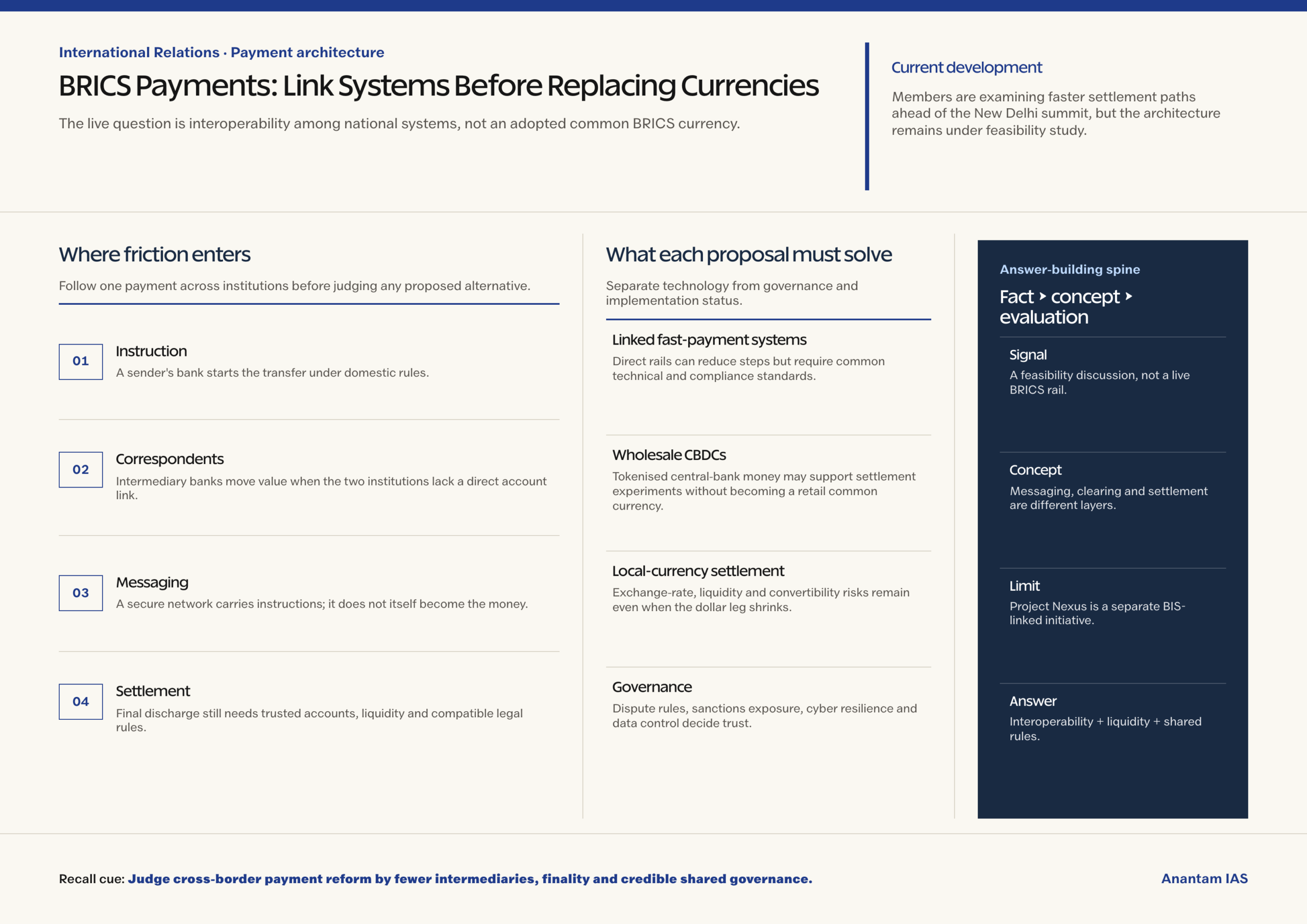
A cross-border transfer is a chain of messages, account movements and currency exchanges rather than one direct movement of money.
- When the payer’s bank lacks a direct relationship with the recipient’s bank, one or more correspondent banks bridge the transaction through accounts they maintain.
- Each intermediary performs screening, updates records and may charge a fee; different operating hours and incomplete information can add delay or require manual repair.
- If the two national currencies lack a liquid direct market, both may be exchanged through a vehicle currency, creating two conversion legs and extra foreign-exchange spreads.
- SWIFT standardises secure messages among financial institutions, but it does not itself hold customer funds or replace the banks that execute settlement.
- The problem is consequently broader than messaging: reform must address settlement assets, foreign-exchange liquidity, compliance, access and coordination across several legal jurisdictions.
Two Architectures Under Discussion
BRICS discussions point to interoperability, but alternative architectures solve different parts of the payment chain and remain proposals.
- One route links domestic instant-payment systems, allowing users of one national system to reach another without building a fresh bilateral connection for every participant.
- The UPI-PayNow link shows how two domestic systems can support remittances, while a multilateral hub could reduce the complexity created by many separate bilateral links.
- A second route would use wholesale CBDCs as settlement assets on a shared platform, enabling participating banks to exchange central-bank money across currencies.
- With payment-versus-payment, both currency legs settle together or neither settles, reducing the risk that one party delivers funds before receiving the counter-payment.
- These routes do not require a single BRICS currency: each country can retain its own unit while agreeing on connectivity, conversion, messaging and settlement rules.
Proposal, Pilot and Operating System Are Different
The central exam trap is to treat exploratory language, tested technology and an adopted multilateral institution as equivalent stages.
- The 2024 Kazan Declaration supported discussion and a feasibility study of BRICS Clear; this language did not establish an independent BRICS settlement system.
- India’s reported proposal to connect members’ CBDCs for trade and tourism is likewise a design option, not proof that common rules or live cross-border settlement exist.
- Project Nexus standardises connections among domestic instant-payment systems through one platform; participating central banks are moving it toward live implementation after BIS-led development.
- Nexus is institutionally separate from BRICS, so its blueprint can illustrate a hub model without serving as evidence that BRICS has adopted or operates that network.
- Implementation still requires decisions on governance, participation, legal finality, exchange-rate pricing, liquidity, consumer protection, sanctions exposure, anti-money-laundering controls, data protection and cyber resilience.
Way Forward
Build Interoperability in Verifiable Stages
A credible path should move from agreed standards to limited corridors before any claim of a common network.
- Define common technical standards while allowing each central bank and payment operator to retain authority over domestic access and risk controls.
- Test limited corridors with transparent measures for cost, speed, failed transactions, foreign-exchange spreads and complaint resolution before widening participation.
- Create joint rules for AML/CFT screening, data minimisation, cyber incident response, operational continuity and allocation of losses.
- Separate public communication about payment efficiency from unsupported claims about a common currency, full de-dollarisation or an already independent BRICS financial system.
Conclusion
- BRICS payment cooperation is best understood as a search for interoperable rails connecting national systems and currencies, not as an adopted common currency or functioning alternative financial order.
- A balanced answer should explain the correspondent-banking problem, distinguish instant-payment links from wholesale-CBDC settlement, and judge feasibility through governance, liquidity, compliance and cyber-risk requirements in equal measure.
UPSC Practice Questions
Prelims MCQ 1
With reference to cross-border payment systems, consider the following statements:
- SWIFT is primarily a secure financial messaging network rather than the institution that settles every payment.
- Payment-versus-payment can reduce settlement risk by making two currency legs conditional on each other.
- Project Nexus is an independent settlement system established and operated by BRICS.
How many of the above statements are correct?
(a) Only one (b) Only two (c) All three (d) None
Answer: (b) Only two
Explanation:
Statements 1 and 2 are correct. Project Nexus originated with the BIS Innovation Hub and participating central banks; it is separate from BRICS.
Prelims MCQ 2
What best distinguishes a wholesale central bank digital currency from a retail central bank digital currency?
(a) It can be issued only by commercial banks (b) It is necessarily a common currency shared by several countries (c) It is intended mainly for settlement among eligible financial institutions (d) It operates without central bank liabilities
Answer: (c) It is intended mainly for settlement among eligible financial institutions
Explanation:
Wholesale CBDC is central-bank money designed for eligible institutional settlement, while retail CBDC is intended for use by the wider public.
UPSC Mains Questions
- BRICS cross-border payment proposals seek efficiency without necessarily creating a common currency. Explain the proposed mechanisms and the principal implementation challenges. (250 words)
- Interlinking domestic payment systems is as much an institutional challenge as a technological one. Discuss with reference to governance, liquidity, compliance and cyber resilience. (250 words)
Sources: The Hindu Explained and Bank for International Settlements.
Frequently Asked Questions
Has BRICS adopted a common currency?
No. BRICS discussions concern payment connectivity, wider use of national currencies and possible CBDC links. They do not establish an adopted common currency or a functioning independent settlement system.
Does SWIFT itself settle cross-border payments?
SWIFT chiefly transmits standardised, secure financial messages. Banks and payment infrastructures separately move funds, convert currencies and settle obligations through accounts and correspondent relationships.
How could wholesale CBDCs reduce settlement risk?
A shared platform could use payment-versus-payment, under which both currency legs settle together or neither does. This reduces the risk of one party paying before receiving the counter-payment.
Is Project Nexus a BRICS initiative?
No. Nexus began as a BIS Innovation Hub project to standardise links among domestic instant-payment systems. Participating central banks are taking it toward implementation outside the BRICS framework.
Why are correspondent banks used in cross-border payments?
Banks without a direct account relationship use intermediary institutions that maintain relevant accounts and currency access. The chain enables reach but can add fees, screening steps and delays.
Source: https://anantamias.com/current-affairs/brics-cross-border-payments-linked-systems/