Why in News?
Phase-3 Special Intensive Revision draft rolls published across 17 States and Union Territories showed a 15.7% aggregate fall in electors compared with the 2024 Lok Sabha rolls.
- The combined count fell from about 355.05 million electors in the 2024 Lok Sabha rolls to 299.30 million in the published drafts.
- Against the higher rolls immediately before enumeration, the reported draft-stage deletions totalled about 61.5 million electors.
- The report classified about 11.1 million deletions as deceased and 45.2 million as absent, while its remaining category line was internally inconsistent.
- These are draft-roll figures, not final electoral rolls or a settled count of people finally excluded from voting.
- The national aggregate matters because a large stock change can reveal both genuine roll cleaning and weaknesses in classification, reconciliation or communication.
- UPSC answers should separate the scale of revision from claims about its correctness; aggregate deletion alone cannot identify whether each entry was validly removed.
UPSC Relevance
Prelims Relevance
- A draft electoral roll is provisional and may differ from the roll finally used after the revision cycle is completed.
- Deletion grounds such as death, absence and duplicate enrolment describe different administrative problems and should be reported separately.
- A fall measured from the 2024 Lok Sabha roll differs from deletions measured against a later pre-revision roll that included subsequent additions.
- The Election Commission of India supervises electoral-roll revision, while local electoral machinery verifies and updates entries.
- A national percentage can conceal major variation among States and Union Territories, so the denominator and reference date are essential.
Mains Relevance
GS Paper 2
- Electoral integrity requires both removal of invalid entries and protection of eligible citizens from erroneous exclusion.
- Transparent, reconcilable deletion categories strengthen accountability in a mass administrative exercise.
GS Paper 3
- Large public datasets need common definitions, comparable baselines, validation rules and an auditable trail.
- Data-quality failures can distort policy debate even when the underlying administrative exercise is legitimate.
Essay
- Democratic legitimacy depends not only on accurate institutions but also on public data that makes institutional action intelligible and verifiable.
Background and Context
Reading the National Aggregate
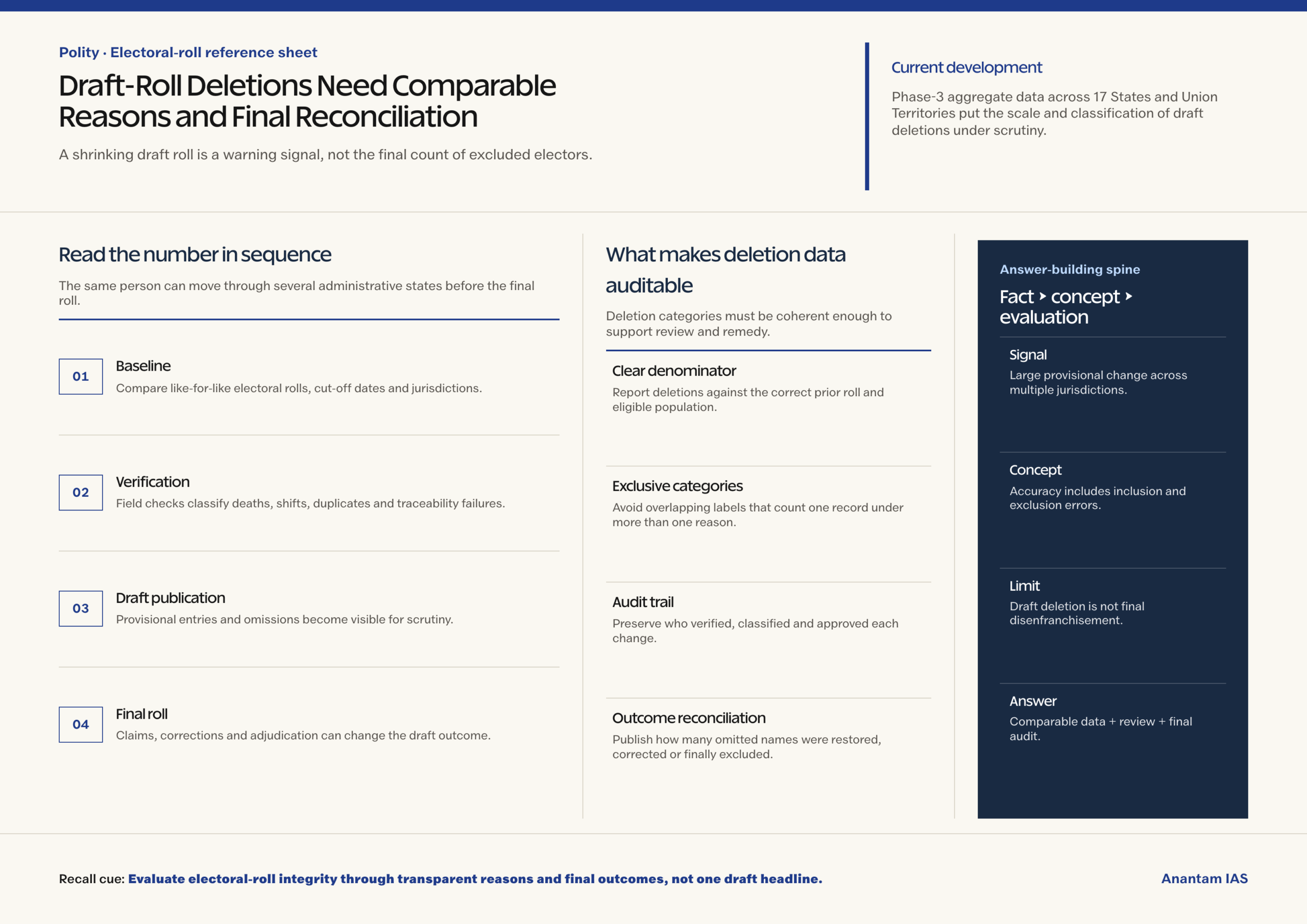
The headline decline is meaningful only when its geography, date and comparison base remain attached to it.
- The published drafts cover 17 States and Union Territories, while the wider third phase spans additional jurisdictions whose drafts were still awaited when the report appeared.
- The 15.7% decline compares the published draft stock with the 2024 Lok Sabha roll; it is a change between two snapshots, not a count of adjudicated errors.
- A separate deletion total uses the larger pre-enumeration stock, which had grown after 2024 through additions; mixing these denominators produces apparently conflicting numbers.
- The aggregate identifies scale, but it does not show whether the same verification conditions, migration patterns or roll-cleaning intensity operated in every jurisdiction.
- State-level variation should be examined before attributing the national fall to one cause, because an aggregate can be driven by a few large electorates.
What Deletion Categories Can and Cannot Show
Administrative labels are evidence only when their definitions are clear, mutually exclusive and arithmetically reconcilable.
- A deceased classification concerns an entry that should no longer remain active; an absent classification records a different verification outcome and should not be treated as death.
- Absence during verification does not by itself explain whether a person moved, was temporarily unavailable, was recorded at another address or remains otherwise eligible.
- Multiple enrolment is a roll-quality problem because one elector should not retain duplicate active entries, but the reported category figure was internally inconsistent and cannot support analysis.
- When category values fail to reconcile with the total, the sound response is to flag the discrepancy and await corrected official data, not invent a residual category.
- A useful audit table should publish definitions, source dates, category totals and a reconciliation check, allowing observers to reproduce the aggregate from its components.
Draft Roll Versus Final Inclusion
A draft is an intermediate administrative output; it indicates possible exclusion, not the final electorate.
- The published figures capture the roll at the draft stage, so later corrections and registrations can raise or otherwise change the final count.
- Draft deletion data should be used to target scrutiny, identify unusual patterns and test record quality rather than announce a settled number of disenfranchised citizens.
- The final roll must be compared with the draft using the same jurisdiction set and reference date; otherwise improvement or deterioration cannot be measured reliably.
- Public reporting should distinguish entries deleted during verification, entries restored later and new registrations, because each movement answers a different governance question.
- For examination answers, balance roll purity with electoral inclusion: accuracy requires removing invalid entries without converting weak data or temporary absence into permanent exclusion.
Way Forward
Make Revision Data Auditable
Better publication standards can convert a contested headline into evidence that administrators, courts, parties and citizens can assess.
- Release machine-readable State-wise tables with one denominator, a fixed cut-off date and category definitions that remain consistent across jurisdictions.
- Publish arithmetic reconciliation checks and corrected versions when totals or category values conflict, while retaining a visible correction history.
- Track the transition from draft to final rolls through additions, restorations and confirmed deletions without exposing personal voter information.
- Use independent statistical checks to flag abnormal geographic or demographic patterns for targeted administrative review.
Conclusion
- The phase-three data establishes a large provisional contraction, but it cannot alone establish the validity, cause or permanence of every deletion across varied electoral and distinct migration contexts.
- A strong answer pairs electoral-roll accuracy with inclusion, then demands comparable baselines, coherent categories and transparent draft-to-final reconciliation before drawing conclusions.
UPSC Practice Questions
Prelims MCQ 1
With reference to the interpretation of Phase-3 SIR data, consider the following statements:
- The published draft-roll count is necessarily identical to the final electoral roll.
- A percentage decline must be read with its baseline and reference date.
- An absent classification is analytically identical to a deceased classification.
How many of the above statements are correct?
(a) Only one (b) Only two (c) All three (d) None
Answer: (a) Only one
Explanation:
Only statement 2 is correct. Draft and final rolls may differ, and absence and death are distinct administrative categories.
Prelims MCQ 2
Which practice best improves the reliability of aggregate electoral-roll deletion data?
(a) Combining figures that use different cut-off dates (b) Treating every draft deletion as final exclusion (c) Publishing category definitions and reconciling their sum with the total (d) Reporting only the national percentage
Answer: (c) Publishing category definitions and reconciling their sum with the total
Explanation:
Clear definitions and arithmetic reconciliation make the aggregate auditable and prevent incompatible categories or denominators from being merged.
UPSC Mains Questions
- Large electoral-roll revisions test both electoral integrity and administrative data quality. Discuss with reference to provisional deletion figures and category-level transparency.
- Why must draft electoral-roll data be distinguished from final electoral inclusion? Suggest standards for transparent reporting of additions, restorations and deletions.
Source: The Hindu.
Frequently Asked Questions
What did the Phase-3 SIR draft rolls show?
Across 17 States and Union Territories with published drafts, the aggregate elector count was reported 15.7% below the corresponding 2024 Lok Sabha-roll total at that stage.
Are all names absent from the draft rolls finally deleted?
No. A draft roll is provisional. Later corrections and registrations can change the final roll, so draft absence should not be equated automatically with permanent electoral exclusion.
Why do deletion categories matter?
Death, absence and duplicate enrolment represent different roll-quality questions. Clear definitions and reconciled totals are necessary to judge the exercise without merging unlike administrative outcomes.
What was wrong with the reported category breakdown?
One published category value was internally incompatible with the overall deletion total. It should be omitted until corrected rather than repeated or used to infer a conclusion.
How should UPSC answers evaluate the SIR figures?
Use the data as a provisional governance signal, distinguish baselines, examine category quality and balance removal of invalid entries with protection against erroneous exclusion of eligible electors.
Tell Google you want more of this.
Add Anantam IAS as a preferred sourceOne tap, and this site shows up more often in your own Top Stories, AI Overviews and AI Mode. Remove it any time.