Why in News?
The Indian Express reported on September 6 that NCB officials had identified two suspected heroin routes into Jammu, one through the Punjab-Jammu corridor and another linked to Uri in North Kashmir.
- NCB officials said a September 3 bus interception near Samba yielded 522 grams of heroin and generated a follow-up lead to Ludhiana.
- Investigators separately attributed an August 22 seizure of 5.160 kg in Jammu to a consignment allegedly routed through the Uri sector.
- Officials placed the cumulative recovery from the connected operations at 6.920 kg, but seizure weight alone does not establish every network link.
- The alleged source, intended recipients, financiers, associates and wider interstate or cross-border connections remain under investigation.
- The reported routes connect border management with ordinary interstate transport, showing how illicit supply chains can combine separate entry, transit and distribution stages.
- Network disruption requires investigators to move from possession evidence toward communications, money flows, logistics and legally sustainable attribution.
UPSC Relevance
Prelims Relevance
- Narcotic Drugs and Psychotropic Substances Act, 1985
- Narcotics Control Bureau as the Central coordinating agency
- Small, intermediate and commercial quantity thresholds
- Section 27A: financing illicit traffic and harbouring offenders
- Section 50 safeguards for personal search
- Interstate and cross-border trafficking routes
Mains Relevance
GS Paper 3
- Border, transport and financial dimensions of narcotics trafficking
- Intelligence-led investigation and inter-agency coordination
GS Paper 2
- Due process, evidentiary integrity and Centre-State coordination in drug-law enforcement
Essay
- Security institutions become more effective when they follow networks and incentives while preserving the evidentiary discipline needed for fair prosecution.
Background and Context
From Seizure Point to Trafficking Chain
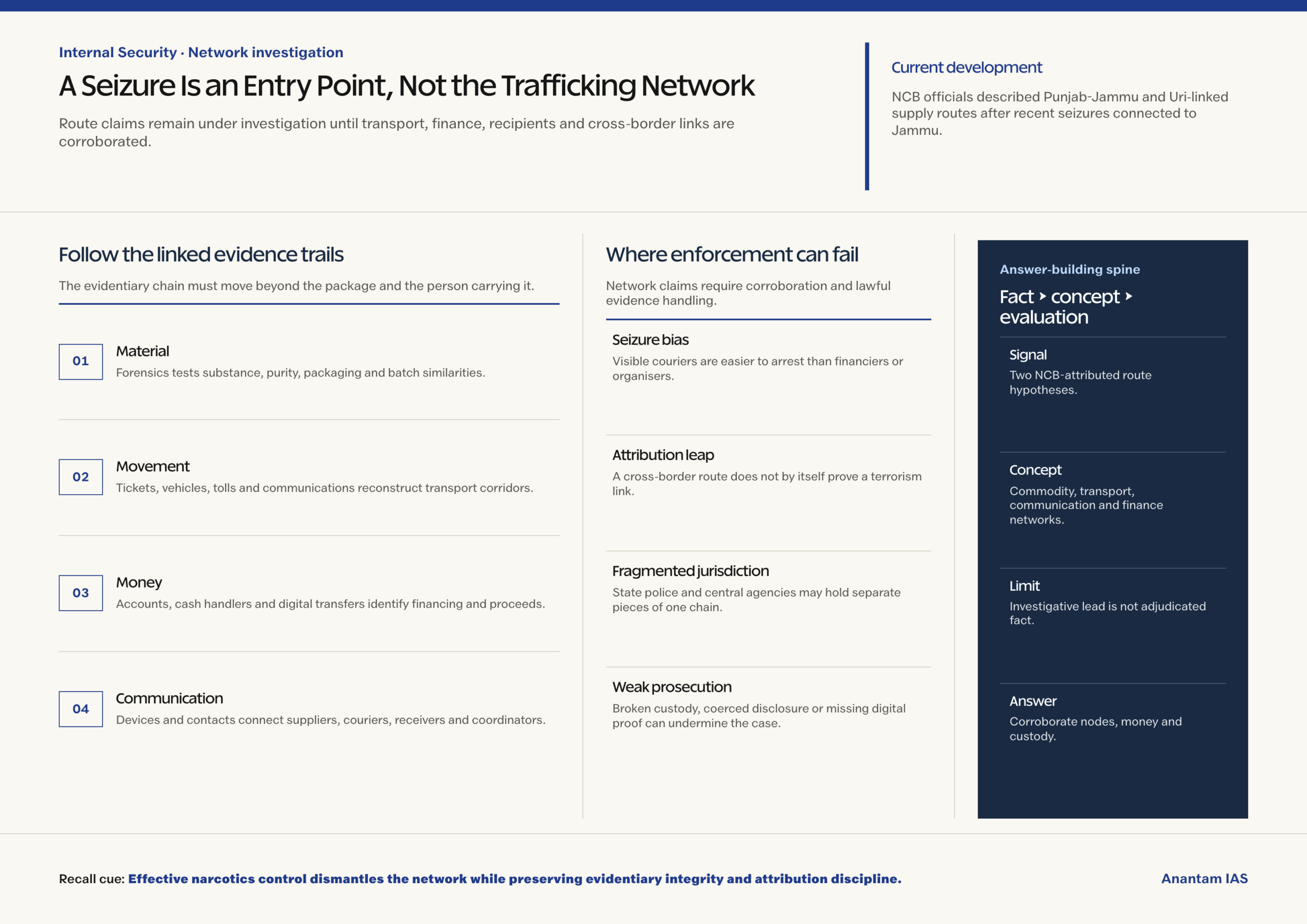
A consignment is a visible node; the trafficking system extends before and after the point of interception.
- Investigators must distinguish the entry route, transit corridor, storage point, courier movement and final distribution layer instead of treating them as one continuous journey with a single controller.
- A Punjab-origin passenger movement and a separately alleged Uri-linked consignment may reach the same market while involving different suppliers, handlers and financing arrangements.
- A courier’s possession can support an individual case, but it does not automatically identify the organiser, intended recipient or person who financed and expected to profit from the shipment.
- Follow-up searches, device analysis, travel records and communications can connect nodes, provided collection and authentication comply with criminal-procedure and evidence requirements.
- Financial trails matter because payments, cash couriers, informal transfers and asset acquisition can reveal controllers who remain distant from the physical drug movement and insulate themselves through intermediaries.
NDPS Enforcement Architecture
India’s framework combines strict drug-control offences with shared enforcement and procedural safeguards.
- The NDPS Act, 1985 regulates narcotic drugs and psychotropic substances and penalises unauthorised production, possession, transport, interstate movement and related conduct.
- Punishment for several offences depends on whether the recovered substance falls within the notified small, intermediate or commercial quantity category, making accurate weighing and chemical identification legally consequential.
- For heroin, the officially notified commercial quantity is 250 grams; each reported principal seizure exceeded that threshold, subject to laboratory confirmation and proof at trial.
- Section 27A separately addresses financing illicit traffic and harbouring offenders, making the money trail central when evidence supports such an allegation.
- The NCB acts as the Central coordinating and enforcement agency, working with State police, Customs, border forces and other drug-law enforcement bodies across territorial and institutional boundaries.
Attribution, Evidence and Enforcement Limits
Strong enforcement depends on proving each link, not converting an investigative theory into a settled conclusion.
- The Punjab-Jammu and Uri descriptions are NCB-attributed investigative claims reported by the newspaper; they are not judicial findings about a complete network.
- The alleged Pakistan origin of the Uri-linked consignment also remains an investigators’ claim and requires corroboration through admissible evidence and cross-agency intelligence.
- Search and seizure documentation, representative sampling, laboratory examination and secure custody protect the identity and integrity of the substance produced before a court, reducing contamination and substitution disputes.
- Investigators must separate possession, knowledge, conspiracy and financing evidence because different participants may perform limited roles without knowing the network’s entire structure, source or ultimate destination.
- Public communication should identify what was seized and what is alleged while avoiding labels that outrun the evidence or prejudice an ongoing investigation.
Way Forward
Disrupt the Network, Preserve the Case
- Create a joint route-intelligence picture linking seizures, vehicles, devices, recurring contact points and financial indicators across Punjab, Jammu and Kashmir, and Ladakh.
- Use risk-based checks on transport corridors without turning routine passenger movement into indiscriminate profiling or weakening lawful search safeguards.
- Trace suspected proceeds and beneficial control in parallel with the physical consignment, using financial intelligence only where evidence establishes a defensible connection.
- Audit chain-of-custody, sampling and digital-evidence procedures early so that operational success can survive scrutiny during prosecution.
Conclusion
- The Jammu cases show why route detection is only the first stage: durable disruption requires proof connecting entry, transport, receipt, finance and control across jurisdictions, followed by prosecution that survives evidentiary scrutiny.
- A strong Mains answer should combine coordinated border and interstate intelligence with financial investigation, forensic custody and careful attribution, while stating clearly that the wider network remains under investigation.
UPSC Practice Questions
Prelims MCQ 1
With reference to India’s narcotics-control framework, consider the following statements:
- The Narcotics Control Bureau is the Central coordinating agency for drug-law enforcement.
- The NDPS Act prescribes the same punishment for every quantity of a narcotic drug.
- Section 27A addresses financing illicit traffic and harbouring offenders.
How many of the above statements are correct?
(a) Only one (b) Only two (c) All three (d) None
Answer: (b) Only two
Explanation:
Statements 1 and 3 are correct. For several NDPS offences, punishment varies according to the notified small, intermediate and commercial quantity categories.
Prelims MCQ 2
Which investigative approach best targets a trafficking network beyond the seizure of a drug consignment?
(a) Treating seizure weight as proof of every alleged cross-border link (b) Examining only the courier’s statement and closing the financial inquiry (c) Linking transport, communications, recipients and financial trails through admissible evidence (d) Publicly assigning every suspect the same role before investigation concludes
Answer: (c) Linking transport, communications, recipients and financial trails through admissible evidence
Explanation:
Network investigation follows the physical and financial chain while preserving evidence and proving each participant’s role instead of relying on inference from one seizure.
UPSC Mains Questions
- Narcotics interdiction must move from consignment seizure to network disruption. Discuss with reference to transport corridors, financial investigation and inter-agency coordination.
- How can drug-law enforcement balance intelligence-led operations with procedural safeguards and careful attribution during an ongoing cross-jurisdictional investigation?
Sources: Indian Express and Narcotics Control Bureau, Government of India.
Frequently Asked Questions
What routes has the NCB claimed to identify into Jammu?
NCB officials reportedly identified one suspected route through the Punjab-Jammu corridor and another linked to Uri in North Kashmir. These remain investigative claims, not final judicial findings.
What remains under investigation in the Jammu heroin cases?
Investigators are still examining the source, intended recipients, financiers, associates and wider interstate or cross-border links. The presently reported seizures do not settle those questions.
Why is a seizure alone insufficient to dismantle a trafficking network?
A seizure may establish possession of a consignment, but investigators must separately connect suppliers, couriers, receivers, financiers and controllers through admissible communications, financial and logistical evidence.
What is the NCB’s role in narcotics enforcement?
The NCB is the Central coordinating agency for drug-law enforcement and also conducts operations through its field units in cooperation with State police, Customs and other agencies.
Why does the financial trail matter in a narcotics case?
Payments and assets may identify organisers who never handle the drugs. A lawful financial inquiry can help prove financing, control and benefit beyond the courier level.
Tell Google you want more of this.
Add Anantam IAS as a preferred sourceOne tap, and this site shows up more often in your own Top Stories, AI Overviews and AI Mode. Remove it any time.