Why in News?
Bihar’s Home Department issued a September 3 notification requiring prior State consent for CBI action involving Bihar public servants while continuing consent for cases involving Central government employees.
- The order covers investigation, search, interrogation, arrest and related CBI action against public servants serving under the Bihar government.
- Consent continues for notified offences involving Central government employees, Central public-sector undertakings and private individuals under direct Central control.
- For covered Bihar public servants and State-controlled bodies, the CBI must send a proposal and obtain case-specific prior consent.
- The notification supersedes earlier State notifications on the subject but does not amount to a total withdrawal of CBI consent.
- The order demonstrates how federalism shapes the territorial reach of a Central investigative agency within a State.
- Its exam value lies in distinguishing general consent, case-specific consent and court-directed investigation.
UPSC Relevance
Prelims Relevance
- Delhi Special Police Establishment Act, 1946
- Section 3: offences investigated by the DSPE
- Section 5: territorial extension of powers
- Section 6: State consent requirement
- General consent and case-specific consent
- CBI and State police jurisdiction
Mains Relevance
GS Paper 2
- Federal distribution of policing powers and the statutory reach of Central investigation
- Accountability, impartial investigation and Centre-State trust
GS Paper 3
- Institutional coordination in corruption and cybercrime investigations
Essay
- Federal checks can protect autonomy, but they work best when accompanied by transparent and time-bound institutional cooperation.
Background and Context
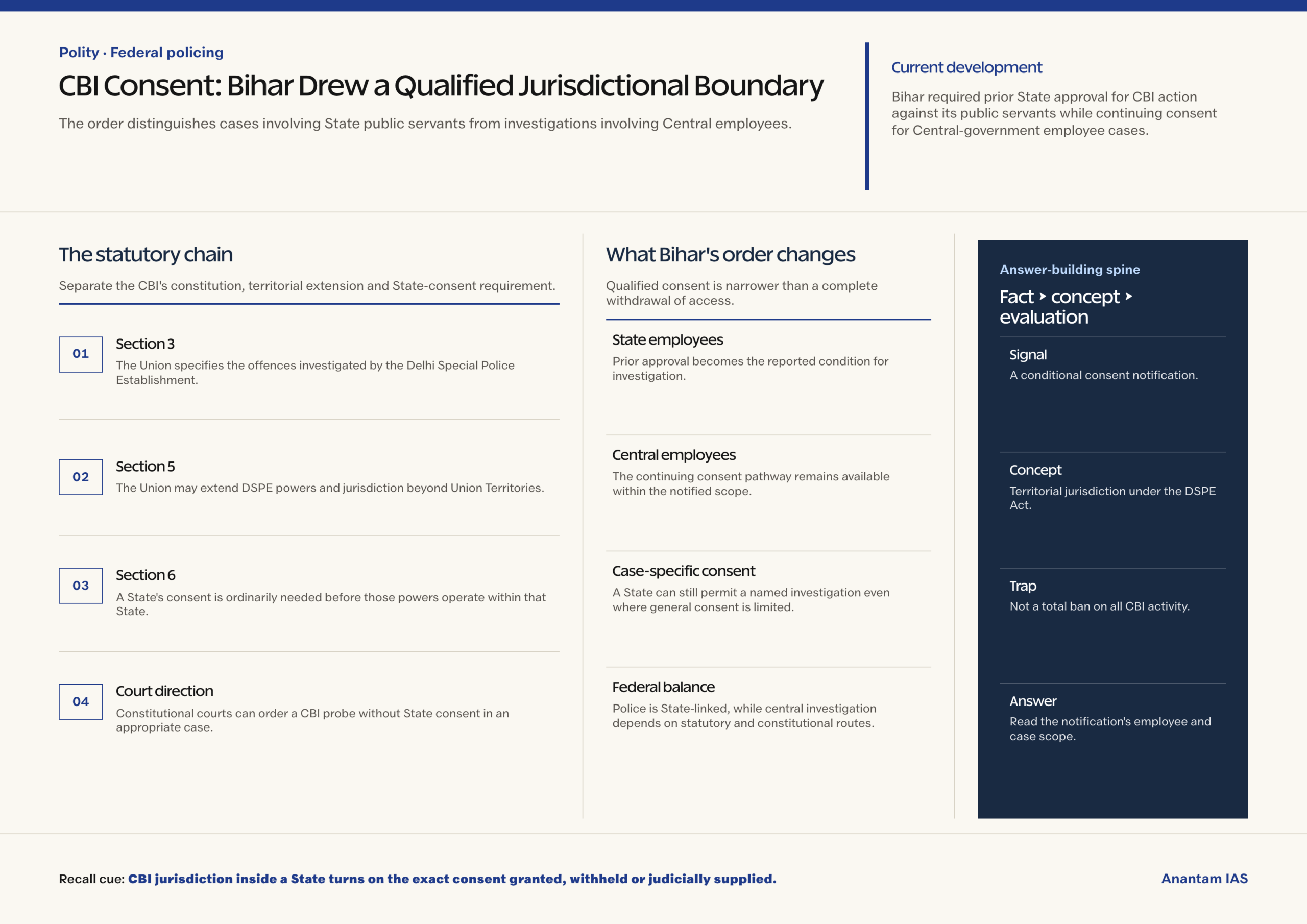
How Sections 3, 5 and 6 Work Together
The consent rule makes sense only when the three-step statutory chain is read together.
- The CBI is not a constitutionally created police force; its investigative police powers operate through the Delhi Special Police Establishment Act, 1946.
- Under Section 3, the Central government specifies the offences or classes of offences that members of the Delhi Special Police Establishment may investigate.
- Under Section 5, the Central government may extend DSPE powers and jurisdiction to an area in a State for those specified offences.
- Section 6 qualifies that extension: DSPE personnel cannot exercise Section 5 powers in a State, outside a Union territory or railway area, without that State government’s consent.
- Consent is consequently a territorial federal boundary. It determines when DSPE officers may use police powers inside the State; it does not abolish the agency itself.
What Bihar's Notification Changes
Bihar has redrawn its consent by category of personnel rather than closing the State entirely to the CBI.
- The notification preserves consent for notified offences involving employees of the Union government, Central public-sector undertakings and private persons under direct Central control.
- It includes offences under the new criminal codes, the Information Technology Act, cybercrime matters and the Prevention of Corruption Act within that retained Central-employee scope.
- When allegations involve Bihar public servants, State-owned or State-controlled entities, or State-funded institutions, the CBI must first obtain Bihar’s prior consent.
- The State will consider a CBI proposal case by case, allowing approval for a particular investigation without granting unrestricted advance authority across the protected category.
- The accurate description is qualified general consent: one personnel category remains covered, while another moves behind a prior-approval gate.
Federal Significance and Exam Traps
Consent balances State control over policing with the demand for credible investigation across jurisdictions.
- Police and public order largely fall within the State List, while Parliament’s DSPE framework supplies the statutory route for extending Central investigative police powers.
- A State consent condition may strengthen democratic control over policing, but slow or selective decisions can delay investigations and create perceptions of political shielding.
- General consent avoids repeated approvals for every covered case; case-specific consent lets a State examine each proposal before DSPE officers exercise powers within its territory.
- Do not confuse Section 6 consent with sanction or approval required under other criminal laws for investigating or prosecuting an individual public servant; they answer different legal questions.
- Constitutional court directions are a separate route: the Supreme Court and High Courts may order a CBI investigation under their constitutional powers without first securing State consent.
Way Forward
Make Consent Decisions Rule-Based
A qualified system needs safeguards against both investigative overreach and politically convenient delay.
- Publish clear criteria and a reasonable timeline for deciding case-specific CBI proposals involving Bihar public servants.
- Record reasons for approval or refusal, subject to legal confidentiality, so that decisions can withstand administrative and judicial scrutiny.
- Create a coordination protocol for evidence preservation, inter-State offences and cases involving both Central and State personnel.
- Review the consent arrangement periodically against investigation delays, jurisdictional disputes and outcomes rather than treating either unrestricted or withheld consent as permanent.
Conclusion
- Bihar’s order is a calibrated use of Section 6: it preserves CBI access for Central-employee cases but requires prior State approval when Bihar public servants are involved.
- In a Mains answer, frame consent as a federal jurisdictional safeguard, then weigh State autonomy against impartial investigation, delay risks and the need for reasoned, time-bound decisions and transparent intergovernmental coordination.
UPSC Practice Questions
Prelims MCQ 1
With reference to the Delhi Special Police Establishment Act, 1946, consider the following statements:
- Section 3 enables the Central government to specify offences or classes of offences for DSPE investigation.
- An order under Section 5 by itself permits DSPE officers to exercise jurisdiction in every State without State consent.
- Section 6’s State-consent restriction excludes Union territories and railway areas.
How many of the above statements are correct?
(a) Only one (b) Only two (c) All three (d) None
Answer: (b) Only two
Explanation:
Statements 1 and 3 are correct. Section 5 permits territorial extension, but Section 6 conditions its exercise in a State on that State government’s consent.
Prelims MCQ 2
Which description most accurately captures Bihar’s September 2026 CBI consent notification?
(a) It abolished the CBI’s jurisdiction throughout Bihar in every category of case. (b) It retained consent for cases involving Central employees but required prior State consent for cases involving Bihar public servants. (c) It transferred all corruption investigations in Bihar to the Union government. (d) It made State consent unnecessary whenever the Prevention of Corruption Act is invoked.
Answer: (b) It retained consent for cases involving Central employees but required prior State consent for cases involving Bihar public servants.
Explanation:
The notification draws a personnel-based boundary. It continues consent within the specified Central sphere and introduces case-specific prior consent for the Bihar public-servant sphere.
UPSC Mains Questions
- Explain how Sections 3, 5 and 6 of the Delhi Special Police Establishment Act structure the CBI’s jurisdiction within a State.
- State consent for CBI investigations is both a federal safeguard and a possible source of investigative delay. Discuss with reference to Bihar’s qualified consent order.
Sources: The Hindu and India Code, Ministry of Law and Justice.
Frequently Asked Questions
Has Bihar completely withdrawn consent for CBI investigations?
No. Bihar retained consent for specified cases involving Central employees and related Central entities, while requiring prior State approval when Bihar public servants or covered State bodies are involved.
What does Section 6 of the DSPE Act require?
It prevents DSPE personnel from exercising powers extended under Section 5 in a State, excluding a Union territory or railway area, unless that State’s government has consented.
What is the difference between general and case-specific consent?
General consent permits CBI action within defined categories without repeated approval. Case-specific consent requires the agency to seek State permission for the particular investigation before exercising powers there.
Can a constitutional court order a CBI investigation without State consent?
Yes. The Supreme Court has held that the Supreme Court and High Courts may use their constitutional powers to direct a CBI investigation without obtaining State consent.
Why is the Bihar notification important for federalism?
It shows that a Central agency’s police powers within a State depend on a statutory consent boundary, allowing State autonomy while preserving defined space for Central investigations.
Tell Google you want more of this.
Add Anantam IAS as a preferred sourceOne tap, and this site shows up more often in your own Top Stories, AI Overviews and AI Mode. Remove it any time.