Why in News?
Indonesia’s Anak Krakatau erupted early on September 6, sending ash across western Indonesia and prompting a temporary suspension of flight operations at Jakarta’s Soekarno-Hatta International Airport.
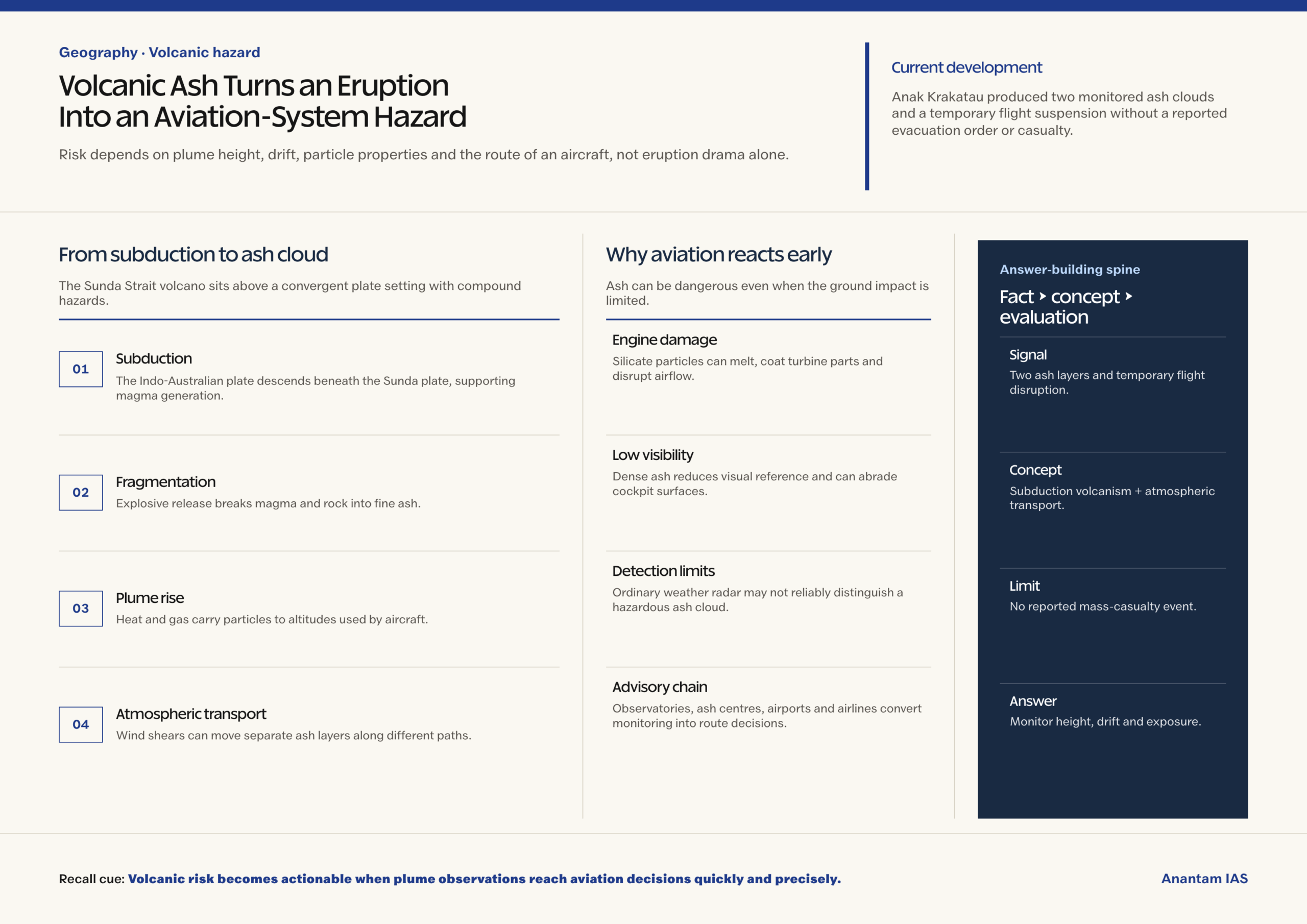
- Indonesia’s volcanology agency and the Darwin Volcanic Ash Advisory Centre identified two ash clouds through satellite imagery.
- The lower cloud reached 20,000 feet and drifted northeast, while the higher cloud reached 50,000 feet and moved west to northwest.
- The airport temporarily suspended all flight operations as a precaution against ash exposure; cancellations and passenger disruption followed.
- Authorities reported no casualties and issued no evacuation order. People were still told to remain outside the active-crater exclusion zone.
- An ash cloud can threaten aircraft far from a crater, so eruption monitoring must connect volcanology, satellite meteorology, air-traffic services and airport decisions.
- The present report did not describe a tsunami. The Sunda Strait’s earlier volcano-generated tsunamis explain why compound-hazard readiness remains necessary.
UPSC Relevance
Prelims Relevance
- Anak Krakatau lies in the Sunda Strait between Java and Sumatra.
- It belongs to a subduction-zone volcanic arc, not a divergent plate boundary.
- Volcanic ash consists of fine, angular fragments of rock, minerals and volcanic glass.
- A Volcanic Ash Advisory Centre tracks and forecasts ash-cloud position and movement for aviation users.
- A volcanic flank collapse can displace seawater and generate a tsunami without a large tectonic earthquake.
Mains Relevance
GS Paper 1
- Subduction-zone volcanism and the formation of island arcs
- Interaction among eruptions, slope failure and tsunami generation
GS Paper 3
- Multi-hazard early warning for island volcanoes and exposed coasts
- Coordination between scientific advisories, civil aviation and local disaster management
Essay
- Invisible risks test institutions: effective safety depends on turning scientific uncertainty into timely, proportionate public action.
Background and Context
Why Anak Krakatau Is Volcanically Active
Anak Krakatau is part of an island-arc system powered by convergence beneath Indonesia.
- At the Sunda subduction zone, dense Indo-Australian oceanic lithosphere descends beneath the Sunda margin, carrying water-rich minerals into depth beneath the volcanic arc.
- Heat and pressure release water from the sinking slab. These fluids lower the melting temperature of the overlying mantle wedge and promote partial melting without the plates pulling apart.
- Buoyant magma rises through fractures and may collect in crustal reservoirs. Dissolved gases expand as pressure falls, helping drive explosive fragmentation near the surface.
- Explosive eruptions break magma and older rock into tephra. The finest fragments become volcanic ash that convection and high-altitude winds can transport widely.
- Anak Krakatau, meaning Child of Krakatau, grew within the older Krakatau caldera after the catastrophic eruption. Repeated construction and collapse shape this young volcanic island.
Why Volcanic Ash Disrupts Aviation
Ash is a mechanical and thermal hazard, not the soft residue associated with an ordinary fire.
- Its angular particles can abrade windscreens, leading edges and compressor blades. Ash can also contaminate sensors, reduce pilots’ external visibility and erode protective surfaces.
- Silicate particles entering a jet engine may melt in the hottest section, then re-solidify on cooler components, disturbing airflow and reducing thrust.
- Even where an aircraft avoids immediate engine failure, low concentrations can accelerate wear. Avoidance is safer than treating an ash cloud as normal weather.
- The two observed clouds travelled in different directions at different heights. This shows why plume altitude and winds aloft matter as much as distance from the crater.
- The Darwin VAAC converts satellite, observatory and meteorological evidence into ash advisories. Operators and aviation authorities use that guidance for rerouting, suspension and reopening decisions.
The Sunda Strait's Compound-Hazard History
Krakatau demonstrates how one volcanic system can produce several hazards with very different footprints.
- Local hazards include ballistic fragments, lava, hot pyroclastic material, gases and ashfall. Airborne ash creates a separate, downwind hazard corridor for settlements and aviation.
- The Krakatau eruption and caldera collapse in the nineteenth century generated destructive tsunamis around the Sunda Strait, reshaped the volcanic complex and showed that hazards can cross land-sea boundaries.
- In 2018, a major eruption and flank collapse at Anak Krakatau displaced seawater and produced a deadly tsunami along parts of Java and Sumatra.
- A flank-collapse tsunami may arrive without the strong tectonic shaking people associate with earthquake-generated waves. Coastal warning systems must account for this short-lead-time problem.
- Today’s ash episode should not be equated with a new collapse or tsunami. Its lesson is to maintain linked monitoring for eruption, slope instability, ocean response and ash transport.
Way Forward
Link Monitoring to Clear Decisions
- Combine seismic, deformation, gas, visual and satellite observations to distinguish routine unrest from rapid changes in eruption or slope stability.
- Integrate volcano observatories, VAAC advisories, meteorological offices, air-traffic control and airlines through tested communication protocols and decision thresholds.
- Maintain tide gauges and other sea-level monitoring around the Sunda Strait, with coastal warnings designed for volcanic tsunamis that may offer little lead time.
- Reopen affected airspace through updated plume observations and risk assessment, while communicating uncertainty and passenger implications clearly.
Conclusion
- Anak Krakatau connects plate tectonics to practical risk governance: subduction supplies magma, explosive fragmentation produces ash, and atmospheric transport can interrupt aviation far from the vent.
- A strong answer should separate the current ash emergency from historical tsunami events, then show why the Sunda Strait needs integrated, multi-hazard monitoring rather than a single-warning system.
UPSC Practice Questions
Prelims MCQ 1
With reference to Anak Krakatau and volcanic-ash monitoring, consider the following statements:
- Anak Krakatau is situated in the Sunda Strait between Java and Sumatra.
- It is associated with a divergent plate boundary.
- Volcanic Ash Advisory Centres provide information on observed and forecast ash-cloud movement for aviation.
How many of the above statements are correct?
(a) Only one (b) Only two (c) All three (d) None
Answer: (b) Only two
Explanation:
Statements 1 and 3 are correct. Anak Krakatau lies in the Sunda Strait and VAACs support aviation with ash advisories. It is linked to subduction-zone volcanism, not divergence.
Prelims MCQ 2
Why can volcanic ash cause a serious loss of jet-engine performance?
(a) It always freezes the aviation fuel inside the wing tanks (b) Silicate particles can melt in hot engine sections and re-solidify on cooler components (c) It removes atmospheric oxygen from the entire flight corridor (d) Its magnetic field disables all navigation satellites
Answer: (b) Silicate particles can melt in hot engine sections and re-solidify on cooler components
Explanation:
Volcanic ash contains silicate material. Ingested particles may melt, deposit on cooler engine components, disrupt airflow and reduce thrust; abrasive particles also damage exposed surfaces.
UPSC Mains Questions
- Explain the tectonic processes that sustain volcanism in the Sunda Arc. How can an explosive eruption affect aviation far beyond the immediate crater zone?
- The Sunda Strait requires a compound-hazard approach to disaster management. Discuss with reference to volcanic ash, flank collapse and tsunami warning.
Sources: The Hindu (Associated Press) and U.S. Geological Survey.
Frequently Asked Questions
Where is Anak Krakatau located?
Anak Krakatau is an active volcanic island in Indonesia’s Sunda Strait, between Java and Sumatra. It grew within the Krakatau caldera after the earlier volcanic edifice collapsed.
Why was Jakarta’s main airport temporarily closed?
Authorities suspended flights because drifting volcanic ash can damage aircraft surfaces, contaminate instruments and impair jet engines. The closure was precautionary while the ash hazard was assessed.
What does a Volcanic Ash Advisory Centre do?
A VAAC analyses observatory, satellite and weather information to describe and forecast volcanic-ash clouds. Its advisories support pilots, airlines, meteorological offices and air-traffic managers.
Did the September 6 eruption cause a tsunami?
The report described ash clouds and aviation disruption, not a tsunami. The tsunami risk belongs to the volcano’s compound-hazard history and should not be presented as a current impact.
How did Anak Krakatau generate a tsunami in 2018?
An eruption accompanied a major flank collapse. Material entering the sea displaced water and generated a tsunami, illustrating why volcanic tsunamis can occur without a large tectonic earthquake.
Tell Google you want more of this.
Add Anantam IAS as a preferred sourceOne tap, and this site shows up more often in your own Top Stories, AI Overviews and AI Mode. Remove it any time.