Deciduous Forest — Moist & Dry Types, Indian Distribution, Flora & Fauna
UPSC guide to deciduous forests in India — moist and dry deciduous types, tropical vs temperate, sal and teak, distribution, conservation threats.
Deciduous forests are India's most widespread natural vegetation, often called the "monsoon forests" because their growth and leaf-shedding cycles track the Indian monsoon. These forests — dominated by species such as teak, sal, shisham, mahua and sandalwood — cover vast stretches of the peninsula and the eastern Himalayan foothills, and supply most of India's commercial timber. Their defining feature is shedding of leaves for 6–8 weeks during the dry season, distinguishing them from evergreen tropical and coniferous forests. For UPSC Prelims and GS Paper I (Geography) and GS Paper III (Environment), deciduous forests are a frequently asked topic.
What Are Deciduous Forests?
A deciduous forest is one in which the dominant trees shed their leaves seasonally — either in the dry season (tropical deciduous) or during winter (temperate deciduous). Leaf-shedding is an adaptation to:
- Water stress during dry months (tropical)
- Freezing temperatures (temperate)
- Reduced sunlight (temperate winter)
By shedding leaves, the tree reduces transpiration and energy expenditure, surviving the adverse season before flushing new leaves at the onset of favourable conditions.
Global Types of Deciduous Forest
| Type | Location | Key features |
|---|---|---|
| Tropical deciduous (Monsoon) forests | South/Southeast Asia, sub-Saharan Africa, Central America | Leaves shed in dry season; monsoon-driven |
| Temperate deciduous forests | Eastern USA, Western Europe, China, Japan, Korea | Leaves shed in autumn/winter; four distinct seasons |
India falls primarily in the tropical deciduous zone. The temperate deciduous type occurs only in narrow belts in the Himalayas (e.g., oak-maple forests).
Tropical Deciduous Forests in India
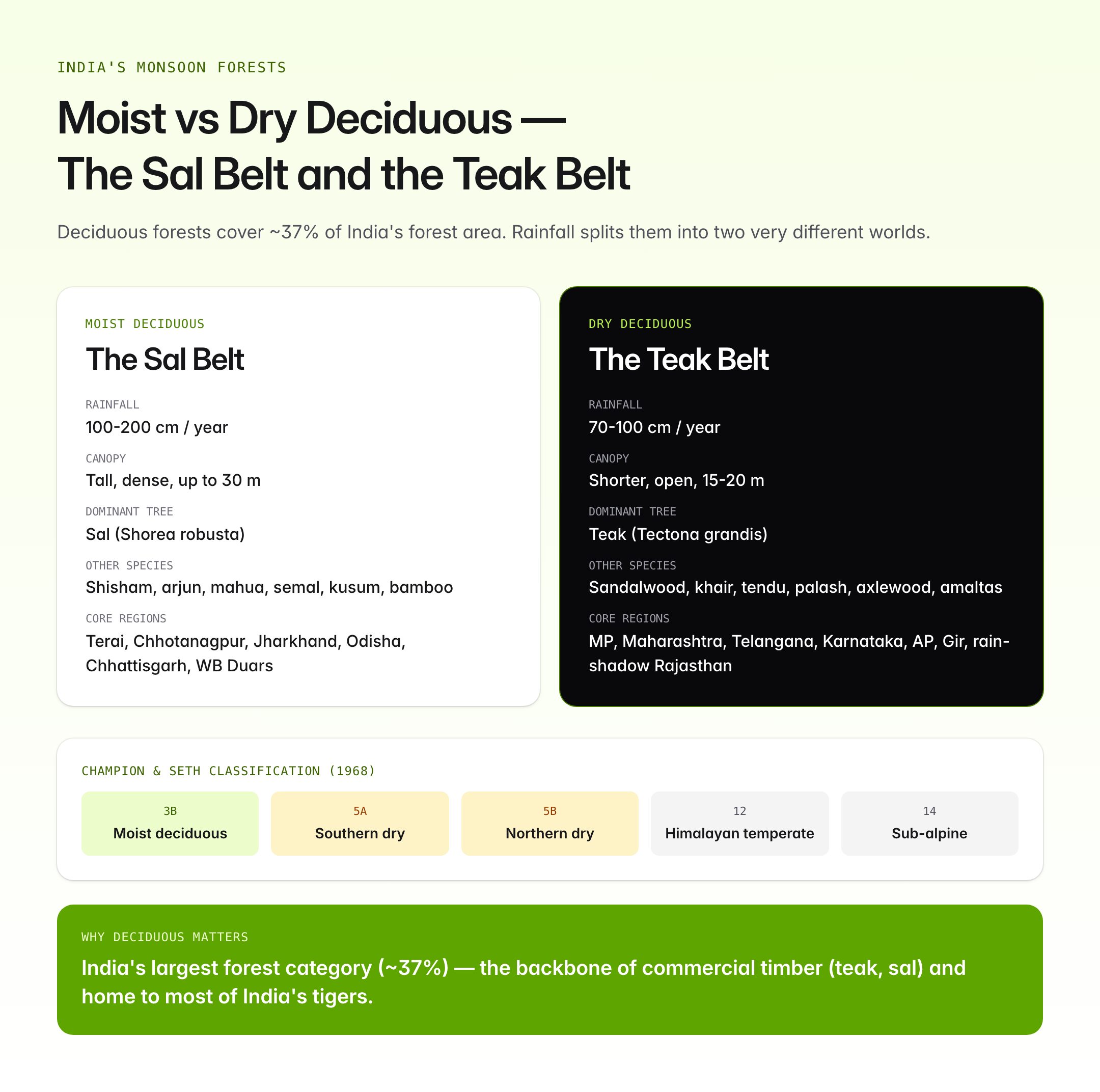
Tropical deciduous forests occupy about 37% of India's forest area — the largest single category. They occur where annual rainfall is 70–200 cm, across the peninsular plateau, Central India, the Bhabar-Terai foothills, and parts of the Eastern Ghats.
Two Sub-Types — Moist and Dry
Based on rainfall and humidity, tropical deciduous forests are classified as:
| Sub-type | Rainfall | Canopy | Character |
|---|---|---|---|
| Moist deciduous | 100–200 cm | Tall, dense (up to 30 m) | Closer to evergreen; richer diversity |
| Dry deciduous | 70–100 cm | Shorter, open (15–20 m) | Transitional to thorn forest |
Moist Deciduous Forest — Sal Belt
Characteristics
- Rainfall: 100–200 cm annually
- Canopy height: up to 30 meters
- Sal (Shorea robusta) is the dominant tree, often in pure stands
- Rich undergrowth of shrubs, climbers, bamboo
- Grass cover after leaf-fall
Major Species
- Sal (Shorea robusta) — leaves used for plates; seeds yield oil
- Teak (Tectona grandis) in drier extents
- Rosewood / Shisham (Dalbergia sissoo and D. latifolia)
- Arjun, Mahua, Sandan, Kusum, Semal
- Bamboo — multiple species
Distribution in India
| Region | States |
|---|---|
| Foothills of Himalayas (Bhabar-Terai) | Uttarakhand, UP (Terai), Bihar, West Bengal (Duars) |
| Chhotanagpur plateau | Jharkhand, Odisha, Chhattisgarh |
| Eastern slopes of Western Ghats | Maharashtra, Karnataka, Kerala (wetter flanks) |
| North-Eastern states | Moist-deciduous patches in foothills |
Sal dominates the north and east; teak dominates central and western moist deciduous zones.
Dry Deciduous Forest — Teak Belt
Characteristics
- Rainfall: 70–100 cm annually
- Canopy height: 15–20 meters, more open
- Teak (Tectona grandis) is the dominant timber tree in central-western India
- Patches of grass, bamboo, thorny shrubs on drier edges
- Transitional to thorn and scrub forest where rainfall drops below 70 cm
Major Species
- Teak (Tectona grandis)
- Sandalwood (Santalum album) — in Karnataka, Tamil Nadu
- Khair (Acacia catechu)
- Mahua (Madhuca longifolia)
- Axlewood (Anogeissus latifolia)
- Tendu (Diospyros melanoxylon — bidi leaves)
- Bijasal, Palash (flame of the forest), Amaltas
Distribution in India
| Region | States |
|---|---|
| Peninsular plateau (core teak belt) | Madhya Pradesh, Maharashtra, Telangana, Karnataka, Andhra Pradesh |
| Chota Nagpur (drier parts) | Jharkhand, Chhattisgarh |
| Rain-shadow areas | Eastern MP, parts of Rajasthan |
| Eastern Ghats | Andhra, Odisha, Tamil Nadu |
| Gir region | Gujarat — dry deciduous with thorn |
Indian Deciduous Forest — Fauna
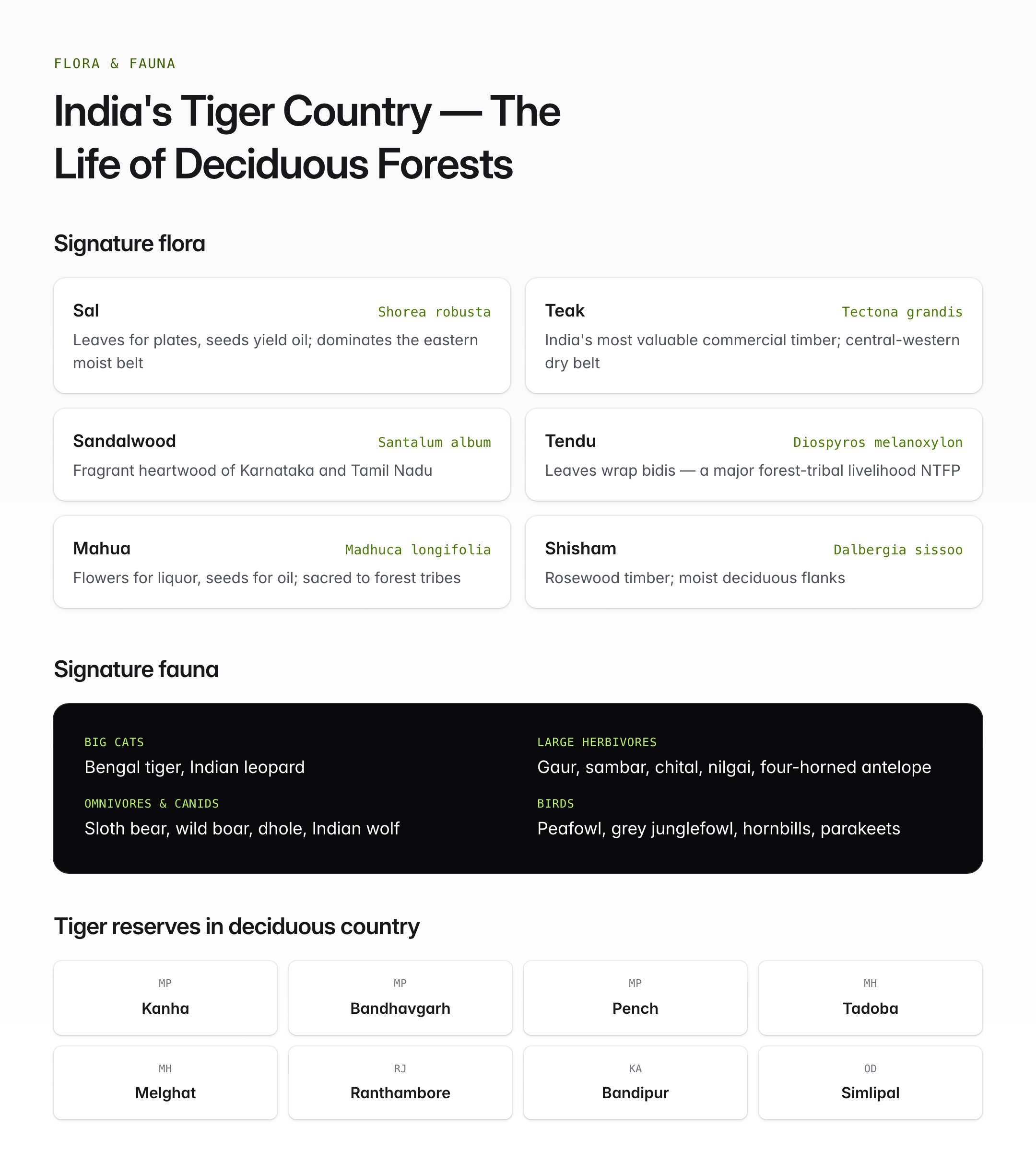
Deciduous forests are India's richest wildlife habitats. Tiger reserves in Madhya Pradesh, Maharashtra, Karnataka and Jharkhand lie within these forests.
| Group | Key Species |
|---|---|
| Big cats | Bengal tiger, Indian leopard |
| Large herbivores | Gaur, sambar, chital, nilgai, four-horned antelope |
| Omnivores | Sloth bear, wild boar |
| Primates | Common langur, rhesus macaque |
| Canids | Dhole (Asiatic wild dog), Indian wolf (edges) |
| Birds | Peafowl, grey junglefowl, hornbills, parakeets |
| Reptiles | Indian rock python, mugger crocodile, monitor lizards |
Major protected areas in deciduous forest: Kanha, Bandhavgarh, Pench, Satpura, Ranthambore (dry deciduous), Nagarahole, Bandipur, Mudumalai, Tadoba, Melghat, Simlipal, Sanjay Dubri.
Ecological Significance
Timber and NTFP Value
- Teak and sal are the two most valuable timbers in India
- NTFP (Non-Timber Forest Products) — tendu leaves (bidis), mahua flowers and seeds, sal seeds, honey, medicinal plants
- Livelihoods for millions of forest-dependent tribes — Gonds, Santhals, Bhils, Oraons, Mundas
Ecosystem Services
- Water regulation — catchments for many peninsular rivers
- Soil conservation — roots bind laterite and alluvial soils
- Carbon sequestration — substantial above-ground biomass
- Biodiversity habitat — India's tiger, leopard and elephant strongholds
Deciduous vs Evergreen vs Coniferous — Comparison
| Parameter | Tropical Deciduous | Tropical Evergreen | Coniferous (Himalayan) |
|---|---|---|---|
| Rainfall | 70–200 cm | >200 cm | 100–200 cm (mostly snow) |
| Leaf habit | Shed in dry season | Year-round | Year-round (needle) |
| Canopy height | 15–30 m | Up to 45 m | 20–40 m |
| Species diversity | Moderate | Very high | Low |
| Dominant species | Sal, teak | Rosewood, mahogany, ebony | Deodar, fir, spruce, chir |
| India distribution | ~37% of forest area | Western Ghats, NE, A&N | Himalayas (1,500–3,500 m) |
| Commercial value | Highest timber output | Cabinet wood | Softwood, resins |
Temperate Deciduous in India
Though most deciduous forest in India is tropical, temperate deciduous types occur in:
- Himalayan mid-elevations (1,500–3,000 m) — mixed with conifers
- Oak (Quercus), Chestnut (Castanopsis), Maple (Acer), Walnut (Juglans), Himalayan alder dominate
- Found in Kashmir, Himachal, Uttarakhand, Arunachal Pradesh, Sikkim
Threats and Conservation
Major Threats
- Deforestation for agriculture, dams, mining, urbanisation
- Illegal felling — teak and sandalwood especially
- Forest fires — prevalent in summer, especially in Bandipur, Mudumalai, Similipal
- Invasive species — Lantana, Prosopis, Parthenium
- Shifting cultivation (jhum) in NE
- Linear infrastructure — roads, railways fragment habitats
- Climate change — altered monsoon patterns affect regeneration
- Overgrazing
Conservation Framework
- Forest (Conservation) Act, 1980 — restricts diversion
- Wildlife (Protection) Act, 1972 — 106 National Parks, 573+ Wildlife Sanctuaries (many in deciduous zones)
- Project Tiger (1973) — 58+ tiger reserves largely in deciduous forests
- Project Elephant (1992)
- Forest Rights Act, 2006 — tribal rights in deciduous forest belts
- CAMPA — compensatory afforestation
- National Afforestation Programme, Green India Mission
Deciduous Forest Governance — Important Sources
- India State of Forest Report (ISFR) — biennial publication by Forest Survey of India (FSI), Dehradun
- Champion and Seth Classification (1968) — scientific classification of Indian forests; recognises Tropical Moist Deciduous (3B) and Tropical Dry Deciduous (5A, 5B) as major types
Champion & Seth Classification — Deciduous Categories
| Code | Type |
|---|---|
| 3B | Tropical moist deciduous forest |
| 5A | Southern tropical dry deciduous |
| 5B | Northern tropical dry deciduous |
| 12 | Himalayan moist temperate (partly deciduous) |
| 14 | Sub-alpine forests (partly deciduous birch-rhododendron) |
UPSC Relevance
GS Paper Mapping
- GS Paper I — Indian Geography (natural vegetation), Physical geography (biomes)
- GS Paper III — Environment and biodiversity, Conservation, Forest classification
- Essay — Conservation vs development; climate and forests
Prelims Pointers
- Deciduous forests = largest forest category in India (~37% of forest area)
- Also called monsoon forests
- Rainfall range: 70–200 cm
- Moist deciduous: 100–200 cm — dominated by Sal (Shorea robusta)
- Dry deciduous: 70–100 cm — dominated by Teak (Tectona grandis)
- Sal belt — eastern India, Chota Nagpur, Terai, West Bengal Duars
- Teak belt — MP, Maharashtra, Telangana, Karnataka, AP
- Classification by Champion and Seth (1968) — 3B, 5A, 5B for deciduous types
- Tendu leaves (Diospyros melanoxylon) — bidi leaves, from dry deciduous
- Mahua (Madhuca longifolia) — flowers for liquor, seeds for oil
- Sandalwood — Karnataka, Tamil Nadu (dry deciduous)
- Key tiger reserves in deciduous forests: Kanha, Bandhavgarh, Pench, Ranthambore, Tadoba, Bandipur, Nagarhole
- ISFR (India State of Forest Report) — biennial, by Forest Survey of India (FSI), Dehradun
- Temperate deciduous in India = Himalayan mid-elevations; oak, chestnut, maple
- Commercial timber: teak and sal are most valuable
Deciduous forests are the green backbone of the Indian peninsula — home to its tigers, timber and tribes. Protecting them is inseparable from protecting India's rural livelihoods and climate future.