Context – The recent release of the revised blueprint for the Green India Mission (GIM) puts restoration at the forefront.
What is the Green India Mission (GIM)?
Definition & background:
- Launched in: 2014
- Under: National Action Plan on Climate Change (NAPCC)
- Nodal ministry: Ministry of Environment, Forest and Climate Change (MoEFCC)
- Vision: Ecological restoration of degraded ecosystems to enhance forest and tree cover, strengthen ecosystem services, and improve forest-dependent livelihoods.
Key objectives:
- Increase forest and tree cover on 5 million ha of land.
- Improve quality of forest cover on another 5 million ha.
- Enhance ecosystem services—biodiversity, carbon sequestration, water regulation.
- Improve livelihoods of 3 million forest-dependent households.
- Create an additional carbon sink of 2.5–3.0 billion tonnes CO₂ equivalent by 2030 (aligned with India’s NDC).
Eight Missions under NAPCC
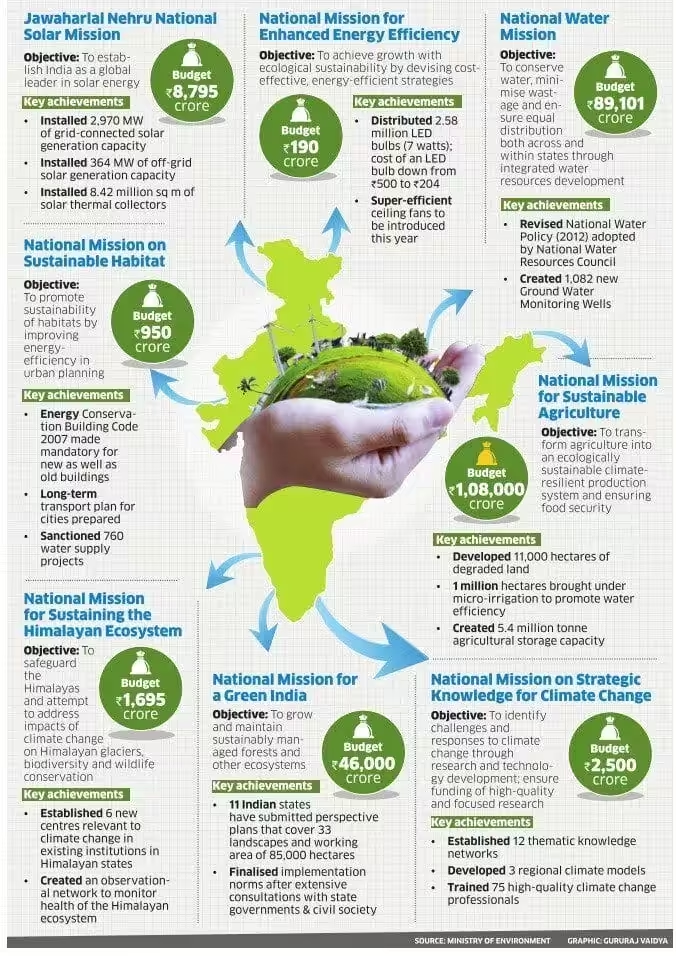
How has been the performance so far?
| Indicator | Achievement |
|---|---|
| Afforestation Coverage | 11.22 million ha (2015–21) under GIM and convergence schemes |
| Funding (2019–24) | ₹624.71 crore allocated to 18 states; ₹575.55 crore utilized |
| Carbon Sink Created | 2.29 billion tonnes CO₂ (2005–2021, Lok Sabha data) |
| Institutional Structure | 26 states onboard; implementation via Forest Development Agencies (FDAs) and JFMCs |
| Monitoring | GIS-based system under development for performance audits |
What are the structural and implementation gaps in India’s afforestation efforts?
- Community participation deficit – Nearly 200 million Indians depend on forests for livelihood and subsistence. The Forest Rights Act (2006) legally empowers local and tribal communities to manage forests, yet plantation drives often bypass community consent. This leads to loss of trust and weak social legitimacy of afforestation programs.
Odisha integrates Joint Forest Management Committees (JFMCs) into afforestation and revenue-sharing.
Chhattisgarh experiments with biodiversity-sensitive plantations, reviving barren lands using mahua and other livelihood-linked native trees.
2. Ecological design: Traditional afforestation relied mainly on monocultures of eucalyptus and acacia, chosen for fast growth but ecologically harmful as they deplete groundwater, reduce native biodiversity, and increase climate vulnerability.
Tamil Nadu’s success — nearly doubling mangrove cover in three years — demonstrates that scientifically guided, native species restoration can deliver strong ecological and climate benefits.
3. Financing bottlenecks and CAMPA fund undertilisation: The CAMPA Fund currently holds over ₹95,000 crore, but fund utilisation remains uneven and bureaucratically slow. Example: Delhi utilised only 23% of its approved CAMPA allocation (2019–24). The Green India Mission itself has received modest allocations, relying heavily on CAMPA convergence rather than independent funding.
How the revised GIM (2021–2030) differs from the original?
| Aspect | Original GIM (2014) | Revised GIM (2021–2030) |
| Focus | Afforestation and reforestation on 10 million ha (5 mha new + 5 mha improved). | Landscape-based ecological restoration across 24.7 million ha through convergence by 2030. |
| Approach | Centralized and scheme-driven, focusing on plantation and afforestation. | Region-specific, micro-ecosystem, bottom-up planning emphasizing local ecology and native species. |
| Geographical Focus | General forest areas with broad afforestation targets. | Ecologically critical landscapes — Aravalli ranges, Western Ghats, Himalayas, mangroves. |
| Integration | Limited convergence with other schemes. | Full convergence with CAMPA, MGNREGA, PMKSY, and the Aravalli Green Wall Project. |
| Livelihood Support | Provided through employment during afforestation works. | Creation of Livelihood Improvement Training Centres (LITCs) and NTFP Processing Centres for long-term forest-based income. |
| Monitoring | Periodic and manual reporting through forest departments. | GIS-based real-time monitoring and social audits using remote sensing. |
| Private Participation | Minimal private or CSR involvement. | Encourages Public–Private Partnerships (PPP), CSR, and carbon market participation. |
| Policy Alignment | Aimed at adaptation and generic climate mitigation. | Directly aligned with Paris Agreement, UNCCD, and India’s NDC targets. |
| Mission Cost | Not clearly specified. | Estimated ₹12,190 crore (2021–30) through CAMPA and convergence funding. |
What is the GIM’s strategy to combat land degradation & desertification?
- Region-specific restoration: target Aravalli ranges, Western Ghats, Himalayas, and mangroves and address site-specific ecological stress (deforestation, mining, desertification).
- Integration with Aravalli Green Wall Project: Restore 8 lakh ha across 29 districts (4 states) and create a 5-km-wide buffer to reduce dust and desertification.
- Focus on open forest restoration: Prioritize open and degraded forests for maximum carbon sequestration. Potential sink: 1.89 billion tonnes CO₂ across 15 mha.
- Convergence Approach: Utilize CAMPA, MGNREGA, PMKSY, NMSA for water conservation & vegetation growth.
- Promote natural ecosystems: promote forests, wetlands, grasslands, and mountain ecologies as natural carbon sinks.
- Technology & monitoring: Use remote sensing, GIS-based monitoring, and desertification mapping for adaptive management.
Key Concepts:
Term Explanation CAMPA Compensatory Afforestation Fund Management and Planning Authority — funds used for compensatory afforestation projects. NAPCC National Action Plan on Climate Change — umbrella program with 8 national missions including GIM. LITCs Livelihood Improvement Training Centres — to skill local communities in forest product processing and marketing. NTFP Non-Timber Forest Produce — includes products like honey, bamboo, medicinal plants used for livelihood generation. Carbon Sink A natural or artificial reservoir that absorbs and stores carbon dioxide from the atmosphere. Open Forests Forests with canopy density between 10–40%; most vulnerable to degradation but crucial for restoration. Micro-Ecosystem Approach Localized restoration model addressing region-specific ecological needs and vulnerabilities.
Practice Question:
Elaborate on the essential features of Green India Mission (GIM). How far do you think that GIM can help India to achieve its target of creating additional carbon sinks? (15 Marks, 250 words)
Tell Google you want more of this.
Add Anantam IAS as a preferred sourceOne tap, and this site shows up more often in your own Top Stories, AI Overviews and AI Mode. Remove it any time.