Deer vs Antelope: Antlers, Horns, and the Indian Species You Should Know
Deer vs antelope explained: antlers vs horns, shed vs permanent, family classification, Indian species like chital, sambar, blackbuck, nilgai, and UPSC pointers.
A herd of brown, hoofed animals moves through a forest clearing in central India. Some are deer. Some are antelope. To a casual observer they look interchangeable, but to a wildlife biologist, a Forest Department officer, or a UPSC aspirant they belong to two different families with separate anatomy, evolution, and conservation stories. Confusing the two is one of the easiest ways to lose marks in the Prelims environment section, and the question almost always turns up in some form every two to three years.
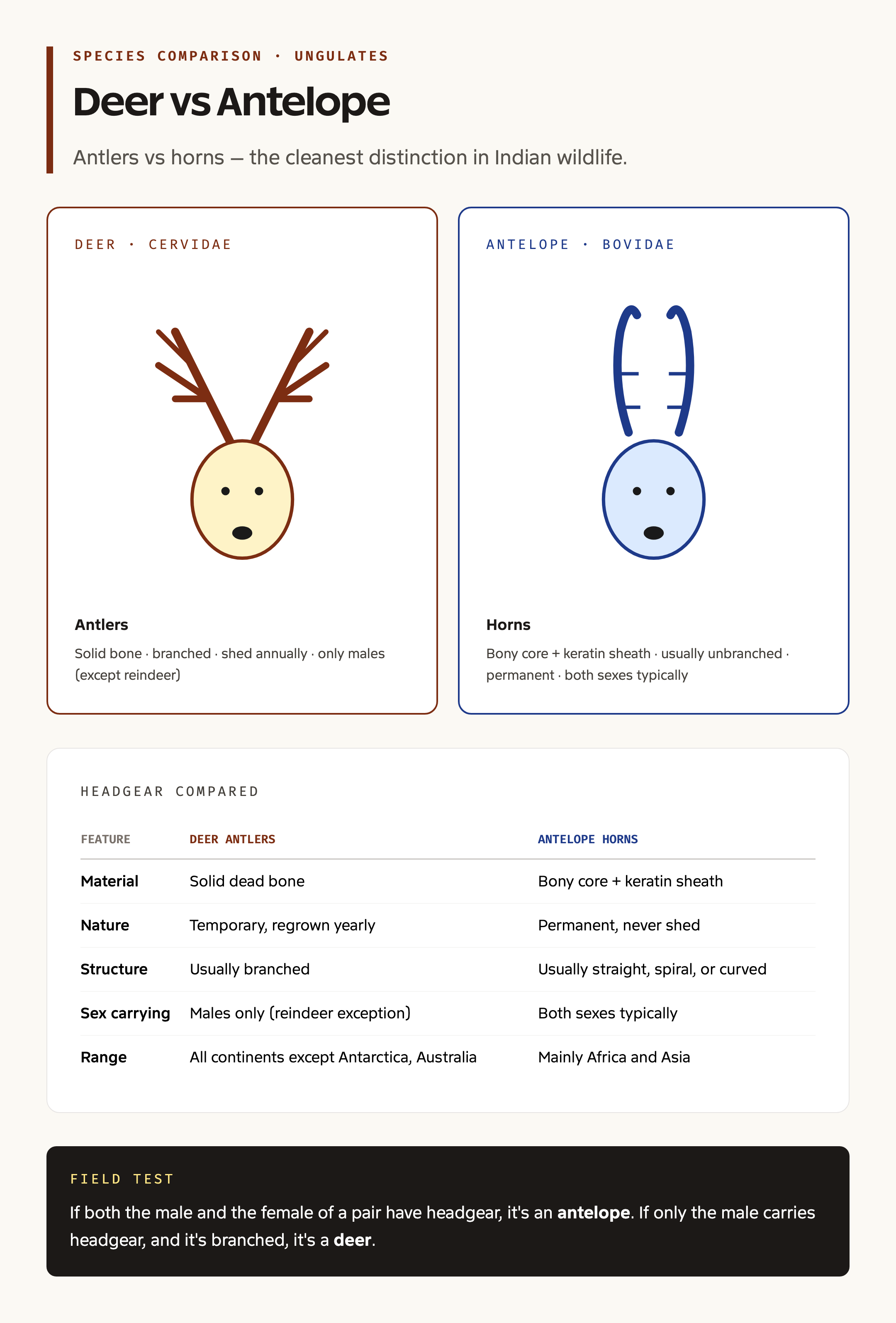
The defining difference is the headgear. Deer carry antlers, made of solid bone, branched, and shed every year. Antelope carry horns, made of a bony core with a permanent keratin sheath that grows continuously through life. That single distinction unlocks every other difference: which family they belong to, which sex carries the headgear, where they live, and how they are classified for taxonomy and conservation. This guide walks through each difference with examples drawn from Indian fauna, then provides the comparative table, the species cards, and the question patterns UPSC has asked.
If you can confidently say whether a chinkara, sambar, barasingha, or chausingha is a deer or an antelope, and explain why, you have got the topic covered.
Quick Facts
- Deer family: Cervidae
- Antelope family: Bovidae (same family as cattle, goats, sheep)
- Deer headgear: Antlers, branched, made of solid bone, shed annually
- Antelope headgear: Horns, unbranched, made of bony core with keratin sheath, permanent
- Sex carrying headgear in deer: Only males (except reindeer, where both sexes have antlers)
- Sex carrying horns in antelope: Both males and females, in most species
- Deer global range: All continents except Antarctica and Australia
- Antelope global range: Africa and parts of Asia primarily
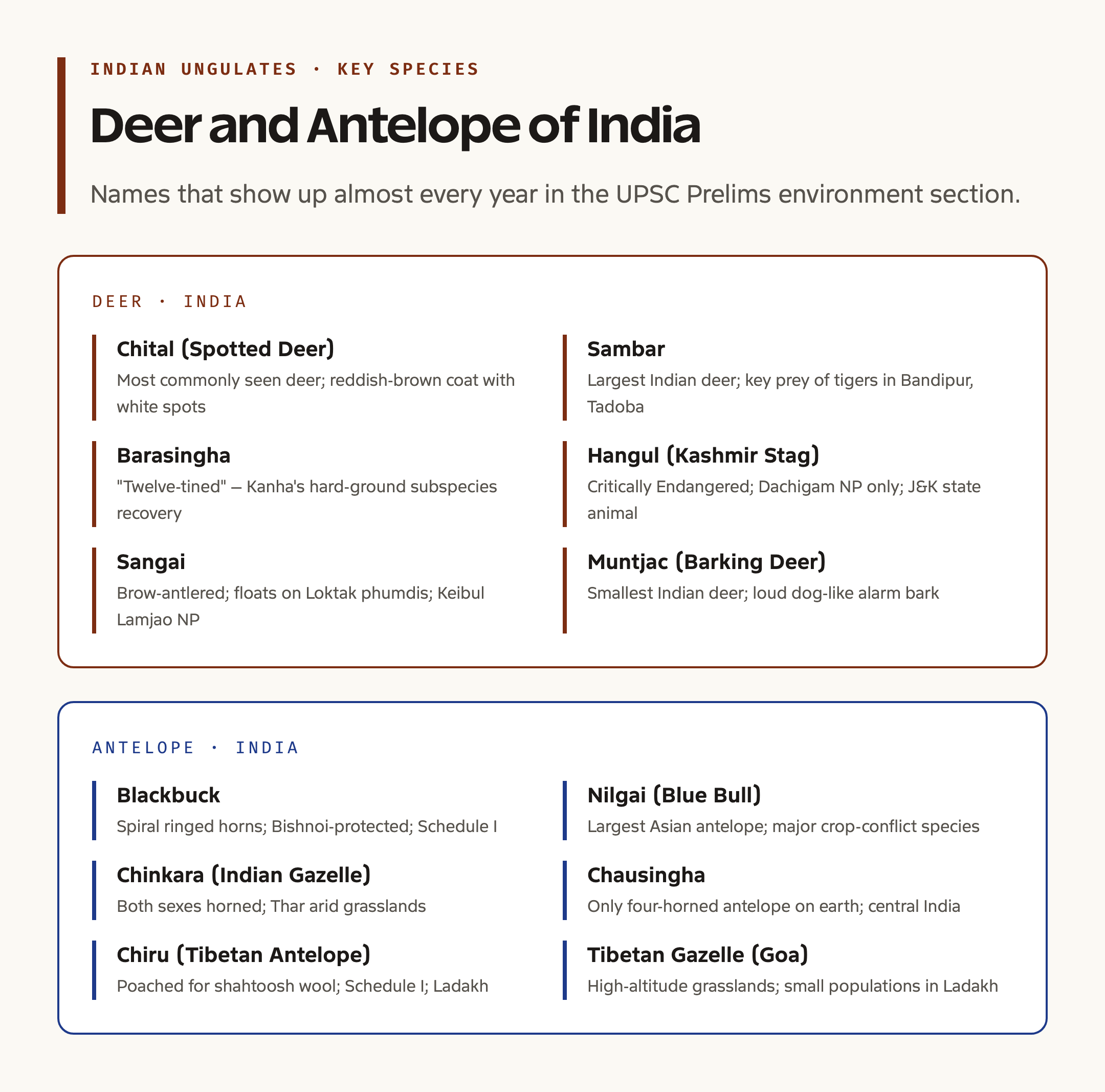
- Indian deer examples: Chital, sambar, barasingha, hangul, muntjac
- Indian antelope examples: Blackbuck, nilgai, chinkara, chausingha (four-horned antelope)
- Famous case: Salman Khan blackbuck poaching case helped raise awareness of antelope conservation
What Deer and Antelope Are
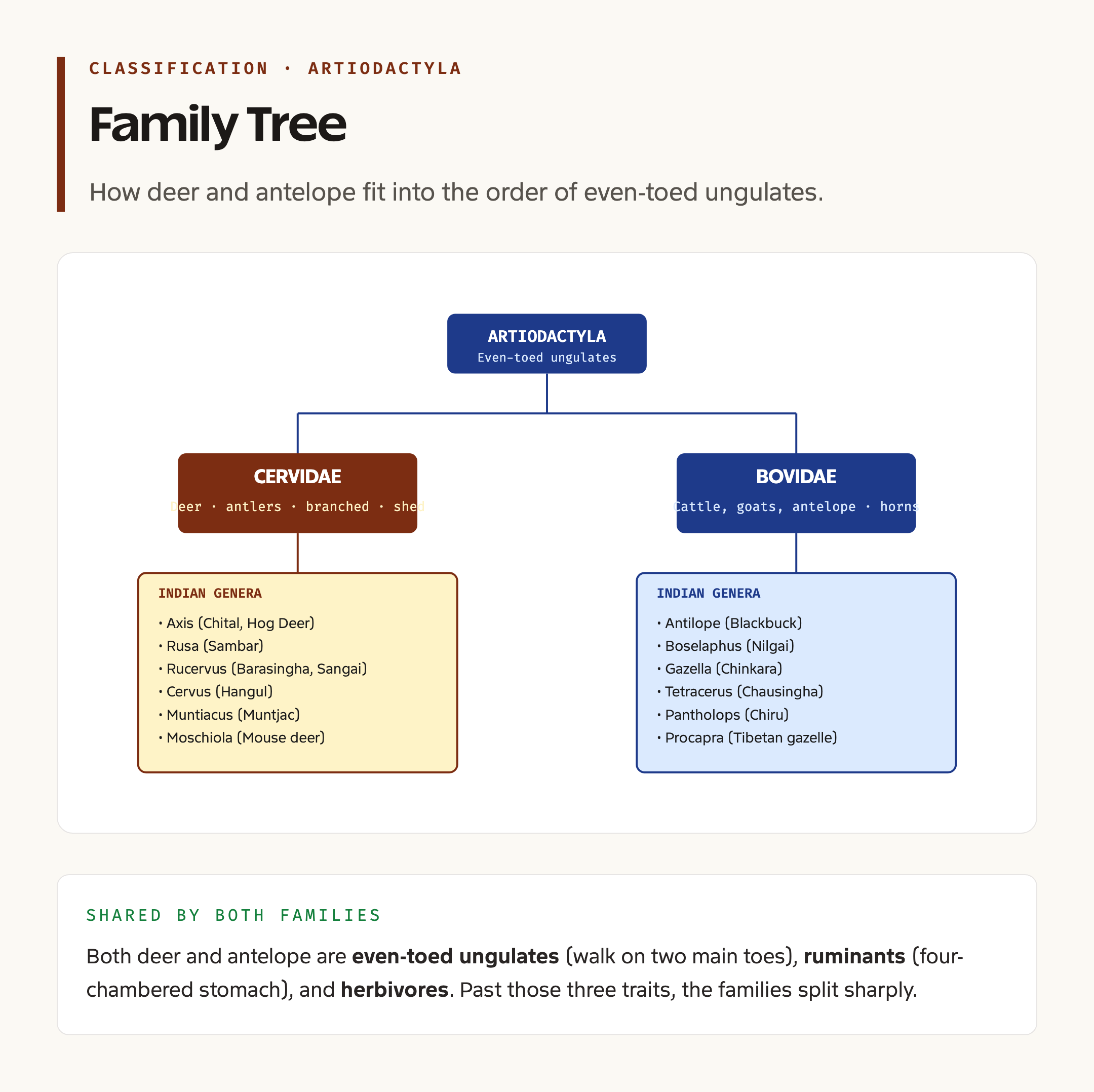
Deer and antelope are both even-toed ungulates (order Artiodactyla), meaning they walk on hooves with two main toes. Both are herbivores. Both are ruminants with a four-chambered stomach. Both move in herds and use sight and smell to detect predators. Past those three similarities, the two groups split apart.
The deer family Cervidae evolved roughly 20 million years ago, mostly in Eurasia. They diversified into roughly 50 species ranging from the tiny pudu of South America to the massive moose of the boreal forest. Their defining trait is antlers, which males regrow and shed every year as part of the rutting cycle.
The antelope is not a single biological group but rather a collection of species within the cattle family Bovidae. The “antelope” label is more of a behavioural and ecological grouping than a strict taxonomic one. Bovids include cows, goats, sheep, buffaloes, and antelope, all of which share the same horn structure. Antelopes diversified strongly in Africa, with a smaller radiation across Asia.
For Indian conditions, every deer-like animal you see in a national park belongs to one of these two families. The way to tell which family is to look at the headgear (and the females).
Background and Historical Context
The distinction between deer and antelope matters in India for reasons that go well beyond academic biology. Three policy episodes show why.
Blackbuck and the Bishnoi: The blackbuck (Antilope cervicapra), an antelope, has long been protected by the Bishnoi community of western Rajasthan as a sacred animal. The famous Salman Khan poaching case (1998) and the Khejarli precedent (1730) have made blackbuck conservation a question of religious as well as wildlife law.
Nilgai and crop conflict: The nilgai or blue bull (Boselaphus tragocamelus) is the largest Asian antelope and India’s only protected animal officially considered an agricultural pest in some states. Bihar and Maharashtra have allowed culling under controlled conditions, drawing legal challenges from animal welfare groups.
Hangul and Kashmir’s identity: The hangul or Kashmir stag is a critically endangered subspecies of red deer found only in Dachigam National Park. It is the state animal of Jammu and Kashmir and a flagship for Himalayan conservation, anchored in the broader biological diversity act, 2002 framework that protects native fauna.
The Central Zoo Authority has been accused of conserving the wrong deer in some captive collections, mistaking similar-looking subspecies. The Forest Department briefings often need biologists to confirm whether an animal in a viral video is a chital or a hog deer, a chinkara or a chausingha.
Key Provisions: How Indian Law Treats Deer and Antelope
Both groups are protected under the Wildlife (Protection) Act, 1972.
- Schedule I: Includes blackbuck, chinkara, chausingha (highest protection); hangul; barasingha
- Schedule II: Spotted deer (chital), sambar, hog deer
- Schedule III: Nilgai (until recent debates over crop damage)
CITES classifies the four-horned antelope (chausingha) under Appendix III for India. The Asiatic cheetah, when present, used to prey on blackbuck as the principal prey base. The Great Indian Bustard’s grassland habitat overlaps with blackbuck and chinkara range. So losing or fragmenting antelope habitat ripples through several Schedule I species at once.
Why the Difference Matters
Identification in the field: Forest officers, veterinarians, and tourist guides need to identify animals correctly to record sightings, treat injuries, and report poaching.
Conservation strategy: Deer that shed antlers annually need calcium-rich diets and access to mineral licks. Antelopes with permanent horns face different pressures, including injury during fights that does not heal because the horn is keratin.
Trade and trafficking: Antlers and horns are both poached, but for different markets. Deer antlers (especially velvet antlers) are used in traditional Chinese medicine. Antelope horns are sometimes used in religious objects, medicines, or trophies.
Climate response: Deer in temperate zones depend on snow cycles for food access. Tropical deer respond to monsoon timing. Antelopes in arid zones can endure long dry spells but suffer when grasslands convert to scrub.
Detailed Analysis: Each Difference Explained
Headgear Material
Deer antlers are made of solid bone. They grow rapidly every year, covered initially by a soft, blood-rich skin called velvet that supplies oxygen and nutrients to the growing bone. Once the antler reaches full size, the velvet dries and is rubbed off against trees. The bare bone is what we see on a mature stag.
Antelope horns have a permanent bony core that grows out of the skull, covered by a sheath of keratin, the same material that makes our fingernails and a rhinoceros’s horn. The keratin sheath grows in layers throughout the animal’s life and never falls off.
Branching
Deer antlers are typically branched, sometimes spectacularly so. A single antler may carry multiple tines or points, used in the sambar and the barasingha to display fitness during the rutting season. Antelope horns are usually straight, spiralled, ringed, or curved but rarely branched. The chausingha or four-horned antelope is the rare exception. It carries two pairs of horns rather than four branches on one horn.
Shedding Cycle
Deer antlers are shed and regrown every year. The cycle is hormonally controlled by testosterone and photoperiod. Stags drop their antlers in late winter or spring and grow new ones over the summer in time for the autumn rut. Antelope horns are permanent. They never fall off. They grow continuously, with growth rings that biologists can sometimes use to estimate age.
Sex Carrying Headgear
In deer, only males carry antlers (with one famous exception, the reindeer / caribou). In antelopes, both sexes typically carry horns, though female horns are usually smaller. This is one of the fastest field tests: if you see two animals with horns walking together and they look like a male-female pair, you are likely looking at antelopes.
Geographic Distribution
Deer are spread across all continents except Antarctica and Australia. They thrive in temperate forests, tropical jungles, alpine meadows, and tundra. Antelopes are concentrated in Africa and parts of Asia, with the highest diversity in the African savannah. India sits at the eastern edge of the historical antelope range.
Indian Examples
| Indian Deer | Indian Antelope |
|---|---|
| Chital (Spotted Deer) | Blackbuck |
| Sambar | Nilgai (Blue Bull) |
| Barasingha (Swamp Deer) | Chinkara (Indian Gazelle) |
| Hangul (Kashmir Stag) | Chausingha (Four-Horned Antelope) |
| Muntjac (Barking Deer) | Tibetan Antelope (Chiru) |
| Hog Deer | Tibetan Gazelle |
| Brow-antlered Deer (Sangai) |
The sangai or brow-antlered deer, found only in Keibul Lamjao National Park on the floating phumdis of Loktak Lake, is one of the most range-restricted deer species in the world.
Comparative Lens: Deer vs Antelope
| Feature | Deer | Antelope |
|---|---|---|
| Family | Cervidae | Bovidae |
| Headgear | Antlers | Horns |
| Headgear material | Solid dead bone | Bony core with keratin sheath |
| Headgear nature | Temporary, shed and regrown each year | Permanent, grows for life |
| Headgear shape | Usually branched | Usually straight, spiralled, or curved |
| Sex carrying headgear | Only males (except reindeer) | Both males and females typically |
| Distribution | Almost worldwide | Mainly Africa and Asia |
| Notable Indian species | Chital, sambar, barasingha, hangul, muntjac | Blackbuck, nilgai, chinkara, chausingha |
Closer Look at Key Indian Species
Chital (Spotted Deer)
The most commonly seen deer in Indian national parks. White spots on a reddish-brown coat. Lives in herds, often associates with langurs to share predator alarm calls. The chital was the favoured prey of the Asiatic cheetah before its extinction.
Sambar
The largest Indian deer. Dark brown coat, large branched antlers, and a thick mane on the neck of mature stags. Important prey species for tigers in Ranthambore, Bandipur, and Tadoba.
Barasingha
Literally “twelve-tined,” referring to the points on a mature stag’s antlers. Three subspecies: hard-ground barasingha (Kanha), wet-ground (terai), and Manipuri. Recovery from near-extinction at Kanha is a celebrated conservation success.
Hangul
Kashmir’s state animal. Critically endangered. Found only in Dachigam National Park. Population dropped below 100 in the 1970s, has recovered partially to around 250 birds.
Blackbuck
Adult males have spectacular spiral, ringed horns and a striking black-and-white coat. Females and young males are tan. National animal of several state-level conservation programmes. Featured in our biosphere reserves in India and arid-zone primers.
Nilgai (Blue Bull)
Largest Asian antelope. Adult males turn slate-blue, hence the name. Considered sacred by some Hindu communities, which protected it from hunting historically but has now allowed populations to expand into farmland.
Chinkara (Indian Gazelle)
Small, graceful antelope of the Thar and arid central India. Both sexes have horns. Heavily protected by the Bishnoi community in Rajasthan.
Chausingha (Four-Horned Antelope)
The only antelope in the world with four horns. Two short on the forehead, two longer behind. Solitary, shy, found in dry deciduous forests of central India.
Challenges
Habitat fragmentation: Deer and antelope both need landscape connectivity. Highways, canals, and railway corridors cut through traditional movement routes.
Crop damage and conflict: Nilgai and wild boar are at the top of farmer-versus-wildlife disputes in northern India. Compensation schemes are slow and often inadequate.
Poaching: Antlers and horns command prices in illegal markets. Tibetan antelope (chiru) are killed for shahtoosh, the underwool used in luxury shawls.
Disease spillover: Free-grazing cattle near protected areas transmit diseases such as Foot-and-Mouth, brucellosis, and bluetongue to wild ungulates, an issue tied to enforcement of environmental laws in India on grazing within reserves.
Climate stress: Snow patterns affect hangul and Himalayan musk deer. Monsoon failure affects chinkara and blackbuck.
Prelims Pointers
- Deer family: Cervidae; antelope family: Bovidae
- Deer have antlers; antelope have horns
- Antlers are solid bone, branched, shed annually; horns are keratin-sheathed, permanent
- In deer, only males have antlers (reindeer is the exception)
- In antelope, both sexes typically have horns
- Indian deer: chital, sambar, barasingha, hangul, muntjac, sangai, hog deer
- Indian antelope: blackbuck, nilgai, chinkara, chausingha, Tibetan antelope (chiru)
- Chausingha is the world’s only four-horned antelope
- Sangai is the brow-antlered deer of Keibul Lamjao National Park, Manipur
- Chiru (Tibetan antelope) is poached for shahtoosh wool, a Schedule I species
- Hangul is the state animal of Jammu and Kashmir
Mains Practice Questions
- The growing nilgai population has triggered a debate on whether to allow culling of a Schedule III species in agricultural landscapes. Examine the legal, ecological, and ethical dimensions of this debate. (250 words)
- Examine the role of community-led conservation, particularly the Bishnoi tradition, in protecting antelope species in arid India. (150 words)
- Compare the conservation challenges faced by the hangul and the chausingha. What lessons do these two species offer for India’s wider deer and antelope conservation? (250 words)
Way Forward
India needs a unified ungulate conservation framework that treats deer and antelope as a single ecological group rather than as scattered species in different schedules. A landscape-level prey base assessment for predator recovery, especially around tiger reserves and the cheetah reintroduction at Kuno, would help align conservation goals across taxa. Compensation schemes for nilgai and wild boar damage should be paid out within 15 days through Aadhaar-linked accounts to reduce farmer hostility. Anti-poaching units need DNA-based identification kits to distinguish between Schedule I antelopes and Schedule II deer when bones, hides, or horns are seized. Finally, traditional protectors such as the Bishnoi and the Buddhist communities of Ladakh should be recognised as conservation partners under the Forest Rights Act and the Biological Diversity Act, transforming centuries of customary protection into formal stewardship.
Frequently Asked Questions
What is the basic difference between deer and antelope?
Deer carry antlers and antelope carry horns. Antlers are made of solid bone, branched, and shed every year. Horns have a permanent bony core covered by a keratin sheath that grows continuously throughout life.
Are deer and antelope from the same family?
No. Deer belong to the family Cervidae, which is unique to deer species. Antelopes belong to the family Bovidae, which they share with cows, goats, sheep, and buffaloes.
Do female deer have antlers?
In almost all deer species, only males have antlers. The reindeer or caribou is the famous exception, where both males and females grow antlers.
Do female antelopes have horns?
In most antelope species, both males and females have horns, though female horns are usually smaller. This is one of the easiest ways to tell deer and antelope apart.
Is the nilgai a deer or an antelope?
Nilgai is the largest antelope in Asia and belongs to the family Bovidae. Despite its English name u0022blue bull,u0022 it is not a bull or buffalo but a true antelope.
Is the chinkara a deer or an antelope?
The chinkara, also called the Indian gazelle, is an antelope. It has permanent ringed horns in both sexes and is found mainly in arid grasslands and scrub forests of western and central India.
What is the four-horned antelope and where is it found?
The chausingha or four-horned antelope (Tetracerus quadricornis) is the only antelope in the world with four horns. Two short horns sit on the forehead and two longer ones behind. It is a shy, solitary species of dry deciduous forests in central India.
Is reindeer the same as deer?
Yes, reindeer are deer. They belong to the family Cervidae and are unique among deer because both males and females grow antlers.
What is the difference between Oryx and Chiru?
The Oryx is adapted to hot, arid lands such as North Africa and the Arabian Peninsula. The Chiru or Tibetan antelope is adapted to the cold, high-altitude steppes and semi-deserts of the Tibetan Plateau, where it is hunted for its underwool used to make shahtoosh shawls.
Which is the smallest deer in India?
The Indian muntjac or barking deer (Muntiacus muntjak) is the smallest deer in India. It earns its name from the dog-like alarm bark it makes when sensing predators.