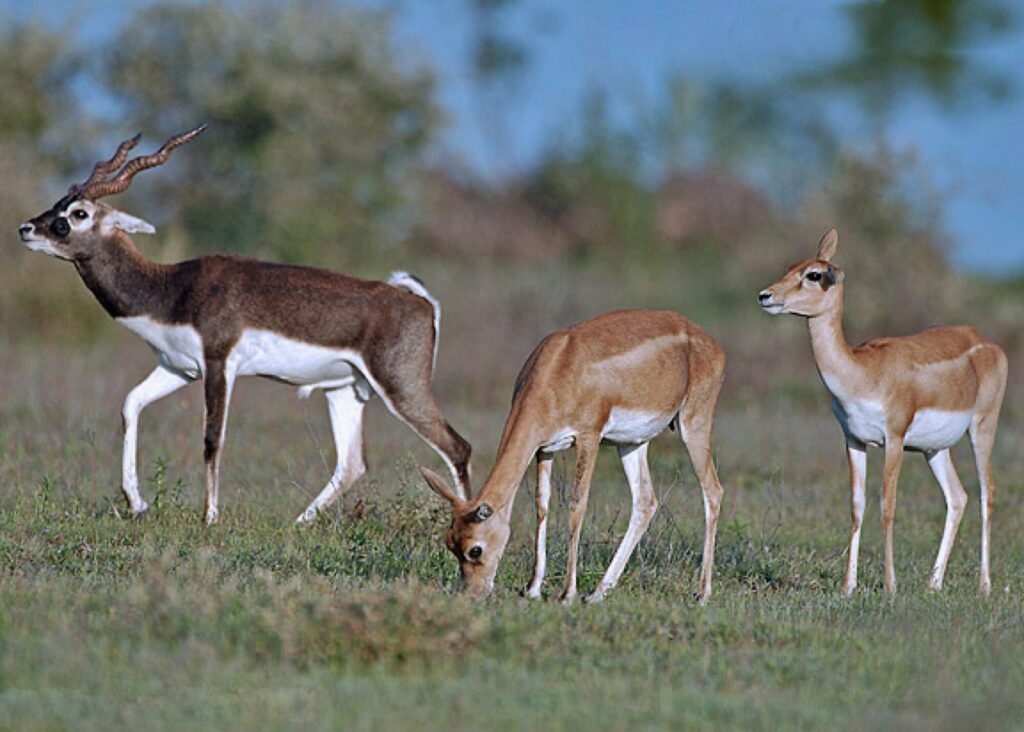
The Blackbuck is the only living species in its genus and one of the most photographed wild animals on the Indian grasslands. With its spiral horns, jet-black flanks, and explosive sprint that touches 80 kilometres per hour, the Blackbuck holds a place in Indian iconography that few wild ungulates can rival. Mughal paintings show emperors hunting them. The Bishnoi community of Rajasthan has died defending them. And in 1998, a Bollywood actor faced trial for shooting one — a case that ran for two decades and still appears in current affairs.
The species was once so abundant that 19th-century British accounts described herds running into the thousands across the Deccan and the Gangetic plains. By independence, hunting and habitat loss had collapsed those numbers. Today the Blackbuck is recovering, listed as Least Concern by the IUCN globally but protected as a Schedule I species under the Wildlife (Protection) Act 1972, the highest legal tier India offers.
This article walks through Blackbuck biology, habitat, the unique role of the Bishnoi community, key sanctuaries, threats, and the species’ relevance to UPSC environment and ethics questions.
Quick Facts About the Blackbuck
- Scientific name: Antilope cervicapra
- Family: Bovidae (true antelope)
- IUCN Red List status: Least Concern
- Wildlife (Protection) Act 1972: Schedule I
- CITES listing: Appendix III (India)
- Indian states with significant populations: Gujarat, Rajasthan, Andhra Pradesh, Karnataka, Odisha, Punjab, Haryana, Maharashtra, Tamil Nadu, Madhya Pradesh
- Iconic sanctuaries: Velavadar (Gujarat), Tal Chhapar (Rajasthan), Point Calimere (Tamil Nadu)
- State animal of: Andhra Pradesh, Haryana, Punjab
- National Animal of India before 1972: Blackbuck (later replaced by the Royal Bengal Tiger)
Taxonomy and Physical Features
The Blackbuck (Antilope cervicapra) is the sole surviving member of its genus. It belongs to the family Bovidae and the subfamily Antilopinae, sharing distant lineage with gazelles. Four subspecies are recognized across the Indian subcontinent based on coat shade and horn structure.
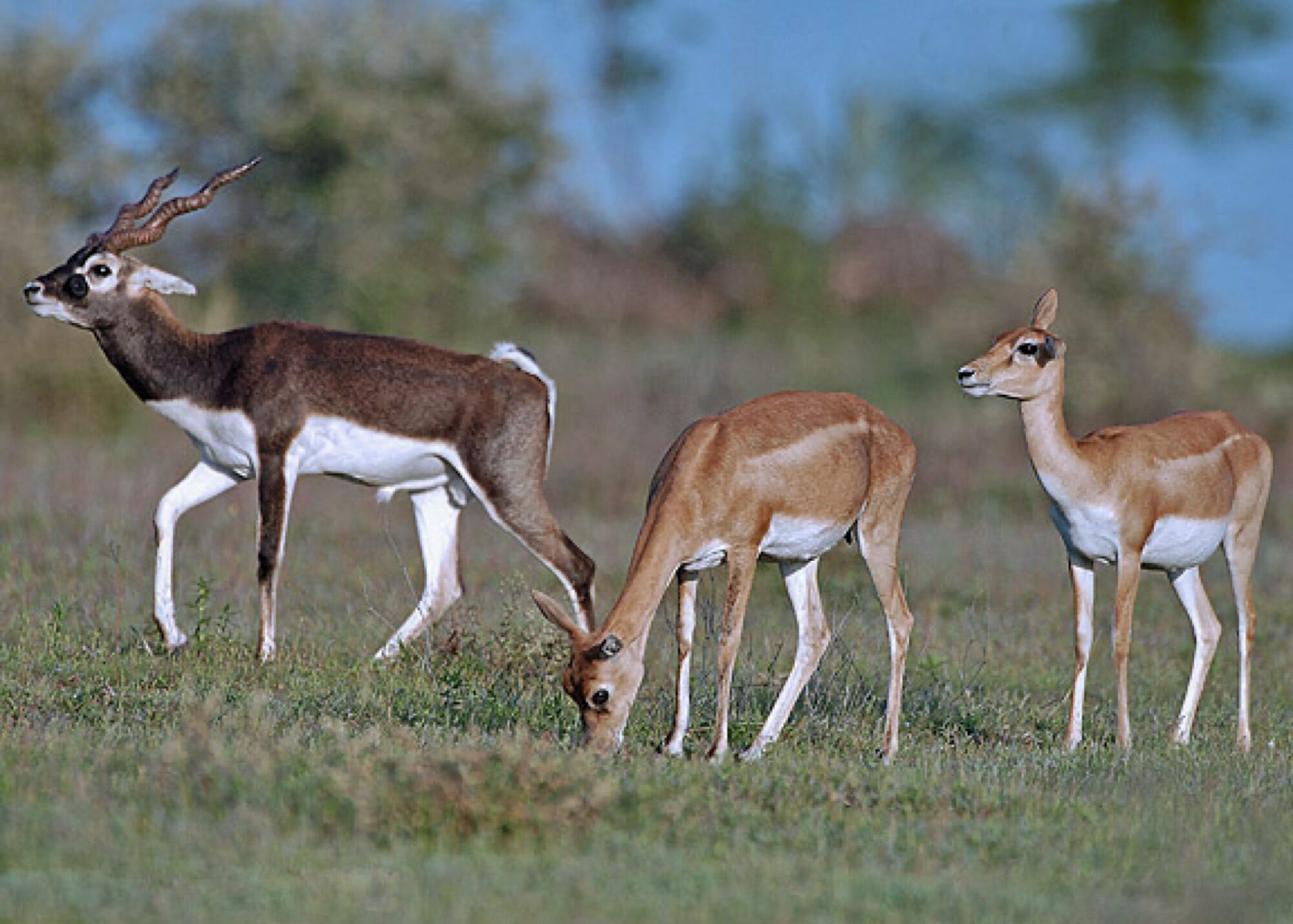
Males stand around 74 to 84 centimetres at the shoulder and weigh 34 to 45 kilograms. Females are smaller and lighter. The sexual dimorphism is striking: adult males develop a deep blackish-brown coat over the upper body, sharply contrasted with white underparts, white facial markings, and a white ring around the eyes. Females remain a uniform yellowish-fawn through life. Only males carry the iconic horns, which spiral upward in three to four turns and can reach 70 centimetres in mature animals.
The Blackbuck is a true sprinter. With a top speed of around 80 kilometres per hour and exceptional stamina over long distances, it relies on open vision and outrun strategy rather than camouflage. Its hooves are pointed and adapted to firm grassland soil.
Habitat and Distribution
The Blackbuck is endemic to the Indian subcontinent. Historically it occupied semi-arid grasslands, open scrub, light dry forest, and agricultural mosaics from the Punjab plains south to the Deccan and east to Odisha and West Bengal. It avoids dense forest and steep terrain.
Today the largest populations are found in Gujarat (especially the Bhal region and Velavadar), Rajasthan (Tal Chhapar, Bishnoi villages around Jodhpur, and the Thar fringes), Andhra Pradesh (Krishna and Guntur districts), Karnataka (Ranibennur), Odisha (Balukhand-Konark), Punjab (Abohar), Haryana, Maharashtra, Madhya Pradesh, and Tamil Nadu (Point Calimere). Smaller populations occur in Nepal’s Bardia and Pakistan’s Cholistan. A feral population thrives in parts of Texas and Argentina, introduced through the exotic game trade.
Behaviour and Ecology
The Blackbuck is a diurnal grazer, most active in the early morning and late afternoon. It feeds primarily on short grasses but also browses on cultivated cereals, lentils, and sorghum when grasslands are exhausted, which sometimes brings the species into conflict with farmers.
Social structure varies with season. Outside the rut, herds typically include around 15 to 50 animals — mixed groups of females and sub-adults, bachelor herds of younger males, and solitary territorial males. During the rutting season, dominant males establish small territories marked by middens of dung and preorbital gland secretions. They patrol these patches aggressively, posturing with raised horns and emitting sharp grunts. Females move through male territories, mating with the resident bull. Gestation lasts around six months, and a single fawn is born and hidden in tall grass for the first weeks of life.
Main natural predators include the Indian wolf, striped hyena, jackal, and historically the cheetah before its extinction in India. Today wolves remain the most significant predator in Velavadar.
Conservation Status and Legal Protection
Globally, the IUCN Red List classifies the Blackbuck as Least Concern, citing stable population trends inside protected areas in India and a total estimated population that crossed 50,000 by the early 2000s and continues to grow.
Within India, the legal status is significantly stricter:
- Wildlife (Protection) Act 1972: Schedule I, Part I (highest level of protection)
- CITES Appendix III for the Indian population
- Maximum penalty under WPA Section 51: imprisonment up to seven years and fine
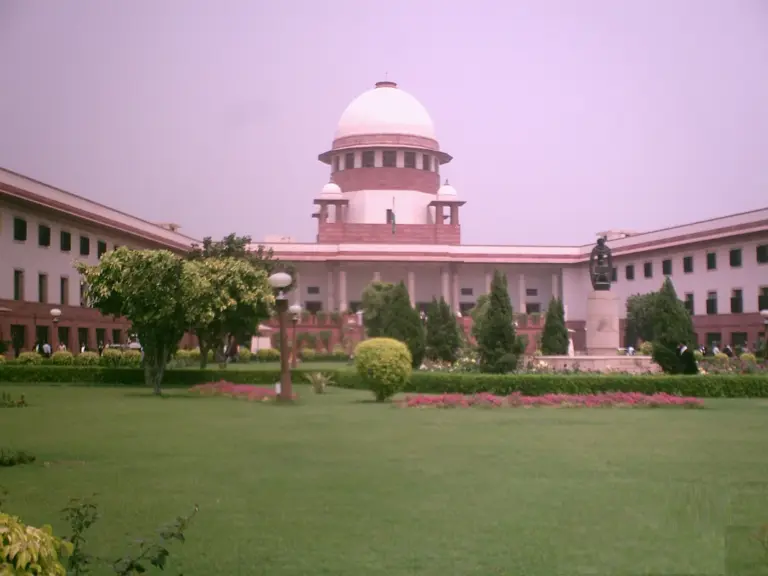
The Schedule I listing means hunting, poaching, trade, or capture without specific authorization carries the same penal weight as offences against tigers, lions, or rhinos. The famous 1998 case against actor Salman Khan, who was accused of shooting two Blackbucks in Jodhpur during a film shoot, illustrated this in full force. The case ran for over twenty years through trial and appeal, ending with a conviction in 2018.
The Bishnoi Community and Blackbuck Protection
No discussion of the Blackbuck is complete without the Bishnoi community of western Rajasthan. The Bishnois follow a 15th-century reformist tradition founded by Guru Jambheshwar (1451 to 1536), built around 29 (bish-noi) principles that include strict prohibitions against cutting green trees and harming wild animals. The Blackbuck and the khejri tree are sacred in Bishnoi belief.
In 1730, the Khejarli massacre unfolded near Jodhpur when Maharaja Abhay Singh’s soldiers came to cut khejri trees for a palace. A Bishnoi woman, Amrita Devi, hugged a tree to stop them. She and her three daughters were killed. Over the next hours, 363 Bishnois were beheaded defending the grove. The episode is widely regarded as the spiritual predecessor of the Chipko movement and stands as one of the earliest recorded acts of community-led environmental protection anywhere in the world.
Today, Bishnoi villages around Jodhpur, Bikaner, Nagaur, and Pali host the largest non-protected-area Blackbuck populations in India. Bishnois treat injured fawns at their homes, intervene against poachers, and have been killed defending herds in the modern era. Their model of community conservation is studied in environmental ethics, the tribal and forest rights framework, and UPSC GS-IV ethics case studies.
Key Sanctuaries and Protected Areas
Velavadar Blackbuck National Park, Gujarat
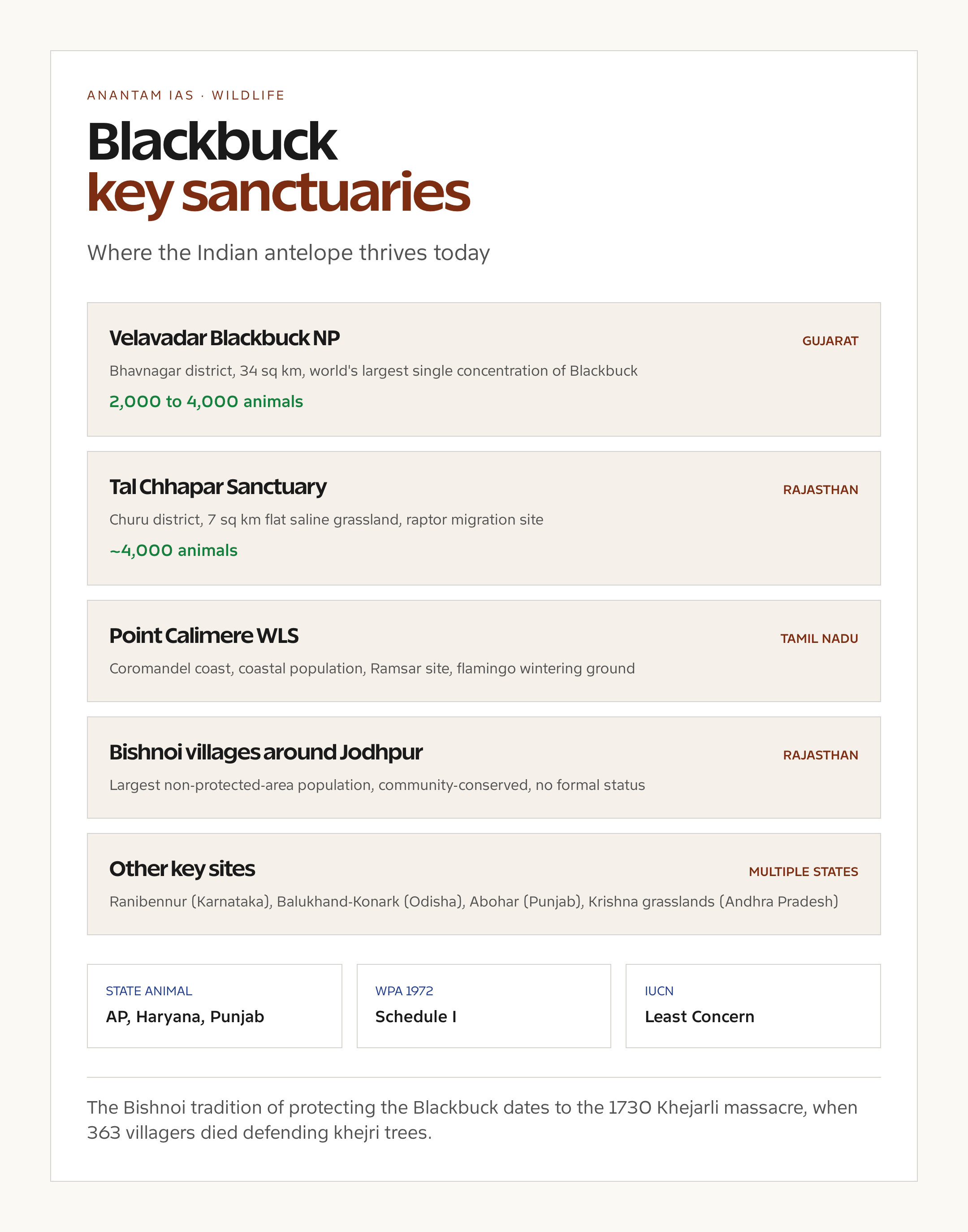
Located in Bhavnagar district, Velavadar covers around 34 square kilometres of grassland and saline plain. It hosts the largest single concentration of Blackbuck in the world, with population estimates between 2,000 and 4,000 animals depending on the season. Velavadar is also famous for harbour-roost congregations of harriers and for one of India’s last surviving Indian wolf populations.
Tal Chhapar Wildlife Sanctuary, Rajasthan
Tal Chhapar lies in Churu district on the fringe of the Thar desert. The sanctuary covers around 7 square kilometres of flat saline grassland. The Blackbuck population here is around 4,000, and the area is also a critical site for migratory raptors including the Eastern Imperial Eagle and the Steppe Eagle. The sanctuary’s open habitat allows close observation and has made it a globally recognized birding and antelope site.
Point Calimere Wildlife Sanctuary, Tamil Nadu
Point Calimere on the Coromandel Coast hosts a coastal population of Blackbuck alongside spotted deer and a major flamingo wintering ground. The sanctuary is a Ramsar site.
Other Key Sites
- Ranibennur Blackbuck Sanctuary, Karnataka
- Balukhand-Konark Wildlife Sanctuary, Odisha
- Abohar Wildlife Sanctuary, Punjab (declared specifically for Blackbuck)
- Krishna and Guntur grasslands, Andhra Pradesh
- Bishnoi villages around Jodhpur (community-conserved area, no formal protected status)
Threats to the Blackbuck
Despite the Least Concern global status, the Blackbuck faces real pressures:
- Habitat loss: grasslands across the country are converted to cropland, plantation, or industrial use; India lost an estimated 31 percent of its grassland between the 1960s and 2010s
- Crop raiding conflict: where wild grassland is fragmented, Blackbucks raid cereals and pulses, leading to retaliation
- Poaching: organized poaching networks operate in Rajasthan, Madhya Pradesh, and Andhra Pradesh
- Free-ranging dogs: feral and village dogs kill fawns and harass adults
- Road and rail accidents: highway expansion through grassland habitat
- Climate stress: prolonged drought reduces grass biomass and surface water
- Misclassification of grasslands as wasteland: under revenue records, grasslands are often termed wasteland and diverted to other uses
- Hybridization in captivity: with non-native antelope species in zoos and game ranches
Blackbuck vs Chinkara: A Common UPSC Confusion
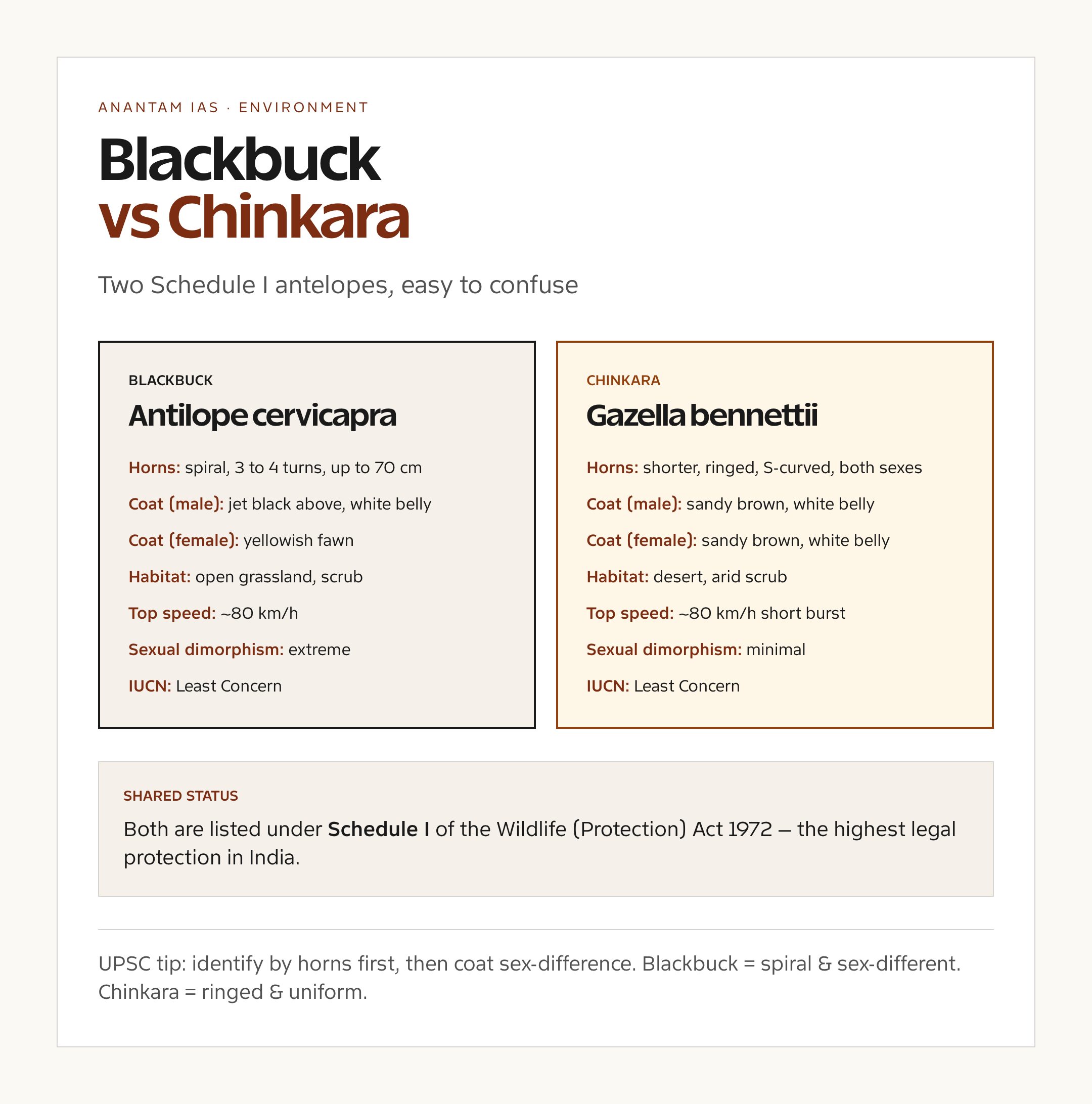
The Blackbuck and Chinkara (Indian gazelle, Gazella bennettii) are often confused. Both are Schedule I species under the WPA 1972. Key differences:
- Horns: Blackbuck horns spiral upward in three to four turns; Chinkara horns are shorter, ringed, and slightly S-curved
- Coat: adult male Blackbuck is jet black with white underparts; Chinkara is uniform sandy-brown with white belly
- Habitat: Blackbuck prefers open grassland; Chinkara is adapted to true desert and scrub
- Size: Blackbuck is larger and heavier
- Speed: both are fast, Blackbuck slightly faster on sustained sprint
- Sexual dimorphism: extreme in Blackbuck; minimal in Chinkara (both sexes carry horns)
UPSC Relevance and Recurring Themes
The Blackbuck reappears in UPSC papers across several subject domains. Prelims questions test on protected areas, Schedule I species, IUCN status, and state animal mappings. Mains GS-III environment and biodiversity questions examine grassland conservation, single-species recovery, and community-led models. Ethics (GS-IV) questions draw on the Bishnoi episode as a case study in environmental sacrifice and indigenous worldviews. Case-based current affairs often link the species to wildlife crime, sentencing, and the politics of celebrity poaching trials.
For broader context, see forest conservation in India, the Greater One-Horned Rhinoceros recovery, and the tribal issues framework that intersects with community conservation models.
Frequently Asked Questions
What is the scientific name of the Blackbuck?
The scientific name of the Blackbuck is Antilope cervicapra. It is the only surviving species in its genus and belongs to the family Bovidae, subfamily Antilopinae.
Where is the Blackbuck found in India?
The Blackbuck is found across Gujarat, Rajasthan, Andhra Pradesh, Karnataka, Odisha, Punjab, Haryana, Maharashtra, Madhya Pradesh, and Tamil Nadu. The largest concentrations live in Velavadar National Park in Gujarat and Tal Chhapar Sanctuary in Rajasthan, along with Bishnoi-protected community lands around Jodhpur.
What is the IUCN status of the Blackbuck?
The Blackbuck is listed as Least Concern on the IUCN Red List globally, owing to stable populations inside protected areas in India. Despite this, it receives Schedule I protection under India’s Wildlife (Protection) Act 1972, the highest national-level legal status.
Why is the Bishnoi community important to Blackbuck conservation?
The Bishnoi community of western Rajasthan follows a 15th-century tradition founded by Guru Jambheshwar that treats the Blackbuck and the khejri tree as sacred. Their villages around Jodhpur protect the largest non-protected-area Blackbuck populations in India. The 1730 Khejarli massacre, where 363 Bishnois died defending khejri trees, is considered a foundational moment in Indian environmentalism.
What is the difference between Blackbuck and Chinkara?
The Blackbuck has long spiral horns up to 70 centimetres, a jet-black coat on adult males with white underparts, and lives in open grasslands. The Chinkara has shorter ringed horns, a uniform sandy-brown coat in both sexes, and is adapted to desert and arid scrub. Both are Schedule I species but occupy different habitats.
Was the Blackbuck ever the National Animal of India?
The Blackbuck was considered for the National Animal status before independence-era successors decided in favour of the Royal Bengal Tiger, formally adopted in 1972 alongside the new Wildlife (Protection) Act. The Blackbuck remains the state animal of Andhra Pradesh, Haryana, and Punjab.
Tell Google you want more of this.
Add Anantam IAS as a preferred sourceOne tap, and this site shows up more often in your own Top Stories, AI Overviews and AI Mode. Remove it any time.