Difference Between Weather and Climate — Definitions, Comparison, and UPSC Notes
Complete UPSC guide to the difference between weather and climate — definitions, comparison table, factors, Koppen classification, IMD role, and climate change context.
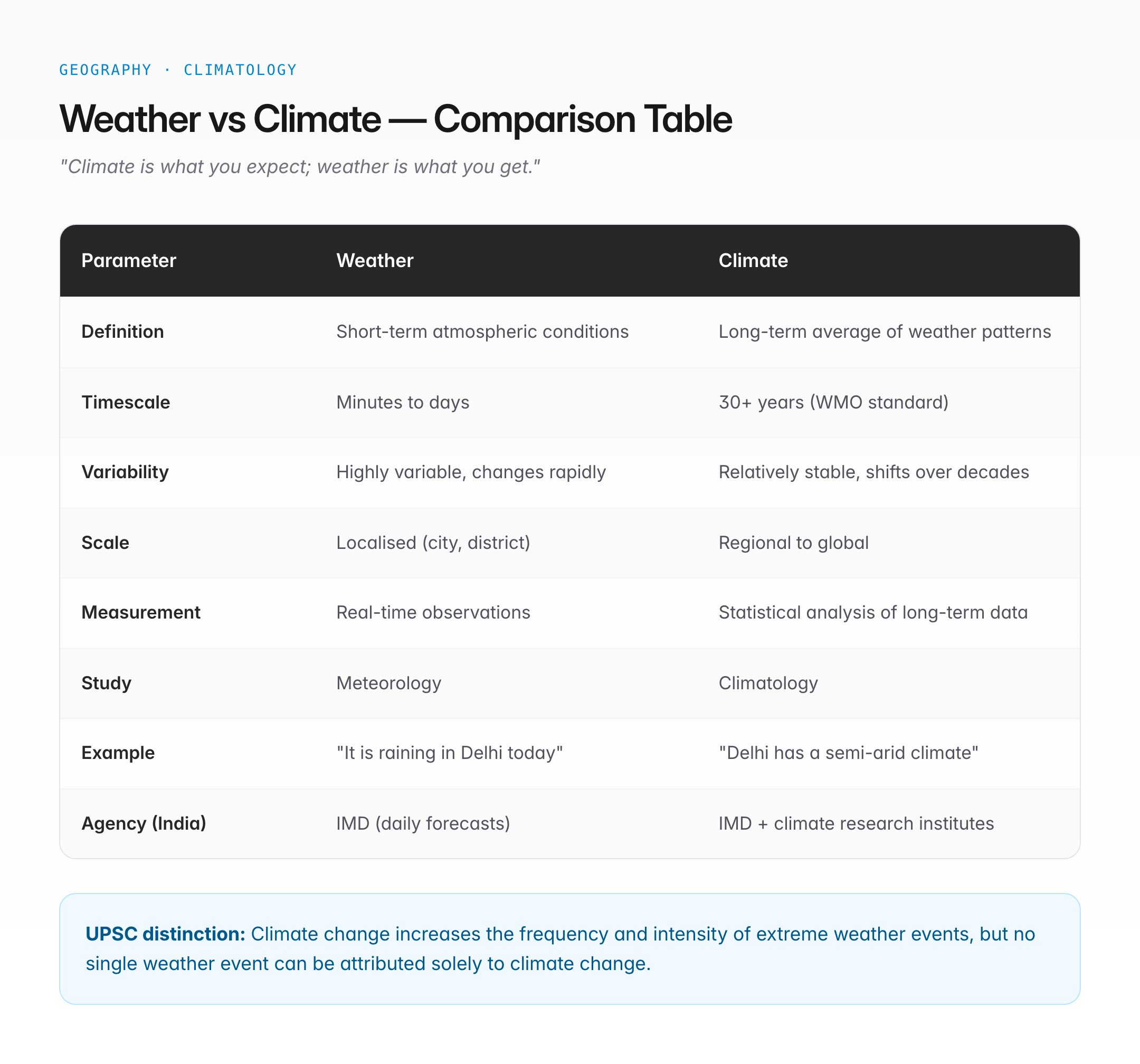
Understanding the difference between weather and climate is one of the most fundamental concepts in physical geography and atmospheric science. While the two terms are often used interchangeably in everyday conversation, they represent distinctly different phenomena operating on different timescales. Weather describes the short-term atmospheric conditions at a specific place and time, while climate refers to the long-term average of weather patterns over a region, typically measured over 30 years or more. As the saying goes: "Climate is what you expect; weather is what you get."
For UPSC, this distinction is critical in Geography (GS1) for understanding climatology, monsoon patterns, climate classification, and the difference between climate change and weather variability.
Definitions
Weather
Weather is the state of the atmosphere at a particular place and time, measured over short periods — minutes, hours, or days. It includes conditions such as temperature, humidity, precipitation, wind speed and direction, cloud cover, and atmospheric pressure. Weather is highly variable and can change rapidly.
Climate
Climate is the average weather pattern of a region over a long period, typically 30 years (as defined by the World Meteorological Organisation / WMO). It represents the statistical summary of weather elements — means, extremes, and variability — and characterises the general atmospheric behaviour expected in a region.
Weather vs Climate — Comparison Table
| Parameter | Weather | Climate |
|---|---|---|
| Definition | Short-term atmospheric conditions | Long-term average of weather patterns |
| Timescale | Minutes to days | 30 years or more (WMO standard) |
| Variability | Highly variable; changes rapidly | Relatively stable; changes over decades/centuries |
| Spatial scale | Localised (a city, a district) | Regional to global |
| Measurement | Real-time observations (thermometers, barometers, radar, satellites) | Statistical analysis of long-term weather data |
| Predictability | Short-range forecasts (up to ~10 days with reasonable accuracy) | Long-term trends and patterns; seasonal forecasts |
| Study | Meteorology | Climatology |
| Examples | "It is raining in Delhi today" | "Delhi has a semi-arid climate with hot summers and cool winters" |
| Key elements | Temperature, humidity, precipitation, wind, pressure, cloud cover | Mean temperature, mean rainfall, temperature range, humidity averages |
| Responsible agency (India) | IMD (daily forecasts) | IMD + climate research institutes (long-term data) |
Elements of Weather and Climate
Both weather and climate are described using the same atmospheric elements, but they differ in how these elements are expressed:
| Element | Weather Expression | Climate Expression |
|---|---|---|
| Temperature | "Today's maximum is 42 degrees C" | "Mean summer temperature is 38 degrees C" |
| Precipitation | "50 mm rainfall recorded yesterday" | "Average annual rainfall is 800 mm" |
| Humidity | "Relative humidity is 85% this morning" | "Average monsoon humidity exceeds 80%" |
| Wind | "Winds blowing at 40 km/h from northwest" | "Prevailing winds are westerlies" |
| Pressure | "Low pressure system over Bay of Bengal" | "Region lies in the sub-tropical high-pressure belt" |
Factors Affecting Weather
- Solar radiation (insolation) — the primary energy source driving all weather
- Latitude — determines the angle of incidence of solar rays
- Altitude — temperature decreases with elevation (normal lapse rate: 6.5 degrees C per 1000 m)
- Air masses and fronts — interaction between warm and cold air masses produces weather disturbances
- Pressure systems — cyclones (low pressure) and anticyclones (high pressure) drive wind and precipitation patterns
- Moisture content — humidity and availability of moisture determine precipitation
- Local topography — mountains, valleys, water bodies create localised weather effects (orographic rainfall, rain shadows, land-sea breezes)
Factors Affecting Climate
- Latitude — the most fundamental factor determining a region's climate zone
- Altitude — highland climates differ markedly from lowland climates at the same latitude
- Distance from the sea — continentality produces extreme temperatures inland; maritime climates are moderate
- Ocean currents — warm currents (Gulf Stream) warm adjacent coasts; cold currents (Labrador) cool them
- Prevailing winds — determine moisture transport (e.g., trade winds, westerlies)
- Mountain barriers — create rain shadow effects (e.g., Western Ghats and Deccan Plateau)
- Vegetation and land use — forests moderate temperature and humidity; urbanisation creates heat islands
- Greenhouse gases — long-term changes in atmospheric CO2, methane, and other gases alter global climate
Climate Classification — Koppen System
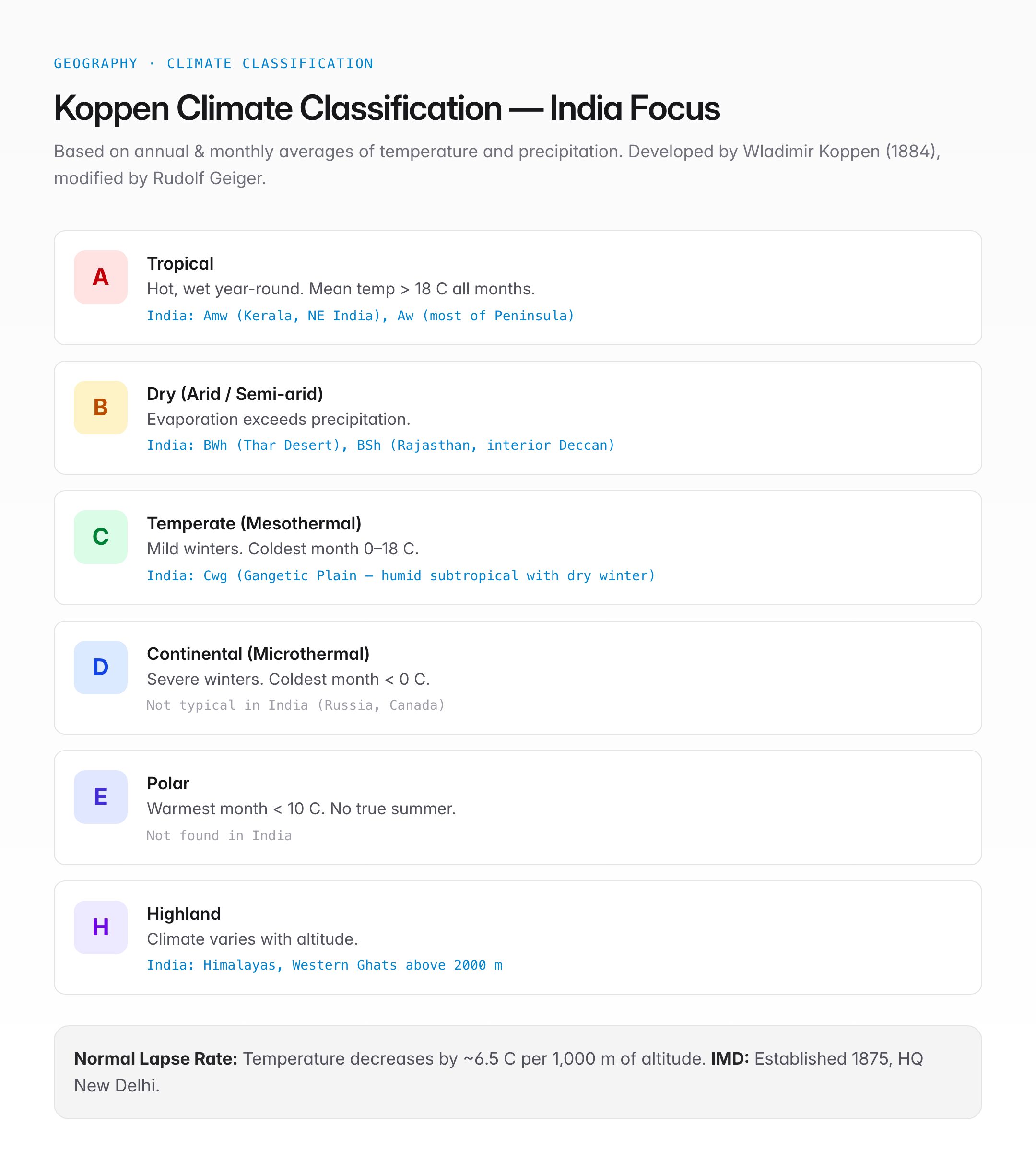
The Koppen Climate Classification (developed by Wladimir Koppen in 1884, modified by Rudolf Geiger) is the most widely used system for classifying world climates. It is based on annual and monthly averages of temperature and precipitation.
Major Climate Groups
| Symbol | Climate Type | Characteristics | Indian Example |
|---|---|---|---|
| A | Tropical | Hot, wet year-round; no winter; mean temp > 18 degrees C all months | Kerala, Andaman Islands |
| B | Dry (Arid/Semi-arid) | Evaporation exceeds precipitation | Rajasthan (BWhw), Gujarat interior |
| C | Temperate (Mesothermal) | Mild winters; warmest month > 10 degrees C; coldest month between 0-18 degrees C | Nilgiri Hills, parts of NE India |
| D | Continental (Microthermal) | Severe winters; coldest month < 0 degrees C; warmest > 10 degrees C | Not typical in India (found in Russia, Canada) |
| E | Polar | Warmest month < 10 degrees C; no true summer | Not found in India |
| H | Highland | Climate varies with altitude | Himalayas, Western Ghats above 2000 m |
India's Climate Under Koppen
India's climate is classified into several Koppen types:
- Amw — Tropical monsoon (Western coast, NE India)
- Aw — Tropical savanna (most of peninsular India)
- BSh — Semi-arid/steppe (Rajasthan, interior Deccan)
- BWh — Hot desert (Thar Desert)
- Cwg — Humid subtropical with dry winter (Gangetic Plain)
- H — Highland (Himalayan regions)
Weather Instruments
| Instrument | Measures |
|---|---|
| Thermometer | Temperature |
| Barometer | Atmospheric pressure |
| Hygrometer | Humidity |
| Anemometer | Wind speed |
| Wind vane | Wind direction |
| Rain gauge | Precipitation |
| Doppler radar | Precipitation intensity, storm tracking |
| Weather satellites | Cloud cover, cyclone tracking, sea surface temperature |
Role of IMD (India Meteorological Department)
The India Meteorological Department (IMD), established in 1875 with headquarters in New Delhi, is the principal agency responsible for meteorological observations, weather forecasting, and seismology in India:
- Issues daily weather forecasts, cyclone warnings, heat wave alerts, and heavy rainfall alerts
- Maintains a network of observatories, Doppler weather radars, and automatic weather stations across India
- Publishes seasonal monsoon forecasts (long-range forecasts based on statistical and dynamical models)
- Collaborates with international agencies (WMO, IPCC)
- Operates the Cyclone Warning Division for tropical cyclone tracking in the North Indian Ocean
Climate Change vs Weather Events
A common misconception is conflating individual weather events (a heat wave, a flood) with climate change. The distinction matters:
| Aspect | Single Weather Event | Climate Change |
|---|---|---|
| Nature | Short-term, localised | Long-term, global/regional trend |
| Example | "Delhi recorded 49 degrees C on one day" | "Average summer temperatures in Delhi have risen by 1.5 degrees C over 50 years" |
| Attribution | Cannot attribute a single event solely to climate change | Statistical analysis can show increased frequency/intensity of extreme events |
| IPCC view | Individual events are not proof of climate change | The increasing frequency and intensity of extreme weather events is consistent with climate change projections |
Key UPSC concept: Climate change makes extreme weather events more likely and more intense, but no single weather event can be attributed solely to climate change. This nuance is important for Mains answers.
UPSC Relevance
GS Paper I: Geography — Climatology, monsoons, climate classification, weather phenomena, factors affecting climate.
GS Paper III: Environment — Climate change, global warming, IPCC findings, India’s climate action.
Key Points for Prelims
- Weather = short-term (hours/days); Climate = long-term (30+ years, WMO standard)
- Meteorology studies weather; Climatology studies climate
- Koppen Classification is based on temperature and precipitation averages
- India's major Koppen types: Amw (tropical monsoon), Aw (tropical savanna), BSh (semi-arid), BWh (desert), Cwg (humid subtropical)
- IMD was established in 1875, headquartered in New Delhi
- Climate change increases the frequency and intensity of extreme weather events but no single event can be attributed solely to it
- Normal Lapse Rate: temperature decreases by approximately 6.5 degrees C per 1000 m of altitude
- Continentality = interior locations have more extreme temperatures than coastal ones