Hemis National Park: Snow Leopard Capital, Largest Park in India, Ladakh
Hemis National Park in Ladakh, India's largest national park and the only one north of the Himalayas, home to snow leopards, bharal, and the Hemis Tsechu festival.
In the cold desert that stretches behind the main ranges of the Himalaya, where the Indus runs grey and fast and the slopes climb past five thousand metres, sits a national park that is unlike any other in the country. Hemis National Park in eastern Ladakh is the largest notified national park in India by area, the only one situated entirely north of the Great Himalayan range, and the most reliable place on earth to see a wild snow leopard. For UPSC, it sits at the intersection of physical geography, biodiversity, and tribal culture in three or four different syllabus boxes.
The park takes its name from the four-hundred-year-old Hemis Monastery that dominates a side valley off the Indus highway, and the cultural rhythm of the surrounding Ladakhi villages still shapes how the protected area is run. Notification came in 1981, before the Wildlife Protection Act framework had matured into the layered tiger-reserve and biosphere model used elsewhere, which is why Hemis is still managed primarily as a high-altitude wildlife park with a strong community interface rather than as a tiger reserve clone.
This guide walks through what Hemis is, why its location matters, what it protects, the festivals and tribes connected to it, and the prelims and mains pointers an aspirant must carry into the exam hall.
Quick Facts
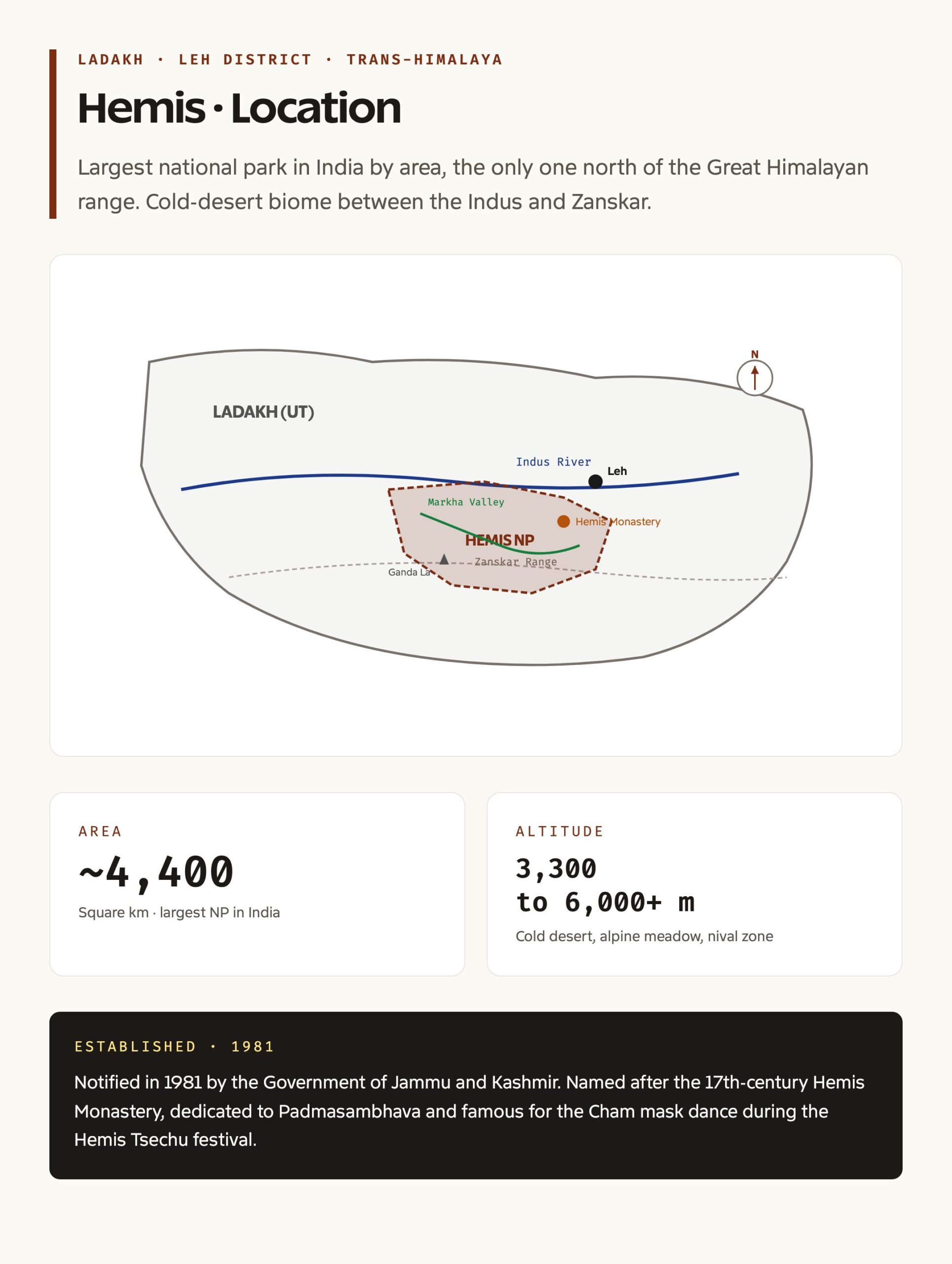
- Location: Leh district, Union Territory of Ladakh, eastern Ladakh
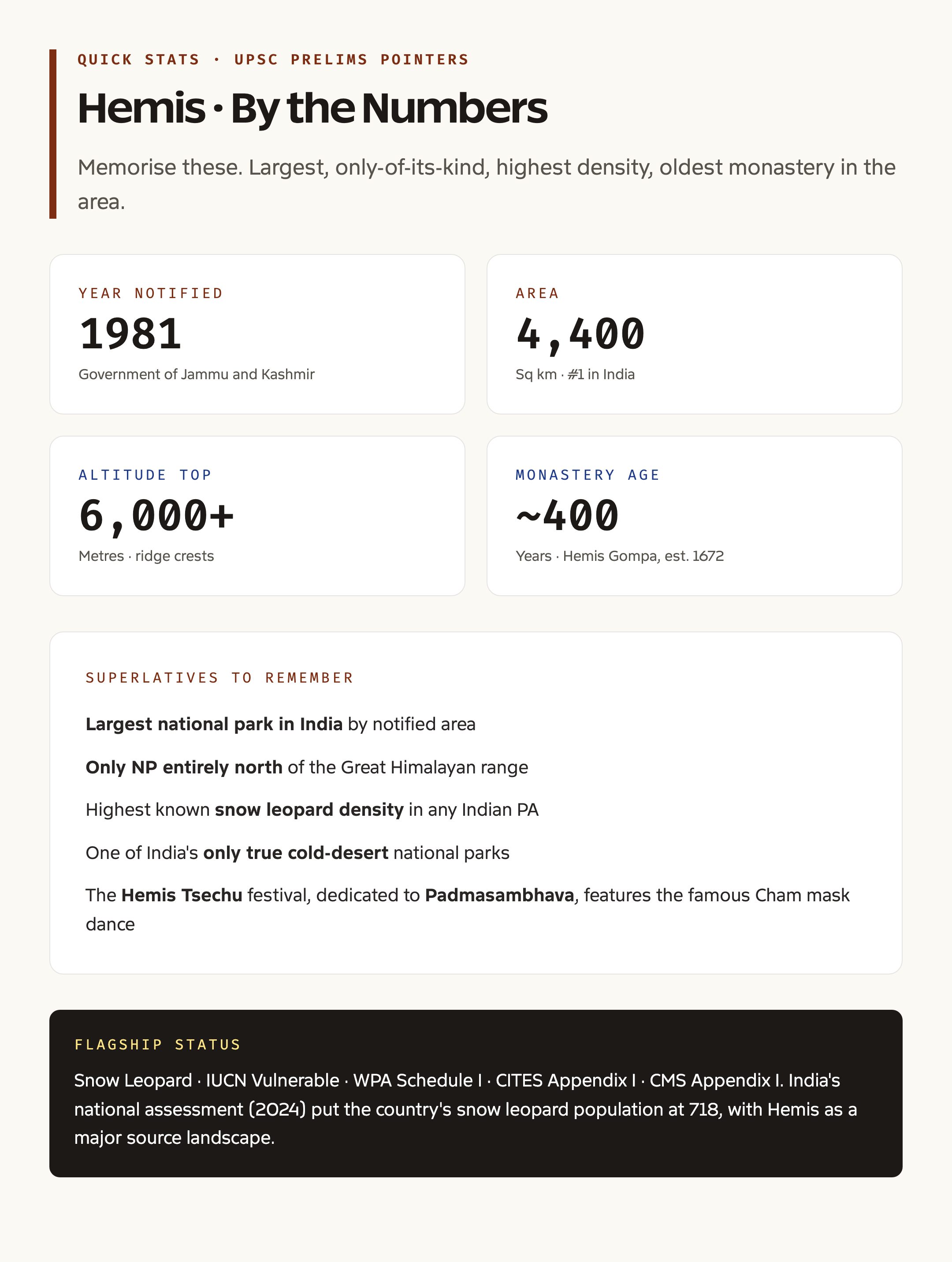
- Notified: 1981
- Area: Approximately 4,400 sq km (largest national park in India)
- Position relative to Himalaya: The only Indian national park located entirely north of the Great Himalayan range
- Origin of name: Hemis Monastery, a 17th century Drukpa Kagyu Buddhist monastery
- Landscape: High-altitude cold desert, alpine shrubland and meadow
- Bounding ranges and rivers: Zanskar Range to the south; Indus River along the northern boundary
- Internal catchments: Markha, Sumdah, and Rumbak streams
- Iconic geographical features: Ganda La pass, Markha Valley
- Flagship species: Snow Leopard (Panthera uncia)
- Other key species: Bharal (Blue Sheep), Shapo (Ladakh Urial), Tibetan Wolf, Eurasian Brown Bear, Himalayan Marmot, Tibetan Argali
- Prominent communities: Ladakhis, predominantly Tibetan Buddhist
- Major festival: Hemis Tsechu, dedicated to Guru Padmasambhava
- Famous performance art: Cham, the masked dance performed by lamas
What Is Hemis National Park
Hemis is a protected area carved out of the trans-Himalayan landscape that lies between the Zanskar range and the Indus valley. The park is shaped less like a forest preserve and more like a vast bowl of arid mountain country, with deep gorges, river-cut valleys, alpine meadows above the tree line, and rocky cliffs that rise to peaks above six thousand metres. There is almost no closed canopy forest here. The vegetation is dwarf juniper, Caragana scrub, willow along the streams, and high-altitude pasture in the summer months.
What makes Hemis ecologically distinct is that it sits on the rain shadow side of the Himalaya. The summer monsoon barely reaches this far north. Rainfall is below 200 millimetres a year in most of the park, and the dominant moisture input is winter snow and glacial melt. This shapes everything that follows. The vegetation is sparse but specialised. Herbivores like the bharal and shapo are adapted to feed on tough alpine grasses and herbs. The snow leopard, in turn, has evolved to hunt these wide-ranging herbivores across enormous territories of broken cliff country.
The park also serves a cultural function. The Markha Valley, one of the best-known trekking routes in Ladakh, runs through Hemis. So does the route to Stok Kangri base. Ladakhi villages with grazing rights and traditional homesteads still operate inside the park boundary, which makes Hemis one of the few large Indian parks that is genuinely co-inhabited rather than evacuated.
Background and Historical Context
The conservation story of Hemis begins long before any forest department file was opened. The Drukpa Kagyu lineage of Tibetan Buddhism, which built Hemis Monastery in 1672 under the patronage of King Sengge Namgyal, has historically discouraged hunting in the surrounding valleys on religious grounds. Whole sections of the upper Markha and Rumbak watersheds were treated as informally protected by the monastery and the village councils. When the Indian state began formal protection of the area, it was layering a legal regime on top of an existing community ethic.
The land that would become Hemis came under formal protection in 1981, when the J&K state government notified it as a national park. The original notified area was much smaller. Successive expansions through the late 1980s and 1990s added the Markha and Rumbak catchments and the high country south of the Indus, taking the park to its current size of about 4,400 sq km. That figure makes Hemis the largest national park in the country, larger than Desert National Park in Rajasthan and several times the size of Kaziranga or Jim Corbett.
The reorganisation of Jammu and Kashmir in 2019 and the creation of the Union Territory of Ladakh placed Hemis under the new UT’s wildlife department, which has since reworked the snow leopard tourism protocol, the homestay programme in Rumbak, and the community conservancy model along the buffer.
Key Provisions and Protected Features
Hemis is notified under the Wildlife Protection Act, 1972, which gives it the highest level of statutory protection available to a terrestrial habitat in India. The Act prohibits hunting, the destruction of habitat, and the alteration of boundaries except by act of the state legislature. Cattle grazing and the collection of forest produce are regulated rather than banned outright, in recognition of the long-standing presence of Ladakhi villages inside the park.
The park is also a key node in the Project Snow Leopard framework, launched by the Government of India in 2009. Project Snow Leopard treats the high-altitude landscape rather than the individual reserve as the unit of management. Under this framework, Hemis is connected with Kibber, Pin Valley, Gangotri, and other trans-Himalayan parks as part of a continuous landscape for snow leopard conservation.
A distinctive feature of Hemis governance is the village conservancy and homestay model. The Snow Leopard Conservancy India Trust and the Ladakhi village councils have built a system where households earn from snow leopard tourism and from a livestock insurance pool funded by the same tourism. The pool compensates herders for animals lost to predators, which has dramatically reduced retaliatory killing of snow leopards in the buffer.
Why Hemis Matters
Hemis matters for at least three reasons that an aspirant should be able to articulate.
First, it is the largest national park in India and the only one north of the Himalaya. That is a prelims fact, but it is also a mains framing. India’s national park system is overwhelmingly tilted toward forested ecosystems. Hemis is one of the few protected areas that holds a genuinely trans-Himalayan, cold desert landscape inside the park network. Without Hemis, the country’s representation of cold desert biodiversity would rest almost entirely on Pin Valley and parts of the Changthang sanctuary.
Second, it is the global reference site for snow leopard tourism. Ullen, Rumbak, and Husing valleys in the park are the most reliable winter sighting sites for Panthera uncia anywhere in its twelve-country range. That has put Indian conservation on the global high-altitude map.
Third, it is a model for community-based conservation. The homestay-cum-insurance model developed in and around Hemis has been studied and replicated in Mongolia, Kyrgyzstan, and parts of the Indian Himalaya. For mains questions on people-and-protected-area conflict, Hemis is the positive case study.
Detailed Ecological Analysis
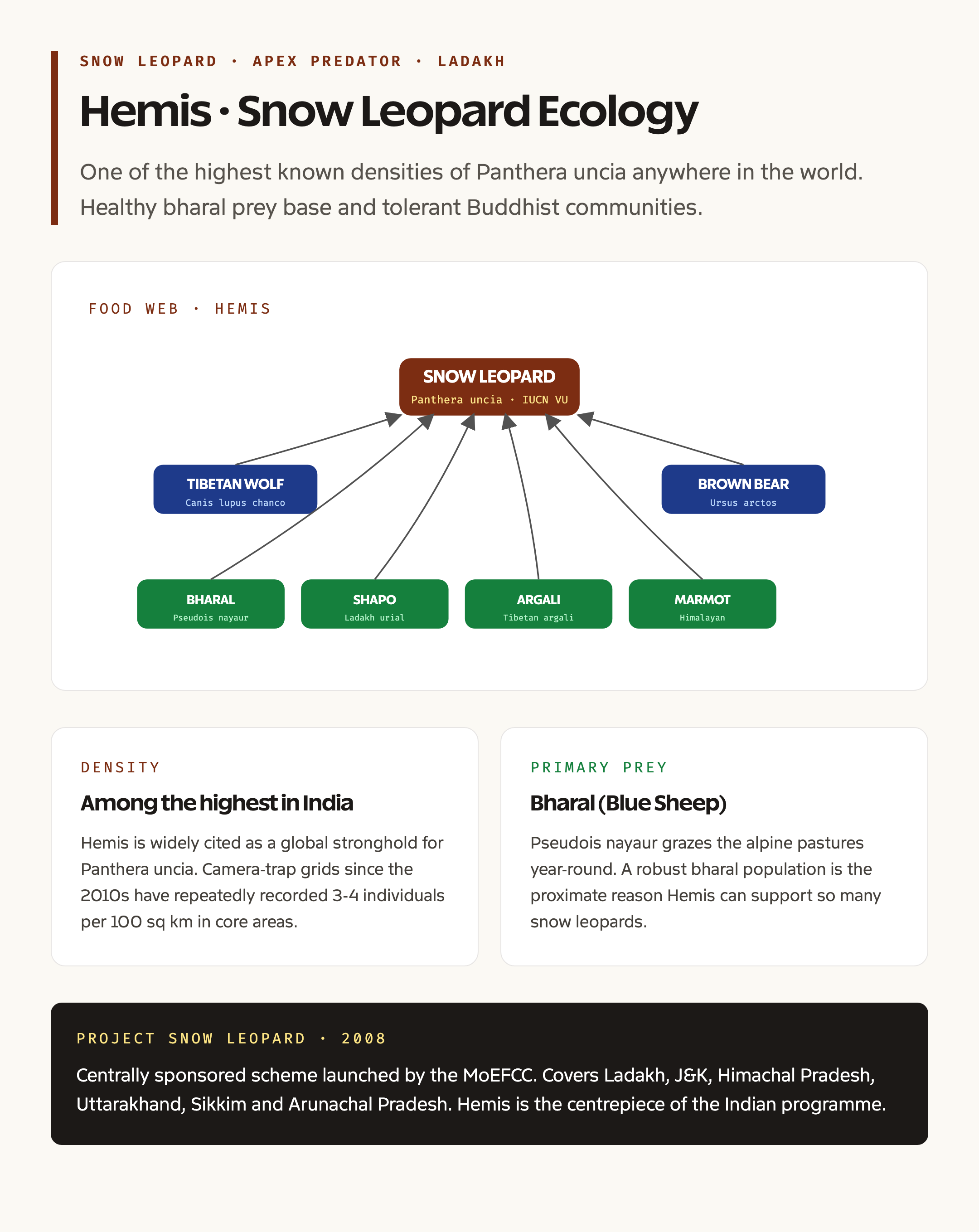
The food web in Hemis is short and visible. Hard alpine grasses, sedges, and dwarf shrubs feed bharal, shapo, and Tibetan argali. The bharal, in particular, is the snow leopard’s primary prey across most of the park. Adult bharal can weigh up to 70 kilograms, and a snow leopard can take down an animal twice its own weight on a steep slope. The Tibetan wolf and the Eurasian brown bear are secondary predators that share the landscape, with bears active mostly in summer and going into winter dens at higher elevations.
The smaller mammal community includes the Himalayan marmot, the woolly hare, the pika, and the stoat. Marmot colonies are visible from a distance in summer, and they are an important prey item for the golden eagle and the lammergeier. The bird community is sparse but distinctive. Lammergeier, Himalayan griffon, golden eagle, snowcock, chukar partridge, robin accentor, and the white-throated dipper along the streams are the marquee species.
Vegetation transitions with altitude. Below about 4,000 metres, willow and seabuckthorn line the streams and Caragana scrub dominates the slopes. Between 4,000 and 5,000 metres, alpine pasture takes over. Above 5,000 metres, the cold desert pavement of stone and lichen begins. Tree line in this part of the trans-Himalaya is unusually low, often below 4,500 metres, because of cold and aridity rather than altitude alone.
Comparative Snapshot
Among Indian national parks, Hemis can be compared most usefully with three others.
Against Jim Corbett National Park, Hemis is roughly four times the size, sits at four times the elevation, and protects a fundamentally different ecological zone. Corbett protects sal-dominated tropical forest with tigers and elephants. Hemis protects cold desert with snow leopards and wild ungulates.
Against Desert National Park in Rajasthan, Hemis is similar in being arid but very different in physics. DNP is a hot Thar desert with great Indian bustard and chinkara. Hemis is a high-altitude cold desert with snow leopard and bharal.
Against Pin Valley National Park in Himachal, Hemis is a sister park within the same trans-Himalayan zone but is much larger and lies further north. Pin Valley is contiguous with Great Himalayan National Park and is a critical corridor; Hemis is the eastern anchor of the same continuum.
These comparisons matter for prelims pair-matching questions and for any mains question that asks about the geographical spread of India’s national park network.
Challenges and Pressures
Hemis faces a set of pressures distinctive to high-altitude protected areas. Climate change is the largest of them. Glacier retreat across the Zanskar range is shifting the timing of stream flow in Markha, Rumbak, and Sumdah, which affects livestock grazing patterns in the buffer and prey distribution for snow leopards. Warmer winters are pushing tree line and shrub line upward, which compresses the cold desert pasture that bharal depend on.
Tourism pressure has grown rapidly since the snow leopard sightings became internationally famous. Winter tourism in particular concentrates large numbers of high-end visitors in the Rumbak and Husing valleys for short windows. Without strict carrying-capacity rules, this can stress prey species and habituate snow leopards.
Livestock disease spillover from domestic sheep and goats to wild bharal and shapo is a recurring concern. So is feral dog predation, especially around military and tourism waste sites. Linear infrastructure including border roads and the Ladakh trans-mission line cuts across the southern edge of the landscape.
Finally, governance capacity is thin. The wildlife department in Ladakh UT is small, the terrain is extreme, and the field season is short. Patrol coverage relies heavily on local knowledge, homestay networks, and seasonal staff.
Prelims Pointers
- Hemis National Park is in Leh district, Union Territory of Ladakh
- It is the largest national park in India by area
- It is the only Indian national park located entirely north of the Great Himalayan range
- It was notified in 1981, named after Hemis Monastery
- It is bounded by the Zanskar Range to the south and the Indus River to the north
- The Markha, Sumdah, and Rumbak streams flow within the park
- The flagship species is the snow leopard, Panthera uncia
- Bharal, shapo, Tibetan wolf, Himalayan marmot, and Eurasian brown bear are key associated species
- Hemis Tsechu festival, dedicated to Guru Padmasambhava, is held at Hemis Monastery
- Cham, a masked dance performed by lamas, is the festival’s signature ritual
- Project Snow Leopard, launched in 2009, treats Hemis as part of a high-altitude landscape conservation unit
Mains Practice Questions
- Examine the conservation significance of trans-Himalayan protected areas, with reference to Hemis National Park. (10 marks)
- The community-based conservation model around Hemis National Park has been hailed as a template for human-wildlife coexistence. Discuss the design features that make it work and the constraints on its replicability. (15 marks)
- India’s national park network underrepresents cold desert ecosystems. Comment, identifying gaps and policy options. (10 marks)
- Snow leopard conservation requires landscape-scale management rather than reserve-scale management. Critically analyse with reference to Project Snow Leopard. (15 marks)
Way Forward
A useful conservation agenda for Hemis must do four things at once. It must hold tourism within demonstrable carrying capacity, particularly in winter, by enforcing sighting protocols and rotating sites. It must scale up the village livestock insurance and homestay model from a few catchments to the whole park, so that the economics of coexistence reach every household. It must invest in long-term monitoring of snow leopard, bharal, and Tibetan argali populations using camera traps, faecal genetics, and herder citizen-science. And it must integrate Hemis into the wider Project Snow Leopard landscape, treating the corridors to Pin Valley and to the Tibetan plateau as part of the management unit.
Read more on India’s protected area network in our guides on biodiversity in India, national parks of India, and the Wildlife Protection Act, 1972, and on adjoining frameworks in biosphere reserves of India.
Frequently Asked Questions
Why is Hemis called the largest national park in India?
Hemis covers about 4,400 sq km in eastern Ladakh, which is larger than any other notified national park in the country. The figure exceeds Desert National Park in Rajasthan and is several times the size of well-known parks like Kaziranga or Jim Corbett. The size reflects the scale needed to protect viable populations of wide-ranging trans-Himalayan species like the snow leopard.
What is unique about Hemis among Indian national parks?
Hemis is the only Indian national park that lies entirely north of the Great Himalayan range. It protects a cold desert and trans-Himalayan landscape rather than a forested one, which makes it ecologically unrepresentative of the rest of the park network. It is also the most reliable place to sight a wild snow leopard.
Where exactly is Hemis National Park?
Hemis sits in Leh district of the Union Territory of Ladakh. It is bounded by the Zanskar Range to the south and the Indus River to the north. The Markha, Rumbak, and Sumdah streams form internal catchments that drain into the Indus.
Which species are protected at Hemis?
The flagship species is the snow leopard. Other significant mammals include the bharal or blue sheep, the shapo or Ladakh urial, the Tibetan argali, the Tibetan wolf, the Eurasian brown bear, the Himalayan marmot, and the woolly hare. Birds include the lammergeier, the Himalayan griffon, the golden eagle, and the Tibetan snowcock.
Why are bharal so important inside Hemis?
Bharal are the principal prey of snow leopards across most of the park. A healthy bharal population sustains a healthy snow leopard population, which makes bharal monitoring a core conservation indicator. Disease spillover and grazing competition from domestic livestock are the main threats to bharal numbers.
What is the Hemis Tsechu festival?
Hemis Tsechu is an annual two-day Buddhist festival held at Hemis Monastery, dedicated to Guru Padmasambhava who introduced Vajrayana Buddhism to Tibet. The signature performance is the Cham, a masked dance performed by lamas in elaborate silk robes, which dramatises the victory of dharma over the forces of evil.
Is Hemis a tiger reserve or biosphere reserve?
No. Hemis is notified as a national park under the Wildlife Protection Act, 1972, but it is not a tiger reserve and not a UNESCO biosphere reserve. It is, however, a key site under Project Snow Leopard, which treats the wider trans-Himalayan landscape as a single conservation unit.
Can people still live inside Hemis National Park?
Yes. Several Ladakhi villages, including Rumbak, Husing, and parts of Markha, are located inside the park boundary. Residents retain regulated grazing and homestead rights, and the homestay-and-livestock-insurance model around snow leopard tourism is designed to align village incomes with conservation outcomes.
How does climate change affect Hemis?
Glacier retreat in the Zanskar range is altering stream flow timing, warmer winters are pushing tree line and shrub line upward, and snowfall patterns are becoming less predictable. Each of these changes compresses the cold desert pasture that bharal depend on and indirectly affects snow leopard prey availability.
How is Hemis governed today?
Since the reorganisation of Jammu and Kashmir in 2019, Hemis falls under the wildlife department of the Union Territory of Ladakh. Day-to-day management combines departmental staff with village councils, the Snow Leopard Conservancy India Trust, and seasonal homestay networks that double as a frontline observation system.