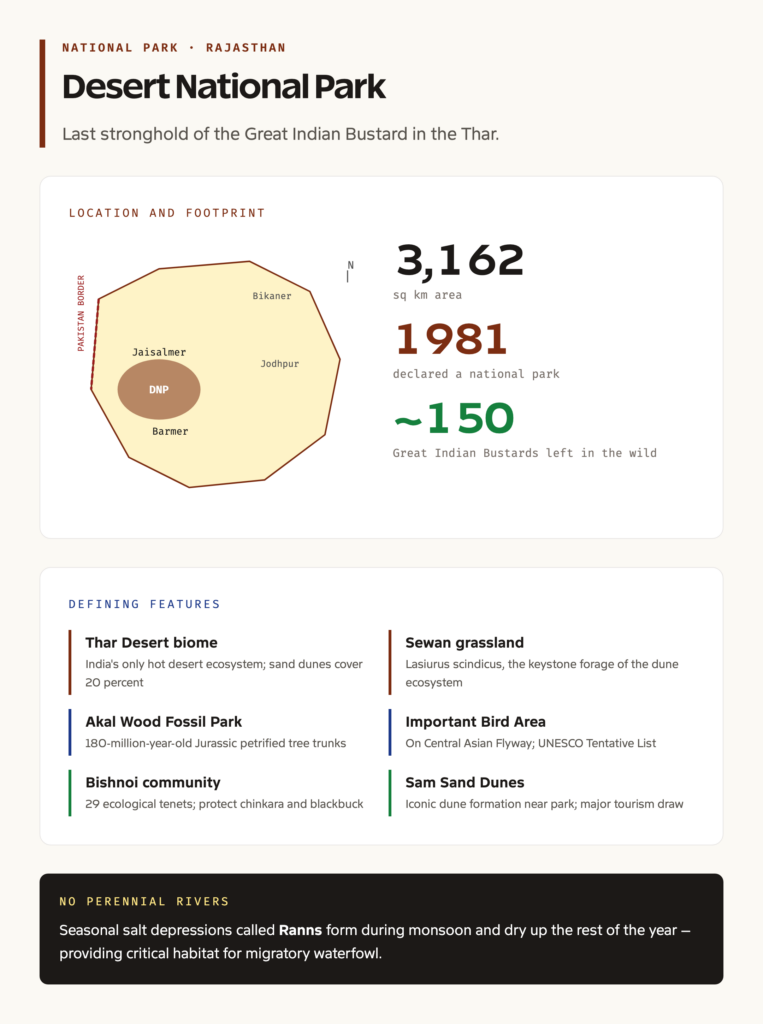
The Desert National Park sits in the windswept Thar, where shifting dunes, salt flats, and clumps of Sewan grass cover an area larger than the city of Mumbai. It is the country’s most important refuge for the Great Indian Bustard, a five-foot tall ground bird that has slipped into the critically endangered list and now numbers fewer than 150 individuals in the wild. The park spans Jaisalmer and Barmer districts in western Rajasthan, hugs the Pakistan border for long stretches, and protects a landscape that looks empty at first glance but supports one of India’s most specialised arid ecosystems.
Most visitors picture a desert as lifeless. The Desert National Park overturns that view. Within its 3,162 square kilometres you will find chinkara, blackbuck, desert cat, desert fox, monitor lizards, and over 120 bird species including migratory MacQueen’s bustard from Central Asia. It carries an Important Bird Area tag from BirdLife International and sits on UNESCO’s Tentative List for World Heritage status. For UPSC aspirants, it is a high-frequency topic that connects national parks, endangered species, traditional ecological knowledge, and renewable energy conflicts in a single case study.
This guide walks through what the park is, why it matters, and how to revise it cleanly for both Prelims and Mains.
Quick Facts
- Location: Jaisalmer and Barmer districts, western Rajasthan
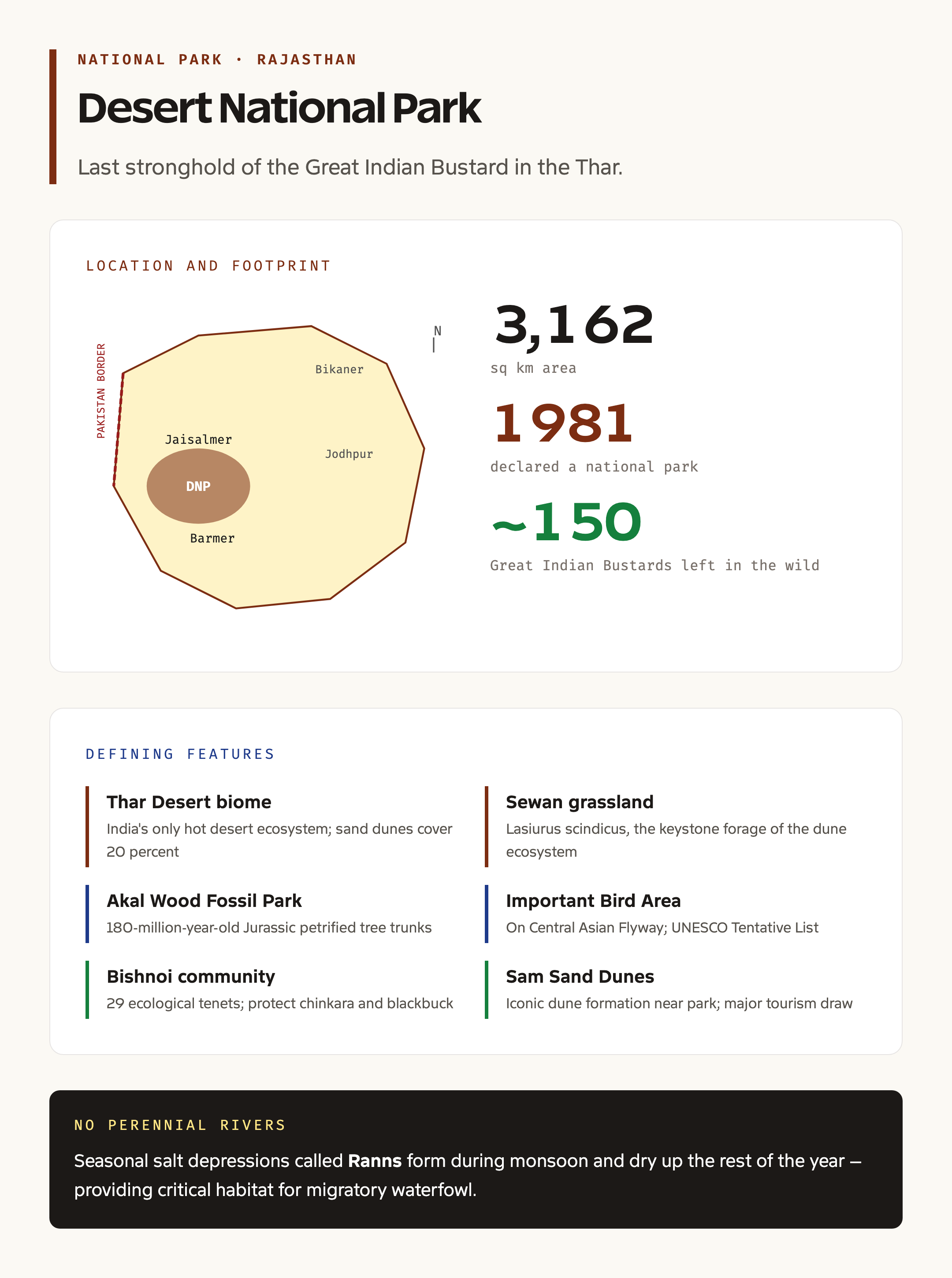
- Area: 3,162 sq km (one of India’s largest national parks)
- Declared: 1981
- Ecosystem: Thar Desert, India’s only hot desert biome
- Flagship species: Great Indian Bustard (state bird of Rajasthan)
- Vegetation: Sewan grass (Lasiurus scindicus), Aak shrub (Calotropis procera), Khejri trees
- International tags: Important Bird Area; on UNESCO Tentative List
- Indigenous community: Bishnoi, known for ecological protection of wildlife
- Famous geo-features: Sam Sand Dunes, Akal Wood Fossil Park
- Rivers: None perennial; seasonal salt depressions called Ranns
What Is the Desert National Park
The Desert National Park is a protected area established under the Wildlife (Protection) Act, 1972 to safeguard the unique flora and fauna of the Thar Desert. Unlike forested parks such as Forest Conservation Act, 1980 reserves or wetland sanctuaries, this park preserves a treeless, semi-arid grassland and dune complex. Twenty percent of its area is covered by sand dunes; the remaining mosaic mixes craggy rocks, compact salt-lake bottoms, inter-medial areas, and fixed dunes anchored by Sewan grass.
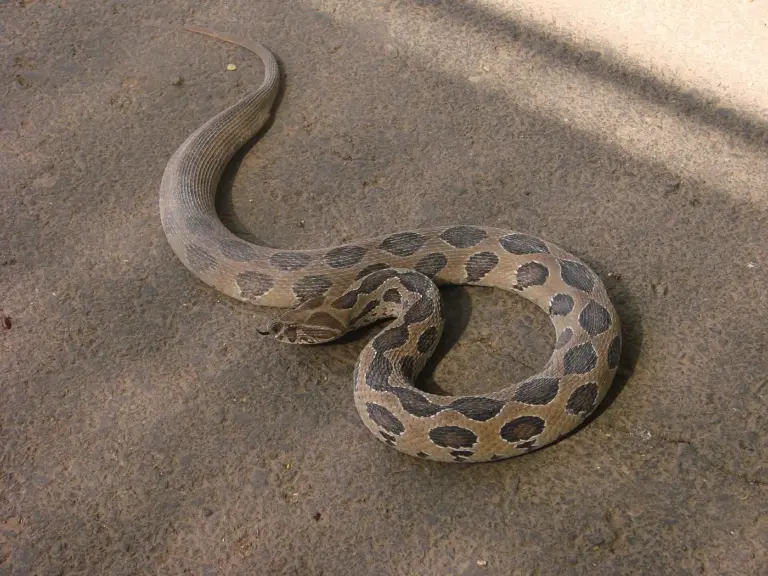
The park holds a complete cross section of Thar biodiversity in one place. Reptiles include the spiny-tailed lizard, monitor lizard, saw-scaled viper, and Russell’s viper. Mammals include the Indian wolf, desert fox, Bengal fox, caracal (extremely rare), striped hyena, chinkara, and blackbuck. Bird life is the real headliner because the park sits on the Central Asian Flyway, drawing harriers, falcons, and houbara bustards in winter alongside resident species like the Indian sandgrouse.
It also functions as a living museum. Akal Wood Fossil Park, a satellite section, holds 180-million-year-old petrified tree trunks from the Jurassic period when the Thar was a dense forest. The juxtaposition of fossil forest and current dune sea makes it one of the most teachable landscapes for Indian school and college geology.
Background and Historical Context
Rajasthan’s western frontier was a princely territory of camel breeders, salt traders, and pastoralists long before national park status. The Bishnoi community, founded in 1485 by Guru Jambheshwar, codified 29 ecological tenets including a ban on cutting green trees and killing animals. The famous Khejarli massacre of 1730, in which 363 Bishnois led by Amrita Devi died protecting Khejri trees from royal woodcutters, is treated as the world’s first organised tree-hugger movement and a direct ancestor of the Chipko movement.
The Government of India notified the Desert National Park in 1981 to protect both the Thar’s natural heritage and the dwindling Great Indian Bustard population. The bird’s range across the subcontinent had collapsed from over 11 states in the 1970s to four states by 2010. Rajasthan, especially the Jaisalmer landscape, became the species’ last meaningful stronghold.
A second wave of protection came through Project Bustard, modelled loosely on Project Tiger but never formally launched as a centrally sponsored scheme. Still, it shaped state-level conservation actions including the Sudasari and Ramdevra enclosures within the park.
Key Provisions and Legal Architecture
The park draws its statutory backbone from the Wildlife (Protection) Act, 1972. Section 35 of the Act allows a state government to declare a national park, which then prohibits hunting, grazing, and any habitat alteration. Several other legal layers stack on top of this base.
- Wildlife (Protection) Act, 1972: Bans hunting, livestock grazing inside core, removal of forest produce
- Eco-Sensitive Zone: A buffer notification requires environmental clearance for industries and constructions within a defined radius around the park boundary, similar to the framework explained in our eco-sensitive zones primer
- Indian Forest Act, 1927: Many sections of the park overlap with reserved and protected forests
- Biological Diversity Act, 2002: Governs access to genetic resources from Thar species
- Right of Passage: Residents in some enclaves retain customary access for grazing and fuelwood, a contested compromise
- Border Security regulations: Parts of the park lie within 10 km of the international border, requiring BSF coordination
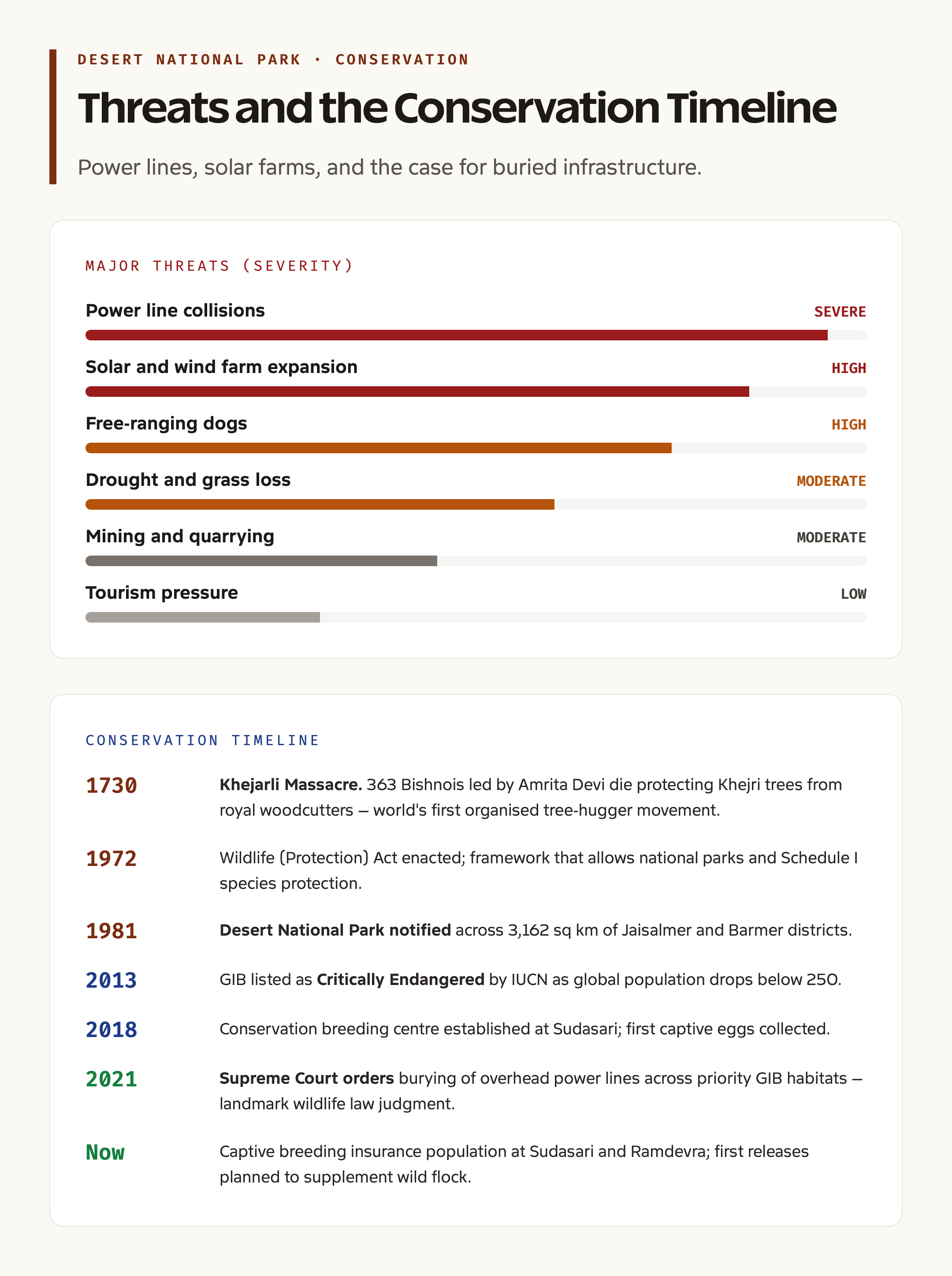
In 2021, the Supreme Court ordered the burying of overhead power lines across priority bustard habitats in the park to prevent electrocution deaths. The order is one of the most significant judicial interventions in Indian wildlife law in the past decade.
Why It Matters
The Desert National Park is more than a tourism asset. It is a working laboratory for several policy questions India is wrestling with right now.
Species recovery: The Great Indian Bustard population has crashed from an estimated 1,260 birds in 1969 to under 150 today. Saving the species in the wild is functionally identical to saving this park.
Renewable energy and biodiversity trade-off: Western Rajasthan hosts some of India’s largest solar parks and wind farms because of high irradiance and steady wind. Many transmission lines cross GIB flight paths. Bird mortality from collisions has triggered a national debate on whether power lines should run underground.
Climate adaptation: The Thar is expanding. Rainfall patterns are shifting and the park’s grass cover has thinned in recent decades. How a desert grassland responds to a warming climate is a question with implications for the Aravalli foothills, Gujarat, and even Pakistan’s Cholistan.
Traditional knowledge: The Bishnoi practice of sheltering chinkara herds inside village boundaries is now studied as a model for community-led conservation that does not depend on fences or armed guards.
Detailed Analysis: Species, Habitat, and Threats
The Great Indian Bustard
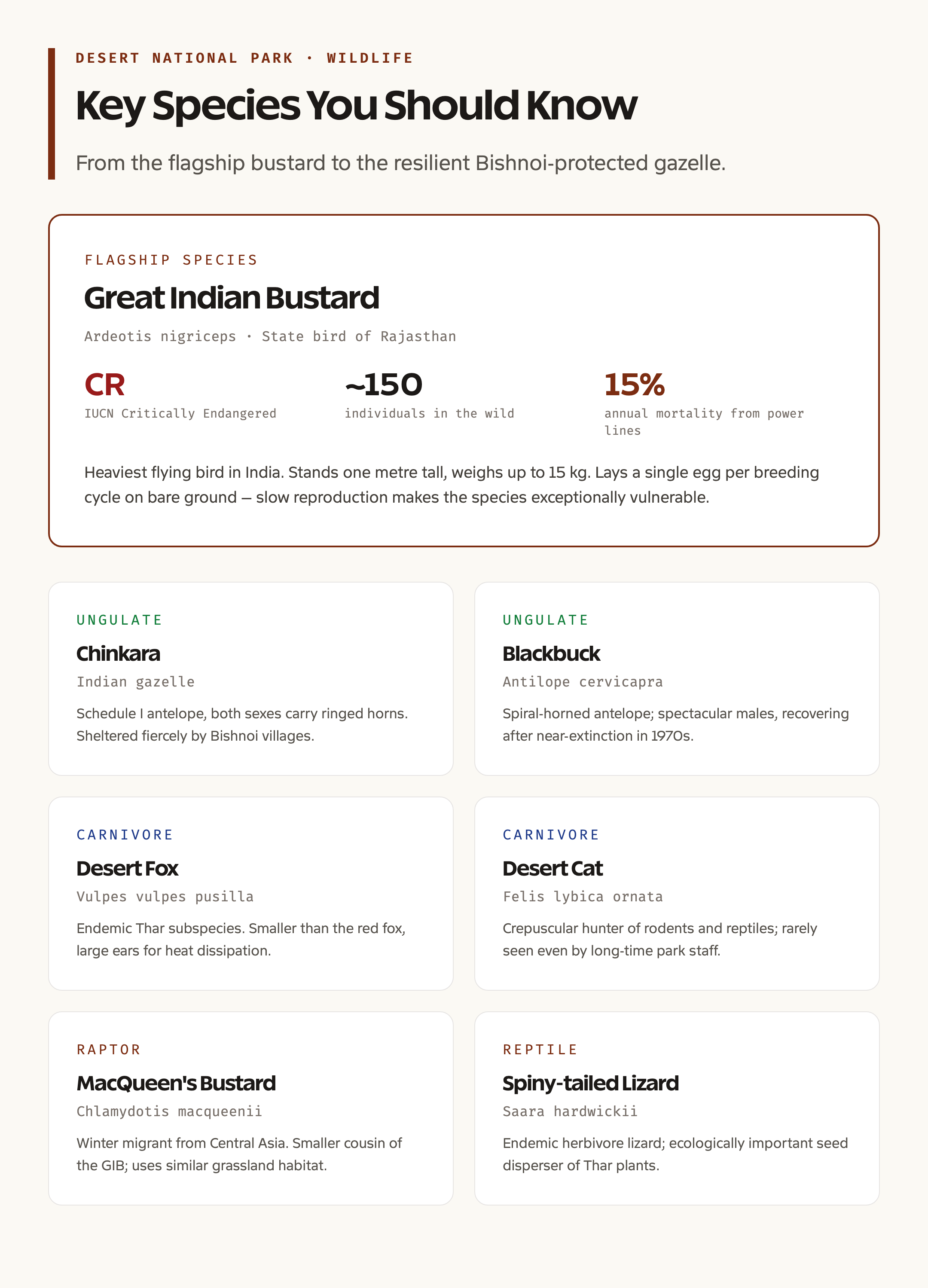
Standing nearly a metre tall and weighing up to 15 kg, the GIB is one of the heaviest flying birds in the world. It nests on bare ground, lays a single egg per breeding cycle, and feeds on insects, lizards, and Sewan seeds. Slow reproduction makes the species exceptionally vulnerable. Three threats dominate.
- Power line collisions, which kill an estimated 15 percent of the wild population every year
- Habitat fragmentation from solar parks, canals, and roads
- Predation of eggs by free-ranging dogs and feral pigs
A captive breeding programme run jointly by the Wildlife Institute of India and the Rajasthan Forest Department at Sudasari and Ramdevra hopes to release insurance birds back into the wild from 2025 onward.
Other Notable Species
- Chinkara (Indian gazelle): Common across the park; protected fiercely by Bishnoi villages
- Blackbuck: Recovering after near-local-extinction in the 1970s
- Desert fox and Bengal fox: Both present, the desert fox is endemic to the Thar
- Macqueen’s bustard: Winter migrant from Central Asia; smaller cousin of the GIB
- Spiny-tailed lizard: Endemic, ecologically important seed disperser
Threats Snapshot
| Threat | Severity | Trend |
|---|---|---|
| Power line collisions | Severe | Worsening |
| Solar and wind farm expansion | High | Worsening |
| Free-ranging dogs | High | Worsening |
| Drought and grass loss | Moderate | Worsening |
| Mining and quarrying | Moderate | Stable |
| Tourism pressure | Low | Rising |
| Poaching of chinkara | Low | Stable |
Comparative Lens: Desert National Park vs Other Arid Reserves
| Feature | Desert NP (Rajasthan) | Kachchh Desert WLS (Gujarat) | Cold Desert Sanctuary (Spiti) |
|---|---|---|---|
| Biome | Hot arid Thar | Salt flat + scrub | Cold high-altitude desert |
| Flagship species | Great Indian Bustard | Indian wild ass, flamingo | Snow leopard, ibex |
| Rainfall | 100-500 mm | 300-400 mm | < 200 mm, mostly snow |
| Temperature range | 0°C to 49°C | 5°C to 45°C | -30°C to 25°C |
| Established | 1981 | 1986 | 1992 (sanctuary), part of biosphere reserves |
| UNESCO link | Tentative List | None | Cold Desert Biosphere Reserve |
Challenges in Park Management
Border location: Long stretches of the park run within 10 km of the international border, restricting movement and complicating night patrolling.
Multiple land categories: The park is a mosaic of reserved forest, protected forest, revenue land, and private holdings. Unified management is administratively heavy.
Conflict with renewables: Rajasthan plans to install over 100 GW of solar and wind capacity by 2030. Routing transmission lines around the park adds cost. Putting them underground costs roughly two to three times more than overhead.
Settlement enclaves: Several villages remain inside the park’s boundary. Voluntary relocation has stalled because compensation packages do not match land aspirations.
Limited budgets: The Rajasthan forest department’s annual outlay for the park is a fraction of comparable budgets at Ranthambore or Sariska.
Climate variability: Erratic monsoons reduce Sewan grass cover, the bedrock of the park’s food web.
Prelims Pointers
- Desert National Park is in Rajasthan, spread across Jaisalmer and Barmer districts.
- Declared in 1981 under the Wildlife Protection Act, 1972.
- Flagship species is the Great Indian Bustard, state bird of Rajasthan, IUCN status Critically Endangered.
- Sewan grass scientific name: Lasiurus scindicus.
- Holds Akal Wood Fossil Park, with Jurassic-era petrified wood.
- Indigenous community famous for wildlife protection: Bishnoi.
- The park is on UNESCO’s Tentative List of World Heritage Sites and is an Important Bird Area.
- No perennial rivers flow through the park; seasonal salt depressions are called Ranns.
- Supreme Court 2021 order: bury overhead power lines in priority GIB habitats.
- Sam Sand Dunes are a famous geographical feature inside or near the park.
Mains Practice Questions
- “Renewable energy expansion in western India and the survival of the Great Indian Bustard are pulling in opposite directions.” Discuss the policy options available to balance the two. (250 words)
- The Bishnoi tradition is often cited as a model of community-led conservation. Examine how far such traditional practices can substitute for formal legal protection in arid ecosystems. (150 words)
- Compare the ecological significance of the Desert National Park with that of Kachchh Desert Wildlife Sanctuary. Highlight how each protects a different facet of India’s arid landscape. (250 words)
- Examine the role of the Supreme Court’s 2021 order on overhead power lines in shaping the trajectory of bustard conservation in India. (150 words)
Way Forward
A workable conservation strategy for Desert National Park rests on four pillars. First, accelerate the captive breeding programme so insurance populations of the Great Indian Bustard can supplement the wild stock. Second, fast-track the burial or rerouting of high-tension transmission lines through priority bustard zones, with the additional cost shared between the central government and project developers. Third, strengthen the eco-sensitive zone around the park, restrict new mining leases, and monitor the cumulative impact of solar farms within a 25 km buffer. Fourth, formalise the Bishnoi-led community conservation model with clear legal recognition under the Forest Rights Act and Biological Diversity Act, so that ecological stewardship becomes a recognised livelihood, not a voluntary burden.
If India can save the bustard at Desert National Park, it will have proved that endangered species recovery is possible in landscapes where energy infrastructure, defence priorities, and biodiversity all overlap. If it cannot, the lesson will be exported in reverse to every desert reserve in the country.
Frequently Asked Questions
Where is the Desert National Park located?
The park lies in the western Rajasthan districts of Jaisalmer and Barmer, close to the international border with Pakistan. It covers 3,162 square kilometres of the Thar Desert.
Why is the Desert National Park important?
It is the last meaningful refuge for the critically endangered Great Indian Bustard, protects a complete Thar Desert ecosystem including Sewan grasslands and sand dunes, and holds the Jurassic-era Akal Wood Fossil Park. It is also an Important Bird Area on the Central Asian Flyway.
What is the flagship species of Desert National Park?
The Great Indian Bustard, locally called Godawan, is the flagship. It is the state bird of Rajasthan and is listed as Critically Endangered by the IUCN, with fewer than 150 birds left in the wild.
When was the Desert National Park established?
The Government of Rajasthan, with support from the central government, notified the park in 1981 under the Wildlife Protection Act, 1972.
Which community is famous for protecting wildlife inside Desert National Park?
The Bishnoi community, founded in 1485 by Guru Jambheshwar, follows 29 tenets that prohibit harm to wildlife and trees. Their ecological stewardship of chinkara and blackbuck is a globally recognised example of community-led conservation.
What are Ranns inside the Desert National Park?
Ranns are seasonal salt depressions or salt lakes that form during the monsoon and dry up during the rest of the year. They are crucial for migratory waterfowl and store salt that supports specialised vegetation.
What is Akal Wood Fossil Park and is it part of Desert National Park?
Akal Wood Fossil Park is a satellite section of the Desert National Park complex. It preserves 180-million-year-old petrified tree trunks from the Jurassic period when the Thar was a dense forest. It is a key geo-heritage site.
What is the biggest threat to the Great Indian Bustard?
Collisions with overhead power lines are the single largest cause of mortality, killing an estimated 15 percent of the wild population every year. The Supreme Court in 2021 ordered priority transmission lines in GIB habitats to be buried underground.
Is Desert National Park a UNESCO World Heritage Site?
Not yet. It is on UNESCO’s Tentative List, which is the first formal step toward potential inscription as a World Heritage Site.
Which other species can be seen in the Desert National Park?
Apart from the Great Indian Bustard, visitors can see chinkara, blackbuck, desert fox, Bengal fox, desert cat, monitor lizards, MacQueen’s bustard in winter, and several raptors including harriers and falcons.
Tell Google you want more of this.
Add Anantam IAS as a preferred sourceOne tap, and this site shows up more often in your own Top Stories, AI Overviews and AI Mode. Remove it any time.