How to Become an IAS Officer: Step-by-Step Guide
Complete guide to becoming an IAS officer: eligibility, UPSC CSE 3 stages, LBSNAA training, posting, career progression & salary. Timeline from start to join.
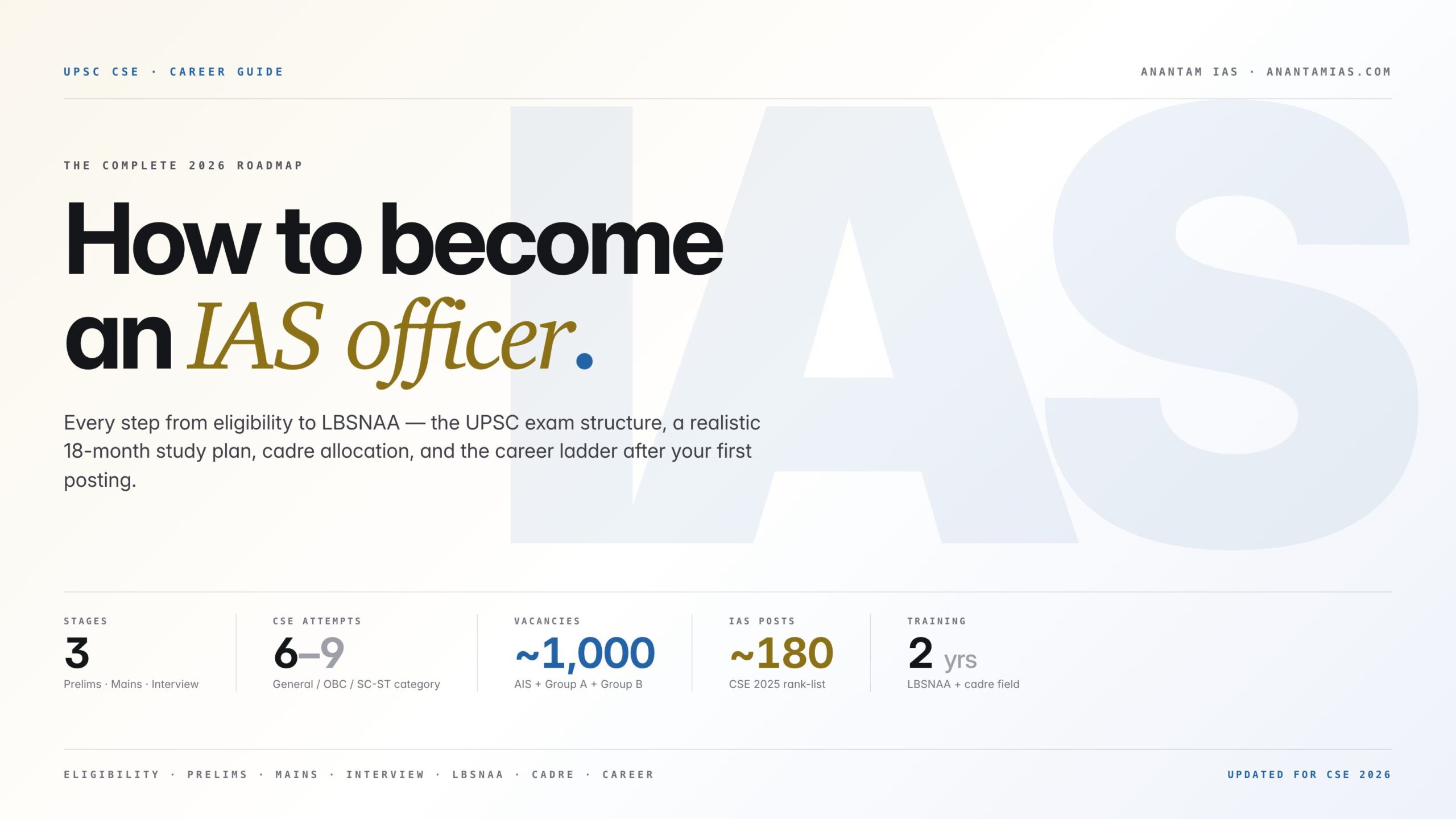
To become an IAS officer you must clear the UPSC Civil Services Examination — a three-stage exam (Prelims, Mains, Interview) — secure a rank high enough to be allocated the Indian Administrative Service, and complete ~2 years of training at the Lal Bahadur Shastri National Academy of Administration (LBSNAA) in Mussoorie plus a 12-month district attachment in your allocated cadre. The full road — from first NCERT to your first day as a Sub-Divisional Magistrate — is roughly 3 to 4 years of preparation followed by 2 years of training.
This guide is built for a 2026 aspirant. It covers eligibility in full, the exam structure paper-by-paper, a five-phase 18-month study plan, how optional choice affects your final rank, what actually happens at LBSNAA, how cadres are allocated, and the 35-year career that follows — with the Seventh Pay Commission pay levels spelled out at every rung. Skip to any section using the contents.
Step 1 · Are you eligible to write UPSC CSE 2026?
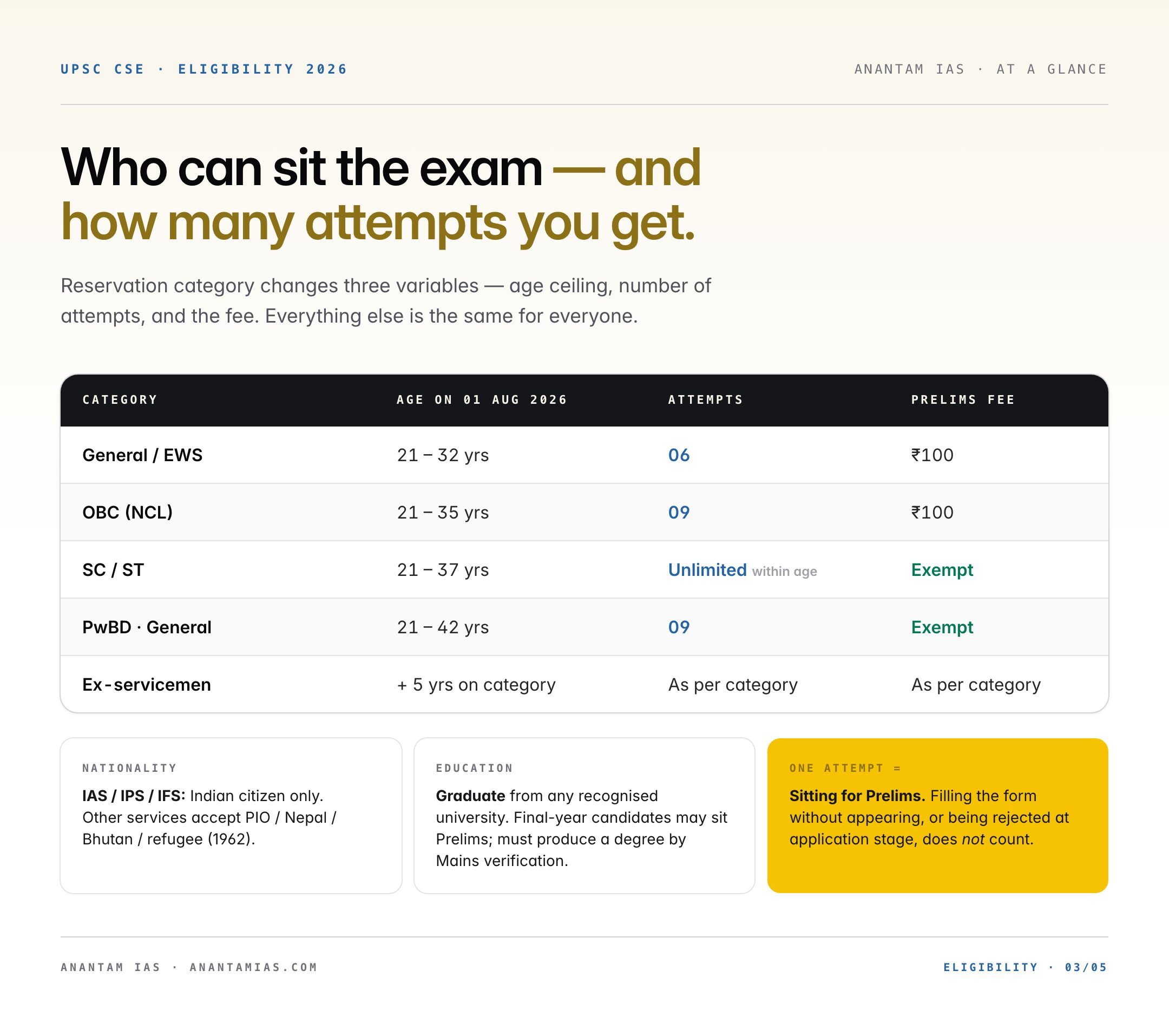
The Union Public Service Commission sets four eligibility tests: nationality, age, education, and a per-category cap on the number of attempts. The Prelims notification for CSE 2026 is expected in January–February 2026; all conditions are tested as of 1 August 2026.
Nationality
For the IAS, IPS and IFS, only Indian citizens are eligible. Other services (IRS, IAAS, IFoS etc.) accept subjects of Nepal and Bhutan, Tibetan refugees (settled before 1 January 1962), and Persons of Indian Origin who have migrated from a short list of countries to settle permanently in India. PIOs and foreign nationals must obtain an eligibility certificate from the Government of India.
Age limit on 1 August 2026
- General / EWS: 21–32 years — must be born between 2 Aug 1994 and 1 Aug 2005.
- OBC (non-creamy-layer): 21–35 years — 3-year relaxation.
- SC / ST: 21–37 years — 5-year relaxation.
- PwBD (General): 21–42 years; PwBD (OBC): 45; PwBD (SC/ST): 47.
- Ex-servicemen: 5-year relaxation over the applicable category ceiling, subject to minimum 5 years of military service.
- Jammu & Kashmir domicile (pre-2019) and riot victims have additional, specific relaxations.
Number of attempts
“One attempt” = appearing in UPSC Prelims. Filling the form without appearing, or being rejected at the application stage, does not count as an attempt.
- General / EWS: 6 attempts.
- OBC (NCL): 9 attempts (within the age ceiling).
- SC / ST: unlimited attempts (within the age ceiling).
- PwBD (General / OBC): 9 attempts. PwBD (SC / ST): unlimited.
Education
A bachelor’s degree in any discipline from a university recognised by the University Grants Commission. Degrees from recognised deemed universities, IITs/IIMs, or statutory/central universities qualify. Distance-learning and private-university degrees are accepted provided the awarding body is UGC-recognised. Final-year students may appear in Prelims, but must produce the degree certificate at the time of Mains application verification. Professional degrees (MBBS, CA, ICWA, Law) qualify too.
Physical standards
Service-specific medical standards apply after you qualify — not at the exam stage. For IAS specifically there is no height/vision requirement at Prelims or Mains; the Ministry of Health conducts a medical examination between the Mains result and the Interview. Visual acuity (with glasses), standard physical fitness, and absence of disqualifying conditions listed in the CSE notification are tested. For uniformed services (IPS, IFS, RPF) height, chest expansion and running tests apply.
Exam fee
Prelims: ₹100 (paid online, by bank challan, or cash at an SBI branch). Fee exempt: women, SC/ST, PwBD. Mains fee: ₹200 — paid only after Prelims qualification.
Rule-of-thumb check. If on 1 August 2026 you are 21 to 32 (General) and hold any undergraduate degree, you can write CSE 2026. Final-year students: register before the application closes — typically first week of March 2026.
Step 2 · Understand the exam you’re signing up for
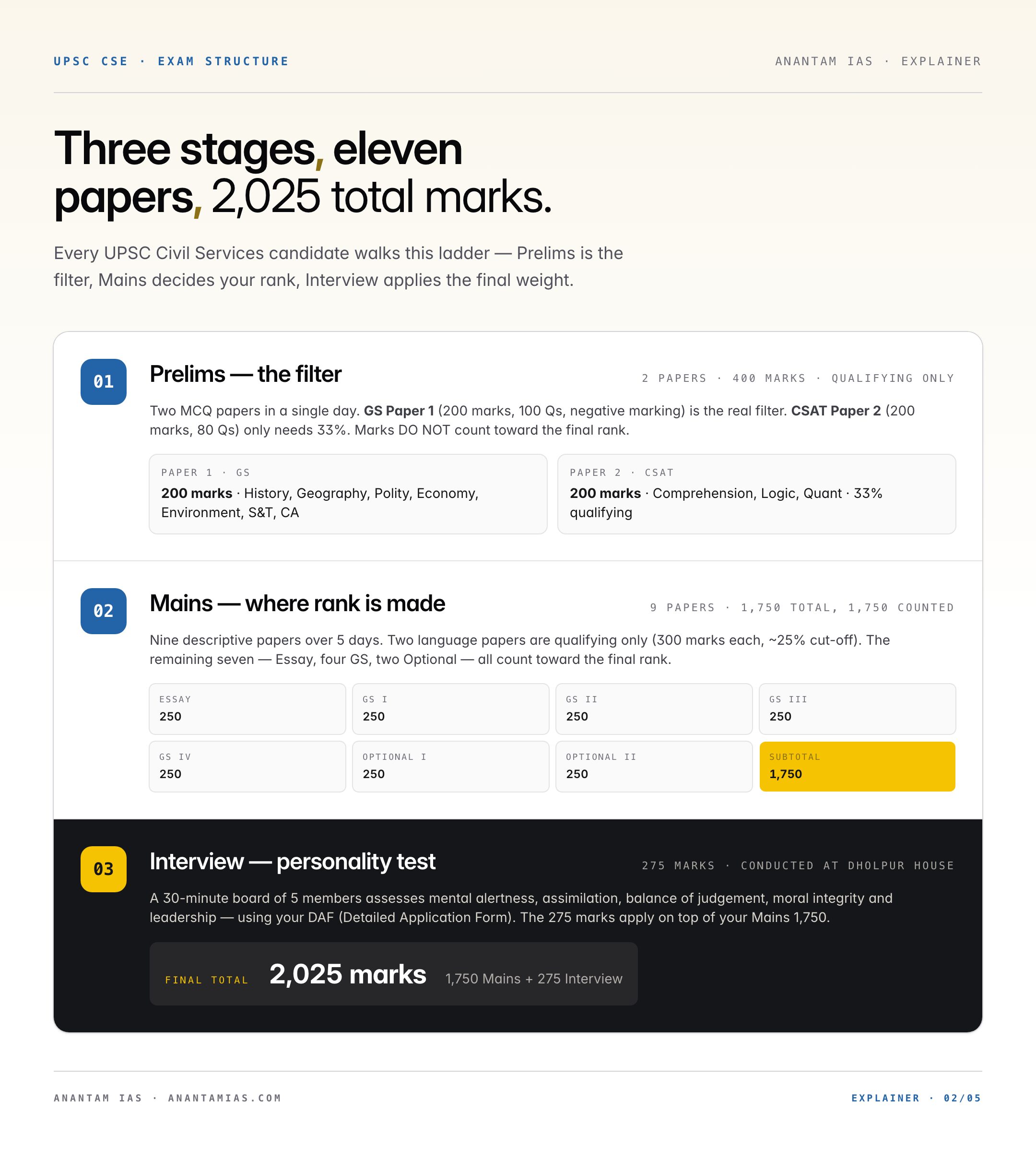
CSE is a three-stage, 12-month cycle. Prelims is held in May/June of the exam year; Mains follows 4 months later in September/October; Interviews run January to April of the next year. Final merit = Mains (1,750) + Interview (275) = 2,025 marks. Prelims marks count only to clear the qualifying cut-off; they do not contribute to the final rank.
Stage 1 · Preliminary Examination (the filter)
Two MCQ papers of 2 hours each, held on a single Sunday. GS Paper 1 is the real filter — 100 questions for 200 marks, negative marking of ⅓ for every wrong answer, covering Indian & World History, Geography (physical, Indian, world), Indian Polity and Governance, Indian Economy, Environment & Ecology, Science & Technology, and Current Affairs of national and international significance. CSAT Paper 2 is qualifying only — 80 questions for 200 marks; you need 66/200 (33%) to pass. It tests Comprehension, Logical Reasoning, Analytical Ability, Decision Making, Basic Numeracy (Class 10 level) and Interpretation.
The cut-off for GS Paper 1 has historically been in the 95–115 range for General, 80–95 for OBC, 75–90 for SC/ST. To cross it, attempt 80–85 questions out of 100 and expect 55–60 correct. This is where most aspirants get filtered — only ~2.5% of CSE applicants clear Prelims.
Ready-to-read: free UPSC Prelims MCQ bank · dedicated CSAT course.
Stage 2 · Main Examination (where rank is made)
Nine descriptive papers written over five days. Two language papers — Indian language (any 8th-Schedule language other than your medium) and English — are qualifying only, 300 marks each, ~25% cut-off. The seven papers that count toward rank:
- Paper I · Essay — 250 marks, two essays (one from each of two sections), ~1,000–1,200 words each.
- Paper II · General Studies I — 250 marks — Indian Heritage & Culture, History, Geography of the World and Society.
- Paper III · General Studies II — 250 marks — Governance, Constitution, Polity, Social Justice, International Relations.
- Paper IV · General Studies III — 250 marks — Economy, Agriculture, Environment, S&T, Security, Disaster Management.
- Paper V · General Studies IV — 250 marks — Ethics, Integrity, Aptitude; includes 6 case-study questions worth ~50% of the paper.
- Papers VI & VII · Optional subject — 250 marks each, total 500, two papers on one subject you choose from a list of 48.
Typical Mains cut-off is 775–800 / 1,750 for General; toppers cross 900. Scoring well depends on answer-writing, not recall. Anantam’s daily Mains answer writing programme is where our cohort drills this skill.
Optional choice is strategic. PSIR, Sociology, Anthropology, and Public Administration have the most GS overlap. See why PSIR works and Anantam’s full optional course catalogue.
Stage 3 · Personality Test (the interview)
Conducted at Dholpur House, UPSC HQ in Delhi. A board of five members — chaired by a serving UPSC Member — interviews you for roughly 30 minutes. Marks: 275, added on top of the Mains 1,750 to make the 2,025-mark final total.
The board is supplied your Detailed Application Form (DAF) — it lists your hobbies, home district, graduation, profession, prizes. Every claim on the DAF is fair game. The board is not testing what you know; it is testing temperament, clarity of expression, integrity, and administrative balance. Interview scores typically cluster between 100 and 200; crossing 175 is rare; dropping below 100 is often a rejection on attitude.
Anantam runs full-length mock interview panels during the Interview stage; see the Interview Preparation programme.
Step 3 · Build a realistic 18-month plan
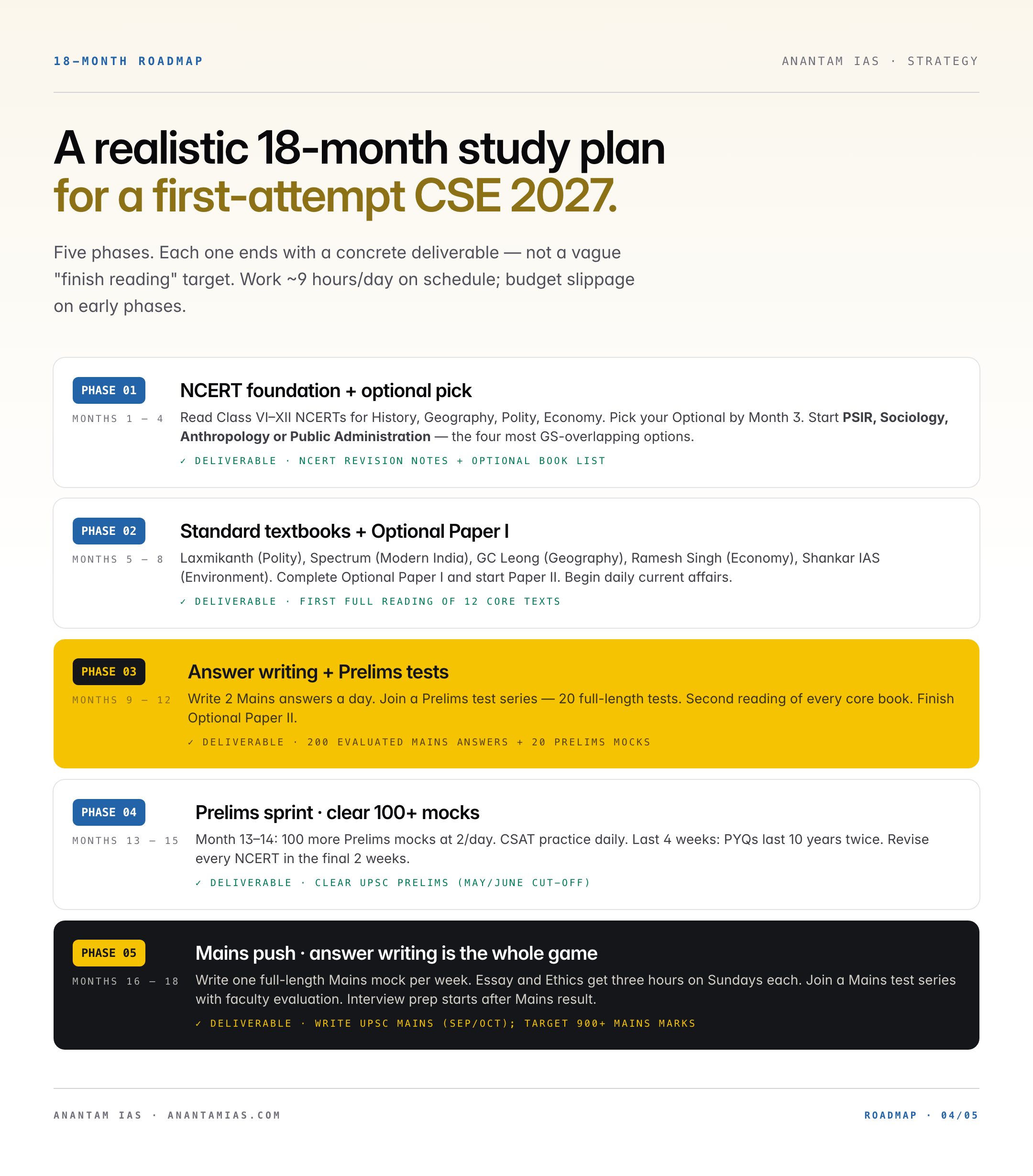
Most first-attempt rank-holders prepare for 14–20 months full-time. Anything shorter almost always means a second attempt. This is the exact roadmap Anantam uses with its CSE 2027 cohort. Adapt the calendar dates to your target year.
Phase 1 · Months 1–4 · NCERT foundation + optional pick
Read Class VI–XII NCERTs for History, Geography, Polity, Economy, Sociology, and Science. These are short, written for 12-year-olds, and the UPSC loves them. Make one set of concise notes per subject — don’t highlight, summarise. Pick your Optional by Month 3 so you can start it in Phase 2. The most GS-friendly options are PSIR, Sociology, Anthropology, and Public Administration.
Deliverable at end of Phase 1: 6 sets of short NCERT notes + a picked optional + that optional’s book list.
Phase 2 · Months 5–8 · Standard textbooks + Optional Paper I
Move to the UPSC standard references. The core stack:
- Polity — Indian Polity, M. Laxmikanth.
- Modern History — A Brief History of Modern India, Spectrum.
- Ancient + Medieval — Tamil Nadu Board Class XI.
- Geography — Certificate Physical & Human Geography, G.C. Leong + NCERTs.
- Economy — Indian Economy, Ramesh Singh + monthly Economic Survey summary.
- Environment — Shankar IAS Environment.
- Art & Culture — Nitin Singhania + NCERT XI.
- Science & Tech — NCERT XI–XII + a current-affairs monthly.
Complete your Optional Paper I in parallel. Begin daily current-affairs — read The Hindu (editorial + front page + national) or Indian Express, not both. Anantam publishes a daily current-affairs digest curated from PIB, The Hindu, IDSA and Foreign Affairs.
Phase 3 · Months 9–12 · Answer writing + Prelims test series
This is the phase that separates first-attempt successes from second-attempt retakers. Start writing 2 Mains answers a day — 150 words, 10-minute timer, on topics from the syllabus you’ve already covered. Join a Prelims test series — target 20 full-length tests this phase, not piecemeal subject tests. Finish Optional Paper II. Second reading of every core book; this time, rewrite your notes.
Phase 4 · Months 13–15 · Prelims sprint
From ten weeks out: 2 Prelims mocks every day. CSAT practice — 10 problems daily. Final 4 weeks: Previous Year Questions of the last 10 years, twice. Read every NCERT again at 2× speed in the final 2 weeks. Write Prelims (May/June).
Phase 5 · Months 16–18 · Mains push
After Prelims, you have ~4 months to Mains. This is when answer writing becomes the whole game. Write one full-length Mains mock per week. Essay and Ethics each get a three-hour slot on Sundays. Join a Mains test series with faculty evaluation — marks are made on the feedback, not the mock. Interview prep begins only after Mains result (January).
Reality check · hours. Budget ~9 effective study hours per day on schedule. That is not 9 hours at your desk — it is 9 hours of focused work, with 2 hours of buffer around it. Track your hours; optimistic aspirants typically do 5–6 and think they did 9.
Step 4 · Service allotment — IAS, IPS, IFS, or one of the 20+ others
After the final rank list, candidates are allotted one of the 24 services based on rank + service preferences + category roster + vacancies. You fill preferences between Mains and Interview. Typical rank-to-service allotment, General category, CSE 2024 data:
| Service | Top rank for 2024 allotment | Marginal rank (approx.) |
|---|---|---|
| IAS — Indian Administrative Service | 1 | ~90 |
| IFS — Indian Foreign Service | Often 2–5 | ~40 |
| IPS — Indian Police Service | Often after IAS+IFS | ~220 |
| IRS (IT) — Indian Revenue Service (Income Tax) | ~90 | ~450 |
| IRS (C&IT) — Customs & Indirect Taxes | ~120 | ~500 |
| Other Group A services — IAAS, IRTS, IRPS, IDAS etc. | Varies | Up to 900 |
| Group B services — DANIPS, Pondicherry, AFHQ | Bottom of list | Up to the last selected candidate |
For IAS specifically, a rank within the top ~90–100 is usually needed. Some ranks between 100 and 130 still get IAS if preferred cadres have vacancies and the candidate is reserved. Ranks beyond 130 in General typically get IPS, IFS or IRS.
Cadre allocation — which state you serve
Since 2017, India has 26 IAS cadres (24 state cadres + the joint AGMUT cadre for Delhi + UTs, and the Nagaland cadre). The allocation process:
- Zone choice: you rank five zones, each covering 5–6 cadres.
- Cadre preference within each zone: inside each zone you rank the cadres.
- Home state: you can name your home state as a preference; whether you get it depends on rank and the insider/outsider roster.
- Insider/outsider rule: every cadre is split 33% insiders (home-state candidates), 67% outsiders (selected from other zones). Gender, category, and attempt also feed into the roster.
In practice: unless your rank is in the top ~50 General, you will likely be assigned an outsider cadre. Officers serve their whole career (save deputations) in the allotted state.
Step 5 · LBSNAA training — the two-year bridge to district
Training for IAS probationers runs ~2 years and has three phases: Foundation Course, Phase I at LBSNAA, and the District Training. It starts in August/September following your result.
Foundation Course — 3 months, all-services
Held at LBSNAA Mussoorie, this 15-week course brings together all Group A service probationers (IAS, IPS, IFS, IRS, IAAS, etc.) for common training. Subjects: Constitution, public administration, political theory, economics, history, law, ethics, language (Hindi for non-Hindi speakers), sports, outdoor/trekking. This is where inter-service relationships that last 35 years are formed.
Phase I — 6 to 12 months at LBSNAA
IAS-specific professional training. Modules: district administration, revenue, budget, law and order, project management, technology in governance, field visits (panchayat, police station, court, hospital, jail). Includes the Bharat Darshan — a multi-week all-India study tour covering rural India, industrial India, the armed forces, the border. Probationers also spend a week attached to Parliament during session.
District Training — ~12 months in the cadre state
Probationers report to their allotted cadre state. They spend the year rotating through every tier: Gram Panchayat, Block Development Office, Tehsil, SDM office, Collector’s office, Police Station, Treasury, development agencies, and occasionally a PSU. This is where the theory of Phase I becomes the reality of running a sub-division.
Phase II — 5 weeks back at LBSNAA
After district training, probationers return to LBSNAA for a final 5-week Phase II. They are assessed, confirmed, and receive their permanent postings. This is also when the combined civil list seniority is finalised.
Step 6 · First posting — the SDM years
On confirmation, an IAS officer is typically posted as Sub-Divisional Magistrate (SDM), Assistant Collector, or in the secretariat as an Assistant Secretary, depending on the state’s rotation practice. Sub-divisional postings are the formative years — a 23–26 year old is magistrate over 200,000–500,000 people, oversees revenue collection, handles law-and-order, runs elections, and is the first-point executive on every central and state scheme in that sub-division.
After 2–3 years as SDM, promotion to Collector & District Magistrate typically follows in the 9–12 year band. The DM rung is the most senior field role and is widely considered the defining chapter of the IAS career.
The career ladder — 35 years, 10 pay rungs
Promotions in the IAS are time-based up to the Selection Grade (Level 13). Above that — Super Time Scale, HAG, Chief Secretary, Cabinet Secretary — promotions depend on empanelment by the Central Staffing Scheme, rated annual performance reviews, and political-administrative chemistry. Seventh Pay Commission pay levels (to be revised under the 8th CPC from 2026):
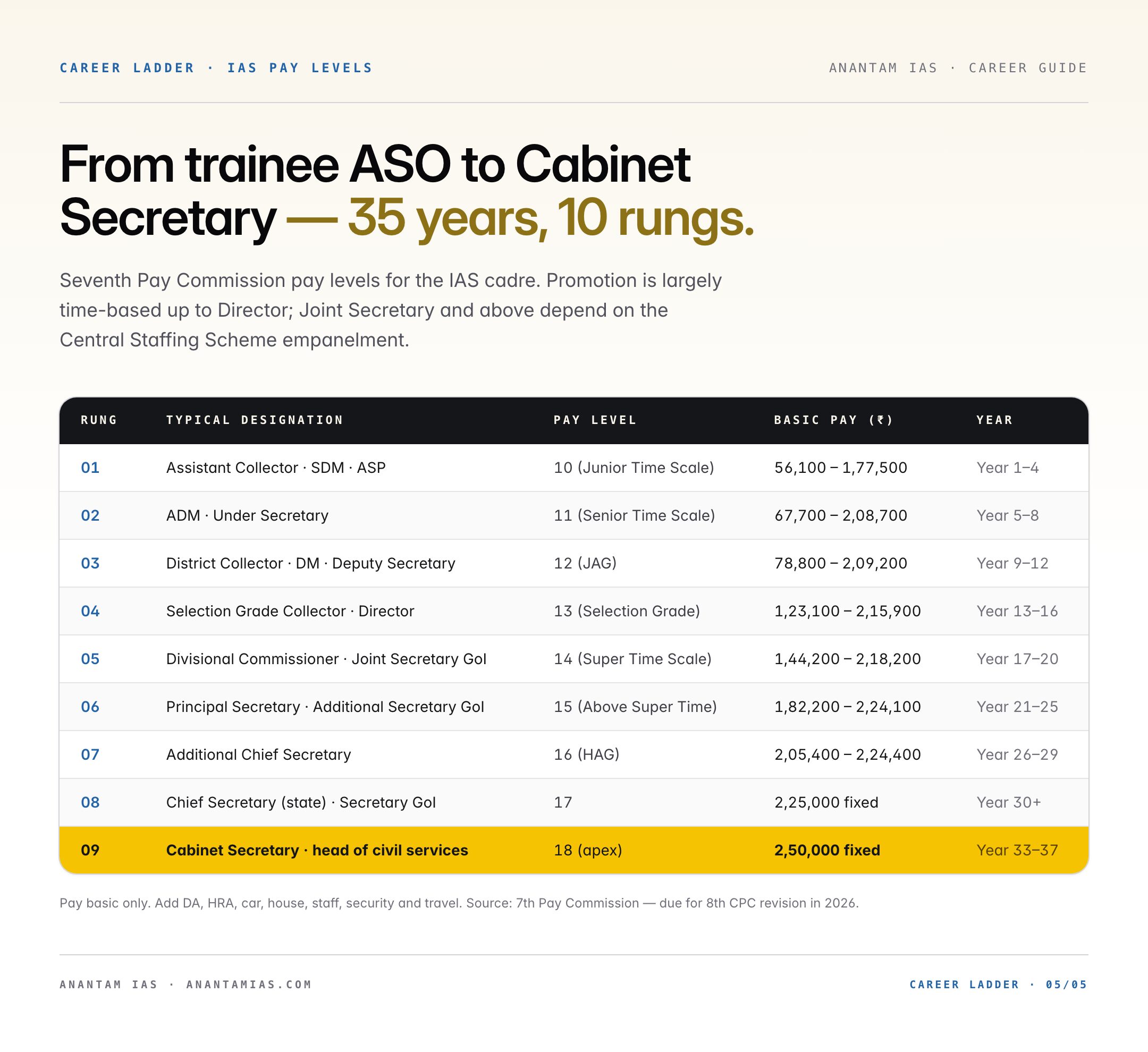
Beyond pay: an IAS officer gets government housing (Type V–VIII depending on rung), a car with driver, personal staff, domestic help allowance, secure accommodation, LTC, and pension/NPS benefits. Total effective compensation at the DM rung (Level 12) is ~₹1.4L per month after allowances; at Secretary rung (Level 17) roughly ₹3.5–4L per month with full perks.
The full CSE-to-Collector timeline
From the day you open the first NCERT to the day you sign your first district land-revenue record as a Collector — roughly 6 to 8 years if you clear on first attempt, up to 12 if it takes three attempts plus training.
| Stage | Duration | What happens |
|---|---|---|
| Preparation · Phase 1–2 | 8 months | NCERT foundation, optional pick, standard textbooks, first CA routine. |
| Preparation · Phase 3–4 | 7 months | Answer writing daily, 120+ Prelims mocks, Optional Paper II. |
| Prelims | 1 day · May/June | GS Paper 1 + CSAT. Result in 3 weeks. |
| Preparation · Phase 5 | 3–4 months | Mains-grade answer writing, full-length mocks. |
| Mains | 5 days · Sep/Oct | Nine papers — Language I/II (qualifying), Essay, GS I-IV, Optional I/II. |
| Mains result | 3 months later · Jan/Feb | Shortlisting for interview. |
| DAF-II + Medical | 2 weeks · Feb | DAF with personal details submitted; medical examination conducted. |
| Interview | 1 day · Mar/Apr | Dholpur House, 30 minutes, 275 marks. |
| Final Result + Service Allocation | Apr/May | Combined Mains + Interview rank, service + cadre allocation. |
| Foundation Course | 3 months · Aug–Oct | LBSNAA, all services together. |
| Phase I training | 6–12 months | IAS-specific, Bharat Darshan, Parliament attachment. |
| District training | ~12 months | Back in cadre state, Gram Panchayat → DM office rotation. |
| Phase II + Confirmation | 5 weeks | LBSNAA final assessment, seniority list. |
| First posting | Year 3 after CSE | SDM / Assistant Collector — first field command. |
Realities nobody tells you
The success rate is ~0.1%
Roughly 1 million candidates apply for CSE. About 550,000 actually write Prelims. Only ~13,000 clear Prelims; ~2,500 clear Mains; ~1,000 are finally selected across all 24 services. Among those 1,000, only ~180 get IAS. That is ~0.03% success rate for IAS specifically. Clear-eyed preparation — and a back-up plan — is not pessimism; it is strategy.
The optimal attempt is usually the second
Most rank holders in the top 100 clear on their second attempt. First-attempt successes exist — and they are rare, usually driven by an extra year of preparation during college. Expect to give yourself two attempts, bracketed by 16–22 months of preparation, to have a realistic shot.
Age strategy matters
If you are 21 when you start, you have 6 attempts before the age ceiling (32 General). If you are 27, you have 5 years × maybe 3 attempts. Plan the optional, the back-up, and the exit criteria accordingly. Anantam’s one-on-one counselling sessions help you model your timeline against career alternatives.
Coaching is not mandatory, but mentorship is
Many toppers cleared without joining a big institute. None cleared without a structured study plan and someone reviewing their answer sheets. If you can engineer that yourself, self-study is viable. If you cannot, the marginal rupee spent on a mentor-led test series is higher-ROI than adding another book.
Five myths that cost aspirants time
- “You need an engineering / Delhi University / English-medium background.” Every UPSC result proves otherwise. Namrata Choubey (AIR 71, 2021) cleared in Hindi medium.
- “You should read 20 newspapers for current affairs.” One disciplined newspaper + a monthly current-affairs compilation is enough. More is noise.
- “Optional choice is about interest.” It is about scoring predictability and GS overlap. Read our optional selection guide.
- “You can self-evaluate your Mains answers.” You cannot. The Mains examiners expect a specific structure and linkage pattern. You need external evaluation.
- “Coaching guarantees selection.” Coaching provides structure and feedback. The work is still yours.
Where Anantam IAS can help you train
Anantam IAS was founded by the ex-faculty of Rau’s IAS — the same team that mentored PK Siddharth Ramkumar (AIR 4, 2023), Shubhankar Pratyush (AIR 11 first attempt, 2021), Kashish Kalra (AIR 111, 2024 PSIR), Prachi Honey (AIR 28, CSE 2025) and eight others in the CSE 2025 list. If you want structure from the people who have done it:
- Full-cycle preparation · GS Foundation Course — 18-month integrated Prelims+Mains track.
- Prelims only · Prelims GS Course + MCQ bank + CSAT Preparation.
- Mains focus · Mains Crash Course + Mains Test Series + daily answer writing.
- Optional subjects · PSIR (taught by Rahul Puri) · Law Optional · all optionals.
- Interview · Interview Preparation — mock panels with former UPSC interviewers.
- Free resources · Daily Current Affairs · UPSC Syllabus · Perspective PSIR magazine · CSE 2025 results page.
Need help picking where to start? Book a free demo class. A mentor will walk you through the eligibility, map your next 18 months, and recommend a starting programme — no sales call.
Frequently Asked Questions
Short answers to the most common questions. Every answer below is also rendered in FAQ schema for AI summaries.
What is the age limit to become an IAS officer?
You must be between 21 and 32 years old (General category) as of August 1 of the exam year. OBC candidates get up to 35 years, SC/ST up to 37 years. The minimum qualification is a bachelor’s degree from a UGC-recognised university. Final year students can also apply.
How many stages are there in the UPSC CSE to become IAS?
Three stages: Preliminary Examination (objective, screening only), Main Examination (9 written papers, 1750 marks in merit), and Personality Test/Interview (275 marks). Final merit = Mains + Interview marks. Prelims marks don’t count in the final tally.
What rank do you need in UPSC to get IAS?
Typically, a rank within the top 90–100 in the UPSC final merit list is needed to secure IAS allocation. This varies by year depending on total IAS vacancies (usually around 180), cadre preferences, and reservation roster. Ranks beyond 100 may still get IAS if preferred cadres have vacancies.
How long is the training at LBSNAA Mussoorie?
Total training is approximately 2 years — a 3-month Foundation Course shared with all civil services, followed by Phase 1 training at LBSNAA (6–12 months), and then state/district training (12 months) in the allocated cadre state. The probationer is formally confirmed after completing training and assessments.
What is the first posting of an IAS officer after LBSNAA?
After training, an IAS officer typically joins as Sub-Divisional Magistrate (SDM) or Assistant Secretary in the state secretariat. Within 3–5 years, they usually get their first posting as District Magistrate/Collector, which is considered the most formative and important field-level role in the IAS career.