Opens in a new tab
Join Anantam IAS Channel on Telegram

UPSC Mains 2026 · Complete guide

UPSC Mains Answer Writing: Format, Examples and Practice.

UPSC Mains answer writing is a separate skill from collecting notes. This guide gives you a working self-review rubric, the current 10-, 15- and 20-mark formats, a five-step method, a side-by-side answer comparison, diagram rules, a feedback loop and a 60-day practice plan.

5-step method directive → way forwardWorked comparison same Q, two drafts10 FAQs60-day plan

Rubric

A practical rubric for reviewing your own answers.

UPSC does not publish a question-level marking scheme. This Anantam IAS rubric is a practice tool: it helps you see whether an answer addresses the directive, supports its claims and remains readable under exam conditions.

DimensionWhat to checkPriority
Relevance + evidenceEvery paragraph answers the exact demand. Use Article numbers, judgments, schemes, reports or data only when they prove the claim.Highest
Coverage + structureAll parts of the directive are visible. The introduction frames the issue, the body covers distinct dimensions and the conclusion resolves the argument.High
LanguageFormal and direct, with short sentences and specific nouns. Remove padding, repeated points and unsupported certainty.Support
PresentationLegible handwriting, useful headings, selective underlining and a layout that lets the argument be scanned quickly.Support

Anatomy

Three answer formats. Same scaffold.

UPSC has used the same answer formats consistently since 2013. The scaffold is identical across all three; only the depth of body dimensions changes.

10 marks
150 words9 min

The compact answer.

  1. Introduction — define the keyword OR set 1-line context (25-30w).
  2. Body — three dimensions in a single paragraph, each anchored with a specific (90-100w).
  3. Conclusion — balancing verdict OR way forward in one sentence (20-25w).

15 marks
250 words14 min

The standard answer.

  1. Introduction — definition + context + thesis sentence (40-50w).
  2. Body 1 — first dimension as a 50-word paragraph with one anchor.
  3. Body 2 — second dimension, parallel structure.
  4. Body 3 — third dimension, parallel structure.
  5. Way forward / Conclusion — balance + forward look (30-40w).
20 marks
250 words in 2025 GS-IVcheck the paper

The case study.

  1. Dilemma — name the competing duties or values.
  2. Stakeholders — identify the parties and legitimate interests.
  3. Options — compare feasible actions and consequences.
  4. Decision — choose, justify and name the governing values.
  5. Safeguard — add a follow-up step that prevents recurrence.

Method

Five moves that make an answer more relevant and scannable.

The method is deliberately repeatable: decode, plan, anchor, develop and conclude. Use it as a checklist until you can apply it without slowing down.

  1. Decode the directive in 10 seconds.Underline the directive verb (Discuss / Examine / Critically analyse / Comment / Evaluate / Illustrate). Each directive expects a different shape. "Discuss" wants multiple perspectives. "Examine" wants weighed evidence. "Evaluate" wants a reasoned verdict. A mismatched structure makes even relevant content look incomplete.
  2. Plan in 90 seconds, write in 8 minutes.For a 10-mark answer, jot a 4-line plan in the margin: intro keyword, three body anchors, conclusion direction. For a 15-mark, sketch one extra body dimension. If your plan does not fit in 30 words, the question is unclear and you should re-read it.
  3. Open with a specific anchor.Use an Article number, a named judgment, a specific scheme, a precise statistic, or a recent report when it directly answers the question. "The 2nd ARC Report on Ethics in Governance" is more useful than "various reports". Do not force a fact into the introduction when a clear definition works better.
  4. Build three dimensions, not three sentences.A 10-mark answer needs three distinct dimensions — political, economic, social; or constitutional, institutional, contemporary; or cause, course, consequence. Each dimension is a paragraph of 35-45 words with one anchor inside it. Three sentences ≠ three dimensions.
  5. Close with a way forward and a named instrument.The conclusion is not a summary. It is one balancing sentence plus one forward-looking sentence that names a ministry, a scheme, a deadline or a principle. "More dialogue is needed" loses marks. "Strengthening the 7th Schedule via the Inter-State Council" earns them.

Presentation + review

Use diagrams when they clarify. Get feedback on the question you actually answered.

The duplicate guide had two useful ideas worth retaining: visual aids need a decision rule, and self-review needs an external check. Both now sit inside the canonical workflow.

When a diagram earns its space.

  • Use a map for location, spatial relationships or regional comparison.
  • Use a flowchart for a process, causal chain or institutional sequence.
  • Use a small stakeholder map when relationships are harder to explain in prose.
  • Skip the diagram when it merely repeats the paragraph or takes longer to draw than to read.

Label it, refer to it in one sentence, and move on. A decorative box is not analysis.

A feedback loop that catches blind spots.

  • Mark your first draft against the rubric above without seeing a model answer.
  • Ask a peer or mentor one question: "Which part of the directive did I leave unanswered?"
  • Rewrite the same answer within the original time and word limit.
  • Log one recurring error, not ten one-off observations.

Need a structured second look? Use the Mains answer evaluation guide before your next rewrite.

Worked example

Same question, two drafts. The stronger one answers the legal ambiguity.

These are teaching drafts, not officially marked UPSC scripts. Compare how each one handles the directive, names the current rule and turns the conclusion into a usable safeguard.

GS-II · Polity Article 200 defines the Governor's options on Bills passed by a State Legislature. Examine the ambiguity created by the absence of a constitutional timeline and the Supreme Court's 2025 clarification. (10 marks · 150 words)

Script A

Revise

Generic opening, no named judgment, no distinction between merits review and prolonged inaction, and a vague conclusion.

The Governor has the power under Article 200 to either give assent, withhold it, return the bill, or reserve it for the President. There has been controversy because some Governors have been sitting on bills for a long time without taking any action. Many states have raised concerns about this. Recently the Supreme Court has said something about this. The Court has clarified that Governors should not delay bills indefinitely. This is a serious issue and the Centre and states should work together to resolve it. The Constitution is supreme and all functionaries must respect it. Governors should not act in a political manner. The matter is about federalism and the role of the Governor in our democracy. More discussion is needed on this important constitutional issue.

Script B

Strong

Names the controlling 2025 Presidential Reference, states the present rule precisely, separates judicial review from merits review, and closes with a workable safeguard.

Article 200 gives the Governor three constitutional options: assent, reserve the Bill for the President, or withhold assent and return a non-Money Bill with comments. Its silence on a fixed timeline can enable prolonged inaction and strain federal accountability. In Presidential Reference No. 1 of 2025, the Supreme Court held that courts cannot prescribe a uniform timeline or create deemed assent. It also clarified that the merits of the Governor's choice are not justiciable, while prolonged, unexplained and indefinite inaction can still invite a limited mandamus to act within a reasonable period. Way forward: Raj Bhavans should publish a dated Bill-status register, and constitutional authorities should record reasons promptly. That preserves the Governor's discretion while making delay visible to the Legislature and the public.

Pitfalls

The six ways "good" Mains answers actually fail.

These are the recurring faults our self-review rubric is designed to expose, especially when a candidate knows the topic but has not answered the exact question.

Writing 5 sentences when the rubric asks for 3 dimensions.

Examiners look for distinct claims, not volume. Five descriptive sentences score lower than three analytical paragraphs of the same length.

Treating every directive the same.

Discuss ≠ Examine ≠ Critically analyse. A directive mismatch usually leaves part of the demand unanswered.

Skipping the way forward.

Conclusion-without-direction is the single most common reason a "good" answer plateaus at 6.5 / 10. Always name an instrument or actor.

Quoting irrelevant statistics.

A number that does not anchor your specific dimension is filler. Two precise numbers beat six approximate ones every time.

Writing past the word limit.

A 15-mark answer at 320 words signals weak planning and steals time from later questions. Train to stop at the word limit printed on the paper.

Memorising "model answers" verbatim.

Copied prose often answers a familiar topic instead of the exact demand. Internalise the structure and evidence pattern; write the final answer in your own words.

Roadmap

60 days to Mains-ready answer writing.

If you have more than 60 days, the early phase widens. If you have fewer, compress evenly. The same-day evaluation in the final 15 days is non-negotiable.

D-60 → D-40

Base block — three 10-mark answers a day, one paper at a time.

Pick one GS paper for the week. Write three 10-mark answers daily, rotating through subtopics. Focus exclusively on the five-step method — speed and length are secondary. Self-mark with the rubric above.

D-40 → D-25

Mixed block — two 10-mark + one 15-mark, across two papers daily.

Introduce the 15-mark format. Rotate papers within the day. Get a peer or a senior to mark every fifth answer. Maintain a one-page mistake log — same shape as the pitfalls section above.

D-25 → D-12

Sectional block — half-papers (10 questions) at the actual time slot.

Write half-papers at 9 AM or 2 PM (the actual Mains windows). Each session is 1.5 hours. Same-day review. Stop fishing for new sources; consolidate what you already know.

D-12 → Exam

Full-paper block — one 3-hour Mains paper every alternate day.

Six full papers in twelve days. Each paper at the actual exam time. Same-day review for content gaps, next-day for structure. Cool-down at D-3: no new content, two re-reads of your error log, eight hours of sleep.

Books

Five resources cover 90% of answer writing.

Aspirants over-buy books on "how to write a Mains answer". The fastest way to internalise structure is to read three Mains test-series answer keys per week and copy the shape — not the prose.

FoundationalSriram Srirangam — How to Write the Mains Answer.Compact methodology book. Read once before your first practice session, never again.
Foundational2nd ARC Reports (selected) — Ethics in Governance, Citizen-centric administration.The bedrock of GS-IV anchoring. Used as "Way forward" templates across all four papers.
Domain languagePRS Legislative Research bill summaries.Trains the register UPSC expects in GS-II. Read three bill summaries a week — write none.
Domain languageEconomic Survey (current chapter).For GS-III openings — the number that goes in the first sentence usually lives here.
Worked answersVision IAS / Anantam IAS Mains test series answer keys.Read keys actively, not passively — mark up the named anchors and copy the way-forward shapes.

FAQs

What aspirants ask about Mains answer writing.

How long should a 10-mark and a 15-mark UPSC Mains answer be?
In the current General Studies format, UPSC usually prints a 150-word limit for 10-mark questions and a 250-word limit for 15-mark questions. GS-IV case studies can carry different marks, and the printed limit can vary; the 2025 paper used 250 words for its 20-mark case studies. Follow the limit printed beside the question.
How many answers should I write per day to be Mains-ready?
For a serious Mains aspirant: 3 to 5 answers per day across GS papers, six days a week, for 60 days before Mains. Quality beats quantity — one 250-word answer rewritten three times until it scores 9/10 is more useful than five fresh first drafts.
How early should I start answer writing practice?
Start once you can explain a topic without copying notes, even if your first reading is incomplete. Begin with one open-book answer, compare it with the question demand, then rewrite it closed-book. Waiting to "finish the syllabus" usually postpones the skill you need most in Mains.
What directives appear in UPSC Mains?
The eight most common: Discuss · Examine · Critically analyse · Comment · Evaluate · Elucidate · Illustrate · Trace. Each expects a different answer shape. See step 1 of the method for the directive-to-shape mapping.
How do I structure a 20-mark case study in GS Paper IV?
Use five labelled parts: dilemma · stakeholders · feasible options with consequences · decision with named values · safeguards. The 2025 GS-IV paper used a 250-word limit for 20-mark case studies, but formats can change. Follow the printed word limit instead of memorising one number.
Should I memorise model answers or write my own?
Internalise the structure, never the prose. Use model answers to learn how evidence supports a claim and how a conclusion resolves the directive. Then close the model and rewrite the answer in your own language.
How is my answer actually graded?
UPSC does not publish a question-level marking rubric. For practice, review four dimensions: relevance and evidence, coverage of the directive, structure and readability, and completion within time and space. The rubric on this page is an Anantam IAS self-review tool, not an official UPSC marking scheme.
Do diagrams and flowcharts help in Mains?
For GS-I (Geography), GS-III (Economy, processes, kill chains) — yes, consistently. For GS-II — only when a single diagram captures a federal or institutional relationship that prose cannot. Hand-drawn, labelled with words, with a one-line caption. Never decorative.
Is Anantam IAS's Mains QIP designed around answer writing?
Yes. The Mains QIP 2026 programme runs from June to August on daily answer writing — lecture-linked practice, same-day evaluation, sectional re-writes. Pair it with the open practice question bank for self-study before classes start.
What is the most common reason a "good" answer plateaus at 6.5 out of 10?
A missing or generic way forward. The structure is sound, the content is there, but the conclusion does not name an instrument or an actor. Read 20 of your own answers — if more than 8 end on "more dialogue is needed" or "a holistic approach is required", that is the gap.

Next step

Write three 10-mark answers today. Mark them tomorrow.

Repeat one concrete loop: write, self-mark, get one external observation, then rewrite. Start with GS-II if you have never written a Mains answer because the directive and evidence structure are easy to see.
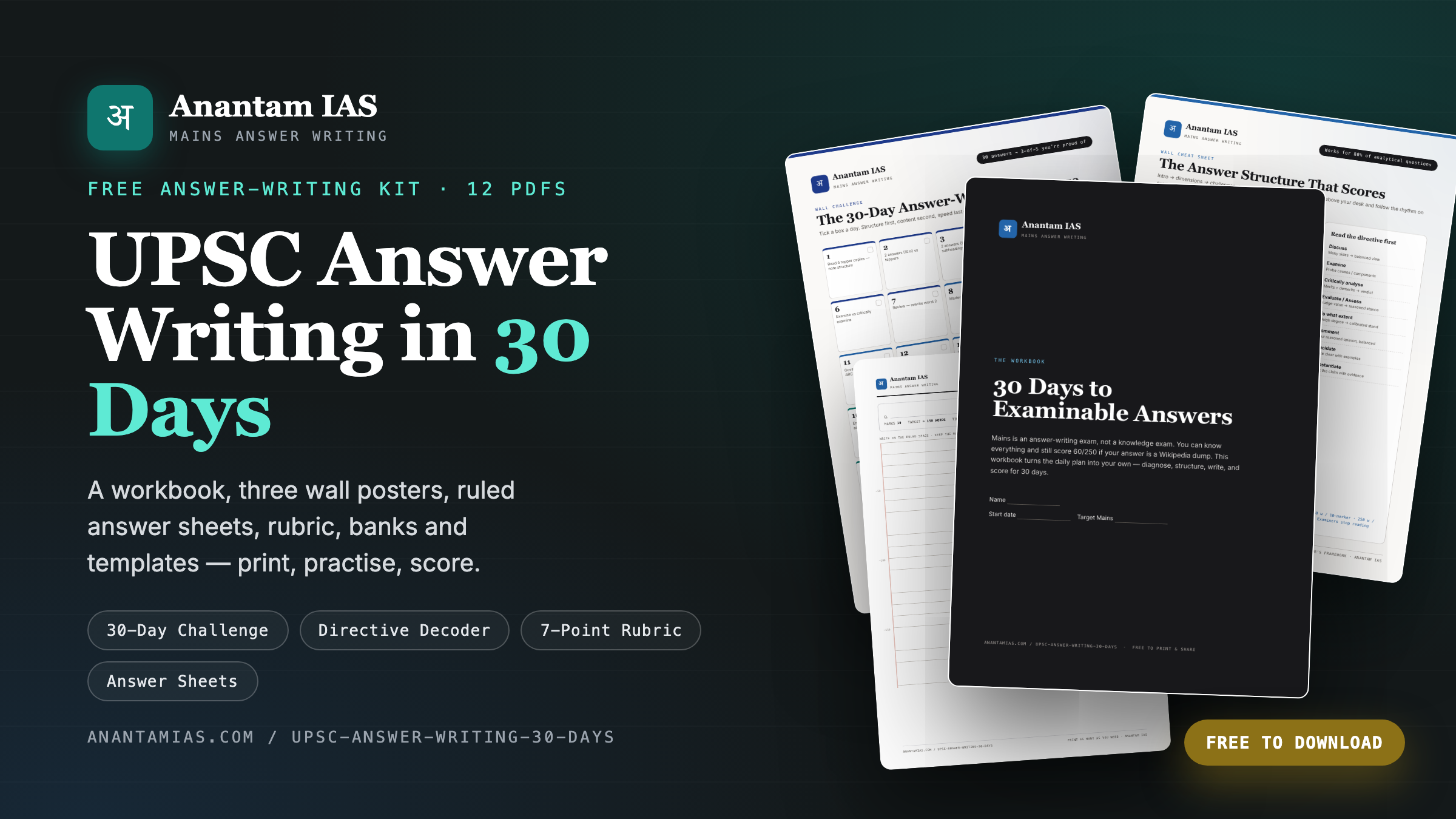
Get the free Answer-Writing Kit
Free · 12-PDF kit

Get the free Answer-Writing Kit

A fill-in workbook, three wall posters, a 7-point evaluation rubric, UPSC-style ruled answer sheets and an interactive directive decoder — everything to turn knowledge into examinable answers.

30-Day ChallengeDirective DecoderEvaluation RubricRuled Answer Sheets