Jim Corbett National Park: India’s First National Park and the Birthplace of Project Tiger
Jim Corbett National Park explained — India's first national park (1936), Project Tiger launch site (1973), Patli Dun valley, Ramganga river, sal forests, and tiger conservation tensions.
Jim Corbett National Park is India’s oldest national park, the operational birthplace of Project Tiger, and one of the most recognisable conservation landscapes in South Asia. Carved out of the sub-Himalayan Bhabar and Shivalik terrain of present-day Uttarakhand, the park covers a mosaic of sal forests, riverine grasslands, and the broad alluvial bowl known as Patli Dun. It is the place where the modern Indian tiger conservation movement was institutionalised in 1973, and the place where the tensions between infrastructure, tourism, and core habitat protection now play out most visibly.
The park was notified in 1936 as Hailey National Park, named after Sir Malcolm Hailey, the then Governor of the United Provinces. It was the first protected area in mainland Asia to be given national park status under formal legislation. After Independence the area was renamed Ramganga National Park in 1954–55, and then renamed again in 1957 in memory of Jim Corbett, the hunter-naturalist-author whose writings drew public attention to the man-eaters and the wildlife of Kumaon.
Today Jim Corbett National Park sits at the heart of the larger Corbett Tiger Reserve, which spans roughly 1,288 sq km when buffer and adjoining reserve forests are included. The core national park area is around 520 sq km. The reserve hosts one of the highest densities of wild tigers on the planet and remains a flagship test case for whether India can hold its biggest carnivore alongside expanding road, rail, and tourism infrastructure.
Location, Geography, and Landscape
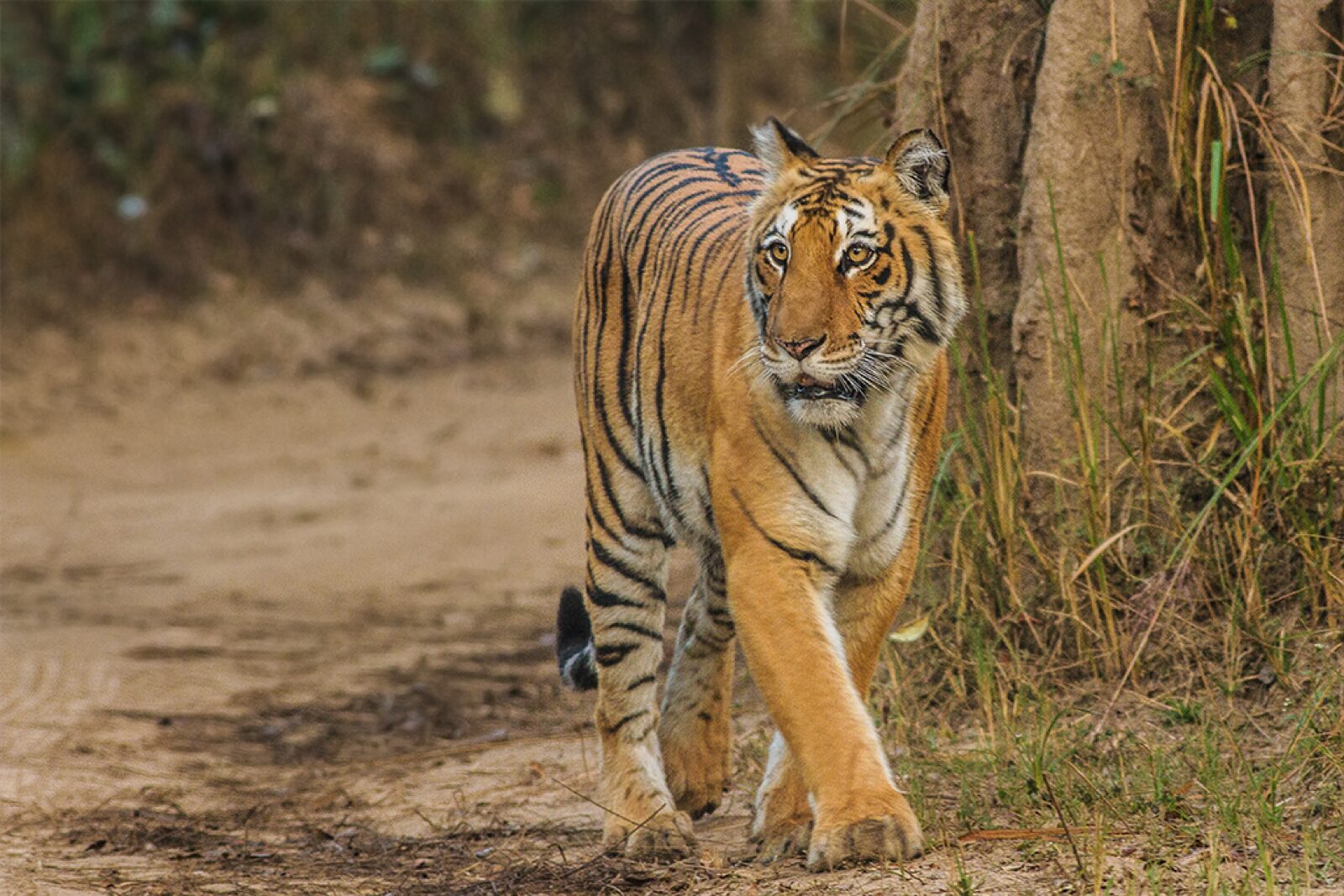
Jim Corbett National Park lies in the Nainital and Pauri Garhwal districts of Uttarakhand, on the southern foothills of the outer Himalaya. The terrain is the textbook Bhabar-Terai transition: gravel-and-boulder fans where Himalayan rivers spill onto the plains, gradually giving way to alluvial silt and swampy grasslands further south.
Patli Dun and the Ramganga
The defining feature of the park is the Patli Dun valley, a broad longitudinal trough running roughly east-west between the outer Himalayan ridges. The Ramganga river, a tributary of the Ganga, meanders through this valley before being impounded by the Kalagarh Dam at the park’s southwestern edge. The reservoir, although controversial in conservation terms, has created seasonal wetland habitat used by mugger crocodiles, gharial, otters, and migratory waterbirds.
Elevation in Jim Corbett National Park ranges from roughly 400 metres along the river beds to over 1,200 metres on the Kanda ridge in the north. This altitudinal spread, combined with the moisture-loaded foothills, supports a remarkably diverse forest profile in a relatively compact area.
Forest Types
The dominant vegetation is moist deciduous sal (Shorea robusta) forest, interspersed with patches of khair-sissoo riverine forest, chir pine on the higher ridges, and extensive chaur (open grassland) along the river floodplain. These chaurs — Dhikala chaur being the most famous — function as the prey-base engine of the park, sustaining large herds of chital, sambar, and hog deer that in turn support a dense tiger population.
History: From Hailey to Project Tiger
The story of Jim Corbett National Park is inseparable from the larger story of Indian wildlife conservation policy.
1936: India’s First National Park
The park was formally constituted on 8 August 1936 under the United Provinces National Parks Act, 1935, becoming the first national park in mainland Asia. It was named Hailey National Park. The original area was roughly 323 sq km. The idea was largely driven by Jim Corbett himself, alongside E. A. Smythies and other forest officers who recognised that the Patli Dun belt had to be insulated from hunting and timber extraction.
Renaming and Expansion
In 1954 the park was renamed Ramganga National Park, and in 1957 it received its present name, Jim Corbett National Park, in honour of Edward James “Jim” Corbett (1875–1955). Boundaries were progressively expanded to absorb adjoining reserve forests, and by the 1970s the area was large enough to function as a single contiguous tiger landscape.
1973: Project Tiger Launch Site
The single most defining event in the modern history of Jim Corbett National Park came on 1 April 1973, when Project Tiger was launched from this park by then Prime Minister Indira Gandhi. Corbett was one of the original nine tiger reserves selected, and the launch ceremony took place at Dhikala. Project Tiger is widely regarded as the most ambitious species-recovery programme attempted by any developing country, and it is fitting that it began on Indian soil at the same park where formal conservation began in 1936.
Flora of Jim Corbett National Park
The park records over 600 species of plants, ranging from large timber trees to ferns, bamboos, and orchids. Major species include:
- Sal (Shorea robusta) — the dominant canopy tree
- Khair (Acacia catechu) and Sissoo (Dalbergia sissoo) along the Ramganga
- Chir pine (Pinus roxburghii) on dry ridges
- Rohini, Tendu, Bel, Kusum, Ber, Dhak, Semal in the mixed forest
- Tall grasses including Saccharum, Themeda, and Imperata in the chaurs
The chaur grasslands are critical fire-managed habitats that prevent forest encroachment and maintain prey densities.
Fauna: Tigers, Elephants, Gharial, and Beyond
Jim Corbett National Park is one of the few Indian protected areas where four megafauna — tiger, Asiatic elephant, gharial, and mugger — co-occur in the same landscape.
Tigers
The 2022 All-India Tiger Estimation placed Corbett Tiger Reserve at around 260 tigers, the highest count for any single reserve in India. Tiger density inside the core park has been recorded at over 14 individuals per 100 sq km, among the highest in the world.
Asiatic Elephants
Jim Corbett National Park supports a resident population of roughly 1,000 Asiatic elephants, part of the larger Shivalik-Terai elephant landscape that stretches into Rajaji National Park to the west and the Nepal Terai to the east. Elephant corridors connecting Corbett with Rajaji and Sonanadi are crucial for long-term genetic viability.
Gharial and Mugger
The Ramganga river is a stronghold for the Critically Endangered gharial (Gavialis gangeticus). Regular nesting and hatchling release programmes have been run from Corbett since the 1970s, making it a key node of India’s gharial recovery effort.
Other Mammals and Birds
Leopard, sloth bear, dhole (Asiatic wild dog), Himalayan goral, yellow-throated marten, smooth-coated otter, and four species of deer (sambar, chital, hog deer, barking deer) round out the mammalian assemblage. The park records over 600 species of birds, including the great hornbill, Pallas’s fish eagle, and the ibisbill along gravel beds.
Legal Status and Protection Framework
Jim Corbett National Park is protected under the Wildlife (Protection) Act 1972 as a notified national park, the strictest category of protected area in India. The larger Corbett Tiger Reserve falls under the National Tiger Conservation Authority (NTCA) and is governed by the provisions inserted into the WLPA by the 2006 amendment.
For a deeper look at the legal architecture, see Wildlife (Protection) Act 1972. The reserve also sits within the Himalayan biodiversity hotspot recognised by Conservation International.
Infrastructure-Conservation Tensions
In recent years Jim Corbett National Park has been at the centre of repeated controversies over construction inside the tiger reserve.
The Kalagarh-Pakhrau Tiger Safari Case
The Supreme Court of India in March 2024 took serious note of illegal tree felling and construction within the Pakhrau range of the tiger reserve for a proposed “tiger safari” enclosure. The court constituted a Central Empowered Committee inquiry, observed that the tiger reserve had been “ravaged”, and prohibited the construction of any tiger safari inside core or critical tiger habitat. The judgment is now a leading authority on the limits of tourism infrastructure inside tiger reserves.
Tourism Zones
Corbett has six tourism zones — Dhikala, Bijrani, Jhirna, Dhela, Durga Devi, and Sonanadi — each with capped daily vehicle entries. Dhikala, the historic forest rest house complex inside the Patli Dun, remains the most sought-after entry. NTCA guidelines cap tourism activity at no more than 20% of the core area.
Linear Infrastructure
Proposals to widen NH-121 (Ramnagar-Ranikhet) and the broad-gauge railway line that skirts the park have raised concerns about wildlife mortality and corridor severance. Mitigation structures — animal underpasses and elevated road sections — are being progressively retro-fitted.
Jim Corbett National Park and UPSC
For Civil Services aspirants, Jim Corbett National Park comes up across General Studies Paper III (Environment, Conservation) and Prelims environment questions. Common themes include:
- Year of notification (1936) and original name (Hailey National Park)
- Project Tiger launch year (1973) and launch site (Corbett)
- Patli Dun, Ramganga river, Kalagarh dam
- Tiger Reserve status and NTCA framework
- 2024 Supreme Court order on Pakhrau tiger safari
- Distinction between national park, tiger reserve, and wildlife sanctuary
For the broader conservation toolkit, cross-read Kaziranga National Park, Kanha National Park, and Sundarbans National Park, which together with Jim Corbett National Park form the four classic flagship reserves taught in environment syllabi.
Conservation Outlook
Jim Corbett National Park enters its tenth decade with a healthy tiger population, a recovering gharial population, and growing pressure on its periphery. The defining challenge of the next decade is not poaching — anti-poaching enforcement has matured — but rather managing the cumulative footprint of tourism, road expansion, and reservoir-related habitat change. The 2024 Supreme Court judgment has set a clearer line on what is and is not permissible inside the tiger reserve, and the test now is whether forest administration can hold that line consistently.
If India is to credibly claim that its tiger numbers are stable or rising, the case for that claim begins at Jim Corbett National Park, where Project Tiger was launched and where the next phase of Indian wildlife conservation will be judged.
Frequently Asked Questions
When was Jim Corbett National Park established?
Jim Corbett National Park was established on 8 August 1936 as Hailey National Park under the United Provinces National Parks Act 1935. It was the first national park in mainland Asia. It was renamed Ramganga National Park in 1954 and finally Jim Corbett National Park in 1957 in memory of Jim Corbett.
Why is Jim Corbett National Park important in the history of Indian wildlife conservation?
It is India’s first national park and the site from which Project Tiger was launched on 1 April 1973 by Prime Minister Indira Gandhi. Both milestones — the very idea of a national park in India and the institutional birth of organised tiger conservation — are anchored in this single landscape.
Where is Jim Corbett National Park located?
The park is in the Nainital and Pauri Garhwal districts of Uttarakhand, on the southern foothills of the Himalaya. The core national park area is about 520 sq km and lies within the larger Corbett Tiger Reserve of around 1,288 sq km.
What is Patli Dun and why does it matter?
Patli Dun is the broad longitudinal valley between the outer Himalayan ridges through which the Ramganga river flows. It contains the famous Dhikala grasslands and forms the productive prey-base heartland of the park, which is why tiger densities here are among the highest recorded anywhere.
What are the major wildlife species in the park?
The flagship species are the Bengal tiger, the Asiatic elephant, the gharial, and the mugger crocodile. Other notable species include leopard, sloth bear, dhole, sambar, chital, hog deer, and over 600 bird species including the great hornbill and Pallas’s fish eagle.
What was the 2024 Supreme Court order on Jim Corbett National Park?
In March 2024 the Supreme Court ruled on illegal construction and tree felling in the Pakhrau range of Corbett Tiger Reserve for a proposed tiger safari. The court ordered an inquiry, prohibited tiger safaris inside core or critical tiger habitat, and observed that the reserve had been u0022ravagedu0022. The judgment is now a benchmark for permissible activities inside tiger reserves.
Is Jim Corbett National Park the same as Corbett Tiger Reserve?
No. Jim Corbett National Park is the inviolate core (about 520 sq km) notified under the Wildlife (Protection) Act 1972. Corbett Tiger Reserve is the larger management unit (about 1,288 sq km) that includes the national park plus buffer forests and the Sonanadi Wildlife Sanctuary, governed under the National Tiger Conservation Authority framework.
How does Jim Corbett National Park rank among tiger reserves in India?
Corbett Tiger Reserve had around 260 tigers in the 2022 All-India Tiger Estimation, the highest count of any single reserve in India. It also records one of the highest tiger densities in the world, exceeding 14 individuals per 100 sq km in the core area.