Kittur Rani Chennamma: The 1824 Karnataka Revolt That Predated the Doctrine of Lapse
Kittur Rani Chennamma (1778-1829) led the 1824 Karnataka rebellion against the British, decades before the Doctrine of Lapse was formally announced. UPSC analysis of the Kittur revolt, the adoption question, and her place in pre-1857 resistance.
Kittur Rani Chennamma (1778–1829) was the queen of Kittur, a small principality in present-day Belagavi district of Karnataka, who led an armed revolt against the British East India Company in 1824 — more than three decades before the 1857 uprising. When the Company refused to recognise her adopted son Shivalingappa as heir, she raised an army, defeated the first British assault (in which the political agent St John Thackeray was killed), and held Kittur through one siege before falling in the second. She died in captivity at Bailhongal Fort in 1829, and is remembered as one of the earliest women to take up arms against colonial rule in India.
The official histories of British annexation in India usually start in 1848. That is the year Lord Dalhousie became Governor-General and began applying what he called the Doctrine of Lapse. Under that rule any princely state without a natural male heir could be absorbed into Company territory, regardless of whether the ruler had adopted a successor. The doctrine is taught as a Dalhousie innovation.
The doctrine was not new. The Company had been refusing to recognise adopted heirs for at least a quarter of a century before Dalhousie put a name to the practice. The clearest early test case was Kittur, a small princely state in present-day Karnataka, in 1824. Its queen, Kittur Rani Chennamma, refused to hand over her kingdom when the Company rejected her adopted son Shivalingappa. She raised an army, killed a British political agent, and held off the Company through one siege before falling in the second. She died in captivity in 1829.
This article reads the Kittur revolt as the first real application of the Doctrine of Lapse, three decades before it had a name. It walks through the political background, the 1824 campaign, and the place of Kittur Rani Chennamma in the longer story of pre-1857 resistance.
Quick Facts
- Born: October 23, 1778, at Kakati village in present-day Belagavi district
- Father: Dhulappa Kati, a Lingayat patel
- Husband: Raja Mallasarja of Kittur (married c. 1796)
- Son: A natural son who died in 1824 before his mother
- Adopted Son: Shivalingappa, named heir in 1824
- Kingdom: Kittur, a Desai principality of about 358 villages near Belagavi
- First Battle of Kittur: October 1824, British forces routed; St John Thackeray killed
- Second Battle of Kittur: December 1824, queen captured
- Imprisonment: Bailhongal Fort
- Died: February 21, 1829, in captivity
- Honorific: Often called the “first Indian queen to fight the British” in Karnataka tradition
Who Was Kittur Rani Chennamma
Chennamma was born in 1778 at Kakati, a Lingayat village near Belagavi in north Karnataka. Her father was a Patel, a hereditary village headman. She learned horse riding, sword fighting and archery from childhood. The Lingayat community of the region traditionally allowed women greater public mobility than many parts of north India, and her training was not unusual for her social class.
She married Raja Mallasarja of Kittur around 1796. Kittur was a small but prosperous Desai principality with about 358 villages, a yearly revenue of around Rs 4.5 lakh, and a fort that had been rebuilt by Mallasarja’s grandfather. The Desai rulers of Kittur traced their lineage to the Vijayanagara administration of the sixteenth century. After Vijayanagara fell, they served the Bijapur Sultans, the Marathas, and finally negotiated terms with the British in 1818 after the Third Anglo-Maratha War.
Mallasarja died in 1816. His son Shivalingappa Rudrasarja succeeded him but died young in 1824, leaving no heir. The throne passed to the dowager queen Chennamma. She had a young natural son, who also died in 1824. Faced with a succession vacuum, Chennamma adopted a boy from a related family, also named Shivalingappa, and declared him heir to the Kittur throne.
Background and Historical Context
The political setting matters. After the defeat of the Peshwa in 1818, the Bombay Presidency of the East India Company controlled the Deccan. Small principalities like Kittur, Sangli, Akkalkot and Kolhapur survived under the Subsidiary Alliance framework. Each paid tribute, allowed a Company resident, and accepted that British paramountcy was final.
The Adoption Crisis of 1824
When Chennamma adopted Shivalingappa in 1824, she followed the standard Hindu legal practice of the period. She had performed a valid datta-homa adoption ritual. The boy was from a kin family. Under Hindu personal law as it was then understood, the adoption was valid and the kingdom passed to him through the queen as regent.
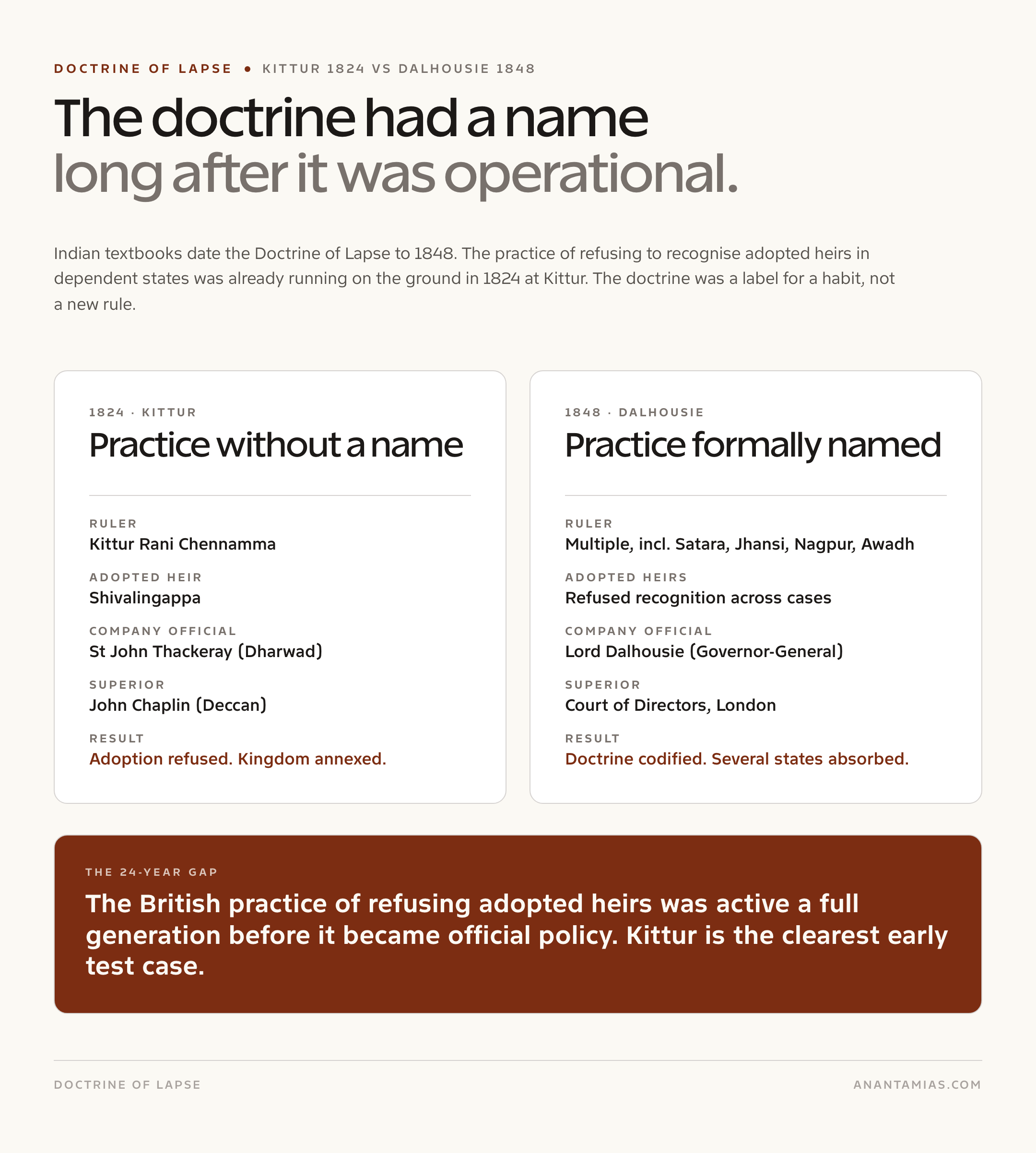
The British Political Agent at Dharwad, St John Thackeray, refused to accept the adoption. His superior, the Commissioner of the Deccan John Chaplin, took the view that the Company alone could decide succession in subordinate states. The two men ordered Chennamma to expel Shivalingappa and accept direct Company rule. They also ordered an inventory of the Kittur treasury, which they planned to confiscate.
This was the Doctrine of Lapse in everything but name. Lord Dalhousie’s 1848 minute would later codify the rule that adopted heirs to dependent states could not inherit. In 1824 the practice was already operational on the ground.
The First Battle of Kittur (October 1824)
Chennamma refused. She prepared the fort, called in her commanders Sangolli Rayanna, Avaradi Veerappa and Gurusiddappa, and mobilised the militia. Thackeray marched on Kittur in October 1824 with around 20,000 troops and four pieces of artillery from the Madras Native Infantry.
The first siege was a disaster for the British. Sangolli Rayanna led a sortie from the fort. Thackeray was shot dead during the engagement. Two British officers, Stevenson and Elliot, were taken hostage. The Company force withdrew. For a few weeks in late October and early November 1824, Kittur was effectively independent again.
The killing of a British political agent was a serious incident. Bombay sent reinforcements. Munro, the Sub-Collector of Sholapur and a nephew of the famous Thomas Munro, was given command. By early December 1824 a far larger Company force was outside Kittur fort.
The Second Battle of Kittur (December 1824)
Chennamma tried to negotiate. She offered to release the hostages in exchange for recognition of Shivalingappa. The Company refused. The second siege began on December 3, 1824. Within a week, Kittur fort fell. Sangolli Rayanna and several other commanders were captured. Chennamma was taken prisoner. The young Shivalingappa was also captured but later escaped.
The British placed Chennamma in confinement at Bailhongal Fort. She lived there in captivity for more than four years. She died on February 21, 1829, after a long illness. The kingdom was absorbed into the Bombay Presidency.
Sangolli Rayanna escaped twice and led a guerrilla campaign in the Kittur countryside from 1829 to 1831. He recruited mainly from the Lingayat and Kuruba villages, attacked Company tax collectors, and tried to find Shivalingappa to install him on the throne. He was captured through a betrayal in 1830 and hanged at Nandagad on January 26, 1831, a date that Kannada nationalists later read as a long-distance echo of Republic Day.
Detailed Analysis: Why Kittur Matters
Three things make the Kittur revolt historically significant.
First, it is a clear early instance of the Doctrine of Lapse in operation. Indian school textbooks routinely date the doctrine to 1848 and to Dalhousie. Kittur shows the practice was already in force in 1824 under the Bombay Presidency. The doctrine was less a single policy than a long pattern of refusing to recognise adopted heirs whenever it suited the Company’s territorial ambitions.
Second, Kittur is a pre-1857 mass uprising. The 1857 Revolt is often described as the first nationwide challenge to Company rule. The Kittur revolt was regional, but it had popular backing across caste lines. Lingayat villagers, Kuruba pastoralists and Muslim soldiers fought together under Chennamma’s banner. The same coalition reformed under Sangolli Rayanna in 1829.
Third, the Kittur revolt belongs to the wider Karnataka resistance arc that connects Hyder Ali, Tipu Sultan, the Polygar Wars in Tamil Nadu, and the later Anglo-Maratha conflicts. It was not an isolated incident. The Bombay Presidency was suppressing local risings continuously through the 1820s and 1830s, and Kittur was simply the most dramatic.
Comparative: Kittur and Sivagangai
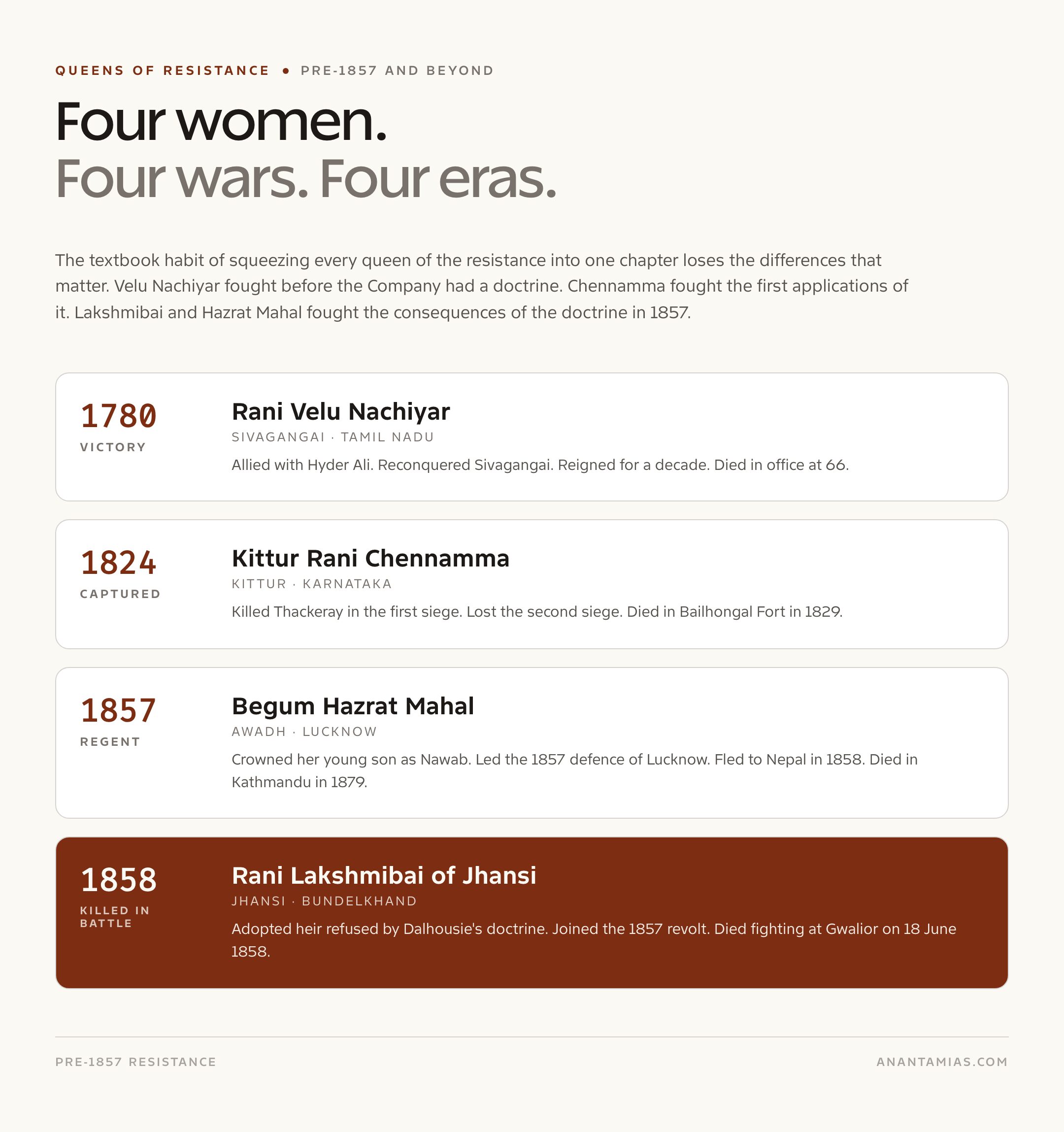
The two Karnataka and Tamil Nadu queens make a natural comparison pair for the UPSC mains. Velu Nachiyar fought in 1780 and won. Chennamma fought in 1824 and lost. The difference is not personal courage. The difference is institutional. By 1824 the Company had a permanent army of around 250,000 troops, an integrated supply chain, and political agents in every district. By 1824 there was no Hyder Ali to call on. The southern kingdoms had been disarmed during the Anglo-Maratha and Anglo-Mysore wars. Chennamma fought a more formidable adversary with fewer allies.
This is the standard pattern across pre-1857 resistance. Each generation of Indian rulers faced a stronger Company than the previous one. Velu Nachiyar in 1780 could win. Chennamma in 1824 could fight one good battle. Lakshmibai in 1857 could only die well.
Challenges and the Sangolli Rayanna Aftermath
Sangolli Rayanna’s two-year guerrilla campaign is sometimes treated as a footnote. It deserves more attention. Rayanna was not a noble. He was a low-caste Kuruba soldier who had served in Chennamma’s army. After her death he became the de facto leader of the Kittur resistance. He moved through forest country, raided revenue convoys, and tried to recruit the adopted heir Shivalingappa as the visible symbol of the revolt.
His arrest in 1830 was the result of betrayal by his own host, who took the British reward. He was hanged at Nandagad on January 26, 1831. A banyan tree he is said to have planted on the way to execution still stands at the spot. Kannada folk songs about Rayanna are sung at Republic Day events in north Karnataka.
The wider Kittur question was not formally closed until the late 1850s, when the Bombay Presidency completed the merger of all surrounding villages into Belgaum district. By then the larger 1857 revolt had come and gone.
Prelims Pointers
- Kittur is in present-day Belagavi district of Karnataka.
- The 1824 revolt was led by Kittur Rani Chennamma against the East India Company.
- The immediate cause was the British refusal to recognise her adopted son Shivalingappa.
- This was a de facto application of the Doctrine of Lapse twenty-four years before Lord Dalhousie formally announced it in 1848.
- St John Thackeray, the British Political Agent, was killed in the first battle of Kittur in October 1824.
- The Bombay Presidency sent reinforcements under Deputy Commissioner Munro for the second siege in December 1824.
- Chennamma was imprisoned at Bailhongal Fort and died there on February 21, 1829.
- Sangolli Rayanna led the post-1829 guerrilla campaign and was hanged at Nandagad on January 26, 1831.
- A commemorative stamp on Kittur Rani Chennamma was issued by the Government of India in 1977.
- The Government of Karnataka observes Kittur Utsava annually in October.
Mains Questions
- “The Doctrine of Lapse was operational well before Lord Dalhousie put a name to it.” Examine this claim with reference to the Kittur revolt of 1824. (GS Paper I, 15 marks)
- Compare and contrast the resistance offered to British expansion by Kittur Rani Chennamma (1824) and Rani Velu Nachiyar (1780). What does the comparison reveal about the changing balance of power between Indian kingdoms and the East India Company? (GS Paper I, 15 marks)
- Discuss the role of pre-1857 popular uprisings in shaping the later national movement, with specific reference to Kittur, Sambalpur and the Bhil revolts. (GS Paper I, 10 marks)
- The career of Sangolli Rayanna shows that anti-colonial resistance in early nineteenth-century India was not confined to royal families. Comment. (Essay / GS Paper I, 10 marks)
Legacy and Way Forward
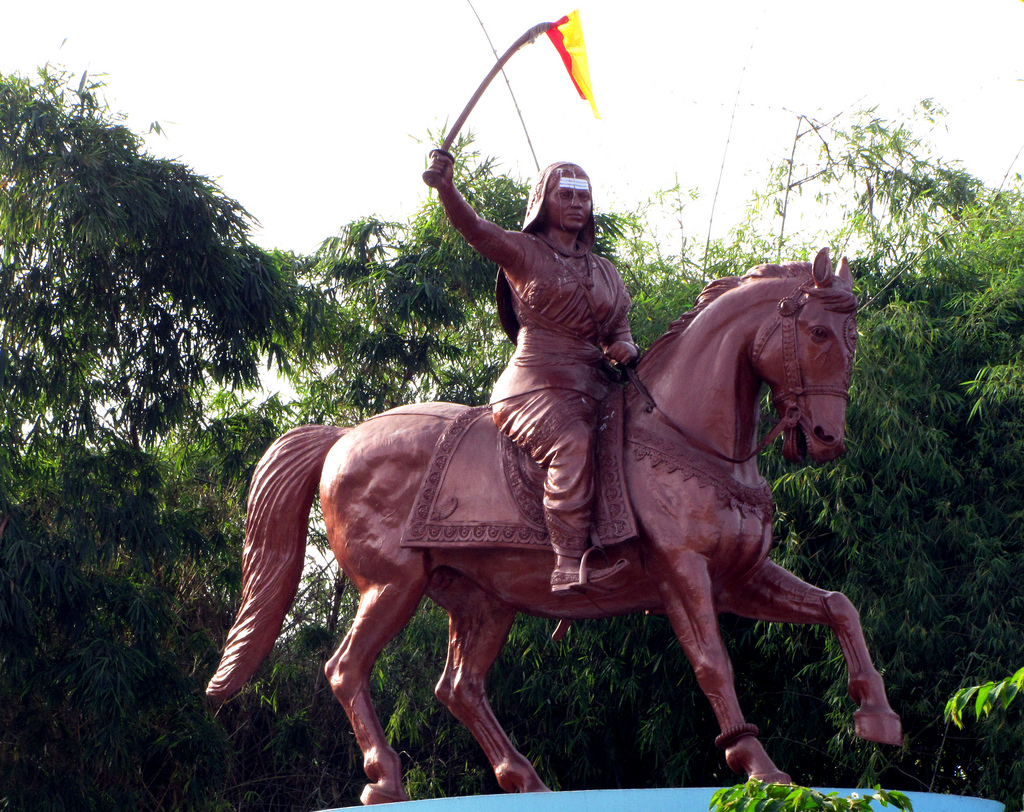
The Karnataka state has built a memorial complex at Kittur, with the queen’s statue at the main entrance to the fort. The Government of Karnataka renamed Bangalore’s State Express Bus Stand area after her in 2007. A 2,400-square-foot bronze statue of Chennamma stands at Parliament House complex in Delhi. Sangolli Rayanna’s statue was unveiled at Bengaluru City Railway Station in 2012 and is now one of the largest equestrian statues in the country.
The deeper task is the textbook one. Karnataka and Tamil Nadu have done a reasonable job of inserting Chennamma and Velu Nachiyar into state-level school syllabi. The NCERT textbooks used across the country still spend more pages on Dalhousie than on Chennamma, even though her revolt is logically a part of the same story. Putting the independence movement on a longer timeline that begins with the 1780 Sivagangai war and runs through 1947 is the correct framing, and the Kittur revolt sits squarely in that timeline.
Comparing Chennamma’s story to the later careers of leaders like Mahatma Gandhi and Bhagat Singh gives mains aspirants a way to write about evolving forms of resistance. It also helps to see her in relation to the older Vijayanagara Empire, since the Kittur Desais traced their administrative lineage to that earlier south Indian state.
Frequently Asked Questions
Who was Kittur Rani Chennamma?
Kittur Rani Chennamma was the queen of Kittur, a small principality in present-day Belagavi district of Karnataka. Born in 1778, she led the 1824 revolt against the East India Company after the Company refused to recognise her adopted heir. She is often called the first Indian queen to take up arms against the British in Karnataka.
Why did Kittur Rani Chennamma revolt in 1824?
Her husband Raja Mallasarja had died in 1816. Her stepson and her own natural son both died by 1824, leaving no direct heir. She adopted a young relative, Shivalingappa, and declared him successor. The Company, through its political agent St John Thackeray, refused to recognise the adoption and ordered direct annexation of Kittur. Chennamma refused to comply and prepared for war.
How is Kittur connected to the Doctrine of Lapse?
The Doctrine of Lapse is usually associated with Lord Dalhousie’s policy from 1848 onwards. The British practice of refusing to recognise adopted heirs in dependent states was already in operation in 1824 at Kittur. The Kittur revolt is therefore the clearest early test case of the doctrine, predating Dalhousie’s formal announcement by twenty-four years.
Who killed St John Thackeray?
St John Thackeray, the Company’s Political Agent at Dharwad, led the first siege of Kittur in October 1824. He was killed during a sortie led by Chennamma’s commander Sangolli Rayanna. His death is one of the highest-ranking British casualties in any pre-1857 uprising.
Where did Kittur Rani Chennamma die?
After the second siege of Kittur in December 1824, Chennamma was captured and imprisoned at Bailhongal Fort. She died there in captivity on February 21, 1829, after a long illness. Her death is commemorated annually by the Karnataka government.
Who was Sangolli Rayanna?
Sangolli Rayanna was a Kuruba soldier and a commander in Chennamma’s army. After her capture in 1824 and death in 1829, he led a two-year guerrilla campaign against the Company in the Kittur countryside. He was captured through betrayal in 1830 and hanged at Nandagad on January 26, 1831. He is one of the most celebrated low-caste freedom fighters of pre-1857 India.
Did Kittur have any natural heir?
Chennamma had a natural son with Raja Mallasarja. He died in 1824, the same year his elder half-brother Shivalingappa Rudrasarja died. The adopted heir, also called Shivalingappa, was a young boy from a related family. After the second siege he escaped into the countryside and disappeared from the historical record.
Why is the Kittur revolt important for UPSC?
The Kittur revolt is important for at least three reasons. It is a pre-1857 popular uprising. It is the clearest early operation of the Doctrine of Lapse. It is one of the most extensive instances of cross-caste resistance to the Company in nineteenth-century India. All three points are mains-relevant for GS Paper I.
Is there a film on Kittur Rani Chennamma?
There are several Kannada films on the queen, the best known being the 1961 black-and-white production directed by B.R. Panthulu with Dr Rajkumar in a supporting role. More recent Kannada and OTT productions have dramatised both Chennamma and Sangolli Rayanna’s careers.