Sansad Bhashini: AI Real-Time Translation in Parliament Explained
Complete guide to Sansad Bhashini, the AI-based real-time translation system deployed in the Indian Parliament: 22 scheduled languages support, Article 120 constitutional linkage, Bhashini Mission under MeitY, NLP technology, and the democratisation of parliamentary participation.
A constitutional democracy works only when its representatives can speak and be understood. The Indian Parliament has, for seven decades, functioned principally in two languages: Hindi and English. Members from non-Hindi belt States who were not fluent in either of the two have either translated themselves on the fly, used the limited manual interpretation arrangement available for a few major regional languages, or self-censored their participation. Article 120 of the Constitution permits the Presiding Officer to allow a Member to address the House in his mother tongue, but the practical operationalisation of that permission has historically been weak.
Sansad Bhashini is the artificial intelligence system that aims to change this. Built on the broader Bhashini platform of the Ministry of Electronics and Information Technology, the system provides real-time translation of parliamentary proceedings into all 22 scheduled languages of the Eighth Schedule. The technical achievement is significant. The constitutional achievement is more so: it converts the Article 120 proviso from a paper permission into a practical right, and it democratises parliamentary participation for Members whose linguistic comfort lies outside the Hindi-English binary.
This guide walks through the Sansad Bhashini system, the technology platform behind it, the constitutional and statutory linkage with Article 120 and the Eighth Schedule languages framework, the broader AI-in-governance trajectory, and the prelims and mains pointers for UPSC aspirants who are likely to encounter this topic in coming examination cycles.
Quick Facts on Sansad Bhashini
Sansad Bhashini is an artificial intelligence-based real-time translation system deployed in the Indian Parliament. Its core function is to translate parliamentary speeches in real time into all 22 scheduled languages listed in the Eighth Schedule of the Constitution. The system runs on the Bhashini platform, developed under the Digital India Bhashini Mission of the Ministry of Electronics and Information Technology. It uses Natural Language Processing and a credo of treating Indian languages as resources for a voice-based Internet for India. The constitutional linkage is Article 120, which empowers the Presiding Officer to permit any Member who cannot adequately express himself in Hindi or English to address the House in his mother tongue. Sansad Bhashini operationalises this proviso by removing the logistical obstacle of finding manual interpreters for every regional dialect.
The Linguistic Reality of Indian Parliamentary Practice
The Indian Parliament represents a country with hundreds of mother tongues and twenty-two scheduled languages. Members come from constituencies where Hindi is not necessarily the first language and where English literacy varies. The Parliament’s official rules accept Hindi and English as the working languages, with Article 120 carving out a constitutional exception for mother-tongue addresses with the Presiding Officer’s permission.
In operational terms, Parliament has historically maintained interpretation booths for a small set of major regional languages, typically including Tamil, Telugu, Bengali, Malayalam, and a few others. Coverage has depended on interpreter availability and on the timing of relevant speeches. A Member from a smaller-language community often had no realistic interpretation support and either spoke in Hindi or English with effort, or skipped substantive participation. The result was an under-realisation of constitutional pluralism: the Eighth Schedule listed twenty-two languages, but Parliament heard from a much smaller subset.
What Sansad Bhashini Actually Does
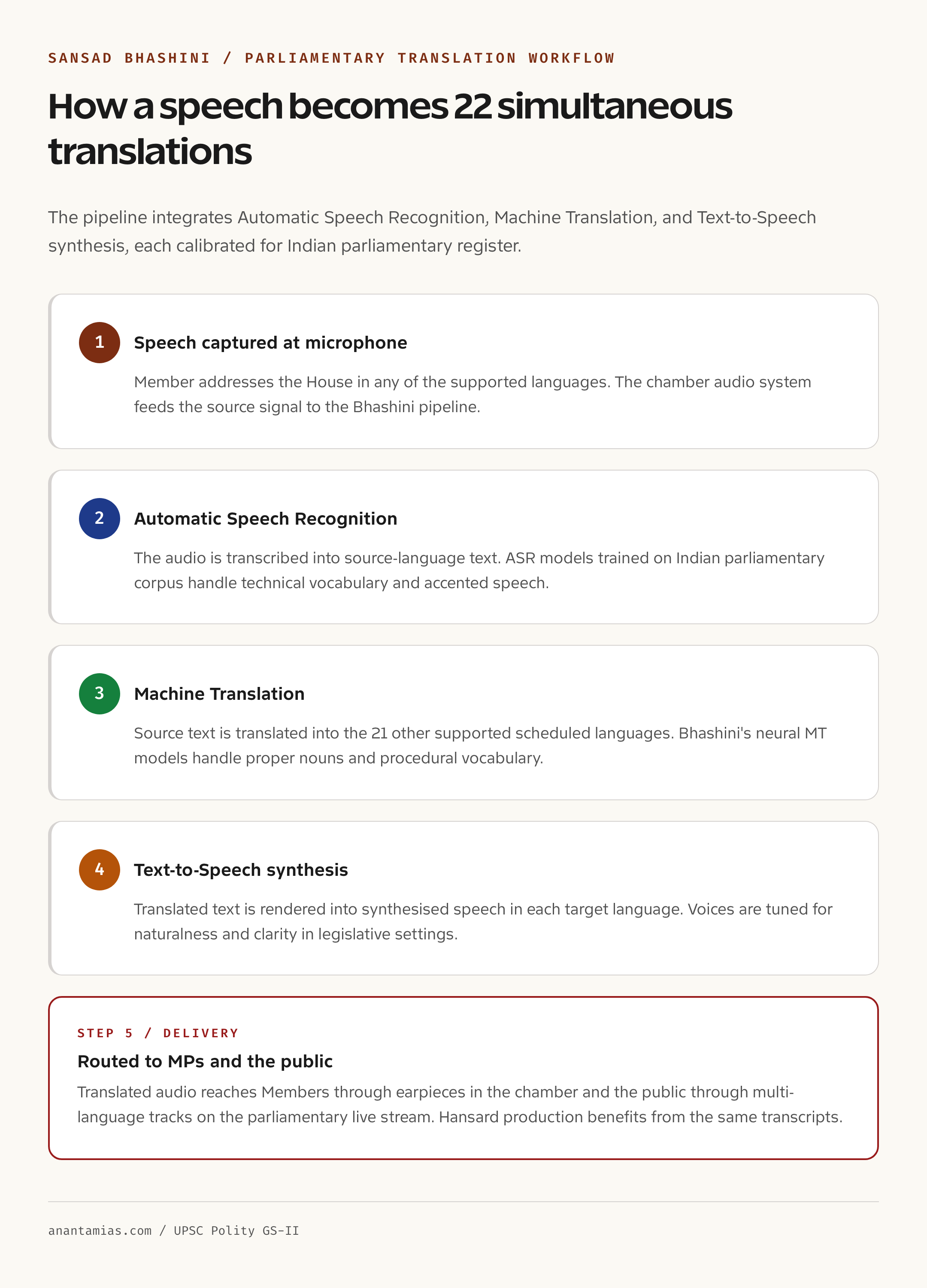
The system performs three functions in real time. It captures the spoken word at the microphone of a Member who is addressing the House in any one of the supported languages. It applies Natural Language Processing to transcribe the speech into text in the source language. And it generates synthesised translations into the other supported languages, which are then routed to the earpieces of Members who choose to listen in that language and to the live broadcast feed for the public.
The technical pipeline integrates Automatic Speech Recognition, Machine Translation, and Text-to-Speech synthesis. The combination is not new, but the calibration of all three for Indian languages, parliamentary register, and proper-noun-heavy political vocabulary is the engineering effort that distinguishes Sansad Bhashini from generic translation tools. The system is trained on Indian parliamentary corpus, which gives it the lexical familiarity needed for technical legislative language, names of ministries, and the procedural vocabulary of motions, resolutions, and divisions.
The Bhashini Platform and the Digital India Mission
Sansad Bhashini is one application built on the broader Bhashini platform. Bhashini, formally the Digital India Bhashini Mission, was launched by the Ministry of Electronics and Information Technology to create a national infrastructure for Indian language artificial intelligence. The mission’s core idea is that the digital divide in India is fundamentally a linguistic divide: a citizen who speaks Maithili or Santhali should be able to access government services, public information, and online content in his own language without having to navigate the Hindi-English barrier.
The platform aggregates language datasets, machine learning models, and translation services into a common infrastructure that any application, public or private, can build on. Bhashini’s contribution layer, called Bhasha Daan, invites citizens to contribute speech and text data in Indian languages, building the corpus that the underlying models need. Sansad Bhashini is therefore not a standalone product but a flagship application that demonstrates what the larger platform can achieve.
The Constitutional Linkage: Article 120
Article 120 of the Constitution governs the language to be used in Parliament. The default rule is that business shall be transacted in Hindi or English. The proviso, however, is significant: the Presiding Officer of the relevant House may permit any Member who cannot adequately express himself in Hindi or English to address the House in his mother tongue. The Presiding Officer also has the power to direct that the use of English may be discontinued after fifteen years from the commencement of the Constitution, but Parliament has by law continued the use of English indefinitely, and the practical default remains Hindi-English bilingualism.
Sansad Bhashini converts the Article 120 proviso from a permission that depends on case-by-case interpreter availability into a permission that can be exercised at scale. The Presiding Officer can grant the permission with confidence that the spoken contribution will be intelligible to the rest of the House and to the public. The Member from a smaller-language community is no longer self-censoring out of consideration for the audience.
The Eighth Schedule Coverage and Why It Matters
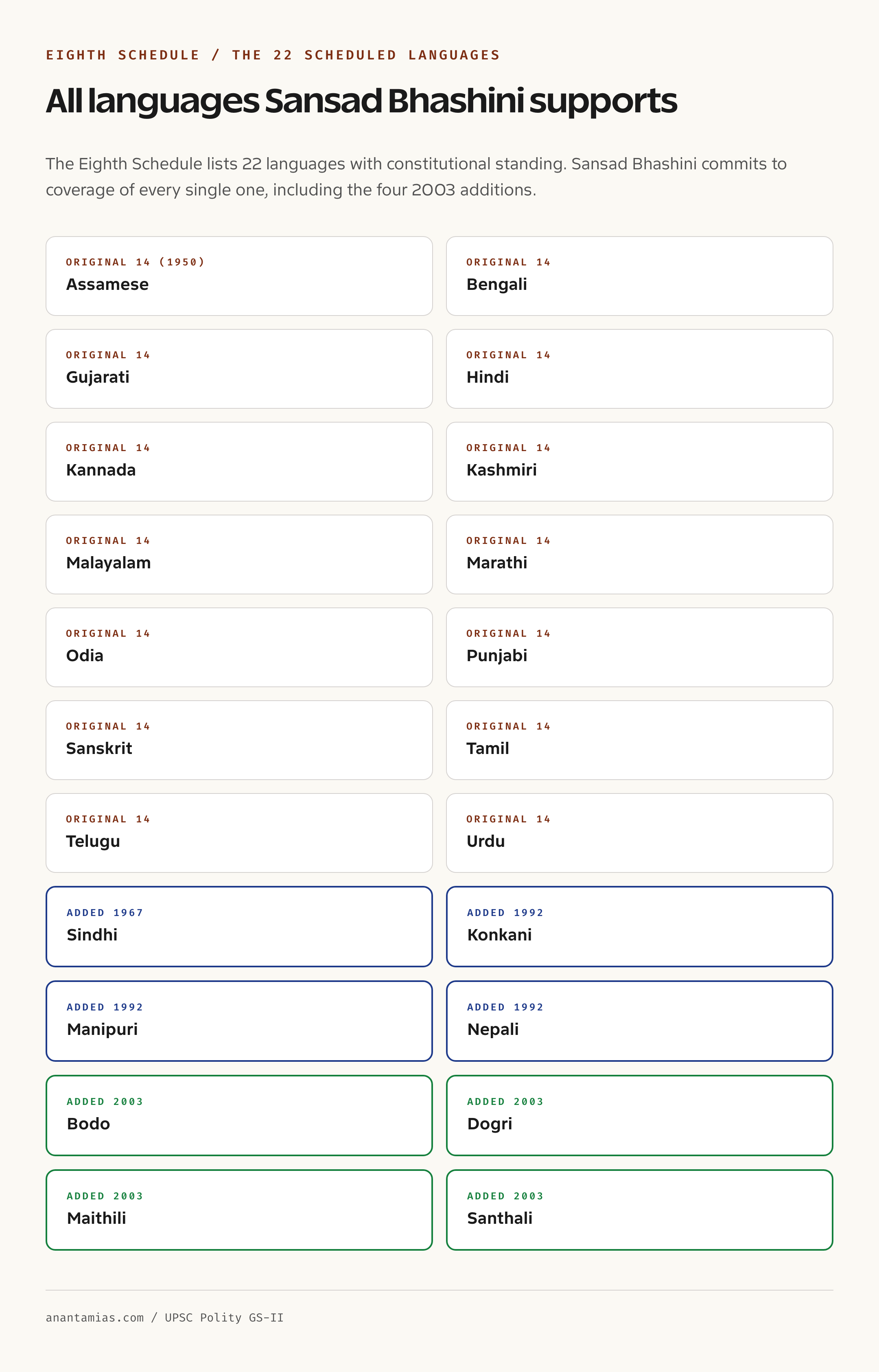
The Eighth Schedule of the Constitution lists 22 scheduled languages. The original list included 14 languages. Subsequent amendments added Sindhi (1967), Konkani, Manipuri, and Nepali (1992), and Bodo, Dogri, Maithili, and Santhali (2003). Sansad Bhashini’s commitment is to cover all 22. That commitment is operationally non-trivial: the four 2003 additions in particular have smaller digital corpora and present greater training-data challenges than the major regional languages.
The Eighth Schedule coverage matters constitutionally because it implements the inclusive logic of the Schedule itself. The Schedule was framed not just as a list of languages but as a recognition of the cultural and political claims of speech communities to formal constitutional standing. Sansad Bhashini’s coverage of all 22 honours that recognition by ensuring that any Member from any of those communities can speak in his language and be heard. The promise is not yet uniformly delivered. Quality varies by language and by speaker accent. But the system’s roadmap commits to ongoing improvement across all 22.
Speaker, Chairperson, and Procedural Considerations
The deployment of Sansad Bhashini does not change the formal procedure for using a non-Hindi, non-English language in Parliament. The Member still requests permission from the Speaker (in Lok Sabha) or the Chairman (in Rajya Sabha) under Article 120. The Presiding Officer continues to exercise discretion in granting or declining permission. What changes is the underlying confidence with which permission can be granted: the Presiding Officer knows that the system will translate the speech for the rest of the House in real time.
The Hansard, which is the official record of parliamentary proceedings, traditionally records speeches in the language they were delivered with English translation as needed. Sansad Bhashini’s transcripts can feed into the Hansard production process, accelerating the publication cycle and improving the consistency of regional-language records. The full integration of Sansad Bhashini outputs with the official record-keeping of Parliament is an evolving administrative project rather than a single deployment moment.
AI in Indian Government: The Broader Trajectory
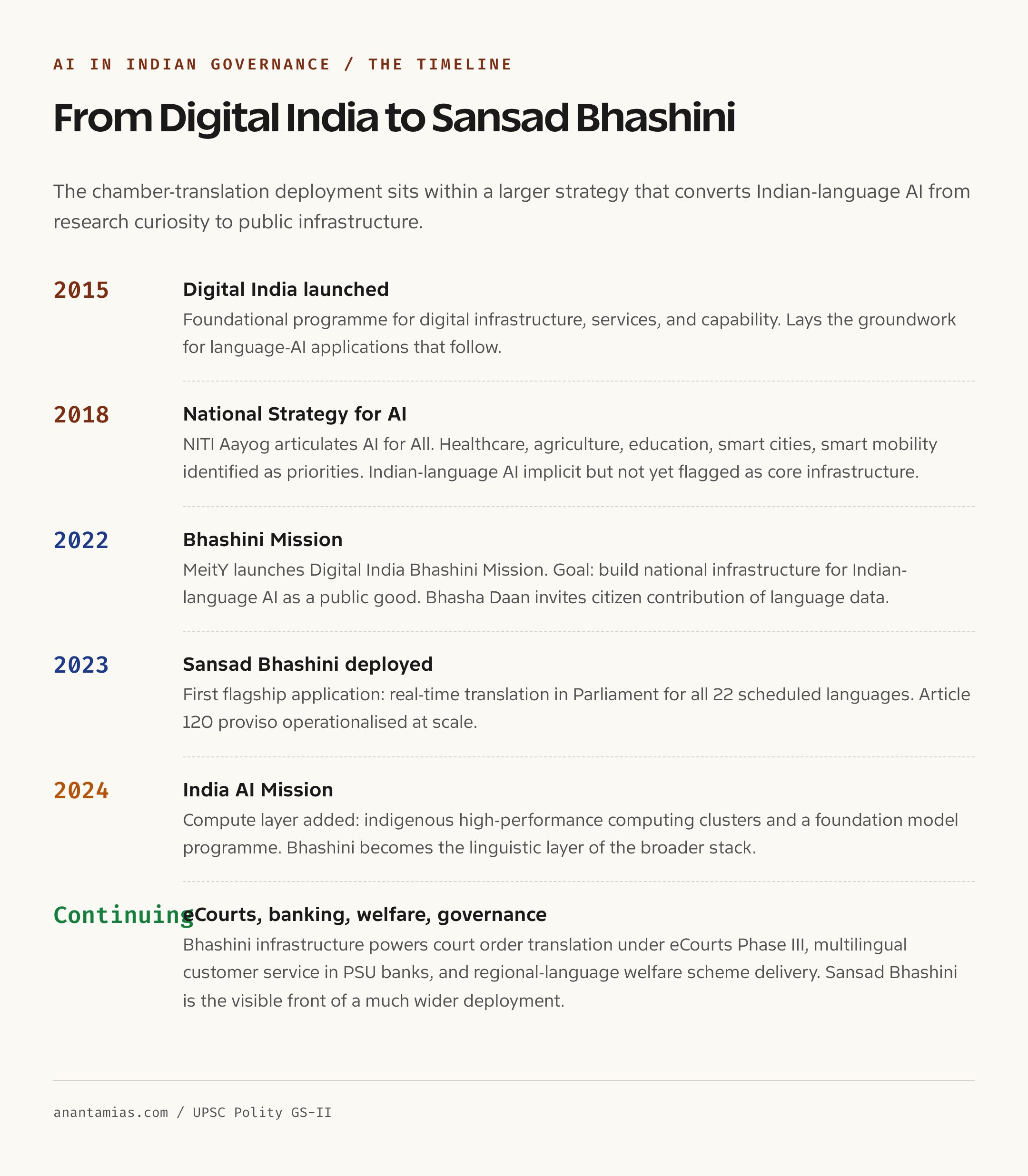
Sansad Bhashini sits within a broader Indian state strategy on artificial intelligence in governance. The National AI Strategy of 2018 articulated AI for All as the framing principle, with healthcare, agriculture, education, smart cities, and smart mobility as priority sectors. The Digital India initiative provided the infrastructure layer. India AI Mission, announced in 2024, added the compute layer through indigenous high-performance computing clusters and a foundation model programme.
Bhashini is the linguistic layer of this stack. By creating Indian-language AI infrastructure as a public good, Bhashini lowers the cost for every other AI application, public or private, to be built in the languages that Indians actually speak. Sansad Bhashini is a high-visibility demonstration of what the platform can do. Other applications already in deployment include translation of court orders for the eCourts Phase III project, multilingual customer service for public sector banks, and regional-language interfaces for government welfare schemes.
Quality, Accuracy, and the Limits of Real-Time Translation
The technical promise of Sansad Bhashini is real, but the limits should be acknowledged. Real-time translation introduces a brief delay between the spoken word and the synthesised output. For fast-paced parliamentary debate, the delay can interfere with the flow of point-and-counter-point exchanges. The system performs better on prepared speeches than on spontaneous interventions. Technical vocabulary, regional idioms, and accented speech are all challenges that the engineering team continues to address through model fine-tuning and corpus expansion.
Quality of translation also varies across language pairs. Major language pairs (Hindi to Tamil, Hindi to Bengali, English to Telugu) have benefitted from larger training corpora and produce translations of high fidelity. Lower-resource pairs (Hindi to Bodo, English to Santhali) are improving but still produce occasional errors in syntax, register, or vocabulary. The Bhashini Mission’s data-collection programme is explicitly aimed at narrowing this quality gap over time.
Constitutional and Democratic Implications
Sansad Bhashini’s contribution to Indian constitutional democracy goes beyond the technical achievement. By making it practically possible for Members to speak in their mother tongues, the system rebalances participation toward Members whose linguistic resources lie outside Hindi and English. The deliberative quality of the House improves when Members can engage in the language of their thinking rather than the language of their secondary fluency.
The implications also extend to public access. Parliamentary debates streamed live with multi-language audio tracks become accessible to citizens whose own language matches the track. The democratising effect on public engagement with the legislative process is not yet fully measurable, but the design intent is clear: the House is for the country, and the country speaks twenty-two scheduled languages.
Prelims and Mains Pointers for UPSC
For prelims, four anchors deserve attention. Sansad Bhashini is built on the Bhashini Mission of the Ministry of Electronics and Information Technology (MeitY), not the Ministry of Parliamentary Affairs. The system covers all 22 scheduled languages of the Eighth Schedule. The constitutional linkage is Article 120 and its proviso permitting mother-tongue addresses. The technology base is Natural Language Processing combining ASR, MT, and TTS.
For mains, the question typically asks how technology can deepen constitutional democracy and what its limits are. Sansad Bhashini is a useful case study. It can be linked to the broader parliamentary committees framework on legislative deliberation, to the Lok Sabha vs Rajya Sabha comparison on procedure, and to the Indian judiciary discussion on access to justice in regional languages. Aspirants writing on AI in governance should integrate Sansad Bhashini with eCourts Phase III, the India AI Mission, and the National AI Strategy to show the ecosystem.
Conclusion: Voice-Based Internet for the Indian Parliament
Sansad Bhashini is the legislative-chamber instantiation of the Bhashini Mission’s larger vision: an India where every citizen and every Member of Parliament can speak in his own language and be heard. The technical engineering, the constitutional linkage with Article 120, and the inclusive coverage of all 22 scheduled languages combine to produce a system that does practical work for Indian democracy.
The system is not perfect. Quality varies by language, real-time translation has inherent latency, and full integration with parliamentary record-keeping remains an evolving project. But the direction is set, and the platform on which Sansad Bhashini is built will improve with use, with corpus expansion, and with the broader maturation of Indian-language AI. For UPSC aspirants, the topic is a clean example of how the digital infrastructure of a state can give constitutional provisions practical effect, and how the Eighth Schedule’s recognition of linguistic plurality is being honoured in the most visible deliberative space of the Indian republic.
Frequently Asked Questions
What is Sansad Bhashini?
Sansad Bhashini is an artificial intelligence-based real-time translation system deployed in the Indian Parliament. It translates parliamentary speeches in real time into all 22 scheduled languages listed in the Eighth Schedule of the Constitution.
Which Mission and Ministry developed Sansad Bhashini?
The system runs on the Bhashini platform, developed under the Digital India Bhashini Mission of the Ministry of Electronics and Information Technology (MeitY).
How many languages does Sansad Bhashini support?
The system supports all 22 scheduled languages of the Eighth Schedule of the Constitution, including the four 2003 additions: Bodo, Dogri, Maithili, and Santhali.
Which constitutional Article is the legal basis for mother-tongue addresses in Parliament?
Article 120 of the Constitution governs the language to be used in Parliament. The default is Hindi or English. The proviso permits the Presiding Officer to allow a Member who cannot adequately express himself in Hindi or English to address the House in his mother tongue.
What technology powers Sansad Bhashini?
The system uses Natural Language Processing combining Automatic Speech Recognition, Machine Translation, and Text-to-Speech synthesis. The models are trained on Indian parliamentary corpus to handle technical legislative vocabulary and Indian-language phonetic features.
Does Sansad Bhashini replace manual interpreters?
The system supplements rather than fully replaces manual interpreters. Major regional language pairs perform well in real time, while lower-resource languages continue to improve as the underlying corpus expands. Manual interpretation remains available for high-stakes debates and for situations where AI translation quality is not yet adequate.
How does Sansad Bhashini connect to the broader Digital India initiative?
Sansad Bhashini is one application of the Bhashini Mission, which is itself part of the Digital India infrastructure layer. The Mission creates Indian-language AI as a public good, enabling Sansad Bhashini and other applications such as eCourts Phase III translation, multilingual public service interfaces, and regional-language welfare scheme delivery.