Shankar IAS Environment: Which Edition to Buy, What to Read and What to Skip for UPSC
Shankar IAS Environment, 11th edition: which print to buy, which of its six parts carry the Prelims marks, a five-week reading plan and what to cross-check.
Shankar IAS Environment is the book most UPSC aspirants buy first for ecology and biodiversity, and the question worth settling before you open it is how much of it to read. The Shankar IAS environment book is a compilation of about 500 pages from Shankar IAS Academy, organized in six parts that run from basic ecology to climate change, laws and conventions. It isn’t a textbook that explains every mechanism, and it isn’t a current affairs source. For UPSC Prelims it’s the closest thing the subject has to a spine. For a state PSC paper it covers more than the paper asks.
That spine matters because of how much environment carries. Across the Prelims papers from 2013 to 2026, environment accounted for 245 questions, an average of 17.5 a year, and it never fell below 13 in any single year. It was the largest subject in the paper in every one of those fourteen years, and it’s still the subject most aspirants prepare with the least plan.
There are two common ways to waste the book. One group reads it cover to cover three times and still drops the pollution questions, because every page got equal time. The other buys PMF IAS as well, reads half of each and revises neither. The sensible path is narrower than either. One book, read part by part, with the previous-year questions deciding which parts get a second and third pass. The edition question comes first, because Amazon.in carries more than one print of the current edition.
What Shankar IAS Environment is, and which edition to buy
Buy the 11th edition in its 2025 color print, about 505 pages, published by Shankar IAS Academy itself. That’s the current edition on Amazon.in, and the academy also sells the book from its own website, with delivery in about a week.
The listings can confuse, so these are the facts that separate one print from another:
- The color print of the 11th edition is listed at 505 pages, with a publication date of 24 March 2025.
- A second 11th-edition listing, dated June 2025, runs 504 pages.
- An older listing dated October 2024 shows 444 pages. A page count well under 500 is the sign of an older print.
The book’s contents fall into six parts:
- Part I, Environment Ecology
- Part II, Biodiversity
- Part III, Climate Change
- Part IV, Legislations, Conventions and Organisations
- Part V, Sustainable Development
- Part VI, Annexure
Protected-area counts, convention decisions and amendments to Indian environmental law change every year, so a print from three or four years ago teaches a map that no longer exists. Buy the current print and don’t learn from a hand-me-down.
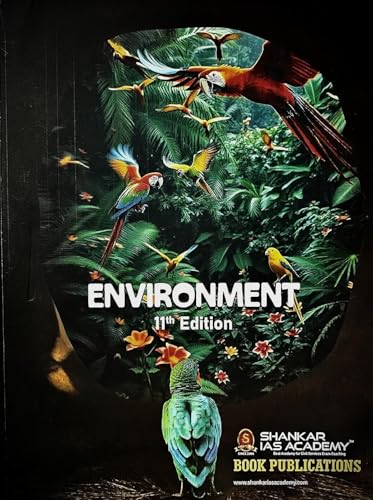
Environment by Shankar IAS Academy, 11th Edition (Color Print)
- About 505 pages, published by Shankar IAS Academy
- Six parts: ecology, biodiversity, climate change, laws and conventions, sustainable development and an annexure
- The 2025 color print of the current 11th edition
If you’d rather buy from the publisher, the academy’s own environment book page takes orders through its distribution desk. Amazon is quicker to order from, and the page count on the listing tells you which print you’re getting.
Who the Shankar environment book is for, and who can skip it
It’s the core environment book for UPSC Prelims and a dependable reference for environment answers in GS Paper 3. For a state PSC it’s a complete book, and for SSC, railway and banking papers it’s more than you need.
Read it as your core book if:
- UPSC Prelims is in your plan this year or next.
- You come from a non-science background and need one place that collects conventions, protected areas and pollutants.
- Your mock tests keep exposing environment as your weakest block.
- A state PSC prelims, such as BPSC or UPPSC, is your parallel exam.
Treat it as optional if:
- SSC or banking papers are your only target. They ask a thin slice of ecology that a general knowledge book covers.
- You already own PMF IAS Environment and have revised it twice. One compilation is enough, and the best environment books list on this site makes the same call.
- You’re in the Mains months with Prelims behind you. Keep it for reference and move to answer practice.
It isn’t wise to buy both compilations, and it isn’t wise to skip a compilation and hope current affairs will carry the subject either. One book, revised until it feels boring, beats two books read once.
The part map: what to read for UPSC and for state PSCs
Parts I, III and IV deserve your closest reading, because the topics they cover carry almost half of all environment questions. The table maps the six parts against the topic tags in our environment PYQ analysis, which counts every environment question in the Prelims papers from 2013 to 2026. Where a topic spans two parts, it’s listed under the closer one.
| Part | Prelims topics it feeds (questions, 2013 to 2026) | UPSC Prelims | State PSC and other exams |
|---|---|---|---|
| Part I, Environment Ecology | Environmental pollution (43), ecology basics (9), functions of ecosystems (8), aquatic and wetland ecosystems (14) | Read closely; pollution is the most-asked topic in the whole paper | Core |
| Part II, Biodiversity | Indian fauna (17), conservation efforts (11), protected area network (10), Indian flora (6) | Read with an atlas and keep a running species list | Core, especially your own state’s parks and sanctuaries |
| Part III, Climate Change | Climate change (30) | Read closely, then update with the latest conference outcomes | Read once |
| Part IV, Legislations, Conventions and Organisations | International frameworks (18), institutional measures (14), national legislation (12) | Read and compress into a one-page convention table | Read the Indian laws; skim the conventions |
| Part V, Sustainable Development | Agriculture and allied activities (17), renewable energy (16) | Read once and cross-check every figure | Read once |
| Part VI, Annexure | Reference lists | Look up, don’t read | Look up |
Two numbers explain the table. Pollution has been asked 43 times in fourteen years, more than any other topic in the Prelims paper, ahead of every polity and economy topic. And the three law-and-convention topics together come to 44 questions that are close to pure recall: which convention covers what, which body runs it, whether India is a party. Those are the cheapest marks this book can give you.
How to read Shankar IAS Environment in five weeks
Read it part by part over five weeks, about an hour a day, and close every week with that week’s previous-year questions. The order below puts the foundation first and the highest-yield parts in the middle, while your attention is still fresh.
- Week 1, the foundation. Read the ecology chapters of NCERT Class 12 Biology first; our NCERT biodiversity guide covers that unit. Then read the ecosystem chapters of Part I.
- Week 2, pollution. Finish Part I with a pollutant sheet: substance, source, effect, standard. Particulate matter, ground-level ozone, oxides of nitrogen and sulfur and the Air Quality Index come round again and again.
- Week 3, biodiversity. Part II with an atlas open. Mark every biosphere reserve, Ramsar site and biodiversity hotspot on a blank map before you memorize anything about it.
- Week 4, climate change and conventions. Parts III and IV together. Build the one-page convention table as you go, and read our notes on the UNFCCC, the Wildlife Protection Act and the Biodiversity Act for the amendments.
- Week 5, the rest and the second pass. Part V once, then a second pass through only what you marked as missed, then the full environment question set.
The test at the end of each session is simple. Close the book and write down what the chapter said. If less than half of it comes back, the chunk was too big, so halve it and try again the next day. Environment rewards this kind of recall more than most subjects, because so much of it is names, places and numbers.
What to skip, and what to cross-check
On a first read, skip the Annexure lists and any descriptive passage that repeats what the NCERT ecology unit already taught you. Don’t skip the chemistry inside the pollution chapters, though. A large share of pollution questions test what a substance is and what it does, and that’s exactly the part aspirants call too technical and leave for later.
Cross-check everything that changes after the print date. A 2025 print cannot know about 2026 designations or decisions:
- Counts of Ramsar sites, tiger reserves and biosphere reserves, which rise almost every year. Take the latest count from the official announcement, never from the book.
- Outcomes of the latest climate and biodiversity conferences.
- Amendments to Indian environmental laws, such as the 2022 amendment to the Wildlife Protection Act and the 2023 amendment to the Biological Diversity Act.
- India’s climate targets and any other figure with a year attached.
The habit that fixes this is cheap. When a fact carries a number or a date, confirm it against the ministry’s release or a recent note before it goes into your revision sheet. Shankar is where you learn the frame. The current number comes from somewhere else.
What Shankar IAS Environment will not do
It won’t teach concepts the way a textbook does. It’s a compilation, so some explanations read like bullet points stitched together, and the reasoning behind a concept has to come from NCERT. It won’t cover the species that were in the news this year; those questions come from monthly current affairs, not from any static book. It won’t write your Mains answers either. A GS Paper 3 answer on air pollution or climate finance needs a recent report, a figure and a case, and the book gives you only the frame.
Coaching shelves treat it as the whole of environment. It’s the first half.
Shankar IAS vs PMF IAS vs McGraw Hill for environment
Three books get bought for the same slot, and you need one of them.
| Book | Pages and edition | What it is | Verdict |
|---|---|---|---|
| Environment, Shankar IAS Academy | About 505, 11th edition color print | A compact compilation built around the topics Prelims asks | The pick for one core book |
| PMF IAS Environment, Manjunath Thamminidi | About 590, 2026-27 edition | Longer, and explains concepts before it lists facts | Buy it instead of Shankar, not with it, if you learn better from explanation |
| Environment, Agriculture and Disaster Management Courseware, Ravi P. Agrahari (McGraw Hill) | About 616, 4th edition (2026) | Adds agriculture and disaster management, with solved Prelims questions from 2013 to 2025 and Mains questions from 2023 to 2025 | For aspirants who want the wider GS Paper 3 cluster and its practice in one volume |
Shankar wins on marks per page read. PMF’s 590 pages are easier to learn from but slower to revise, and in environment the number of revisions decides the score. The McGraw Hill volume bundles solved previous-year questions inside it, which suits someone who studies through practice more than through reading.
Is there a Shankar IAS Environment PDF?
No official one. Shankar IAS Academy sells the printed book, on Amazon.in and through its own website, and its book page offers the paperback, not a download. The files that circulate as a Shankar IAS environment PDF come from third-party sites, and nothing on them tells you which print you’re looking at. For a subject where counts and amendments change every year, an undated scan is the one copy you shouldn’t learn from.
Shankar IAS Environment earns its place as the one environment book for UPSC Prelims, as long as it’s read the way the question paper is set. Buy the 11th edition color print, read Parts I, III and IV hardest, build the convention table in week four and take every count and date from a fresh source. Do that and a subject that brings anywhere from 13 to 27 questions a year stops feeling unfinished. Start with the pollution chapter this week, because it’s the topic the paper asks most.
Frequently Asked Questions
Is Shankar IAS Environment enough for UPSC Prelims?
It is enough as the static core, not as the whole subject. Pair it with the ecology chapters of NCERT Class 12 Biology for concepts and a monthly current affairs compilation for species, conventions and reports in the news. Environment carried 245 Prelims questions from 2013 to 2026, and a share of them every year come from the news, not from any book.
Which edition of Shankar IAS Environment should I buy?
The 11th edition in its 2025 color print, listed at about 505 pages and published by Shankar IAS Academy. Listings with a page count well under 500, such as a 444-page print dated October 2024, are older prints.
Shankar IAS or PMF IAS for environment, which is better?
Shankar is more compact and faster to revise; PMF IAS runs about 590 pages and explains concepts more fully. Pick one as your core book. Owning and reading both is the most common way to spend twice the time for the same marks.
How long does it take to read Shankar IAS Environment?
About five weeks at an hour a day, reading part by part and ending each week with previous-year questions. The second and third revisions go much faster if you mark what you missed on the first pass.
Should I read NCERT before Shankar IAS Environment?
Yes, the ecology chapters of NCERT Class 12 Biology. They explain populations, ecosystems and biodiversity in a way the compilation does not, and they make Parts I and II of Shankar much easier to retain.
Is Shankar IAS Environment useful for state PSC exams?
Yes. It covers more environment than most state PSC prelims ask. Read Parts I and II fully and the Indian laws in Part IV, and add your own state’s national parks, sanctuaries and Ramsar sites from official sources.
Does Shankar IAS Environment cover current affairs?
Only what was known when it was printed. Counts of Ramsar sites and tiger reserves, recent conference outcomes and new amendments must come from a current affairs source and should be checked against the official announcement.
Is there a free Shankar IAS Environment PDF?
There is no official PDF. The academy sells the printed book on Amazon.in and through its own website. Scans on third-party sites carry no print date, and an older print misses recent changes to protected areas and environmental law.