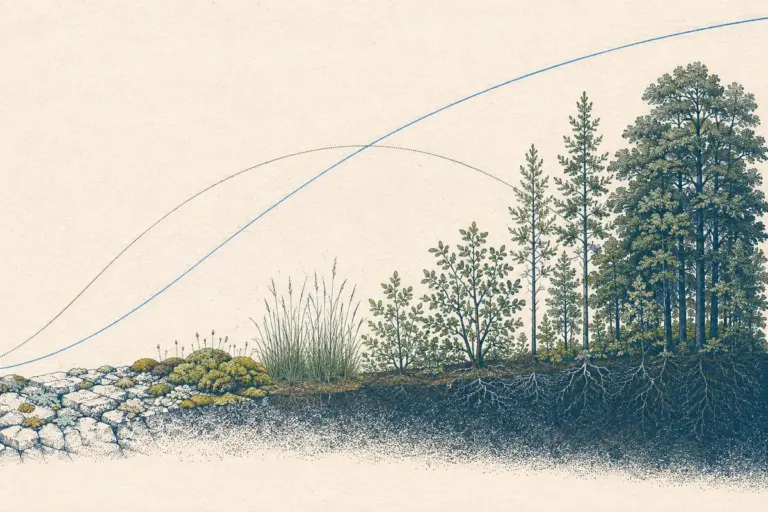
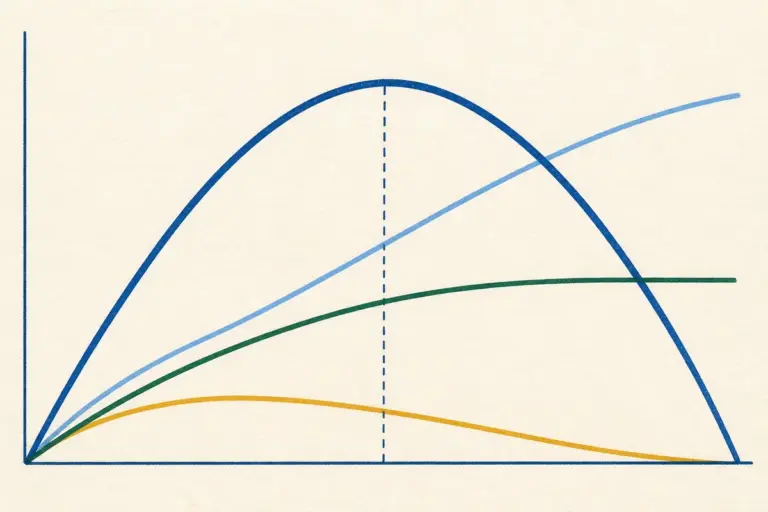
The biodiversity and conservation NCERT chapter, drawn from Class 12 Biology, is one of the most dependable sources for UPSC preparation in environment and ecology. It introduces aspirants to the levels of biodiversity, patterns of species richness, biodiversity hotspots, causes of loss, and the principles of in-situ and ex-situ conservation. This guide distils that chapter, aligns it with current international frameworks, and adds the Indian legal and institutional context that UPSC regularly tests. The goal is not to replace NCERT, but to help you revise it with a syllabus-aware lens.
| Biodiversity & Conservation: Key Facts (NCERT) | Detail |
|---|---|
| Levels of biodiversity | Genetic, species, and ecosystem diversity |
| Described species (global) | ~1.7–1.8 million |
| India's share | ~2.4% of land area, ~7–8% of recorded species (megadiverse) |
| Species-area relation | log S = log C + Z log A |
| Threats (Evil Quartet) | Habitat loss, overexploitation, alien invasions, co-extinctions |
| Global hotspots | 36 total; India has 4 (Himalaya, Indo-Burma, Western Ghats–Sri Lanka, Sundaland) |
| Conservation types | In-situ (parks, sanctuaries, reserves) and ex-situ (zoos, gene banks) |
| Key Indian law | Biological Diversity Act, 2002 (implements the CBD) |
What Biodiversity Means
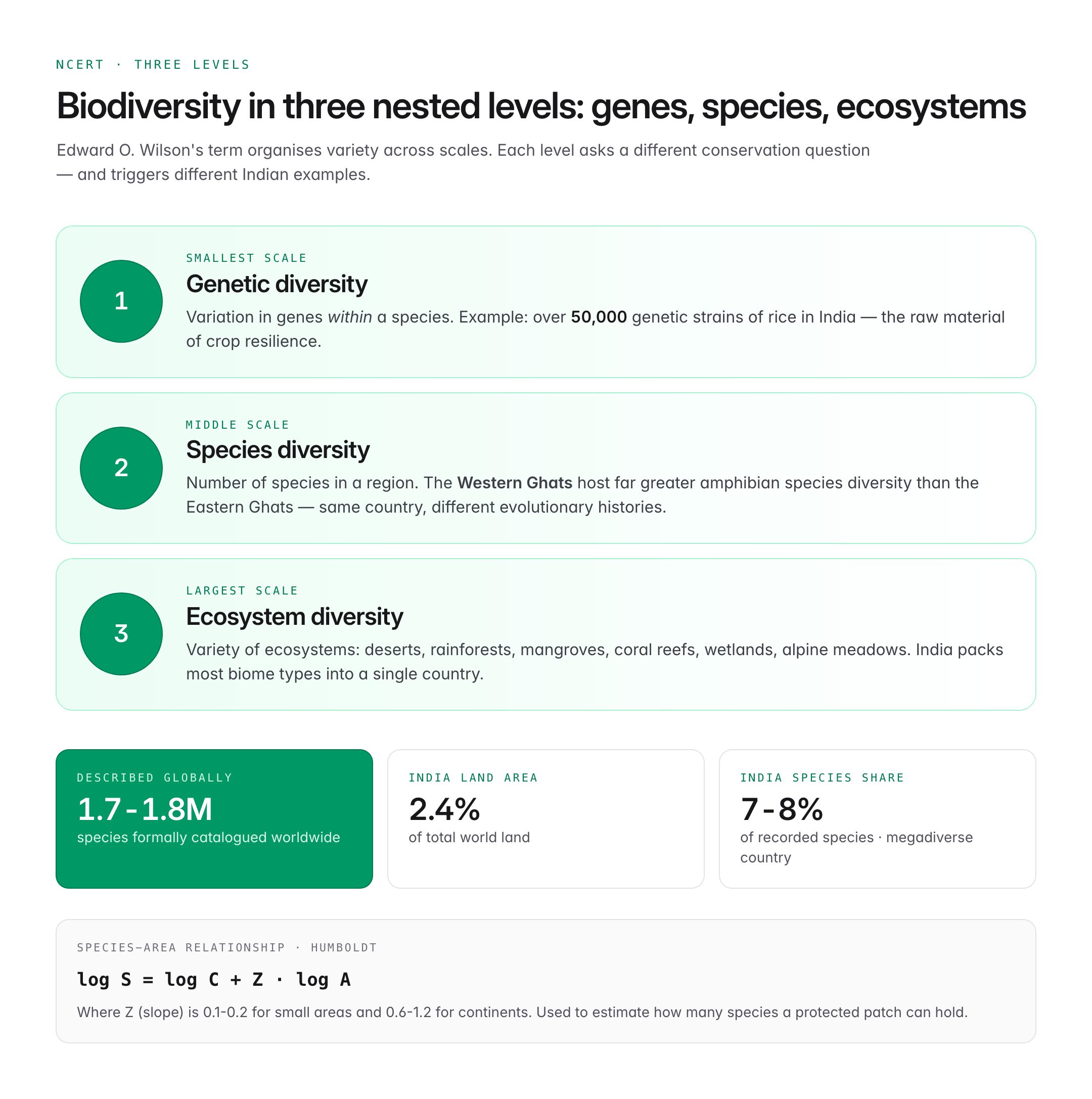
Biodiversity, a term popularised by Edward O. Wilson, refers to the variety of life at all levels of biological organisation. NCERT recognises three levels:
- Genetic diversity – variation in genes within a species (for example, over 50,000 genetic strains of rice in India).
- Species diversity – number of species in a region (Western Ghats have greater amphibian species diversity than Eastern Ghats).
- Ecological/ecosystem diversity – variety of ecosystems: deserts, rainforests, mangroves, coral reefs, wetlands, alpine meadows.
Globally, about 1.7-1.8 million species have been formally described, though the real number is estimated to be much higher. India, with about 2.4% of the world's land area, hosts roughly 7-8% of recorded species, making it a megadiverse country.
Patterns and Importance
Species are not distributed evenly. NCERT highlights two patterns:
- Latitudinal gradient – species richness generally increases from poles to equator. Tropical rainforests like the Amazon host the highest diversity.
- Species-area relationship – studied by Alexander von Humboldt, expressed as log S = log C + Z log A, where S is species richness, A is area, Z is the slope (typically 0.1-0.2 for small areas, 0.6-1.2 for continents).
Importance of biodiversity can be grouped as:
- Ecological – nutrient cycling, pollination, pest control, climate regulation.
- Economic – food, medicine, timber, fibre, genetic resources.
- Scientific and ethical – research value and intrinsic right of species to exist.
The "rivet popper" hypothesis (Paul Ehrlich) compares each species to a rivet holding an aircraft together; losing keystone species is like removing critical rivets.
Threats to Biodiversity
NCERT summarises four major drivers of biodiversity loss – the "Evil Quartet":
- Habitat loss and fragmentation – biggest cause; e.g., tropical forest clearing, wetland drainage.
- Overexploitation – overfishing, overhunting; led to extinction of Steller's sea cow, passenger pigeon.
- Alien species invasions – water hyacinth (Eichhornia), African catfish (Clarias gariepinus), lantana in India.
- Co-extinctions – when a host species dies, its obligate parasites or mutualists follow.
Additional pressures include pollution, climate change, and illegal wildlife trade.
IUCN Red List and Threat Categories
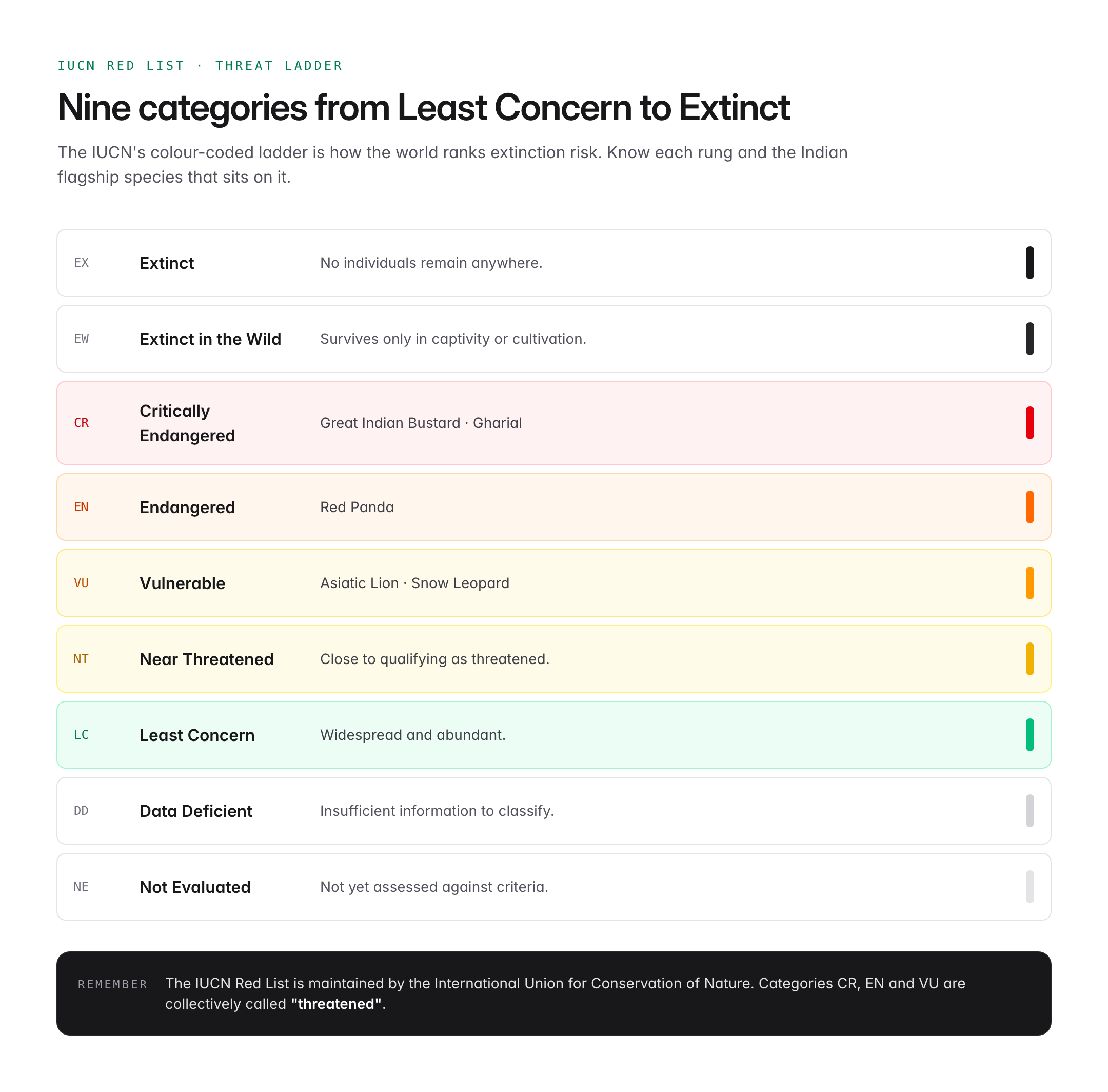
The International Union for Conservation of Nature (IUCN) maintains the Red List of threatened species, classifying them by extinction risk.
| Category | Meaning |
|---|---|
| Extinct (EX) | No individuals remain |
| Extinct in the Wild (EW) | Survives only in captivity |
| Critically Endangered (CR) | Extremely high risk of extinction |
| Endangered (EN) | Very high risk |
| Vulnerable (VU) | High risk |
| Near Threatened (NT) | Close to qualifying as threatened |
| Least Concern (LC) | Widespread and abundant |
| Data Deficient (DD) | Insufficient information |
| Not Evaluated (NE) | Not yet assessed |
Indian examples often referenced: Great Indian Bustard and Gharial (CR), Asiatic Lion and Snow Leopard (VU), Red Panda (EN).
Biodiversity Hotspots
The biodiversity hotspot concept, proposed by Norman Myers (1988), identifies regions with high endemism and severe habitat loss. To qualify, a region must have:
- At least 1,500 endemic vascular plant species, and
- Have lost at least 70% of its original primary vegetation.
There are currently 36 global biodiversity hotspots. India is part of four:
- Himalayas
- Indo-Burma
- Western Ghats-Sri Lanka
- Sundaland (Nicobar Islands fall here)
Conservation Strategies
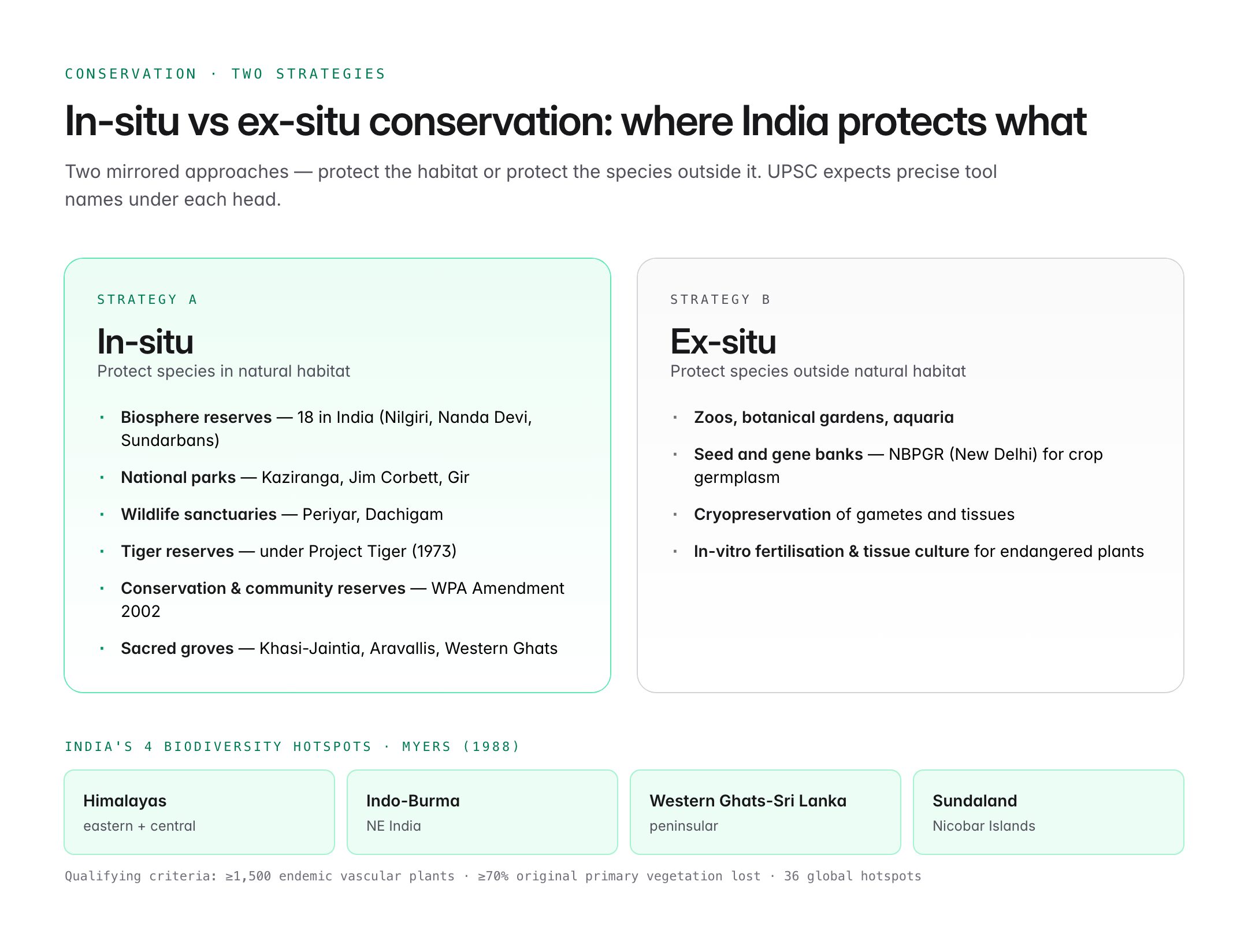
Conservation is broadly split into two approaches:
In-situ conservation
Protecting species in their natural habitat. Tools include:
- Biosphere reserves (18 in India, e.g., Nilgiri, Nanda Devi, Sundarbans).
- National parks (e.g., Kaziranga, Jim Corbett, Gir).
- Wildlife sanctuaries (e.g., Periyar, Dachigam).
- Tiger Reserves under Project Tiger (1973).
- Conservation reserves and community reserves (added via WPA Amendment 2002).
- Sacred groves – community-protected forest patches (Khasi Jaintia hills, Aravallis, Western Ghats).
Ex-situ conservation
Protection outside natural habitats:
- Zoos, botanical gardens, aquaria.
- Seed banks and gene banks – e.g., NBPGR (New Delhi) for crop germplasm.
- Cryopreservation of gametes and tissues.
- In-vitro fertilisation and tissue culture for endangered plants.
Indian Framework and Global Instruments
Key Indian laws and institutions:
- Wildlife (Protection) Act, 1972 – schedules for species protection; creates sanctuaries and national parks.
- Forest (Conservation) Act, 1980 – restricts diversion of forest land.
- Biological Diversity Act, 2002 – implements CBD; sets up National Biodiversity Authority (NBA) at Chennai, State Biodiversity Boards and Biodiversity Management Committees.
- Wetlands (Conservation and Management) Rules, 2017.
Important global frameworks:
- Convention on Biological Diversity (CBD), 1992 – three objectives: conservation, sustainable use, fair sharing of benefits.
- Nagoya Protocol, 2010 – access and benefit-sharing of genetic resources.
- Kunming-Montreal Global Biodiversity Framework, 2022 – "30 by 30" target: protect 30% of land, inland waters, coastal and marine areas by 2030.
- CITES – regulates international trade in endangered species.
- Ramsar Convention, 1971 – wetlands of international importance.
UPSC Relevance
Prelims focus
- Three levels of biodiversity; species-area relation (S = C A^Z).
- Evil quartet of threats.
- IUCN categories and current status of flagship species.
- India's 4 biodiversity hotspots and examples of endemic species.
- Distinction between biosphere reserve, national park, wildlife sanctuary, conservation reserve, community reserve.
- Key bodies: NBA, NBPGR, WII (Dehradun).
Mains GS-III angle
Environment and ecology questions often ask: "Assess the effectiveness of India's biodiversity conservation framework" or "Critically examine the relevance of biodiversity hotspots for conservation planning." Bring in the Biological Diversity Act, 2002, compliance with CBD and Kunming-Montreal targets, and critique gaps such as weak enforcement, invasive species management, and human-wildlife conflict.
Sample PYQ angle – past questions on "How does biodiversity vary in India? How is the Biological Diversity Act, 2002 helpful in the conservation of flora and fauna?" require a structured answer combining NCERT fundamentals with legal architecture and specific hotspot and species examples.
Treat the NCERT chapter as a foundation; layer current affairs – like revised IUCN categorisations, Kunming-Montreal targets, and invasive species action plans – on top of it to score in both Prelims and Mains.
Tell Google you want more of this.
Add Anantam IAS as a preferred sourceOne tap, and this site shows up more often in your own Top Stories, AI Overviews and AI Mode. Remove it any time.