The UNFCCC is the United Nations Framework Convention on Climate Change, the parent international treaty under which all subsequent climate negotiations — including the Kyoto Protocol of 1997 and the Paris Agreement of 2015 — sit. Opened for signature at the Earth Summit in Rio de Janeiro on 9 May 1992, the UNFCCC entered into force on 21 March 1994 and today has 198 parties — every UN member state plus the European Union, Cook Islands, Niue, Palestine and the Holy See, making it one of the most universally ratified treaties in the world.
The objective of the UNFCCC, set out in Article 2, is to stabilise greenhouse gas concentrations in the atmosphere at a level that would prevent dangerous anthropogenic interference with the climate system. It does not set binding emission reduction targets itself — those came through its protocols and the Paris Agreement — but it establishes the principles, institutions and machinery that have governed climate diplomacy for over three decades.
Origin and the Rio Earth Summit
The UNFCCC was negotiated between February 1991 and May 1992 under the Intergovernmental Negotiating Committee established by UN General Assembly resolution 45/212. It was one of three “Rio Conventions” opened for signature at the United Nations Conference on Environment and Development (UNCED) — alongside the Convention on Biological Diversity and (later, in 1994) the Convention to Combat Desertification.
Why a Framework Convention
A framework convention is a deliberately light first step. It sets out shared principles, defines the problem and creates institutions, but leaves specific commitments and targets to be elaborated through subsequent protocols and amendments. This design — borrowed from the Vienna Convention on the Ozone Layer (1985), which preceded the Montreal Protocol of 1987 — allowed states to commit to a process without immediately agreeing on numbers. The structure has proved durable: every major climate instrument since 1992 has been built on top of the UNFCCC.
Key Definitions
The UNFCCC defines key terms that have governed climate diplomacy ever since. “Climate change” under Article 1 means a change of climate attributable directly or indirectly to human activity, distinguishing anthropogenic change from “climate variability.” Greenhouse gases include carbon dioxide, methane, nitrous oxide and three fluorinated families. “Sources” emit GHGs; “sinks” absorb them; “reservoirs” store them.
The Three Annexes and Differentiated Commitments
The UNFCCC categorises parties into three groups, a structure that has been central — and contested — for thirty years.
Annex I: Industrialised Countries
Annex I lists 43 industrialised countries plus the European Union, comprising the OECD members of 1992 and the “economies in transition” (EITs) of the former Soviet bloc. Annex I parties committed under Article 4.2 to adopt national policies and measures with the aim of returning their GHG emissions to 1990 levels by 2000 — an aspirational target later operationalised through binding commitments under the Kyoto Protocol.
Annex II: Developed-Country Donors
Annex II is a subset of Annex I — the original OECD members minus the economies in transition. Annex II parties have additional obligations under Articles 4.3, 4.4 and 4.5 to provide financial resources, including for technology transfer, to enable developing countries to implement their UNFCCC obligations.
Non-Annex I: Developing Countries
All other parties — including India, China, Brazil, South Africa and the entire Global South — are non-Annex I. They have general obligations under Article 4.1 (national inventories, mitigation programmes, adaptation planning) but no specific quantitative emission reduction commitments. A subset of 49 Least Developed Countries (LDCs) receives further preferential treatment.
Principles of the UNFCCC
Five guiding principles in Article 3 of the UNFCCC shape every subsequent negotiation.
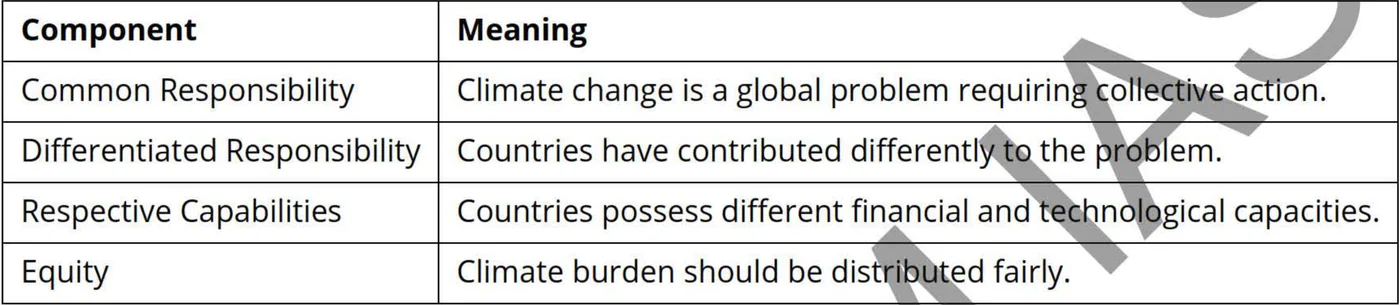
Common but Differentiated Responsibilities and Respective Capabilities (CBDR-RC)
CBDR-RC is the cornerstone principle. Article 3.1 states that parties should protect the climate system “on the basis of equity and in accordance with their common but differentiated responsibilities and respective capabilities.” Developed countries, having contributed most of the historical emissions and having greater capacity, should take the lead. The interpretation of CBDR-RC has been the most contentious element of climate negotiations.
Precautionary Principle
Article 3.3 states that where there are threats of serious or irreversible damage, lack of full scientific certainty should not be used as a reason for postponing cost-effective measures. This anticipates that climate action cannot wait for perfect science.
Right to Sustainable Development
Article 3.4 affirms the right of parties to promote sustainable development. Policies and measures to protect the climate should be appropriate to specific national conditions and integrated with development programmes.
Cooperation and Open International Economy
Article 3.5 commits parties to a supportive and open international economic system, and Article 3.5 also warns that measures to combat climate change should not constitute a means of arbitrary discrimination or a disguised restriction on international trade.
Institutional Architecture
The UNFCCC has produced a complex but coherent set of negotiating bodies and subsidiary structures.
COP — Conference of the Parties
The COP is the supreme decision-making body of the UNFCCC. It meets annually, rotating across the five UN regional groups, and reviews implementation of the convention and any related legal instruments. The first COP was held in Berlin in 1995; COP30 will convene in Belém, Brazil in November 2026.
CMP and CMA
When the Kyoto Protocol entered into force in 2005, COP sessions began serving simultaneously as the Conference of the Parties serving as the Meeting of the Parties to the Kyoto Protocol (CMP). With the Paris Agreement entering into force in 2016, the COP also convenes as the Conference of the Parties serving as the Meeting of the Parties to the Paris Agreement (CMA). Each COP year therefore hosts three governing bodies in parallel: COP, CMP, CMA.
Subsidiary Bodies
Two permanent subsidiary bodies support the COP. The Subsidiary Body for Scientific and Technological Advice (SBSTA) provides information and advice on scientific and technological matters relating to the Convention. The Subsidiary Body for Implementation (SBI) assists the COP in the assessment and review of effective implementation.
Secretariat
The UNFCCC Secretariat is based in Bonn, Germany, and is currently led by Executive Secretary Simon Stiell of Grenada. It services the COP, CMP, CMA and the subsidiary bodies, maintains the international transaction log for emissions trading, and supports the operations of the financial mechanism.
Financial Mechanism
The convention’s financial mechanism channels funding from developed to developing countries. The Global Environment Facility (GEF) was designated as an operating entity in 1992. The Green Climate Fund (GCF) was established at COP16 in 2010 and operationalised in 2015; it has emerged as the largest dedicated climate fund. The Adaptation Fund (under Kyoto) and the Loss and Damage Fund (under Paris, operationalised at COP28) round out the architecture.
Key Instruments Negotiated Under the UNFCCC
The UNFCCC has spawned two major legal instruments and several political decisions that have shaped global climate governance.
Kyoto Protocol (1997)
Adopted at COP3 in Kyoto on 11 December 1997, the Kyoto Protocol was the first legally binding international agreement to set emission reduction targets. It bound 37 industrialised countries plus the European Community to reduce GHG emissions by an average of 5.2 percent below 1990 levels during the first commitment period of 2008–2012. The Doha Amendment of 2012 extended commitments to 2013–2020.
Paris Agreement (2015)
Adopted at COP21 on 12 December 2015, the Paris Agreement 2015 replaced the top-down Kyoto architecture with a bottom-up framework of nationally determined contributions. It is universal — applying to all parties — and combines a binding procedural framework with nationally determined ambition. It entered into force on 4 November 2016.
Loss and Damage Fund (2022)
At COP27 in Sharm el-Sheikh, parties agreed in principle to establish a fund for loss and damage. At COP 28 of UNFCCC in Dubai in 2023, the fund was formally operationalised, with the World Bank serving as interim host and an initial capitalisation of approximately USD 700 million.
Linkages with Other Conventions
The UNFCCC sits within a broader ecosystem of multilateral environmental agreements. The Vienna Convention (1985) and the Montreal Protocol (1987) address stratospheric ozone depletion but, through the Kigali Amendment of 2016, also regulate hydrofluorocarbons — potent greenhouse gases. The Convention on Biological Diversity addresses biodiversity loss, with strong climate co-benefits. The IPCC, established in 1988 by WMO and UNEP, provides the scientific assessments — most recently the IPCC AR6 Report — that inform UNFCCC negotiations without being a UNFCCC body itself.
India and the UNFCCC
India signed the UNFCCC on 10 June 1992 and ratified it on 1 November 1993. As a non-Annex I party, India has consistently anchored its negotiating position in the principle of CBDR-RC, climate justice and the right to development.
India’s Negotiating Postures
India has been a leading voice of the G77 plus China and the Like-Minded Developing Countries (LMDC) group. Key Indian demands have included: full operationalisation of CBDR-RC, recognition of historical responsibility, scaled-up climate finance from developed countries, and unhindered technology transfer. India has resisted the dilution of the Annex I / non-Annex I firewall while accepting, through the Paris Agreement, the application of CBDR-RC in light of different national circumstances.
India’s Reporting Obligations
India has submitted four National Communications (1st in 2004, 2nd in 2012, 3rd in 2023, 4th in 2025) and four Biennial Update Reports under the UNFCCC. From 2024, all parties submit Biennial Transparency Reports (BTRs) under the Enhanced Transparency Framework of the Paris Agreement.
India and the Conference of the Parties
India has hosted COP8 in New Delhi in 2002 and has been an active participant in every COP. Indian leaders have shaped key outcomes — Manmohan Singh’s voluntary 2009 emission-intensity pledge in Copenhagen, Narendra Modi’s Panchamrit announcement at COP26 in 2021 and the launch of the International Solar Alliance and the Coalition for Disaster Resilient Infrastructure as parallel initiatives.
UNFCCC for UPSC
The UNFCCC features in UPSC General Studies Paper III (Environment) and Paper II (International Relations). Candidates should know its date of opening for signature (1992), entry into force (1994), number of parties (198), location of the secretariat (Bonn), the three annexes and the meaning of CBDR-RC. Prelims questions have tested differences between COP, CMP and CMA; the role of SBSTA and SBI; the relationship of the GCF and Adaptation Fund to the convention; and the chronology Rio 1992 → Berlin Mandate 1995 → Kyoto 1997 → Bali 2007 → Copenhagen 2009 → Paris 2015 → Glasgow 2021 → Dubai 2023.

Frequently Asked Questions
What is the UNFCCC and when was it adopted?
The UNFCCC is the United Nations Framework Convention on Climate Change, the parent international treaty for climate cooperation. It was opened for signature at the Earth Summit in Rio de Janeiro on 9 May 1992 and entered into force on 21 March 1994. It has 198 parties and is one of the most universally ratified treaties in the world.
What is the objective of the UNFCCC?
Article 2 of the UNFCCC defines its objective as stabilising greenhouse gas concentrations in the atmosphere at a level that would prevent dangerous anthropogenic interference with the climate system. The level should be achieved within a time frame that allows ecosystems to adapt naturally, ensures food production is not threatened, and enables sustainable economic development.
What does CBDR-RC mean?
CBDR-RC stands for Common but Differentiated Responsibilities and Respective Capabilities. Codified in Article 3.1, it recognises that all countries share responsibility for protecting the climate system but that developed countries — having contributed most of the historical emissions and having greater capacity — should take the lead. It is the cornerstone principle of the UNFCCC.
What are Annex I, Annex II and non-Annex I countries?
Annex I lists 43 industrialised countries plus the EU, including OECD members and economies in transition. Annex II is a subset of Annex I — the original OECD members with additional obligations to provide financial resources. Non-Annex I refers to all developing countries, including India, China and Brazil, which have no quantitative emission reduction commitments under the convention itself.
What is the difference between COP, CMP and CMA?
The COP is the supreme body of the UNFCCC. The CMP is the COP serving as the Meeting of the Parties to the Kyoto Protocol, in operation since 2005. The CMA is the COP serving as the Meeting of the Parties to the Paris Agreement, in operation since 2016. They meet simultaneously each year.
Where is the UNFCCC Secretariat located?
The UNFCCC Secretariat is based in Bonn, Germany. It services the COP, CMP, CMA and the subsidiary bodies. The current Executive Secretary is Simon Stiell of Grenada, who took office in August 2022.
When did India ratify the UNFCCC?
India signed the UNFCCC on 10 June 1992 at the Rio Earth Summit and ratified it on 1 November 1993. India is a non-Annex I party and has consistently anchored its negotiating position in CBDR-RC, climate justice and the right to development.
How is the UNFCCC linked to the Kyoto Protocol and the Paris Agreement?
The UNFCCC is the framework convention; the Kyoto Protocol (1997) and the Paris Agreement (2015) are legal instruments adopted under it. The Kyoto Protocol set binding emission reduction targets only for Annex I countries; the Paris Agreement applies to all parties through nationally determined contributions. Both instruments retain the UNFCCC principles of CBDR-RC and equity.
Tell Google you want more of this.
Add Anantam IAS as a preferred sourceOne tap, and this site shows up more often in your own Top Stories, AI Overviews and AI Mode. Remove it any time.