Spectrum Modern History by Rajiv Ahir: Which Edition, What to Read and How to Finish It
Spectrum's A Brief History of Modern India is on its 31st edition at about 1,000 pages. Which edition to buy, which blocks matter for Prelims and a six-week plan.
Spectrum modern history is the book most UPSC aspirants mean when they say “modern history”, and the question behind it is a practical one: is this 1,000-page Rajiv Ahir book the one to read, does all of it need reading, and which edition is current? A Brief History of Modern India, published by Spectrum Books, runs from the arrival of the Europeans to independence in 1947 and then takes a short look at the years after. For UPSC Prelims it is the nearest thing modern history has to a standard text. For Mains it is the fact base, not the argument.
The trouble is the size. The title says brief and the spine says otherwise, and aspirants usually handle that in one of two ways. The first group reads it like a novel in month one and has forgotten the Congress sessions by month three. The second group hears it is only a Prelims crammer, skips it for a heavier classic and then loses the pairing questions Prelims sets every single year.
Spectrum works best as a spine you build tables from, not a book you finish. Buy the current print, read it once with a pen, turn five of its blocks into your own tables and let the previous-year questions decide what earns a second pass. The edition question comes first, because a lot of the confusion starts with a free scan from 2019.
What Spectrum modern history is, and which edition to buy
A Brief History of Modern India is written by Rajiv Ahir with the Spectrum editorial team and published by Spectrum Books, New Delhi. The current English print is the 31st edition (2025), about 1,000 pages, which Amazon sellers list as the edition for the 2026 exams, with a QR code that leads to online material. The Hindi edition, Adhunik Bharat ka Itihas, is on its 27th edition (2025) at about 1,120 pages.
Two things to know before you pay:
- Spectrum’s own catalogue lists the 31st edition, 2025, as the current print of this title. A few third-party listings call their copy a “2026 edition”, so read the edition line on the listing rather than the headline.
- The book is revised most years, and the publisher posts supplementary notes for its modern India readers on its website between editions. An old print misses both the revisions and the notes.
The publisher’s description of what the book covers is worth reading closely, because it tells you where the pages go:
- The advent of the Europeans in the 15th century and the gradual establishment of British rule, up to independence in 1947.
- Socio-economic developments, the reform movements, the growth of the press, the progress of education and the economic impact of British rule.
- Tribal movements, workers’ movements and constitutional developments, which recent revisions have expanded.
- A brief assessment of the challenges after independence and the developments under later governments.
- Appendices on personalities and women freedom fighters, with tables of Congress annual sessions (1885 to 1950), caste movements, governors-general and viceroys, and newspapers and journals.
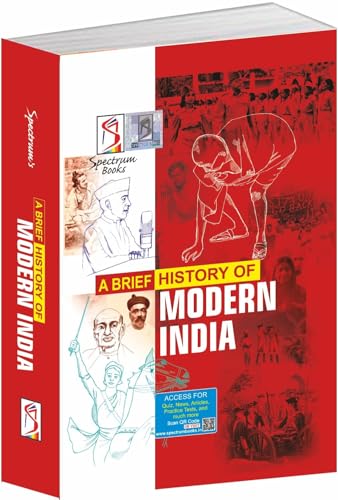
A Brief History of Modern India, Rajiv Ahir (Spectrum), 31st edition 2025
- About 1,000 pages, Spectrum Books, by Rajiv Ahir with the Spectrum editorial team
- From the advent of the Europeans to 1947, with a short post-independence section
- Appendix tables: Congress sessions 1885 to 1950, governors-general and viceroys, newspapers and journals
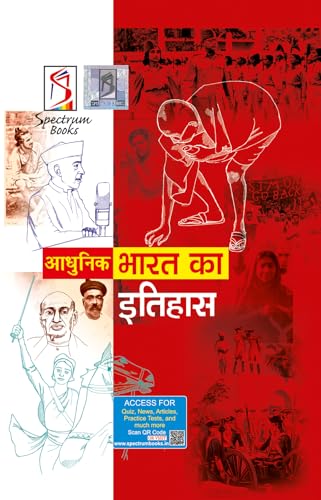
Spectrum आधुनिक भारत का इतिहास, राजीव अहीर (27वाँ संस्करण, 2025)
- लगभग 1,120 पेज, Spectrum Books, राजीव अहीर और Spectrum संपादकीय बोर्ड
- यूरोपीय कंपनियों के आगमन से 1947 तक, साथ में आज़ादी के बाद का संक्षिप्त हिस्सा
- हिंदी माध्यम से परीक्षा देने वालों के लिए यही संस्करण, अंग्रेज़ी वाला नहीं
If you write the exam in Hindi, buy Adhunik Bharat ka Itihas and not the English book. The terms in the Hindi paper are the terms in the Hindi edition, and translating Congress resolutions in your head during revision costs time you won’t have. The Hindi-medium booklist pairs it with the rest of the Hindi stack.
Who the Rajiv Ahir book is for, and who should wait
For UPSC Prelims, Spectrum is a core book. For a Mains-stage aspirant it is the fact base under the answers, and that is a smaller job than most people give it.
The numbers make the case. Our Prelims question bank holds 154 history questions from GS Paper I between 2013 and 2026, and 91 of them are modern, about 59% of the subject and 6.5 questions a year. The modern history PYQ analysis shows what those questions look like: a person paired with an organization, a session with its president, an Act with the thing it introduced first. That is recall, and Spectrum’s lists and appendix tables are built to hold exactly that kind of fact.
Mains asks something else. Modern Indian history is 32 of 270 GS Paper I questions from 2013 to 2025, or 11.9%, and they ask you to evaluate a claim about Dalhousie or the reform movements, not to recall a year. The Mains analysis puts it plainly: the facts carry over from Prelims, the arguments don’t.
Spectrum should be read as a core book if:
- UPSC Prelims is within the next twelve months.
- A state PSC exam such as UPPSC or BPSC is also on your list.
- You have finished the NCERTs and want one book that holds every name, date and Act in one place.
It should wait if:
- You are starting modern history from zero. A 1,000-page compilation is a hard first read, and Bipan Chandra’s 360-page History of Modern India tells the same story as a narrative in a third of the pages.
- You are in the Mains-only months and already know the facts. That time belongs to answer frames and historiography.
It isn’t wise to treat Spectrum as a novel, and it isn’t wise to dismiss it as a crammer either. It is the reference shelf for the one part of GS history that Prelims tests most heavily.
The section map, and what each block is worth
The book has more chapters than any aspirant needs to weigh one by one, so the useful unit is the block. The Prelims counts below come from the topic tags in our question bank, grouped to match the way the book is organized.
| Block of the book | What it holds | Prelims questions, 2013 to 2026 | UPSC reading | State PSC and other exams |
|---|---|---|---|---|
| Europeans and the British conquest | The European companies, the wars of expansion, the consolidation of British power | 3 on the Europeans, plus a few single questions | Read once, skim the battle detail | Read properly |
| Resistance and the Revolt of 1857 | Risings against British rule before 1857, the revolt itself | 4 on resistance to British rule | Read, then revise from a short note | Read properly |
| British policy and its impact | Administration, land revenue, the economy, education, the press | 9 on British policies, 3 on education | Core; also the base for Mains impact questions | Core |
| Constitutional development | The Regulating Act to the Government of India Act 1935 | 9 | Core; build an Acts table | Core |
| Socio-religious reform | Brahmo Samaj to the anti-caste movements | 7 | Core; founder, year, place, publication | Core |
| National movement to 1918 | Early Congress, the Moderates, Swadeshi, the Surat split, Home Rule | 13, the largest single topic | Core | Core |
| Gandhian phase to 1947 | Gandhi’s emergence, Non-Cooperation, Civil Disobedience, Quit India, Partition | 25 across six tags | Core | Core |
| Workers and revolutionaries | The working-class movement, the revolutionary groups | 3 and 2 | Read once | Read once |
| After independence | Challenges after 1947 and later developments | No separate Prelims tag | Skim; a dedicated post-1947 book serves Mains better | Skim |
| Appendices | Personalities, women freedom fighters, Congress sessions, governors-general and viceroys, newspapers | 2 on personalities, and the raw material for every pairing question | Revise from these in the final month | Core |
Five blocks carry 66 of the 91 questions: British policy, the Acts, the reform movements, the national movement to 1918 and the Gandhian phase. That’s roughly seven in ten, and it’s where your pen should be working hardest. The rest you read once and look up when a mock test catches you out.
How to read Spectrum modern history in six weeks
One pass with a pen, then tables, then questions. A little under 30 pages a day, six days a week, takes you through the main text in six weeks, and the seventh day is for closing the book and writing down what stayed.
- Week 1, Europeans to 1857. Read the conquest and resistance blocks, then write the sequence of annexations as a single timeline. Check your 1857 facts against the Revolt of 1857 note before moving on.
- Week 2, British policy and the Acts. Start the Acts table: one row per Act with the year, the key provisions and what it did for the first time. The Ilbert Bill note is a good test of whether you’ve understood why a racial controversy mattered.
- Week 3, reform and the early Congress. Build the organizations table (founder, year, place, publication) and start the sessions table from the appendix.
- Week 4, Gandhi to 1947. Read the phases in order, and write one line on why each movement began and why it ended.
- Week 5, the remaining blocks. Workers and revolutionaries, the post-independence chapters at skim speed, then the appendices.
- Week 6, second pass. Only your tables this time, followed by all 91 previous-year questions topic by topic.
The test of the plan is the tables, not the page count. If your Acts table still has blank rows at the end of week two, you read the chapter; you didn’t study it. Go back to the rows, not the whole block.
What to skip, and what to cross-check
Skip or skim for UPSC: the battle-by-battle narrative of the wars of expansion, the post-independence chapters until Prelims is behind you, and any personality in the appendix you’ve already met properly in a main chapter. For a state PSC, read those parts properly all the same, and let your state’s own syllabus decide how much of the post-1947 part to keep.
Cross-check three kinds of material:
- Anything in the post-independence part tied to a recent year, since the book is printed once and the news keeps moving.
- Any fact that changed between editions. The publisher’s supplementary notes are where those corrections land first.
- Interpretive labels. Spectrum states what happened; a Mains answer needs one historian’s reading of it, and naming a school such as nationalist, Cambridge, subaltern or Marxist costs one line.
The habit that settles most of this is cheap. When a fact carries a date after the print year, confirm it on an official site before it enters your notes.
What Spectrum modern history will not do
It won’t argue for you. The book tells you what Lord Dalhousie annexed and built; it doesn’t tell you whether calling him the founder of modern India holds up, and that is the shape of a real Mains question. It won’t teach historiography. It won’t cover world history, which is a separate part of GS Paper I with its own booklist. And it won’t make itself shorter. The only version of Spectrum that is actually brief is the set of tables you make from it.
The word brief in the title is carrying a lot of weight.
Spectrum vs Bipan Chandra vs India’s Struggle for Independence
Three books get bought for modern history, and they do three different jobs.
| Book | Pages and edition | What it is | Verdict |
|---|---|---|---|
| A Brief History of Modern India, Rajiv Ahir (Spectrum) | About 1,000, 31st edition (2025) | A fact-dense reference with appendix tables | The pick for Prelims and for revision |
| History of Modern India, Bipan Chandra (Orient BlackSwan) | 360, 2020 edition | A readable narrative from the Mughal decline to 1947 | Read first if the period is new to you |
| India’s Struggle for Independence, Bipan Chandra and others (Penguin) | About 600 | An interpretive history of the national movement, 1857 to 1947 | For Mains depth, chapter by chapter, not cover to cover |
Most aspirants need the first book and one of the other two, not all three. The best book for Indian history page covers the full stack across ancient, medieval and modern, and the modern Indian history notes on this site are the place to go when a single topic needs more than Spectrum gives it.
Is there a Spectrum modern history PDF?
No official free one. Spectrum sells the print book, the QR code inside leads to its online material, and the publisher’s website carries supplementary notes for registered readers. It does not give the book away as a PDF.
The files passed around as a spectrum modern history pdf are scans of older prints, several of them from 2019. Those predate the recent revisions on tribal movements, workers’ movements and constitutional developments, which are the parts of the book the publisher itself says it has expanded. You’d be learning from a version the author has already corrected.
Spectrum modern history is a good book that most people misuse by trying to finish it. Buy the 31st edition, or the 27th if you write in Hindi, read it once with a pen, build the Acts, organizations and sessions tables from the five blocks that carry seven in ten Prelims questions, and let the question bank decide what gets a second look. Read that way, it covers Prelims modern history better than any other single book. Start the Acts table this week, with the Regulating Act in the first row.
Frequently Asked Questions
Is Spectrum modern history enough for UPSC Prelims?
For modern history it is the closest to enough of any single book. Our question bank has 91 modern history questions from 2013 to 2026, and most of them test the pairings, organisations and Acts that Spectrum lists. Pair it with the previous-year questions and your own tables, and cross-check anything dated after the print year.
Which edition of Spectrum modern history should I buy?
The 31st edition (2025), about 1,000 pages, which Spectrum’s own catalogue lists as the current print and Amazon sellers offer for the 2026 exams. The Hindi edition, Adhunik Bharat ka Itihas, is on its 27th edition. Check the edition line on any listing that calls itself a 2026 edition.
Should I read Bipan Chandra before Spectrum?
Only if modern history is new to you. Bipan Chandra’s History of Modern India tells the story in 360 pages, which makes Spectrum’s 1,000 pages much easier to hold. If you already know the period from the NCERTs, go straight to Spectrum.
How long does it take to read Spectrum modern history?
About six weeks at a little under 30 pages a day, six days a week, including a second pass through your own tables. Reading it without making tables is faster and far less useful, because the tables are what you revise from.
Is Spectrum useful for UPSC Mains?
As the fact base, yes. Mains modern history questions ask you to evaluate a claim rather than recall a date, so Spectrum supplies the facts while the argument has to come from a narrative book and from answer practice.
Is Spectrum modern history available in Hindi?
Yes. Adhunik Bharat ka Itihas is the Hindi edition from the same author and publisher, on its 27th edition (2025) at about 1,120 pages. Hindi-medium aspirants should buy it rather than the English book, because the paper uses its terminology.
Is the Rajiv Ahir book good for state PSC exams?
Yes, and for a state PSC the whole book is worth reading, including the conquest narrative and the appendix tables. Use your state’s own syllabus to decide how much of the post-independence part to keep.
Is there a free Spectrum modern history PDF?
There is no official free PDF. The scans that circulate are older prints, several of them from 2019, which miss the publisher’s recent revisions. The current paperback and the publisher’s supplementary notes are the reliable versions.