The Ilbert Bill of 1883 was a short, technical piece of legislation that produced one of the loudest political eruptions in British India. On paper it merely sought to remove a racial distinction in the criminal procedure code. In practice, it exposed the raw racial hierarchy of empire, triggered the so-called “white mutiny” by European settlers, and convinced educated Indians that constitutional agitation required organised national effort. The controversy directly shaped the environment in which the Indian National Congress was founded two years later.
Background: Why Was the Bill Needed?
Under the Code of Criminal Procedure (1873), Indian magistrates and sessions judges in mofussil (rural) areas could not try Europeans or British subjects in criminal cases. Only European District Magistrates or Sessions Judges held that jurisdiction. As more Indians entered the Indian Civil Service after the 1860s, this created an absurd situation: a qualified Indian ICS officer posted as a District Magistrate could try every resident in his district except the British planters and traders living in it.
Viceroy Lord Ripon (1880–1884), a liberal Gladstonian, considered this anomaly incompatible with the promise of equality in the Queen's Proclamation of 1858. He asked his Law Member, Sir Courtenay Peregrine Ilbert, to draft a corrective bill.
Provisions of the Bill
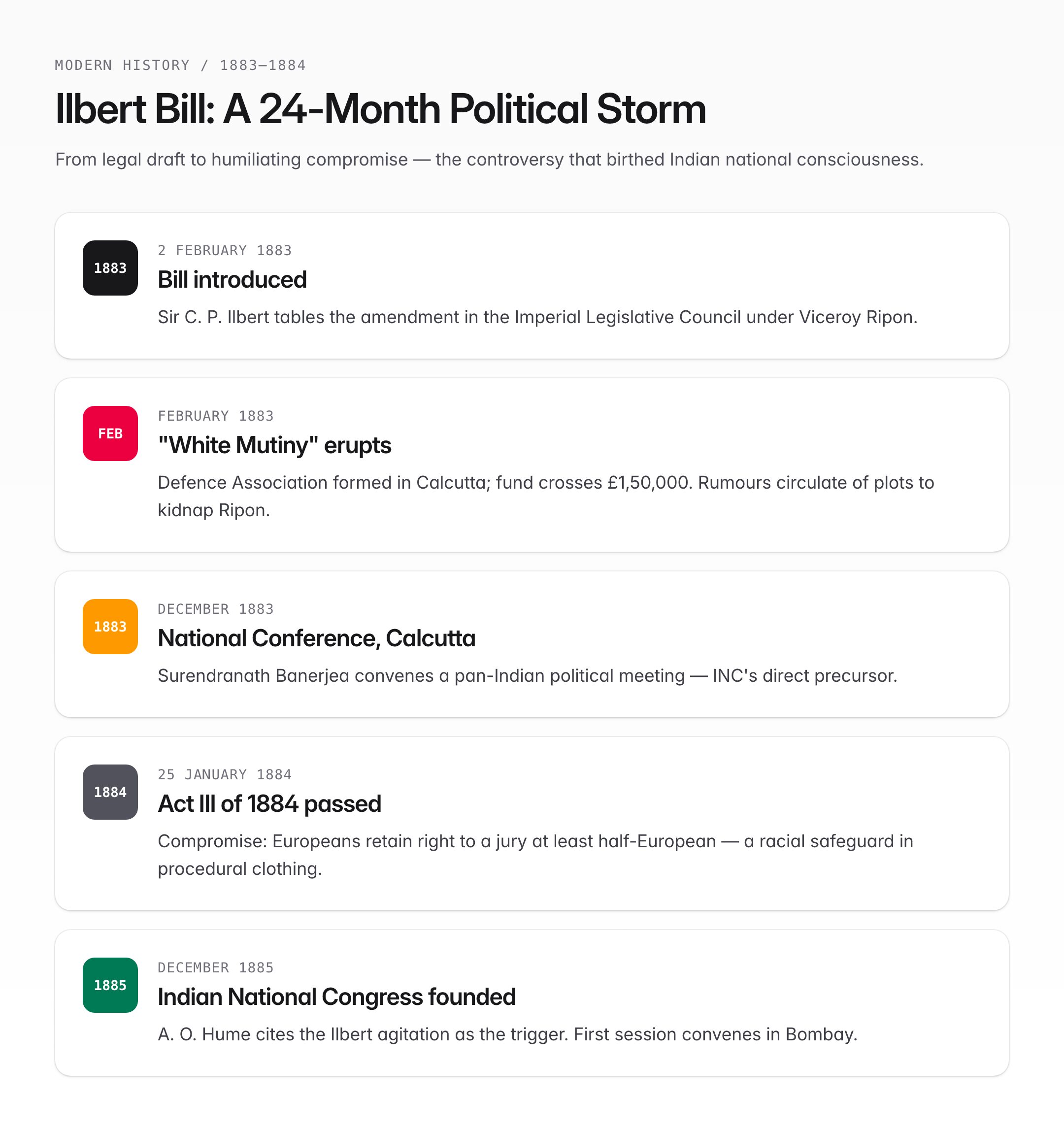
Ilbert introduced the bill in the Imperial Legislative Council on 2 February 1883. Its core was narrow and precise.
| Feature | Before the Bill | Proposed by the Bill |
|---|---|---|
| Who could try Europeans in mofussil | European judges only | Indian and European judges alike |
| Legal basis | Section 443–446, CrPC 1873 | Amendment removing racial bar |
| Scope | Rural districts | Same districts, all magistrates |
| Jury trial | Not guaranteed for Europeans in mofussil | Not changed by the bill |
The bill did not extend to the Presidency towns (Calcutta, Bombay, Madras), where High Courts already had mixed jurisdiction. It did not alter the right to appeal. It simply removed the racial disqualification of Indian judges.
The European Backlash — The "White Mutiny"
The Anglo-Indian community and British planters in Bengal, Assam and Bihar reacted with extraordinary fury. Their core objection was racial, though dressed in procedural language: no Indian, however qualified, should sit in judgment over an Englishman.
Key features of the agitation included:
- Defence Association formed in Calcutta (February 1883), with branches across India and a Defence Fund reportedly exceeding £1,50,000.
- Mass meetings at Calcutta Town Hall, where planter leader J. J. Keswick and Griffith Evans led opposition.
- The Anglo-Indian press — The Englishman, The Statesman, The Pioneer — ran sustained vitriolic campaigns against Ripon and Ilbert.
- Wild rumours circulated of a plot to kidnap the Viceroy and put him on a ship to England.
- Petitions and deputations dispatched to Parliament in London to pressure the Secretary of State.
The opposition invoked the 1857 Revolt imagery, claiming English women and children would be unsafe if tried by Indian judges — a particularly venomous argument that exposed the gendered-racial anxieties of empire.
The Indian Response
Indian opinion, initially surprised, mobilised rapidly. Surendranath Banerjea, W. C. Bonnerjee, Lal Mohan Ghosh, Anandamohan Bose and others organised counter-meetings and petitions in support of the bill. Newspapers like The Hindu, Amrita Bazar Patrika, The Bengalee and The Tribune defended the principle of judicial equality.
The Indian Association, founded by Surendranath Banerjea in 1876, played a coordinating role. For the first time, educated Indians across provinces cooperated on a single political question. They learned, in real time, the methods of organised agitation — pamphlets, public meetings, press campaigns, deputations — from the very Europeans opposing them.
The Compromise of 1884
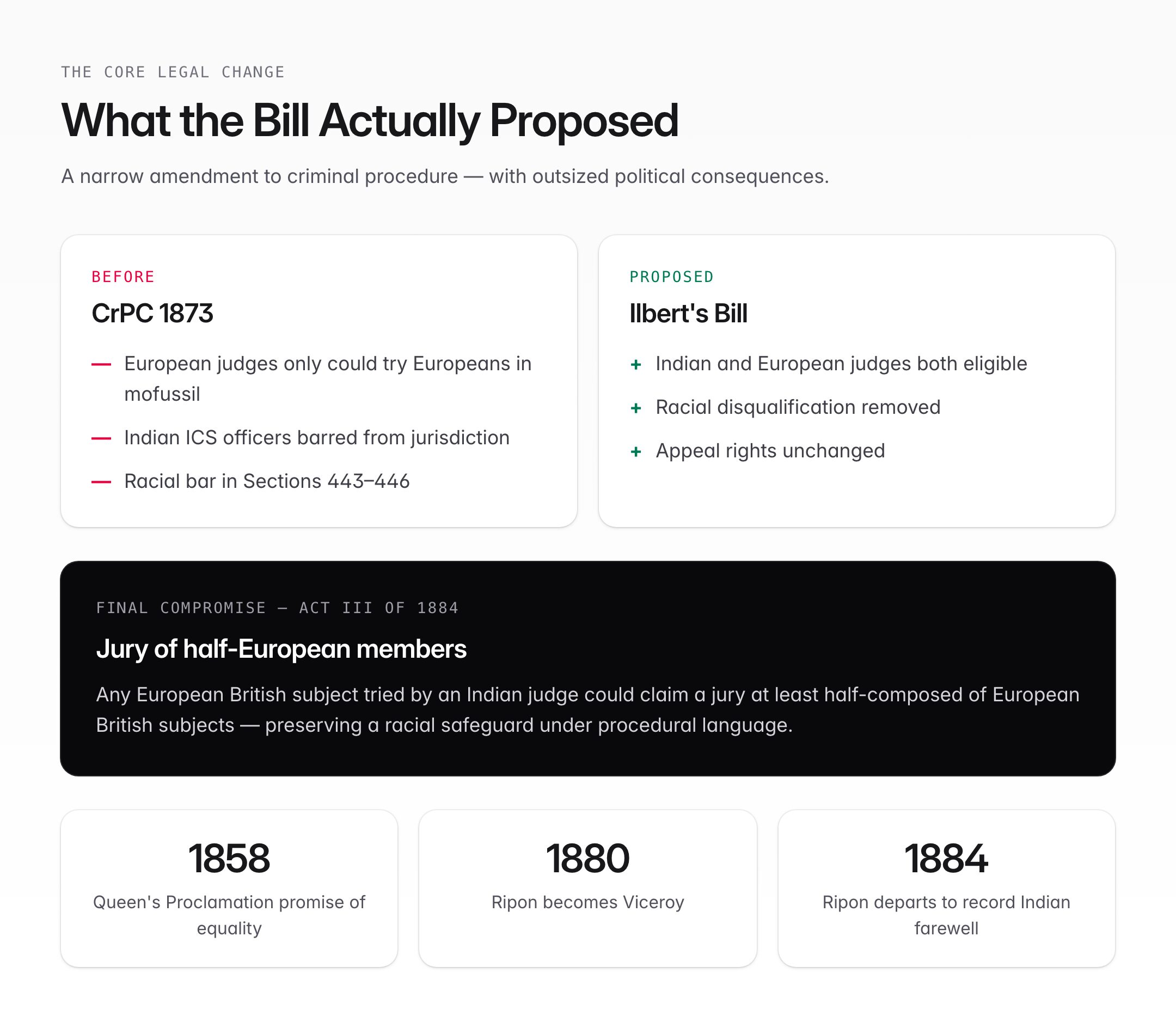
Unable to withstand the combined pressure of Anglo-Indian agitation, Parliamentary lobbying and threats of non-cooperation from British officials in India, Ripon accepted a humiliating compromise. The amended Act (Act III of 1884) passed on 25 January 1884 included one crucial concession:
Any European British subject tried by an Indian District Magistrate or Sessions Judge would have the right to claim a jury of which at least half the members were European British subjects.
This effectively preserved a racial safeguard while nominally removing the bar. Ilbert himself called it a "surrender of principle under the guise of procedural reform."
Significance for Indian National Consciousness
The Ilbert Bill episode is studied not for the legal provision it produced but for the political consciousness it crystallised.
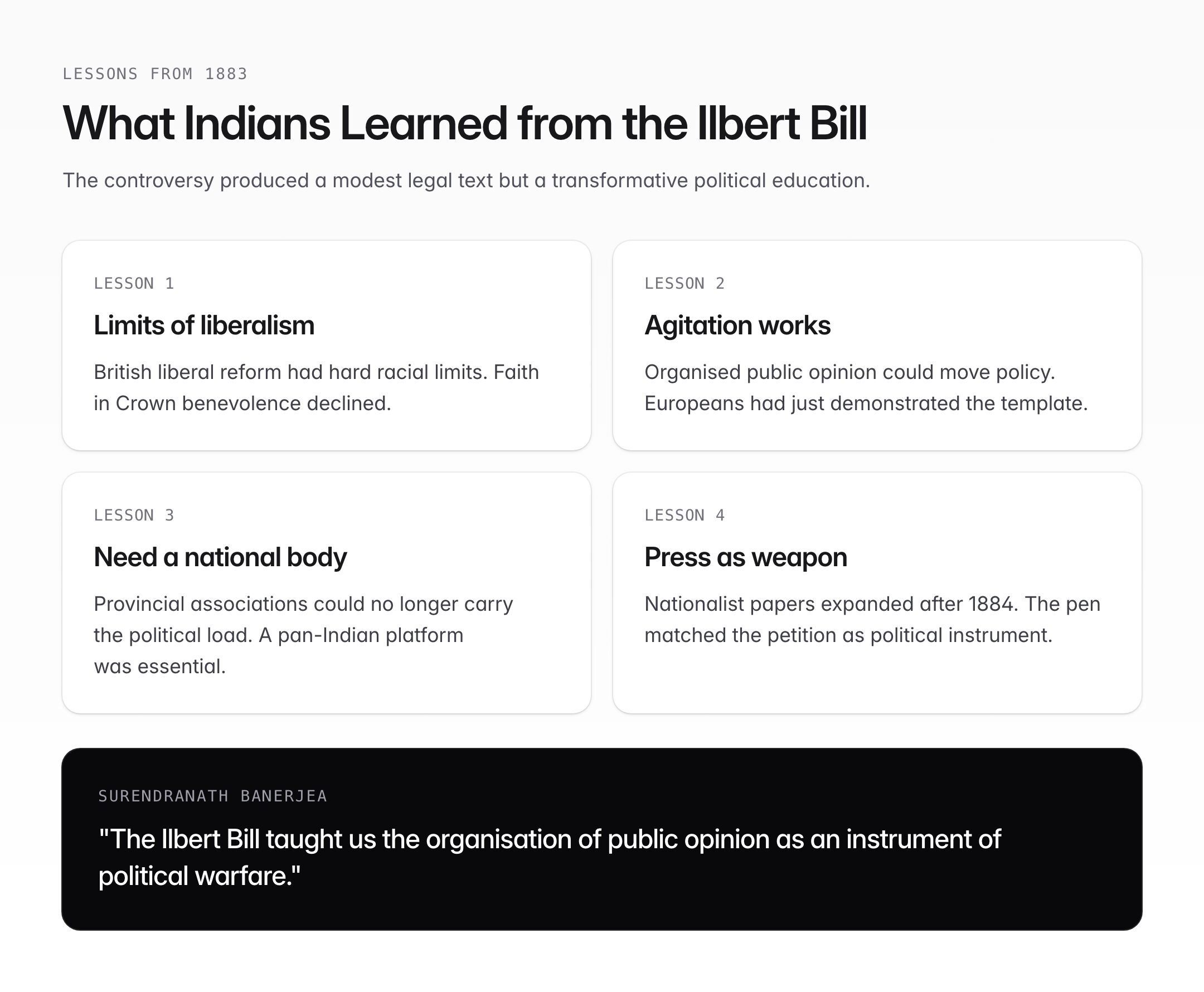
| Lesson Learned by Indians | Long-term Impact |
|---|---|
| British liberalism had clear racial limits | End of uncritical faith in Crown benevolence |
| Organised agitation could influence policy | Template adopted for later nationalist movements |
| Provincial politics needed a national platform | Direct trigger for founding Indian National Congress (1885) |
| The press was a political weapon | Expansion of nationalist newspapers post-1884 |
| Indians must unite across region, religion, caste | Shift from provincial associations to pan-Indian body |
Surendranath Banerjea later wrote that the Ilbert Bill "taught us the organisation of public opinion as an instrument of political warfare." A. O. Hume, who founded the Indian National Congress in December 1885, explicitly cited the Ilbert Bill agitation as the immediate catalyst for conceiving a national body. The National Conference of December 1883 in Calcutta — widely seen as a precursor to the INC — was itself born out of the Ilbert debates.
Contemporary European Voices
Not all Europeans opposed Ripon. A small but articulate minority — including Sir Henry Cotton, William Wedderburn (later INC president) and Allan Octavian Hume — supported the bill. Their isolation within the European community underlined how exceptional Indian-sympathetic Englishmen were, and how much the dominant Anglo-Indian voice was committed to racial privilege.
Ripon's Legacy
Despite the climbdown, Lord Ripon left India in December 1884 to an unprecedented farewell. Thousands of Indians lined the streets of Bombay and Calcutta. He was the first Viceroy accorded such a send-off by Indians. His other reforms — local self-government resolution (1882), repeal of the Vernacular Press Act (1882), First Factory Act (1881), education reforms via the Hunter Commission — cemented his reputation among Indians as a sympathetic administrator who tried to do the right thing and was defeated by settler racism.
UPSC Relevance
The Ilbert Bill is a high-probability topic across all three phases of the examination.
Prelims: Factual anchors — year (1883), Viceroy (Ripon), Law Member (C.P. Ilbert), relevant code (CrPC 1873), compromise feature (half-European jury), Act number (Act III of 1884). Frequently paired with other Ripon reforms in matching and elimination questions.
Mains GS-I (Modern History): The episode appears under "factors leading to the rise of Indian nationalism," "role of press and associations," and "racial policies of the Raj." A typical question: "The Ilbert Bill controversy marked a turning point in the evolution of Indian national consciousness. Discuss." Link it to the 1876 Indian Association, 1883 National Conference, and 1885 INC to demonstrate causal continuity.
Essay Paper: Useful illustration for essays on "liberty and equality under colonial rule," "press and public opinion" or "leadership and moral authority" (Ripon's conduct in defeat).
Interview: Expect questions on whether Ripon should have resigned, how the bill exposed the limits of imperial reform, or parallels with contemporary judicial independence debates.
Study the Ilbert Bill not as an isolated law but as the first coordinated pan-Indian political response to a racist colonial measure — the laboratory in which the techniques of the national movement were first tested.
Tell Google you want more of this.
Add Anantam IAS as a preferred sourceOne tap, and this site shows up more often in your own Top Stories, AI Overviews and AI Mode. Remove it any time.