Tiger (Panthera tigris): UPSC Guide to the Subspecies, Biology, and India’s Conservation Story
A complete UPSC GS-III guide to the tiger Panthera tigris. Covers the six living and three extinct subspecies, biology and behaviour, India's tiger census from 2006 to 2022, Schedule I and CITES Appendix I status, the TX2 doubling target, and the country's role in global tiger recovery.
The tiger, Panthera tigris, is the largest cat species on the planet and the apex predator of the Asian forest. It is also the species that has shaped wildlife conservation policy in India more than any other. Project Tiger, launched in 1973, was the first major species-recovery programme in the country. The Wildlife Protection Act 1972 was drafted with the tiger in mind. The National Tiger Conservation Authority is a statutory body created exclusively for this species. The international TX2 commitment, the all-India tiger estimation cycle, and the Global Tiger Forum all flow from the same starting point. For UPSC GS-III, the tiger sits at the centre of the country’s conservation story and its biology, distribution, subspecies, and policy framework form one of the highest-frequency topics in the syllabus.
The tiger is also a textbook flagship and umbrella species. Protecting tiger habitat at landscape scale automatically protects every co-occurring species in that landscape, from the dhole to the gaur to the great hornbill. Tiger numbers track the integrity of the forest itself. The doubling of India’s tiger population from 1,411 in 2006 to 3,682 in 2022 is therefore a story not just about a single big cat but about the recovery of dry deciduous forest, moist deciduous forest, mangrove, and Himalayan foothill habitats across 18 states.
Quick Facts on the Tiger
The tiger is the largest of the four big cats in the genus Panthera, alongside the lion, the leopard, and the jaguar. Adults can weigh up to 300 kilograms in the Siberian subspecies, with Bengal tigers averaging 220 kilograms for males and 140 kilograms for females. Body length runs to 3.3 metres including the tail. The species is solitary and territorial, marks home ranges with scent and scrapes, and is one of the few cats that swims voluntarily and well, a trait that lets it occupy mangrove and riverine habitats no other large carnivore exploits.
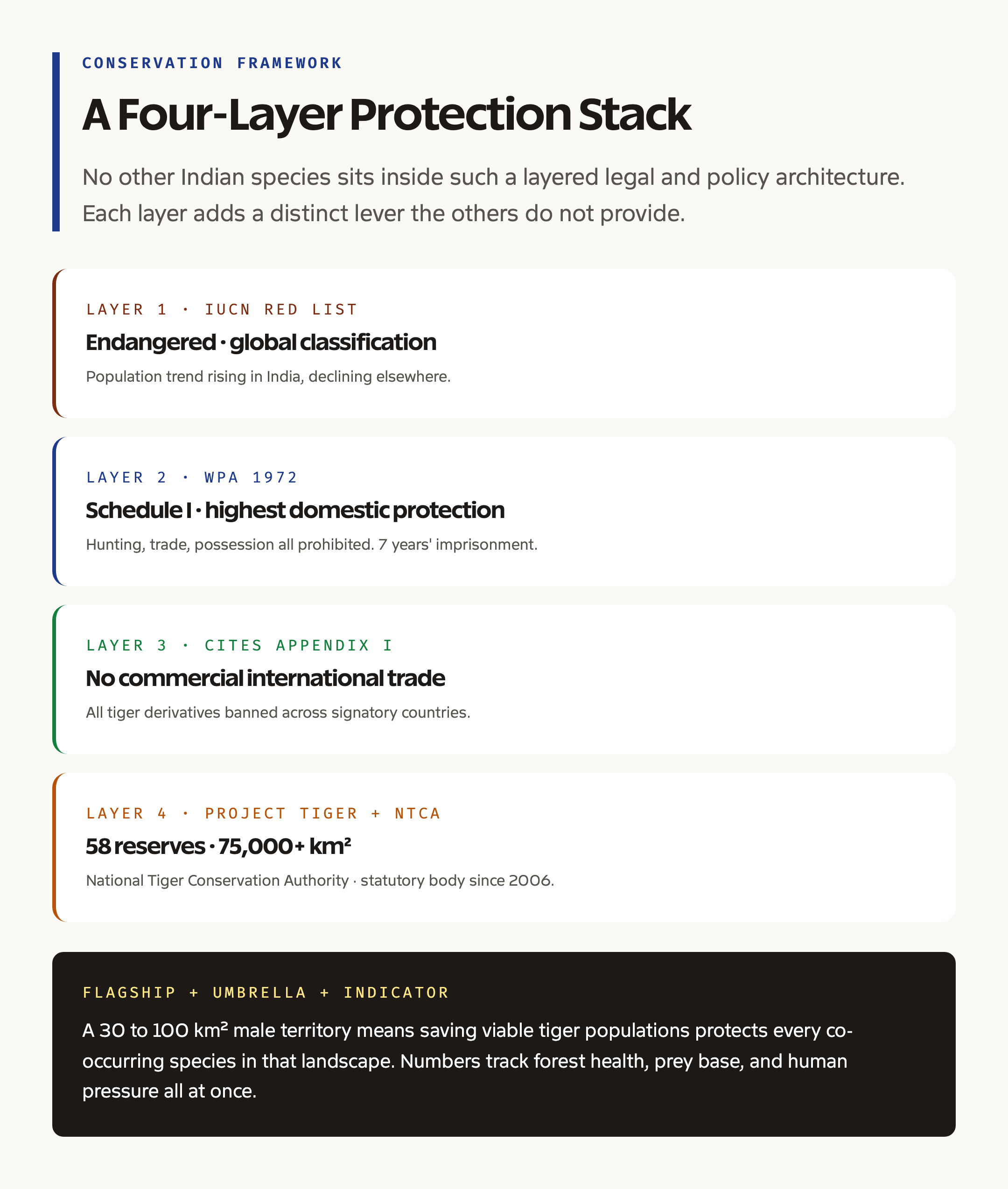
Conservation status is comprehensive. The IUCN Red List classifies the species as Endangered. Schedule I of the Wildlife Protection Act, 1972 gives it the highest possible protection in India. CITES Appendix I bans all international commercial trade in the tiger and its body parts. India hosts roughly 75 percent of the global wild tiger population in 58 dedicated tiger reserves and a wider network of national parks and sanctuaries.
What the Tiger Is
The tiger is a large, solitary, ambush predator of forested and grassland habitats across Asia. The orange coat with vertical black stripes is the most recognisable pattern in the natural world, and like a human fingerprint, no two tigers carry the same stripe arrangement. That uniqueness is the basis of camera-trap census methods now used across the global range. Skin pigmentation is also patterned, so a shaved tiger would still show stripes on the skin itself, a feature unique among striped mammals.
The species is built for power and patience. The skull is heavily reinforced for the killing bite, the canines are 9 to 10 centimetres long, the front limbs are heavily muscled for grappling large prey, and the retractable claws can extend to nearly 10 centimetres. A tiger can take down prey two to three times its own weight, and the typical kill is delivered with a throat bite that suffocates the prey. The species is largely nocturnal and crepuscular but adjusts to local human pressure and prey behaviour.
Background and the Nine Subspecies
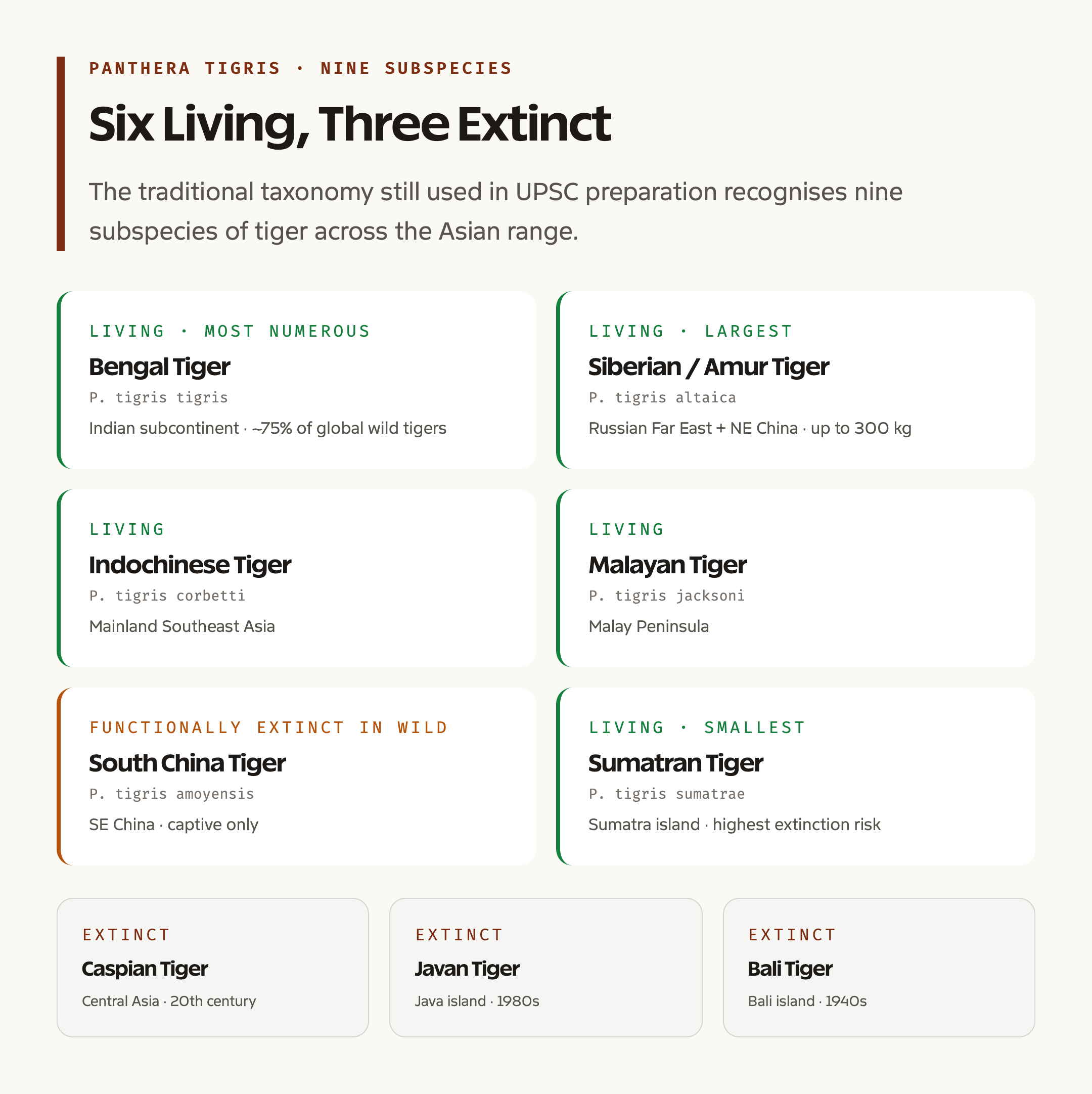
Taxonomists currently recognise nine subspecies of the tiger, of which six are extant and three are extinct. The six living subspecies are the Bengal tiger Panthera tigris tigris of the Indian subcontinent, the Siberian or Amur tiger Panthera tigris altaica of the Russian Far East and northeastern China, the Indochinese tiger Panthera tigris corbetti of mainland Southeast Asia, the Malayan tiger Panthera tigris jacksoni of the Malay Peninsula, the South China tiger Panthera tigris amoyensis of southeastern China which is functionally extinct in the wild, and the Sumatran tiger Panthera tigris sumatrae of the island of Sumatra. The three extinct subspecies are the Caspian tiger Panthera tigris virgata of Central Asia, the Javan tiger Panthera tigris sondaica of the island of Java, and the Bali tiger Panthera tigris balica of the island of Bali. All three were lost in the 20th century to hunting and habitat conversion.
The most recent molecular work, published since 2017, has compressed the formal subspecies count down to two, the continental Panthera tigris tigris and the Sundaland Panthera tigris sondaica. UPSC questions, however, still treat the traditional nine-subspecies scheme, and that is the framework students should memorise. The Bengal tiger accounts for around three-quarters of all wild tigers, and India is the global stronghold.
Key Provisions of Tiger Conservation in India
Tiger conservation in India sits on four legal and policy pillars. The first is Schedule I of the Wildlife Protection Act 1972, which prohibits hunting, capture, and trade in any form, with penalties of up to seven years’ imprisonment, raised under the 2022 amendment. The second is CITES Appendix I, which bans all international commercial trade and tightly regulates non-commercial movement of tigers and tiger parts. The third is Project Tiger, launched on 1 April 1973 with nine reserves and now covering 58 reserves and over 75,000 square kilometres of habitat. The fourth is the National Tiger Conservation Authority, a statutory body constituted in 2006 under the amended Wildlife Protection Act, which is the central regulator of all tiger reserves.
The all-India tiger estimation, conducted every four years by the NTCA and the Wildlife Institute of India, is the world’s largest mammal survey. The 2022 cycle covered 6,41,449 square kilometres of forested habitat, used 32,588 camera traps, and produced an estimate of 3,682 wild tigers, with a reliable identified set of 3,167. This is the dataset behind every figure in policy documents. For the broader picture, read the parent guides on tiger reserves in India and Project Tiger conservation.
Why the Tiger Matters
The tiger matters first as a flagship species. Public attention to tiger conservation has driven funding, legal protection, and political will at a scale that few other species command in India. The 2010 St. Petersburg Tiger Summit set the TX2 goal, the global commitment to double wild tiger numbers by 2022. India met that target ahead of time, and the country’s tiger numbers now drive global tiger recovery.
It matters second as an umbrella species. A 12 to 15 square kilometre territory for an adult female and a 30 to 100 square kilometre territory for an adult male means that protecting a viable tiger population requires protecting hundreds of square kilometres of contiguous forest with intact prey base. Every co-occurring species in that landscape benefits, from the four-horned antelope to the Indian wolf to the giant squirrel. The tiger’s home range is the natural unit of landscape conservation in India.
It matters third as an indicator. Tiger numbers track forest health, prey numbers, and human pressure all at once. The collapse of the tiger in Sariska in 2004 and Panna in 2009 was an early warning of management failure that triggered system-wide reforms. The recovery in central India and the Western Ghats since 2010 reflects the integration of habitat protection, anti-poaching, and corridor management at landscape scale.
Detailed Analysis: Biology and Behaviour
The tiger is solitary and territorial. Adult females hold relatively stable territories of 12 to 30 square kilometres in productive habitat, larger in low-prey areas. Adult males hold larger territories that overlap with several female ranges, typically 30 to 100 square kilometres. Territories are marked with scent on prominent trees, scrapes on the ground, and vocalisations. A male defends his territory aggressively against other males, and territorial fights between males can be fatal.
Reproduction is opportunistic. Females come into oestrus every three to nine weeks if not pregnant, and each oestrus lasts three to seven days. Gestation is around 100 to 110 days, and a litter typically consists of two to four cubs, though only one or two usually survive to independence. Cubs are born blind and weigh around a kilogram each. They open their eyes at six to fourteen days, are weaned at three to six months, learn to hunt with the mother through their second year, and become independent at 18 to 24 months. Sexual maturity is at three to four years, and reproductive lifespan is around eight to ten years.
Diet is broad. The tiger takes any large ungulate it can ambush, with sambar deer, chital, gaur, nilgai, wild boar, and water buffalo forming the bulk of the diet across India. A single tiger needs around 50 to 70 large prey kills per year, equivalent to a kilogram of meat per kilogram of body weight per year. Large kills are dragged into cover, fed on over several days, and revisited until largely consumed.
Tiger Census in India 2006 to 2022
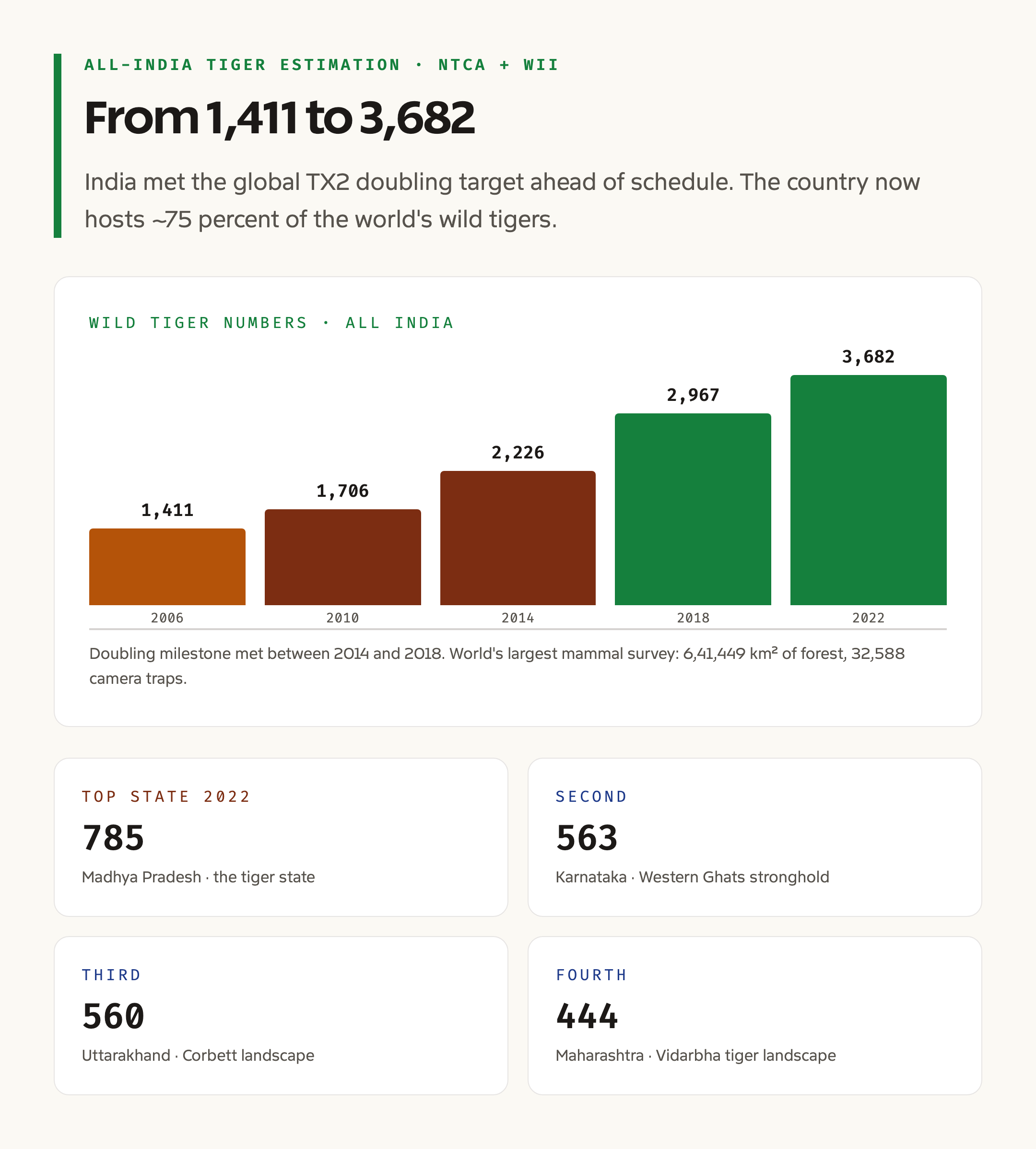
The all-India tiger estimation has been conducted in 2006, 2010, 2014, 2018, and 2022. The 2006 estimate of 1,411 was a shock, well below earlier informal numbers, and it triggered the post-Sariska reforms. The 2010 number rose to 1,706, the 2014 number to 2,226, the 2018 number to 2,967, and the 2022 number to 3,682. The doubling milestone, set under the TX2 commitment for 2022, was achieved between 2014 and 2018.
The 2022 census also confirmed the geographic distribution of recovery. Madhya Pradesh leads with 785 tigers, followed by Karnataka with 563, Uttarakhand with 560, Maharashtra with 444, and Tamil Nadu with 306. The central Indian highlands and the Western Ghats together hold roughly 60 percent of the country’s tigers. The Sundarbans hold around 100 tigers in the world’s only mangrove tiger population, and the Northeast holds around 200 spread across Kaziranga, Pakke, Manas, and Namdapha.
Threats to the Tiger
Three threats dominate. The first is poaching for the illegal wildlife trade. Tiger bones, skins, and other body parts are still in demand in some traditional medicine markets in Asia, and the per-tiger value on the black market remains high enough to attract organised poaching networks. The Wildlife Crime Control Bureau treats tiger products as a top-priority commodity, and India’s enforcement record has been among the strongest in the global tiger range in the last decade.
The second threat is habitat loss and fragmentation. Linear infrastructure projects such as highways, railways, and transmission lines cut tiger corridors. Mining and large hydropower projects fragment landscape connectivity. Encroachment of forest land for agriculture and settlements reduces the available habitat. The Cauvery-Mysore corridor, the Kanha-Pench corridor, and the Pakke-Kaziranga corridor are among the most studied examples of where landscape connectivity is being actively defended through legal and infrastructural mitigation.
The third threat is human-wildlife conflict. Tigers occasionally take livestock and very rarely kill humans, particularly in the Sundarbans. Local communities affected by livestock loss are eligible for compensation under state government schemes, but compensation processes are slow and often inadequate, and retaliatory killings continue to occur. Resolving the conflict-compensation gap is one of the central challenges for the next phase of tiger conservation.
Connections With Related UPSC Topics
The tiger story connects with several other recurring UPSC themes. It connects with biodiversity in India as the country’s most-cited flagship species. It connects with national parks of India since most tiger reserves overlap with national parks or sanctuaries. It connects with Kaziranga National Park, which is both a single-rhinoceros and tiger landscape. It connects with the State of India Environment 2026 report where the latest tiger numbers and corridor analyses are tabulated. And it connects with environmental laws in India through the entire Wildlife Protection Act and NTCA framework.
For prelims, anchor four facts. First, the tiger has six living subspecies and three extinct subspecies, with the Bengal tiger Panthera tigris tigris dominant in India. Second, the species is on Schedule I of the Wildlife Protection Act and CITES Appendix I, with IUCN Endangered status. Third, India’s tiger numbers have grown from 1,411 in 2006 to 3,682 in 2022 across 58 tiger reserves. Fourth, the TX2 commitment of 2010 to double wild tiger numbers by 2022 was achieved by India ahead of schedule.
Frequently Asked Questions
How many tigers are there in India?
The latest all-India tiger estimation, completed in 2022, reported 3,682 wild tigers, with a reliable identified set of 3,167 individuals. India hosts roughly 75 percent of the global wild tiger population. The estimation is conducted every four years by the National Tiger Conservation Authority and the Wildlife Institute of India.
What are the subspecies of tiger?
The traditional taxonomy recognises nine subspecies. The six living subspecies are the Bengal, Siberian or Amur, Indochinese, Malayan, South China, and Sumatran tiger. The three extinct subspecies are the Caspian, Javan, and Bali tiger, all lost in the 20th century. Recent genetic work compresses these to two subspecies, the continental and the Sundaland tiger, but the nine-subspecies scheme is still standard in UPSC preparation.
What is the IUCN status of the tiger?
The tiger is classified as Endangered on the IUCN Red List, with a declining population trend globally. India’s recovery has been the primary driver of overall numbers since 2010. The Sumatran tiger and the South China tiger are in much worse shape than the Bengal tiger and are at the highest risk of extinction.
What is Project Tiger?
Project Tiger is a centrally sponsored conservation programme launched on 1 April 1973 with nine tiger reserves. It is now expanded to 58 reserves covering more than 75,000 square kilometres. The programme provides funding, monitoring, and central coordination through the National Tiger Conservation Authority, a statutory body constituted in 2006.
What is the TX2 goal?
The TX2 goal was the global commitment made at the 2010 St. Petersburg Tiger Summit to double wild tiger numbers by 2022. Thirteen tiger range countries signed on. India achieved the doubling between 2014 and 2018, ahead of schedule, and contributed the largest share of the global increase. Several other range countries have not met their share of the target.
Why is the tiger called a flagship and umbrella species?
The tiger is a flagship species because public attention to its conservation drives funding and policy at a scale few other species command. It is an umbrella species because protecting a viable tiger population requires protecting hundreds of square kilometres of contiguous forest with an intact prey base, which automatically protects every other species in that landscape.