Types of Forests in India: Classification, Features and Distribution
A clear, exam-ready guide to the types of forests in India, organised by the Champion & Seth classification, with rainfall triggers, regions, signature species and forest-cover data.
Ask ten aspirants where teak grows and you’ll get teak in the evergreen forests, teak in the rainforest, teak everywhere. The real answer is narrower: teak is the signature tree of India’s moist deciduous forests, the rainfall band between roughly 100 and 200 cm. Once you anchor a tree to a rainfall number and a region, the whole subject of Indian forests stops being a memory dump and starts behaving like a logic puzzle you can solve.
That logic is exactly what UPSC tests. Prelims loves a four-item match: a forest type, its rainfall, the region it covers, and a species that lives there. Get the chain right and you clear the question; mix up evergreen with deciduous and you lose it. This guide builds that chain for every major forest type, using the standard Champion & Seth (1968) classification that the Forest Survey of India still works from, so you read it once and stop second-guessing.
Why India’s Forests Are Classified the Way They Are
Forests are classified mainly by climate, and within climate by rainfall, because rainfall is what decides whether a tree can afford to keep its leaves all year or must drop them to survive a dry spell. The botanists Harry George Champion and S.K. Seth turned this into a formal system in their 1968 work, A Revised Survey of the Forest Types of India. They sorted the country’s vegetation into five major groups and sixteen type groups, using temperature and rainfall as the master controls.
The five major groups are Tropical, Montane Subtropical, Montane Temperate, Sub-Alpine, and Alpine. That sounds like a lot, but for the exam you can collapse it into a handful of pictures you’ll actually remember: evergreen rainforest, the deciduous monsoon forest, thorn scrub, the layered Himalayan forests, and the coastal mangrove. The trick is to read each one as a response to water, not as a name to be memorised.
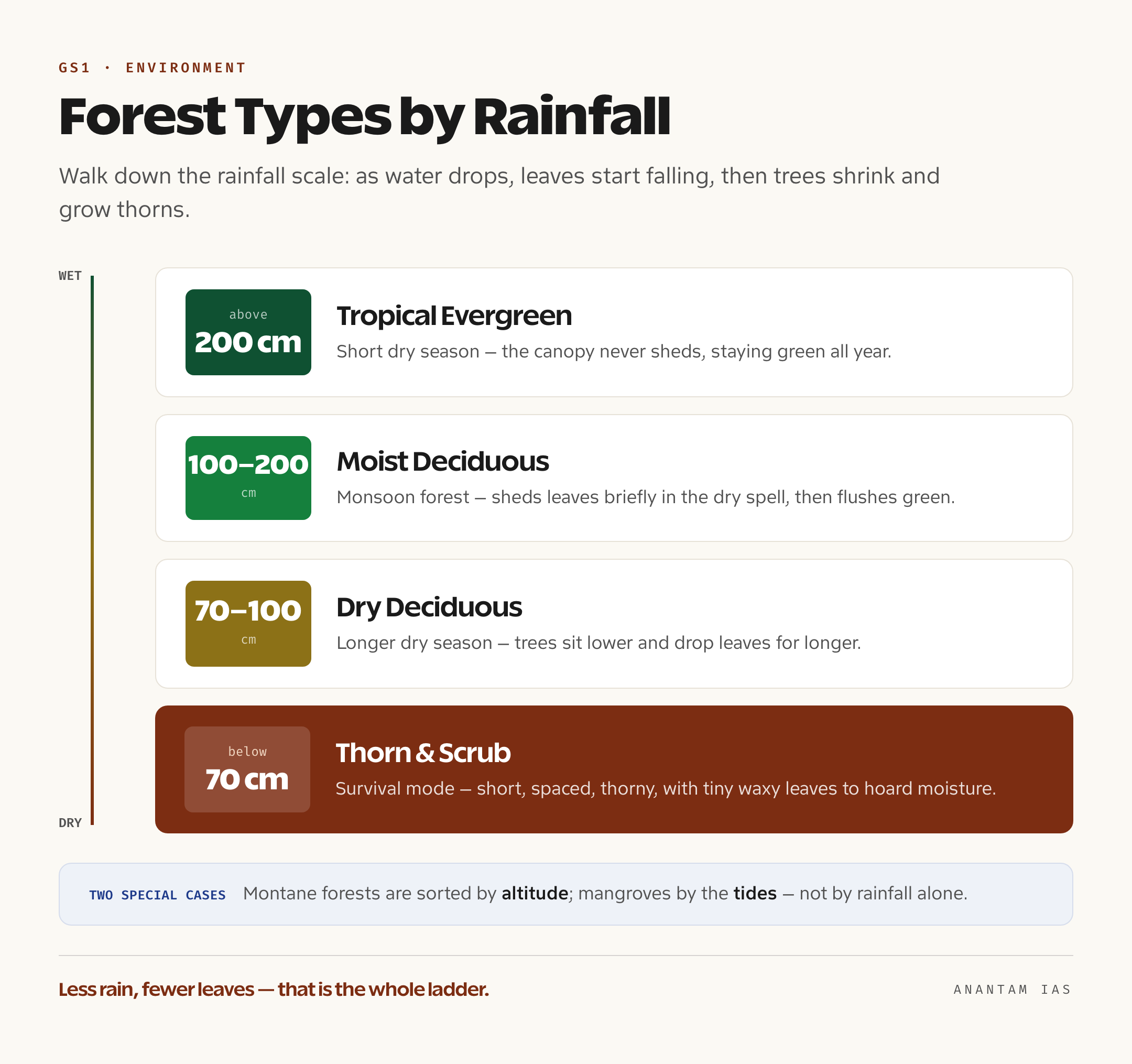
So the single most useful habit is to think in a gradient. Start where rain is heaviest and trees never need to shed, then walk down the rainfall scale: as water drops, leaves start falling in the dry season, then trees shrink and spread thorns, until you reach near-desert scrub. Hold that ladder in your head and most of this article is just labels hung on rungs you already understand. For the legal side of how these forests are governed, our explainer on the Forest Conservation Act 1980 picks up where this one ends.
The Major Forest Types of India and Where They Grow
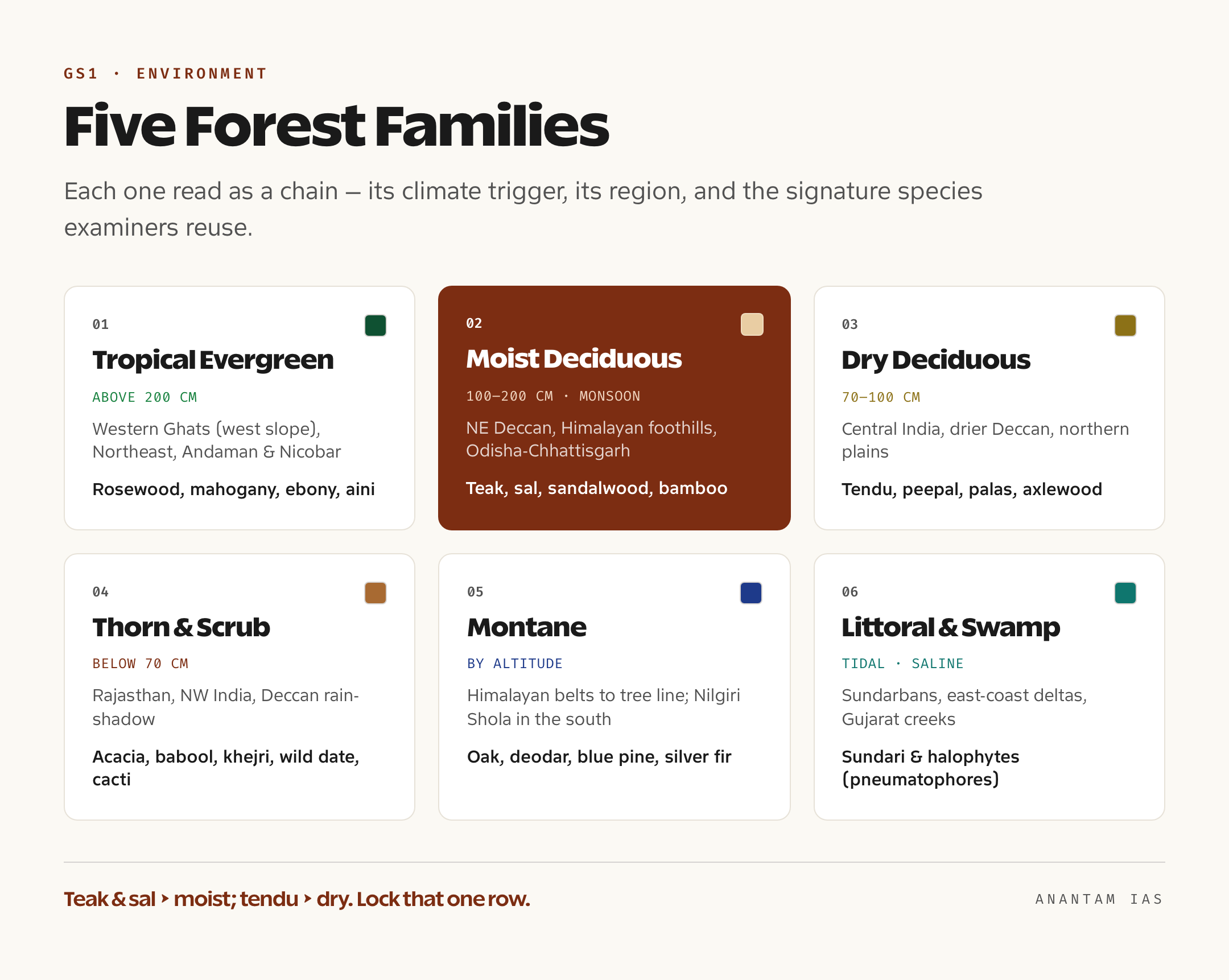
India has five forest families worth knowing cold: tropical evergreen and semi-evergreen, tropical deciduous (moist and dry), tropical thorn and scrub, montane forests, and littoral and swamp (mangrove). Each one is triggered by a rainfall and temperature band, sits in identifiable regions, and carries a few signature species that examiners reuse year after year. We’ll take them in order down the rainfall ladder.
Tropical Evergreen and Semi-Evergreen Forests
These are India’s rainforests, found where annual rainfall crosses 200 cm (often well above 250 cm) and the dry season is short. Because water is never scarce, the trees never need a fixed leaf-shedding season, so the canopy stays green all year, which is exactly what “evergreen” means here. They form dense, multi-storeyed, dark forests along the western slopes of the Western Ghats, the northeastern states, and the Andaman and Nicobar Islands. Signature timbers include rosewood, mahogany, ebony, and aini. Where rainfall dips slightly, you get semi-evergreen forests, a transition belt mixing evergreen and deciduous species. The Western Ghats stretch is a global treasure, which is why it features in our guide to biodiversity hotspots in India and the dedicated Western Ghats explainer.
Tropical Deciduous (Monsoon) Forests
This is the most widespread forest type in India, and the one most likely to surface in Prelims. These are the monsoon forests that shed their leaves for six to eight weeks in the dry season to cut water loss, then flush green again with the rains. Champion and Seth split them by rainfall into two:
- Moist deciduous forests grow in the 100 to 200 cm band and carry the commercially famous trio of teak, sal, and sandalwood, plus bamboo and shisham. They cover the northeastern Deccan, the foothills of the Himalayas, and Odisha-Chhattisgarh.
- Dry deciduous forests sit lower, in the 70 to 100 cm band, with a longer dry season. Think tendu (used for bidis), peepal, palas, and axlewood, found across central India, the drier Deccan, and parts of the northern plains.
Tropical Thorn and Scrub Forests
Below about 70 cm of rainfall the trees give up on a closed canopy and switch to survival mode: short, widely spaced, thorny, with tiny waxy leaves to hoard moisture. These thorn and scrub forests dominate the northwest, much of Rajasthan, southern Punjab, Haryana, and the Deccan rain-shadow behind the Western Ghats. The classic species are acacia, babool (Acacia nilotica), khejri (Prosopis cineraria, Rajasthan’s state tree), wild date, and cacti like euphorbias. Roots run long and deep to chase scarce groundwater. This is the natural vegetation of the Thar margins, the same dry belt that hosts the Great Indian Bustard.
Montane Forests (Himalayan and Southern)
Montane forests are sorted by altitude rather than by rainfall alone, because climbing a mountain mimics travelling toward the poles. In the Himalayas, you climb through bands: wet and dry temperate forests of oak, chestnut, deodar (Himalayan cedar), blue pine, and silver fir, giving way above the tree line to alpine meadows and scrub used for summer grazing. In the south, isolated high patches of the Western Ghats and Nilgiris hold the Shola forests, stunted evergreen woodland tucked into valley folds and ringed by rolling grassland, home to the Nilgiri tahr and the lion-tailed macaque.
Littoral and Swamp Forests (Mangroves)
These are the tidal forests of the coast, growing where rivers meet the sea in saline, waterlogged mud. The largest single stretch is the Sundarbans in the Ganga-Brahmaputra delta, the world’s biggest mangrove forest and home to the only mangrove-dwelling tiger population. The trees are halophytes (salt-tolerant), led by the sundari tree that gives the Sundarbans its name. Their standout adaptation is pneumatophores, breathing roots that poke up out of the oxygen-starved mud to take in air. India’s other major mangroves fringe the deltas of the Mahanadi, Godavari, Krishna, and Kaveri, and the creeks of Gujarat. For the conservation angle, see our dedicated pages on mangroves and the broader forests in India, including mangrove and montane types.
Forest Type at a Glance: Rainfall, Region and Species
The table below is the single thing to revise the night before Prelims. It holds the four-way chain examiners love to scramble: forest type, the rainfall or climate that triggers it, where it grows, and the species that flags it. Read it across each row as a story, not down each column as a list.
| Forest type | Rainfall / climate | Where found | Characteristic species |
|---|---|---|---|
| Tropical evergreen & semi-evergreen | Above 200 cm; short dry season | Western Ghats (west slope), Northeast India, Andaman & Nicobar | Rosewood, mahogany, ebony, aini |
| Tropical moist deciduous | 100 to 200 cm | Northeastern Deccan, Himalayan foothills, Odisha-Chhattisgarh | Teak, sal, sandalwood, bamboo |
| Tropical dry deciduous | 70 to 100 cm; long dry season | Central India, drier Deccan, northern plains | Tendu, peepal, palas, axlewood |
| Tropical thorn & scrub | Below 70 cm | Rajasthan, NW India, Deccan rain-shadow | Acacia, babool, khejri, wild date, cacti |
| Montane (Himalayan) | Temperate to alpine, by altitude | Himalayas (temperate belts to tree line) | Oak, deodar, blue pine, silver fir |
| Montane (Southern / Shola) | High-altitude tropical | Nilgiris, high Western Ghats | Shola evergreens with grassland |
| Littoral & swamp (mangrove) | Tidal, saline, waterlogged | Sundarbans, east-coast deltas, Gujarat creeks | Sundari, halophytes, pneumatophore-bearing trees |
The one row that trips up everyone is the deciduous split. If a question gives you teak and sal, that’s moist deciduous (100 to 200 cm); if it gives you tendu in a longer dry season, that’s dry deciduous (70 to 100 cm). Lock that distinction and you’ve handled the most-tested ambiguity in the whole topic.
India’s Forest Cover and the Legal Categories
Forest type is about biology; forest cover and forest categories are about counting and law, and the exam tests both. The authoritative number comes from the India State of Forest Report (ISFR), published every two years by the Forest Survey of India (FSI) under the Ministry of Environment, Forest and Climate Change. The ISFR 2023, the 18th in the series, recorded India’s forest cover at 7,15,343 sq km, or about 21.76% of the geographical area. Add tree cover (patches under one hectare and trees outside forests) and the combined forest and tree cover reaches 25.17%. So when you see “around 21 to 22%,” that’s forest cover; the higher quarter-of-the-country figure includes tree cover.
Here’s the distinction that catches people: recorded forest area is not the same as forest cover. Recorded forest area is the land legally notified as forest in government records, regardless of whether trees actually stand on it. Forest cover, by contrast, is what the FSI sees from satellites: any land of at least one hectare with a tree canopy density of 10% or more, even if it sits outside the legal forest boundary. The two numbers rarely match, and Prelims has asked exactly this difference.
Legally, the Indian Forest Act, 1927 sorts recorded forests into three classes by how tightly they’re protected. Reserved forests carry the strongest protection: everything is prohibited unless specifically permitted, and they make up the largest share of recorded forest area. Protected forests flip the logic: activities are allowed unless specifically banned. Unclassed forests are the leftover government or community forests not yet placed in either bucket. For how these categories interact with diversion and clearance rules, the India State of Forest Report explainer and the Forest Conservation Act guide carry the governance detail.
How to Study This for UPSC
Study this topic as a Prelims-first chapter that pays a small dividend in Mains. Start with the rainfall ladder, not the Champion & Seth list of sixteen type groups, which you can safely skip in detail. Memorise the order evergreen, moist deciduous, dry deciduous, thorn, then bolt on montane and mangrove as the two special cases driven by altitude and tides rather than plain rainfall.
The highest-return drill is matching. Make four columns, forest type, rainfall, region, species, and practise reading any one cell to recall the other three. That mirrors the match-the-following and statement-based questions that show up most. Pair the species with their forest: teak and sal to moist deciduous, tendu to dry deciduous, sundari to mangrove, deodar to Himalayan temperate, khejri to thorn. Layer ISFR numbers on top: the latest forest cover percentage, the recorded-area-versus-cover distinction, and the three legal categories under the 1927 Act.
For Prelims, expect this in GS Paper 1 (Geography) as natural vegetation, and in environment questions that fuse forest type with a national park or species. For Mains, it feeds GS3 environment answers on conservation, deforestation, and climate, where naming the right forest type and its rainfall band signals command of the basics. Skip the deep ecological subtypes; spend that time instead on linking forests to the national park versus wildlife sanctuary framework, since examiners often bridge the two.
Frequently Asked Questions
What are the five major types of forests in India? Under the Champion & Seth (1968) classification, the five major groups are tropical, montane subtropical, montane temperate, sub-alpine, and alpine. For exam purposes these reduce to five everyday families: tropical evergreen and semi-evergreen, tropical deciduous (moist and dry), tropical thorn and scrub, montane (Himalayan and southern Shola), and littoral and swamp or mangrove forests.
Which is the most widespread forest type in India? Tropical deciduous, the monsoon forest, covers the largest area. It splits into moist deciduous (100 to 200 cm rainfall, with teak and sal) and dry deciduous (70 to 100 cm, with tendu and palas). Its wide spread reflects the monsoon climate over most of the Indian peninsula.
What is the difference between evergreen and deciduous forests? Evergreen forests grow where rainfall tops 200 cm and the dry season is short, so trees never shed all their leaves at once and the canopy stays green year-round. Deciduous forests grow in the 70 to 200 cm band and shed their leaves in the dry season to save water, flushing green again with the rains.
What is India’s total forest cover according to the latest ISFR? The India State of Forest Report 2023, the 18th edition by the Forest Survey of India, put forest cover at about 7,15,343 sq km, or 21.76% of the country’s geographical area. Counting tree cover as well, the combined forest and tree cover reaches 25.17%.
What is the difference between reserved, protected and unclassed forests? Under the Indian Forest Act, 1927, reserved forests have the strongest protection (everything banned unless permitted), protected forests are more relaxed (everything allowed unless banned), and unclassed forests are government or community forests not yet placed in either category.
Practice Questions
Prelims MCQs
- The Champion & Seth (1968) classification of Indian forests is based primarily on which factors? (a) Soil type and drainage (b) Climate, mainly temperature and rainfall (c) Altitude and latitude only (d) Ownership and legal status. Answer: (b) Champion and Seth used temperature and rainfall as the master controls, producing five major groups and sixteen type groups.
- Which forest type in India is associated with teak and sal as characteristic species? (a) Tropical evergreen (b) Tropical thorn (c) Tropical moist deciduous (d) Montane temperate. Answer: (c) Teak and sal flag moist deciduous forests, found in the 100 to 200 cm rainfall band.
- Tropical thorn and scrub forests in India are typically found where annual rainfall is: (a) above 200 cm (b) between 100 and 200 cm (c) between 70 and 100 cm (d) below 70 cm. Answer: (d) Below 70 cm, trees turn short, thorny and widely spaced, as in Rajasthan and the Deccan rain-shadow.
- The breathing roots seen in mangrove forests are called: (a) buttress roots (b) pneumatophores (c) prop roots (d) haustoria. Answer: (b) Pneumatophores rise out of oxygen-starved tidal mud to take in air, a hallmark of mangroves like the Sundarbans.
- With reference to the India State of Forest Report 2023, consider the difference between “recorded forest area” and “forest cover.” Which statement is correct? (a) They are identical by definition (b) Recorded forest area is the legally notified forest land, while forest cover is the satellite-assessed land with at least 10% canopy density (c) Forest cover is always larger than recorded forest area (d) Recorded forest area excludes reserved forests. Answer: (b) Recorded forest area is a legal figure; forest cover is a remote-sensing measure of actual canopy, so the two need not match.
Mains Practice Questions
- Explain how rainfall acts as the master control in classifying India’s natural vegetation, and illustrate with the gradient from tropical evergreen to thorn forests. (15 marks, 250 words)
- The Champion & Seth (1968) classification remains the backbone of forest mapping in India. Critically examine its continued relevance for forest management today. (15 marks, 250 words)
- Distinguish between “recorded forest area” and “forest cover,” and discuss why the gap between them matters for forest governance in India. (10 marks, 150 words)
- Mangrove forests are described as natural bio-shields. Discuss their ecological significance and the threats they face along India’s coastline. (15 marks, 250 words)
- Compare the montane forests of the Himalayas with the Shola forests of the Western Ghats in terms of structure, distribution and conservation challenges. (15 marks, 250 words)
Treat this topic as low-effort, high-yield: a handful of rainfall numbers and species pairs that almost guarantee a Prelims mark or two each year, with enough depth to anchor a Mains environment answer. The aspirants who lose marks here aren’t the ones who studied too little; they’re the ones who memorised names without tying them to a rainfall band and a region. Build the ladder once, drill the matches, and this becomes one of the calmest chapters in your environment prep.