Uranium Mining in India: From Jaduguda to Tummalapalle and Beyond
A complete UPSC GS-III explainer on uranium mining in India. Covers UCIL as the sole nodal agency, the Singhbhum Shear Zone in Jharkhand, the Tummalapalle deposit in Andhra Pradesh, upcoming mines at Rohil, KPM, and Gogi, the difference between domestic production and imports, the role of Kazakhstan, Canada, Russia, and Uzbekistan as suppliers, and how all of this feeds India's three-stage nuclear programme.
A nuclear reactor needs fuel, and the fuel begins as a yellow-brown rock pulled out of the ground. India’s nuclear power programme generates a little under five per cent of the country’s electricity, but the long-term plan is to take that figure to twenty-five per cent over the next two decades. Behind every kilowatt-hour of nuclear electricity sits a logistical chain that begins at a few specific places on the Indian map. Most of those places are in Jharkhand, where the country’s first uranium mine opened in 1967. The biggest reserve, by ore tonnage if not by metal content, is in Andhra Pradesh. A small number of upcoming projects in Rajasthan, Meghalaya, and Karnataka will determine whether the country can stay self-sufficient as the nuclear fleet grows.
This piece is about that chain. Where India’s uranium actually comes from, why the country still imports about half of what it uses, who handles the mining, and how the front-end of the fuel cycle fits into the broader nuclear programme. Uranium mining is also a sensitive subject locally, with concerns about radiation exposure, displacement, and environmental impact at every operating mine, so the article covers the regulatory and community dimensions as well.
For UPSC, the topic sits at the intersection of nuclear energy, mineral resources, internal security, and energy security. This article walks through what UCIL does, the geography of Indian uranium, the mining process, the import basket, and the way all of it feeds into the Indian nuclear power programme and the three-stage strategy laid out by Homi Bhabha in the 1950s.
Who Mines Uranium in India
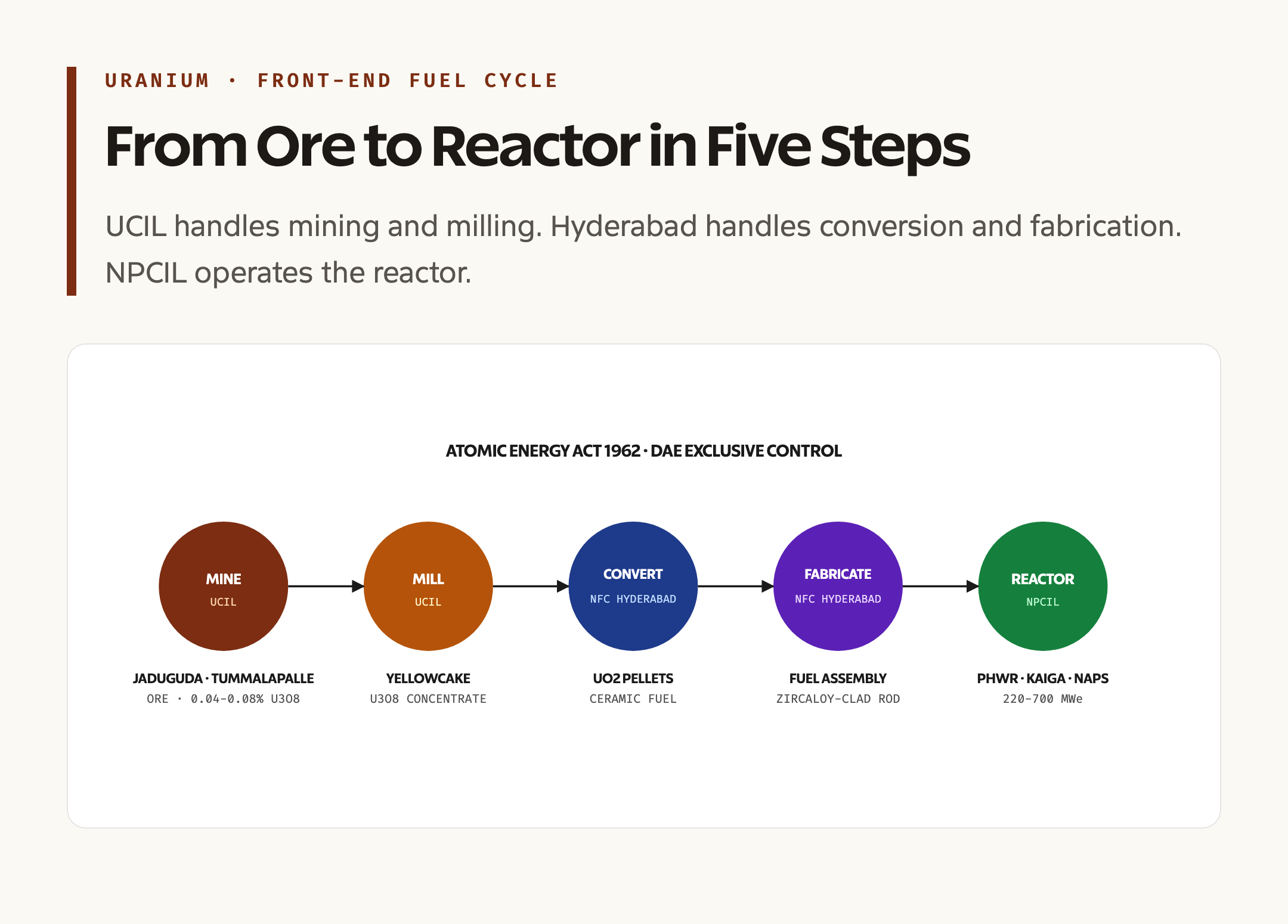
Uranium is a prescribed substance under the Atomic Energy Act of 1962, which means it can only be mined and processed by entities authorised by the central government. In practice, that authorisation has been delegated to a single public sector undertaking. Uranium Corporation of India Limited, or UCIL, is the only company in the country that mines and processes uranium ore. UCIL is a wholly owned undertaking of the Department of Atomic Energy and is headquartered at Jaduguda in Jharkhand, near the country’s first operating mine.
UCIL’s mandate covers the front-end of the fuel cycle from the ore body to a uranium concentrate, often called yellowcake. The concentrate is shipped to the Nuclear Fuel Complex at Hyderabad, which is run by the Department of Atomic Energy and which converts yellowcake into reactor-grade fuel rods and assemblies. The reactors themselves are operated by Nuclear Power Corporation of India Limited and the Bharatiya Nabhikiya Vidyut Nigam, both also under the DAE umbrella.
The reason for this concentrated structure is partly historical, going back to the establishment of the Department of Atomic Energy in 1954 with full executive authority over nuclear matters. It is also a consequence of India’s unsafeguarded status before the 2008 civil nuclear cooperation agreement, when the entire fuel cycle had to be domestically controlled to avoid international concerns. Even after the 2008 deal, mining and the early steps of the fuel cycle have remained under exclusive DAE management.
The Singhbhum Belt: Where It All Started
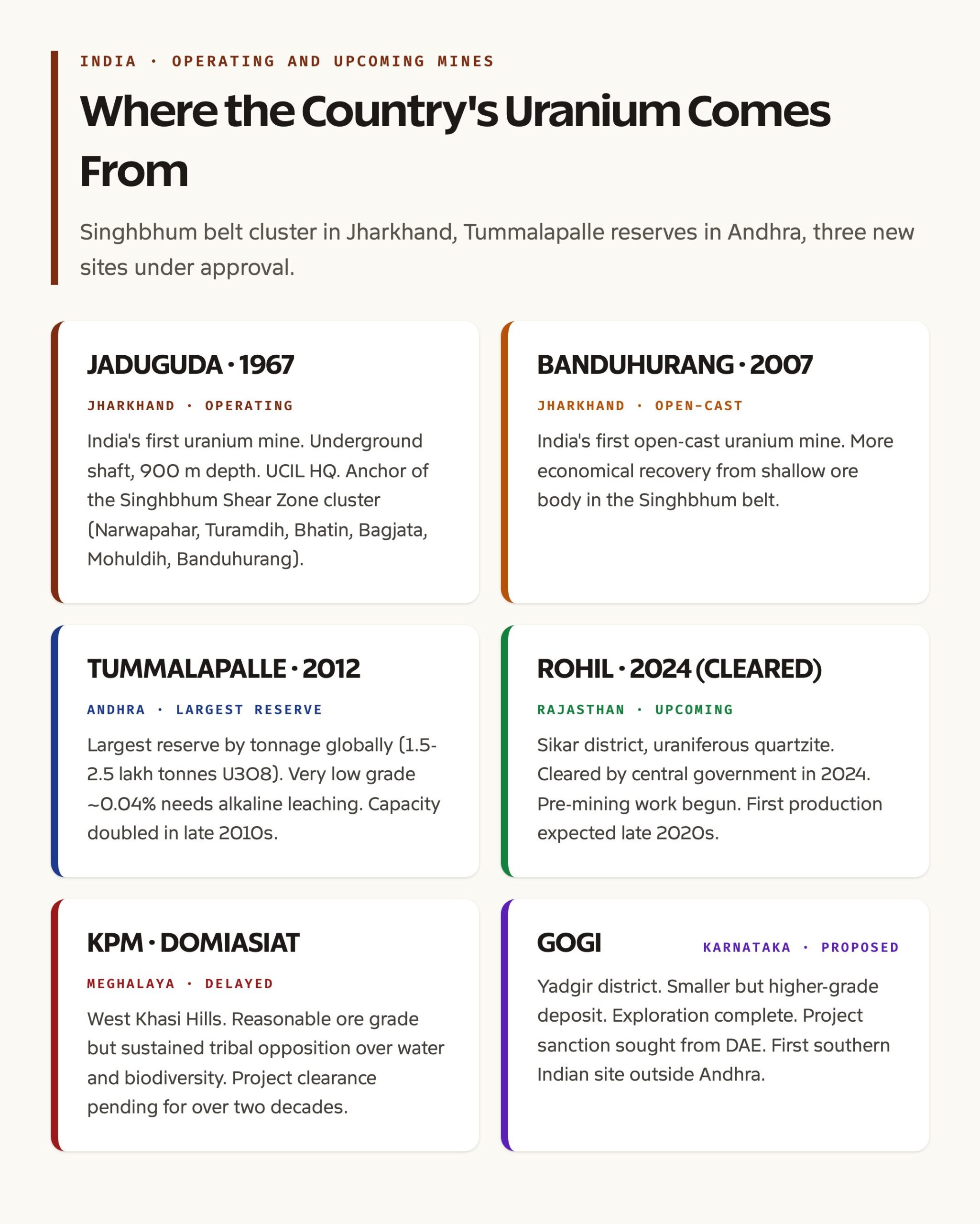
India’s uranium mining began in Jharkhand. The Singhbhum Shear Zone, a long arc of metamorphic rock running through what is now East Singhbhum district, was identified in the 1950s as containing economically viable uranium ore in association with copper and other minerals. The Atomic Minerals Directorate carried out the systematic exploration, and the first underground mine was opened at Jaduguda in 1967.
Jaduguda is a small town that has grown around the mine and the associated milling complex. The shaft reaches a depth of more than nine hundred metres, and the ore body extends laterally for several kilometres. The concentration of uranium in the ore is low by world standards, typically a few hundredths of a per cent of U3O8 by weight, but the mine has been worked continuously for nearly six decades because the geology is well understood and the infrastructure is in place.
A cluster of associated mines has grown up in the same belt over the years. Narwapahar, opened in the early 1990s and described by UCIL as its most modern mine, uses ramp access rather than a shaft. Turamdih is connected to a separate mill of the same name. Bhatin and Bagjata are smaller producers. Mohuldih opened in the 2010s. Banduhurang, opened in 2007, is India’s first open-cast uranium mine, which is a more economical mining technique where the ore body sits close to the surface.
All of these mines feed into one of two milling complexes, Jaduguda and Turamdih, where the ore is crushed and treated with sulphuric acid or sodium carbonate to extract the uranium and produce yellowcake. The mill tailings, which contain the bulk of the rock with the metal removed, are stored in engineered impoundments that are monitored for radiation and seepage.
Tummalapalle and the Andhra Pradesh Reserve
The most consequential development in Indian uranium mining of the last twenty years was the proving of the Tummalapalle deposit in the Cuddapah Basin of Andhra Pradesh. Discovered in the 1990s and developed in the 2000s, Tummalapalle is one of the largest uranium reserves in the world by tonnage, with estimates ranging from one hundred fifty thousand to over two hundred fifty thousand tonnes of uranium oxide.
The catch is that the ore grade at Tummalapalle is very low, typically around 0.04 per cent U3O8, which is roughly half the grade at Jaduguda and a small fraction of the grade at world-class mines such as Cigar Lake in Canada. Extracting uranium economically from such a low-grade ore body required a new metallurgical process that uses alkaline leaching with sodium carbonate, suitable for the dolomitic limestone host rock at Tummalapalle, instead of the acid leaching used in the Singhbhum belt. The technology was developed at the Bhabha Atomic Research Centre and at the Atomic Minerals Directorate.
The mine and processing plant came into operation in 2012 and have steadily ramped up production. A second processing line, doubling capacity, was added in the late 2010s. By the early 2020s, Tummalapalle had become the largest single contributor to India’s domestic uranium output by tonnage, although the ore grade means a much larger volume of rock has to be moved per kilogram of metal recovered.
A separate proposed mine at Lambapur and Peddagattu, in the Nalgonda district of Telangana, has been on the planning list for two decades but has not progressed because of local opposition and concerns about the impact on the Nagarjuna Sagar reservoir downstream. Whether it will eventually be developed remains uncertain.
Upcoming Mines: Rohil, KPM, and Gogi
Three other deposits are at advanced stages of approval and could come into production within the current decade. The Rohil deposit, in the Sikar district of Rajasthan, is the most significant of these. It is associated with a uraniferous quartzite formation and was approved for development by the central government in 2024. Pre-mining work has begun, and UCIL expects first production in the late 2020s.
The Domiasiat-Kylleng Pyndensohiong-Mawthabah deposit, often abbreviated as KPM, is located in the West Khasi Hills of Meghalaya. The deposit was identified decades ago and has reasonable ore grade, but project clearance has been delayed by sustained local opposition over the impact on tribal communities, water sources, and the surrounding biodiversity. The project remains on UCIL’s list of future development sites.
The Gogi deposit, in the Yadgir district of Karnataka, is a smaller find with a relatively higher ore grade. Exploration work is complete and project sanction has been sought from the Department of Atomic Energy. If approved, Gogi would be the first uranium mine in southern India outside of the Andhra Pradesh deposits.
Domestic Output Versus Demand
India’s installed nuclear power capacity is around eight thousand megawatts as of 2026, and the long-term target is twenty-two thousand megawatts by the early 2030s and substantially more thereafter. The pressurised heavy water reactors that dominate the fleet use natural uranium as fuel, which means they consume domestic UCIL output directly. The light water reactors at Kudankulam, supplied by Russia, and the planned imported reactors at Jaitapur and elsewhere, including the upcoming small modular reactor fleet, use enriched uranium that has to be sourced abroad because India does not yet have a civilian enrichment industry.
Even within the heavy water reactor fleet, domestic uranium has historically been insufficient to keep all the reactors running at full capacity. In the late 2000s and early 2010s, several reactors had to be operated at reduced capacity factors because of the uranium shortage, which was one of the practical motivations for India to seek the 2008 civil nuclear cooperation agreement and the consequent access to international uranium markets.
UCIL’s current production capacity, across all operating mines, is roughly equal to the natural uranium demand of the existing PHWR fleet at full output. The proposed expansion of the nuclear programme, including more PHWRs, will require both higher domestic production and continued imports. The country’s broader space technology and strategic infrastructure programmes also depend on radioactive material supply chains coordinated through the DAE.
The Imports: Kazakhstan, Canada, Russia, and Uzbekistan
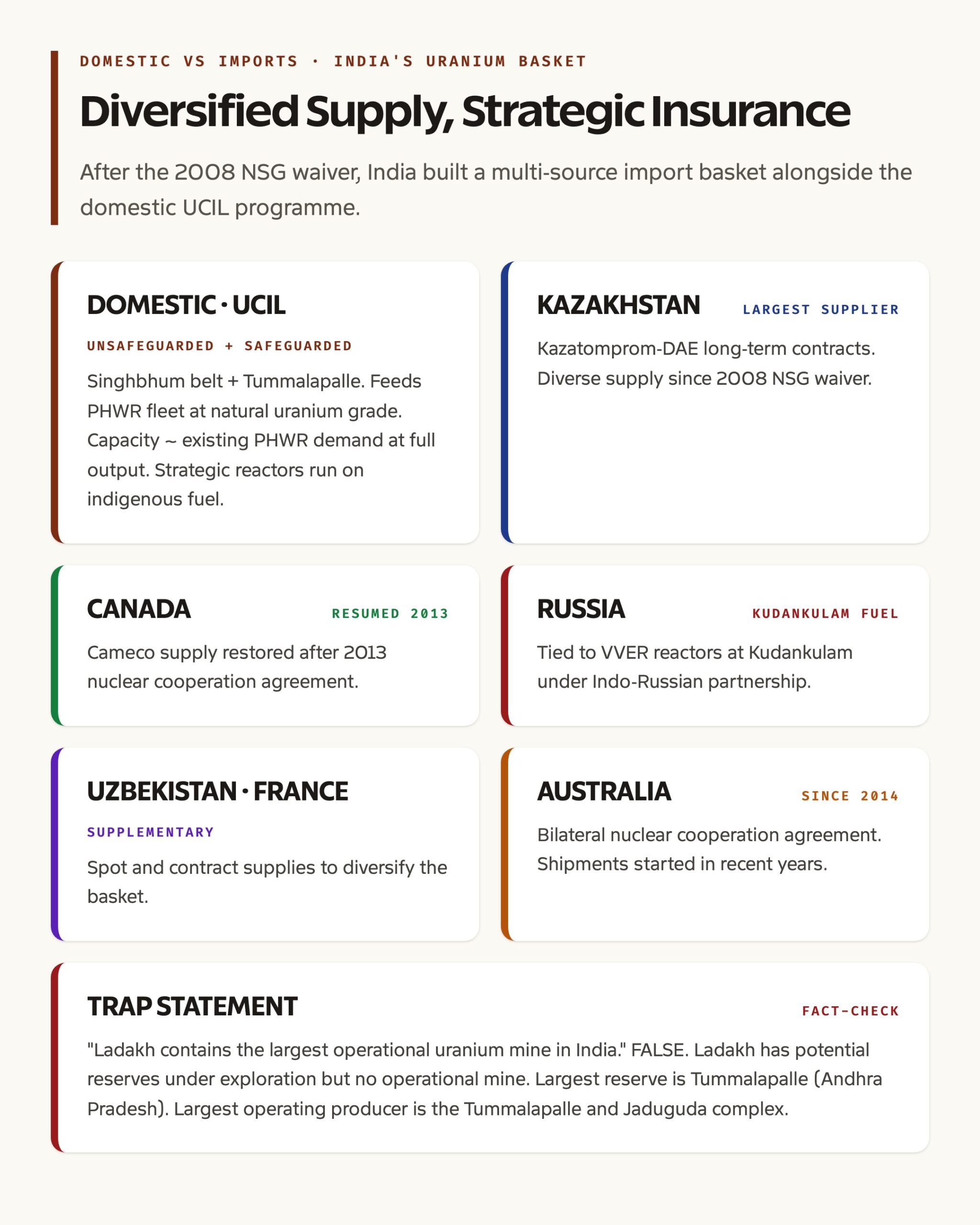
After the 2008 civil nuclear cooperation deal and the subsequent waiver from the Nuclear Suppliers Group, India has signed long-term uranium supply agreements with several countries. Kazakhstan is the largest supplier, with multiple contracts between Kazatomprom and the Department of Atomic Energy. Canada resumed supply after the 2013 nuclear cooperation agreement. Russia supplies uranium under the Indo-Russian nuclear partnership and to fuel the Kudankulam reactors. Uzbekistan and France have provided supplementary supplies. Australia agreed to supply uranium under a 2014 agreement, and shipments have begun more recently.
All these imports come into reactors that are placed under International Atomic Energy Agency safeguards, in line with the separation plan India agreed in 2008. Reactors that are not on the safeguards list, including the strategic ones associated with the weapons programme and the upcoming fast breeder programme, run on indigenous uranium and indigenous fuel.
The strategic point is that the import basket is now diversified across geographies and political relationships, which insulates India from any single-supplier disruption. At the same time, no responsible energy strategy can rely entirely on imports for a fuel as politically sensitive as uranium, so the domestic mining programme remains the foundation of India’s nuclear security.
Common Misconceptions
A common trap statement that turns up in question banks is that Ladakh contains the largest operational uranium mine in India. This is false. While Ladakh has been identified as a region with potential reserves and exploration is ongoing, no operational uranium mine exists there. The largest reserves by tonnage are at Tummalapalle in Andhra Pradesh, and the largest production by mine is currently from the Tummalapalle complex along with the Jaduguda cluster.
A second common confusion is between uranium mining and uranium enrichment. Mining produces yellowcake, which is U3O8 with about 0.7 per cent of the fissile isotope uranium-235. Enrichment is the separate process of increasing the U-235 fraction to about three to five per cent for power reactor fuel or to over ninety per cent for weapons. India’s enrichment activity is small and is largely associated with the strategic programme; it is not part of the civilian uranium mining story.
A third confusion is between the front-end and the back-end of the fuel cycle. UCIL handles the front-end: mining and milling. The Hyderabad fuel complex handles conversion and fuel fabrication. The back-end, which deals with spent fuel, reprocessing, waste storage, and the linkage to the fast breeder reactor and thorium programme, is handled by other DAE units, including BARC and the Indira Gandhi Centre for Atomic Research at Kalpakkam.
Health, Environment, and Local Concerns
Uranium mining and milling produce a series of environmental and health concerns that have been the subject of long-running debate in the Singhbhum belt. Tailings impoundments can release radon gas and contain low levels of radioactivity that persist for thousands of years. Workers in the mines are exposed to ionising radiation and have to be monitored. Communities living downwind or downstream of mining areas have raised concerns about cancer rates, birth defects, and water contamination.
UCIL’s position, supported by the Atomic Energy Regulatory Board, is that exposure levels are within international limits and that mining areas are continuously monitored. Independent surveys have produced mixed findings, and a series of academic studies have documented elevated rates of certain health outcomes in some surrounding villages, although attribution to mining specifically remains contested. The honest summary is that uranium mining is industrially safer than coal mining by most measures but is not free of impacts, and that the regulatory and grievance redress mechanisms could be strengthened.
These concerns have shaped the long delays at KPM in Meghalaya and at Lambapur-Peddagattu, and they will shape any future expansion of the industry. The right policy response, both for community well-being and for the long-term sustainability of the programme, is transparent monitoring data, independent epidemiological studies, and proper consultation with affected populations.
Why It All Matters
India’s nuclear programme is one of the few large-scale low-carbon power options available to the country at the timescales relevant to the 2070 net-zero target. The fuel for that programme comes either from a small number of domestic mines or from a basket of foreign suppliers, and both are necessary. The domestic mining footprint is modest in the global picture but is critical to the country’s strategic autonomy. Expanding it without imposing unacceptable local costs is a balancing act that will define the front-end of India’s nuclear future.
Frequently Asked Questions
Who is the only entity allowed to mine uranium in India?
Uranium Corporation of India Limited, or UCIL, is the only entity authorised to mine and process uranium ore in India. UCIL is a public sector undertaking under the Department of Atomic Energy and is headquartered at Jaduguda in Jharkhand. Uranium is a prescribed substance under the Atomic Energy Act of 1962 and cannot be mined by any other company.
Where is India’s first uranium mine?
India’s first uranium mine is at Jaduguda in the East Singhbhum district of Jharkhand. It opened in 1967 and continues to operate today. Jaduguda is part of the larger Singhbhum Shear Zone, which also includes the Narwapahar, Turamdih, Bhatin, Bagjata, Mohuldih, and Banduhurang mines.
Where is the largest uranium reserve in India?
The largest uranium reserve by tonnage is at Tummalapalle in the Cuddapah Basin of Andhra Pradesh, with estimates ranging from one hundred fifty thousand to over two hundred fifty thousand tonnes of uranium oxide. The ore grade is very low, around 0.04 per cent U3O8, which means a large volume of rock has to be processed for each kilogram of metal recovered.
Which countries does India import uranium from?
India imports uranium from Kazakhstan, which is the largest supplier, along with Canada, Russia, Uzbekistan, France, and Australia. All imported uranium is used in reactors placed under International Atomic Energy Agency safeguards, in line with the separation plan India agreed under the 2008 civil nuclear cooperation deal.
Is there an operational uranium mine in Ladakh?
No. While Ladakh has been identified as a region with potential uranium reserves and exploration work is ongoing, no operational uranium mine exists there. The largest reserves are at Tummalapalle in Andhra Pradesh, and the operating mines are mostly in the Singhbhum belt of Jharkhand and at Tummalapalle.