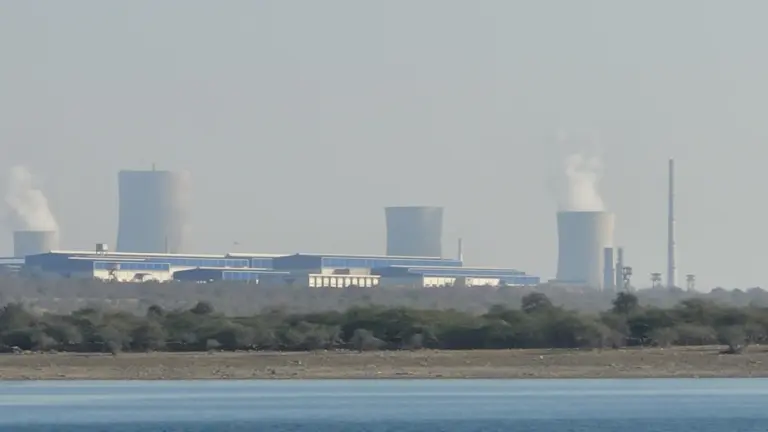
Small Modular Reactors (SMRs) are compact, factory-assembled nuclear reactors with a power output of up to about 300 MWe per unit — roughly a third of a conventional plant. They promise to change the economics, siting and safety profile of nuclear power. India’s Union Budget 2024-25 announced a dedicated Nuclear Energy Mission and Bharat Small Reactor (BSR) programme, making SMRs a frontline UPSC topic in GS Paper III.
What Are Small Modular Reactors?
- Small — physically a fraction of the size of a conventional reactor, typically under 300 MWe.
- Modular — systems and components are factory-assembled and transported as units for on-site installation.
- Reactors — harness nuclear fission to generate heat for power or process applications.
Their compact footprint, factory fabrication and passive safety make them suitable for diverse sites, including retired thermal plant locations and remote industrial clusters.
Mechanism and Technology Variants
Most operating and proposed SMRs are variants of Light Water Reactors (LWRs) — such as NuScale, Rolls-Royce SMR and Holtec SMR. Others include:
- High-Temperature Gas-cooled Reactors (HTGR).
- Liquid Metal Fast Reactors (LMFR).
- Molten Salt Reactors (MSR).
- Heavy Water Reactors — including India's proposed Bharat Small Reactor, a 220 MWe PHWR variant.
Applications of SMRs
- Electricity generation in remote areas off the grid.
- Industrial process heat — steel, cement, chemicals.
- Desalination for coastal water-stressed regions.
- Hydrogen production via high-temperature electrolysis.
- Nuclear submarines and research reactors (conceptually similar).
- Replacement of retiring thermal plants — retaining grid and transmission infrastructure.
Advantages
Flexibility and Scalability
- Units can be added incrementally as demand grows.
- Suitable for retrofitting older thermal plant sites.
Longer Refuelling Cycle
- Some SMR designs refuel every 3-7 years, versus 1-2 years for conventional reactors.
Compact Design
- Factory construction reduces build time from 10+ years to 3-5 years.
- Lower site footprint and smaller exclusion zones.
Passive Safety
- Gravity, natural circulation and passive heat sinks shut down and cool reactors without active intervention or external power.
- Reduces the probability and consequences of accidents dramatically.
Economics
- Lower capital requirements per unit make financing more accessible.
- Modular learning curves potentially bring down unit costs with volume.
Challenges
- Higher cost per unit of electricity in early deployments due to supply-chain immaturity and lack of scale economies.
- Radioactive waste per MWh may be higher than in large reactors for some designs, and spent fuel still requires storage and disposal facilities.
- Regulatory approval — novel designs need international safeguards and safety approvals; regulators worldwide are still building expertise.
- Socio-political resistance to new reactor sites, even smaller ones.
- Proliferation concerns with certain high-assay low-enriched uranium (HALEU) fuels.
India's Approach: Bharat Small Reactor
The Bharat Small Reactor (BSR) is a 220 MWe PHWR, a proven indigenous technology now adapted for modular deployment. A parallel track will develop a genuinely new Bharat Small Modular Reactor (BSMR) of around 200 MWe and advanced SMR technologies. The Nuclear Energy Mission announced in Budget 2024-25 has an outlay of Rs 20,000 crore and targets deployment of five indigenous SMRs by 2033.
Way Forward
- Amend the Atomic Energy Act 1962 to allow the private sector to invest in and operate SMRs.
- Fuel control and waste management should remain with the Government of India for safety, security and safeguards.
- Create an empowered, independent regulatory board with expertise across design approval, siting, construction, operation, certification of operators and waste reprocessing.
- Security of SMRs remains government-controlled; NPCIL can operate privately owned SMRs during a hand-holding phase.
- Negotiate with foreign suppliers to reprocess spent fuel from SMRs at state-controlled facilities under IAEA safeguards.
- The Department of Atomic Energy should improve public perception through transparent disclosure of environmental and public health data from existing civilian reactors under IAEA safeguards.
- Public-private partnerships with NTPC, Tata Power, Reliance and international SMR vendors.
India's Position Globally
Russia, the United States, China, Canada, the United Kingdom and Argentina lead in SMR deployment or demonstration. Russia's Akademik Lomonosov is already operational (floating SMR). China's HTR-PM is grid-connected. NuScale secured US NRC design certification. India's entry with Bharat Small Reactors places it in early-mover position for PHWR-based SMRs.
Ethical and Policy Concerns
- Safety standardisation for modular builds that will be replicated rapidly.
- Transboundary spent fuel transportation risks.
- Nuclear proliferation under export scenarios.
- Local community consent for siting, especially near sensitive ecosystems.
- Regulatory independence — critical to avoid conflict of interest as government is both promoter and regulator.
Latest Developments (2024-26)
- Union Budget 2024-25 announced Nuclear Energy Mission with Rs 20,000 crore outlay and five operational indigenous SMRs by 2033 target.
- Union Budget 2025-26 proposed amendments to the Atomic Energy Act and Civil Liability for Nuclear Damage Act to enable private participation and address supplier concerns.
- AI Action Summit, Paris (2025) — SMRs discussed as low-carbon compute infrastructure for AI data centres.
- India Semiconductor Mission — supplies sensors and radiation-hardened electronics for SMR instrumentation.
- Chandrayaan-4 and Gaganyaan — advance high-technology ecosystem supporting nuclear innovation.
- National Quantum Mission — enables quantum-secure communications for reactor control and safeguards.
- DPDP Act governs personal data of operators, contractors and local communities.
- BARC partnerships announced with private industry for SMR design and manufacturing in 2024-25.
- International tie-ups — discussions with Russia (Rosatom), United States (NuScale, Holtec), France (EDF) and South Korea (KAERI) on SMR cooperation.
UPSC Relevance
For Prelims, remember the 300 MWe upper limit, the Nuclear Energy Mission (Budget 2024-25), Bharat Small Reactor, and the distinction between BSR (220 MWe PHWR-based) and BSMR (new design). For GS III Mains, SMRs illustrate the intersection of science, energy transition, industrial policy and regulatory reform. Ethics and Environment sections can explore safety, waste and public consent. The sector is on the cusp of structural reform, so aspirants should track the Atomic Energy Act and Civil Liability amendments closely.
Tell Google you want more of this.
Add Anantam IAS as a preferred sourceOne tap, and this site shows up more often in your own Top Stories, AI Overviews and AI Mode. Remove it any time.