Basic Structure Doctrine of the Indian Constitution: Origin, Cases and Elements (UPSC Polity)
Basic Structure Doctrine: Kesavananda Bharati 1973 origin, Article 368 limits, evolving list of elements, landmark cases, and UPSC GS-II answer hooks.
The Basic Structure Doctrine is the rule, laid down by a 13-judge bench of the Supreme Court in Kesavananda Bharati v State of Kerala (1973), that Parliament's power to amend the Constitution under Article 368 is wide but not unlimited — Parliament cannot alter the Constitution's "basic structure" or essential framework. The doctrine grew out of a long tussle between Parliament's amending power and the protection of Fundamental Rights, and it has since been used to test every major constitutional amendment. It matters because it is the device that stops any sitting majority from converting the Constitution into something the framers would not recognise.
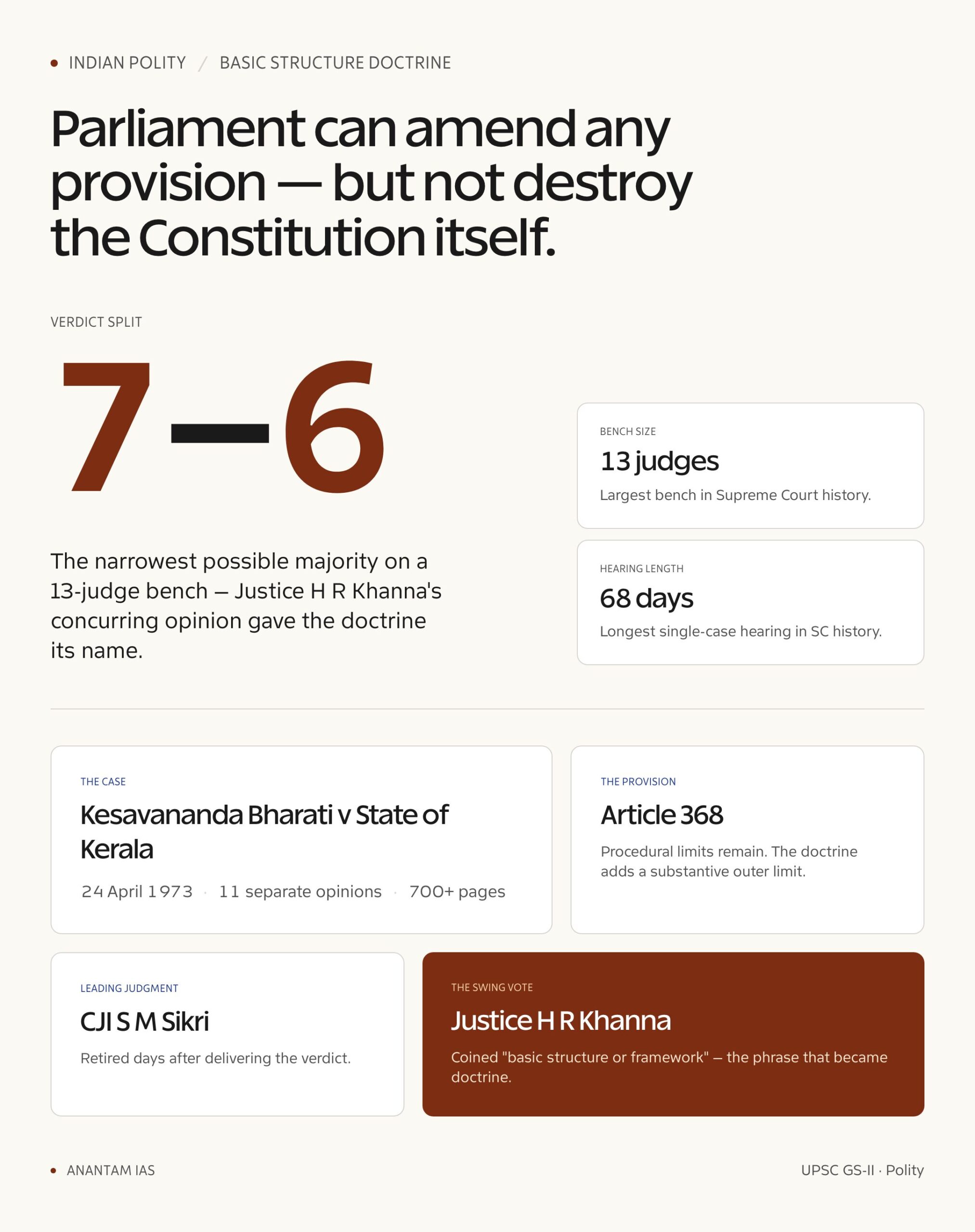
What the Basic Structure Doctrine Says
In one sentence: Parliament can amend any article of the Constitution, but it cannot use that power to destroy or damage the Constitution's basic structure. The amending body under Article 368 is a constituent power, not an original power; it works within the four corners of the document and cannot remake the document itself. If a constitutional amendment alters something the Court treats as basic structure, it is liable to be struck down on judicial review even after clearing the prescribed majorities.
The doctrine has three features. It is judge-made — the words "basic structure" do not appear in the Constitution. It operates as a substantive limit on Article 368, alongside the procedural limits (special majority, sometimes ratification) in Article 368(2). And the list of what counts as basic structure is open-ended; the Court adds to it case by case.
For UPSC GS-II, the doctrine sits at the intersection of three syllabus heads — the Constitution, separation of powers, and judicial review — and is the single most-asked theme on amendments and judicial activism.
The Constitutional Question Behind the Doctrine
The doctrine answers a question the framers never settled in plain text: what is the relationship between Article 368 and Part III?
Article 368 allows Parliament, by a two-thirds majority of members present and voting in each House (with at least an absolute majority of total membership), to add, vary or repeal "any provision" of the Constitution. Entrenched matters — federal features, election of the President, powers of the Supreme Court and High Courts, Seventh Schedule lists, Article 368 itself — additionally require ratification by at least half the State Legislatures.
Part III contains the Fundamental Rights; Article 13(2) says the State "shall not make any law" taking away or abridging those rights. The first practical question after 1950 was whether a constitutional amendment was a "law" within Article 13. The framers did not write the answer. The journey from the First Amendment (1951) to Kesavananda Bharati (1973) is the story of how the courts filled that gap. For the amendment process, see total amendments to the Indian Constitution and the first amendment of the Indian Constitution.
Pre-Kesavananda: Three Cases That Built the Tension
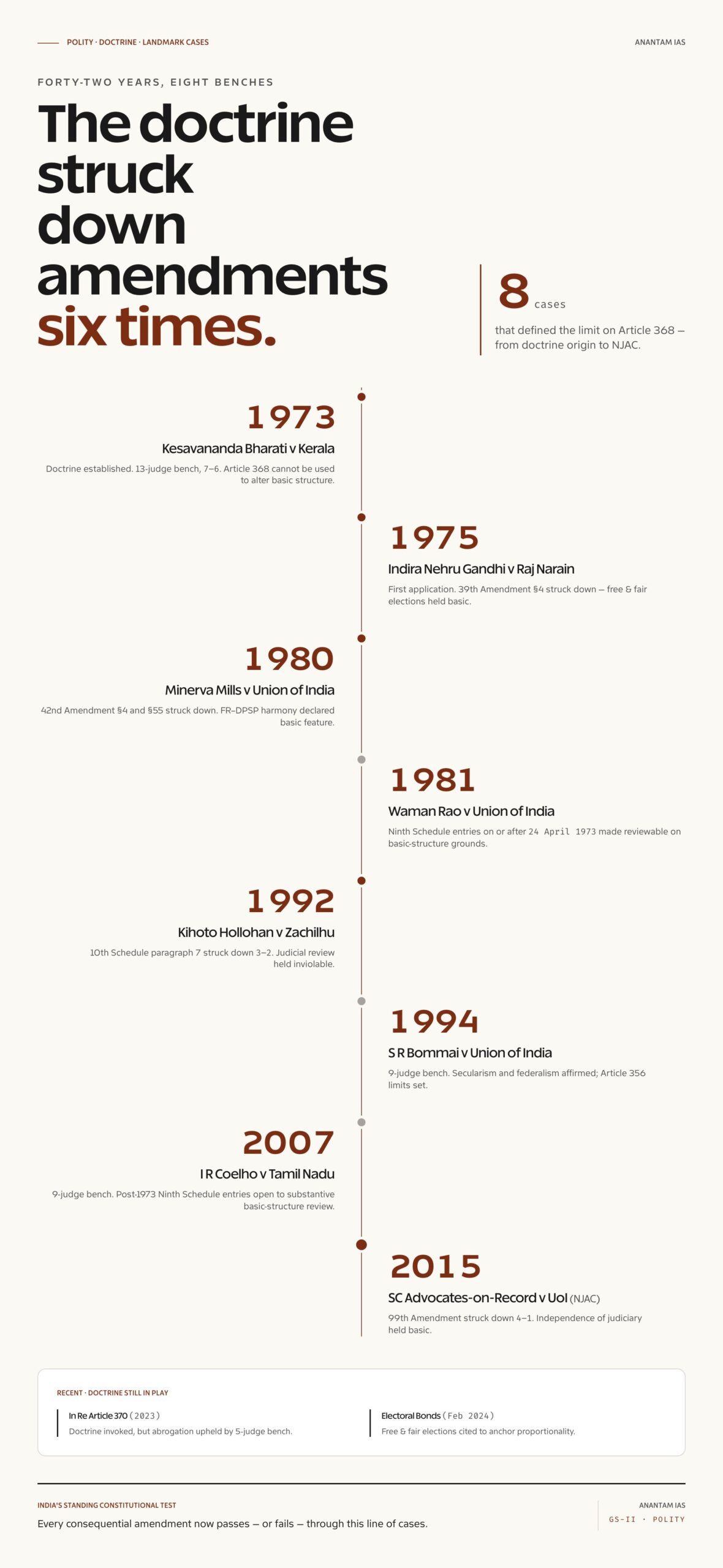
Three cases between 1951 and 1967 set the stage. Each one tightened the question that Kesavananda would finally answer.
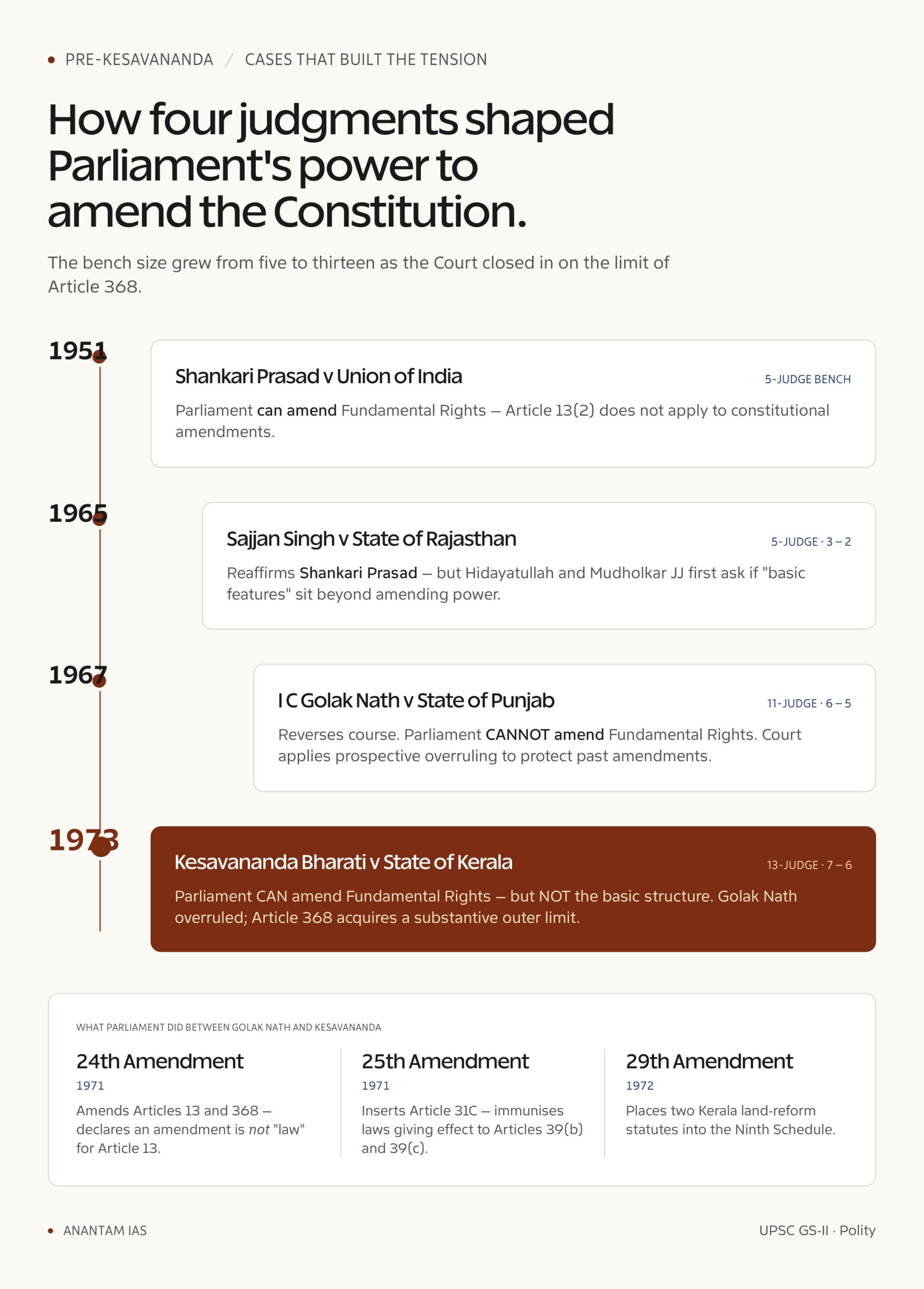
Shankari Prasad v Union of India (1951) — 5-judge bench
The First Amendment of 1951 had inserted Articles 31A, 31B and the Ninth Schedule, putting State zamindari-abolition statutes beyond Articles 14, 19 and 31. It was challenged as hit by Article 13(2). A five-judge bench led by CJI Patanjali Sastri rejected the challenge: "law" in Article 13 meant ordinary law; an amendment under Article 368 was constituent law and stood outside Article 13(2). Parliament could therefore amend any part of the Constitution, including Part III.
Sajjan Singh v State of Rajasthan (1965) — 5-judge bench
The Seventeenth Amendment, which expanded the Ninth Schedule, was challenged on the same Article 13 ground. By 3-2 the Court reaffirmed Shankari Prasad. But Justices Hidayatullah and Mudholkar wrote separately, doubting whether Fundamental Rights could really be abridged by amendment. Justice Mudholkar went further, asking whether there were "basic features" of the Constitution beyond the amending power — the phrase that, eight years later, would harden into a doctrine.
I C Golaknath v State of Punjab (1967) — 11-judge bench
The Court reversed itself. By 6-5, an 11-judge bench led by CJI Subba Rao held that Fundamental Rights are transcendental and that Parliament has no power to amend Part III at all. A constitutional amendment was held to be "law" within Article 13(2). To soften the disruption, the Court used prospective overruling — the First, Fourth and Seventeenth Amendments stood, but no future amendment could touch Part III.
Parliament retaliated. The 24th Amendment (1971) amended Articles 13 and 368 to declare that an amendment under 368 is not "law" for Article 13. The 25th Amendment (1971) inserted Article 31C, immunising laws giving effect to Articles 39(b) and 39(c) from challenge under Articles 14, 19 and 31. The 29th Amendment (1972) put two Kerala land-reform acts into the Ninth Schedule. Kesavananda Bharati was assembled to test all three.
Kesavananda Bharati v State of Kerala (1973) — The 13-Judge Bench
His Holiness Sripadagalvaru Sri Kesavananda Bharati Swamiji, head of the Edneer Mutt in Kasaragod, Kerala, filed a writ petition under Article 32 challenging the Kerala Land Reforms Act 1963, which had brought Mutt lands within the State's land-ceiling regime. The Mutt's pleading rested on Article 26 — the right of a religious denomination to administer property — but as the matter moved up, what was actually on trial was the validity of the 24th, 25th and 29th Amendments, and through them the survival of Golaknath.
A 13-judge bench — the largest in Indian constitutional history — sat for 68 working days, the longest hearing the Supreme Court has ever held on a single case. Judgment was delivered on 24 April 1973, days before CJI S M Sikri retired. The decision runs to more than 700 pages across eleven separate opinions; the holding emerged from a one-page "View by Majority" signed by nine judges, pulling together what at least seven had agreed on.
For the petitioner's biography, the Edneer Mutt context, and the case-level minutiae, see the Kesavananda Bharati case explainer. This article stays with the doctrine.
The 7-6 Majority Verdict and What It Held
The Court split 7-6. The majority held that Article 368 does empower Parliament to amend any provision, including Part III, but this power does not extend to altering the basic structure or framework of the Constitution. Golaknath was overruled — Fundamental Rights are amendable. The 24th Amendment was upheld. The 25th Amendment was upheld in part; the second clause of Article 31C, which had ousted judicial review of any law declaring itself made to give effect to 39(b) or 39(c), was struck down. The 29th Amendment was upheld but made subject to basic-structure scrutiny.
The seven in the majority were Sikri CJI, Shelat, Hegde, Grover, Jaganmohan Reddy, Mukherjea and Khanna JJ. The six dissenters — Ray, Mathew, Beg, Dwivedi, Chandrachud and Palekar JJ — would have allowed unlimited amending power, subject only to the procedure in Article 368.
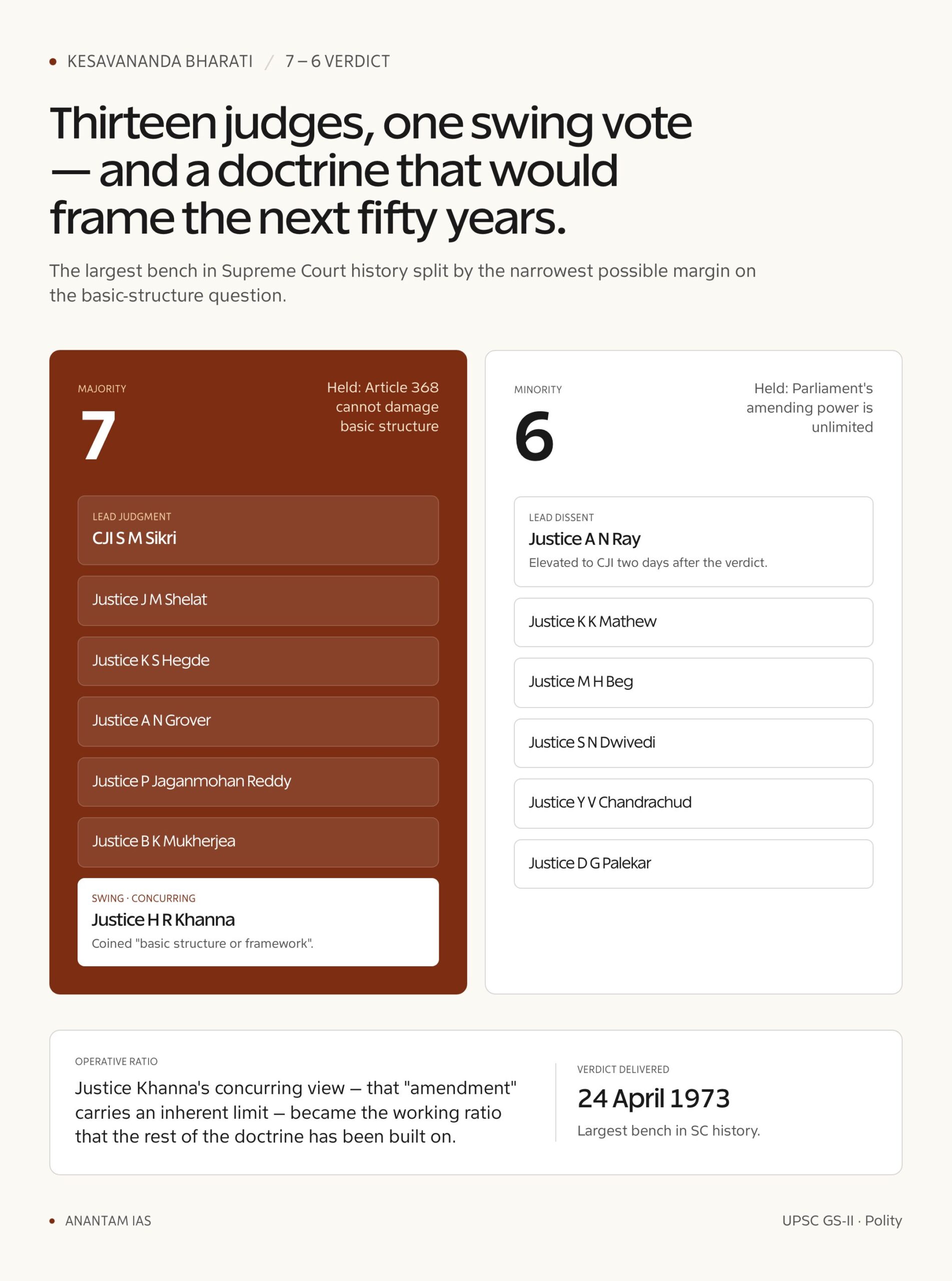
The decisive vote was Justice H R Khanna's. He agreed that Fundamental Rights are amendable, but wrote that the word "amendment" in Article 368 carried an inherent limit — the power cannot be used to abrogate the Constitution itself. The "basic structure or framework", he held, must remain. His phrasing became the doctrine's working name.
The political backlash was sharp. Two days after the judgment, the Government superseded the three senior-most majority judges — Shelat, Hegde and Grover — and elevated A N Ray, the senior-most dissenter, as Chief Justice.
The Doctrine in One Page — What Is "Basic Structure"?
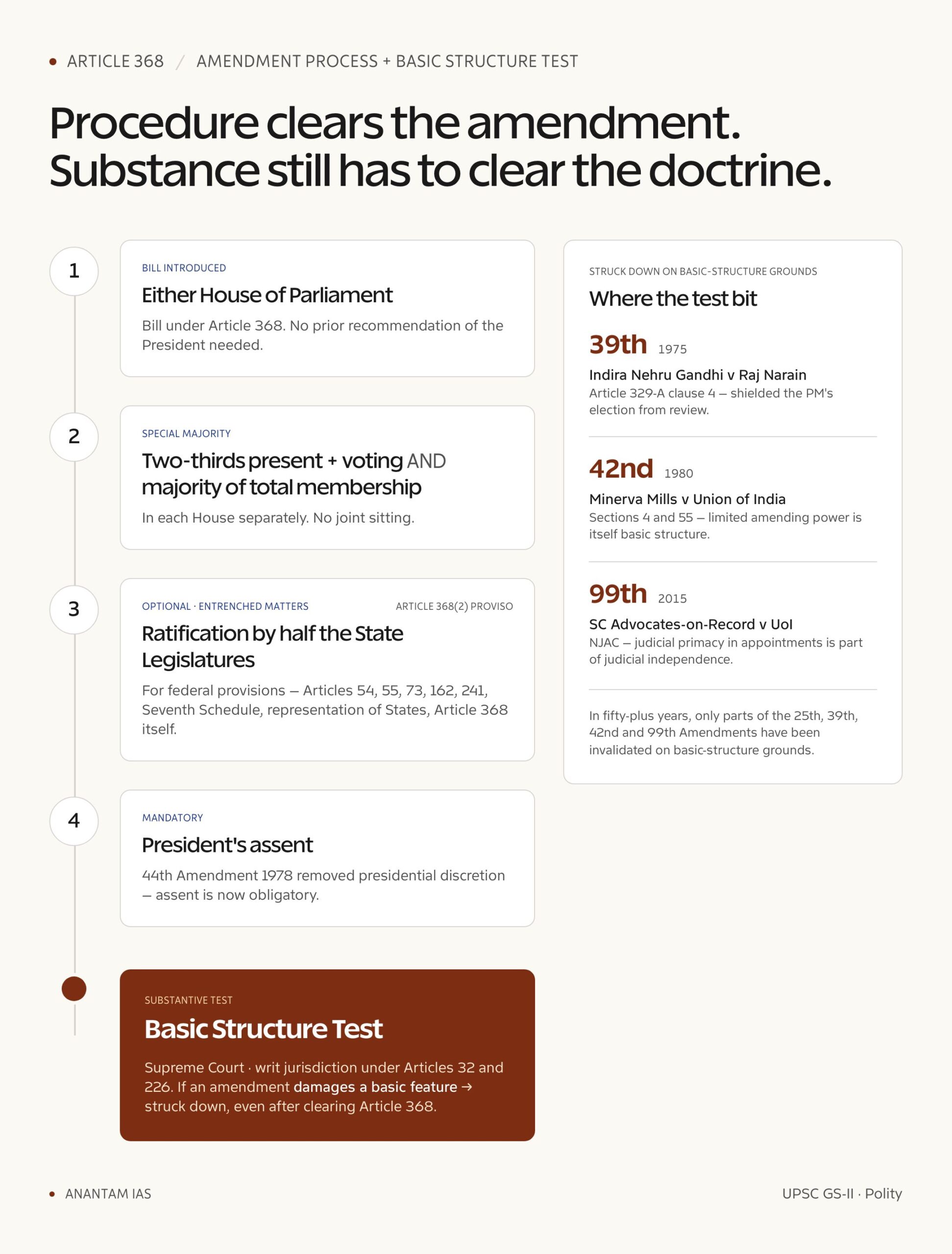
A constitutional amendment is moved under Article 368. It clears the procedural test — special majority, ratification where required, presidential assent — and becomes part of the Constitution. On challenge under Articles 32 or 226, the Court asks two questions: what does the amendment do, and does what it does damage or destroy a feature that is part of basic structure? If yes, the amendment is unconstitutional notwithstanding compliance with Article 368.
The doctrine limits the amending power and preserves constitutional identity — the features without which the document would no longer be the Constitution of India. It does not freeze the Constitution. Parliament can still amend Part III, recalibrate the federal balance at the margins, reorganise institutions. What it cannot do is hollow out the framework until what remains is a different constitution wearing the old name. The Court asks whether the essence of an identified feature is destroyed, not whether the feature has been touched.
Elements of Basic Structure — The Evolving List
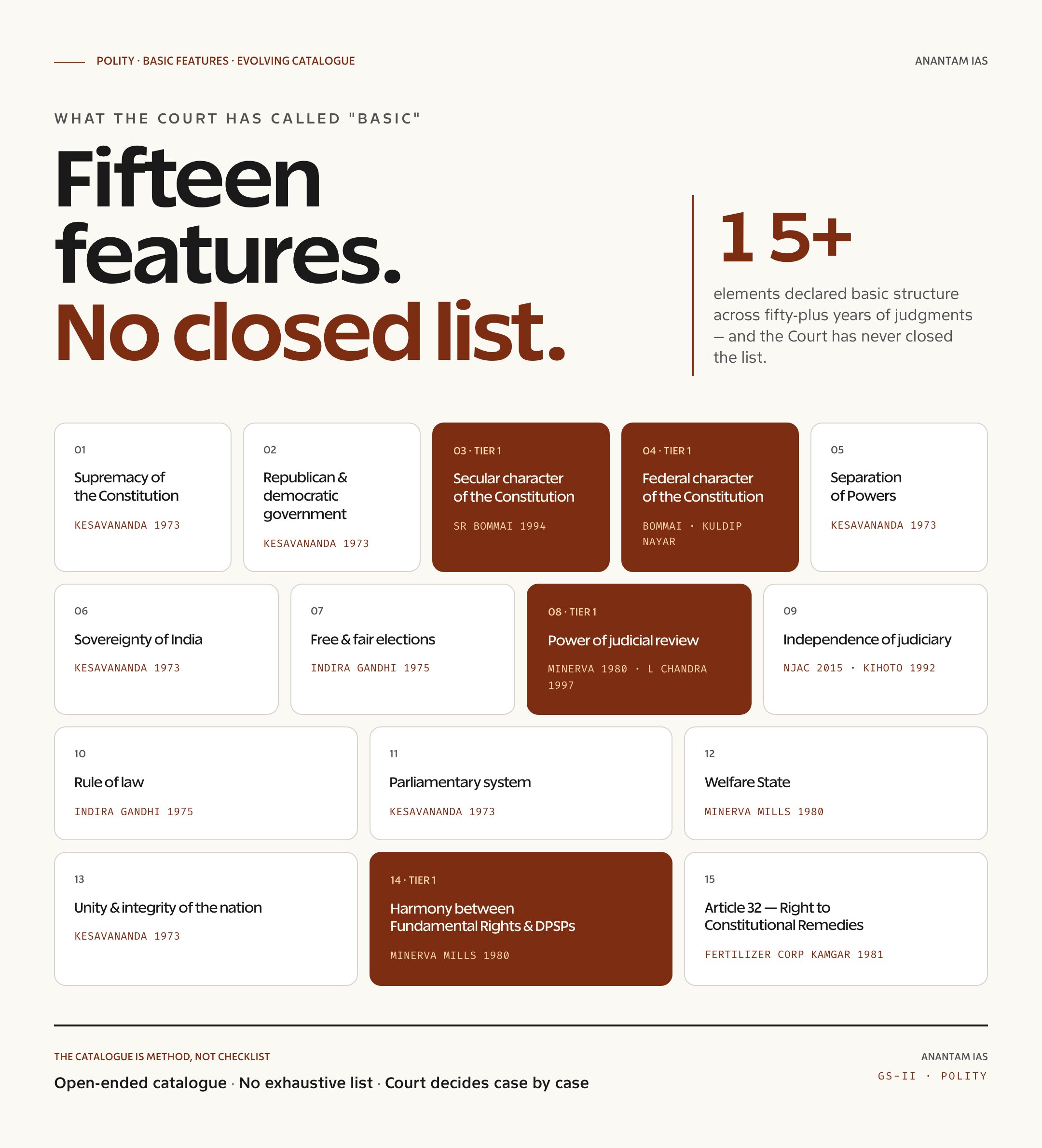
There is no exhaustive list. The Court has been careful never to give one. Across fifty years of rulings, the elements declared part of basic structure include:
- Supremacy of the Constitution
- Republican and democratic form of government
- Secular character of the Constitution
- Federal character of the Constitution
- Separation of powers between Legislature, Executive and Judiciary
- Sovereignty and unity of India
- Free and fair elections
- Independence of the judiciary
- Power of judicial review under Articles 32, 226 and 227
- Rule of law
- Parliamentary system of government
- Objectives in the Preamble
- Welfare State (socio-economic justice)
- Harmony and balance between Fundamental Rights and Directive Principles
- Limited amending power of Parliament under Article 368
- Substantive content of Articles 14, 19 and 21 read together
Different elements have been declared in different cases — secularism in S R Bommai (1994), free and fair elections in Indira Gandhi v Raj Narain (1975), independence of the judiciary reinforced in the NJAC judgment (2015), the "essence" of equality and personal liberty read in through I R Coelho (2007). The list is deliberately open. What survives across the cases is a method, not a checklist — identify the essential feature, ask whether the amendment damages that essence, decide.
Indira Nehru Gandhi v Raj Narain (1975) — First Application of the Doctrine
The Allahabad High Court set aside Indira Gandhi's election from Rae Bareli on 12 June 1975 for corrupt electoral practices. While her appeal was pending, Parliament — sitting during the Emergency — passed the 39th Amendment, inserting Article 329-A. Clause 4 placed the elections of the Prime Minister and Speaker beyond the jurisdiction of any court and required pending challenges to "be deemed to be void and shall be dismissed".
A five-judge bench (Ray CJ, Khanna, Mathew, Beg and Chandrachud JJ) struck down clause 4. This was the first time the doctrine was actually used to invalidate a constitutional amendment. Different judges identified different damaged features — democratic government, rule of law, free and fair elections, judicial review — but the conclusion was unanimous: an amendment that selectively shielded one election from any scrutiny destroyed the features that made the Constitution democratic. After Raj Narain, the doctrine had teeth.
Minerva Mills v Union of India (1980) — Strengthening the Doctrine
The 42nd Amendment of 1976, passed during the Emergency, was the most ambitious constitutional rewrite India has seen. Two of its provisions were aimed straight at Kesavananda. Section 4 expanded Article 31C to immunise all Directive Principles — not just 39(b) and 39(c) — from challenge under Articles 14 and 19. Section 55 amended Article 368, inserting clauses (4) and (5): clause (4) said no amendment "shall be called in question in any court on any ground"; clause (5) declared, for the avoidance of doubt, that there was no limitation whatsoever on Parliament's amending power.
In Minerva Mills v Union of India (1980), a five-judge bench led by CJI Y V Chandrachud struck down both sections. Limited amending power was itself a basic feature; you cannot use the limited power to make it unlimited. Section 55 was a transparent attempt to overrule Kesavananda by amendment, and it failed.
Justice P N Bhagwati's separate opinion is the textbook statement on Fundamental Rights and Directive Principles. The two together form the conscience of the Constitution; the harmony between them is itself a basic feature. An amendment that subordinates Part III entirely to Part IV destroys that balance.
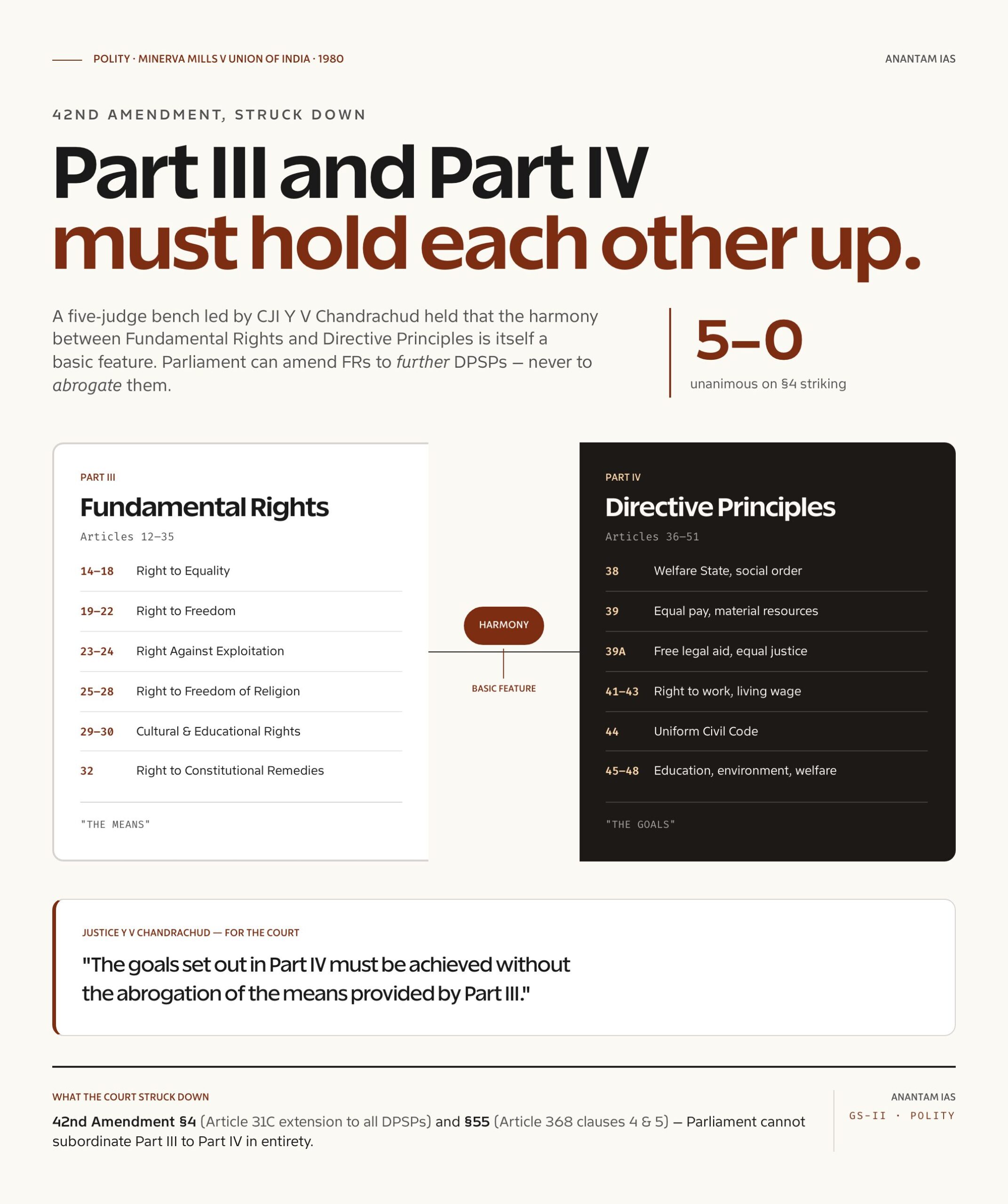
The shorthand attached to Minerva Mills — Parliament can amend Fundamental Rights to further Directive Principles, not to abrogate them — captures the net effect. For the wider 42nd Amendment context, see the 42nd amendment of the Indian Constitution.
Waman Rao v Union of India (1981) — Prospective Operation
The next question was practical. The Ninth Schedule, born of the First Amendment in 1951, already contained dozens of statutes placed beyond Articles 14, 19 and 31. Did the new doctrine apply to the entries already there?
In Waman Rao v Union of India (1981), a five-judge bench fixed 24 April 1973 — the date of Kesavananda — as the cut-off. Statutes inserted before that date were protected; litigants had relied on the existing law. Statutes inserted on or after 24 April 1973 were open to basic-structure challenge. The cut-off was a pragmatic compromise: it did not retrospectively unsettle land-reform statutes that had reshaped rural India, but it told future Parliaments that the Ninth Schedule was no longer a constitutional raincoat.
S R Bommai v Union of India (1994) — Federalism and Secularism
A nine-judge bench delivered S R Bommai v Union of India on 11 March 1994. The case concerned the imposition of President's Rule under Article 356 in several States, including Karnataka, Meghalaya, Nagaland and the three BJP-ruled States dismissed after the Babri Masjid demolition in December 1992.
Two basic-structure findings stand out. Federalism is a basic feature; the Centre cannot use Article 356 to dismiss elected State governments without satisfying objective material standards, and Presidential proclamations are subject to judicial review. Secularism is a basic feature; a State government that disregards the secular character of the Constitution can itself be a ground for action under Article 356. Bommai tightened Centre-State practice on Article 356 and put secularism on the basic-structure list, where it has stayed.
I R Coelho v State of Tamil Nadu (2007) — Ninth Schedule and Basic Structure
The Ninth Schedule question returned to a nine-judge bench in I R Coelho v State of Tamil Nadu (2007), decided on 11 January 2007. The Waman Rao cut-off stood — pre-1973 entries remained protected — but every Ninth Schedule entry made on or after 24 April 1973 had to be tested on basic-structure grounds, and the test was substantive. The Court applied the "rights test" and the "essence test": does the law, measured against Articles 14, 19 and 21 read together, damage the essence of any basic feature? If yes, placement in the Ninth Schedule is no protection. Coelho effectively closed the Ninth Schedule as a sanctuary.
Kihoto Hollohan v Zachilhu (1992) — Anti-Defection and Judicial Review
The Tenth Schedule, inserted by the 52nd Amendment in 1985, set up the anti-defection regime. Paragraph 7 said that no court — Supreme Court or High Courts — had any jurisdiction over disqualification proceedings under it.
In Kihoto Hollohan v Zachilhu (1992), a five-judge bench upheld the Tenth Schedule but struck down paragraph 7 by 3-2. Paragraph 7, in ousting writ jurisdiction under Articles 226 and 136, attempted to take judicial review off the table. Judicial review is a basic feature; an amendment cannot extinguish it. The Speaker's decision on disqualification therefore remains subject to judicial review on the standard grounds — mala fides, perversity, violation of natural justice, ultra vires. The judgment is also one of the cleanest illustrations of how the doctrine prunes a single offending sub-clause without disturbing the rest of an amendment.
NJAC Judgment (2015) — Independence of Judiciary
The 99th Amendment of 2014 and the NJAC Act 2014 replaced the Collegium with a six-member National Judicial Appointments Commission — the CJI, two senior-most Supreme Court judges, the Union Law Minister, and two "eminent persons" jointly chosen by a panel including the Prime Minister and Leader of the Opposition.
In Supreme Court Advocates-on-Record Association v Union of India (2015), a five-judge bench struck down both the 99th Amendment and the NJAC Act by 4-1. The majority — Khehar, Lokur, Goel and Joseph JJ — held that independence of the judiciary, of which judicial primacy in appointments is an integral part, is a basic feature; the inclusion of the Law Minister and a veto-style mechanism for the eminent persons damaged that feature. Justice Chelameswar dissented, arguing that the Collegium itself had serious accountability deficits. The NJAC judgment is the most consequential application of the doctrine in the past two decades.
What Is NOT Part of Basic Structure
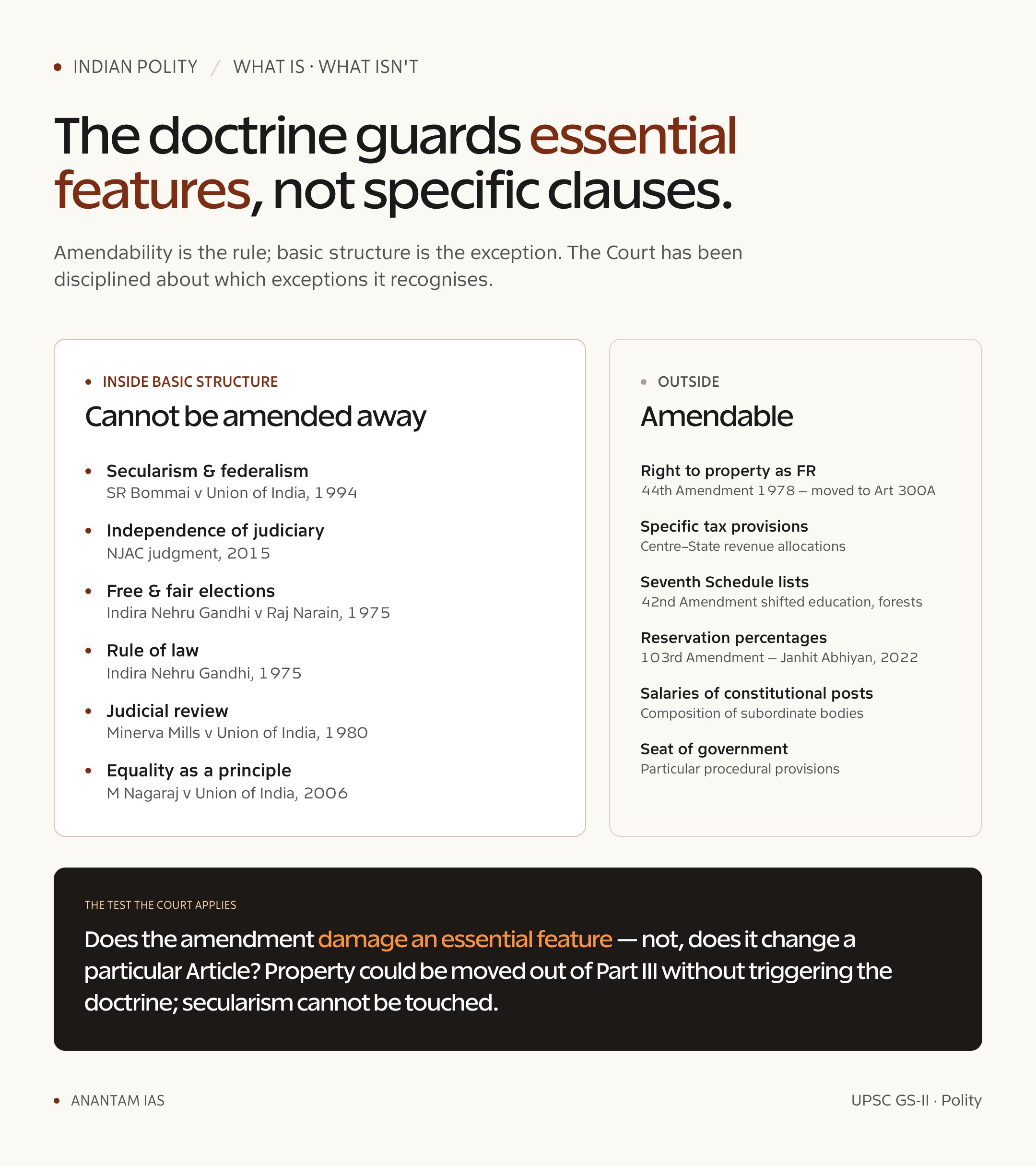
The doctrine is selective, not blanket. The Court has explicitly held that several things are not part of basic structure:
- Right to property as a Fundamental Right. The 44th Amendment (1978) deleted Article 19(1)(f) and Article 31, moving property out of Part III and into Article 300A as a constitutional right. The shift was treated as a permissible amendment.
- Specific tax provisions and revenue allocations governing Centre-State financial relations at the level of detail.
- The distribution of subjects across the Seventh Schedule lists. Federalism is basic structure; the precise carving up of Lists I, II and III is not. The Constitution can be — and has been — amended to move items between lists, as the 42nd Amendment did with education and forests. See the Seventh Schedule of the Indian Constitution.
- Reservation policy at the level of percentages and categories. The 103rd Amendment, which introduced 10% EWS reservation, was upheld by a Constitution Bench in Janhit Abhiyan (2022); economic-criteria reservation and a State-prescribed ceiling were not held to damage basic structure. See the 103rd amendment of the Indian Constitution.
- Particular provisions such as the seat of government, salaries of constitutional functionaries, or composition of subordinate bodies.
Amendability is the rule; the doctrine is the exception. The Court has been disciplined about which exceptions it recognises.
Comparison with Other Constitutions
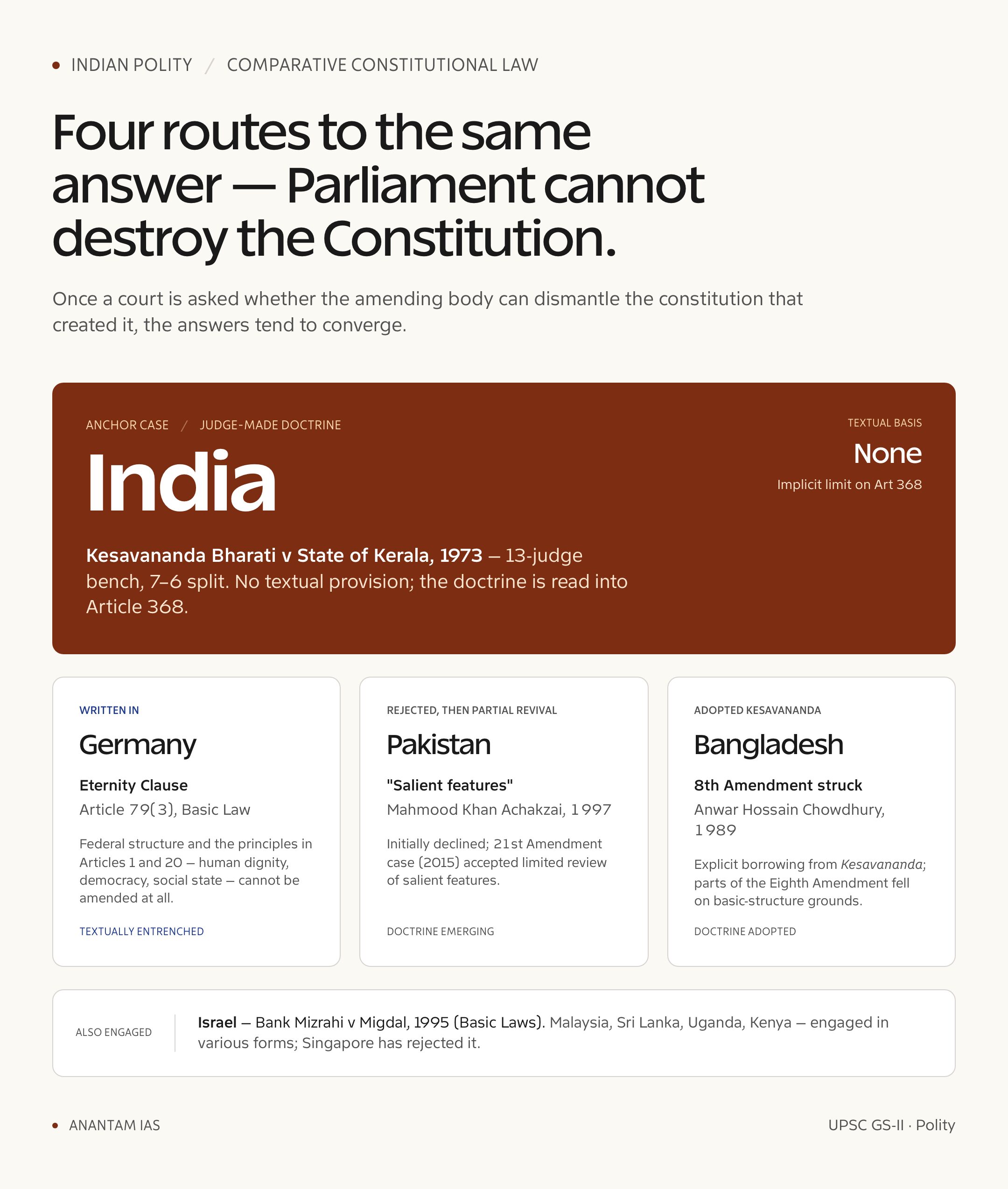
India's doctrine is judge-made. Other systems reach similar destinations by different routes.
- Germany has the only major written equivalent. Article 79(3) of the Basic Law — the "Eternity Clause" — declares that the federal structure and the principles in Articles 1 and 20 (human dignity, democracy, federal republic, social state, rule of law) cannot be amended at all. India's doctrine is read in; Germany's is written down.
- Pakistan initially rejected the doctrine in Mahmood Khan Achakzai v Federation of Pakistan (1997). It has shifted since — in Sindh High Court Bar Association (2009) and the 21st Amendment case (2015), the Court accepted "salient features" amenable to limited review.
- Bangladesh adopted the doctrine in Anwar Hossain Chowdhury v Bangladesh (1989), striking down parts of the Eighth Amendment — an explicit borrowing from Kesavananda.
- Israel accepted a form of the doctrine in Bank Mizrahi v Migdal (1995), applied to its Basic Laws.
- Malaysia, Sri Lanka, Uganda and Kenya have engaged with the doctrine in various forms; Singapore has rejected it.
Once a constitutional court is asked whether the amending body can destroy the constitution that created it, the answers tend to converge on no.
Criticism of the Doctrine
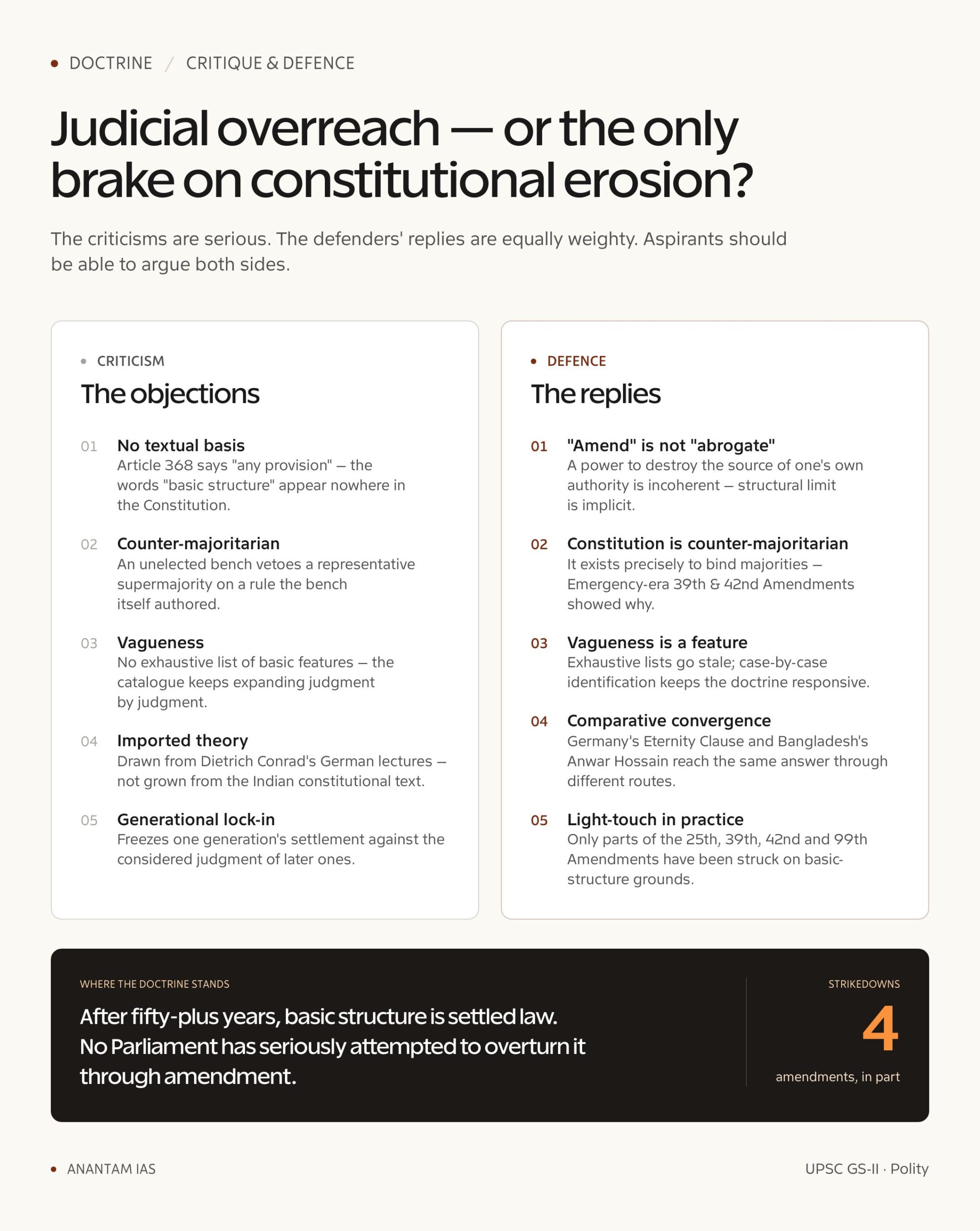
The criticisms are serious. Textual — Article 368 says "any provision of the Constitution" and the words "basic structure" appear nowhere; on this reading, the doctrine is a judicial graft. Democratic — an Article 368 amendment needs a special majority in both Houses, entrenched amendments need half the States, and there is a genuine question about an unelected bench vetoing a representative supermajority on a rule the bench itself authored. Vagueness — the Court has refused to commit to an exhaustive list, which critics say licenses the Court to declare almost anything basic when it suits. Counter-majoritarian risk — if a future Parliament is committed to fundamental change, the doctrine could freeze one generation's settlement against later ones.
The defenders' replies are equally weighty. "Any provision" cannot mean "destroy the Constitution itself" — a power to destroy the source of one's own authority is incoherent. The Constitution is itself a counter-majoritarian instrument. The vagueness is a feature; exhaustive lists go stale. And the rule is light-touch: in fifty-plus years, only parts of the 25th, 39th, 42nd and 99th Amendments have been struck down on basic-structure grounds.
Why the Doctrine Matters Today
The doctrine is not a 1970s artefact. In recent years it has framed the most important constitutional disputes:
- Article 370 abrogation. The Presidential Orders of 5 August 2019 and the Jammu and Kashmir Reorganisation Act 2019 were challenged on multiple grounds, including federalism and democratic process as basic structure. In In Re Article 370 (December 2023), a five-judge bench upheld the abrogation.
- Electoral bonds. Association for Democratic Reforms v Union of India (February 2024) struck down the electoral bonds scheme. The judgment leaned on free and fair elections — a basic feature — to anchor the proportionality analysis under Article 19(1)(a).
- Citizenship Amendment Act. The CAA 2019 challenge, pending before a Constitution Bench, raises a secularism argument — whether a citizenship route using religion as a classifier damages secularism as essential character.
- EWS reservation. Janhit Abhiyan v Union of India (2022) upheld the 103rd Amendment by 3-2; the dissent rested on basic-structure damage to equality.
- Same-sex marriage. Supriyo v Union of India (2023) declined to recognise marriage equality through judicial declaration, on a separation-of-powers reading that itself draws on basic-structure principles.
As of 2026, the doctrine is the standing test. Every consequential constitutional amendment of the past decade has either passed or failed it.
UPSC Relevance
The doctrine is dense Mains material and steady Prelims material.
Prelims facts:
- Kesavananda Bharati v State of Kerala — judgment 24 April 1973, 13 judges, 7-6 majority, CJI S M Sikri leading.
- Indira Gandhi v Raj Narain (1975) — 39th Amendment, Article 329-A clause 4 struck down.
- Minerva Mills (1980) — 42nd Amendment Sections 4 and 55 struck down.
- Waman Rao (1981) — 24 April 1973 cut-off for Ninth Schedule.
- Kihoto Hollohan v Zachilhu (1992) — paragraph 7 of Tenth Schedule struck down.
- S R Bommai (1994) — secularism declared basic feature; 9-judge bench.
- I R Coelho (2007) — post-1973 Ninth Schedule entries open to basic-structure review; 9-judge bench.
- NJAC Judgment (2015) — 99th Amendment struck down 4-1.
- Article 368 carries procedural limits (special majority, ratification) and, after Kesavananda, a substantive limit (basic structure).
Mains hook lines:
- The doctrine reframes Article 368 from procedure to identity.
- Limited amending power is itself basic structure — Minerva Mills.
- The Ninth Schedule is no longer a sanctuary after I R Coelho.
- Independence of the judiciary is structural, not merely institutional — NJAC.
Anchor your wider prep in the Indian Polity hub and the chapter map on Fundamental Rights and articles.
Mains Practice Questions
Q1. (150 words / 10 marks). "The basic structure doctrine is a judicial response to a textual silence in Article 368." Examine the doctrine's origin in pre-1973 case law and explain why a constitutional amendment that satisfies Article 368's procedural requirements can still be struck down.
Q2. (250 words / 15 marks). Critically evaluate the basic structure doctrine as a check on Parliament's constituent power. Bring out, with reference to at least four post-Kesavananda decisions, how the doctrine has been applied. Should the doctrine be codified in the text of the Constitution?
Conclusion
The basic structure doctrine is India's answer to a question every written constitution faces: what stops the document from being amended out of existence? Other systems answer with eternity clauses, super-supermajorities, referendums. India's answer is judicial — a 13-judge bench in 1973, a 7-6 verdict, a phrase from Justice H R Khanna's opinion.
The doctrine has held for fifty-three years through Emergencies, supersession of judges, frontal political assaults, and good-faith disagreement about what counts as basic. It has matured into the test by which every consequential amendment is now judged. For UPSC, it is the single most important conceptual lens for GS-II Polity. For the rest of us, it is the rule that makes the Constitution's central promise — that the document outlasts any single political moment — credible.
For the case-level deep dive, see the Kesavananda Bharati case. For the document itself, see the Constitution of India book and how many fundamental rights are there in the Indian Constitution.
Frequently Asked Questions
Q1. What is the basic structure doctrine in simple words?
Parliament can amend the Constitution under Article 368, but it cannot use that power to destroy the Constitution's essential framework — features like supremacy of the Constitution, secularism, federalism, separation of powers, free and fair elections, judicial review, and rule of law.
Q2. In which case was the basic structure doctrine first laid down?
Kesavananda Bharati v State of Kerala (1973), decided on 24 April 1973 by a 13-judge bench, 7-6 majority. Justice H R Khanna's swing opinion gave the doctrine its name — "basic structure or framework".
Q3. Are "basic features" listed anywhere in the Constitution?
No. The phrase "basic structure" is not in the Constitution. The Supreme Court has built up the list case by case and has never claimed to give an exhaustive one.
Q4. Can Fundamental Rights be amended?
Yes. Kesavananda Bharati overruled Golaknath (1967) on this point. Parliament can amend Part III, but the amendment must not damage basic structure — for example, the essence of equality (Article 14), liberty (Article 21), or judicial review under Articles 32 and 226.
Q5. What did the Minerva Mills case decide?
It struck down Sections 4 and 55 of the 42nd Amendment (1976). Section 4 had expanded Article 31C to immunise all DPSP-implementing laws from Articles 14 and 19; Section 55 had inserted clauses (4) and (5) into Article 368 to declare unlimited amending power. Limited amending power is itself basic structure, and the FR-DPSP balance cannot be destroyed.
Q6. What is the Waman Rao cut-off?
In Waman Rao (1981), the Court held that Ninth Schedule entries made before 24 April 1973 are protected from basic-structure challenge; entries made on or after that date are open to scrutiny.
Q7. Is judicial review part of basic structure?
Yes — confirmed in Kihoto Hollohan (1992) and the NJAC judgment (2015). An amendment cannot oust the Court's writ jurisdiction in matters affecting fundamental rights or constitutional limits.
Q8. Is the right to property part of basic structure?
No. The 44th Amendment (1978) moved property out of Part III into Article 300A as a constitutional right. The shift has not been treated as basic-structure damage.
Q9. Did I R Coelho change the Ninth Schedule?
Yes. The 9-judge bench in I R Coelho (2007) held that any law placed in the Ninth Schedule on or after 24 April 1973 must pass a substantive basic-structure test measured against Articles 14, 19 and 21 read together.
Q10. What was the NJAC judgment about?
The 99th Amendment of 2014 had replaced the Collegium with a six-member National Judicial Appointments Commission. In 2015 a five-judge bench struck it down 4-1: independence of the judiciary, including primacy in appointments, is basic structure.
Q11. Why do critics object to the doctrine?
Main objections are textual (the words "basic structure" are not in the Constitution), democratic (an unelected bench overrides a representative supermajority), and definitional (the list is judge-controlled). Defenders reply that a power to destroy the Constitution from inside is incoherent, the Constitution is itself counter-majoritarian, and the doctrine has been used sparingly.
Q12. Has the doctrine been applied recently?
Yes — In Re Article 370 (2023), the electoral bonds judgment (2024), Janhit Abhiyan (2022), and Supriyo (2023) have all engaged basic-structure reasoning. The doctrine remains the standing constitutional test as of 2026.