Disclosure: this guide contains Amazon affiliate links. As an Amazon Associate, Anantam IAS earns from qualifying purchases — at no extra cost to you.
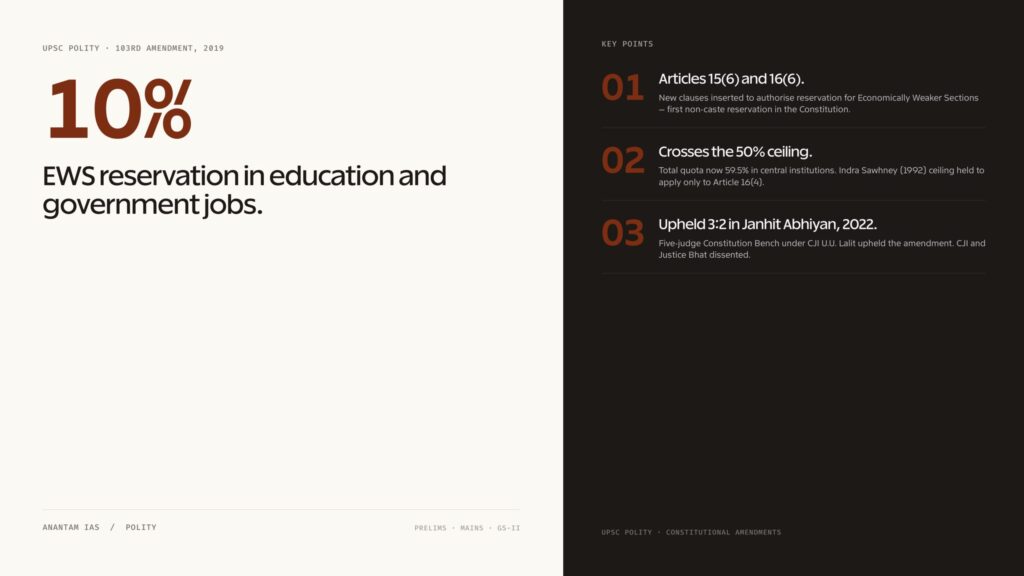
The 103rd amendment of indian constitution is the only reservation amendment in independent India that is not based on caste. It carved out a 10% quota for Economically Weaker Sections (EWS) in education and government jobs — and crucially, it excluded Scheduled Castes, Scheduled Tribes, and Other Backward Classes from this benefit. Most aspirants memorise the 10% number and stop there. That’s a Mains marks-loss waiting to happen… because the real story is in the constitutional articles it added (15(6) and 16(6)), the criteria it set (Rs 8 lakh annual family income), and the Janhit Abhiyan v. Union of India (2022) verdict where a Constitution Bench upheld it 3:2. Here’s the full read — provisions, eligibility, judicial test, dissents, and where it shows up in the exam.
What is the 103rd Amendment of Indian Constitution?
The Constitution (One Hundred and Third Amendment) Act, 2019 introduced a 10% reservation in educational institutions (private and unaided too) and government jobs for the Economically Weaker Sections (EWS) of citizens not already covered by existing SC, ST, or OBC reservations. The Act amended Article 15 and Article 16 of the Indian Constitution, inserting new sub-clauses 15(6) and 16(6).
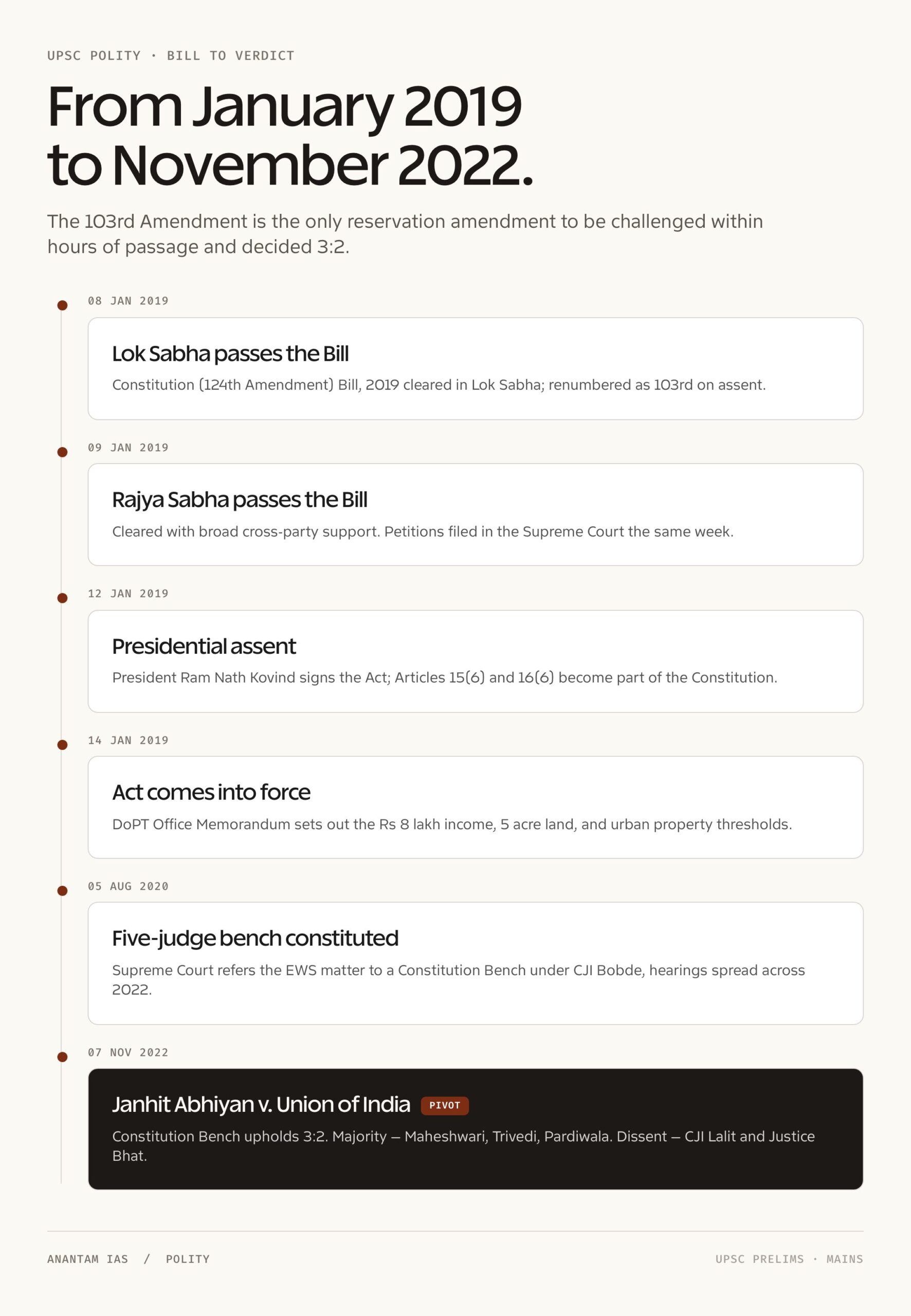
The Bill was introduced as the Constitution (124th Amendment) Bill, 2019. It was passed by Lok Sabha on 8 January 2019 and Rajya Sabha on 9 January 2019, and received Presidential assent from Ram Nath Kovind on 12 January 2019. The Act came into force on 14 January 2019.
Three quick factual triples for revision:
- 103rd Amendment — 2019 — 10% EWS reservation in education and government jobs.
- Article 15(6) and Article 16(6) — new clauses added; together they form the constitutional basis for EWS reservation.
- Janhit Abhiyan v. Union of India (2022) — Supreme Court Constitution Bench upheld the amendment by a 3:2 majority on 7 November 2022.
Why was the 103rd Amendment passed?
OK, let’s set the political context. India’s reservation framework — built over decades through SC, ST, and OBC quotas — leaves the general category (people not classified as SC/ST/OBC) outside the reservation system entirely. The Modi government argued that economically weak sections within this general category needed a similar booster… and the 50% Indra Sawhney ceiling was the obstacle.
The 50% reservation ceiling laid down by the Supreme Court in Indra Sawhney v. Union of India (1992) was the obvious obstacle. The 103rd Amendment took a different route: it created a separate 10% slot, taking the total beyond 50%. The argument? The 50% ceiling applies to caste-based reservations under Article 16(4), not to a new economic-criteria reservation under a new Article 16(6).
Three reasons this amendment is loaded for UPSC:
- First non-caste reservation in the constitutional scheme.
- First time the 50% ceiling was crossed with explicit constitutional sanction — taking the total quota to 59.5% in central institutions.
- First time private and unaided educational institutions were brought into the reservation framework via constitutional amendment for general-category beneficiaries.
For the broader reservation framework, see Analysis of Reservation in India.
What did the 103rd amendment of indian constitution change?
The 103 amendment of indian constitution amended exactly two articles — but the consequences are wide. Here’s the precise text and effect.
1. Article 15(6) — reservation in educational institutions
A new clause (6) was inserted into Article 15. It empowers the State to make special provisions, including reservations of up to 10%, for the advancement of “any economically weaker sections of citizens” other than the classes already mentioned in Article 15(4) and 15(5) — i.e., other than SCs, STs, and socially and educationally backward classes.
The reservation extends to admissions in:
- Government educational institutions.
- Aided educational institutions.
- Private unaided educational institutions — which is the constitutional novelty, since SC/ST/OBC reservations under Article 15(5) had already been extended here, but EWS is now a separate parallel head.
- Excluded: minority educational institutions referred to in Article 30(1).
For the full reading of Articles 15 and 16, see the linked deep-dive.
2. Article 16(6) — reservation in government employment
A new clause (6) was inserted into Article 16. It empowers the State to make provision for reservation of appointments or posts in favour of “any economically weaker sections of citizens” — other than the classes mentioned in Article 16(4) — in addition to the existing reservation, subject to a maximum of 10% of the posts in each category.
This is the parallel to Article 16(4) — but explicitly for EWS. Read it alongside Article 16 — Equality of Opportunity.
Who qualifies as EWS? The eligibility criteria
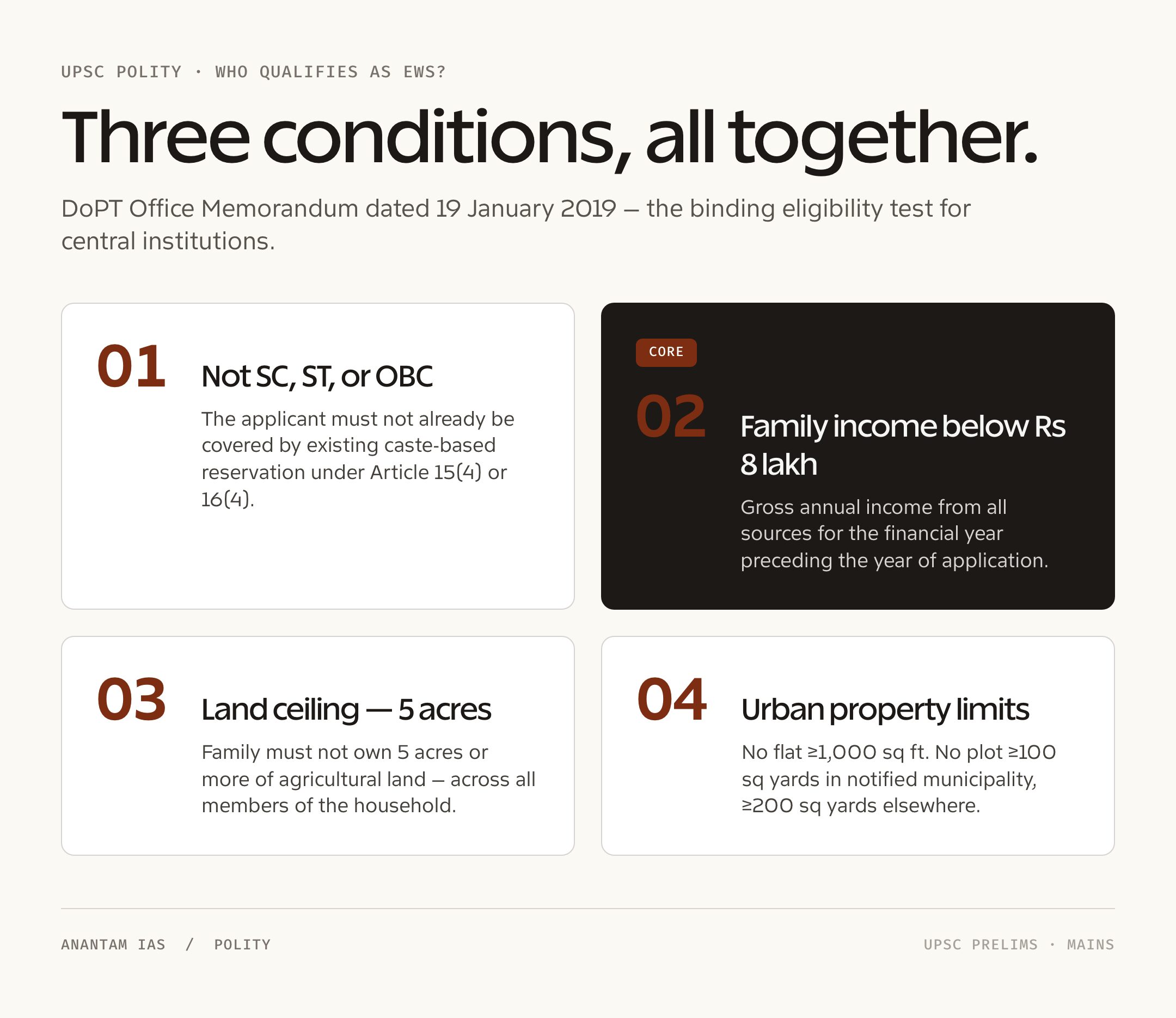
The amendment leaves “economically weaker sections” to be defined by the State based on family income and other indicators. The Department of Personnel and Training (DoPT) Office Memorandum dated 19 January 2019 set out the criteria for central government posts and central educational institutions.
A person belongs to EWS if all three conditions are met:
- Family does not belong to SC/ST/OBC — the person must not already be covered by existing caste-based reservation.
- Annual family income is below Rs 8 lakh — gross income from all sources for the financial year preceding the year of application.
- Family does not own — any of the following: – 5 acres or more of agricultural land; – Residential flat of 1,000 sq. ft. or more; – Residential plot of 100 sq. yards or more in a notified municipality; – Residential plot of 200 sq. yards or more in areas other than notified municipalities.
“Family” includes the applicant, parents, siblings below 18 years, spouse, and children below 18 years. For full background, see EWS Full Form: Economically Weaker Section guide.
The Sinho Commission (2010) had earlier studied the question of economic backwardness; the Pandey Committee (2019), constituted after the amendment, refined the income and asset criteria.
EWS vs SC/ST/OBC — comparison
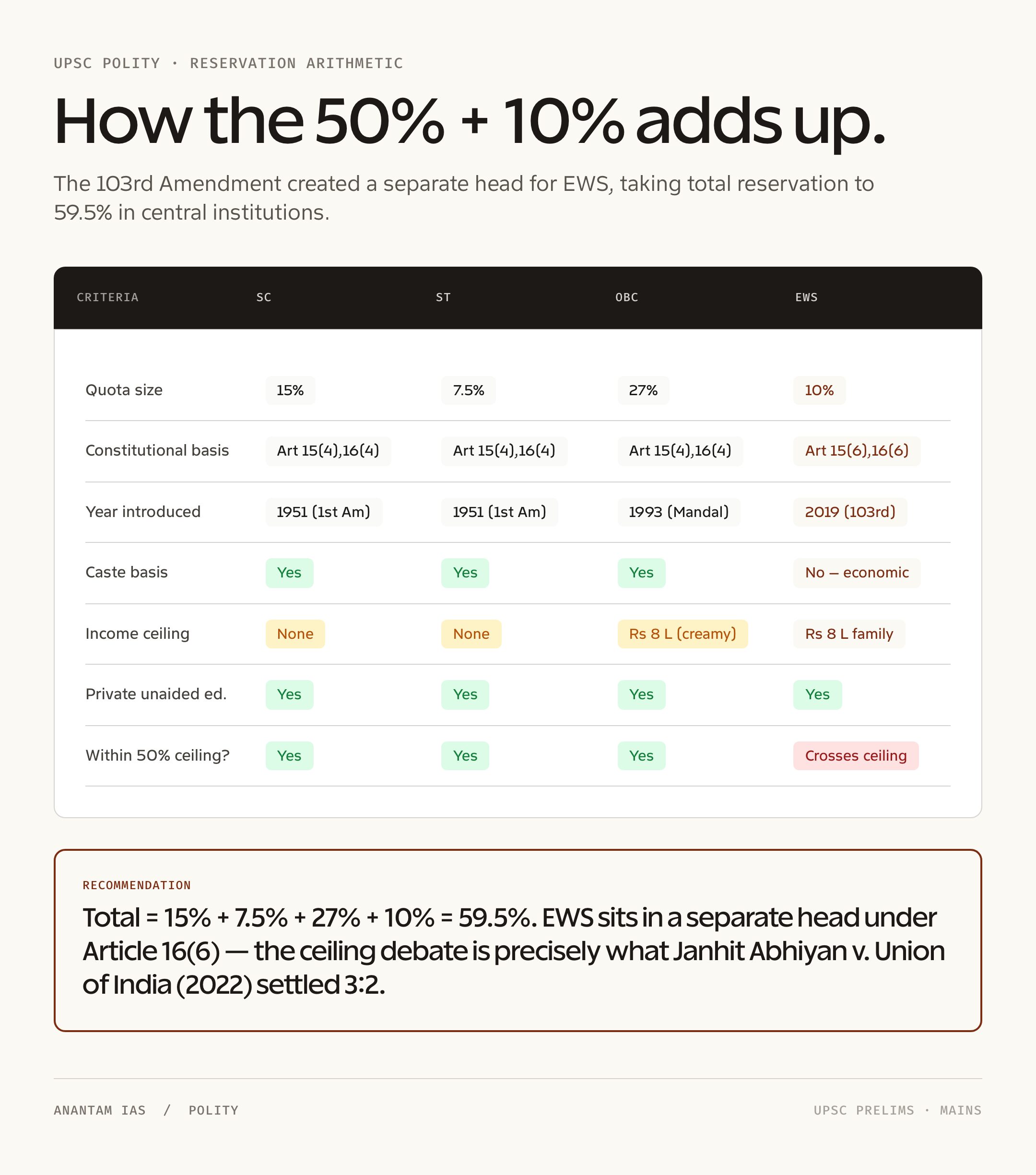
This table is what aspirants need for any 10-marker on the difference between caste-based and economic-criteria reservation.
| Parameter | EWS Reservation (103rd Amendment) | SC/ST Reservation | OBC Reservation |
|---|---|---|---|
| Constitutional basis | Articles 15(6), 16(6) | Articles 15(4), 16(4), 16(4A), 16(4B), 335 | Articles 15(4), 15(5), 16(4) |
| Year introduced | 2019 | 1950 (Articles 15(4) added by 1st Amendment, 1951) | Mandal report adopted 1990; OBC central jobs reservation 1993 |
| Quota size | 10% | 15% (SC), 7.5% (ST) | 27% |
| Applies to private unaided institutions | Yes (except minority) | Yes (15(5), 93rd Amendment, 2005) | Yes |
| Income criterion | Yes — Rs 8 lakh family income | No | Yes — creamy layer Rs 8 lakh |
| Caste criterion | Excludes SC/ST/OBC | Caste-based | Caste-based |
| Total + EWS in central jobs (2026) | 10% | 22.5% (combined) | 27% |
| 50% ceiling status | Crosses ceiling (total 59.5%) | Within original ceiling | Within ceiling |
Janhit Abhiyan v. Union of India (2022) — the constitutional test
Honestly, you cannot answer any Mains question on the 103rd Amendment without Janhit Abhiyan. The amendment was challenged within hours of its passage… and stayed in litigation for nearly four years. The petitioners — including Janhit Abhiyan, Youth for Equality, and several political parties — argued three points:
- Reservation based purely on economic criteria violates the basic structure of the Constitution.
- Excluding SCs, STs, and OBCs from EWS benefits violates the equality code.
- Crossing the 50% ceiling laid down in Indra Sawhney (1992) damages the basic structure.
A five-judge Constitution Bench led by then Chief Justice U.U. Lalit delivered the verdict on 7 November 2022. The split was 3:2 in favour of upholding the amendment.
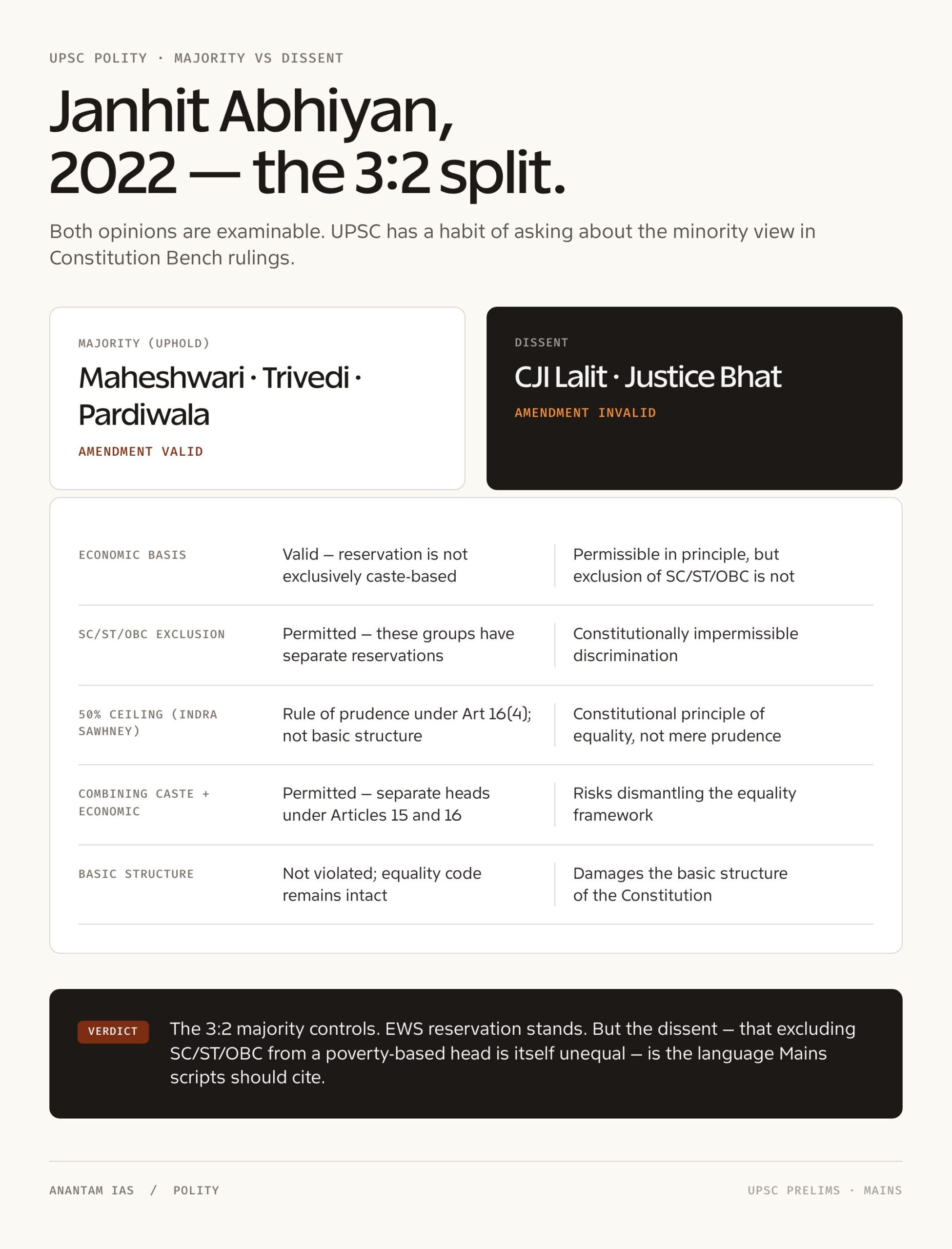
Majority (uphold) — Justices Dinesh Maheshwari, Bela Trivedi, J.B. Pardiwala:
- Economic criteria can be a valid basis for reservation; reservation is not exclusively caste-based.
- Excluding SC/ST/OBC from EWS does not violate equality, because they already have separate reservations.
- The 50% ceiling is a rule of prudence under Article 16(4), not part of the basic structure; Parliament can create a separate 10% beyond it.
Dissent — Chief Justice U.U. Lalit and Justice S. Ravindra Bhat:
- Excluding SC/ST/OBC from EWS reservation is constitutionally impermissible discrimination, even if they have other reservations.
- The 50% ceiling is a constitutional principle of equality, not a mere rule of prudence.
- Allowing the State to combine caste-based and economic reservations risks dismantling the equality framework.
The majority view prevailed. The amendment stands. But the dissent is itself examinable… UPSC has a habit of asking about minority opinions in landmark cases. Read the full text on Indian Kanoon if you want the language for a Mains-grade quote.
For the underlying basic structure doctrine from Kesavananda Bharati Case (1973), see the linked deep-dive.
Why this matters for UPSC
Three exam zones to know cold:
- Prelims — Article numbers (15(6), 16(6)), year of assent (2019), the 10% number, the EWS criteria (Rs 8 lakh, 5 acres, 1,000 sq. ft.). UPSC asked an EWS-related question in CSE Prelims 2020.
- Mains GS Paper II — “Critically examine the validity of reservation based on economic criteria. Refer to Janhit Abhiyan v. Union of India (2022).” Or: “Has the 103rd Amendment damaged the basic structure of the Constitution?” Both are asked in mock papers and have appeared in PYQ-style framings.
- Essay / Ethics — GS IV — Equality of opportunity, distributive justice, reservation philosophy. The 103rd Amendment is the modern hook for an old debate.
Look, I’ve watched aspirants lose easy marks here for one reason — they argue the political merits of EWS reservation instead of the constitutional question. Examiners want the legal reasoning… cite the article numbers, cite Janhit Abhiyan, cite the dissent. Then add your view in two sentences.
Common misconceptions
Myth 1: “EWS reservation is available to anyone earning under Rs 8 lakh.” Wrong. Family income under Rs 8 lakh is one of three conditions. The applicant must also not belong to SC/ST/OBC, and the family must meet the land and house thresholds. All three together.
Myth 2: “The 103 amendment of indian constitution adds reservation only in government jobs.” Wrong. It applies to admissions in private unaided educational institutions too — that’s the explicit text of Article 15(6). Minority institutions under Article 30(1) are excluded.
Myth 3: “The 103rd Amendment crossed the 50% ceiling, which is unconstitutional.” Half-true and contested. The Supreme Court in Janhit Abhiyan (2022) held by 3:2 that the 50% ceiling under Indra Sawhney (1992) applies to Article 16(4) reservations, and the EWS reservation under Article 16(6) is a separate head. The dissent disagreed.
Myth 4: “EWS includes economically poor SC/ST/OBC families.” Wrong. The amendment specifically excludes SC, ST, and OBC categories from EWS benefits. They access reservations under Articles 15(4), 16(4), and the OBC framework — not 15(6) or 16(6).
Myth 5: “The 103th amendment of indian constitution was passed in 2018.” Wrong. It was passed by both Houses on 8–9 January 2019 and received assent on 12 January 2019.
How to revise this in 30 minutes
Source priority for Mains-grade depth:
- Laxmikanth — *Indian Polity* — Chapter on amendments and reservation.
- PRS Legislative Brief — Constitution (One Hundred and Third Amendment) Act, 2019.
- Janhit Abhiyan v. Union of India (2022) — read the full Supreme Court judgment summary, both majority and dissent, on Indian Kanoon or the Supreme Court Observer site.
- Indian Express explainers on the EWS verdict (November 2022 archives).
- DoPT Office Memorandum dated 19 January 2019 for the exact eligibility criteria.
Make a one-page note with: Articles 15(6) and 16(6), Rs 8 lakh income, three asset thresholds, Janhit Abhiyan verdict and split, and the 50% ceiling argument. That’s any 10-marker.
Frequently Asked Questions
When did the 103rd Amendment of Indian Constitution come into force?
The Act received assent from President Ram Nath Kovind on 12 January 2019 and came into force on 14 January 2019.
What is the EWS quota under the 103rd Amendment?
It is a 10% reservation in admissions to educational institutions (including private unaided) and government appointments, for citizens belonging to economically weaker sections who are not already covered by SC, ST, or OBC reservations.
Which articles did the 103rd Amendment add?
It inserted Article 15(6) — reservation in educational institutions — and Article 16(6) — reservation in public employment — into the Constitution.
Did the Supreme Court uphold the 103rd Amendment?
Yes. In Janhit Abhiyan v. Union of India, decided on 7 November 2022, a five-judge Constitution Bench upheld the amendment by a 3:2 majority. CJI U.U. Lalit and Justice Ravindra Bhat dissented.
What are the income and asset criteria for EWS reservation?
Family income below Rs 8 lakh, ownership of less than 5 acres of agricultural land, no residential flat of 1,000 sq. ft. or more, no residential plot of 100 sq. yards or more in a notified municipality, and the family must not belong to SC, ST, or OBC.
Why is EWS reservation controversial?
Because it is the first non-caste reservation, it crosses the 50% ceiling laid down in Indra Sawhney (1992), and it excludes SC, ST, and OBC families from EWS benefits — a point on which the Janhit Abhiyan dissent strongly objected.
Does EWS reservation apply to private institutions?
Yes. Under Article 15(6), EWS reservation extends to admissions in private unaided educational institutions, except those covered by Article 30(1) (minority educational institutions).
What is the total reservation in central government jobs after the 103rd Amendment?
The combined reservation now stands at approximately 59.5% in central institutions: 15% SC + 7.5% ST + 27% OBC + 10% EWS.
Tell Google you want more of this.
Add Anantam IAS as a preferred sourceOne tap, and this site shows up more often in your own Top Stories, AI Overviews and AI Mode. Remove it any time.