Disclosure: this guide contains Amazon affiliate links. As an Amazon Associate, Anantam IAS earns from qualifying purchases — at no extra cost to you.
You searched for first amendment of Indian Constitution because you want to know what it did, why it was rushed through within 16 months of the Constitution coming into force, and how it became the template for every controversial amendment that followed. Most coaching notes treat it as “added Ninth Schedule, restricted free speech, end of story”… that’s three lines for a 5-mark Mains anchor. The First Amendment, 1951 was passed by the Provisional Parliament under Nehru — not by an elected Lok Sabha — and it was a direct reaction to Romesh Thappar (1950) and the Patna HC striking down Bihar’s Land Reforms Act. This article gives you the full context, the Article-by-Article changes, and the basic-structure connection examiners love to test.
What is the First Amendment of the Indian Constitution?
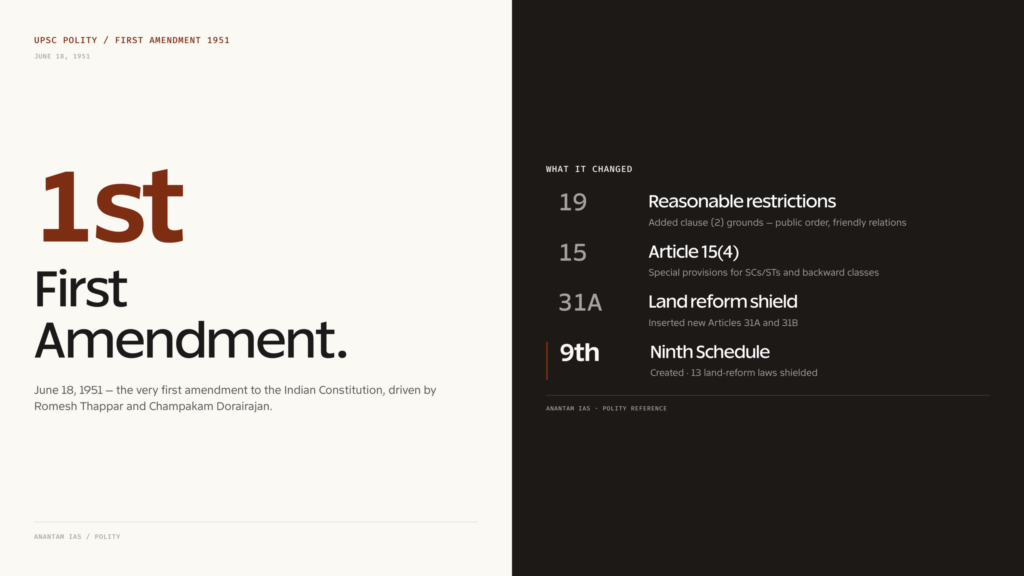
The Constitution (First Amendment) Act, 1951 was the very first amendment to the Indian Constitution. It was moved by Prime Minister Jawaharlal Nehru on May 10, 1951 and enacted on June 18, 1951. It modified Articles 15, 19, 31, 85, 87, 174, 176, 341, 342, 372, and 376. It added Articles 31A and 31B, and the Ninth Schedule. Its three big jobs: protect zamindari abolition laws, restrict free speech, and authorise special provisions for backward classes.
- First Amendment — June 18, 1951 — passed by the Provisional Parliament before the first general elections.
- Added Articles 31A, 31B, and the Ninth Schedule.
- Restricted Article 19(1)(a) by adding “public order” and “incitement to an offence” to Article 19(2).
The constitutional context — three crises Nehru wanted to solve
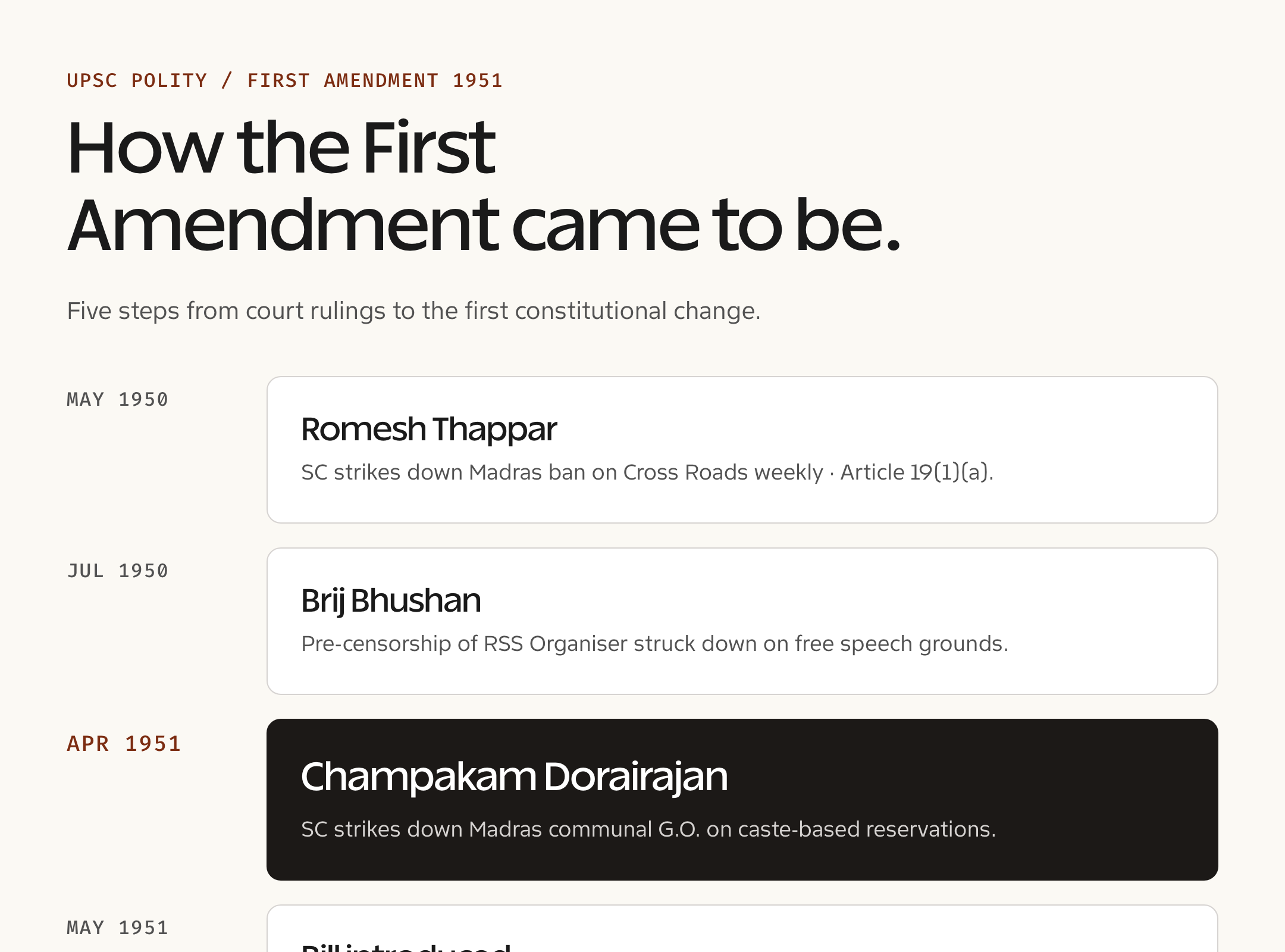
The First Amendment didn’t appear in a vacuum. Three concurrent legal storms forced it.
Crisis 1 — Land reforms hitting walls
State after state passed zamindari abolition laws — Bihar (1950), UP (1951), MP (1950). Zamindars rushed to courts. The Patna High Court struck down the Bihar Land Reforms Act, 1950 in Kameshwar Singh v. State of Bihar — finding it violated Article 14 because it classified zamindars unequally for compensation purposes. The Allahabad and Nagpur High Courts followed similar logic.
This was a national problem… if land reform — the central plank of Congress policy — could be struck down on Article 14 grounds, the entire socio-economic agenda was paralysed.
Crisis 2 — Free speech vs internal security
Two cases gutted the government’s speech regulation power.
- Romesh Thappar v. State of Madras (1950) — The Madras government banned the entry of Thappar’s left-leaning weekly Cross Roads under the Madras Maintenance of Public Order Act. The SC struck down the ban — Article 19(2) at the time only allowed restrictions on free speech for matters that undermined the security of the State or tended to overthrow it. “Public order” was not a permissible ground.
- Brij Bhushan v. State of Delhi (1950) — Pre-censorship of the RSS magazine Organiser. Same reasoning. Struck down.
These two judgments together meant that ordinary public-order regulation of speech was unconstitutional. Communal riots, defamation laws, sedition under IPC 124A — all suddenly vulnerable.
Crisis 3 — Reservation under attack
In State of Madras v. Champakam Dorairajan (1951), the SC struck down the Madras Communal Government Order which reserved seats in medical and engineering colleges by community. Held: violates Article 29(2). Reservation policy was now legally questionable.
Three crises. One amendment… that’s the design logic.
What the First Amendment actually did — provision by provision
Read this carefully. Every clause matters for Prelims.
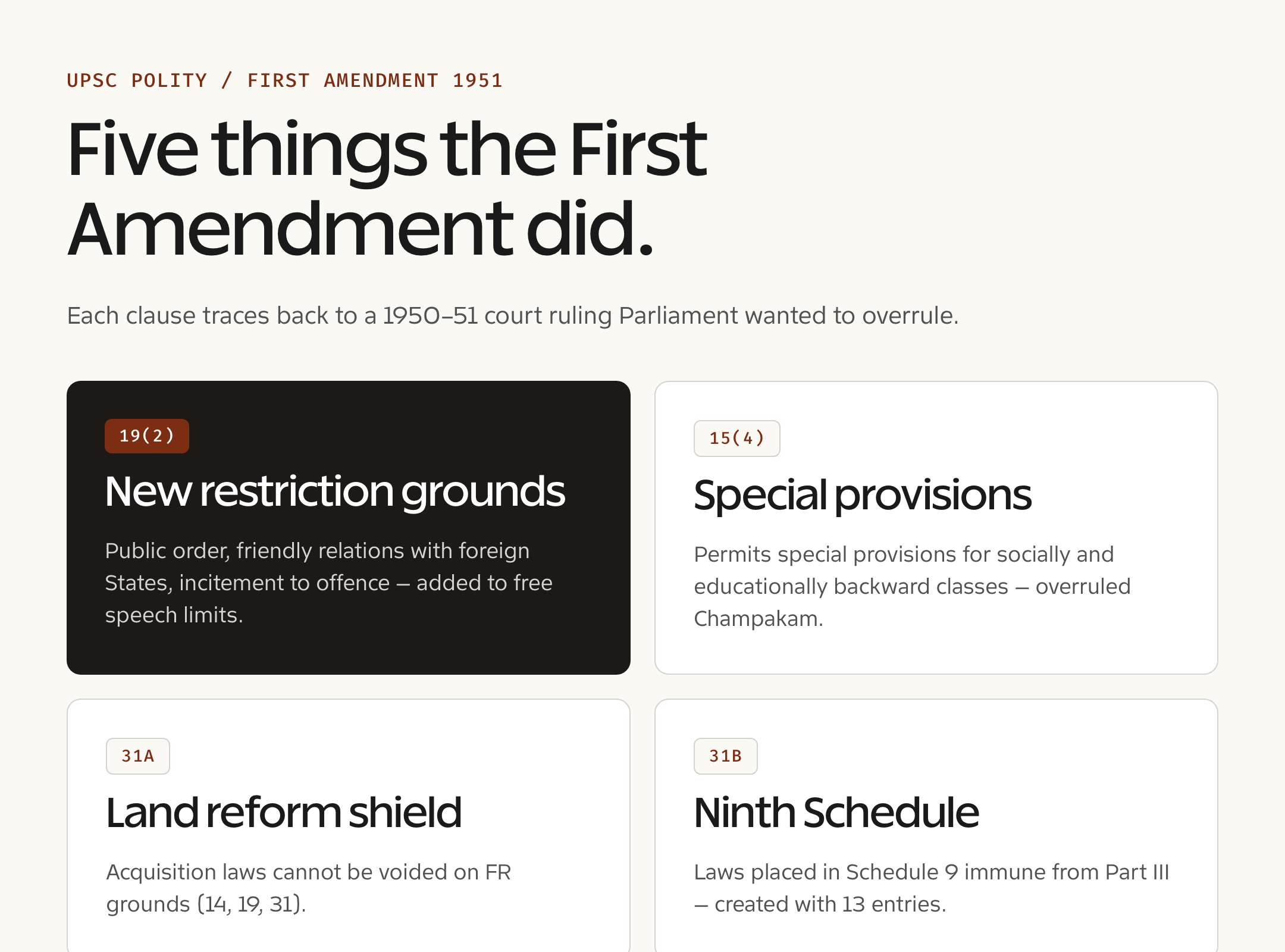
1. Article 15 — added clause (4) for special provisions
Inserted Article 15(4): “Nothing in this article or in clause (2) of Article 29 shall prevent the State from making any special provision for the advancement of any socially and educationally backward classes of citizens or for the SCs and STs.”
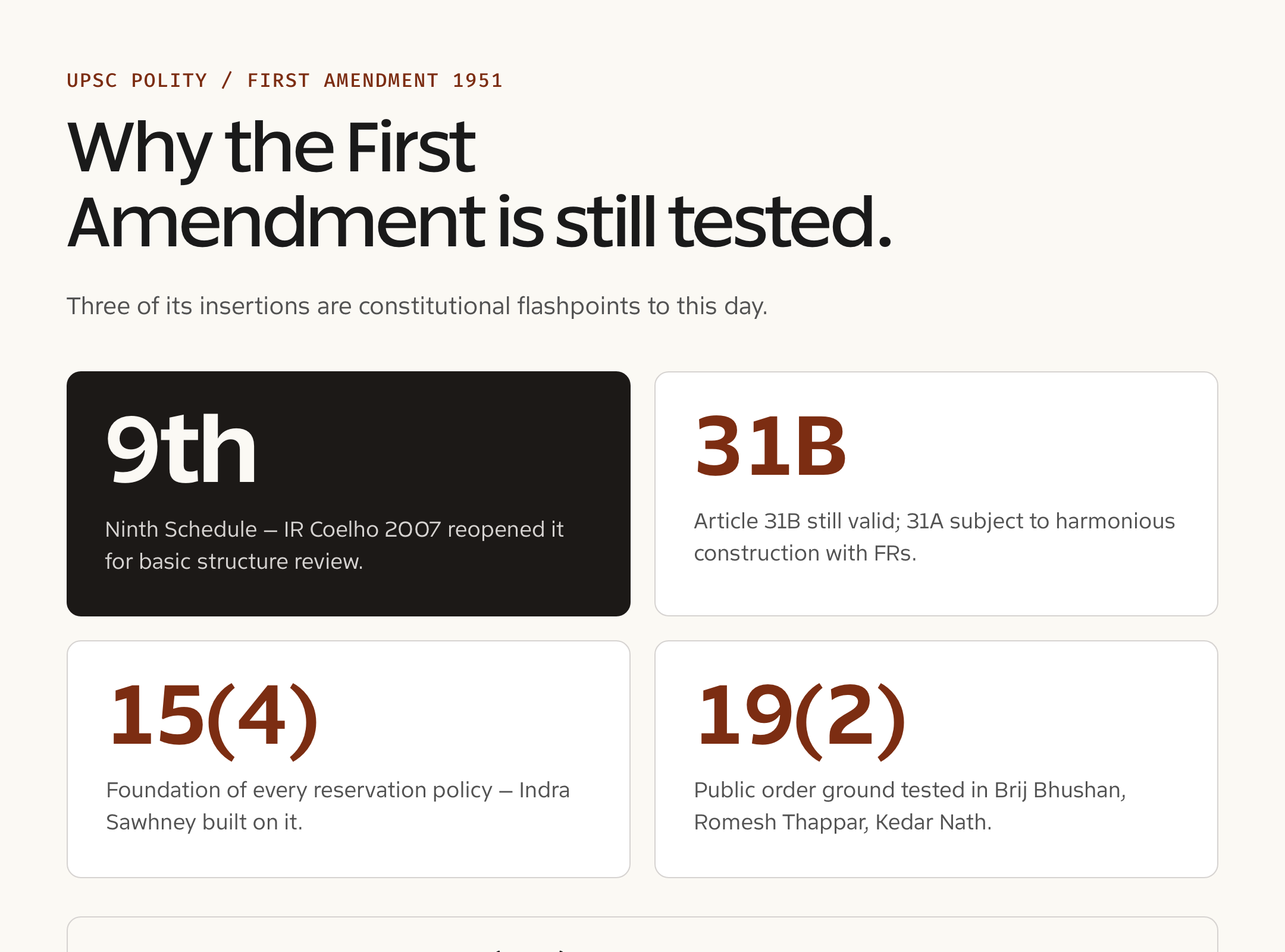
This neutralised Champakam Dorairajan. Reservation in admissions was now constitutionally backed. Article 15(4) is the parent of all reservation jurisprudence.
2. Article 19 — restrictions on free speech expanded
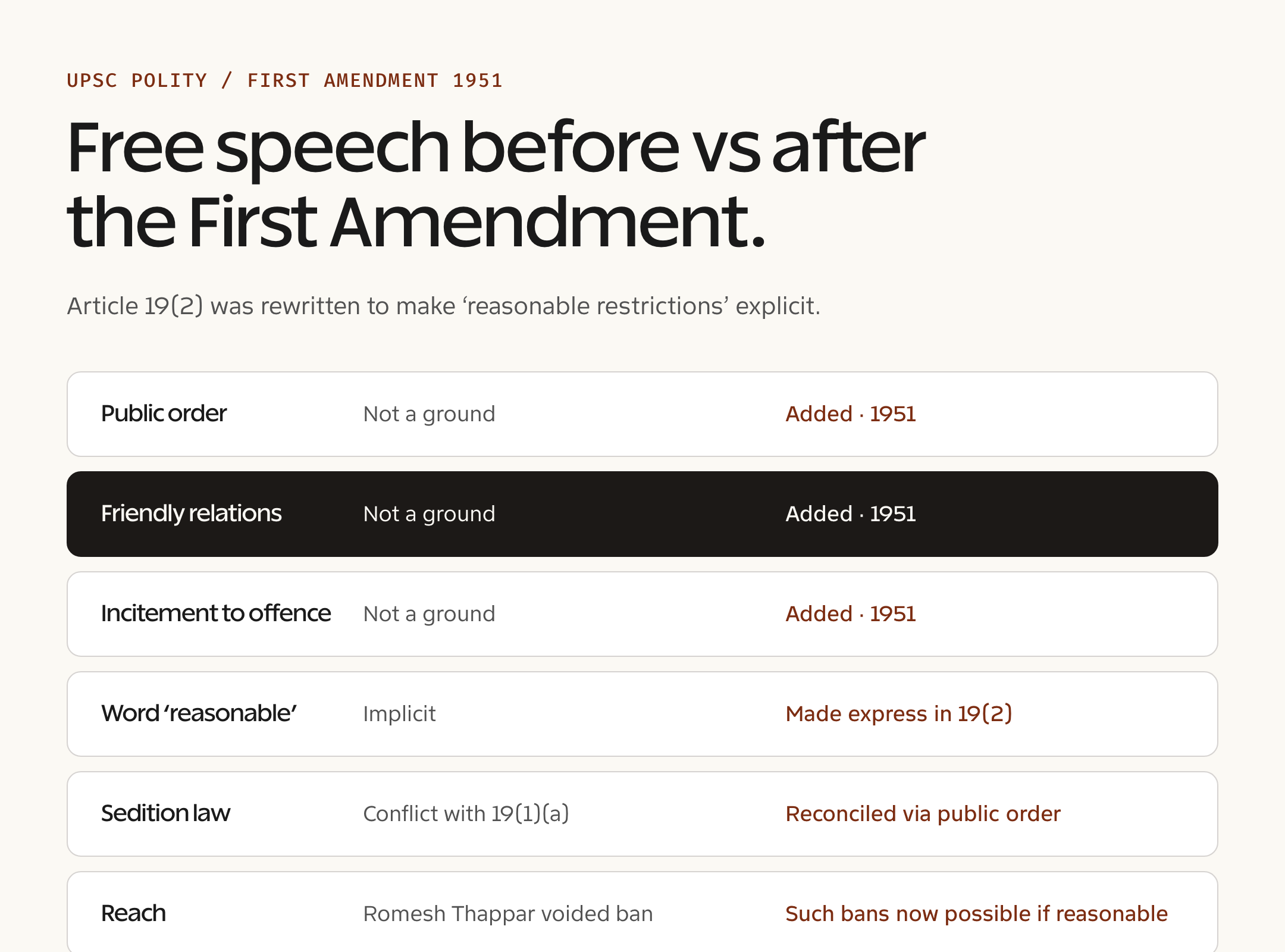
Article 19(2) was rewritten. Three new grounds for “reasonable restrictions” on Article 19(1)(a) (free speech):
- Public order — added to overrule Romesh Thappar.
- Friendly relations with foreign States — added.
- Incitement to an offence — added.
The word “reasonable” was inserted before “restrictions” — a small but important addition… that gave courts the power to test the proportionality of restrictions.
Article 19(6) (restrictions on profession/business) was also amended to authorise State monopoly in any trade.
3. Article 31 — and the new Articles 31A, 31B
Article 31 (right to property) was amended to immunise certain laws from challenge.
- Article 31A — Saved laws providing for the acquisition of estates from challenge under Articles 14, 19, and 31. Gave constitutional cover to land reform, including the abolition of zamindari, ryotwari, and intermediary tenures.
- Article 31B — Combined with the new Ninth Schedule, said any Act placed in the Schedule cannot be challenged on the ground of violating any Fundamental Right. Retrospective.
- Ninth Schedule — A new schedule added to the Constitution. The First Amendment placed 13 laws in it, mostly state-level land reforms.
4. Article 85 / 87 / 174 / 176 — President’s address procedure
Procedural changes — frequency of addresses by the President to Parliament and the Governor to the State Legislature. Minor.
5. Article 341 / 342 — SC and ST list mechanism
Procedural amendments to allow Parliament to modify the list of Scheduled Castes and Tribes by ordinary law.
6. Article 372 / 376 — pre-Constitution laws
Clarified that pre-Constitution laws continue to apply with necessary modifications.
Significance — why this is the most important amendment after the original Constitution
Three reasons the First Amendment is often called the “Second Constitution”.
1. It set the template for all amendments after it
Every subsequent controversial amendment — 24th, 25th, 39th, 42nd — followed the First Amendment’s playbook: when the SC restricts the State, amend the Constitution to override the court.
2. It created the Ninth Schedule — the Constitution’s “secret bank vault”
By 2026, the Ninth Schedule has 284 laws. Originally meant to protect 13 land reform statutes, it has expanded to cover everything from reservations (Tamil Nadu’s 69% reservation law) to industrial regulation. I.R. Coelho v. State of TN (2007) held that any law inserted into the Ninth Schedule after April 24, 1973 (the Kesavananda Bharati date) is open to basic-structure challenge. The Ninth Schedule is no longer absolute, but it remains the most powerful constitutional shield available to the State.
3. It exposed the Provisional Parliament problem
The First Amendment was passed by a Provisional Parliament — the same members who had served on the Constituent Assembly. The first general elections under universal adult franchise happened only between October 1951 and February 1952 — after the amendment. Critics like Shyama Prasad Mookerjee argued: how can a Parliament that has not faced the people amend the Constitution they just ratified?
Constitutionally valid? Yes. Politically clean? Honestly… aspirants should be able to argue both sides.
First Amendment and the Basic Structure Doctrine
This is where Mains marks live. Connect the First Amendment to Kesavananda Bharati (1973).
The First Amendment was challenged in Sankari Prasad v. Union of India (1951). The SC upheld the amendment, holding that “law” in Article 13(2) does not include constitutional amendments — therefore Parliament can amend Fundamental Rights.
That principle held for 16 years. Then Golak Nath (1967) reversed it. Then Kesavananda Bharati (1973) settled the question with a middle path — Parliament can amend any part of the Constitution, including Fundamental Rights, but not the basic structure. Judicial review, federalism, secularism, separation of powers, and the FR–DPSP harmony are all part of basic structure.
So the First Amendment itself remains good law — but the unlimited power it asserted has been doctrinally curtailed. Article 31A and Article 31B still operate. The Ninth Schedule still exists. But after I.R. Coelho (2007), no shield is absolute.
Why this matters for UPSC
- Prelims — Direct factual MCQs on year (1951), articles modified, what the Ninth Schedule was created for. Asked in 2018, 2022.
- Mains GS-II — “Discuss the significance of the First Amendment in the constitutional history of India.” Standard 10–15 mark question.
- Essay — “Constitution as a living document”.
- Interview — Be ready for “Was the First Amendment a violation of the spirit of the Constitution?” Argue both sides — necessary for socio-economic justice; but rushed through a Provisional Parliament.
Common misconceptions
- “The First Amendment was passed by an elected Lok Sabha.” No. It was passed by the Provisional Parliament — the Constituent Assembly continuing as a legislature. The first general elections happened after this amendment.
- “The First Amendment created Article 21A.” Wrong. Article 21A came in by the 86th Amendment, 2002.
- “The Ninth Schedule is fully protected from judicial review.” Outdated. I.R. Coelho (2007) opened all post-1973 insertions to basic-structure scrutiny.
- “The First Amendment didn’t restrict free speech.” It did. Adding “public order”, “friendly relations”, and “incitement” to Article 19(2) significantly narrowed Article 19(1)(a).
- “The First Amendment was unanimous.” Far from it. The opposition — Shyama Prasad Mookerjee, Hriday Nath Kunzru — argued vigorously against it. The vote was contested.
How to revise this in 30 minutes
- Laxmikanth — Amendments chapter — read the First Amendment box. 5 minutes.
- Bare text — Article 31A, Article 31B, Ninth Schedule — Indiacode.nic.in. 10 minutes.
- Wikipedia — First Amendment of the Constitution of India — Best chronological summary online. 10 minutes.
- PRS legislative history brief — for the Provisional Parliament debate.
- Indian Express explainer (Aug 2025) — Ninth Schedule status today — 5 minutes.
Frequently Asked Questions
When was the First Amendment passed?
The Constitution (First Amendment) Act was enacted on June 18, 1951, after being introduced by Nehru on May 10, 1951.
Who passed the First Amendment?
The Provisional Parliament — the Constituent Assembly continuing as the legislature. The first general elections under universal franchise had not yet been held.
What did the First Amendment add to the Constitution?
Articles 31A and 31B, the Ninth Schedule, Article 15(4), and three new grounds in Article 19(2) — public order, friendly foreign relations, and incitement to an offence.
Why was the Ninth Schedule created?
To protect 13 state-level land reform (zamindari abolition) laws from being challenged on the ground of violating Fundamental Rights.
Did the First Amendment restrict free speech?
Yes. It added u0022public orderu0022, u0022friendly relations with foreign Statesu0022, and u0022incitement to an offenceu0022 as new grounds for reasonable restrictions on Article 19(1)(a) — overriding Romesh Thappar (1950).
Is the First Amendment still valid today?
Yes. Article 15(4), Article 31A, Article 31B, and the Ninth Schedule all remain in force. But after I.R. Coelho (2007), post-1973 Ninth Schedule insertions can be challenged on basic-structure grounds.
Which case upheld the First Amendment?
Sankari Prasad v. Union of India (1951) — the SC held that Parliament’s power under Article 368 includes the power to amend Fundamental Rights.
Tell Google you want more of this.
Add Anantam IAS as a preferred sourceOne tap, and this site shows up more often in your own Top Stories, AI Overviews and AI Mode. Remove it any time.