Daily Digest
UPSC · Civil Services Examination
Current Affairs · Wednesday, 10 June 2026
Current affairs curated and edited by Anantam IAS faculty — pulled from The Hindu, PIB, IDSA, Foreign Affairs and the ministries. Read, annotate, revise.
Old Rajinder Nagar · Delhi 110005 · anantamias.com
BHAVYA Portal and Bharat Audyogik Vikas Yojana: 100 Plug-and-Play Industrial Parks Explained
On 9 June 2026, Union Commerce and Industry Minister Piyush Goyal launched the BHAVYA portal in New Delhi, the digital backbone of the Bharat Audyogik Vikas Yojana (BHAVYA, literally India’s Industrial Development Scheme). The scheme is a roughly Rs 33,660-crore programme to build 100 investment-ready, plug-and-play industrial parks across the country over six years. The portal itself is the operational layer: a single online window where states submit detailed project reports, the Centre appraises them, parks are selected competitively, and progress is monitored in real time. For UPSC, the news matters less for the website and more for what it signals about how India is trying to fix the oldest bottleneck in its manufacturing story — the absence of serviced, ready-to-occupy industrial land.
The headline number is the Rs 33,660-crore outlay tied to 100 parks, implemented by the National Industrial Corridor Development Corporation (NICDC), the same agency that runs the country’s industrial corridor programme. PIB framed it as a push for manufacturing-led growth and ease of doing business; reporting in Insights on India and across the trade press confirmed the same outlay, park count and the 51:49 Centre-State funding model. That convergence is the cross-paper relevance line: this is a GS3 economy story that also reads as a GS2 governance story about cooperative federalism and single-window delivery.
An examiner will not test the portal’s URL — they will test whether you can connect plug-and-play infrastructure to the manufacturing-share-of-GDP problem and to the older NICDP and Make in India framework.
Quick Facts
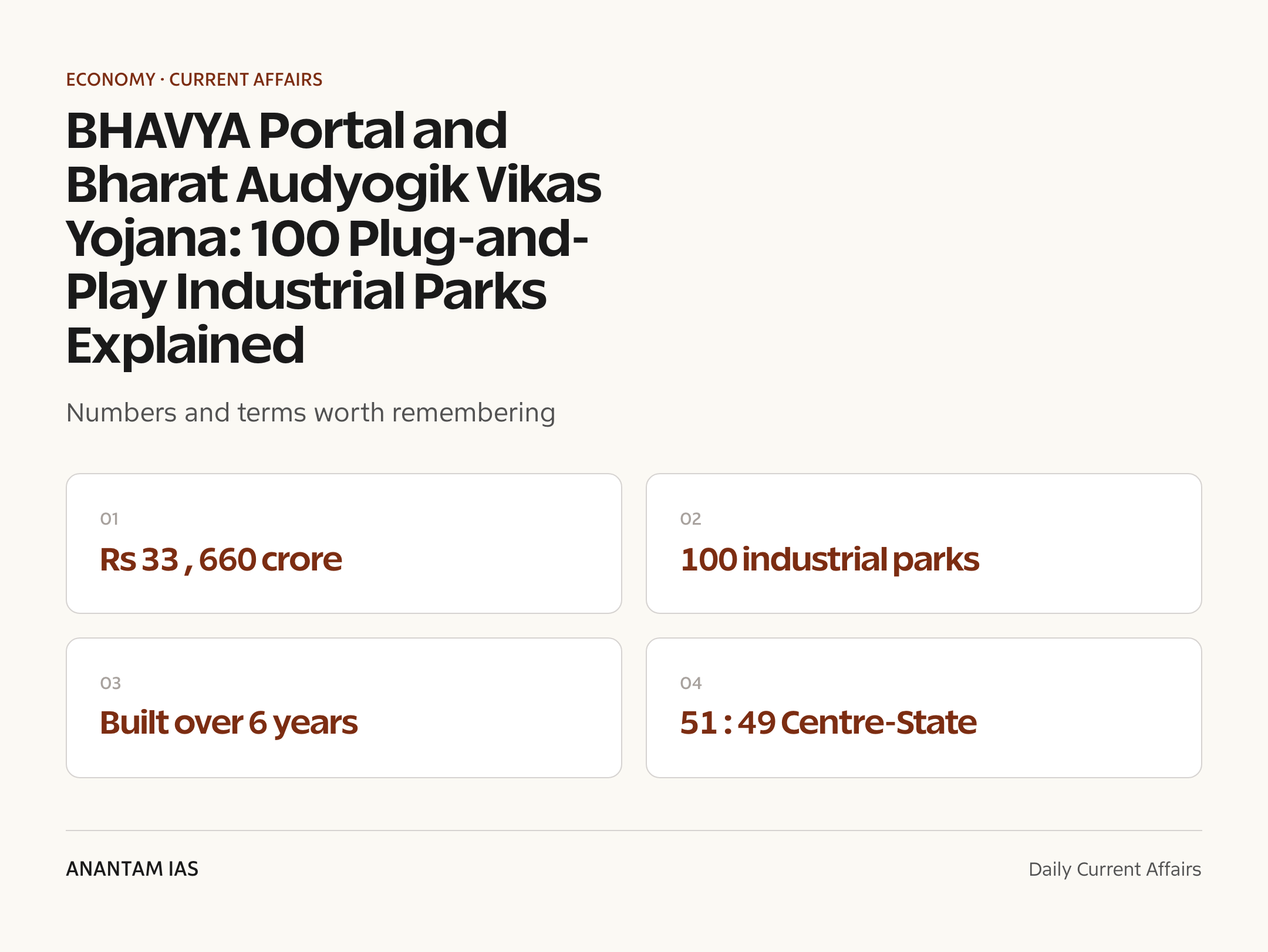
- Scheme: Bharat Audyogik Vikas Yojana (BHAVYA), launched 9 June 2026 in New Delhi.
- Outlay: approximately Rs 33,660 crore, approved by the Union Cabinet.
- Target: 100 investment-ready, plug-and-play industrial parks built over six years.
- Nodal ministry: DPIIT, Ministry of Commerce and Industry; implementing agency NICDC.
- Funding model: 51:49 Centre-State partnership, with states providing the land.
- Park sizes: about 25 acres in hilly or northeastern areas, 100-500 in mid states, up to 1,000 acres near cities.
- Selection: competitive framework where states bid with land, sectoral strength and investor interest.
- Anchor: built on the National Industrial Corridor Development Programme; aligned with Make in India and PM GatiShakti.
- Sources: PIB, Ministry of Commerce & Industry and Insights on India.
What Just Happened
Piyush Goyal launched the BHAVYA portal on 9 June 2026 as the delivery platform for the Bharat Audyogik Vikas Yojana, the Rs 33,660-crore scheme the Union Cabinet had cleared to create 100 industrial parks. The portal acts as a single digital window covering the full project lifecycle — submission of detailed project reports by states, technical appraisal, competitive selection, fund release, and real-time monitoring of construction. The intent is to remove the file-shuffling between state agencies and central ministries that has historically delayed industrial estates by years.
The parks are designed on a plug-and-play model. A plug-and-play park is one where common infrastructure is already built and serviced before a manufacturer arrives, so a unit can lease a plot and begin operations quickly instead of spending two to three years acquiring land, securing power and water, and chasing clearances. Under BHAVYA each park is to come with assured water and power supply, road, rail and air connectivity, digital single-window clearances, testing and quality infrastructure, worker housing, and social amenities, on land with clear titles.
NICDC, which runs the national industrial corridor programme, is the project management agency. The financing is structured on a 51:49 Centre-State split, with states contributing land and a share of cost while the Centre funds core infrastructure. Park sizes are deliberately flexible — roughly 25 acres for hilly regions, small union territories and the Northeast, 100 to 500 acres for mid-sized states, and up to 1,000 acres near urban centres — so the model fits both land-scarce and land-rich states. The competitive design means a state cannot simply demand a park; it has to make a case on land availability, sectoral potential and investor interest.
The competitive selection is the procedural heart of the scheme. Rather than a fixed quota of parks per state, BHAVYA invites states and union territories to submit detailed proposals showcasing land that is contiguous and clean-titled, the sectors they can anchor, existing investor commitments and the connectivity already in place. Proposals are appraised on the portal and ranked, so funding flows to the most investment-ready locations first. Reporting in the trade press, echoing the PIB note, described parks layered into three tiers of facilities — core infrastructure such as roads, drainage, power, water and ICT; value-added facilities like factory sheds, common testing labs and warehousing; and social amenities including worker housing — with space carved out for startups and deep-tech enterprises. The portal keeps every stage visible, which is itself the reform: an industrial estate that once moved through opaque, sequential approvals now sits on a tracked, time-bound pipeline.
Background and Context
India’s manufacturing sector has been stuck at roughly 17 per cent of GDP for years, well short of the 25 per cent target that Make in India set in 2014. The reasons are well documented — costly and contested land acquisition, unreliable power, weak last-mile connectivity, and a thicket of approvals. The National Manufacturing Policy of 2011 first tried to address this through National Investment and Manufacturing Zones; the 25 per cent goal has since been carried forward, with the National Manufacturing Mission of 2025 resetting the timeline to 2035. BHAVYA is the latest instrument aimed squarely at the land-and-infrastructure leg of that problem.
The scheme does not stand alone. It builds on the National Industrial Corridor Development Programme (NICDP), launched around the Delhi-Mumbai Industrial Corridor and now spanning multiple corridors, under which the Cabinet in 2024 approved 12 new industrial cities (smart industrial townships) worth about Rs 28,602 crore. NICDC, the implementing arm here, is the same special purpose vehicle that develops those greenfield cities. BHAVYA effectively extends the corridor logic — pre-built, serviced, plug-and-play land — to a wider set of 100 parks chosen competitively from across states rather than fixed along the corridor alignments.
The portal also sits inside the wider ease-of-doing-business and PM GatiShakti agenda. GatiShakti is the national master plan for multimodal connectivity that maps infrastructure on a single GIS platform; industrial parks built under BHAVYA are meant to plug into that network so factories get road, rail and port links by design rather than as an afterthought. The single-window clearance feature mirrors the National Single Window System and the broader regulatory-cholesterol reduction drive that has run through recent Economic Surveys.
To see why serviced land matters, it helps to read BHAVYA against the long arc of India’s industrial-estate experiments. State industrial development corporations have notified thousands of plots since the 1960s, yet a large share sat idle for want of trunk infrastructure, poor siting away from ports and highways, or buyers who never came. The Make in India decade then leaned heavily on demand-side and fiscal tools — liberalised foreign investment, then production-linked incentives that subsidise output in chosen sectors. Those moved some needles but left the physical bottleneck intact, which is why the manufacturing share of GDP barely shifted. BHAVYA is best read as the supply-side complement to incentives: where PLI pays a firm to produce, BHAVYA hands it a place to produce in. The two are meant to work together, alongside the National Manufacturing Mission’s broader 2035 roadmap, rather than substitute for one another.
Key Features of Bharat Audyogik Vikas Yojana
- Plug-and-play parks: common infrastructure is built and serviced before units arrive, cutting the typical two-to-three-year setup wait to weeks.
- Single digital window: the BHAVYA portal handles DPR submission, appraisal, selection, fund flow and real-time monitoring in one place.
- Core infrastructure assured: water, power, road-rail-air connectivity, ICT, drainage and effluent systems are guaranteed at park level.
- Value-added and social facilities: testing labs, warehousing, factory sheds, worker housing and amenities, plus space for startups and deep-tech firms.
- 51:49 cooperative model: states provide land and share cost; the Centre funds core infrastructure, making it a federal partnership not a central handout.
- Competitive, flexible design: states bid on merit and parks scale from about 25 acres in the Northeast to 1,000 acres near cities.
Why It Matters for UPSC
This is a high-yield topic because it ties a current development to durable syllabus themes.
- GS3 economy and infrastructure: a direct case study on industrial policy, the manufacturing-share-of-GDP gap, and how serviced land and ease of doing business drive investment.
- Links current to static: connects a 2026 launch to the durable framework of NICDP, NICDC, Make in India, the National Manufacturing Mission and PM GatiShakti.
- Prelims angle: scheme name and full form, outlay, park count, implementing agency (NICDC) and nodal department (DPIIT) are all crisp, testable facts.
- GS2 governance and federalism: the 51:49 model and single-window portal illustrate cooperative federalism and the move from approvals to facilitation.
What It Means: Economy Lens
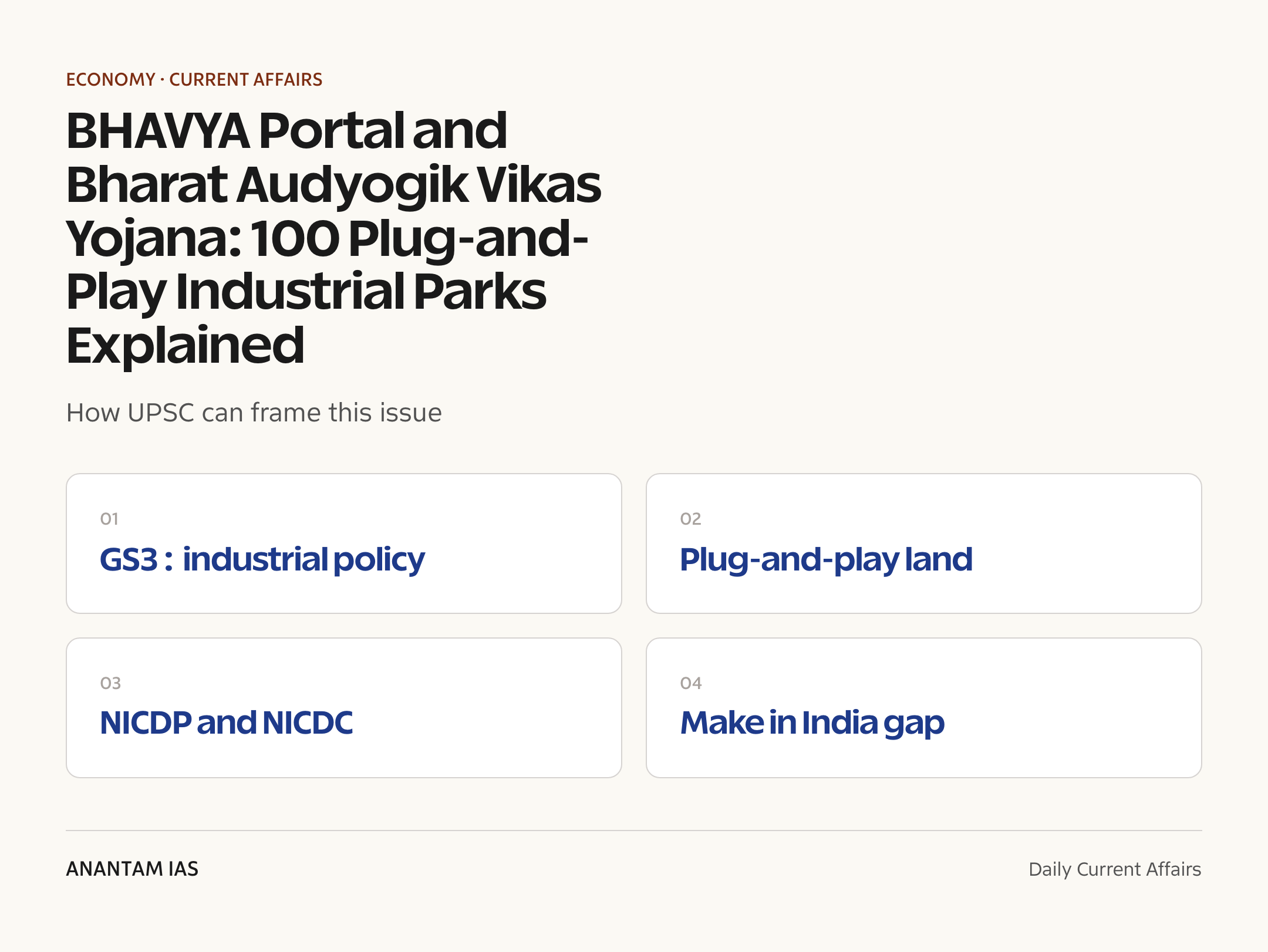
BHAVYA reframes industrial policy from incentives to infrastructure. For a decade the headline tools of Make in India were fiscal — tax cuts, then production-linked incentive subsidies. BHAVYA shifts the lever to the supply side of physical capacity: it accepts that no incentive offsets the cost of a manufacturer spending years assembling land, power and clearances. By pre-building serviced parks, the state absorbs the upfront coordination risk that markets price heavily, especially for first-time and mid-sized investors who cannot self-develop estates the way a large conglomerate can.
The 51:49 model is the structurally interesting part. Land is a state subject and the single biggest source of industrial delay, so a scheme that runs through central diktat would stall. By making states co-investors who must compete with credible proposals, BHAVYA aligns incentives — a state that wins a park has skin in the game to deliver clearances and connectivity, and the competitive bidding rewards genuine reform rather than political allocation. It is cooperative federalism used as an implementation device, not just a slogan.
The risk is that the binding constraint was never the portal. India already has thousands of notified industrial plots lying under-utilised because of poor location, missing trunk infrastructure or absent buyers. A digital window speeds approvals but does not by itself guarantee demand, quality construction, or that parks land where firms actually want to be. The scheme’s success turns on three things outside the portal — honest competitive selection, GatiShakti-grade connectivity, and whether global supply chains diversifying away from China actually choose Indian parks over Vietnam or Mexico.
There is also a federalism dividend worth weighing in the answer. Land, electricity distribution and local clearances are largely state and concurrent subjects, so the manufacturing problem has always been a coordination problem as much as a capital one. BHAVYA’s competitive, co-funded design quietly reshapes the centre-state bargain: a state that wants a park must do the reform homework — assemble land, fix power, simplify approvals — before the money arrives, and is then bound by its own proposal to deliver. That converts ease of doing business from a central exhortation into a state-level race. Whether the timeline holds is a fair question; building 100 serviced parks in six years is ambitious against India’s record on greenfield delivery. But the structural shift — from subsidising firms to building the platform they stand on, and from central allocation to competitive federalism — is the durable point an examiner is testing, and it is the reason this clipping deserves a place in the static notes on industrial policy.
Challenges and Concerns
- Land remains the hard constraint: states must aggregate clean-title land at scale, and acquisition disputes can stall even well-funded parks.
- Risk of repeating the under-utilised-estate problem if parks are sited by political bargaining rather than genuine demand and connectivity.
- Six-year timeline is ambitious for 100 parks given India’s record on greenfield industrial-city delivery under existing corridors.
- A portal streamlines approvals but cannot create investor demand; success depends on global supply-chain shifts choosing India.
- Centre-State cost sharing can strain weaker states, and quality of common infrastructure varies widely across implementing agencies.
Prelims Pointers
- BHAVYA stands for Bharat Audyogik Vikas Yojana, launched on 9 June 2026 in New Delhi.
- The scheme has an outlay of about Rs 33,660 crore approved by the Union Cabinet.
- It targets 100 investment-ready, plug-and-play industrial parks built over six years.
- The nodal department is DPIIT under the Ministry of Commerce and Industry.
- The implementing and project management agency is the National Industrial Corridor Development Corporation (NICDC).
- Funding follows a 51:49 Centre-State partnership model, with states providing land.
- Park sizes range from about 25 acres in hilly or northeastern areas up to 1,000 acres near cities.
- BHAVYA builds on the National Industrial Corridor Development Programme (NICDP).
- Plug-and-play infrastructure means common services are built before manufacturing units arrive.
- The BHAVYA portal is a single digital window for DPR submission, appraisal, selection and monitoring.
- India’s manufacturing share of GDP is around 17 per cent against a 25 per cent target.
- The scheme aligns with Make in India, the National Manufacturing Mission and PM GatiShakti.
Mains Practice Questions
- Plug-and-play industrial parks address India’s deepest manufacturing bottleneck better than fiscal incentives alone. Critically examine in the context of the Bharat Audyogik Vikas Yojana. (GS3, 15 marks)
- Discuss how the National Industrial Corridor Development Programme and schemes like BHAVYA seek to raise the manufacturing share of GDP, and assess the structural constraints they still face. (GS3, 15 marks)
- The 51:49 Centre-State model in industrial-park development reflects cooperative federalism as an implementation tool. Examine its strengths and limitations. (GS2, 10 marks)
- Ease of doing business depends as much on serviced infrastructure as on regulatory reform. Evaluate this statement using single-window industrial schemes in India. (GS3, 10 marks)
Way Forward
The portal must be backed by transparent, demand-driven site selection so parks land where firms want to invest, not where allocation is politically convenient.
Connectivity through PM GatiShakti, clean-title land banks at the state level, and credible single-window clearances will decide whether the six-year target is met.
BHAVYA should be read alongside the National Manufacturing Mission as part of a coherent push to move India’s manufacturing share toward 25 per cent of GDP.
Frequently Asked Questions
What is the BHAVYA portal?
BHAVYA is the digital single-window platform launched on 9 June 2026 to run the Bharat Audyogik Vikas Yojana. States use it to submit project reports, the Centre appraises and selects parks competitively, and implementation is monitored in real time. It turns a Rs 33,660-crore industrial-park scheme into a transparent, trackable pipeline rather than a paper trail.
What does Bharat Audyogik Vikas Yojana aim to do?
It aims to build 100 investment-ready, plug-and-play industrial parks across India over six years with an outlay of about Rs 33,660 crore. By giving manufacturers serviced land with power, water, connectivity and clearances ready, it targets the oldest drag on Indian factories — the years lost setting up a site before a single unit is made.
What is plug-and-play infrastructure?
Plug-and-play means a park’s common infrastructure — roads, power, water, drainage, ICT and single-window clearances — is built and serviced before any manufacturer arrives. A firm leases a plot and starts production in weeks rather than the two-to-three years usually spent acquiring land and chasing approvals. It shifts coordination risk from the investor to the state.
Which ministry and agency run BHAVYA?
The nodal department is the Department for Promotion of Industry and Internal Trade (DPIIT) under the Ministry of Commerce and Industry. The National Industrial Corridor Development Corporation (NICDC) is the implementing and project management agency, the same body that delivers India’s industrial corridor cities. So one experienced agency runs both corridors and these parks.
How is BHAVYA funded between Centre and states?
BHAVYA uses a 51:49 Centre-State partnership model. States provide the land and a share of the cost, while the Centre funds core infrastructure. The design makes states co-investors who must win parks through competitive proposals, giving them a direct stake in delivering clearances and connectivity. It is cooperative federalism used as an implementation tool.
How does BHAVYA connect to Make in India?
BHAVYA tackles the supply-side gap Make in India never closed — India’s manufacturing share is stuck near 17 per cent against a 25 per cent target. Where earlier policy leaned on incentives, BHAVYA builds physical capacity through serviced parks linked to NICDP and PM GatiShakti. Incentives attract firms; ready land lets them actually build.
Source: https://anantamias.com/current-affairs/bhavya-portal-100-industrial-parks/
Land Port Management System (LPMS): Digitising India’s Border Trade Gateways
On 9 June 2026 the Union Home Minister launched the Land Port Management System (LPMS), a centralised digital platform built by the Land Ports Authority of India (LPAI) to run all of India’s land ports from one electronic backbone. A land port is a notified gateway on a land border where cargo and people are checked, cleared and moved across into a neighbouring country — the road-and-rail equivalent of an airport or a seaport. Until now each port ran its own paper-heavy counters, with a trader registering separately at every gate, paying different fees at different windows and waiting in physical queues for clearance. LPMS folds slot booking, online payments, customs filing and cargo tracking into a single web window, the same way air and sea cargo have worked digitally for years. The launch event also saw upgraded stakeholder facilities inaugurated at the Dawki land port in Meghalaya and the Srimantapur land port in Tripura, both on the India-Bangladesh border, tying the new software to fresh physical capacity on the ground.
The platform covers the 15 operational land ports that connect India with Bangladesh, Nepal, Bhutan, Myanmar and Pakistan, and it arrives as land-border trade has scaled sharply. EXIM (export-import, the standard shorthand for cross-border trade) routed through these ports grew from about Rs 5,000 crore in 2014-15 to roughly Rs 82,800 crore in 2024-25 — a more-than-sixteenfold rise in a decade — while around 25.8 lakh passengers and 6.69 lakh cargo vehicles crossed via land ports in 2024-25 alone. For the exam this is a governance-meets-trade-facilitation story sitting at the seam of GS3 border management and the neighbourhood economy. It is best understood not as a security gadget but as the moment India’s land frontiers got the same digital plumbing its airports and seaports have had for years, and it tracks closely with what The Hindu, the Indian Express and PIB have flagged as the digitisation of India’s frontier infrastructure under the Viksit Bharat 2047 agenda.
An examiner will read this as a test of whether you can separate border management (a governance and institutional question) from border security (an operational one), and connect a digital tool to the static LPAI Act, 2010 framework behind it.
Quick Facts
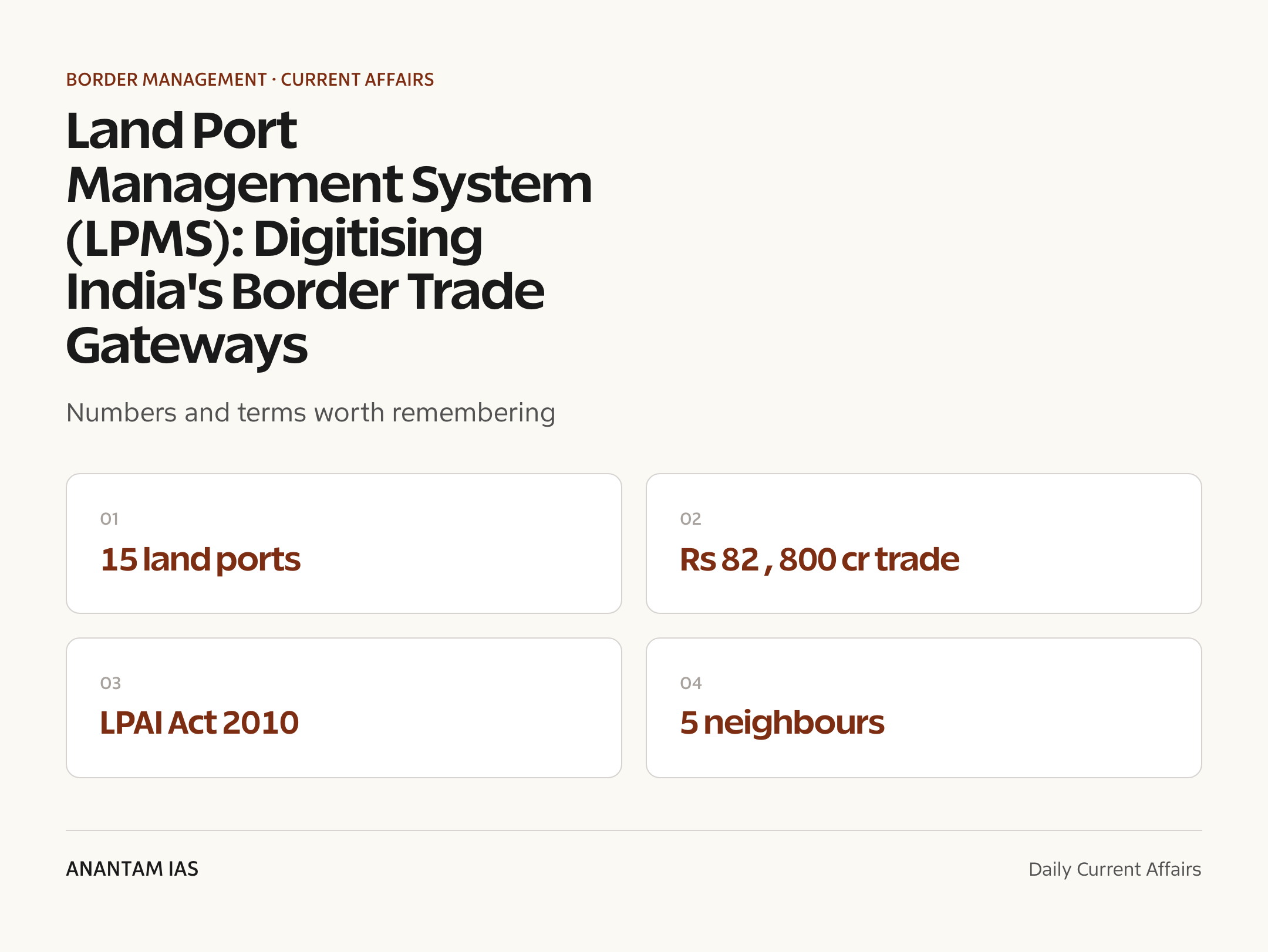
- Launched 9 June 2026 by the Union Home Minister in New Delhi.
- Built by the Land Ports Authority of India (LPAI), a statutory body under the LPAI Act, 2010.
- Covers India’s 15 operational land ports across five neighbouring countries.
- Land-port EXIM trade rose from ~Rs 5,000 crore (2014-15) to ~Rs 82,800 crore (2024-25).
- ~25.8 lakh passengers and ~6.69 lakh cargo vehicles crossed via land ports in 2024-25.
- Single-window features: slot booking, online payments, customs filing, cargo tracking.
- Integrates with ICEGATE customs, the Unified Logistics Interface Platform and the motor-vehicle ecosystem.
- Aligned with the Viksit Bharat 2047 vision and neighbourhood-first connectivity.
- Sources: PIB, Ministry of Home Affairs (via GKToday) and Insights on India.
What Just Happened
The Union Home Minister formally launched the Land Port Management System in New Delhi, describing it as a single, secure electronic gateway that standardises how cargo and passenger data move across India’s international land borders. The system was conceptualised and developed by the Land Ports Authority of India, the statutory body that owns and manages the country’s land ports, and is positioned to bring those ports on par with the high-efficiency digital systems already operational at major airports and seaports. The same event saw the inauguration of upgraded stakeholder facilities at the Dawki land port in Meghalaya and the Srimantapur land port in Tripura, both on the India-Bangladesh frontier, signalling that the digital layer and the physical infrastructure are being pushed together rather than in sequence. Government framing tied the launch to the goal of a secure, smart border-management system and to the Viksit Bharat 2047 vision of a developed India.
Functionally, LPMS replaces a scatter of port-by-port manual counters with one online window. Insights on India lists its core modules. A Single Registration Request (SRR) lets a trader file stakeholder details once instead of repeating the paperwork at every port. Predictive slot management lets cargo vehicles book a time-slot in advance against the real-time capacity at an Integrated Check Post (ICP), so trucks arrive to a confirmed window rather than joining an open queue. A unified payment gateway collects customs duties, parking, weighbridge and terminal charges through one online counter. Dedicated warehouse and yard-optimisation modules manage storage, and business-intelligence dashboards give the LPAI and the agencies live cargo tracking and operational analytics. Security recording, including integration with full-body truck scanners, is logged digitally rather than on paper, which keeps the audit trail intact end to end.
Crucially, the platform doesn’t sit in isolation — its value comes from what it talks to. GKToday’s reading of the PIB material notes that LPMS connects to ICEGATE (the Indian Customs Electronic Gateway, the customs department’s online filing portal) for direct filing of Shipping Bills, which document exports, and Bills of Entry, which document imports. It also links to the Unified Logistics Interface Platform (ULIP), the national data backbone meant to stitch together India’s logistics systems, and to the motor-vehicle ecosystem that tracks the trucks themselves. So a single consignment can be registered once, slot-booked, scanned, customs-cleared and paid for inside one connected chain. That interoperability is the real shift: the land port stops being a standalone counter and becomes a node in India’s wider digital trade and logistics network.
Background and Context
The durable anchor here is the Land Ports Authority of India Act, 2010, which created the LPAI as a statutory authority under the Ministry of Home Affairs to develop, sanitise and manage the infrastructure at India’s land borders. The placement under the Home Ministry, rather than Commerce, is itself a clue to read carefully: India treats its land frontiers first as a matter of secure entry and exit, and only then as trade. Before the LPAI, most border-crossing points were makeshift — open patches of land with minimal customs, immigration or warehousing — where formalities were slow, informal trade leaked across, and travellers faced scattered, undignified facilities. The Act gave India a dedicated institution to plan, build and operate proper facilities at notified entry-exit points, the way the Airports Authority of India does for airports and major port trusts do for seaports.
The flagship instrument the LPAI delivers is the Integrated Check Post (ICP). An ICP brings every regulatory agency a traveller or trader meets — customs, immigration, plant and animal quarantine, the border-guarding force, currency exchange, warehousing, parking and weighbridges — under one roof at the border, replacing the old model where each agency sat in a separate shed sometimes kilometres apart. The point of an ICP is a single, modern, secure facility that handles all entry-exit functions at one stop, cutting the dwell time of cargo and the harassment of passengers. India now runs 15 operational land ports of this kind. They are spread across the Pakistan border (Attari and Dera Baba Nanak in Punjab), the Nepal border (Rupaidiha in Uttar Pradesh, Raxaul and Jogbani in Bihar), and the Bangladesh border, which carries the largest share — Petrapole in West Bengal, Dawki in Meghalaya, Agartala, Srimantapur and Sabroom in Tripura, and Sutarkandi, Golakganj and Mankachar in Assam — with the Myanmar gateway at Moreh in Manipur. Petrapole, opposite Benapole in Bangladesh, is among the busiest land ports in South Asia by trade value.
A point the exam loves to test: a land port is not the same as a border outpost (BOP). A BOP is a forward defensive post manned by a border-guarding force — the BSF on the Pakistan and Bangladesh borders, the SSB on the Nepal and Bhutan borders, the Assam Rifles and the Army on the Myanmar and China fronts — whose job is patrolling the line and stopping illegal crossing. That is a security function. A land port is a regulated, civilian trade-and-travel gateway run by the LPAI for lawful cross-border movement. That is a facilitation and governance function. They sit on the same border but answer different questions: the BOP asks who is crossing unlawfully, the land port asks how to clear lawful trade and travel faster. Mixing the two is a classic error in answers, so hold the line cleanly. This distinction sits inside India’s wider neighbourhood policy. India shares land borders of roughly 15,000 km with seven neighbours — Bangladesh (the longest), China, Pakistan, Nepal, Myanmar, Bhutan and Afghanistan — and sub-regional frameworks like BBIN (the Bangladesh-Bhutan-India-Nepal initiative for seamless movement of goods and vehicles) and the Neighbourhood First policy depend on exactly the kind of efficient land connectivity that land ports and LPMS are meant to deliver. Efficient gateways turn shared borders from barriers into corridors.
Key Features of the Land Port Management System
- Single Registration Request (SRR): a trader submits stakeholder details once and reuses them across every land port, ending repeat paperwork.
- Predictive slot management: advance booking of cargo time-slots against real-time capacity at each Integrated Check Post, cutting queues and idle truck time.
- Unified payment gateway: one online counter for customs duties, parking, weighbridge and terminal charges instead of separate cash windows.
- Customs and logistics integration: direct linkage to ICEGATE for Shipping Bills and Bills of Entry, plus the Unified Logistics Interface Platform and motor-vehicle ecosystem.
- Digital security and scanning: shipment recording tied to full-body truck-scanner data, logged electronically rather than on paper.
- Business-intelligence dashboards: live cargo tracking, warehouse and yard optimisation, and operational analytics for the LPAI and agencies.
Why It Matters for UPSC
This is a high-yield topic because it ties a current development to durable syllabus themes.
- GS3 border management: shows how India is shifting from purely guarding borders to governing them as managed economic gateways, a structural theme in mains answers.
- Links current to static: a single launch lets you cite the LPAI Act, 2010, the Integrated Check Post model, and the land-port-versus-border-outpost distinction in one frame.
- Prelims angle: clean facts to test — launch authority and date, the parent statute and year, the count of 15 land ports, and the five neighbouring countries.
- Economy and diplomacy crossover: ties trade facilitation and ease-of-doing-business to neighbourhood-first connectivity, BBIN and the cost of cross-border logistics.
What It Means: Border Management Lens
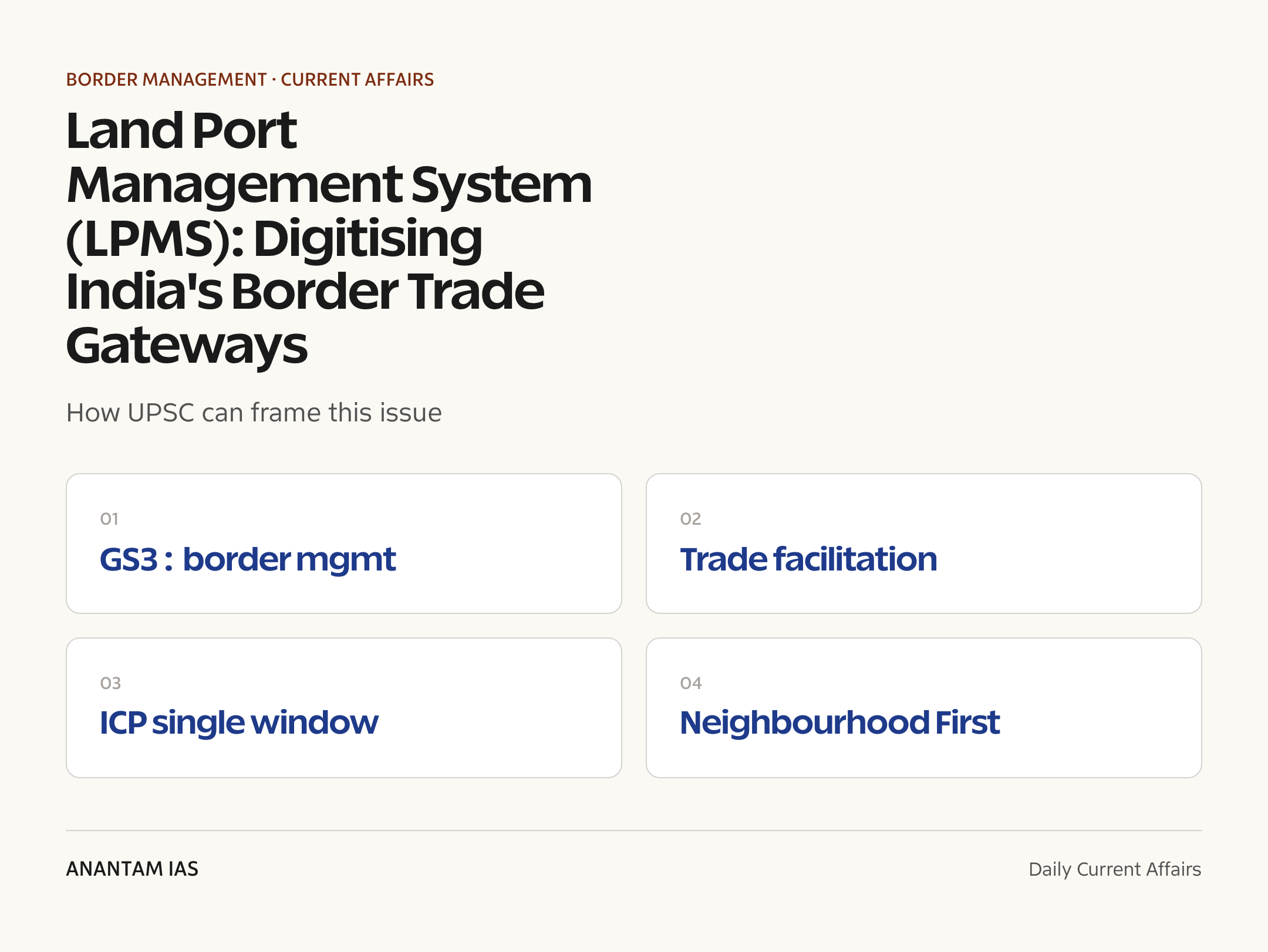
This is border management catching up with how India already runs its airports and seaports. The deeper shift LPMS marks is conceptual: a land border can be treated as a piece of national logistics infrastructure, not merely a defensive line. For most of independent India the frontier was framed almost entirely through security — who crosses, who is stopped. The LPAI Act, 2010 created the institution to govern that geography; LPMS now reframes it as a managed gateway where the headline metric is how fast and cheaply lawful trade clears. That is why the platform’s design language — slot booking, single window, unified payments, business-intelligence dashboards — is borrowed wholesale from civil aviation and ports, not from policing. The same border can be both: a guarded line for the BSF and a throughput system for the LPAI, with LPMS sitting firmly on the second side of that ledger.
The economics explain the urgency. Land-port EXIM trade grew from about Rs 5,000 crore in 2014-15 to roughly Rs 82,800 crore in 2024-25, yet for years the clearance machinery stayed manual, so each port became a bottleneck that taxed trade through waiting time and informal friction. A truck idling for a day at a paper counter is a direct cost to the trader, a source of perishable-cargo loss, and a leak in India’s competitiveness against alternative routes. By digitising registration, payment and customs filing into one chain that talks to ICEGATE and ULIP, LPMS attacks the time-cost of crossing — the dwell time and paperwork that make a land border expensive even when the tariff is low. Lowering that friction is the single biggest lever for land-border trade facilitation, and it maps directly onto India’s wider logistics-cost-reduction agenda under PM Gati Shakti and the National Logistics Policy, which target the same goal of moving goods faster and cheaper.
There’s a governance dividend too. A central platform creates a single, auditable data trail of every consignment and crossing. That improves transparency, narrows the discretion that breeds rent-seeking at manual counters, and gives the LPAI real-time visibility to plan capacity at each ICP — which port needs more parking, which scanner is a chokepoint, where a slot system is straining. Digitising security recording alongside trade clearance also means facilitation and oversight ride on the same rails rather than competing for the same desk. Read alongside the Neighbourhood First policy and BBIN connectivity, the message is that India sees efficient land ports as instruments of regional integration — the soft infrastructure that makes physical corridors actually usable for trade with Bangladesh, Nepal, Bhutan and Myanmar.
The honest caveat keeps the analysis balanced. A digital window on the Indian side speeds clearance only up to the line on the map; the gain is realised in full only when the neighbouring country’s customs and infrastructure can keep pace, which is why cross-border digital harmonisation matters as much as the platform itself. The structural insight worth carrying into an answer: LPMS converts the border from a cost centre into a throughput system, a different and more ambitious goal than simply securing it — but one whose payoff depends on diplomacy, last-mile connectivity and physical capacity catching up with the software.
Challenges and Concerns
- Cross-border benefit is asymmetric: a digital window on the Indian side speeds clearance only as far as the neighbouring country’s customs and infrastructure can match it.
- Adoption and digital literacy among small traders and transporters at remote land ports can lag, leaving parallel manual processes alive.
- Connectivity and uptime risk: a single platform concentrates dependency, so outages or weak last-mile internet at frontier locations can stall entire ports.
- Data security and interoperability: linking customs, payments and scanner data raises questions of protection and clean integration across legacy agency systems.
- Hardware gaps remain: software cannot fix shortfalls in warehousing, scanners, road access or staffing where the physical ICP is still being built out.
Prelims Pointers
- The Land Port Management System (LPMS) was launched on 9 June 2026 by the Union Home Minister.
- LPMS is built and operated by the Land Ports Authority of India (LPAI).
- The LPAI is a statutory body created under the Land Ports Authority of India Act, 2010.
- The LPAI functions under the Ministry of Home Affairs, not the Ministry of Commerce.
- India currently has 15 operational land ports.
- India’s land ports connect it with Bangladesh, Nepal, Bhutan, Myanmar and Pakistan.
- An Integrated Check Post (ICP) houses customs, immigration, quarantine and border-guarding functions under one roof.
- Attari and Dera Baba Nanak are land ports on the India-Pakistan border.
- Petrapole and Dawki are land ports on the India-Bangladesh border; Moreh is on the India-Myanmar border.
- LPMS integrates with ICEGATE (Indian Customs Electronic Gateway) for Shipping Bills and Bills of Entry.
- A land port is a civilian trade-and-travel gateway, distinct from a Border Out Post (BOP), which is a forward security post.
- BBIN refers to the Bangladesh-Bhutan-India-Nepal sub-regional connectivity grouping.
Mains Practice Questions
- Distinguish between a land port and a border outpost, and examine how institutions such as the Land Ports Authority of India have reshaped India’s approach to border management. (GS3, 15 marks)
- “Efficient land ports are as much an instrument of neighbourhood diplomacy as of trade.” Discuss in the light of India’s Neighbourhood First policy and frameworks like BBIN. (GS2/GS3, 15 marks)
- Digital platforms are turning India’s land borders from security lines into managed economic gateways. Evaluate the gains and the risks of this shift. (GS3, 10 marks)
- Examine the role of Integrated Check Posts in facilitating cross-border trade while maintaining security at India’s land borders. (GS3, 15 marks)
Way Forward
Pair the platform with diplomacy: push neighbouring customs administrations toward compatible digital systems so single-window gains are not lost at the far side of the border.
Close the hardware gap in step with the software — warehousing, scanners, road and rail access and staffing at every notified ICP — so the digital window opens onto a working port.
Build redundancy and offline fallbacks for connectivity-poor frontier sites, train small traders and transporters, and publish performance data so the throughput gains are measurable and durable.
Frequently Asked Questions
What is the Land Port Management System?
It’s a centralised digital platform launched on 9 June 2026 by the Union Home Minister and built by the Land Ports Authority of India. LPMS unifies slot booking, online payments, customs filing and cargo tracking across India’s 15 land ports, replacing scattered manual counters with one secure electronic window for cross-border trade and travel.
Who runs India’s land ports?
The Land Ports Authority of India (LPAI), a statutory body under the Ministry of Home Affairs created by the Land Ports Authority of India Act, 2010. The LPAI plans, builds and operates land ports and Integrated Check Posts, doing for land borders what the Airports Authority of India does for airports.
How is a land port different from a border outpost?
A border outpost (BOP) is a forward security post manned by a border-guarding force to patrol and stop illegal crossing. A land port is a regulated civilian gateway run by the LPAI for lawful cross-border trade and travel. One is a security function, the other a facilitation function on the same border.
How many land ports does India have?
India has 15 operational land ports connecting it with Bangladesh, Nepal, Bhutan, Myanmar and Pakistan. They include Attari and Dera Baba Nanak with Pakistan, Petrapole and Dawki with Bangladesh, Raxaul with Nepal, and Moreh with Myanmar. All now run on the single LPMS digital backbone.
What is an Integrated Check Post (ICP)?
An ICP brings every agency at a border crossing — customs, immigration, quarantine, the border-guarding force, currency exchange and warehousing — under one roof. It replaces the old model of scattered sheds, so a trader or traveller clears all formalities in a single, modern facility at the frontier.
Why does LPMS matter for the economy?
Land-port trade grew from about Rs 5,000 crore in 2014-15 to roughly Rs 82,800 crore in 2024-25, but clearance stayed manual and slow. LPMS cuts the time-cost of crossing by digitising registration, payment and customs into one chain, making land borders work as efficient economic gateways rather than bottlenecks.
Source: https://anantamias.com/current-affairs/land-port-management-system-lpms-launch/
Houthi Red Sea Ban and Strait of Hormuz Tensions: India’s Energy-Security Squeeze
Two of the world’s busiest energy and trade chokepoints are under simultaneous strain. On 8 June 2026 the Houthi movement in Yemen declared what it called a “complete and total ban” on Israeli maritime navigation in the Red Sea, branding Israel-linked vessels legitimate targets, even as tensions over Iran’s Strait of Hormuz threatened to choke Gulf energy flows. For India, which buys most of its crude from West Asia and ships much of its trade through these waters, the convergence is a textbook energy-security and sea-lanes problem.
The numbers frame the stakes. The Red Sea route carries roughly $1 trillion of goods a year and about 12 percent of global maritime trade through the Bab-el-Mandeb strait, while the Strait of Hormuz moves close to a fifth of the world’s seaborne oil and gas. The Hindu’s analysis flagged the disruption as a “twin threat to India’s trade and energy security,” with Brent crude climbing about 4 percent toward $94 a barrel after the Houthi declaration and domestic LPG prices already revised upward.
An examiner will read this not as a war update but as a case study in chokepoint geography, sea lanes of communication, and how external shocks transmit into India’s import bill and inflation.
Quick Facts
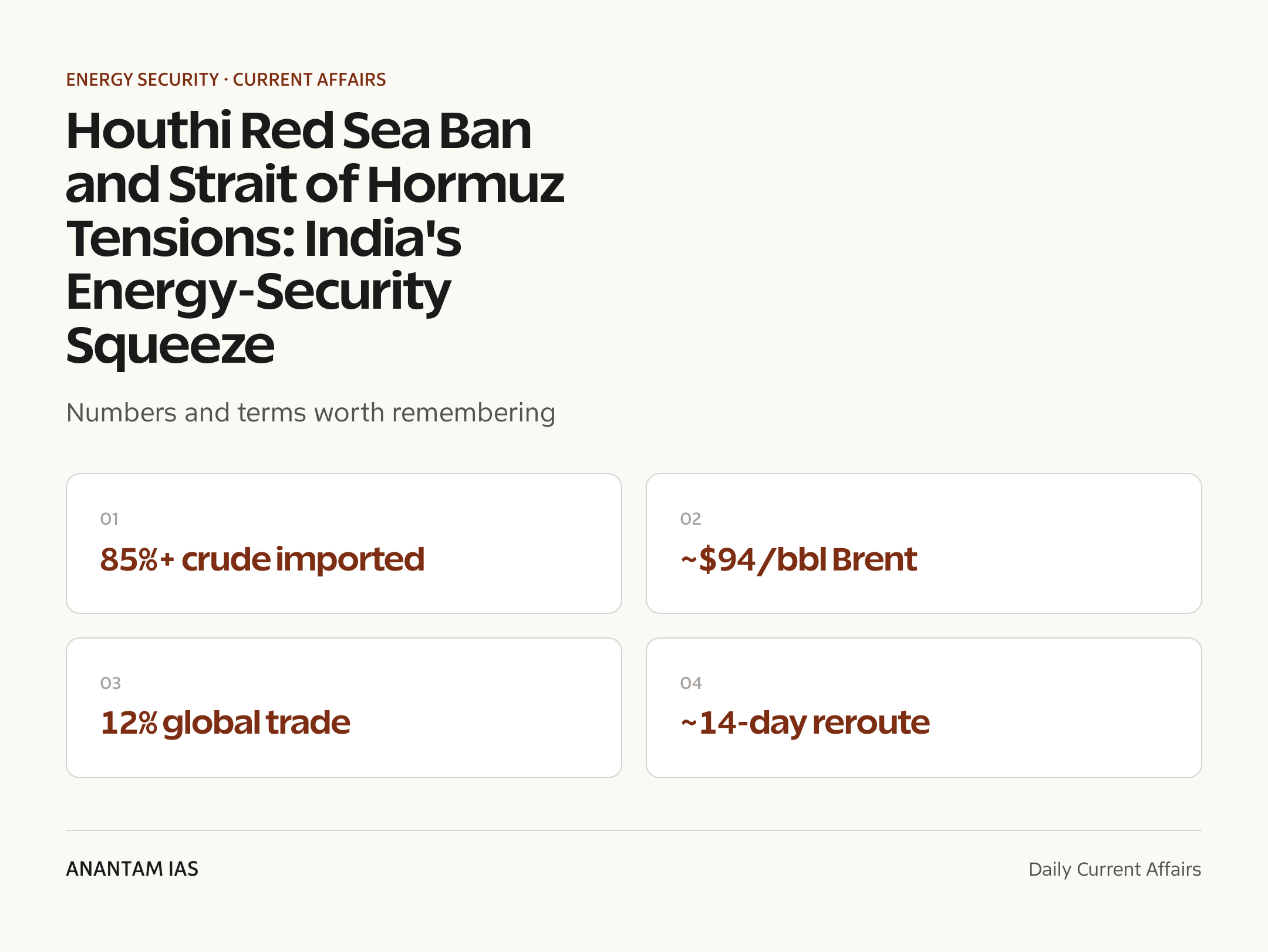
- On 8 June 2026 the Houthis declared a “complete and total ban” on Israeli maritime navigation in the Red Sea.
- The Bab-el-Mandeb strait is about 26 km wide at its narrowest and carries roughly 12 percent of global maritime trade.
- The Red Sea route handles around $1 trillion of goods every year.
- The Strait of Hormuz carries close to one-fifth of the world’s seaborne oil and gas.
- India imports more than 85 percent of its crude oil, a large share of it from West Asian Gulf suppliers.
- Roughly 40 to 50 percent of India’s crude imports transit the Strait of Hormuz, though about 70 percent is now sourced via routes outside it.
- Rerouting Asia-Europe cargo around the Cape of Good Hope adds about 14 days and heavy fuel and insurance costs.
- Brent crude rose about 4 percent to near $94 a barrel after the Houthi announcement, per The Hindu analysis.
- Sources: The Hindu (UPSC news analysis) and Euronews.
What Just Happened
The Houthi authorities in Sanaa announced on 8 June 2026 a total ban on Israeli shipping through the Red Sea, declaring that Israeli-flagged vessels and ships engaged in Israeli maritime commerce would be treated as legitimate military targets. The move revived the disruption pattern seen during the earlier Gaza conflict, when the group launched close to 200 attacks on shipping and pushed many carriers off the Red Sea entirely.
The shipping ban landed alongside heightened tension over the Strait of Hormuz, the narrow gateway between the Persian Gulf and the Gulf of Oman through which most Gulf crude and LNG reaches the world. With both the southern Red Sea entrance at Bab-el-Mandeb and the Gulf exit at Hormuz under pressure at once, planners describe a “double chokepoint squeeze” on the West Asia-to-world energy corridor.
The market reaction was immediate. The Hindu’s UPSC analysis recorded Brent crude rising about 4 percent toward $94.38 a barrel, domestic LPG cylinder prices revised up by about ₹29 in one step and roughly ₹89 across two revisions, and oil marketing companies absorbing under-recoveries on diesel and petrol. Euronews noted that during the earlier campaign, daily oil flows through Bab-el-Mandeb fell from about 8.8 million to roughly 4 million barrels as ships detoured around southern Africa.
Background and Context
The geography is the lesson. The Red Sea connects to the Indian Ocean through Bab-el-Mandeb (“the Gate of Tears”) in the south and to the Mediterranean through the Suez Canal in the north, making it the spine of the shortest sea route between Asia and Europe. Close the southern gate, and carriers must sail around the Cape of Good Hope at the tip of Africa, adding roughly two weeks of sailing, fuel, crew and capital costs to every voyage. The Strait of Hormuz, only about 33 km wide at its narrowest, is the single most important oil chokepoint, with no equally large bypass for Gulf exports.
These are India’s sea lanes of communication (SLOCs), the maritime arteries that carry trade and energy and that the Indian Navy is tasked to keep open. India imports more than 85 percent of its crude oil, drawing heavily on Saudi Arabia, Iraq, the UAE and other Gulf suppliers whose cargoes pass through Hormuz, while Suez-Red Sea shipping links India to European and Mediterranean markets. A chokepoint shock hits both the import bill and the export route at the same time.
India’s standing response is Operation Sankalp. The Navy first launched it in June 2019 in the Gulf of Oman and Persian Gulf to escort Indian-flagged ships near Hormuz, and re-energised it from December 2023 as the Red Sea crisis and Somali piracy spiked. Across that surge the Navy deployed dozens of warships, escorted hundreds of merchant vessels and responded to attacks and hijack attempts, becoming one of the largest national naval presences in the region and the practical face of India’s maritime-security doctrine.
Key Pressure Points for India
- Twin chokepoints: Bab-el-Mandeb (Red Sea) and Hormuz (Gulf) are strained together, hitting both India’s trade route and its energy import route.
- Crude exposure: India imports more than 85 percent of its oil, with a large share transiting Hormuz from Gulf suppliers.
- Reroute cost: Diverting around the Cape of Good Hope adds about 14 days plus fuel, crew and capital costs to each voyage.
- Freight and insurance: War-risk insurance premiums and container freight rates spike whenever Red Sea passage is judged unsafe.
- Inflation channel: Higher crude and shipping costs feed into LPG, diesel, petrol and imported-input prices at home.
- Strategic hedge: Strategic petroleum reserves, supplier diversification, Operation Sankalp and the IMEC corridor are India’s structural cushions.
Why It Matters for UPSC
This is a high-yield topic because it ties a current development to durable syllabus themes.
- GS2 IR: how chokepoint conflicts in West Asia test India’s neutrality, energy diplomacy and naval reach in the Indian Ocean Region.
- Links the current Red Sea-Hormuz shock to the durable syllabus on SLOCs, maritime security and India’s crude-import dependence.
- Prelims: locations of Bab-el-Mandeb, Suez Canal, Strait of Hormuz, Gulf of Aden and the Cape of Good Hope route.
- GS3 economy: transmission of an oil-price and freight shock into India’s import bill, current account and retail inflation.
What It Means: Energy Security Lens
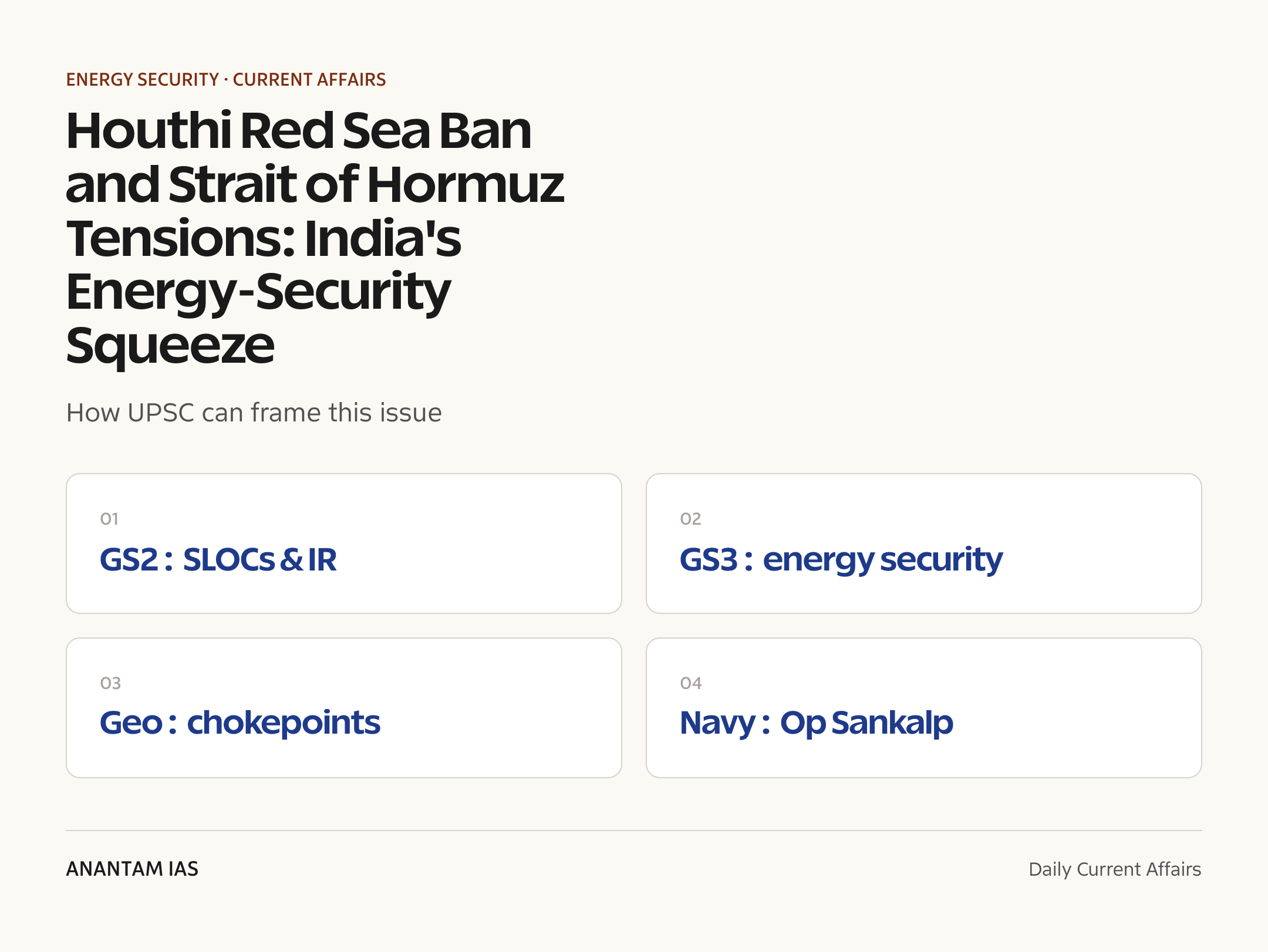
A chokepoint shock is a geography problem before it is a war problem. The reason a localised conflict off Yemen can move prices in Mumbai is that the global energy and container system funnels through a handful of narrow straits with no cheap substitute. When Bab-el-Mandeb becomes risky, the only large-scale alternative is the Cape of Good Hope, which lengthens every Asia-Europe voyage by roughly two weeks. That extra time is not free: it ties up ships, raises fuel burn, and shrinks effective shipping capacity, so freight rates and delivery times rise even for cargo that never goes near the Red Sea.
India’s vulnerability is concentrated on the oil side. With import dependence above 85 percent and a heavy Gulf tilt, a Hormuz scare threatens both the volume and the price of India’s crude. The partial cushion is that New Delhi has diversified aggressively, sourcing from around 40 countries and routing close to 70 percent of imports outside Hormuz, with Russian, American and African barrels reducing single-chokepoint risk. The Red Sea side is less about crude and more about merchandise trade and exports, where insurance and freight costs do the damage rather than outright shortage.
The structural answer is redundancy, not reaction. Strategic petroleum reserves buy time during a spike; supplier and route diversification dilute any one chokepoint; and naval presence through Operation Sankalp protects flagged shipping and signals capability. The India-Middle East-Europe Economic Corridor (IMEC), conceived to link India to Europe through the Gulf, Israel and onward rail-and-sea legs, is also relevant here, because its viability depends on the very stability of this region that the current crisis is testing. A corridor designed to be an alternative to Suez only works if its own nodes stay calm.
Challenges and Concerns
- No large-scale bypass exists for Hormuz; pipelines through Saudi Arabia and the UAE carry only a fraction of Gulf export volumes.
- War-risk insurance and freight surcharges raise landed costs even when supply itself is not interrupted.
- Sustained naval deployment far from home stretches the Navy’s ships, crews and logistics over long periods.
- Regional instability undercuts the near-term promise of IMEC as a stable Suez alternative.
- Higher crude and shipping costs squeeze oil-company finances and risk passing through to retail fuel and LPG prices.
Prelims Pointers
- Bab-el-Mandeb connects the Red Sea to the Gulf of Aden and the Indian Ocean; it is about 26 km wide at its narrowest.
- The Suez Canal links the Red Sea to the Mediterranean Sea, completing the short Asia-Europe sea route.
- The Strait of Hormuz links the Persian Gulf to the Gulf of Oman and carries close to one-fifth of seaborne oil and gas.
- The Cape of Good Hope reroute lies at the southern tip of Africa and adds roughly 14 days to Asia-Europe voyages.
- Sea lanes of communication (SLOCs) are the primary maritime routes used for trade and energy supply.
- Operation Sankalp is the Indian Navy’s deployment to secure shipping; first launched in June 2019 near the Strait of Hormuz.
- India imports more than 85 percent of its crude oil, with major suppliers in the Gulf, Russia and the United States.
- Roughly 40 to 50 percent of India’s crude transits Hormuz, while about 70 percent is now sourced via routes outside it.
- The Houthi movement is based in Yemen and controls the country’s Red Sea coast around Hodeidah.
- IMEC, the India-Middle East-Europe Economic Corridor, was announced on the sidelines of the 2023 G20 Summit in New Delhi.
- Brent crude is the international benchmark price commonly used to track West Asian oil-supply shocks.
- The Gulf of Aden lies between Yemen and Somalia and is a focus of India’s anti-piracy escort missions.
Mains Practice Questions
- “India’s energy security is hostage to a handful of maritime chokepoints.” Examine this statement with reference to the Strait of Hormuz and the Bab-el-Mandeb, and outline measures to reduce this vulnerability. (GS2/GS3, 15 marks)
- Discuss how instability in the Red Sea and the Strait of Hormuz affects India’s trade costs, current account and domestic inflation. (GS3, 10 marks)
- Evaluate the role of the Indian Navy, through deployments such as Operation Sankalp, in securing India’s sea lanes of communication in the Indian Ocean Region. (GS2/GS3, 15 marks)
- Assess the strategic significance of the India-Middle East-Europe Economic Corridor (IMEC) as an alternative trade route, and the risks West Asian instability poses to it. (GS2, 10 marks)
Way Forward
Deepen crude-supplier and route diversification so no single chokepoint carries a dominant share of imports, and keep building strategic petroleum reserves as a shock buffer.
Sustain calibrated naval presence and maritime domain awareness in the Indian Ocean Region while using energy diplomacy to keep Gulf supply lines open and IMEC nodes stable.
Frequently Asked Questions
What did the Houthis ban on 8 June 2026?
The Houthi movement declared a complete and total ban on Israeli maritime navigation in the Red Sea, calling Israeli-flagged ships and vessels in Israeli commerce legitimate military targets. The move revived the shipping disruption seen during the earlier Gaza conflict and pushed up oil prices and freight risk across the region.
Why does the Red Sea matter so much for global trade?
The Red Sea links Asia to Europe through Bab-el-Mandeb in the south and the Suez Canal in the north, carrying about 12 percent of global maritime trade and roughly $1 trillion of goods a year. Closing it forces ships around the Cape of Good Hope, the long and costly way around southern Africa.
How dependent is India on the Strait of Hormuz?
India imports more than 85 percent of its crude oil, and roughly 40 to 50 percent of those imports pass through the Strait of Hormuz from Gulf suppliers. New Delhi has diversified so that about 70 percent of crude now arrives via routes outside Hormuz, but the strait remains a single point of acute risk.
What is Operation Sankalp?
Operation Sankalp is the Indian Navy’s mission to protect shipping in the region. It was first launched in June 2019 near the Strait of Hormuz and was re-energised from December 2023 during the Red Sea crisis, with dozens of warships escorting merchant vessels. It is the practical face of India’s maritime-security doctrine.
How does this crisis reach Indian consumers?
Higher crude prices and longer, riskier shipping routes raise India’s import bill and freight and insurance costs. Those costs feed into LPG, diesel, petrol and imported-input prices, and the analysis noted LPG revisions and oil-company under-recoveries soon after the Houthi declaration. A distant strait becomes a kitchen-table price.
How is IMEC relevant to this issue?
The India-Middle East-Europe Economic Corridor is designed to connect India to Europe through the Gulf and onward legs as an alternative to the Suez route. Its promise depends on a stable West Asia, so the current Red Sea and Hormuz tensions are a direct test of whether that alternative can deliver.
Source: https://anantamias.com/current-affairs/houthi-red-sea-ban-strait-of-hormuz-energy/
ALMM List-II in Force: India’s Domestic Solar-Cell Mandate vs the Capacity Gap
From 1 June 2026, the Ministry of New and Renewable Energy (MNRE) brought its Approved List of Models and Manufacturers List-II into force, a step that quietly rewires India’s solar supply chain. ALMM is a government register of solar equipment cleared for use in publicly supported projects, first introduced in 2019 to set quality and origin standards. List-I covers approved module makers, and the newly enforced List-II covers approved solar-cell makers. The practical effect is that most government-backed, net-metered and open-access solar projects commissioned after 1 June must now use cells manufactured in India, not just modules assembled here from imported cells.
The number that defines the story is a mismatch. India’s ALMM-listed module capacity sits near 193 GW, while listed cell capacity is only about 31 GW after the seventh revision in April 2026. The Hindu, reporting on the rollout, notes that domestic cells meet barely a quarter to a third of demand and trade at more than double the price of imports. Down To Earth frames it as a factory-floor test: a self-reliance rule has arrived before the factory floor is ready to supply it. This is a clean cross-paper case for UPSC on Atmanirbhar manufacturing, energy security and the cost of a renewables push that still leans on China.
An examiner will read this less as a notification and more as a test case in sequencing industrial policy: when a domestic-content mandate runs ahead of domestic capacity, who bears the adjustment cost.
Quick Facts
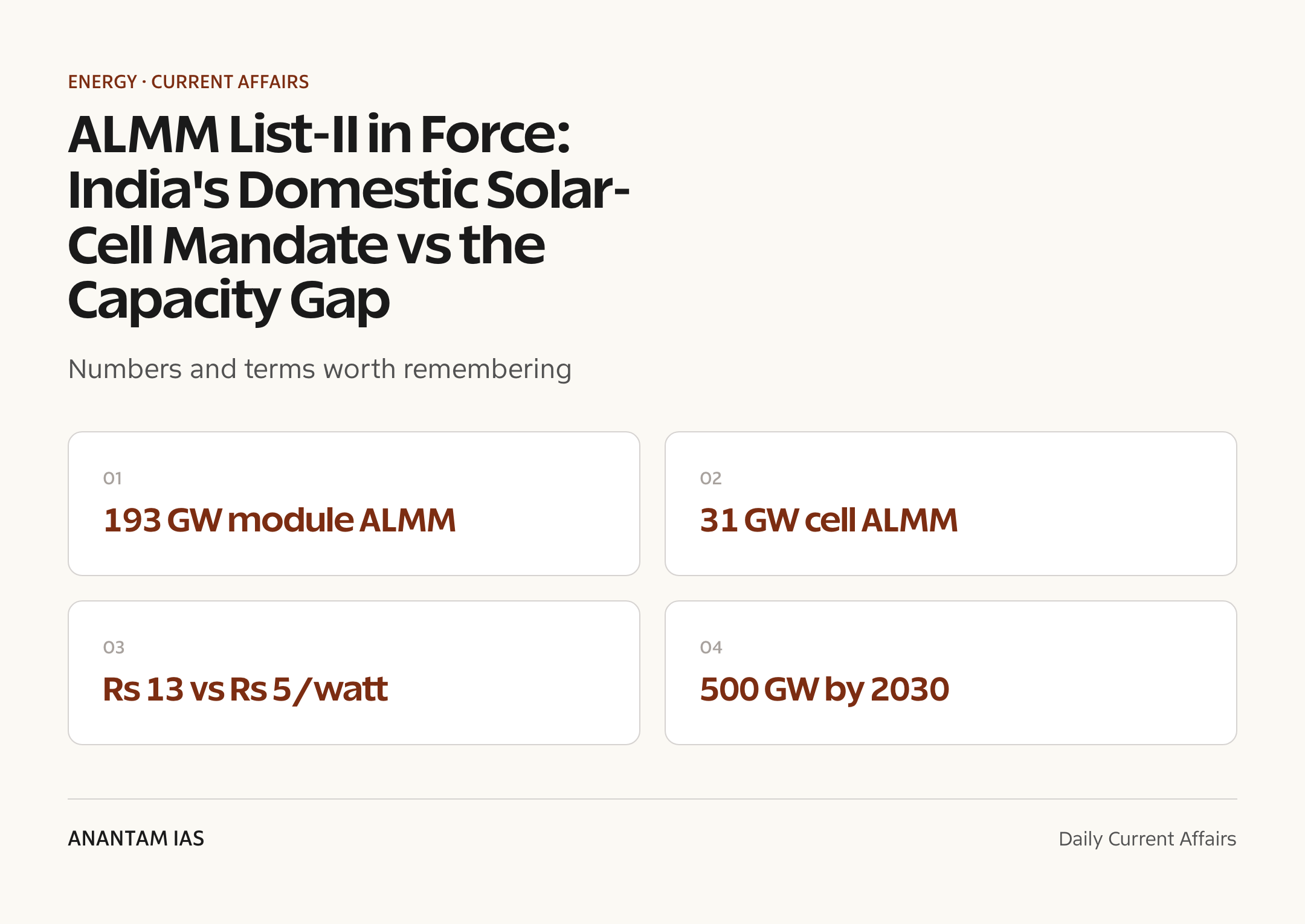
- ALMM List-II for solar cells took effect on 1 June 2026, enforced by MNRE.
- ALMM List-I (modules) capacity is about 193 GW; List-II (cells) is about 31 GW after the seventh revision in April 2026.
- In TOPCon technology, approved module capacity is near 172 GW but cell capacity only about 10 GW.
- MNRE on 25 May 2026 refused a blanket deadline extension, offering only case-by-case relief.
- Domestic List-II cells cost roughly Rs 13 per watt against about Rs 5 per watt for imported cells.
- China holds over 90 percent of global polysilicon and wafer capacity, over 85 percent of cells and about 80 percent of modules.
- Around 95 percent of the polysilicon used by Indian makers is imported, mostly from China.
- India targets 500 GW of non-fossil installed capacity by 2030; solar is the largest single pillar.
- Sources: The Hindu and Down To Earth.
What Just Happened
MNRE confirmed that ALMM List-II would apply from 1 June 2026 and, in an order dated 25 May 2026, declined to push the date back despite repeated industry requests. Projects commissioned after the cut-off must source cells from manufacturers enlisted on List-II, with relief decided case by case through an expert committee rather than through a general extension; claims for transitional relief were to be filed by the end of June. This closes a long-criticised loophole: until now a firm could import finished cells, assemble them into panels on Indian soil, and still pass off the panel as domestic equipment for government tenders. List-II ends that by testing origin at the cell, not the module.
The capacity figures explain the alarm. The Hindu reports installed solar capacity above 144 GW, module-assembly capacity near 210 GW, and cell-manufacturing capacity around 27 GW at the end of 2025, with high-efficiency cells made by only a handful of companies such as Emmvee, Premier Energies, Mundra Solar PV, Tata Power Renewable, Waaree and Renewsys. Down To Earth puts ALMM-listed module capacity at roughly 193 GW against about 31 GW of listed cells, and notes that in TOPCon, the dominant high-efficiency cell type, approved module capacity of about 172 GW dwarfs cell capacity of about 10 GW. After captive use by integrated firms, open-market cell availability shrinks to a sliver of what standalone module makers need, leaving the bulk of assembly capacity chasing a thin pool of merchant cells.
The cost gap sharpens the squeeze. Domestic List-II cells run around Rs 13 per watt while imported cells are near Rs 5 per watt, a spread of more than two to one that flows straight into project tariffs and developer margins. Down To Earth reports that building a cell line is far heavier than module assembly, costing several times more per gigawatt, which is why assembly capacity raced ahead while cell capacity lagged. The result is that standalone module makers, who collectively hold large assembly capacity but no cell lines, now depend on a small set of vertically integrated players such as Waaree, Adani, Tata Power Renewable and ReNew that can supply their own cells. That dependence, plus the price shock, has pushed developers and standalone manufacturers to seek relief and, in some cases, to challenge the timing of the mandate in court.
The relief architecture is itself a flashpoint. By refusing a blanket extension and routing every plea through a case-by-case committee, MNRE keeps the headline rule intact but turns compliance into a discretionary, project-by-project negotiation. Developers with projects bid years ago at low tariffs, before the cell rule was certain, now face a cost they did not price in, and the scramble for exemptions risks a two-speed market where the well-connected secure relief and the rest absorb the shortfall. Both reports stress the same near-term reality: the cells simply do not exist in the open market in the volumes the mandate assumes, so the binding question for 2026 is not whether the policy is right in principle but how the system bridges roughly a year or two of supply scarcity without stalling installations or stranding factory investment.
Background and Context
ALMM was introduced by MNRE in 2019 under the Solar Photovoltaic Systems, Devices and Components Goods Order to set quality and origin standards for solar equipment in government-linked projects. It functions as a domestic-content gate: only equipment on the list qualifies for government-supported, subsidised, net-metered and open-access projects. List-I, covering modules, has been operational for years and is the backbone of India’s domestic-content approach. List-II, covering cells, was repeatedly deferred while domestic cell lines were built up, and 1 June 2026 is the date it finally bites. The two lists together trace the value chain one notch deeper, from where panels are assembled to where the active semiconductor layer is actually made. A recurring complication is the World Trade Organisation angle: India’s earlier domestic-content requirements in solar were challenged at the WTO, so the government now leans on ALMM and a government-procurement framing rather than open import bans to keep its self-reliance push defensible.
The solar value chain runs polysilicon to ingot and wafer to cell to module. Polysilicon is purified silicon; it is cast into ingots and sliced into thin wafers; wafers are processed into cells that convert sunlight into electricity; cells are wired and laminated into modules, the finished panels. The cell is the technologically demanding, capital-heavy stage, costing several times more per gigawatt than a module line, while module assembly is comparatively easy and low-value. China dominates every link, with more than 90 percent of global polysilicon and wafer capacity, over 85 percent of cells and about 80 percent of modules. India built module capacity fast but stayed thin upstream: roughly 95 percent of its polysilicon is imported, mostly from China, and even new cell lines lean on imported wafers for the near term. ALMM List-II is an attempt to force investment one step up that chain, from assembly toward genuine cell fabrication.
The policy backdrop is India’s pledge of 500 GW of non-fossil installed capacity by 2030, with solar as the single largest contributor, building on the Jawaharlal Nehru National Solar Mission launched in 2010 as one of the eight missions under the National Action Plan on Climate Change. The Production Linked Incentive scheme for High Efficiency Solar PV Modules, run since 2021, subsidises integrated manufacturing from polysilicon down to modules to cut import reliance and reward firms that build deeper into the chain. ALMM List-II is the demand-side companion to PLI’s supply-side push: PLI funds factories, while ALMM guarantees them a captive government market. Read together, the two are India’s twin levers to localise solar manufacturing, and List-II is the point where that strategy meets its hardest test, the cell.
Key Features of the ALMM List-II Mandate
- Effective date: List-II for solar cells applies to eligible projects commissioned from 1 June 2026.
- Scope: covers government-backed, net-metered and open-access projects, closing the assembled-from-imported-cells route.
- Origin deepening: moves the domestic-content test from modules (List-I) down to cells (List-II).
- No blanket extension: MNRE’s 25 May 2026 order offers only case-by-case relief via an expert committee.
- Policy pairing: works with the PLI scheme for high-efficiency solar modules to anchor a captive home market.
- Strategic intent: reduce import dependence on China and build energy security in the renewables transition.
Why It Matters for UPSC
This is a high-yield topic because it ties a current development to durable syllabus themes.
- GS-III industrial policy and energy: a textbook case of sequencing a domestic-content mandate against actual manufacturing capacity.
- Links the current notification to static themes: Atmanirbhar Bharat, PLI schemes, National Solar Mission and the 500 GW by 2030 target.
- Prelims-ready terms: ALMM List-I vs List-II, MNRE, TOPCon, domestic-content requirement, the polysilicon-wafer-cell-module chain.
- Essay and ethics angle: balancing self-reliance, affordable clean power and climate commitments without picking winners by accident.
What It Means: Energy Lens
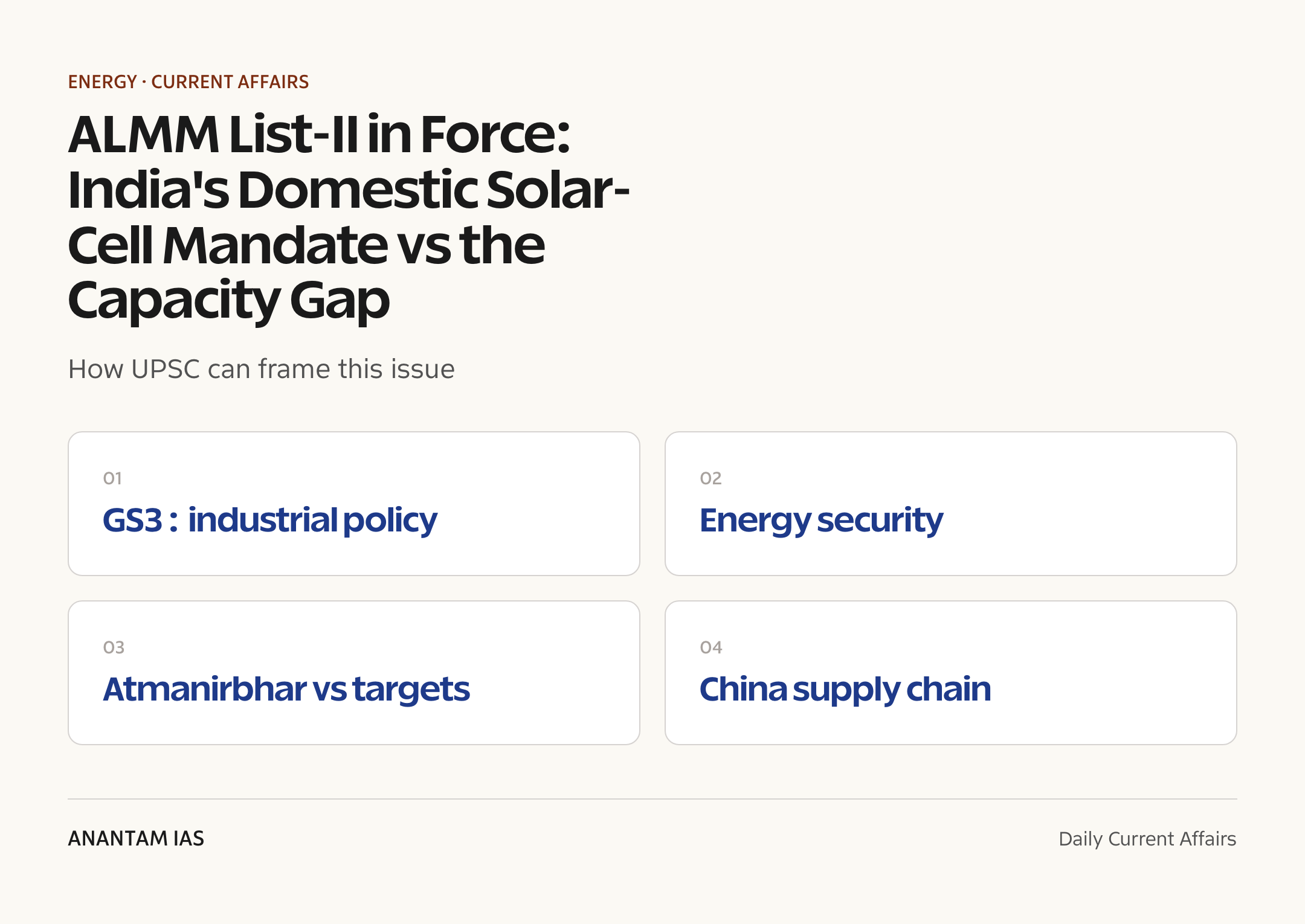
A mandate is only as strong as the capacity behind it. ALMM List-II is sound in intent: assembling Chinese cells into Indian-branded panels never built real industrial depth, and forcing the cell stage onshore targets the value chain’s hardest link. But sequencing matters. With listed cell capacity near 31 GW against module capacity near 193 GW, and the TOPCon gap even wider, the rule asks the system to consume what it cannot yet make. The predictable result is scarcity pricing, with domestic cells near Rs 13 per watt against imports near Rs 5, and a rush for exemptions that can hollow out the policy from within.
The distributional effect runs toward concentration. Vertically integrated firms that already make their own cells gain a protected, high-margin position, while the many standalone module makers who scaled assembly under earlier policy signals are left short of inputs and exposed to stranded lines. A self-reliance policy can quietly become a market-power policy if a handful of integrated players capture the captive government demand and set the price for everyone else. That is the equity question UPSC likes: who captures the rents created by a protective rule, and whether industrial policy is building a competitive ecosystem or simply handing incumbents an entry barrier. The same logic warns against over-reliance on one or two domestic suppliers, because a thin supplier base can extract monopoly pricing as surely as foreign dependence once did.
The real fix is upstream, not at the cell gate. India’s deeper dependence is on polysilicon, ingots and wafers, where it imports roughly 95 percent of polysilicon and China holds over 90 percent of global capacity. A cell mandate without a parallel wafer and polysilicon push simply shifts the import line one notch up the chain: domestic cells stamped Indian may still be cut from Chinese wafers. Genuine energy security needs the whole ladder, paired with phased and published capacity targets, so that domestic-content ambition and the 500 GW by 2030 renewables timeline pull in the same direction rather than against each other. The WTO history is a reminder that the safest route is to build capacity that makes domestic cells competitive on cost, not merely mandatory on paper, because a rule that survives trade scrutiny but starves projects of affordable cells helps neither manufacturing nor the climate target.
Challenges and Concerns
- Cell capacity near 31 GW cannot supply module capacity near 193 GW, so a supply shortage and price spike are near-certain in the near term.
- The roughly Rs 13 versus Rs 5 per watt gap raises project costs and can slow capacity additions against the 2030 target.
- Standalone module makers without cell lines face input scarcity and risk stranded assets, feeding court challenges.
- Case-by-case relief is discretionary and can create uncertainty, rent-seeking and an uneven playing field.
- Upstream weakness in polysilicon and wafers, mostly imported, means the cell rule only shifts import dependence higher up the chain.
Prelims Pointers
- ALMM is the Approved List of Models and Manufacturers, maintained by the Ministry of New and Renewable Energy (MNRE).
- ALMM List-I covers approved solar modules; List-II covers approved solar cells.
- ALMM List-II for solar cells came into force on 1 June 2026.
- ALMM was introduced in 2019 under the Solar PV Systems, Devices and Components Goods Order.
- ALMM-listed module capacity is about 193 GW; listed cell capacity is about 31 GW after the April 2026 revision.
- In TOPCon technology, approved module capacity is about 172 GW versus cell capacity of about 10 GW.
- The solar value chain runs polysilicon to ingot and wafer to cell to module.
- China holds over 90 percent of global polysilicon and wafer capacity and over 85 percent of cell capacity.
- India imports roughly 95 percent of its polysilicon, mostly from China.
- The PLI scheme for High Efficiency Solar PV Modules has run since 2021 to build integrated manufacturing.
- India targets 500 GW of non-fossil installed capacity by 2030; the National Solar Mission was launched in 2010.
- Domestic List-II cells cost about Rs 13 per watt against about Rs 5 per watt for imported cells.
Mains Practice Questions
- India’s domestic-content mandates in solar manufacturing seek self-reliance but can collide with renewable-energy targets. Examine this tension using the ALMM List-II rollout, and suggest a phased pathway to reconcile the two. (GS-III, 15 marks)
- The cell is the hardest link in the solar value chain. Analyse why India’s module capacity has outpaced its cell and wafer capacity, and assess the role of PLI and ALMM in correcting this. (GS-III, 15 marks)
- Energy security in the clean-energy transition is as much about supply chains as about installed capacity. Discuss with reference to India’s import dependence on China for solar equipment. (GS-III, 10 marks)
- A domestic-content requirement can deepen manufacturing or entrench market power. Critically evaluate the ALMM List-II mandate from an industrial-policy and equity standpoint. (GS-III, 15 marks)
Way Forward
Pair the cell mandate with phased, published capacity targets so demand and domestic supply ramp together, avoiding shortage-driven price spikes.
Extend incentives upstream to wafers, ingots and polysilicon, since a cell rule without wafer capacity only moves the import line higher up the chain.
Keep transitional relief transparent and rule-bound rather than purely discretionary, to prevent rent-seeking and protect standalone module makers.
Diversify import sources and build strategic input reserves while domestic upstream capacity matures, so the 500 GW by 2030 timeline stays on track.
Frequently Asked Questions
What is ALMM List-II?
ALMM List-II is the Ministry of New and Renewable Energy’s register of approved domestic solar-cell manufacturers. From 1 June 2026, most government-backed, net-metered and open-access solar projects must source cells from this list, deepening the domestic-content rule from modules to cells. It is the cell-stage twin of the older List-I for modules.
How is List-II different from List-I?
List-I approves solar module makers and has run for years; List-II approves solar cell makers and took effect on 1 June 2026. The cell is where sunlight becomes electricity, the value chain’s hardest stage, so List-II pushes self-reliance one notch deeper than assembling imported cells into Indian panels.
Why is the capacity gap a problem?
India’s ALMM-listed module capacity is near 193 GW but cell capacity only about 31 GW, and in TOPCon the gap is wider. The mandate asks the system to consume cells it cannot yet make, so domestic cells trade near Rs 13 per watt against imports near Rs 5, driving shortages and exemption requests.
How does this link to the 500 GW target?
India aims for 500 GW of non-fossil capacity by 2030, with solar the largest pillar. ALMM List-II is meant to make that build-out self-reliant, but if it raises costs and curbs supply in the near term, it can slow capacity additions. Sequencing the mandate with capacity is the policy’s success test.
Why does China matter here?
China holds over 90 percent of global polysilicon and wafer capacity, over 85 percent of cells and about 80 percent of modules. India imports roughly 95 percent of its polysilicon. So a cell mandate without upstream investment only shifts import dependence higher up the chain rather than ending it.
What is the policy fix?
Pair ALMM List-II with phased targets and upstream incentives for wafers and polysilicon, keep relief transparent, and diversify imports while capacity matures. The goal is to make self-reliance, affordable power and the 2030 timeline pull together rather than against each other.
Source: https://anantamias.com/current-affairs/solar-almm-list-ii-domestic-cell-mandate/
PMSMA Completes 10 Years: India’s Maternal-Health Scorecard
Pradhan Mantri Surakshit Matritva Abhiyan (PMSMA) completed a decade on 9 June 2026, and Union Health Minister J.P. Nadda opened nationwide celebrations, releasing a ₹75 commemorative coin and a ₹5 postal stamp. PMSMA, launched on 9 June 2016 by the Ministry of Health and Family Welfare, promises every pregnant woman free, assured, quality antenatal care (ANC) on the 9th of every month at designated government health facilities, with specialists volunteering through a public-private model. It is the scheme that turned a routine check-up into a fixed-date national appointment.
The headline number is the reach: in ten years PMSMA delivered more than 7.5 crore antenatal check-ups and flagged nearly 1.2 crore high-risk pregnancies (HRPs) for closer follow-up. That second figure is the real story for an exam answer. PMSMA is not just about coverage; it is a screening engine that finds the women most likely to die and routes them to specialist care. The cross-paper relevance is direct: this is a GS-II governance and social-justice case study on how a health scheme bends a hard SDG indicator, India’s Maternal Mortality Ratio.
An examiner will not test the anniversary; she will test whether you can connect PMSMA to the MMR trend, to the JSY-JSSK-SUMAN scheme stack, and to the unfinished SDG 3.1 target.
Quick Facts
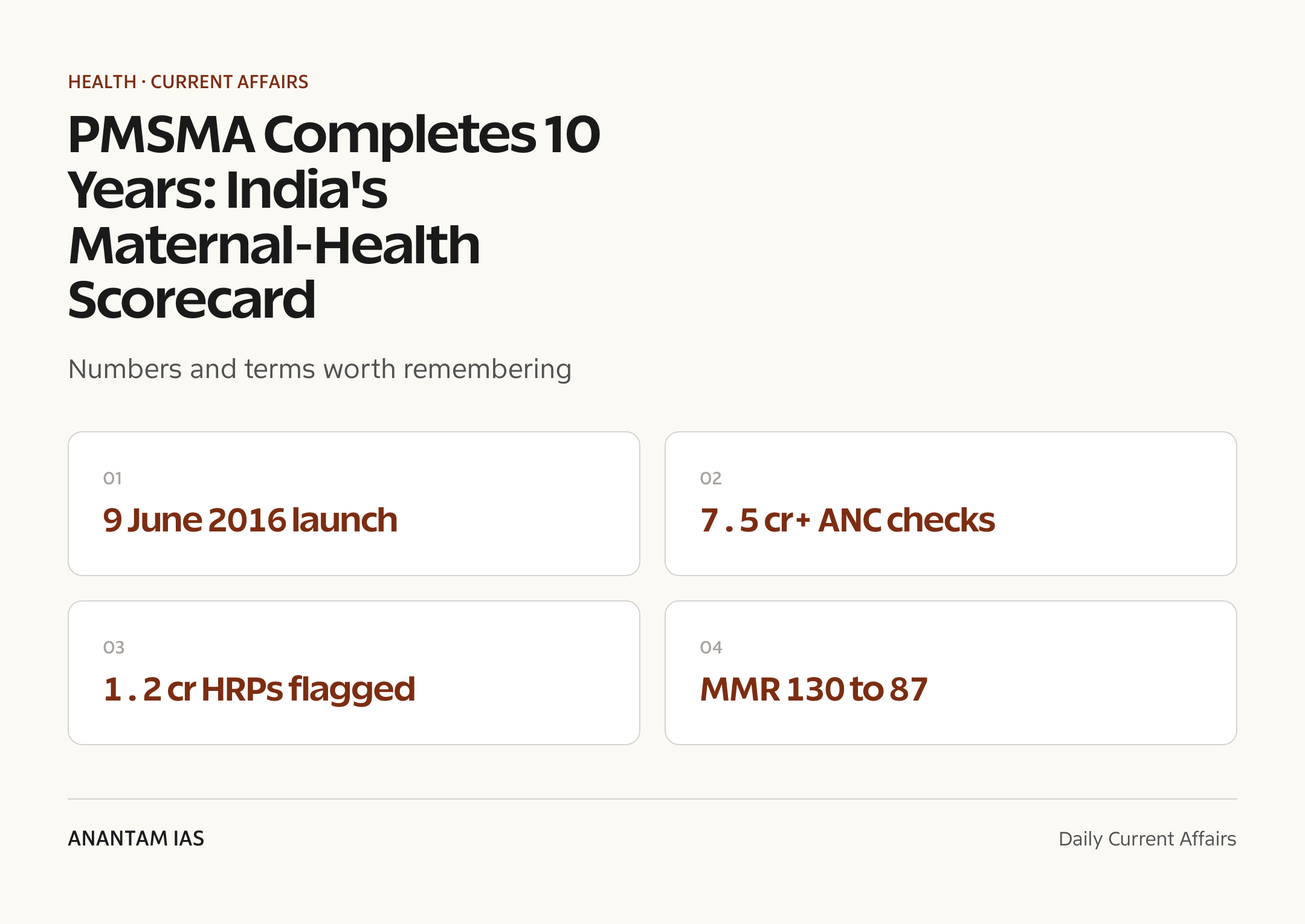
- PMSMA was launched on 9 June 2016 by the Ministry of Health and Family Welfare; it completed 10 years on 9 June 2026.
- The scheme guarantees free antenatal care to every pregnant woman on the 9th day of every month at government facilities.
- Over the decade, more than 7.5 crore antenatal check-ups were conducted under PMSMA.
- Nearly 1.2 crore high-risk pregnancies were identified and tracked through the programme.
- India’s Maternal Mortality Ratio (MMR) per the Sample Registration System fell from 130 (2014-16) to 93 (2019-21), with the latest bulletin near 87.
- The SDG 3.1 target is to cut MMR below 70 per 1,00,000 live births by 2030; India has already crossed the National Health Policy target of under 100.
- Institutional deliveries rose to 88.6 percent in NFHS-5, up from 78.9 percent in NFHS-4.
- Women get a green sticker for a normal pregnancy and a red sticker for a high-risk one, guiding follow-up till 45 days after delivery.
- Sources: PIB, Ministry of Health & Family Welfare and PIB / SRS Special Bulletin on Maternal Mortality.
What Just Happened
On 9 June 2026 the Health Ministry launched a year-long set of activities themed ’10 years of PMSMA: a decade of care’. The minister unveiled a ₹75 commemorative coin and a ₹5 postal stamp, and the ministry placed the scheme’s cumulative record on view: 7.5 crore-plus antenatal check-ups and close to 1.2 crore high-risk pregnancies identified since 2016. The framing was deliberate, presenting PMSMA as one of the most far-reaching public-health interventions of the period rather than a single-day event.
The operating model that produced those numbers is simple by design. On the 9th of every month, government health facilities run dedicated PMSMA sessions where a pregnant woman, ideally in her second or third trimester, gets a clinical examination, counselling, free medicines, laboratory tests and at least one ultrasound. Each woman is colour-coded: a green sticker for a normal pregnancy, a red sticker for a high-risk one. The red-sticker cohort, women with severe anaemia, hypertension, diabetes, or a history of obstetric complications, is then tracked more closely from pregnancy through 45 days after delivery.
Crucially, PMSMA leans on volunteerism. Private obstetricians and gynaecologists are invited to donate time at public facilities on PMSMA day, widening the specialist pool in districts where the government cadre is thin. ASHAs and Auxiliary Nurse Midwives (ANMs) do the groundwork, mobilising women, ensuring they attend, and feeding the high-risk list back into the system so that a flagged pregnancy is not lost to follow-up.
Background and Context
PMSMA sits inside a longer scheme stack that India built to make childbirth safe and institutional. Janani Suraksha Yojana (JSY), launched in 2005 under the National Health Mission, used a conditional cash transfer to pull poor women out of risky home deliveries and into hospitals. Janani Shishu Suraksha Karyakram (JSSK), launched in 2011, went further and made delivery, drugs, diagnostics, diet, blood, transport and even caesarean sections completely free in public facilities, attacking the out-of-pocket cost that kept women away. PMSMA, added in 2016, plugged the remaining gap: not the delivery, but the quality antenatal care before it.
The latest layer is Surakshit Matritva Aashwasan (SUMAN), launched on 10 October 2019. SUMAN sets an explicit goal of zero preventable maternal and newborn deaths and a ‘zero tolerance for denial of services’ guarantee. It bundles free, dignified, respectful care for every pregnant woman, mother up to six months postpartum, and sick newborn at a public facility, including free transport to and from the facility. Read together, JSY, JSSK, PMSMA and SUMAN form a continuum of care from the first antenatal visit to the postnatal period.
The number these schemes are judged against is the Maternal Mortality Ratio, the number of maternal deaths per 1,00,000 live births, tracked by the Sample Registration System (SRS). India’s MMR fell from 130 in 2014-16 to 103 in 2017-19, 97 in 2018-20 and 93 in 2019-21, with the most recent SRS special bulletin putting it near 87. That is well below the National Health Policy target of 100, and within striking distance of the Sustainable Development Goal 3.1 target of fewer than 70 by 2030. States such as Kerala (around 30), Maharashtra (38) and Telangana (56) have already crossed the SDG line; the laggard belt of high-focus states is where the remaining deaths cluster.
Key Features of PMSMA
- Fixed-date care: Assured antenatal care on the 9th of every month at every designated government facility, so the visit is predictable, not discretionary.
- Free and comprehensive: Clinical check-up, counselling, free drugs, lab tests and at least one ultrasound at no cost to the woman.
- Risk stratification: Green sticker for normal pregnancies, red sticker for high-risk ones, with the red cohort tracked till 45 days after delivery.
- Specialist volunteerism: Private obstetricians and gynaecologists donate time at public facilities, expanding the specialist pool through a public-private model.
- Frontline backbone: ASHAs and ANMs mobilise women, ensure attendance and maintain the high-risk-pregnancy follow-up loop.
- Part of a continuum: PMSMA covers the antenatal phase that JSY (cash for institutional delivery) and JSSK (free delivery) do not.
Why It Matters for UPSC
This is a high-yield topic because it ties a current development to durable syllabus themes.
- GS-II direct hit: a flagship welfare scheme and a clean case study on government policies for vulnerable sections and SDG-linked health governance.
- Links the current event to static syllabus: maternal health, SDG 3, National Health Mission, NFHS data and the determinants-of-health framework.
- Prelims angle: pairing schemes to launch years (JSY 2005, JSSK 2011, PMSMA 2016, SUMAN 2019) and MMR-MMR/SRS definitions are high-frequency matches.
- Essay and ethics angle: gives a concrete India example for prompts on women’s empowerment, equity in health and the social cost of preventable death.
What It Means: Health Lens
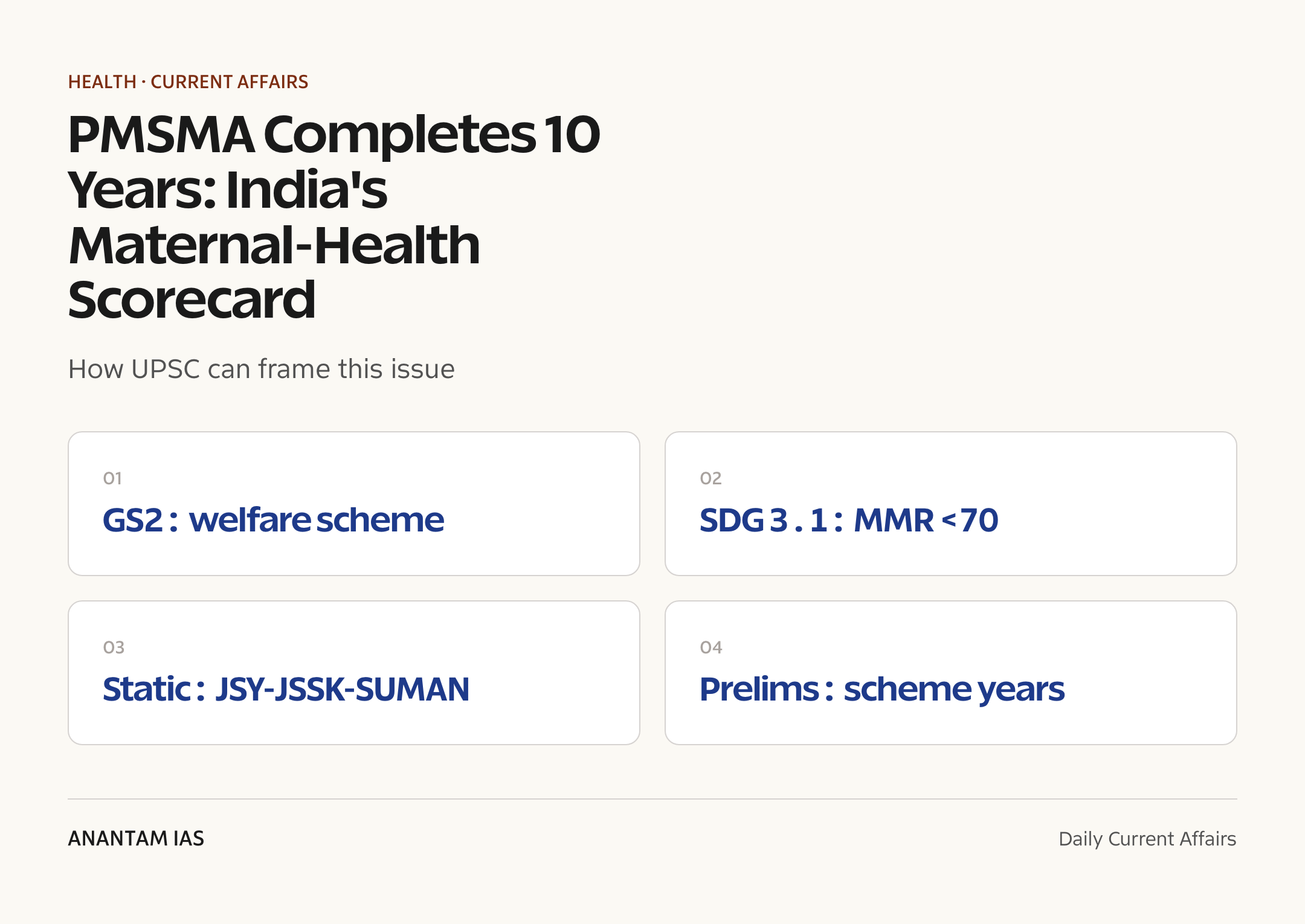
PMSMA’s design insight is that the danger is not childbirth alone, it is the undetected high-risk pregnancy. India had already won the institutional-delivery battle; NFHS-5 shows 88.6 percent of births now happen in facilities, up from 78.9 percent a survey earlier. Getting a woman into a hospital, though, does not help if she arrives in crisis, undiagnosed and untreated. PMSMA’s contribution is the 1.2 crore red stickers: it pushes the system to find anaemia, hypertension, diabetes and obstetric history during pregnancy, when intervention is cheap and effective, rather than during a midnight emergency, when it often is not.
The MMR curve tells the harder half of the story, which is that the easy gains are over. Falling from 130 to roughly 87 in under a decade is a genuine achievement, but the slope is flattening, and the national average masks deep inter-state inequality. Kerala sits near 30 while several high-focus states remain far above the national line. The remaining maternal deaths are concentrated, driven by obstetric haemorrhage, sepsis and hypertensive disorders, often the result of the three classic delays: delay in deciding to seek care, delay in reaching a facility, and delay in receiving quality care once there.
So the policy frontier has shifted from coverage to quality. Schemes like SUMAN and the LaQshya labour-room quality initiative, and the persistent burden of anaemia among pregnant women, signal that the next points of MMR reduction will come from better-functioning facilities, blood availability, skilled birth attendance and respectful care, not merely from more visits. PMSMA at ten is a hinge: it built the screening habit; the unfinished task is making sure that a flagged woman actually receives the care her red sticker promises.
Challenges and Concerns
- Quality, not coverage, is now the binding constraint: identifying a high-risk pregnancy helps little if blood, specialists and functioning labour rooms are absent at the referral point.
- Sharp inter-state inequality means the national MMR hides a cluster of high-focus states where most preventable deaths still occur.
- Specialist volunteerism is uneven; many rural and tribal blocks lack the obstetricians PMSMA day depends on, leaving sessions thinly staffed.
- Persistent anaemia and undernutrition among pregnant women keep raising the baseline risk despite better antenatal contact.
- Last-mile follow-up of red-sticker pregnancies strains an already overstretched ASHA and ANM workforce.
Prelims Pointers
- PMSMA was launched on 9 June 2016 by the Ministry of Health and Family Welfare.
- PMSMA guarantees free antenatal care on the 9th of every month at government health facilities.
- A green sticker marks a normal pregnancy and a red sticker marks a high-risk pregnancy under PMSMA.
- Janani Suraksha Yojana (JSY) was launched in 2005 under the National Health Mission as a conditional cash transfer.
- Janani Shishu Suraksha Karyakram (JSSK), 2011, makes delivery, drugs, diagnostics and transport free in public facilities.
- Surakshit Matritva Aashwasan (SUMAN) was launched on 10 October 2019 with a zero-tolerance-for-denial-of-services pledge.
- Maternal Mortality Ratio (MMR) is maternal deaths per 1,00,000 live births, tracked by the Sample Registration System.
- India’s MMR fell from 130 (2014-16) to 93 (2019-21), with the latest SRS bulletin near 87.
- The SDG 3.1 target is to reduce MMR below 70 per 1,00,000 live births by 2030.
- Institutional deliveries reached 88.6 percent in NFHS-5, up from 78.9 percent in NFHS-4.
- Kerala, Maharashtra and Telangana have already achieved an MMR below the SDG target of 70.
- ASHAs and ANMs are the frontline workers who mobilise women and track high-risk pregnancies under PMSMA.
Mains Practice Questions
- Pradhan Mantri Surakshit Matritva Abhiyan has shifted the maternal-health challenge from coverage to quality. Examine this statement in the light of India’s Maternal Mortality Ratio trend and the SDG 3.1 target. (GS-II, 15 marks)
- Discuss how the scheme stack of JSY, JSSK, PMSMA and SUMAN together forms a continuum of maternal and newborn care. What gaps remain in its implementation? (GS-II, 15 marks)
- India’s falling Maternal Mortality Ratio hides sharp inter-state inequality. Analyse the structural reasons behind this and suggest measures to reach the high-focus states. (GS-II, 10 marks)
- ‘The next gains in reducing maternal mortality will come from facility quality, not from more antenatal visits.’ Critically evaluate with reference to recent health-sector initiatives. (GS-II, 15 marks)
Way Forward
Close the quality loop so that every red-sticker pregnancy meets a referral facility with blood, a skilled birth attendant and a functioning labour room, not just a screening visit.
Concentrate resources, specialists and incentives on the high-focus states where the remaining maternal deaths cluster, since the national average is no longer the right unit of action.
Tackle the upstream risk drivers, especially anaemia and undernutrition among pregnant women, and pair PMSMA’s antenatal contact with SUMAN’s quality and dignity guarantees to push India past the SDG 3.1 line before 2030.
Frequently Asked Questions
What is PMSMA in simple terms?
PMSMA, the Pradhan Mantri Surakshit Matritva Abhiyan, gives every pregnant woman free, comprehensive antenatal care on the 9th of every month at government health facilities. Launched in 2016, it includes a check-up, counselling, free medicines, tests and an ultrasound, with the goal of catching high-risk pregnancies before they turn deadly.
When was PMSMA launched?
PMSMA was launched on 9 June 2016 by the Ministry of Health and Family Welfare. It completed ten years on 9 June 2026, marked by a ₹75 commemorative coin and a ₹5 postal stamp. Across the decade it delivered over 7.5 crore antenatal check-ups and identified nearly 1.2 crore high-risk pregnancies.
What is India’s Maternal Mortality Ratio now?
Per the Sample Registration System, India’s Maternal Mortality Ratio fell from 130 in 2014-16 to 93 in 2019-21, with the most recent bulletin near 87 per 1,00,000 live births. India has crossed the National Health Policy target of 100 and is closing in on the SDG goal of fewer than 70 by 2030.
How is PMSMA different from JSY and JSSK?
JSY (2005) pays poor women a cash incentive to deliver in a hospital, and JSSK (2011) makes the delivery itself free. PMSMA fills the earlier gap, the quality antenatal care before birth. Together with SUMAN (2019), they form a continuum of care from the first antenatal visit to the postnatal period.
What is the SDG target for maternal mortality?
Sustainable Development Goal 3.1 asks every country to cut its Maternal Mortality Ratio below 70 per 1,00,000 live births by 2030. India’s national figure is near 87, and states like Kerala, Maharashtra and Telangana have already crossed the line. The remaining task lies in a cluster of high-focus states.
What do the green and red stickers mean?
Under PMSMA, every screened woman is colour-coded. A green sticker marks a normal, low-risk pregnancy, while a red sticker marks a high-risk one, for instance severe anaemia or hypertension. The red-sticker cohort is then tracked more closely, right through to 45 days after delivery, so dangerous cases are not lost to follow-up.
Source: https://anantamias.com/current-affairs/pmsma-ten-years-maternal-health/
Ujjwala LPG Refills Cut to Four: Subsidy Strain Meets West Asia Shock (UPSC GS2/GS3)
The Centre has reportedly reduced the annual cap on subsidised LPG refills under the Pradhan Mantri Ujjwala Yojana (PMUY) from nine cylinders to four per beneficiary household, a change reported in the second week of June 2026 against the backdrop of a sharp West Asia oil shock. PMUY is the 2016 scheme that gives below-poverty-line women a free LPG connection so they can move away from firewood, dung and kerosene. As per the reports, the ₹300-per-cylinder Direct Benefit Transfer subsidy now stops after the fourth refill, after which a beneficiary pays the full market price. The number of households affected is not marginal — coverage stood at about 10.55 crore connections, so a quota change of this kind reshapes the cooking-fuel budget of a tenth of India’s population in one stroke.
The trigger sits on the supply side. As the conflict tightened the Strait of Hormuz — through which roughly 54 percent of India’s LPG demand is routed — the Saudi contract price benchmark rose about 46 percent since late February, the Delhi domestic cylinder climbed to ₹942, and oil marketing companies (OMCs) booked an under-recovery of close to ₹700 on each domestic cylinder. That is the cross-paper relevance line: one welfare cut that simultaneously touches GS-II social justice, GS-III energy security and GS-III public finance. Read together, the supply shock and the subsidy cap are two halves of a single problem — a state trying to hold a clean-cooking promise to the poor while a geopolitical event abroad rewrites the cost of keeping it.
An examiner will read this not as an LPG price story but as a stress test of how a flagship welfare scheme behaves when an external price shock collides with a stretched subsidy bill.
Quick Facts
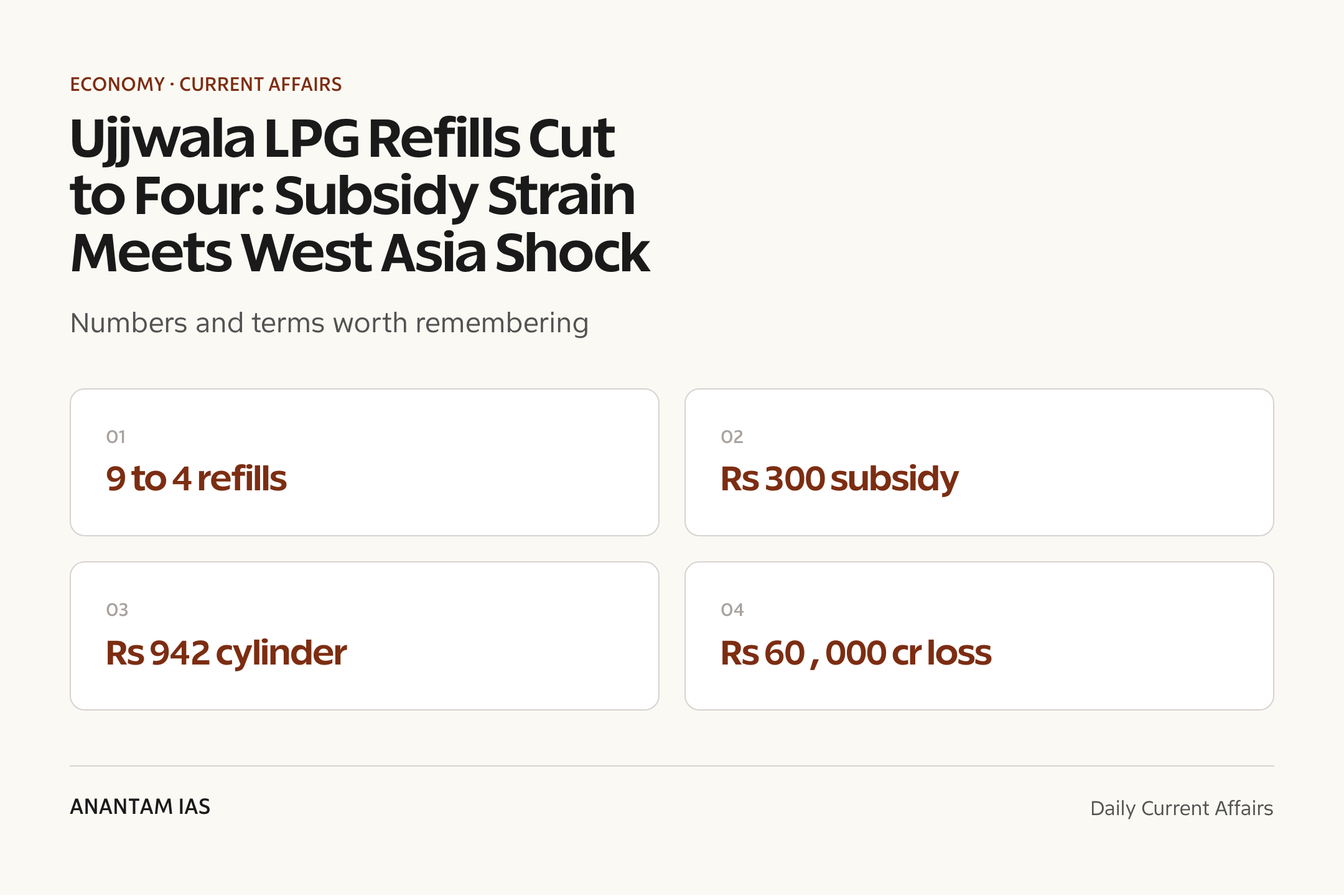
- As per reports, the subsidised PMUY refill cap was cut from 9 to 4 cylinders per year in June 2026.
- PMUY beneficiaries get a Direct Benefit Transfer (DBT) subsidy of about ₹300 per 14.2-kg cylinder.
- PMUY launched on 1 May 2016; the original ceiling was up to 12 refills, rationalised to 9 for FY 2025-26.
- PMUY covered about 10.55 crore connections as of late May 2026.
- The Delhi domestic LPG cylinder rose to ₹942; the effective PMUY price was about ₹642 per cylinder.
- OMC under-recovery reached roughly ₹700 a cylinder against a supply cost above ₹1,600.
- Cumulative domestic-LPG under-recovery touched about ₹60,000 crore by end-FY25, up from ₹1,338 crore a year earlier.
- About 54 percent of India’s LPG demand transits the Strait of Hormuz, exposing supply to West Asia disruption.
- Sources: The Hindu (UPSC analysis, 9 June 2026) and The Hindu Editorial Analysis, 9 June 2026.
What Just Happened
As per the reports, the government lowered the annual quota of subsidised 14.2-kg cylinders for PMUY households from nine to four. The ₹300 DBT continues on those first four refills; beyond the cap, a beneficiary buys LPG at the full retail price with no subsidy. Officials, as quoted in the coverage, justified the move on two grounds — that average PMUY consumption already runs at about four to five cylinders a year, so the new cap roughly tracks typical rural usage, and that a tighter cap curbs the diversion of cheap domestic cylinders into commercial use. It is worth flagging the uncertainty honestly: the figure is reported across outlets as a notified change, but the primary government notification text was not independently available, so it should be cited as “reportedly” until the gazette or OMC circular is confirmed.
The change cannot be read apart from the price spike that preceded it. The domestic LPG cylinder in Delhi was raised by ₹29 in early June 2026, the second hike in three months, taking the general-consumer price to ₹942 and the effective PMUY price to about ₹642. Because the OMCs’ cost of supplying a cylinder had crossed ₹1,600 — driven by a Saudi contract-price benchmark up about 46 percent since 28 February — each domestic cylinder sold carried an under-recovery near ₹700. The cumulative under-recovery on domestic LPG had already ballooned to roughly ₹60,000 crore by the close of the last financial year, against a mere ₹1,338 crore the year before.
On the wider fuel basket, OMCs were also running under-recoveries of about ₹6 a litre on petrol and ₹30 a litre on diesel as the West Asia conflict pushed crude and product benchmarks to multi-month highs. That matters for the LPG decision because the three OMCs absorb domestic-LPG losses on the same balance sheets that carry petrol and diesel margins, so a simultaneous squeeze on all three fuels narrows the room to keep cross-subsidising cooking gas. When auto-fuel margins are healthy, OMCs can quietly carry an LPG under-recovery for a few quarters; when petrol and diesel are themselves loss-making, that cushion disappears and the pressure to either raise the cylinder price or compress the subsidy bill becomes acute.
The political reaction was immediate, with the Congress attacking the refill cut as a squeeze on the poorest households at the worst possible moment, calling the move proof of a government detached from rural distress. That framing turns a technical pricing decision into a visible equity question, which makes this an unusually clean GS-II debate: the same fact set supports both the fiscal-prudence reading (a runaway subsidy bill was capped, and the cap roughly tracks actual usage) and the welfare-failure reading (the state withdrew support from women-led poor households exactly when the alternative — firewood — became most tempting). A good answer holds both readings at once rather than choosing a side.
Background and Context
PMUY was launched on 1 May 2016 by the Ministry of Petroleum and Natural Gas to provide deposit-free LPG connections to adult women from poor households, with the connection issued in the woman’s name. The aim was a clean-cooking transition: replacing biomass and kerosene combustion that causes household air pollution, indoor smoke deaths and the daily time-burden of fuel collection borne mostly by women and girls. So PMUY is as much a public-health and gender-empowerment scheme as an energy scheme, and it maps directly onto Sustainable Development Goal 7 (affordable and clean energy).
The harder design problem PMUY has always faced is the refill or usage gap. Giving a free connection is one thing; ensuring a poor household actually buys refills at market-linked prices is another. When the international LPG price rises, the cash outlay on a refill can push beneficiaries back toward firewood — the so-called fuel-stacking or relapse problem, where a household keeps the LPG connection but burns biomass for routine cooking and reserves the cylinder for guests or emergencies. The targeted ₹300 subsidy, delivered by DBT into the beneficiary’s bank account, was the government’s answer to keep refills affordable without reverting to a blanket consumer subsidy. The original ceiling allowed up to 12 subsidised refills; it was trimmed to nine for FY 2025-26 and now, as per reports, to four — a downward drift that tracks the rising cost of honouring the subsidy as global prices climbed, and that quietly narrows the gap between PMUY’s promise of clean cooking and the volume the budget is willing to underwrite.
The DBT mechanism itself descends from DBTL/PAHAL (Pratyaksh Hanstantarit Labh), launched in 2015, which moved the LPG subsidy from a price subsidy at the cylinder to a direct cash transfer into Aadhaar-linked bank accounts. Under the old price-subsidy model, every consumer — rich or poor — bought the cylinder at a discounted counter price, which leaked benefits up the income ladder and invited diversion to the black market. PAHAL flipped the logic: the consumer pays the market price at the point of sale and the subsidy lands later in the bank account, only for verified beneficiaries. That plugged leakages, weeded out duplicate and ghost connections, and built the plumbing that now lets the state switch a per-cylinder subsidy on or off and cap it at four refills. The same architecture that made the ‘Give It Up’ campaign possible — voluntarily surrendered subsidies — is what makes a hard refill cap administratively feasible today.
The fiscal backdrop is India’s structural import dependence. The country imports well over half its LPG, so the domestic subsidy bill is hostage to the global benchmark and the exchange rate, and a West Asia shock passes through almost directly to the under-recovery. India consumes far more LPG than it produces domestically, and the gap is met by imports priced off the Saudi Contract Price; when that benchmark jumps, the OMCs either pass the cost to consumers or absorb it as under-recovery, and the government either lets the cylinder price rise or compensates the OMCs out of the budget. PMUY sits at the sharp end of this chain because its beneficiaries are the least able to absorb a price rise, which is precisely why the ₹300 DBT exists — and why capping it is so consequential.
Key Features of the PMUY LPG Subsidy Design
- Free connection: A deposit-free LPG connection issued in the name of an adult woman from an eligible poor household.
- Targeted DBT subsidy: About ₹300 per 14.2-kg refill credited directly to the beneficiary’s bank account, not paid at the cylinder.
- Refill cap (reported): The subsidy now reportedly applies to only four refills a year, down from nine; further refills are at full market price.
- Clean-cooking goal: The scheme targets a shift away from biomass and kerosene, aligning with SDG 7 and reduced household air pollution.
- PAHAL backbone: The 2015 DBTL/PAHAL architecture enables Aadhaar-linked, leakage-resistant subsidy delivery and quick policy switching.
- Import-linked pricing: Retail LPG is benchmarked to international (Saudi CP) prices, so global shocks pass through to the subsidy bill.
Why It Matters for UPSC
This is a high-yield topic because it ties a current development to durable syllabus themes.
- GS-II: it tests welfare-scheme design, last-mile delivery and the equity cost of fiscal consolidation for the poorest women-led households.
- GS-III: it links the current LPG shock to static topics — energy security, import dependence, under-recoveries, oil-price pass-through and the subsidy bill.
- Prelims: refresh PMUY launch year, DBT/PAHAL, the ₹300 subsidy, the Strait of Hormuz exposure and SDG 7.
- Essay/Ethics: clean cooking versus affordability, and the moral hazard of capping a health-and-gender subsidy during a price spike.
What It Means: Economy Lens
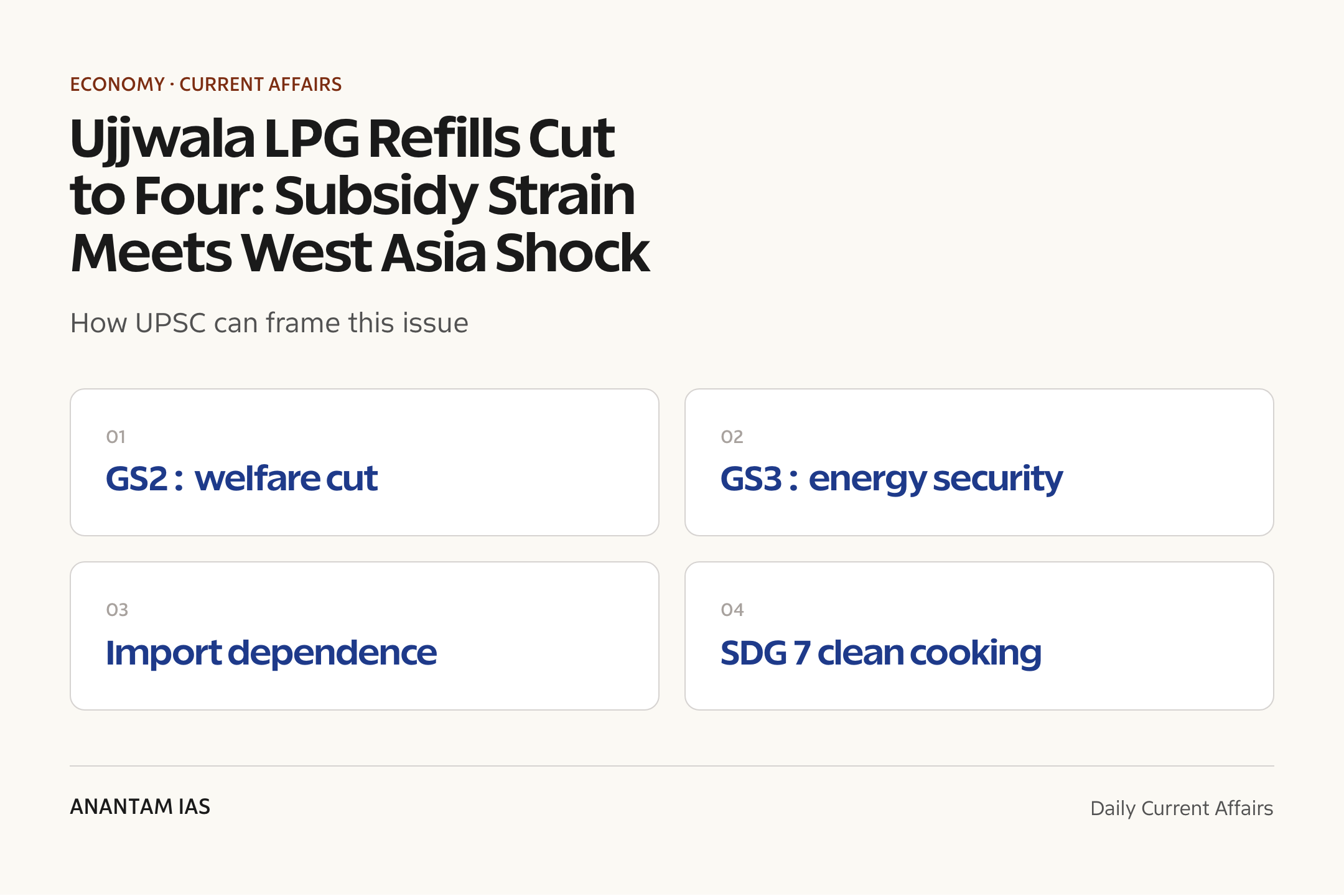
This is a subsidy-design trade-off, not just a price hike. Capping subsidised refills at four converts an open-ended welfare commitment into a bounded one, which protects the budget when the international benchmark spikes. But it shifts the entire price risk onto the household precisely when LPG is dearest. A beneficiary whose genuine need exceeds four cylinders now faces the full ₹942 cylinder for the fifth onward — the exact moment fuel-stacking and a relapse to firewood become rational, undercutting the clean-cooking purpose the scheme exists to serve. The design choice is between two kinds of risk: a fixed cap caps the government’s fiscal risk but loads price risk onto the poorest, while an uncapped subsidy protects the household but leaves the exchequer exposed to a benchmark it cannot control. The June move resolves that tension firmly in favour of the budget, which is defensible in a fiscal sense but reverses the scheme’s original premise that the state, not the beneficiary, should absorb LPG-price volatility for the poorest.
The shock exposes how little buffer sits between a global benchmark and an Indian kitchen. With about 54 percent of LPG demand routed through the Strait of Hormuz and a Saudi CP benchmark up roughly 46 percent, the pass-through to the under-recovery was almost mechanical — ₹1,338 crore of annual under-recovery becoming ₹60,000 crore. PAHAL gave the state precise control over who gets the subsidy, but it did nothing to reduce the import dependence that makes the subsidy so volatile. Energy security, not just welfare design, is the deeper variable.
The defensible core of the move is targeting, not retrenchment. If average PMUY usage is genuinely four to five cylinders and diversion to commercial use is real, a cap can be fiscally honest without hurting the median beneficiary. The risk is distributional: averages hide the larger households and colder regions that legitimately consume more. A static four-cylinder cap is administratively simple but blunt; a needs-responsive cap, or a price-linked top-up that widens when the benchmark spikes, would defend both the budget and the scheme’s health rationale. There is also a behavioural subtlety — the very fact that many PMUY households already buy only four to five cylinders may itself be a symptom of the affordability problem, not proof that four is enough. A family rationing its cooking gas because refills are dear is not the same as a family whose genuine need is four cylinders, and a cap that freezes the rationed level in place risks mistaking distress for preference.
For the examiner, the durable lesson is that subsidy reform and energy security are inseparable. The cleanest fix for the welfare side — keep the ₹300 flowing on more cylinders — worsens the fiscal side, and the cleanest fix for the fiscal side — cap the subsidy — worsens the welfare side. The only way to relax that trade-off is to attack the underlying volatility: reduce import dependence, build buffer stocks, diversify supply routes away from a single chokepoint and broaden the clean-cooking mix beyond LPG to piped natural gas and electric or solar cooking. Capping refills manages the symptom for one budget cycle; energy resilience is what actually shrinks the problem over time.
Challenges and Concerns
- A fixed four-refill cap may underserve larger households and colder regions whose genuine need exceeds the rural average.
- Withdrawing the subsidy at the fifth cylinder during a price spike risks fuel-stacking and a relapse to biomass, defeating the clean-cooking goal.
- Heavy LPG import dependence keeps the subsidy bill hostage to West Asia geopolitics and the rupee, limiting domestic policy room.
- Distinguishing genuine high consumption from commercial diversion is hard, so a blunt cap can penalise honest beneficiaries.
- The reported figure’s policy status needs confirmation; communicating a contested welfare cut poorly can erode trust in DBT-based schemes.
Prelims Pointers
- PMUY was launched on 1 May 2016 by the Ministry of Petroleum and Natural Gas.
- PMUY connections are issued in the name of an adult woman of an eligible poor household.
- The targeted PMUY refill subsidy is about ₹300 per 14.2-kg cylinder, delivered by Direct Benefit Transfer.
- DBTL/PAHAL (2015) shifted the LPG subsidy from a price subsidy to a direct cash transfer in Aadhaar-linked accounts.
- As per reports, the subsidised PMUY refill cap fell from nine to four cylinders a year in June 2026.
- About 54 percent of India’s LPG demand transits the Strait of Hormuz.
- The Saudi Contract Price (CP) is the international benchmark for LPG retail pricing in India.
- Under-recovery is the gap between an OMC’s cost and the regulated retail price it can charge.
- SDG 7 targets affordable, reliable, sustainable and modern energy for all, including clean cooking.
- PMUY coverage was about 10.55 crore connections as of late May 2026.
- Cumulative domestic-LPG under-recovery reached roughly ₹60,000 crore by end-FY25.
- India imports more than half its LPG, making its subsidy bill sensitive to global price shocks.
Mains Practice Questions
- The Pradhan Mantri Ujjwala Yojana shows that providing access is easier than ensuring sustained usage. Critically examine the refill-gap problem and recent measures to address it. (GS Paper II, 250 words)
- Examine how India’s dependence on LPG imports transmits West Asian geopolitical shocks into its domestic fuel-subsidy bill. Suggest measures to build resilience. (GS Paper III, 250 words)
- Capping subsidised LPG refills illustrates the tension between fiscal consolidation and welfare entitlements. Discuss with reference to clean-cooking and SDG 7. (GS Paper III, 150 words)
- Direct Benefit Transfer has improved subsidy targeting but not insulated beneficiaries from price volatility. Analyse with reference to LPG. (GS Paper II, 150 words)
Way Forward
Make the refill cap responsive rather than static — for example, a needs-based or price-linked subsidy that widens when the international benchmark spikes, so the clean-cooking goal is not abandoned at the worst moment.
Attack the import-dependence root cause: expand domestic gas output, build strategic LPG storage, diversify import sources beyond Gulf routes and accelerate alternatives such as PNG piped gas and electric and solar cooking.
Pair any cap with transparent communication and a grievance route, so a contested welfare change does not erode trust in the DBT system that makes targeted subsidies possible in the first place.
Frequently Asked Questions
What is the PMUY refill change in June 2026?
As per reports, the Centre cut the cap on subsidised LPG refills under the Pradhan Mantri Ujjwala Yojana from nine to four cylinders a year. The ₹300 subsidy continues on the first four refills; beyond that, a beneficiary pays the full market price. The figure should be cited as reported until the official notification is confirmed.
Why was the cap reduced now?
A West Asia oil shock pushed the international LPG benchmark up about 46 percent, the Delhi cylinder to ₹942 and OMC under-recoveries near ₹700 a cylinder. With the subsidy bill ballooning, the cap is presented as a way to contain fiscal strain while matching average rural usage.
What is the ₹300 LPG subsidy?
It is the targeted per-cylinder amount credited by Direct Benefit Transfer into a PMUY beneficiary’s bank account to keep refills affordable. It descends from the DBTL/PAHAL reform of 2015, which moved the subsidy from the cylinder price to a direct cash transfer.
How does West Asia affect India’s LPG?
About 54 percent of India’s LPG demand transits the Strait of Hormuz, so conflict near the strait disrupts supply and lifts the Saudi benchmark price. Because India imports over half its LPG, that shock passes almost directly into the domestic subsidy bill.
What is the refill or usage gap in PMUY?
It is the problem that beneficiaries get a free connection but may not buy enough refills at market prices, sliding back to firewood when LPG turns costly. This fuel-stacking undercuts the scheme’s clean-cooking and health goals, which is why an affordable refill matters as much as the connection.
How is PMUY linked to SDG 7?
PMUY supports SDG 7’s clean-cooking target by replacing biomass and kerosene with LPG, cutting household air pollution and easing the fuel-collection burden on women. A subsidy cut that pushes households back to dirty fuels works against that goal.
Source: https://anantamias.com/current-affairs/pmuy-ujjwala-lpg-subsidy-cut/
Supreme Court Upholds ECI’s Special Intensive Revision of Electoral Rolls
On 27 May 2026 the Supreme Court of India upheld the legality of the Election Commission of India’s Special Intensive Revision (SIR) of electoral rolls, dismissing a batch of petitions that had challenged the exercise after it began in Bihar in mid-2025 and spread to other States. A bench led by Chief Justice Surya Kant, with Justices Joymalya Bagchi and Vipul M. Pancholi, held that the SIR fell within the Commission’s mandate under Article 324 of the Constitution, read with the Representation of the People Act and the Registration of Electors Rules, 1960. For a polity paper this is a clean GS2 set-piece: it pulls together the Election Commission, the right to vote, the machinery for preparing electoral rolls, and the limits of judicial review of a constitutional body, all in one judgment.
The Court’s framing was that an election does not begin on polling day. It rests, the bench observed, on the accuracy and credibility of the electoral roll, and a roll that had not been intensively revised for roughly four decades, across a period of heavy migration and urbanisation, had accumulated duplications and errors the Commission was entitled to correct. The cross-paper relevance is that The Hindu’s 9 June analysis and the constitutional-law commentary at Verfassungsblog read the same judgment in opposite registers: one as a reaffirmation of the ECI’s autonomy, the other as a caution about power exercised with thin oversight. The exam-useful skill is holding both readings at once without taking a side.
An examiner will read this as a test of whether you can separate the right to be enrolled from the right to vote, and connect a topical verdict to the static framework of Article 324, Article 326 and the Representation of the People Act, 1950.
Quick Facts
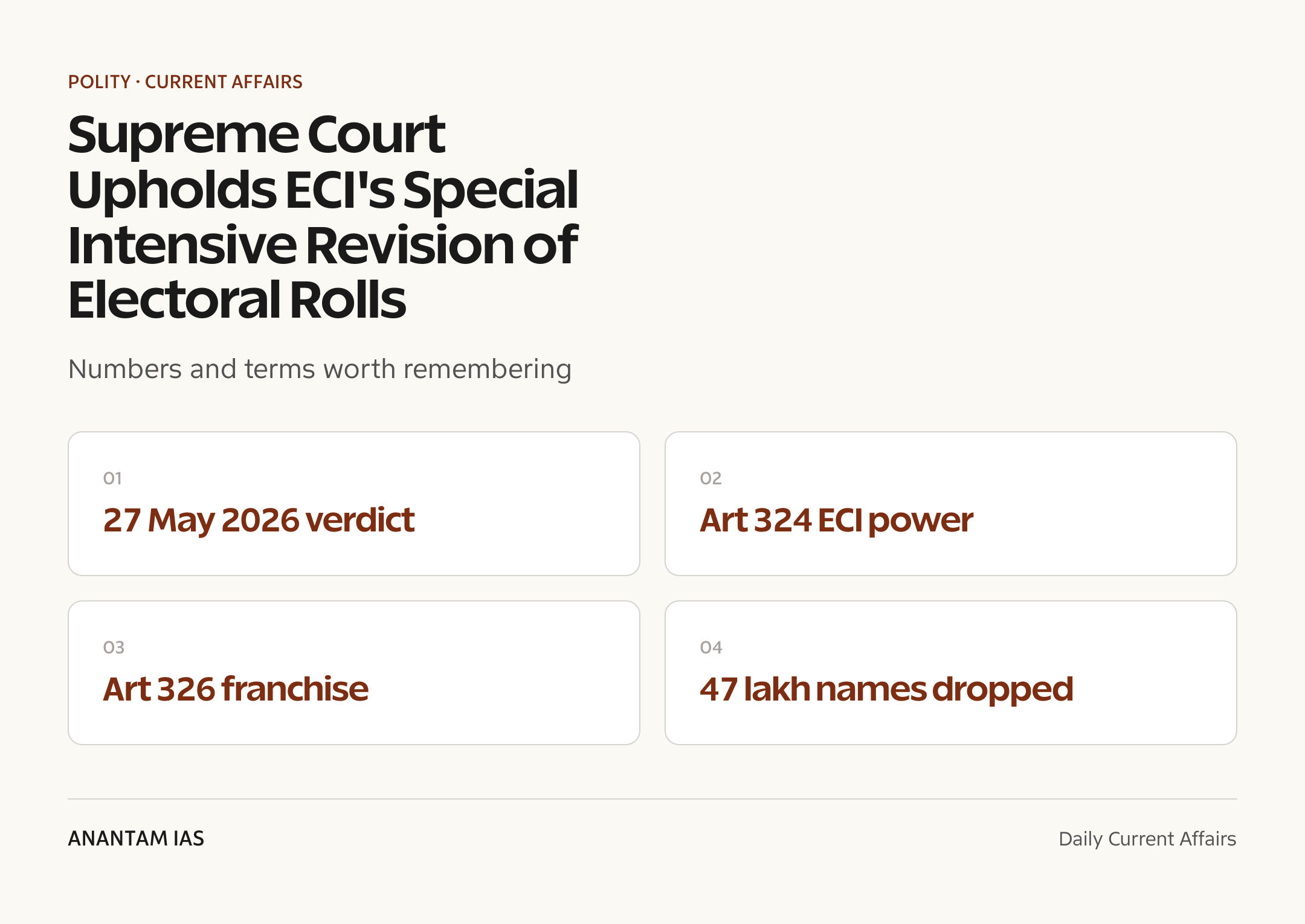
- Judgment delivered 27 May 2026 by the Supreme Court of India.
- Bench: CJI Surya Kant with Justices Joymalya Bagchi and Vipul M. Pancholi.
- SIR upheld as valid under Article 324 of the Constitution.
- Statutory anchor: Representation of the People Act, 1950 and Registration of Electors Rules, 1960.
- SIR began in Bihar in mid-2025; the first phase deleted around 47 lakh names from the draft roll.
- Article 326 confines the franchise to citizens aged 18 and above.
- Court read in safeguards: show-cause notice, claims and objections, and a right of appeal before deletion.
- Aadhaar and the voter ID card (EPIC) were held not to be conclusive proof of citizenship by themselves.
- Sources: The Hindu (UPSC analysis, 9 June 2026) and Verfassungsblog.
What Just Happened
The Special Intensive Revision is a door-to-door re-verification of the electoral roll in which the Commission distributes pre-filled enumeration forms, asks existing voters to confirm or update their entries, and in contested cases asks them to establish a link to an earlier roll. The first round ran in Bihar from mid-2025, where roughly 47 lakh names were dropped from the draft roll on grounds of death, migration, duplication or non-response, and the model was then extended to further States. Petitioners — political parties, civil-society groups and affected voters — argued that the timing, scale and documentary demands of the exercise risked disenfranchising genuine electors, especially the poor, the migrant and the undocumented, and that the Commission had strayed into deciding citizenship, a subject that belongs to the Union government under the Citizenship Act, 1955.
The Court rejected the challenge in full. It held that intensive revision is a recognised statutory tool, distinct from the lighter annual summary revision, and that the Commission’s decision to use it after four decades bore a reasonable nexus to the legitimate object of an accurate roll. On the most sensitive question, the bench accepted that verifying eligibility necessarily involves confirming that an applicant is a citizen, because Article 326 limits the vote to citizens; it framed this as the Commission examining eligibility for enrolment rather than conferring or cancelling citizenship as such. The judgment also recorded the Commission’s position that documents like Aadhaar and the EPIC card establish identity but are not, on their own, conclusive proof of citizenship.
Crucially, the Court did not give the Commission a blank cheque. It read the exercise as constitutional because, and to the extent that, it carried procedural protection: a show-cause notice before any deletion, a structured window for claims and objections, an opportunity to be heard, and an appeal to the designated electoral authority. The bench described the measures as not manifestly excessive and as accompanied by sufficient safeguards to prevent arbitrary exclusion. In other words, the validity of the SIR was tied to due process being followed, not merely to the Commission’s good intentions.
The petitioners had also pressed a statutory-design argument worth knowing for the answer. They contended that an intensive revision is meant for periods well before an election, because complete re-enumeration takes time, and that running it at scale close to polls inverts the scheme of the law and squeezes the window in which a wrongly deleted voter can seek restoration. They argued, further, that asking ordinary voters to produce ancestral-linkage documents effectively shifts the burden of proof onto the elector, when the working presumption for someone already on the roll should be inclusion unless there is specific reason to doubt it. The Court did not accept that these features rendered the SIR illegal; it treated the timing and documentary load as matters of administrative judgment that remained within bounds so long as the safeguards held. That is why the judgment can be read as both a vindication of the Commission’s power and an implicit warning that the same power, exercised without notice, hearing and appeal, would not survive the next challenge.
Background and Context
The body at the centre of the case is the Election Commission of India, created by Article 324, which vests in it the superintendence, direction and control of the preparation of electoral rolls and the conduct of elections to Parliament and the State legislatures. This is the constitutional source of the Commission’s authority to revise rolls, and it is deliberately broad: the Court has long read Article 324 as a reservoir of power to fill gaps where the statute is silent, provided the Commission acts fairly. The actual mechanics of who gets enrolled, though, sit in ordinary law, and the two main statutes must not be confused. The Representation of the People Act, 1950 deals with the allocation of seats, the delimitation machinery and, most relevant here, the preparation and revision of electoral rolls. The Representation of the People Act, 1951 deals with the actual conduct of elections, qualifications and disqualifications of candidates, and election disputes. Roll revision is a 1950-Act subject, operationalised through the Registration of Electors Rules, 1960.
Within roll-making, the syllabus distinction the examiner wants is summary revision versus intensive revision. A summary revision updates the existing roll by inviting additions, deletions and corrections, typically without a house-to-house enumeration; it is the routine, lower-cost mode used before most elections. An intensive revision is a fresh, ground-up enumeration in which officials visit households, re-verify every entry and effectively rebuild the roll, which is far more thorough but far more disruptive. The SIR is the intensive variety, applied at scale, which is why it became contentious: a deep re-verification carries a higher risk of wrongly dropping genuine voters even as it removes ghost and duplicate entries.
The deepest fault line is the citizenship-versus-eligibility distinction. Under Article 326 the franchise rests on universal adult suffrage but only for citizens aged 18 and above who are not otherwise disqualified, so a non-citizen has no right to be on the roll. Citizenship itself, however, is governed by the Citizenship Act, 1955 and administered by the Union government, not the Commission. The unresolved tension the petitioners pressed is that when the Commission asks a voter to prove ancestral linkage to an old roll, it can look, in practice, like an adjudication of citizenship by an authority designed to run elections. The Court’s answer was that confirming eligibility for the vote is part of preparing an accurate roll and does not amount to a determination of citizenship status for all purposes — a line that critics argue is finer in theory than in administration.
Two further static anchors complete the picture. First, the Commission’s broad Article 324 powers are not unreviewable: the courts have consistently held that the ECI must act fairly and within the law, and that its actions are open to judicial review on grounds of mala fides, arbitrariness or breach of natural justice — which is exactly the lens through which the SIR was tested. The Commission’s autonomy is structural too, since the Chief Election Commissioner can be removed only by the same process as a Supreme Court judge, insulating the office from executive pressure. Second, Article 325 supplies the equality backstop for the whole exercise: there is to be one general electoral roll for every constituency, and no person may be excluded on grounds of religion, race, caste or sex. Any revision, however intensive, has to respect that floor, which is why the fear of selective or community-specific deletions, rather than the idea of revision itself, was the heart of the petitioners’ case.
What the Court Actually Held
- Power affirmed: The SIR is valid under Article 324 read with the Representation of the People Act and the 1960 Rules.
- Roll accuracy as the object: A four-decade gap since the last intensive revision justified a thorough re-verification.
- Eligibility, not status: Verifying that an enrollee is a citizen under Article 326 is part of roll preparation, not a citizenship adjudication.
- Documents not conclusive: Aadhaar and the EPIC card prove identity but are not, alone, conclusive proof of citizenship.
- Safeguards read in: Validity is conditioned on show-cause notice, claims and objections, hearing and appeal before deletion.
- Proportionality test: The measures were held not manifestly excessive and accompanied by sufficient safeguards against arbitrary exclusion.
Why It Matters for UPSC
This is a high-yield topic because it ties a current development to durable syllabus themes.
- GS2 polity: a live application of Article 324 and the limits of the ECI’s powers, and of judicial review of a constitutional body.
- Links the current verdict to the static framework — Articles 324, 325, 326 and the Representation of the People Acts of 1950 and 1951.
- Prelims angle: the 1950 Act handles rolls, the 1951 Act handles conduct of elections; summary vs intensive revision is a classic distractor.
- Essay and ethics angle: balancing electoral integrity against the risk of disenfranchisement, and institutional autonomy against accountability.
What It Means: Polity Lens
The judgment is less a green light than a conditional permission. Read closely, the Court did not hold that the Commission can do whatever it likes with the roll. It held that this exercise survived because it was wrapped in due process — notice, an opportunity to be heard, claims and objections, and appeal. Strip those away and the same exercise would fail the proportionality test the bench applied. For an answer, the sharp formulation is that the SIR’s legality is procedural before it is substantive: the power to revise is settled, the manner of revising is where the constitutional action lies.
The harder structural question is institutional. The Commission sits at the intersection of two functions that pull in different directions — keeping the roll clean by removing ineligible entries, and keeping the roll inclusive so no eligible citizen is wrongly dropped. An intensive revision sharpens the first and stresses the second. The citizenship-versus-eligibility line is where this bites: the Constitution makes citizenship a precondition for the vote, yet hands the determination of citizenship to a different arm of the State. When a poll body asks for proof that resembles citizenship documentation, the boundary between verifying eligibility and adjudicating status becomes a question of administrative design, not just doctrine. The Court’s reasoning holds the line; whether field practice does is an empirical matter that future litigation will test.
There is also a federal and trust dimension. Electoral rolls are the shared foundation on which every party contests, so a large-scale revision close to elections inevitably reads through a political lens, whatever its administrative merit. The durable lesson for the exam is that the credibility of the outcome depends as much on perceived fairness and transparency of process as on the legality of the power. The verdict strengthens the Commission’s constitutional hand while making clear that the hand is only as strong as the safeguards it honours.
It is worth noting how the judgment positions judicial review itself. The Court did not substitute its own view of how the roll should have been revised; it asked the narrower question of whether the Commission had stayed within its powers and observed due process, and answered yes. That is the deferential posture courts typically adopt towards expert constitutional bodies — reviewing the legality and fairness of a decision rather than its wisdom. For an answer the useful framing is that the SIR verdict reinforces a settled division of labour: the Commission designs and runs the revision, the elector is owed notice and a hearing, and the Court polices the boundary between the two. The constitutional machinery works only when each part plays its assigned role, and the durable takeaway is that an electoral roll is not just an administrative list but the register of who counts as a member of the political community on polling day.
Challenges and Concerns
- Burden of proof can fall hardest on the poor, migrants and the undocumented, who are least able to produce legacy or ancestral-linkage records.
- The line between examining eligibility and adjudicating citizenship is thin in practice, raising overlap with the Union government’s role under the Citizenship Act, 1955.
- Large deletions just before elections can erode trust even where each deletion is individually lawful.
- Effective safeguards depend on field-level capacity — whether every notice is genuinely served and every appeal genuinely heard.
- Reliance on a decades-old base roll for linkage can disadvantage families that have moved, lost documents or were never well documented.
Prelims Pointers
- Article 324 vests superintendence, direction and control of elections and roll preparation in the Election Commission of India.
- Article 326 provides for elections on the basis of universal adult suffrage for citizens aged 18 and above.
- Article 325 mandates one general electoral roll per constituency and bars exclusion on grounds of religion, race, caste or sex.
- Article 327 empowers Parliament to make laws on elections, including the preparation of electoral rolls.
- The Representation of the People Act, 1950 governs the preparation and revision of electoral rolls.
- The Representation of the People Act, 1951 governs the conduct of elections and election disputes.
- The Registration of Electors Rules, 1960 operationalise enrolment and roll revision.
- Summary revision updates the roll without house-to-house enumeration; intensive revision rebuilds it through field enumeration.
- Citizenship is governed by the Citizenship Act, 1955 and administered by the Union government, not the Election Commission.
- The SIR verdict was delivered on 27 May 2026 by a bench led by CJI Surya Kant.
- The voting age was lowered from 21 to 18 by the 61st Constitutional Amendment Act, 1988.
- Aadhaar and the EPIC (voter ID) card establish identity but were held not to be conclusive proof of citizenship by themselves.
Mains Practice Questions
- The Special Intensive Revision verdict ties the legality of electoral-roll revision to procedural safeguards rather than to the power itself. Critically examine, with reference to Article 324 and the right to vote under Article 326. (GS2, 15 marks)
- Distinguish between summary and intensive revision of electoral rolls and discuss the conditions under which an intensive revision is justified. (GS2, 10 marks)
- The Constitution makes citizenship a precondition for the franchise but assigns its determination to a different authority. Discuss the tension this creates for the Election Commission in preparing electoral rolls. (GS2, 15 marks)
- Evaluate the scope and limits of judicial review of the Election Commission of India in light of recent decisions on electoral-roll revision. (GS2, 10 marks)
Way Forward
The operative takeaway is that an accurate roll and an inclusive roll are not rivals but joint objectives, and the safeguards the Court emphasised — notice, hearing, claims and objections, and appeal — are the mechanism that reconciles them.
Strengthening that mechanism means well-publicised timelines, accessible appeal channels, special facilitation for migrants and the undocumented, and transparent, auditable records of every deletion, so that the credibility of the exercise rests on demonstrable fairness and not on assurance alone.
Frequently Asked Questions
What did the Supreme Court decide on the SIR?
On 27 May 2026 the Court upheld the Election Commission’s Special Intensive Revision of electoral rolls as valid under Article 324 of the Constitution, read with the Representation of the People Act and the 1960 Rules. It dismissed the petitions but conditioned validity on procedural safeguards being followed before any voter is deleted.
What is the difference between summary and intensive revision?
A summary revision updates the existing roll by inviting additions, deletions and corrections, usually without house-to-house visits. An intensive revision is a fresh, ground-up enumeration in which officials visit homes and re-verify every entry. The SIR is the intensive type, which is more thorough but carries a higher risk of dropping genuine voters.
Can the Election Commission decide citizenship?
The Court held that verifying whether an enrollee is a citizen is part of preparing an accurate roll, because Article 326 limits the vote to citizens. But citizenship itself is governed by the Citizenship Act, 1955 and administered by the Union government. The Commission examines eligibility for enrolment; it does not confer or cancel citizenship.
Which law governs the preparation of electoral rolls?
The Representation of the People Act, 1950 governs the preparation and revision of electoral rolls, operationalised through the Registration of Electors Rules, 1960. The Representation of the People Act, 1951 is the separate statute that governs the conduct of elections and election disputes. Mixing up the two Acts is a common error.
What safeguards did the Court insist on?
The Court read the SIR as constitutional because it carried procedural protection: a show-cause notice before deletion, a structured window for claims and objections, an opportunity to be heard, and a right of appeal to the designated electoral authority. The validity of the exercise was tied to these safeguards being honoured in practice.
Are Aadhaar and the voter ID enough to stay on the roll?
The Court recorded the Commission’s position that Aadhaar and the EPIC voter ID card establish identity but are not, on their own, conclusive proof of citizenship. In contested cases the exercise asked voters to establish a link to an earlier roll, which is why documentation became the most disputed part of the SIR.
Source: https://anantamias.com/current-affairs/supreme-court-sir-electoral-rolls-verdict/
Calcutta HC on Public Parading of Accused: State Power vs Human Dignity (UPSC GS2/GS4)
A vacation division bench of the Calcutta High Court has pulled up the police over the public parading of arrested persons with ropes tied around their waists, with videos of the spectacle circulating on social media. Hearing public interest petitions, the bench of Justice Jay Sengupta and Justice Smita Das De framed the issue in plain constitutional terms, observing that the State may arrest and prosecute a person but cannot humiliate them. The Court asked the West Bengal government to file a report within three weeks and listed the matter for hearing after four weeks. The petitions described arrested persons being walked through public places in restraints, in some cases partly undressed, while the footage was filmed and shared.
The single line that travelled furthest, as LiveLaw reported, was the bench’s oral remark: “You may arrest them, you may prosecute them, but you cannot humiliate them.” For an aspirant, the value here is not the local incident. It is the durable principle the case restates, that the power to arrest is not a license to defame, and that an accused person keeps the right to dignity and the presumption of innocence until a fair trial concludes. The same fault line, state coercive power against individual dignity, is exactly what GS2 and GS4 keep testing. Read this case as a hook for a cluster of static topics, Article 21, fair trial, custodial safeguards and police accountability, rather than as a passing headline. That is how a study note earns its place, by converting a news flash into a reusable frame for several questions at once.
This note reads the Calcutta High Court’s intervention the way an examiner would, as a rights-of-the-accused and police-ethics precedent that ties Article 21, the presumption of innocence and custodial dignity into one answerable theme.
Quick Facts

- A vacation bench of Justice Jay Sengupta and Justice Smita Das De heard the matter on Friday, 5 June 2026.
- Public interest petitions alleged that arrested persons were paraded with ropes tied around their waists, some in a state of partial undress.
- Videos of the parading were said to have been circulated on social media.
- The persons had been arrested on charges including extortion and intimidation.
- The bench remarked: “You may arrest them, you may prosecute them, but you cannot humiliate them.”
- The Court questioned the necessity of the practice, noting the absence of any clear risk of escape.
- The State was directed to file a detailed report within three weeks, with the next hearing after four weeks.
- Indian criminal law contains no provision authorising police to parade or publicly display an accused person.
- Sources: LiveLaw, Calcutta High Court proceedings and Millennium Post.
What Just Happened
The petitions before the Calcutta High Court flagged a pattern of police in West Bengal taking arrested persons through public places with ropes tied around their waists, at times in a partially undressed state, while recordings of these scenes spread on social media. The persons concerned had been arrested on charges including extortion and intimidation. The petitioners argued that this practice had no basis in law and amounted to punishment before trial, and that filming and sharing the parading compounded the harm by broadcasting it to an audience that no court had authorised. The choice of public interest litigation matters here, because it lets a systemic practice, not just one person’s grievance, be tested before a constitutional court.
The vacation bench of Justice Jay Sengupta and Justice Smita Das De was unambiguous on principle. The Court drew a clear line between the lawful powers of arrest and prosecution on one side, and humiliation on the other, observing that the State cannot subject a person to public shaming simply because it has the authority to detain and try them. The bench also questioned why a person already in custody and restraint would need to be paraded at all when there was no indicated risk of escape, a point that goes to necessity and proportionality rather than to the bare legality of the arrest. Importantly, the Court did not suggest that the underlying arrests were wrong. Its concern was the extra, gratuitous humiliation layered onto an otherwise lawful process.
Rather than deciding the matter finally at the vacation stage, the Court sought accountability through process. It directed the West Bengal government to file a detailed report on the allegations within three weeks and scheduled the next hearing after four weeks. The interim message was procedural restraint, that the burden now sits on the State to explain and justify, or end, a practice for which Indian criminal law supplies no authority. For students, the takeaway is that these were oral observations and an interim direction at a vacation hearing, persuasive in framing but not yet a final, citable judgment. The principle the bench invoked, however, is long settled, and that is what makes the case worth filing away.
Background and Context
The constitutional anchor is Article 21, which guarantees that no person shall be deprived of life or personal liberty except by procedure established by law. Since Maneka Gandhi v. Union of India (1978), that procedure must be fair, just and reasonable, not arbitrary. The Supreme Court has long read “life” in Article 21 to mean a life with dignity, not mere animal existence. Public parading of an unconvicted person attacks that dignity directly, and it does so to someone the law still treats as innocent. The presumption of innocence, that a person is innocent until proven guilty after a fair trial, is the bedrock of criminal justice and a facet of the fair-trial guarantee under Article 21. Crucially, the protection of Article 21 is not lost on arrest. A person in custody surrenders liberty to the extent the law allows, but not the right to be treated as a human being.
The treatment of arrested persons is already hedged by binding Supreme Court guidance. In D.K. Basu v. State of West Bengal (1997), the Court laid down detailed safeguards against custodial abuse, including the right to be informed of grounds of arrest, a memo of arrest signed by witnesses, the right to inform a relative or friend, and medical examination, with the larger aim of protecting the dignity and bodily integrity of the detained. In Prem Shankar Shukla v. Delhi Administration (1980), the Court held that routine handcuffing is degrading and unconstitutional, permissible only when clearly justified by a real risk, because restraining a person before the public without necessity offends Article 21 and the equality guarantee of Article 14. The Calcutta High Court’s concern over restraints used without any escape risk sits squarely in this line, extending the same logic from handcuffs to ropes and public display.
There is also a human-rights and oversight dimension. Custodial dignity is a recurring concern of the National Human Rights Commission (NHRC), the statutory body under the Protection of Human Rights Act, 1993, which treats public humiliation, unlawful restraint and custodial mistreatment as violations warranting inquiry and recommendation. Police conduct of this kind also runs against the spirit of police-reform jurisprudence, notably Prakash Singh v. Union of India (2006), which pressed for professional, accountable policing insulated from extraneous pressures. The wider current is the global recognition of dignity in instruments such as the Universal Declaration of Human Rights, which India has long endorsed. Read together, these strands show why parading an accused is not a minor procedural lapse but a structural rights problem, and why a constitutional court treats it as worth its time.
It helps to separate two roles the State plays. As prosecutor, the State accuses and tries; as guardian of constitutional order, it must also protect the rights of the very person it accuses. Public parading collapses that separation, letting the prosecuting arm act as judge, jury and informal punisher in the street. This is where the idea of constitutional morality enters, the expectation that public power restrains itself by the discipline of the Constitution rather than by popular mood. The presumption of innocence is not a technicality that shields the guilty. It is the structural assumption that forces the State to prove its case through evidence and process, and that protects the innocent who are, at the point of arrest, indistinguishable from the rest. Strip it away in public, and an acquittal later cannot return the reputation already destroyed.
Why Public Parading Fails the Constitutional Test
- No statutory backing: No provision of Indian criminal law authorises police to parade, display or publicly shame an accused person.
- Presumption of innocence: Parading treats an unconvicted person as guilty, inverting the burden the State must discharge at trial.
- Article 21 dignity: The right to life includes the right to live and be treated with dignity, which public humiliation violates.
- Punishment without trial: Shaming imposes a social sanction the court has not ordered, bypassing due process entirely.
- Disproportion: Restraint and exposure without any escape risk fail the necessity-and-proportionality test that limits coercive power.
- Irreversible harm: Once a video spreads online, reputational damage persists even if the person is later acquitted.
Why It Matters for UPSC
This is a high-yield topic because it ties a current development to durable syllabus themes.
- GS2 Polity and Governance: a live illustration of fundamental rights (Article 21), the presumption of innocence and limits on executive and police power.
- Links the current event to the static core, D.K. Basu, Prem Shankar Shukla and the fair-trial reading of Article 21.
- Prelims angle: rights of the accused, D.K. Basu guidelines, handcuffing jurisprudence, and the role of the NHRC.
- GS4 Ethics: dignity, due process, public-administration restraint, and the contest between rule of law and mob-justice instincts.
What It Means: Polity Lens

The case is about restraint, not leniency. Nothing the Court said weakens the State’s power to arrest, investigate or prosecute. What it questions is the addition of humiliation to that lawful process. The distinction is the whole point of constitutional governance, that legitimate authority is bounded authority. When police convert an arrest into a public spectacle, they substitute social punishment for judicial determination, which is precisely the outcome due process exists to prevent. The bench’s framing, arrest yes, humiliation no, is a compact statement of the proportionality principle that governs every exercise of coercive power.
The harm is to the system, not only the individual. Public shaming of the accused corrodes the presumption of innocence as a working norm. It signals that guilt can be declared on the street before it is proved in court, and it invites the public to treat suspicion as conviction. That is the seedbed of mob justice, where rule of law gives way to a rule of sentiment. For administrators, the lesson is that the State must model the very restraint it expects from citizens. A police force that humiliates suspects teaches society that humiliation is an acceptable response to alleged wrongdoing.
This is where GS2 and GS4 meet. On the law side, the issue maps cleanly onto Article 21, fair trial and the D.K. Basu and Prem Shankar Shukla lineage. On the ethics side, it tests dignity as a non-negotiable value, the duty of public servants to act with objectivity and compassion, and the difference between enforcing the law and exacting revenge. The strongest answers will not treat these as separate. They will show that the constitutional rule and the ethical duty are the same commitment, that the dignity of even an accused person is part of the dignity of the whole justice system.
Process as remedy is itself instructive. By demanding a report rather than issuing a sweeping order at the vacation stage, the Court placed the onus of justification on the State. That is a model of institutional accountability, where the executive must give reasons for a contested practice and a court holds the space open until it does. For aspirants, it is a clean example of how rights are protected not only by dramatic verdicts but by steady judicial insistence that power explain itself.
The viral video changes the calculus. Older debates on custodial dignity assumed harm confined to a cell or a courtroom corridor. Filming and circulating a parading turns a private indignity into a permanent, searchable public record. Even an eventual acquittal cannot fully undo it, because the footage outlives the verdict. That is why dignity-based protections matter more, not less, in a networked age, and why administrators should treat the recording and sharing of an accused person’s humiliation as a distinct harm in its own right, separate from the arrest itself.
Restraint is strength, not weakness. A common public instinct holds that visible, harsh treatment of suspects shows the State is serious about crime. The opposite is closer to the truth. A justice system confident in its own processes does not need to perform punishment in advance, because it trusts that proof and trial will deliver the outcome. The parading impulse is a symptom of low institutional confidence, a temptation to substitute spectacle for the slower work of investigation and conviction. The most useful frame for an answer is this: the test of a constitutional State is not how it treats those it is sure are guilty, but how it treats those who are merely accused, including the ones who turn out to be innocent. Protecting their dignity is what keeps the line between policing and persecution from blurring.
Challenges and Concerns
- Oral remarks at a vacation hearing are not a final, citable judgment, so the binding precedent will depend on what the Court ultimately holds.
- Enforcement is the hard part, since informal parading and viral video can recur faster than any single order can police.
- A populist appetite for visible punishment can pressure both police and politicians toward spectacle over due process.
- Once footage circulates online, takedown and reputational repair are difficult even after an acquittal.
- Existing safeguards like the D.K. Basu guidelines depend on day-to-day compliance and supervision that is uneven across districts.
Prelims Pointers
- Article 21 guarantees the right to life and personal liberty and has been read to include the right to live with dignity.
- The presumption of innocence holds that a person is innocent until proven guilty after a fair trial.
- D.K. Basu v. State of West Bengal (1997) laid down safeguards against custodial torture and arbitrary arrest.
- Prem Shankar Shukla v. Delhi Administration (1980) held that routine handcuffing is unconstitutional and permissible only when justified.
- Indian criminal law contains no provision authorising the public parading or display of an accused person.
- The fair-trial guarantee is treated by the Supreme Court as a facet of Article 21.
- The National Human Rights Commission (NHRC) inquires into custodial abuse and violations of dignity in detention.
- Prakash Singh v. Union of India (2006) is the leading judgment on police reforms and accountability.
- A vacation bench of a High Court hears urgent matters during court vacations.
- Public interest litigation (PIL) allows issues of public concern to be raised before constitutional courts.
- Proportionality requires that a coercive measure be necessary and not excessive relative to its aim.
- Article 14 guarantees equality before law and equal protection of the laws.
Mains Practice Questions
- “The power to arrest is not a license to humiliate.” Examine, with reference to Article 21 and the presumption of innocence, the constitutional limits on police treatment of accused persons. (GS2, 15 marks, 250 words)
- Discuss how D.K. Basu and Prem Shankar Shukla together shape the rights of arrested and detained persons in India. How relevant are these safeguards to the public parading of the accused? (GS2, 15 marks, 250 words)
- Public shaming of an accused person before trial pits the dignity of the individual against popular demands for visible justice. As a district administrator, how would you uphold dignity and due process while maintaining public confidence in the law? (GS4, 20 marks, 250 words)
- “When the State humiliates a suspect, it teaches society that humiliation is justice.” Critically comment on this statement in the context of human dignity, rule of law and the ethics of public administration. (GS4, 10 marks, 150 words)
Way Forward
Clear standing instructions should bar the parading, public display or filming of accused persons, with accountability fixed on supervising officers for breaches.
Training must internalise the D.K. Basu and Prem Shankar Shukla principles so that restraint and dignity become routine practice, not exceptions ordered by a court.
Oversight bodies, from internal police inquiry to the NHRC, should treat public humiliation of the accused as a reportable rights violation with prompt remedial action.
The deeper shift is cultural, replacing the instinct for spectacle with confidence that due process, conducted quietly, is what justice actually looks like.
Frequently Asked Questions
What did the Calcutta High Court say?
A vacation bench of Justice Jay Sengupta and Justice Smita Das De criticised police for parading arrested persons with ropes around their waists. The bench remarked that the State may arrest and prosecute a person but cannot humiliate them, and asked the West Bengal government to file a report within three weeks. Arrest is power, humiliation is not.
Why is public parading unconstitutional?
It has no backing in Indian criminal law and it violates Article 21, which protects the right to live with dignity. It also breaches the presumption of innocence by treating an unconvicted person as guilty. In effect, the State imposes a punishment no court has ordered, which is the opposite of due process.
How does Article 21 protect the accused?
Article 21 guarantees life and personal liberty, and the Supreme Court has read “life” to mean a life with dignity. That protection does not switch off on arrest. An accused person retains the right to be treated with dignity and to a fair trial until guilt is proved, which is why public shaming offends the Constitution.
What are the D.K. Basu guidelines?
In D.K. Basu v. State of West Bengal (1997), the Supreme Court laid down safeguards against custodial abuse, including a memo of arrest, the right to inform a relative, and medical examination. The aim is to protect the dignity and bodily integrity of every detained person. The guidelines remain binding on the police.
What did Prem Shankar Shukla decide?
In Prem Shankar Shukla v. Delhi Administration (1980), the Supreme Court held that routine handcuffing is degrading and unconstitutional, allowed only when clearly justified. Restraining a person before the public without necessity offends Articles 14 and 21. The Calcutta High Court’s concern over restraints used without any escape risk follows the same reasoning.
Why does this matter for ethics?
It sets dignity and due process against the popular appetite for visible punishment. Public servants are expected to enforce the law without becoming instruments of humiliation, and to model the restraint that separates rule of law from mob justice. The case is a clean GS4 study in dignity, objectivity and administrative restraint.
Source: https://anantamias.com/current-affairs/calcutta-hc-public-shaming-accused-dignity/
Bonn Climate Conference 2026: The Push to Triple Adaptation Finance
The mid-year UN climate talks in Bonn, Germany, running from 8 to 18 June 2026, became the staging ground for a sharp demand: that developed countries triple public adaptation finance to roughly USD 120 billion a year by 2035. The Bonn session is the 64th meeting of the UNFCCC subsidiary bodies (SB64), the technical and political workshop where the texts that COP30 in Belem, Brazil, will later adopt are drafted and bargained over.
The headline figure is a multiplier on an older promise. The Glasgow Climate Pact of 2021 asked rich nations to double adaptation finance from a 2019 baseline by 2025, taking it to about USD 40 billion a year. Bonn 2026 reframed that as a floor, not a ceiling, and tied adaptation money to the wider battle over the New Collective Quantified Goal and the Baku-to-Belem roadmap. For UPSC, this is the live edge of the climate-finance and equity debate that runs through GS-III and International Relations.
What makes the moment sharp is the calendar. Every climate year now bends toward Belem, where COP30 will sit in November 2026, and Bonn is the last full negotiating session before that summit. Whatever ambition survives the June talks in draft form is roughly what ministers will have to work with in Brazil. So the demand to triple adaptation finance is less a slogan than a marker laid down early, an attempt to set the anchor before the bargaining narrows. Adaptation finance, unlike the more glamorous mitigation pledges, rarely makes headlines, which is precisely why its backers chose a single, hard, memorable number.
An examiner will read Bonn 2026 not as a press event but as a test of whether the global climate-finance architecture can move from pledges to delivery, and where India’s equity argument fits inside it.
Quick Facts
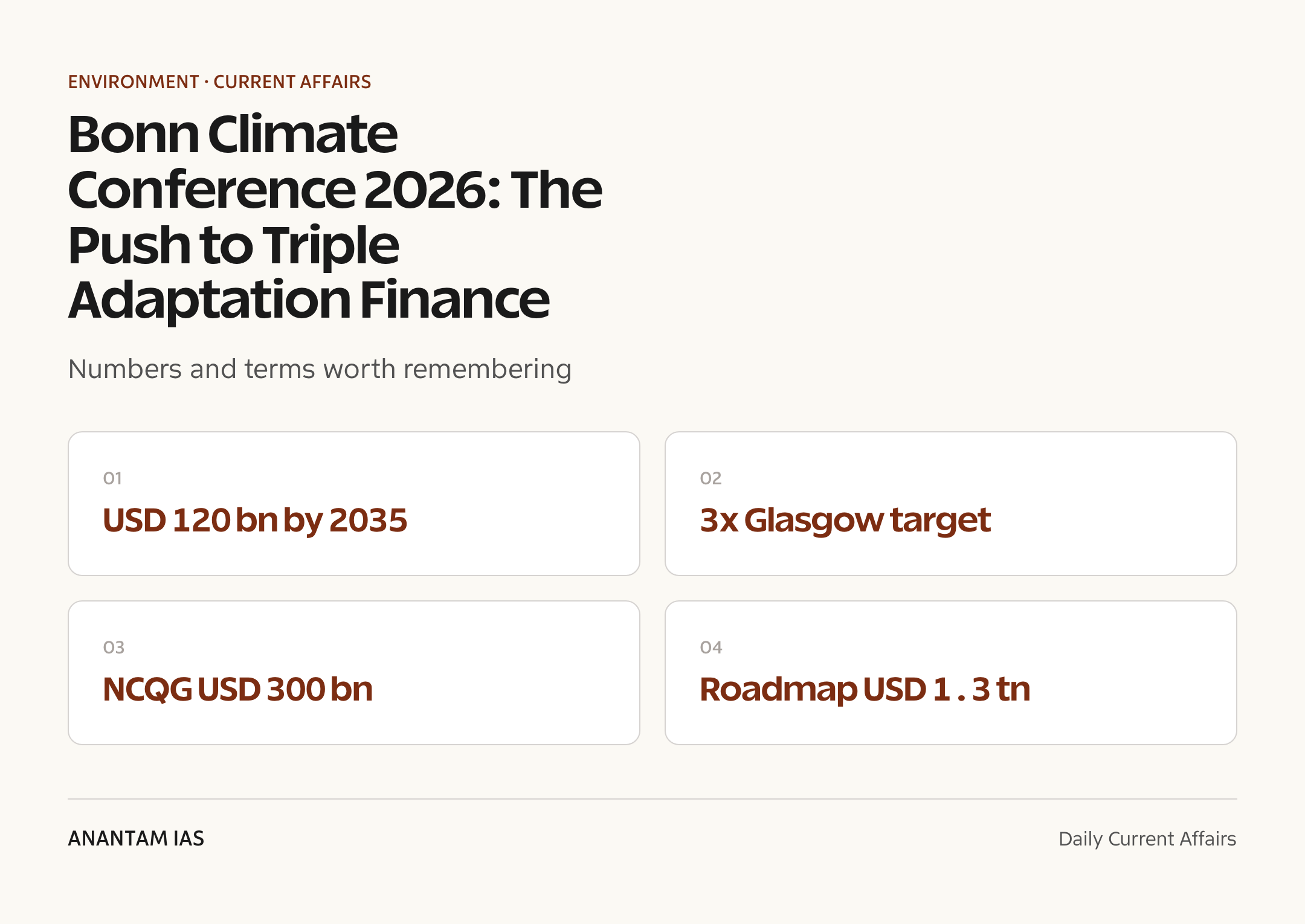
- The June 2026 Bonn talks are the 64th sessions of the UNFCCC subsidiary bodies (SB64), held 8-18 June 2026.
- The demand at Bonn was to triple public adaptation finance to about USD 120 billion a year by 2035.
- The Glasgow Climate Pact (2021) sought to double adaptation finance from a 2019 baseline by 2025, to about USD 40 billion a year.
- The New Collective Quantified Goal set at COP29 Baku is at least USD 300 billion a year by 2035, scaling toward USD 1.3 trillion from all sources.
- The Global Goal on Adaptation is anchored in Article 7 of the Paris Agreement.
- The UAE-Belem work programme aims to narrow over 9,000 proposed adaptation indicators to about 100 for adoption at COP30.
- The Loss and Damage Fund was operationalised at COP28 Dubai in 2023, with the World Bank as interim host.
- COP30 is scheduled for Belem, Brazil, in November 2026.
- Sources: UNFCCC, Subsidiary Bodies (SB64), Bonn and IISD Earth Negotiations Bulletin.
What Just Happened
Bonn does not adopt binding decisions. It is the engine room: the Subsidiary Body for Scientific and Technological Advice (SBSTA) and the Subsidiary Body for Implementation (SBI) meet in parallel tracks to refine draft texts that COP30 will later finalise. At SB64 the loudest theme around adaptation was finance. Health and development coalitions, backed by vulnerable-country negotiators, pressed developed nations to triple public adaptation finance to about USD 120 billion a year by 2035, treating the 2025 doubling target of roughly USD 40 billion as an interim step rather than the destination.
The number is not arbitrary. It is three times the Glasgow-era adaptation target, and it lands at the same 2035 horizon used for the New Collective Quantified Goal on climate finance. By aligning the adaptation ask with the NCQG timeline, advocates tried to force adaptation, which has long been the under-funded twin of mitigation, into the centre of the finance conversation instead of its margins.
Alongside the finance push, SB64 carried forward the technical work on the Global Goal on Adaptation. Negotiators worked to streamline the indicators that will measure adaptation progress worldwide, the so-called UAE-Belem work programme, with the aim of handing COP30 a workable shortlist. Adaptation, food systems, a just transition, and the means of implementation, including finance, access and quality, ran through the Bonn agenda.
The indicator work is technical but consequential. Experts had begun with more than 9,000 proposed metrics, distilled them to roughly 490, and now aim to land near 100 indicators that COP30 can adopt. A late but important shift at Bonn was the insistence that the final set must include means-of-implementation indicators, ones that track not just whether a country adapted, but whether it could access finance, and whether that finance was of adequate quality. That single design choice decides whether the GGA becomes a tool that holds donors accountable or stays a catalogue of project counts.
It is worth being clear about what Bonn did and did not settle. Because the subsidiary bodies cannot adopt decisions, no new finance figure was agreed and no indicator list was locked. What emerged instead was direction and pressure: draft conclusions, bracketed text where countries still disagree, and a political signal from vulnerable nations and civil society that adaptation finance will be a red line at Belem. In UNFCCC practice, that is how outcomes are built, the contours are drawn in June so that November can fill them in.
Background and Context
The United Nations Framework Convention on Climate Change (UNFCCC), agreed at the 1992 Rio Earth Summit, is the parent treaty for global climate cooperation. It works through annual Conferences of the Parties (COP) and two permanent subsidiary bodies created under the Convention: SBSTA, which feeds in scientific and technical advice, and SBI, which reviews implementation and finance. The June meeting in Bonn, home of the UNFCCC secretariat, is the year’s only formal sitting of these bodies outside the COP itself, which is why it shapes what is realistic by the time leaders gather.
The treaty system has layered three milestones on this base. The Kyoto Protocol (1997) bound only developed countries to emission cuts, a top-down model that strained as emerging economies grew. The Paris Agreement (2015) replaced it with a bottom-up design built on Nationally Determined Contributions, voluntary pledges that each country sets and revises, alongside a long-term temperature goal of holding warming well below 2 degrees Celsius and pursuing 1.5 degrees. Crucially, Paris put adaptation and finance on the same footing as mitigation, which is the legal hook that makes the Bonn adaptation-finance fight more than rhetoric.
Adaptation, the work of building resilience to climate impacts already locked in, sits at the heart of this session. The Paris Agreement (2015) created the Global Goal on Adaptation (GGA) in its Article 7, a collective aim to raise adaptive capacity, strengthen resilience and cut vulnerability. COP28 in Dubai (2023) gave the GGA structure through the UAE Framework for Global Climate Resilience, with eleven targets, seven thematic ones covering water, food, health, ecosystems, infrastructure, poverty and livelihoods, and cultural heritage, plus four covering the adaptation cycle. The UAE-Belem work programme was then launched to build indicators to measure that progress.
Climate finance is the other static anchor. COP29 in Baku (2024) replaced the expired USD 100 billion goal with the New Collective Quantified Goal (NCQG): at least USD 300 billion a year by 2035 with developed countries in the lead, and a wider call to scale finance toward USD 1.3 trillion a year from all public and private sources. The COP29 and COP30 presidencies, Azerbaijan and Brazil, were tasked with a Baku-to-Belem roadmap to chart how that USD 1.3 trillion can be reached. The roadmap maps five fronts: replenishing concessional finance, rebalancing fiscal space for indebted nations, rechanneling private capital, improving coordination, and reshaping the wider financial system. The Loss and Damage Fund, operationalised at COP28 with the World Bank as interim host for an initial four-year period, completes the picture by addressing harm that adaptation cannot prevent.
Three concepts knit the static syllabus together. The first is the split between mitigation, cutting greenhouse-gas emissions at source, and adaptation, adjusting to the warming already in train; finance has historically tilted toward the former. The second is Common But Differentiated Responsibilities and Respective Capabilities (CBDR-RC), the founding equity principle of the UNFCCC that recognises rich nations’ historical emissions and greater capacity, and so places the lead obligation on them. The third is the architecture of climate funds, the Green Climate Fund, the Adaptation Fund, the Global Environment Facility and the Loss and Damage Fund, which are the channels through which any new pledge must actually flow. Bonn 2026 is where these durable concepts meet a live number.
Key Threads at Bonn SB64 2026
- Adaptation finance: the call to triple public adaptation finance to about USD 120 billion a year by 2035, three times the Glasgow target.
- GGA indicators: narrowing the UAE-Belem indicator list toward roughly 100, so adaptation progress can finally be measured.
- Subsidiary bodies: SBSTA and SBI draft the technical and implementation texts that COP30 in Belem will adopt.
- Finance architecture: linking adaptation money to the NCQG and the Baku-to-Belem roadmap to USD 1.3 trillion.
- Means of implementation: indicators to track access, quality and finance, not just outputs, so support reaches the most vulnerable.
- Just transition: work on a just-transition mechanism and food systems carried forward as part of the resilience agenda.
Why It Matters for UPSC
This is a high-yield topic because it ties a current development to durable syllabus themes.
- It is core GS-III material on climate change, environmental governance and the adaptation-versus-mitigation finance gap.
- It links current news to static syllabus: UNFCCC, the Paris Agreement, the GGA, the NCQG and the Loss and Damage Fund.
- Prelims-relevant terms cluster here: SBSTA, SBI, GGA, NCQG, CBDR-RC, UAE Framework and the Baku-to-Belem roadmap.
- It feeds International Relations answers on North-South equity and Essay material on climate justice and intergenerational responsibility.
What It Means: Environment Lens
Adaptation is finally fighting for finance parity with mitigation. Most climate money has flowed to mitigation, the work of cutting emissions, because it produces measurable tonnes of carbon avoided and bankable returns. Adaptation, by contrast, protects lives and livelihoods in ways markets struggle to price, so it has been chronically starved. The Bonn push to triple adaptation finance is an attempt to correct that imbalance before COP30 hardens the numbers. The deeper problem the talks expose is that the Baku-to-Belem roadmap fixes a headline of USD 1.3 trillion but carries no separate, ring-fenced adaptation sub-target, which is exactly why advocates put a hard figure on the table at Bonn. The asymmetry is not accidental: mitigation projects, a solar park or a transmission line, attract private capital because they return revenue, while a sea wall or a drought-resistant cropping programme protects the poorest and pays back in disasters avoided, a benefit no balance sheet captures. Left to the market, adaptation will always be under-supplied, which is the structural case for public, concessional finance that the Bonn demand is built on.
Indicators are where ambition meets accountability. A goal with no way to measure it is a slogan. The UAE-Belem work programme matters because it decides what counts as adaptation progress, and whether finance, access and quality, not just project counts, are tracked. Streamlining thousands of proposed indicators to a usable set is a quiet but decisive fight: too few and the picture is shallow, too many and no developing country can report against them. The choice of indicators will shape who gets funded and on what evidence.
For India, the structural argument is equity, not charity. India frames climate finance through Common But Differentiated Responsibilities and Respective Capabilities (CBDR-RC): the countries that built their wealth on past emissions owe a finance and technology obligation to the developing world, which faces the heaviest adaptation burden with the fewest resources. India has consistently argued that adaptation finance must be public, grant-based and additional, not loans that deepen debt. Bonn 2026 hands India a sharper line for COP30: that delivery, predictability and the quality of finance matter as much as the headline figure.
The fight over numbers is really a fight over definitions. A pledge of USD 120 billion means little until it is clear what counts. Is a market-rate loan from a development bank adaptation finance, or only a grant? Does money routed through private intermediaries count toward a public target? Developing countries have long warned that headline figures are inflated by re-labelled aid, double-counted loans and over-stated private leverage. This is why the GGA indicator work and the finance fight are two halves of one problem: without agreed definitions and a way to measure access and quality, even a tripled target can dissolve into accounting. India and the wider developing-country bloc press as hard on the rules of the game as on the size of the cheque, because a transparent USD 40 billion in grants may help more than an opaque USD 120 billion in loans.
Bonn is a stress test of multilateralism itself. The deeper lesson for an answer is procedural. The UNFCCC works by consensus, which gives every party a brake and makes ambition slow and incremental. The subsidiary-body system exists to do the patient, unglamorous drafting that consensus demands, and the June session is where goodwill or distrust built up over a year is converted into bracketed text. When commentators say a COP succeeded or failed, much of that outcome was already shaped in Bonn. For India, a rising power that speaks for the Global South on equity, this process is also a platform: the place to insist that the burden of a crisis it did least to cause is shared on fair terms.
Challenges and Concerns
- The Baku-to-Belem roadmap names USD 1.3 trillion but sets no separate, binding adaptation finance sub-target.
- Much climate finance is delivered as loans, which adds to the debt burden of the countries it is meant to help.
- Bonn produces only draft texts, so the political fight over numbers is deferred to COP30 in Belem.
- The gap between adaptation needs and finance available remains wide, and the 2025 doubling target was itself contested.
- Streamlining the GGA indicators risks dropping metrics that matter to the most vulnerable communities.
Prelims Pointers
- UNFCCC was adopted at the 1992 Rio Earth Summit; its secretariat is in Bonn, Germany.
- The two permanent UNFCCC subsidiary bodies are SBSTA (scientific and technological advice) and SBI (implementation).
- The June 2026 Bonn talks are the 64th sessions of the subsidiary bodies (SB64).
- The Global Goal on Adaptation is established under Article 7 of the Paris Agreement.
- The UAE Framework for Global Climate Resilience was adopted at COP28 Dubai in 2023.
- The New Collective Quantified Goal sets at least USD 300 billion a year by 2035, scaling toward USD 1.3 trillion.
- The Glasgow Climate Pact (2021) sought to double adaptation finance from a 2019 baseline by 2025.
- The Bonn push sought to triple public adaptation finance to about USD 120 billion a year by 2035.
- The Loss and Damage Fund was operationalised at COP28 in 2023, with the World Bank as interim host.
- The Baku-to-Belem roadmap was tasked to the COP29 and COP30 presidencies, Azerbaijan and Brazil.
- COP30 is scheduled for Belem, Brazil, in November 2026.
- CBDR-RC stands for Common But Differentiated Responsibilities and Respective Capabilities.
Mains Practice Questions
- The Global Goal on Adaptation has been called a goal without a metric. Examine how the UAE-Belem work programme on indicators tries to fix this, and the trade-offs in narrowing the indicator list. (GS-III, 15 marks)
- Adaptation finance has long been the under-funded twin of mitigation. Critically analyse the demand to triple public adaptation finance and the gaps in the global climate-finance architecture. (GS-III, 15 marks)
- Discuss the principle of Common But Differentiated Responsibilities and Respective Capabilities (CBDR-RC) and its relevance to India’s stance on climate finance in the run-up to COP30. (GS-III, 10 marks)
- Mid-year UNFCCC sessions at Bonn shape the texts that COP later adopts. Explain the roles of SBSTA and SBI and why the Bonn session matters for climate negotiations. (GS-II, 10 marks)
Way Forward
The credible next step is a separate, time-bound adaptation finance sub-goal inside the Baku-to-Belem roadmap, so adaptation is not crowded out by the larger USD 1.3 trillion headline.
Quality matters as much as quantity: shifting from loans toward grant-based, predictable and additional public finance, and locking in a lean but meaningful GGA indicator set at COP30, would turn Bonn’s pressure into delivery that vulnerable countries can actually use.
Frequently Asked Questions
What is the Bonn Climate Conference 2026?
It is the mid-year UN climate meeting held in Bonn, Germany, from 8 to 18 June 2026, formally the 64th sessions of the UNFCCC subsidiary bodies (SB64). It is a technical and political workshop that drafts the texts COP30 in Belem will later adopt, the only formal sitting of these bodies outside the COP itself.
Why triple adaptation finance to USD 120 billion?
The figure is three times the Glasgow-era target of about USD 40 billion a year. Advocates set it at the 2035 horizon to match the New Collective Quantified Goal, pushing adaptation, long under-funded next to mitigation, into the centre of the finance debate ahead of COP30. It signals a floor, not a ceiling.
What is the Global Goal on Adaptation?
The Global Goal on Adaptation (GGA) is a collective aim under Article 7 of the Paris Agreement to raise adaptive capacity, strengthen resilience and reduce vulnerability. COP28 gave it shape through the UAE Framework for Global Climate Resilience, and the UAE-Belem work programme is now building indicators to measure progress against it.
What is the NCQG and the Baku-to-Belem roadmap?
The New Collective Quantified Goal, agreed at COP29 Baku, sets at least USD 300 billion a year by 2035 with developed countries leading, scaling toward USD 1.3 trillion from all sources. The Baku-to-Belem roadmap, run by the COP29 and COP30 presidencies, charts how that USD 1.3 trillion can be reached.
What is India’s stance on climate finance?
India argues through CBDR-RC, that nations enriched by past emissions owe a finance and technology obligation to the developing world. It presses for adaptation finance that is public, grant-based and additional rather than loans that deepen debt, and insists delivery and predictability matter as much as the headline number.
What are SBSTA and SBI?
They are the two permanent subsidiary bodies under the UNFCCC. SBSTA provides scientific and technological advice; SBI reviews implementation and finance. Both meet each June in Bonn and at every COP, drafting the technical groundwork that ministers later turn into formal decisions. Bonn is their engine room.
Source: https://anantamias.com/current-affairs/bonn-climate-conference-2026-adaptation-finance/
Science Roundup: Certified Quantum Randomness and Herbicide-Tolerant Mustard for UPSC
Two science stories worth filing together as study notes sit at opposite ends of the technology spectrum but answer the same examiner question — how does a frontier advance translate into security, sovereignty and farm economics. The first is certified quantum randomness: a quantum computer that does not just produce random numbers but mathematically proves they are genuinely random and were generated freshly, a capability classical machines cannot honestly claim. The second is a herbicide-tolerant mustard line carrying tolerance to imidazolinone (IMI) herbicides, developed in India through mutation breeding rather than genetic modification — a distinction that decides which regulator clears it and how the public receives it. Both are GS3 science-and-technology material, and both reward a candidate who can explain the mechanism in plain prose.
On the quantum side, the landmark demonstration published in Nature on 26 March 2025 by JPMorganChase, Quantinuum, Argonne and Oak Ridge National Laboratories and the University of Texas at Austin ran a certified-randomness-expansion protocol on a 56-qubit trapped-ion machine and certified 71,313 bits of genuine entropy. On the agriculture side, an IMI-tolerant mustard rests on a single point mutation in the ALS enzyme and lands against India’s roughly 16-million-tonne edible-oil import bill of about Rs 1.6 lakh crore. The cross-paper relevance line is that the quantum story feeds GS3 cyber and emerging-tech (and India’s National Quantum Mission), while the mustard story feeds GS3 agri-biotech, biosafety and oilseed self-reliance — two durable syllabus anchors from a single day’s roundup.
An examiner will not test the bit count or the enzyme name in isolation — they will test whether you can separate certified randomness from ordinary random numbers, and non-GM mutation breeding from GM transgenics, and tie each to a policy debate.
Quick Facts
- Certified quantum randomness was demonstrated by JPMorganChase, Quantinuum, Argonne, Oak Ridge and UT Austin, published in Nature on 26 March 2025.
- The experiment used a 56-qubit Quantinuum System Model H2 trapped-ion quantum computer running a certified-randomness-expansion protocol via Random Circuit Sampling.
- Classical supercomputers delivering about 1.1 ExaFLOPS certified 71,313 bits of genuine entropy after verifying the output could not be classically pre-computed.
- Certified randomness underpins cryptographic keys, public randomness beacons, lotteries and audits where the numbers must be provably unpredictable and tamper-free.
- The herbicide-tolerant mustard line tolerates imidazolinone (IMI) herbicides through a single point mutation in the acetolactate synthase (ALS/AHAS) enzyme.
- The IMI trait is created by mutation breeding, a non-GM method, distinct from GM mustard hybrid DMH-11 cleared by GEAC for environmental release in 2022.
- IMI tolerance lets a farmer spray a broad-spectrum herbicide over the crop, controlling weeds including the parasitic Orobanche while sparing the mustard.
- India imported roughly 16 million tonnes of edible oil worth about Rs 1.6 lakh crore in 2024-25, making mustard a strategic oilseed for import substitution.
- Sources: The Hindu, Science and Nature / JPMorganChase Technology.
What Just Happened
The certified randomness milestone is the first time a quantum computer has been used to generate randomness that is then mathematically certified as genuine. Cryptographers at JPMorganChase designed a certified-randomness-expansion protocol, which is a procedure that takes a short seed of random input and returns a far larger string of output that is provably random. They ran it on Quantinuum’s 56-qubit System Model H2, a trapped-ion machine, using Random Circuit Sampling — sending the quantum computer a stream of randomly chosen circuits and demanding answers fast enough that no classical computer could have secretly pre-computed them. The US Department of Energy’s leadership-scale supercomputers, delivering about 1.1 ExaFLOPS combined, then verified the results and certified 71,313 bits of true entropy. The point is the certificate, not the speed: a sceptic can check the proof and be sure the numbers were fresh and unpredictable.
The logic of the protocol is worth spelling out because it is what makes the result trustworthy. The verifier picks circuits at random and times how quickly the quantum machine returns plausible answers; because faithfully simulating those circuits would take a classical supercomputer far longer than the machine’s response window, a correct and fast answer can only have come from genuine quantum behaviour. That speed gap is itself a form of proof. The work was run between May 2023 and May 2024, accessed remotely over the internet, and published in Nature on 26 March 2025 — a detail that matters because it shows the certificate survives even when the user does not physically control the quantum hardware. The headline is not a faster dice-roll; it is the first demonstration that a quantum computer can hand an outsider numbers they can independently confirm were impossible to fake.
A related strand of work, from a separate ETH Zurich team, certified randomness using a Bell test on entangled particles held about 30 metres apart, recording a Bell-violation score of 2.271 against the classical ceiling of 2 and distilling roughly 45 million certified-random bits. That approach is device-independent, meaning the certificate holds even if you do not trust the hardware, but its throughput is modest. Read together, both efforts show the same idea maturing — randomness whose authenticity can be proven to an outside party rather than merely asserted by the device that made it.
On the same science page, the agriculture development concerns a mustard line carrying tolerance to imidazolinone herbicides. The crop carries a single altered base in the gene coding for acetolactate synthase, the enzyme that imidazolinones normally block to starve the plant of branched-chain amino acids. The mutation reshapes the enzyme so the herbicide can no longer bind it, letting the mustard survive a spray that kills surrounding weeds. Crucially, breeders created this not by inserting foreign DNA but by selecting a naturally arising mutation — mutation breeding — so the line is not a genetically modified organism in the regulatory sense. The practical promise is cleaner weed control, including against the parasitic broomrape (Orobanche) that drains mustard yields, with far less hand-weeding during the crop’s narrow critical window.
The agronomy behind that promise explains why farmers care. Mustard is a slow starter, and weeds that emerge alongside it in the first few weeks rob the young crop of light, moisture and nutrients during the window when yield is decided. Conventional selective herbicides are limited, hand-weeding is expensive and increasingly hard to staff, and the soil-borne parasite Orobanche attaches directly to mustard roots and cannot be pulled out without damaging the crop. A line that tolerates a broad-spectrum imidazolinone lets a grower clear that whole spectrum of weeds with a single timed spray. The same enzyme target, ALS or AHAS, has already been used in India to breed imidazolinone-tolerant rice through identical mutation-breeding routes, so the science is not speculative — it is an established non-GM trait now being extended to the country’s most important oilseed.
Background and Context
Randomness is the silent foundation of digital security. Every encryption key, secure session, digital signature and lottery draw depends on numbers an attacker cannot guess. Classical computers cannot produce true randomness on their own — they run deterministic algorithms and so generate pseudo-random numbers, which are predictable to anyone who learns the seed. Hardware random generators tap physical noise but cannot prove to an outside auditor that their output was genuinely unpredictable and not quietly biased or backdoored. Certified randomness closes that trust gap: it pairs a quantum source, whose unpredictability follows from the laws of physics, with a mathematical certificate that a third party can independently verify. This is why India’s National Quantum Mission, approved in 2023 with an outlay of about Rs 6,000 crore, lists quantum communication and secure cryptography alongside quantum computing and sensing as priority verticals.
The agricultural anchor is the long-running debate over how India should raise oilseed output and control weeds. Weeds compete with crops for light, water and nutrients and can cut mustard yields sharply; manual weeding is costly and labour-scarce, while ordinary herbicides cannot be sprayed over a standing crop because they kill the crop too. Herbicide-tolerant crops solve this by surviving a specific herbicide. There are two routes to that trait, and the distinction is the heart of the exam answer. One is genetic modification, inserting a gene — often from a bacterium — that confers tolerance, as in transgenic crops. The other is mutation breeding, in which breeders induce or select small changes in the plant’s own DNA, with no foreign gene added; such lines are treated as non-GM and face a lighter regulatory path.
India’s flagship GM oilseed, mustard hybrid DMH-11, sharpens the contrast. Developed at Delhi University using the barnase-barstar-bar gene system from a soil bacterium to enable hybridisation, DMH-11 received environmental-release clearance from the Genetic Engineering Appraisal Committee (GEAC) in 2022, after which the matter went to the Supreme Court amid public and activist concern over the bar gene’s herbicide-tolerance implications. GEAC, under the Ministry of Environment, Forest and Climate Change, is the apex body that appraises and approves GMOs in India under the 1989 Rules of the Environment (Protection) Act. An IMI-tolerant line made by mutation breeding sidesteps that GM-appraisal pathway precisely because no foreign DNA is introduced — which is why the GM-versus-non-GM framing matters so much for both regulation and acceptance.
Both stories also sit inside larger self-reliance arguments. Quantum-secure randomness speaks to sovereign control over cryptography at a time when a future fault-tolerant quantum computer could break today’s public-key encryption, the reason the world is migrating to post-quantum algorithms. Herbicide-tolerant mustard speaks to the edible-oil import dependence that sees India buy well over half its cooking oil from abroad. Neither is a magic fix — certified randomness does not by itself defend against quantum attacks, and a single-herbicide trait can breed resistant weeds — but both are exactly the kind of frontier-meets-policy material UPSC likes to test.
Key Concepts in the Roundup
- Certified randomness: randomness that is mathematically proven genuine and fresh, verifiable by an outside party, unlike pseudo-random or unverifiable hardware output.
- Randomness-expansion protocol: takes a short random seed and returns a much larger provably-random string, run here via Random Circuit Sampling on a quantum computer.
- Trapped-ion qubit: the 56-qubit System Model H2 holds quantum bits as charged atoms in electromagnetic traps, valued for high fidelity and all-to-all connectivity.
- IMI tolerance via ALS mutation: a single change in the acetolactate synthase enzyme stops the imidazolinone herbicide from binding, so the crop survives the spray.
- Mutation breeding (non-GM): selecting or inducing changes in the plant’s own DNA with no foreign gene added, so the line is not treated as a GMO by regulators.
- GM mustard (DMH-11) contrast: a transgenic hybrid using the barnase-barstar-bar system, GEAC-cleared in 2022, faces the full GMO appraisal and litigation that the non-GM route avoids.
Why It Matters for UPSC
This is a high-yield topic because it ties a current development to durable syllabus themes.
- GS3 science and technology: certified randomness is a clean case study on quantum computing’s first real-world utility for cryptography, mapped to the National Quantum Mission.
- GS3 agriculture and biotech: the IMI-mustard story tests the GM-versus-non-GM mutation-breeding distinction, biosafety regulation and oilseed import substitution in one case.
- Prelims angle: trapped-ion qubits, ALS/AHAS enzyme, imidazolinone herbicides, GEAC’s mandate and the National Quantum Mission outlay are all crisp, testable facts.
- Essay and ethics angle: both raise the frontier-technology-versus-precaution tension — verifiable trust in cryptography, and weed-resistance and acceptance risks in herbicide-tolerant crops.
What It Means: Science Lens

Certified randomness is the first quantum application where the proof matters more than the speed. Most quantum-advantage demonstrations chase raw computation. This one is different: a commercial random-number generator already spits out a billion bits a second, so the quantum machine’s modest throughput is beside the point. What it adds is a certificate — an outside auditor can verify the numbers were generated freshly and could not have been pre-computed or rigged. For high-stakes systems such as cryptographic key generation, public randomness beacons, financial audits and tamper-evident lotteries, that verifiable trust is the whole game. It is also a useful corrective to hype: this milestone does not protect anyone from a future quantum attack on encryption, which is a separate problem solved by migrating to post-quantum algorithms. The exam-grade insight is to distinguish quantum-enabled trust from quantum-enabled code-breaking.
The mustard story turns on a regulatory and biological fork that candidates routinely blur. Because the IMI trait comes from a point mutation in the plant’s own ALS gene rather than an inserted foreign gene, it is non-GM and avoids the GEAC appraisal, environmental-release litigation and labelling debates that have stalled transgenic crops like DMH-11. That lighter path is the trait’s biggest practical advantage — easier registration and wider public acceptance — but it does not erase the agronomic risk. Leaning on a single herbicide mode of action applies strong directional selection on weeds: the few that survive pass on resistance, and within a few seasons the spray can fail. The same trait that lets a farmer skip hand-weeding can, if used carelessly, breed an Orobanche or grass population that no longer responds to it.
Read against the edible-oil import bill, the policy case writes itself but needs a caveat. India spends roughly Rs 1.6 lakh crore importing about 16 million tonnes of edible oil a year, and mustard is the country’s most strategically important oilseed for closing that gap. A trait that cuts weeding costs and protects yield helps farm economics and import substitution at once. But the durable lesson — the one an examiner rewards — is that herbicide tolerance is a weed-management tool, not a weed-management strategy. It works only inside integrated weed management: rotating crops, alternating herbicide modes of action, and retaining mechanical and manual control. Stewardship, not the gene, decides whether the benefit lasts. Both halves of this roundup carry the same moral: a frontier technology delivers value only when paired with the discipline — verifiable proofs, or resistance stewardship — that keeps it honest.
Challenges and Concerns
- Certified randomness throughput is low compared with commercial generators, so its near-term role is high-assurance applications, not mass key generation.
- The randomness milestone does not defend against future quantum attacks on encryption; migration to post-quantum cryptography remains a separate, urgent task.
- Quantum hardware access for such protocols is concentrated in a few firms and labs, raising sovereignty and dependence concerns for countries without their own machines.
- Single-mode herbicide tolerance applies strong selection pressure and can breed resistant weeds within a few seasons if not paired with integrated weed management.
- Herbicide-tolerant traits can encourage heavier herbicide use and gene flow to weedy relatives, requiring stewardship even when the line is non-GM and lightly regulated.
Prelims Pointers
- Certified quantum randomness was demonstrated by JPMorganChase with Quantinuum, Argonne, Oak Ridge and UT Austin, published in Nature in March 2025.
- The experiment used a 56-qubit Quantinuum System Model H2 trapped-ion quantum computer.
- Random Circuit Sampling was used to run a certified-randomness-expansion protocol that outputs more randomness than it takes in.
- Classical supercomputers at about 1.1 ExaFLOPS certified 71,313 bits of genuine entropy.
- Trapped-ion qubits store quantum information in charged atoms held by electromagnetic fields, valued for high fidelity and all-to-all connectivity.
- India’s National Quantum Mission, approved in 2023, has an outlay of about Rs 6,000 crore and covers computing, communication, sensing and materials.
- Imidazolinone (IMI) herbicides act by inhibiting the acetolactate synthase (ALS/AHAS) enzyme in branched-chain amino acid biosynthesis.
- IMI tolerance is conferred by a single point mutation in the ALS gene, developed through non-GM mutation breeding.
- Mutation breeding adds no foreign gene, so the resulting line is not classified as a genetically modified organism.
- GM mustard hybrid DMH-11 uses the barnase-barstar-bar gene system and was cleared for environmental release by GEAC in 2022.
- GEAC, under the Ministry of Environment, Forest and Climate Change, is the apex body for approving GMOs under the 1989 Rules of the Environment (Protection) Act.
- India imported roughly 16 million tonnes of edible oil worth about Rs 1.6 lakh crore in 2024-25, with mustard a key oilseed for import substitution.
Mains Practice Questions
- Certified quantum randomness is being called the first real-world utility of quantum computing. Explain what certified randomness means and assess its significance for cryptography and India’s National Quantum Mission. (GS3, 15 marks)
- Distinguish between genetically modified crops and crops developed through mutation breeding. In this light, examine the regulatory and acceptance implications of herbicide-tolerant mustard in India. (GS3, 15 marks)
- Herbicide-tolerant crops can lower weeding costs yet accelerate weed resistance. Critically examine, with reference to integrated weed management and India’s edible-oil import dependence. (GS3, 10 marks)
- A future fault-tolerant quantum computer could break current public-key encryption. Discuss the threat and the steps India should take towards quantum-secure communication. (GS3, 10 marks)
Way Forward
On quantum security, India should pair National Quantum Mission investment in hardware and quantum communication with a clear roadmap to post-quantum cryptography, so certified randomness and quantum-safe encryption advance together.
On herbicide-tolerant mustard, any release should be embedded in mandatory integrated weed-management protocols — rotation, alternating herbicide modes and mechanical control — so the trait’s life is not cut short by resistant weeds.
Both technologies need transparent, science-led regulation and public communication: a verifiable certificate builds trust in randomness, and a clear non-GM versus GM distinction builds trust in agri-biotech.
Frequently Asked Questions
What is certified quantum randomness?
It is randomness produced by a quantum computer and then mathematically proven to be genuine and freshly generated, so an outside party can verify it was not pre-computed or rigged. Ordinary computers only make predictable pseudo-random numbers, and hardware generators cannot prove their output is honest. The certificate is what makes quantum randomness trustworthy.
Why does certified randomness matter for security?
Encryption keys, digital signatures, audits and lotteries all depend on numbers an attacker cannot guess or influence. Certified randomness gives a verifiable guarantee that the numbers are truly unpredictable and tamper-free, closing a trust gap that classical and hardware generators leave open. For high-stakes systems, provable randomness is worth far more than fast randomness.
How is herbicide-tolerant mustard different from GM mustard?
Herbicide-tolerant mustard here comes from mutation breeding — a small change in the plant’s own ALS gene, with no foreign DNA added — so it is non-GM. GM mustard DMH-11 inserts bacterial genes and is a transgenic crop appraised by GEAC. The difference decides the regulatory path and shapes public acceptance of the two lines.
What does imidazolinone tolerance let a farmer do?
It lets a farmer spray the broad-spectrum imidazolinone herbicide over a standing mustard crop. The herbicide kills surrounding weeds, including the parasitic Orobanche, but cannot harm the crop because a mutated ALS enzyme no longer binds it. This cuts costly hand-weeding during the crop’s narrow critical window and protects yield.
What is the risk in herbicide-tolerant crops?
Relying on one herbicide applies strong selection pressure on weeds: the few that survive pass on resistance, and within a few seasons the spray can fail. The trait also can encourage heavier herbicide use and gene flow to weedy relatives. It works only inside integrated weed management, so stewardship, not the gene, decides whether the benefit lasts.
Does certified randomness protect against quantum attacks?
No. Certified randomness proves numbers are genuinely random; it does not defend today’s encryption against a future fault-tolerant quantum computer. That threat is met separately by moving to post-quantum cryptography. The two are different problems, and conflating them is a common mistake worth avoiding in an answer.
Source: https://anantamias.com/current-affairs/certified-quantum-randomness-and-imi-mustard/
Can a Political Party have the Cockroach as its Election Symbol?
Why in News?
The issue of election symbols recently came into focus following the emergence of the satirical “Cockroach Janta Party” (CJP), a youth pressure group formed in response to remarks made by Chief Justice of India Surya Kant.
The group’s use of the cockroach as a political metaphor sparked public discussion on whether a political party can obtain a cockroach as its official election symbol. Under the current framework of the Election Commission of India (ECI), such a request is unlikely to be approved.
| UPSC Relevance: GS-2 Polity and Governance: Electoral Reforms Prelims: Election Symbols in India |
Election Symbols in India: Why They Matter?
- Election symbols are central to India’s electoral system. They help voters identify parties and candidates easily, especially in a country with linguistic diversity and varying levels of literacy. Symbols also create political memory, emotional association and campaign recall.
- For example, the lotus, hand, elephant, bicycle, hammer and sickle, and broom have become part of the political identity of parties and their support bases.
Legal Framework Governing Election Symbols:
The allotment of symbols is governed by the Election Symbols (Reservation and Allotment) Order, 1968, issued by the Election Commission under Article 324 of the Constitution. The Order classifies symbols into two categories: Reserved Symbols & Free Symbols.
1. Reserved Symbols: These are exclusively allotted to recognised political parties. Recognised Parties
- National Parties
- State Parties
A recognised party’s candidates automatically receive the party’s reserved symbol in elections.
2. Free Symbols: Free symbols are available for:
- Registered Unrecognised Political Parties (RUPPs)
- Independent candidates
Candidates may express preferences for a symbol from the free-symbol list, but the final decision rests with the Election Commission and Returning Officers. If multiple candidates seek the same symbol, specific allocation rules apply.
What are Registered Unrecognised Political Parties?
- A party registered under Section 29A of the Representation of the People Act, 1951, but not meeting the electoral performance criteria required for recognition as a State or National Party, is classified as a Registered Unrecognised Political Party (RUPP).
- Such parties do not possess permanent election symbols and must generally choose from the free-symbol pool.
What types of Symbols are allowed?
The Election Commission periodically revises the list of free symbols. The latest list contains approximately 184 free symbols. These include symbols representing:
- Household Articles: Air conditioner, Doorbell, Toothbrush, TV remote, Mixer
- Agricultural Equipment: Farming tools, Rural implements
- Food Items
- Fruits and Vegetables
- Sports Equipment
The objective is to provide simple, easily identifiable, and non-controversial visual symbols.
Why are some symbols restricted in Certain States?
- A symbol that is reserved for a recognised State Party in one state cannot simultaneously be used as a free symbol in that state. For example, the “apple” symbol may be freely allotted in some states but not in others where it is already reserved for a recognised political party.
- This reflects the federal nature of India’s party system, where different recognised state parties can legally possess the same symbol in different states if their electoral jurisdictions do not overlap.
Can a Cockroach become an Election Symbol?
- Under the current Election Commission practice, the answer is highly unlikely.
- The principal reason is that the Election Commission generally does not allot animals, birds, or insects as new election symbols. This policy emerged following concerns raised by animal welfare organisations in the 1990s.
Why did the Election Commission stop Allotting Animal Symbols?
- Animal rights activists argued that the use of animals as political symbols often resulted in cruelty during election campaigns.
- A frequently cited example comes from the 1989 Tamil Nadu Assembly elections, when a faction of the All India Anna Dravida Munnetra Kazhagam reportedly used live roosters in campaign processions after receiving the rooster symbol. Animal welfare advocates alleged that large numbers of birds suffered injuries and death during campaign activities.
- Following such concerns, the Election Commission gradually discontinued the allotment of new animal-based symbols.
Existing Exceptions:
- Some parties continue to use animal symbols because they received them before the policy change. The most prominent example is the elephant symbol of the Bahujan Samaj Party.
- These are exceptions and do not imply that new parties can obtain animal or insect symbols today.
Power Subsidies are Slowing Household Solar Adoption
Why in News?
Incentivising households and farmers to generate electricity locally is a crucial step for India’s clean energy transition. But high upfront costs and cheap grid power have slowed the adoption of decentralised solar.
| UPSC Relevance: GS-3 Economy: Energy; GS-3 Environment and Biodiversity: Renewable energy, climate change Prelims: PM Surya Ghar, PM-KUSUM scheme Mains: India’s Clean Energy Transition & the significance of solar energy |
India’s Clean Energy Transition:
- India is rapidly expanding renewable energy, especially solar power. As of early 2026, India’s cumulative solar capacity stood at about 157 GW, including 118.7 GW ground-mounted solar, 27.8 GW grid-connected rooftop solar, and 6.3 GW off-grid solar.
- Finding land for large solar parks is a problem. This is why decentralised solar power, through rooftop solar and solar pumps, has become important.
- Two major schemes are central to this transition:
- PM Surya Ghar: Muft Bijli Yojana for household rooftop solar
- PM-KUSUM for solarisation of agriculture and irrigation
Ironically, the same welfare tool that has made electricity affordable, free or highly subsidised power, is also reducing the incentive for households and farmers to invest in decentralised solar.
What is Decentralised Solar Power?
- Decentralised solar refers to electricity generation close to the point of consumption, rather than at large centralised power plants.
Examples:
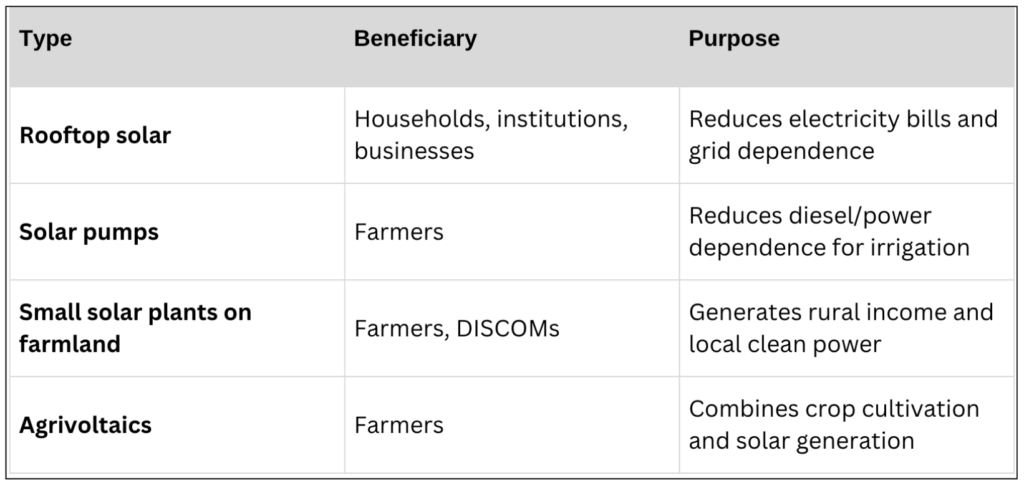
Key Government Schemes:
1. PM Surya Ghar: Muft Bijli Yojana
- The scheme was launched in 2024 with an outlay of ₹75,021 crore to install rooftop solar systems for one crore households and provide up to 300 units of free electricity per month.
- The scheme provides central financial assistance for residential rooftop solar systems and seeks to reduce household power bills, promote clean energy, and lower the subsidy burden of governments.
- The scheme offers subsidy support of up to 40% of the cost of solar panels and is expected to benefit one crore households.
2. PM-KUSUM:
- PM-KUSUM was launched to promote solar energy in agriculture, reduce diesel dependence, provide energy security to farmers and improve farmer incomes. The scheme aims to add 34.8 GW solar capacity with central financial support of ₹34,422 crore.
- Its major components include:
- Component A: Setting up decentralised ground-mounted or stilt-mounted solar power plants
- Component B: Installation of standalone solar agriculture pumps
- Component C: Solarisation of grid-connected agriculture pumps
MNRE states that PM-KUSUM targets 10,000 MW under Component A and 14 lakh standalone solar agriculture pumps under Component B.
What is the Progress So Far?
- India’s distributed solar segment has grown significantly. In FY26, distributed renewable energy from solar contributed 16.3 GW, including 7.6 GW under PM-KUSUM and 8.7 GW from rooftop solar.
- The government also reported that cumulative rooftop installations had benefited more than 42 lakh households with PM Surya Ghar at 34.3 lakh installations.
- Under PM-KUSUM, installation accelerated in FY26 with 25 lakh pumps installed or solarised till date.
However, performance remains uneven across states.
- Together, PM Suryaghar Yojana and PM-KUSUM have resulted in the installation of about 13 GW of decentralised solar power against a target of 40 GW by the end of the current financial year.
- The top five states under PM Surya Ghar (Gujarat, Maharashtra, Uttar Pradesh, Kerala and Rajasthan) account for nearly 70% of rooftop installations.
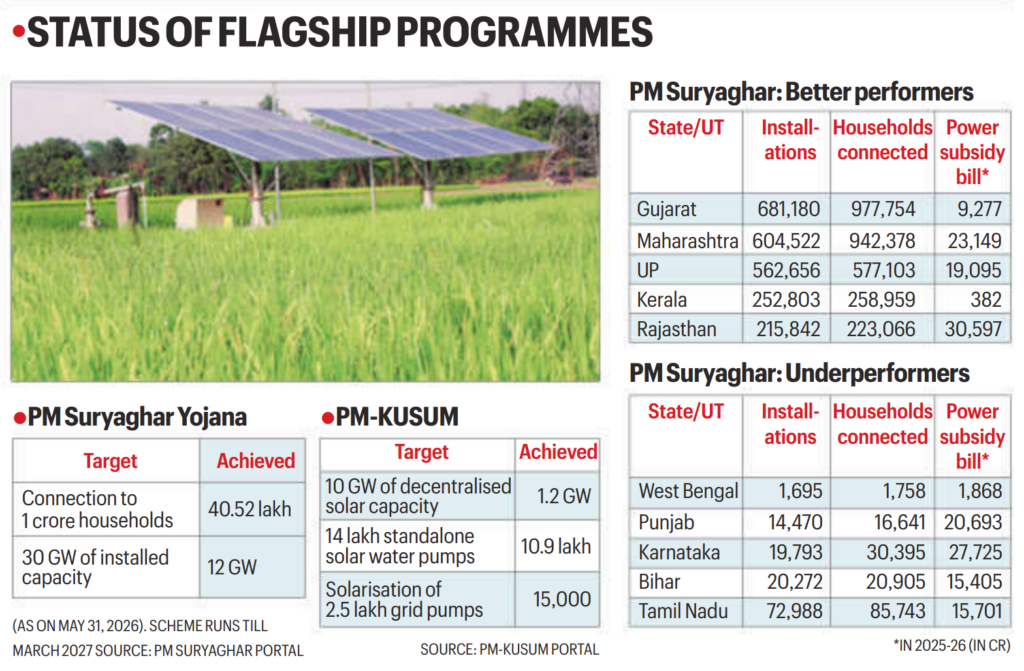
Why are Power Subsidies Slowing Solar Adoption?
Weak Financial Incentive for Consumers:
- Rooftop solar requires upfront investment. Even with a central subsidy, households often need to pay a significant amount initially. If grid electricity is already free or almost free, consumers do not see rooftop solar as financially attractive.
- For example, states such as Punjab provide free electricity to domestic consumers up to a certain limit and free power for agricultural tubewells. In such cases, households and farmers ask a simple question: Why invest in solar when grid electricity is already free?
- The Estimates Committee of Parliament observed that one reason for the low adoption of PM Surya Ghar in some states was that free or near-zero electricity tariffs reduce the attractiveness of rooftop systems.
Recurring Subsidies Distort Energy Choices:
Electricity subsidies lower the visible price of grid power. This creates a mismatch between:
- the economic cost of supplying electricity,
- the tariff paid by consumers, and
- The long-term value of switching to solar.
As a result, even environmentally beneficial technologies may fail to attract users because the pricing system hides the real cost of power.
Agricultural Power Subsidies Reduce PM-KUSUM Uptake:
- Agricultural electricity is either free or highly subsidised in many states. This reduces farmers’ incentive to shift to solar pumps or grid-connected solar pumps.
- Under PM-KUSUM, the Estimates Committee noted that for grid-connected pump solarisation, only 60,828 pumps had been sanctioned against a target of 1.5 lakh pumps, and progress was concentrated in a few states. It also observed that in some states, lack of additional state support meant farmers had to bear about 70% of the cost, making adoption difficult.
High Upfront Cost:
- A rooftop solar system may cost a few lakh rupees, depending on capacity. Poor and lower-middle-class households may not have the liquidity to invest, even if they are eligible for a subsidy.
- This is especially important because many target beneficiaries of PM Surya Ghar are not high-income households but ordinary domestic consumers.
DISCOM Incentive Problem:
- DISCOMs often lose high-paying consumers when they shift to rooftop solar. In states where cross-subsidy is important for DISCOM finances, large-scale rooftop solar can reduce revenue from better-paying consumers while subsidised consumers remain dependent on the grid.
- This creates a governance challenge: DISCOMs are expected to promote rooftop solar, but their revenue model may make them reluctant.
State-Level Variation:
- States with higher effective tariffs, better urban implementation capacity, smoother net metering, and additional incentives have performed better. States with very low consumer tariffs or free electricity have weaker consumer demand for solar.
- This explains why Gujarat, Maharashtra, Kerala, Rajasthan and Uttar Pradesh have performed better, while some states with large subsidy commitments have shown lower uptake.
Why more Subsidies may still be a Rational Solution?
- At first, it may seem contradictory that power subsidies are slowing solar adoption, and the suggested solution is more subsidies. But there is an important difference between:
- Electricity consumption subsidy: Recurring/Continues every year
- Solar capital subsidy: One-time: Paid once to create a long-term asset
- A one-time subsidy for rooftop solar or solar pumps can reduce future recurring power subsidy obligations. Therefore, targeted solar subsidies may be a more fiscally prudent approach than indefinite electricity subsidies.
The Estimates Committee also suggested that the government should explore ways to make it easier for consumers to pay the upfront cost and access scheme benefits.
Way Forward:
- Replace Recurring Power Subsidies with Smart Solar Subsidies: States should gradually shift from open-ended consumption subsidies to targeted capital subsidies for solar assets. This should be done carefully so that poor households and small farmers are protected.
- Target the Poor and Low-Consumption Households: Solar subsidies should be higher for low-income households, small and marginal farmers, and rural consumers who face unreliable power supply.
- Improve Access to Finance: The government should expand:
- collateral-free loans
- interest subvention
- pay-as-you-save models
- EMI-linked rooftop solar
- SHG-based and cooperative financing.
The government has already reported progress on collateral-free soft loans, with 13.7 lakh loan applications sanctioned and 11.3 lakh disbursed under rooftop solar-related efforts.
- Strengthen DISCOM Incentives: DISCOMs should be compensated for facilitating rooftop solar, feeder solarisation and net metering. Their role should shift from electricity sellers to local energy service providers.
- Promote Agrivoltaics: The Estimates Committee recommended studying the impact of agrivoltaics on crops and farmer income and considering subsidies for large-scale adoption. This can reduce land conflicts and support farmer income.
- Link Solar Pumps with Water Governance: Solar irrigation should be combined with:
- micro-irrigation,
- groundwater monitoring,
- feeder-level metering,
- incentives for selling surplus power instead of over-pumping water.
- Improve Implementation and Awareness: Local bodies, panchayats, SHGs and cooperatives should be used to create awareness, identify beneficiaries, and help households navigate applications, loans and vendor selection.
Power subsidies have played an important welfare role in India, especially for poor households and farmers. But when electricity becomes free or nearly free, consumers have little incentive to invest in rooftop solar or solar pumps. This slows India’s decentralised clean energy transition.
A shift from recurring electricity subsidies to one-time, targeted solar capital subsidies can reduce fiscal stress, improve energy access, support farmers, strengthen climate resilience and accelerate the clean energy transition.
Source: https://anantamias.com/current-affairs/power-subsidies-are-slowing-household-solar-adoption/
India’s Road through Myanmar is One of Engagement
Why in News?
Myanmar President U Min Aung Hlaing paid an official visit to India from May 30 to June 3, 2026, beginning with a visit to Bodh Gaya before holding talks with the Prime Minister of India and the Indian President.
The visit was significant because Myanmar has remained internationally isolated after the 2021 military coup, while India has continued a policy of calibrated engagement driven by geography, security, connectivity and China-related strategic concerns.
| UPSC Relevance: GS-2 International Relations: Bilateral Relations, India and Neighbourhood Mains: India-Myanmar Bilateral Relations |
Why Myanmar Matters to India?
- India shares a 1,643-km land border with Myanmar across Arunachal Pradesh, Nagaland, Manipur and Mizoram, along with a maritime boundary in the Bay of Bengal.
- Instability in Myanmar directly affects India through refugee flows, insurgent sanctuaries, narcotics trafficking, arms movement and cybercrime networks.
- Myanmar is also India’s land bridge to Southeast Asia. Without a workable relationship with the country, India’s Act East Policy, its Northeast development strategy, and its ambition to connect with ASEAN through land corridors remain constrained.
This explains why India has avoided a purely isolationist approach despite democratic concerns.
Strategic Rationale behind India’s Engagement:
- Geography leaves India with limited choices:
- Unlike Western countries, India cannot afford complete disengagement because Myanmar’s conflict spills directly into India’s Northeast.
- Border communities in Manipur and Mizoram are affected by ethnic linkages, displacement and armed-group movements.
- India-Myanmar border lies close to the “Golden Triangle” region. This makes drug trafficking, arms smuggling and organised crime serious concerns for India’s internal security.
- Therefore, India’s Myanmar policy is shaped less by diplomatic preference and more by geographic compulsion.
- Countering China’s expanding influence: China has remained a major external actor in Myanmar through infrastructure projects, energy pipelines, arms supplies, diplomatic support and access to the Indian Ocean. If India vacates strategic space in Myanmar, China’s influence over India’s eastern flank and the Bay of Bengal neighbourhood could deepen further. Recent reporting also highlights India’s interest in Myanmar’s rare earth resources, an area where China has a strong presence.
- Protecting India’s Northeast: Myanmar’s Sagaing, Chin and Rakhine regions are crucial for India’s border security. Insurgent groups from India’s Northeast have historically used Myanmar’s difficult terrain for safe havens. During the 2026 talks, Myanmar reiterated that its territory would not be used against India’s security interests.
- Connectivity and economic integration: India sees Myanmar as essential for transforming the Northeast from a landlocked periphery into a regional gateway. This is where the Kaladan project and the India-Myanmar-Thailand Trilateral Highway become strategically important.
Connectivity Projects:
Kaladan Multi-Modal Transit Transport Project:
- The Kaladan project aims to connect Kolkata to Sittwe Port by sea, then to Paletwa through the Kaladan River, and finally to Zorinpui in Mizoram by road. The project includes a 158-km waterway component from Sittwe to Paletwa and a 109-km road component from Paletwa to the India-Myanmar border.
- The project is strategically important because it provides an alternative route to the Northeast, reducing dependence on the narrow Siliguri Corridor.
- However, the road component has faced delays because of difficult terrain, floods, security risks and Myanmar’s internal conflict.
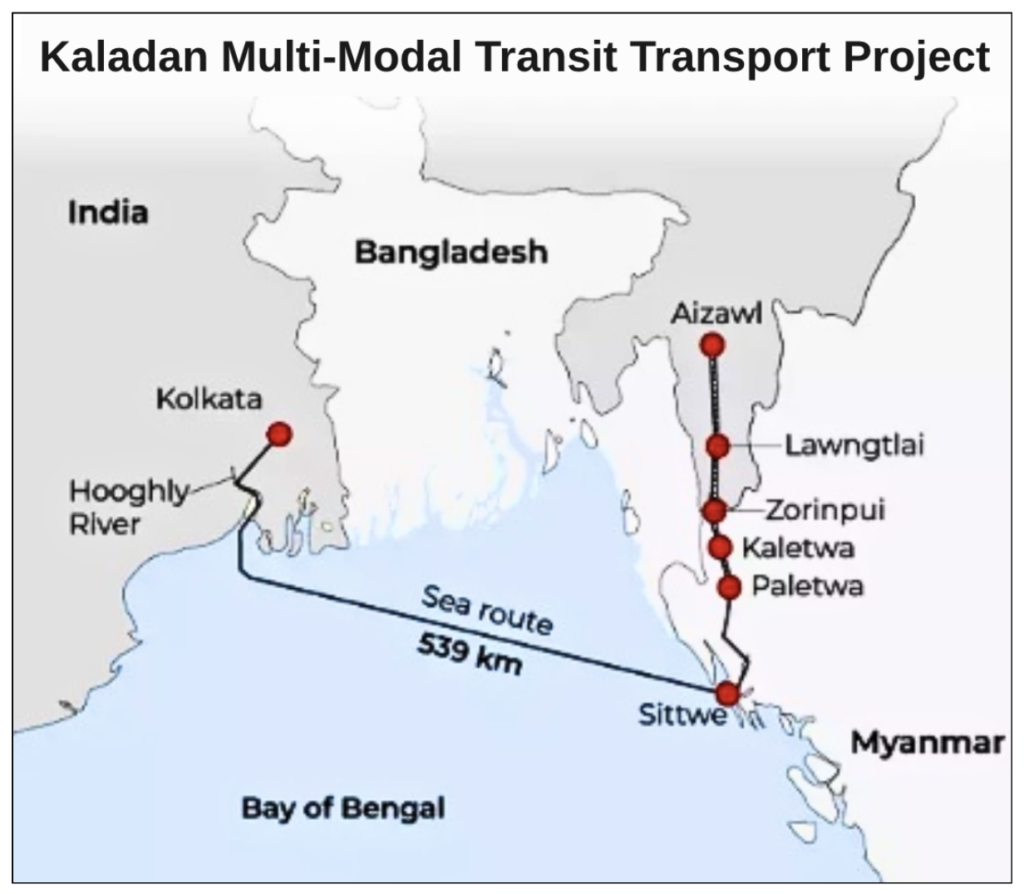
India-Myanmar-Thailand Trilateral Highway:
- The Trilateral Highway is designed to connect Moreh in Manipur to Mae Sot in Thailand through Myanmar, creating a land corridor between India and ASEAN. It supports India’s Act East Policy and could eventually link India to Cambodia, Laos and Vietnam.
- However, the highway has missed earlier deadlines. Armed conflict, weak administrative control, poor maintenance and political instability inside Myanmar have slowed implementation. The 2026 joint statement again emphasised the need to complete both the Kaladan project and the Trilateral Highway.
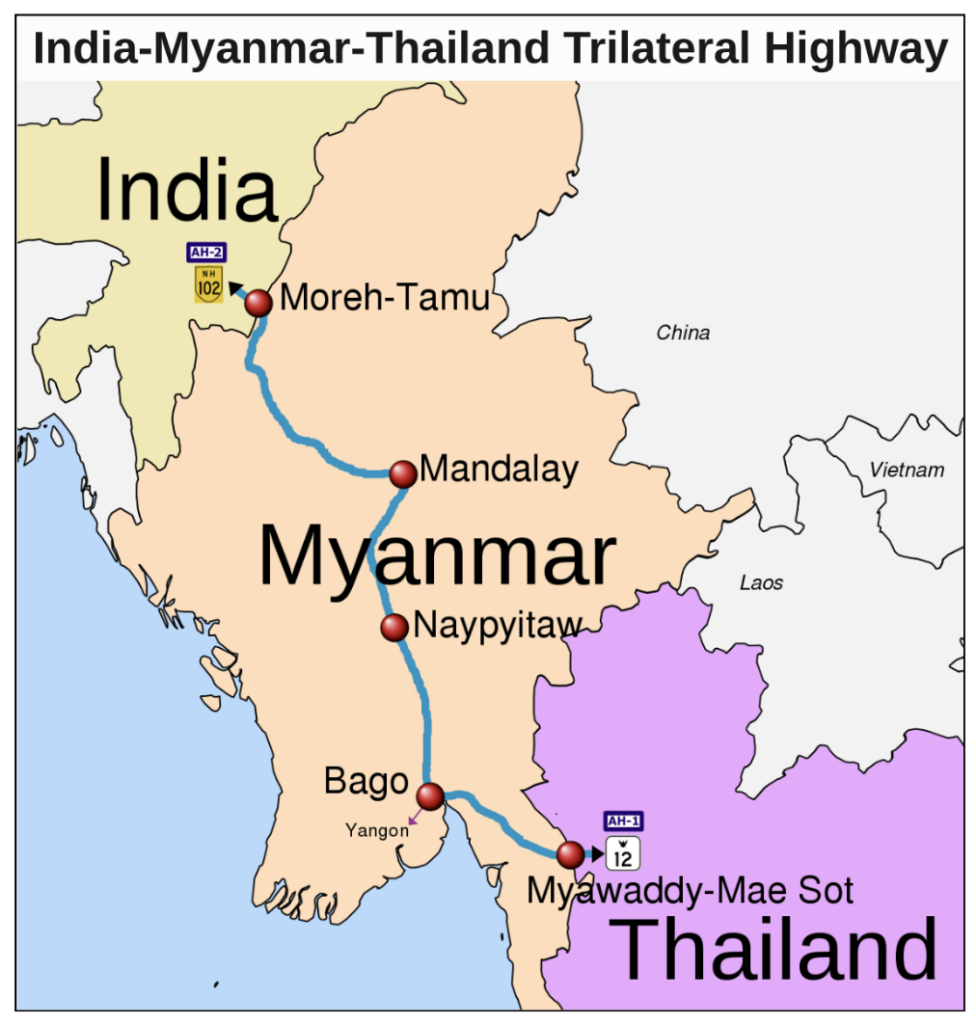
Trade and Economic Cooperation:
- India and Myanmar are natural trading partners, especially in pulses, pharmaceuticals, petroleum products, agro-processing and border trade.
- According to India’s official data, bilateral trade reached USD 2.15 billion in 2024-25, and both sides have discussed raising trade to USD 5 billion by 2030.
- During the 2026 visit, both sides agreed to promote trade through the Rupee-Kyat settlement mechanism, which became operational in 2024. This mechanism can reduce dependence on third-country currencies and ease trade payments amid sanctions-related financial complications.
Democratic and Ethical Dilemma:
- India’s engagement with Myanmar’s military-backed government raises a moral and diplomatic dilemma. Western countries have imposed sanctions and sought to isolate Myanmar’s military rulers after the 2021 coup. Human rights groups argue that hosting Min Aung Hlaing risks legitimising a regime accused of repression and abuses.
- However, India’s position is shaped by strategic realism. New Delhi argues that engagement is necessary to secure its border, protect Indian citizens, maintain connectivity projects and prevent Myanmar from falling completely into China’s strategic orbit. The challenge is to engage without appearing to endorse authoritarianism.
India’s Policy Approach:
India’s Myanmar policy can be described as principled pragmatism. It involves:
- Maintaining working relations with whoever controls state authority in Myanmar.
- Supporting Myanmar’s sovereignty and territorial integrity.
- Calling for peace, stability and national reconciliation.
- Continuing development assistance and connectivity projects.
- Securing Indian citizens and border communities.
- Avoiding a policy vacuum that China can exploit.
The 2026 joint statement reflected this balance by reaffirming India’s support for Myanmar-led peace, stability, national reconciliation and socio-economic development, while also deepening cooperation on security and connectivity.
Way Forward:
- Maintain engagement, but diversify channels: India should engage the authorities in Naypyidaw while also maintaining humanitarian, civil-society and ethnic-community channels wherever feasible.
- Fast-track realistic connectivity segments: Rather than treating Kaladan and the Trilateral Highway as symbolic mega-projects, India should prioritise secure, usable and phased completion.
- Strengthen border management with sensitivity: Border fencing, surveillance and policing must be combined with local consultation, livelihood support and humanitarian protocols.
- Expand economic cooperation in low-risk sectors: Pulses, pharmaceuticals, agro-processing, healthcare, education, energy and digital payments can build mutual dependence without excessive strategic exposure.
- Use Buddhism and education as soft-power bridges: The increase in Mekong-Ganga ICCR scholarships from 36 to 100 annually from 2026 is a useful step. Educational and cultural links can sustain long-term goodwill beyond regime-level ties.
- Coordinate with ASEAN and BIMSTEC: India should avoid unilateral overexposure and work with regional platforms for humanitarian assistance, connectivity and political stabilisation.
A policy of total isolation would reduce India’s leverage and enlarge China’s space. India need not adopt Western-style sanctions, but it should continue to support inclusive dialogue, peace, reconciliation and eventual democratic normalisation.
Source: https://anantamias.com/current-affairs/indias-road-through-myanmar-is-one-of-engagement/
A New Phase in India-Nepal Relations
Why in News?
India-Nepal relations appear to be entering a new phase after the Nepalese Prime Minister Balendra Shah suggested in Parliament that the boundary dispute over Kalapani, Lipulekh and Limpiyadhura should not be viewed as a one-sided question. His remarks indicated that both countries need to examine facts objectively and resolve the issue through diplomatic channels.
| UPSC Relevance: GS-2 International Relations: Bilateral Relations, India and Neighbourhood Mains: India-Nepal Bilateral Relations |
Background: India-Nepal Relations
- India and Nepal ties are rooted in geography, civilisation, religion, culture, kinship and economic interdependence. The two countries share an open border of about 1,751 km across five Indian States: Sikkim, West Bengal, Bihar, Uttar Pradesh and Uttarakhand.
- The relationship has traditionally been described as “special” because of the 1950 Treaty of Peace and Friendship, open-border mobility, deep defence linkages, common cultural circuits, extensive trade, and India’s role as Nepal’s major transit and development partner.
However, Nepal often worries about asymmetry and overdependence, while India worries about security vulnerabilities, external influence in the Himalayas, and cross-border instability. Thus, the India-Nepal relationship is both exceptionally close and periodically fragile.
The Boundary Dispute: Kalapani, Lipulekh and Limpiyadhura:
- The boundary dispute is centred on the interpretation of the 1816 Treaty of Sugauli, which defined Nepal’s western boundary with British India along the Kali river. The disagreement arises from different interpretations of the river’s origin.
- Nepal argues that the Kali river originates from the Limpiyadhura area and therefore Kalapani, Lipulekh and Limpiyadhura fall within Nepali territory.
- India maintains that the areas are part of Uttarakhand and that its administrative and security presence reflects the boundary it inherited at Independence.
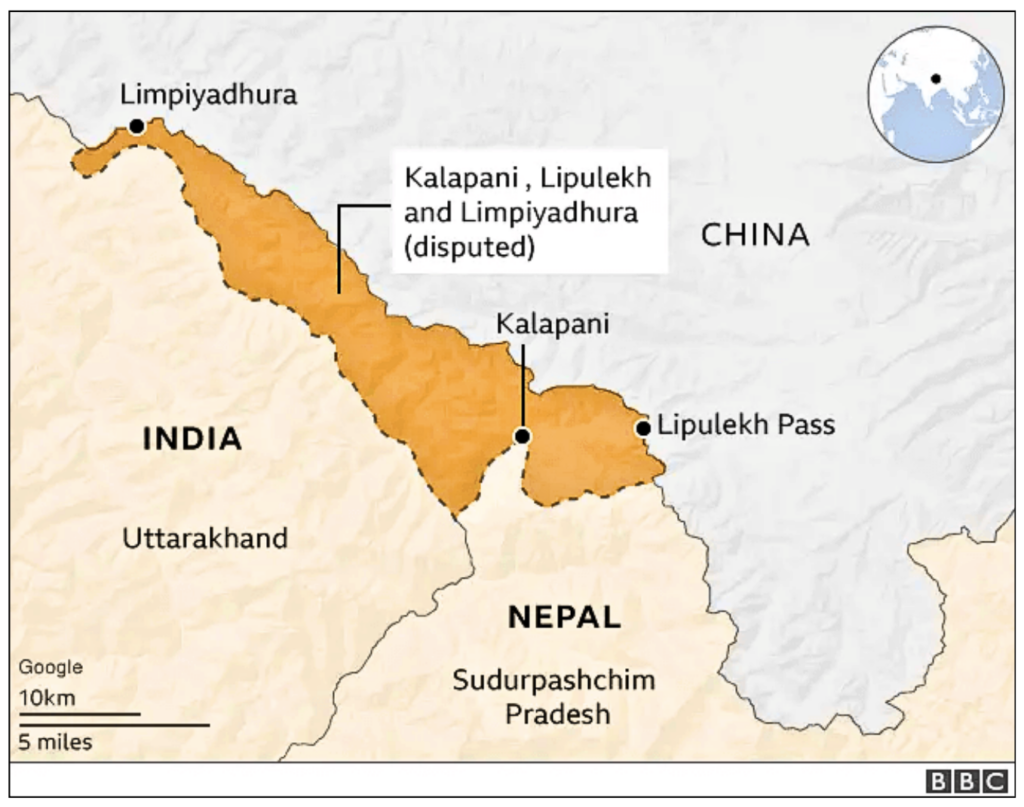
The area is strategically important because Lipulekh lies near the India-Nepal-China tri-junction and provides access to Tibet. It is also connected with the Kailash Mansarovar Yatra route and historical trade routes. After the India-China war of 1962, the security significance of the region increased substantially for India.
The dispute escalated sharply in 2020 when Nepal issued a revised political map showing Kalapani, Lipulekh and Limpiyadhura within its territory. Later, Nepal’s decision to print its revised map on currency notes further hardened positions. India has rejected Nepal’s expanded claims as artificial and unilateral.
Why does the Recent Statement Matter?
Nepalese Prime Minister Balendra Shah’s statement is significant for four reasons.
- It departs from a purely accusatory nationalist framing. By saying that the issue may not be one-sided, he acknowledged the complexity of border management along an open and historically porous frontier.
- It creates space for technical and diplomatic processes. Border disputes cannot be resolved by slogans. They require historical documents, maps, surveys, river morphology, administrative records and ground-level verification.
- It reflects a generational change in Nepal’s politics. The rise of younger political leadership suggests a shift from old ideological alignments and anti-India mobilisation towards governance, employment, anti-corruption and development-oriented politics.
- It allows India to respond with maturity. New Delhi must avoid reading every assertion of Nepali sovereignty as hostility. Nepal’s desire to be treated as an equal partner is natural for a sovereign state.
The new political climate in Nepal is marked by a desire to move away from older patterns of corruption, ideological rivalry and elite bargaining. The public mood that propelled new leadership in Kathmandu is linked to dissatisfaction with unemployment, weak governance and political instability.
This shift is visible in Nepal’s approach towards India. Kathmandu may continue to emphasise the “special relationship,” but it is also likely to insist on formal protocol, equality and institutional engagement.
Major Pillars of India-Nepal Cooperation:
- Civilisational and People-to-People Linkages: India and Nepal share Hindu and Buddhist heritage, linguistic affinities, pilgrimage routes, inter-marriages and kinship networks. Sites such as Pashupatinath, Janakpur, Lumbini, Bodh Gaya, Varanasi and Ayodhya form a shared civilisational geography.
- Open Border and Mobility: The open border allows citizens of both countries to cross without passports or visas. This has supported livelihoods, trade, family ties and cultural continuity. However, it also creates challenges such as trafficking, smuggling, illegal migration, counterfeit currency, narcotics movement and security threats.
- Trade and Transit: India is Nepal’s largest trade and investment partner. Since Nepal is landlocked, India provides crucial transit access for Nepal’s third-country trade. Rail connectivity, integrated check posts, road links and inland cargo movement are central to Nepal’s economic future.
- Energy Cooperation: Hydropower has become one of the most promising areas of cooperation. The long-term power trade agreement aims to enable Nepal to export large quantities of electricity to India over the coming decade. This can transform Nepal’s economy, support India’s renewable energy needs, and deepen regional power trade, including potential electricity movement to Bangladesh through Indian grids.
- Connectivity: Rail links, petroleum pipelines, roads, bridges, integrated check posts and digital payment connectivity are gradually changing the texture of the relationship. Connectivity reduces the psychological distance between the two countries and turns geography into an economic asset.
- Security and Defence: Indian and Nepali armies share a distinctive relationship, including recruitment of Nepali Gorkhas in the Indian Army and the tradition of honorary generalship. Security cooperation is vital because instability in Nepal directly affects India’s Himalayan security, border management and internal security.
Key Irritants in the Relationship:
- Boundary and Cartographic Nationalism: The Kalapani-Lipulekh-Limpiyadhura dispute has become emotionally charged in Nepal. Maps, currency notes and parliamentary resolutions can harden public opinion and reduce diplomatic flexibility.
- Asymmetry and Sovereignty Concerns: Nepal is much smaller than India in size, population and economy. This asymmetry often produces fears of domination. India’s challenge is to reassure Nepal through respectful engagement, not through paternalism.
- China Factor: China’s infrastructure and political presence in Nepal have grown. Nepal seeks diversification of external partnerships, while India sees the Himalayan region through a security lens.
- Implementation Deficit: Many India-Nepal projects face delays due to land acquisition, environmental clearances, bureaucratic procedures and local-level politics. Announcements often outpace delivery. This creates frustration in Nepal and weakens India’s credibility.
- Trade Imbalance: Nepal has long complained of an unfavourable trade balance with India. Greater market access, value-chain integration, power exports, tourism and investment can help reduce this imbalance.
- Domestic Political Use of Anti-India Sentiment: In Nepal, anti-India nationalism has often been used as a political tool. In India, too, public opinion can become rigid on territorial issues. Both sides need to prevent domestic politics from overwhelming diplomacy.
Why India Must Take Nepal Seriously?
- Nepal is not just another neighbour. It is central to India’s Himalayan security, Ganga basin ecology, energy transition, cultural diplomacy and regional connectivity. A stable and prosperous Nepal serves India’s interests in at least five ways.
- It reduces external strategic penetration in the Himalayas.
- It supports secure borders.
- It offers renewable hydropower for India’s energy transition.
- It strengthens sub-regional connectivity under BIMSTEC and BBIN.
- It reinforces India’s credibility under the Neighbourhood First policy.
Therefore, India’s approach should not be reactive or episodic. It must be patient, generous and institutionally consistent.
Way Forward:
- Revive High-Level Political Dialogue: Regular Prime Minister-level, Foreign Minister-level and Foreign Secretary-level exchanges should be institutionalised. Political trust is necessary before technical solutions can succeed.
- Strengthen Boundary Mechanisms: The boundary dispute should be addressed through a time-bound expert process. Both sides should identify areas of agreement, areas of technical disagreement and areas needing political decision.
- De-politicise the Border: The open border should remain a symbol of trust, but it must be better managed through joint surveillance, biometric-friendly facilitation where needed, modern customs infrastructure and community cooperation.
- Build an Energy Partnership: Hydropower trade can become the backbone of a new economic relationship. India should facilitate long-term power purchase, cross-border transmission and trilateral electricity trade with Bangladesh.
- Expand Connectivity: Rail, road, riverine, pipeline, and digital connectivity should be accelerated. Connectivity should be treated as a public good for the entire Himalayan-Gangetic region.
- Address Trade Imbalance: India can help Nepal integrate into the Indian and regional value chains. Agriculture processing, herbal products, tourism, textiles, hydropower and digital services can create new opportunities.
- Promote Youth and Civil Society Engagement: Given Nepal’s changing political demography, India should expand scholarships, start-up linkages, media exchanges, university partnerships and cultural programmes for younger Nepalis.
The new phase in India-Nepal relations should be built on three principles: respect for sovereignty, sensitivity to security, and commitment to shared prosperity. If both countries can combine historical wisdom with future-oriented pragmatism, they can transform a fragile “special relationship” into a modern, sustainable and mutually beneficial partnership.
Practice Mains Question:
Q. “India-Nepal relations are marked by deep civilisational intimacy but recurring political distrust.” Discuss with reference to recent boundary-related developments.
Source: https://anantamias.com/current-affairs/a-new-phase-in-india-nepal-relations/