Pradhan Mantri Surakshit Matritva Abhiyan (PMSMA) completed a decade on 9 June 2026, and Union Health Minister J.P. Nadda opened nationwide celebrations, releasing a ₹75 commemorative coin and a ₹5 postal stamp. PMSMA, launched on 9 June 2016 by the Ministry of Health and Family Welfare, promises every pregnant woman free, assured, quality antenatal care (ANC) on the 9th of every month at designated government health facilities, with specialists volunteering through a public-private model. It is the scheme that turned a routine check-up into a fixed-date national appointment.
The headline number is the reach: in ten years PMSMA delivered more than 7.5 crore antenatal check-ups and flagged nearly 1.2 crore high-risk pregnancies (HRPs) for closer follow-up. That second figure is the real story for an exam answer. PMSMA is not just about coverage; it is a screening engine that finds the women most likely to die and routes them to specialist care. The cross-paper relevance is direct: this is a GS-II governance and social-justice case study on how a health scheme bends a hard SDG indicator, India’s Maternal Mortality Ratio.
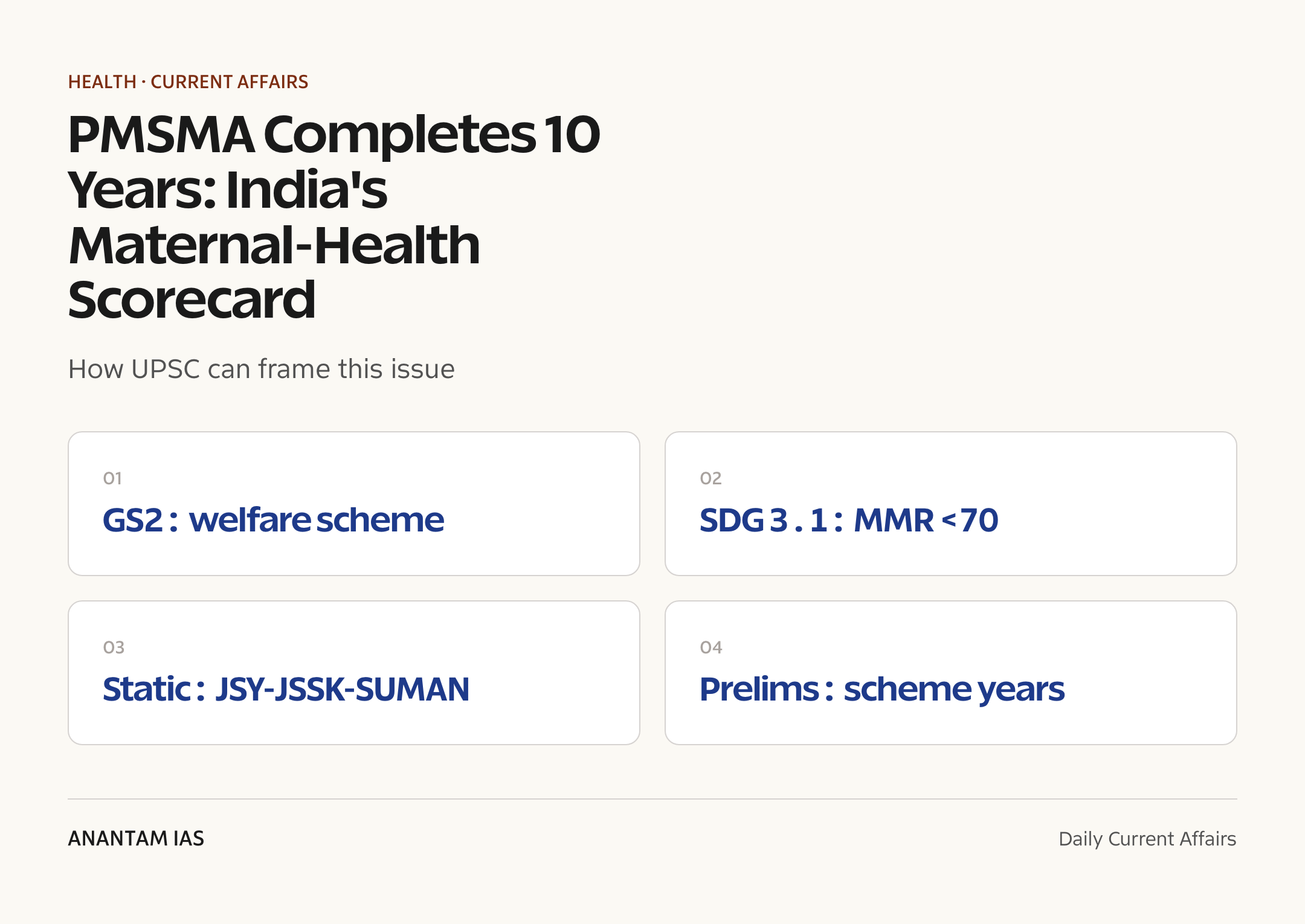
An examiner will not test the anniversary; she will test whether you can connect PMSMA to the MMR trend, to the JSY-JSSK-SUMAN scheme stack, and to the unfinished SDG 3.1 target.
Quick Facts
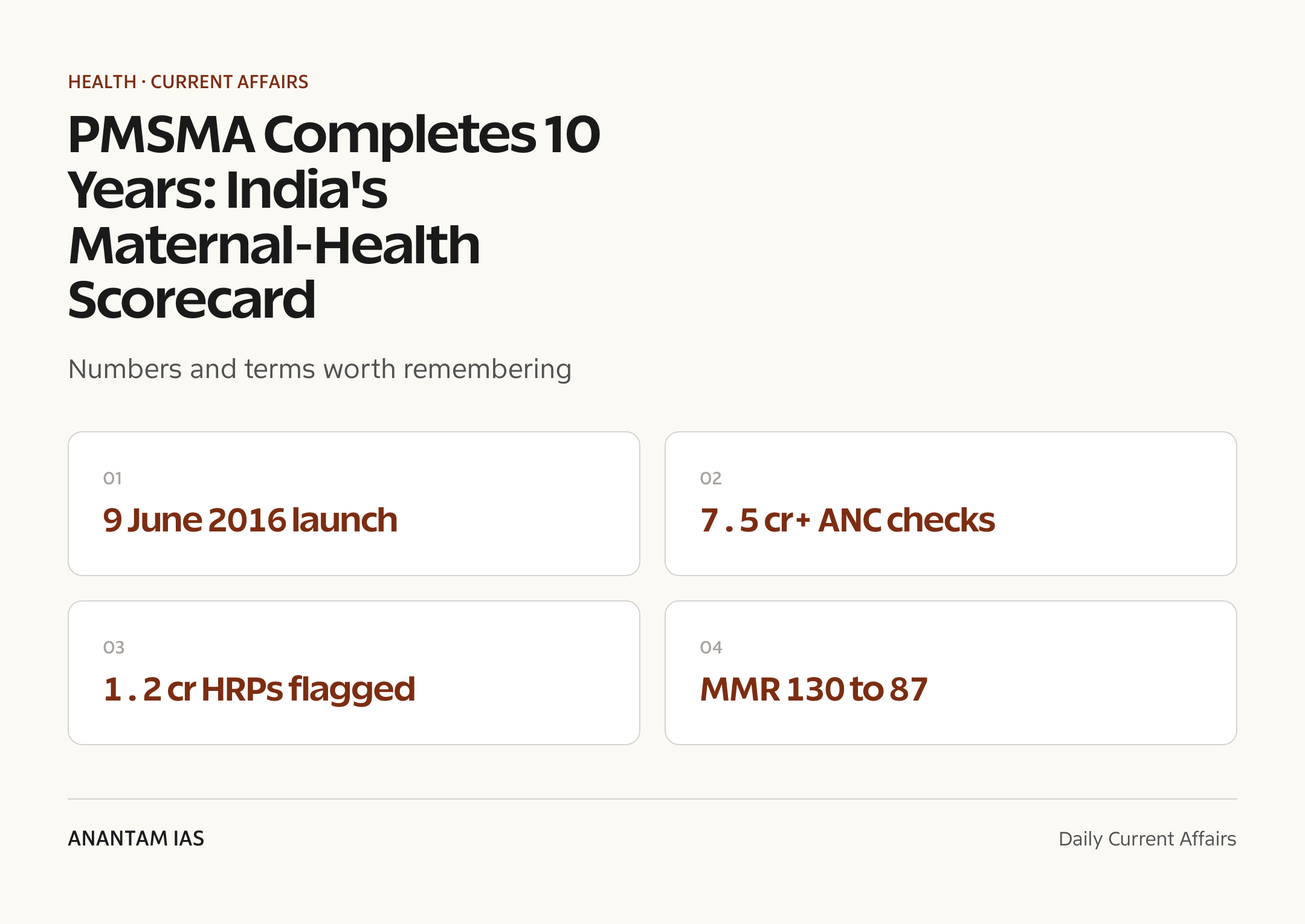
- PMSMA was launched on 9 June 2016 by the Ministry of Health and Family Welfare; it completed 10 years on 9 June 2026.
- The scheme guarantees free antenatal care to every pregnant woman on the 9th day of every month at government facilities.
- Over the decade, more than 7.5 crore antenatal check-ups were conducted under PMSMA.
- Nearly 1.2 crore high-risk pregnancies were identified and tracked through the programme.
- India’s Maternal Mortality Ratio (MMR) per the Sample Registration System fell from 130 (2014-16) to 93 (2019-21), with the latest bulletin near 87.
- The SDG 3.1 target is to cut MMR below 70 per 1,00,000 live births by 2030; India has already crossed the National Health Policy target of under 100.
- Institutional deliveries rose to 88.6 percent in NFHS-5, up from 78.9 percent in NFHS-4.
- Women get a green sticker for a normal pregnancy and a red sticker for a high-risk one, guiding follow-up till 45 days after delivery.
- Sources: PIB, Ministry of Health & Family Welfare and PIB / SRS Special Bulletin on Maternal Mortality.
What Just Happened
On 9 June 2026 the Health Ministry launched a year-long set of activities themed ’10 years of PMSMA: a decade of care’. The minister unveiled a ₹75 commemorative coin and a ₹5 postal stamp, and the ministry placed the scheme’s cumulative record on view: 7.5 crore-plus antenatal check-ups and close to 1.2 crore high-risk pregnancies identified since 2016. The framing was deliberate, presenting PMSMA as one of the most far-reaching public-health interventions of the period rather than a single-day event.
The operating model that produced those numbers is simple by design. On the 9th of every month, government health facilities run dedicated PMSMA sessions where a pregnant woman, ideally in her second or third trimester, gets a clinical examination, counselling, free medicines, laboratory tests and at least one ultrasound. Each woman is colour-coded: a green sticker for a normal pregnancy, a red sticker for a high-risk one. The red-sticker cohort, women with severe anaemia, hypertension, diabetes, or a history of obstetric complications, is then tracked more closely from pregnancy through 45 days after delivery.
Crucially, PMSMA leans on volunteerism. Private obstetricians and gynaecologists are invited to donate time at public facilities on PMSMA day, widening the specialist pool in districts where the government cadre is thin. ASHAs and Auxiliary Nurse Midwives (ANMs) do the groundwork, mobilising women, ensuring they attend, and feeding the high-risk list back into the system so that a flagged pregnancy is not lost to follow-up.
Background and Context
PMSMA sits inside a longer scheme stack that India built to make childbirth safe and institutional. Janani Suraksha Yojana (JSY), launched in 2005 under the National Health Mission, used a conditional cash transfer to pull poor women out of risky home deliveries and into hospitals. Janani Shishu Suraksha Karyakram (JSSK), launched in 2011, went further and made delivery, drugs, diagnostics, diet, blood, transport and even caesarean sections completely free in public facilities, attacking the out-of-pocket cost that kept women away. PMSMA, added in 2016, plugged the remaining gap: not the delivery, but the quality antenatal care before it.
The latest layer is Surakshit Matritva Aashwasan (SUMAN), launched on 10 October 2019. SUMAN sets an explicit goal of zero preventable maternal and newborn deaths and a ‘zero tolerance for denial of services’ guarantee. It bundles free, dignified, respectful care for every pregnant woman, mother up to six months postpartum, and sick newborn at a public facility, including free transport to and from the facility. Read together, JSY, JSSK, PMSMA and SUMAN form a continuum of care from the first antenatal visit to the postnatal period.
The number these schemes are judged against is the Maternal Mortality Ratio, the number of maternal deaths per 1,00,000 live births, tracked by the Sample Registration System (SRS). India’s MMR fell from 130 in 2014-16 to 103 in 2017-19, 97 in 2018-20 and 93 in 2019-21, with the most recent SRS special bulletin putting it near 87. That is well below the National Health Policy target of 100, and within striking distance of the Sustainable Development Goal 3.1 target of fewer than 70 by 2030. States such as Kerala (around 30), Maharashtra (38) and Telangana (56) have already crossed the SDG line; the laggard belt of high-focus states is where the remaining deaths cluster.
Key Features of PMSMA
- Fixed-date care: Assured antenatal care on the 9th of every month at every designated government facility, so the visit is predictable, not discretionary.
- Free and comprehensive: Clinical check-up, counselling, free drugs, lab tests and at least one ultrasound at no cost to the woman.
- Risk stratification: Green sticker for normal pregnancies, red sticker for high-risk ones, with the red cohort tracked till 45 days after delivery.
- Specialist volunteerism: Private obstetricians and gynaecologists donate time at public facilities, expanding the specialist pool through a public-private model.
- Frontline backbone: ASHAs and ANMs mobilise women, ensure attendance and maintain the high-risk-pregnancy follow-up loop.
- Part of a continuum: PMSMA covers the antenatal phase that JSY (cash for institutional delivery) and JSSK (free delivery) do not.
Why It Matters for UPSC
This is a high-yield topic because it ties a current development to durable syllabus themes.
- GS-II direct hit: a flagship welfare scheme and a clean case study on government policies for vulnerable sections and SDG-linked health governance.
- Links the current event to static syllabus: maternal health, SDG 3, National Health Mission, NFHS data and the determinants-of-health framework.
- Prelims angle: pairing schemes to launch years (JSY 2005, JSSK 2011, PMSMA 2016, SUMAN 2019) and MMR-MMR/SRS definitions are high-frequency matches.
- Essay and ethics angle: gives a concrete India example for prompts on women’s empowerment, equity in health and the social cost of preventable death.
What It Means: Health Lens
PMSMA’s design insight is that the danger is not childbirth alone, it is the undetected high-risk pregnancy. India had already won the institutional-delivery battle; NFHS-5 shows 88.6 percent of births now happen in facilities, up from 78.9 percent a survey earlier. Getting a woman into a hospital, though, does not help if she arrives in crisis, undiagnosed and untreated. PMSMA’s contribution is the 1.2 crore red stickers: it pushes the system to find anaemia, hypertension, diabetes and obstetric history during pregnancy, when intervention is cheap and effective, rather than during a midnight emergency, when it often is not.
The MMR curve tells the harder half of the story, which is that the easy gains are over. Falling from 130 to roughly 87 in under a decade is a genuine achievement, but the slope is flattening, and the national average masks deep inter-state inequality. Kerala sits near 30 while several high-focus states remain far above the national line. The remaining maternal deaths are concentrated, driven by obstetric haemorrhage, sepsis and hypertensive disorders, often the result of the three classic delays: delay in deciding to seek care, delay in reaching a facility, and delay in receiving quality care once there.
So the policy frontier has shifted from coverage to quality. Schemes like SUMAN and the LaQshya labour-room quality initiative, and the persistent burden of anaemia among pregnant women, signal that the next points of MMR reduction will come from better-functioning facilities, blood availability, skilled birth attendance and respectful care, not merely from more visits. PMSMA at ten is a hinge: it built the screening habit; the unfinished task is making sure that a flagged woman actually receives the care her red sticker promises.
Challenges and Concerns
- Quality, not coverage, is now the binding constraint: identifying a high-risk pregnancy helps little if blood, specialists and functioning labour rooms are absent at the referral point.
- Sharp inter-state inequality means the national MMR hides a cluster of high-focus states where most preventable deaths still occur.
- Specialist volunteerism is uneven; many rural and tribal blocks lack the obstetricians PMSMA day depends on, leaving sessions thinly staffed.
- Persistent anaemia and undernutrition among pregnant women keep raising the baseline risk despite better antenatal contact.
- Last-mile follow-up of red-sticker pregnancies strains an already overstretched ASHA and ANM workforce.
Prelims Pointers
- PMSMA was launched on 9 June 2016 by the Ministry of Health and Family Welfare.
- PMSMA guarantees free antenatal care on the 9th of every month at government health facilities.
- A green sticker marks a normal pregnancy and a red sticker marks a high-risk pregnancy under PMSMA.
- Janani Suraksha Yojana (JSY) was launched in 2005 under the National Health Mission as a conditional cash transfer.
- Janani Shishu Suraksha Karyakram (JSSK), 2011, makes delivery, drugs, diagnostics and transport free in public facilities.
- Surakshit Matritva Aashwasan (SUMAN) was launched on 10 October 2019 with a zero-tolerance-for-denial-of-services pledge.
- Maternal Mortality Ratio (MMR) is maternal deaths per 1,00,000 live births, tracked by the Sample Registration System.
- India’s MMR fell from 130 (2014-16) to 93 (2019-21), with the latest SRS bulletin near 87.
- The SDG 3.1 target is to reduce MMR below 70 per 1,00,000 live births by 2030.
- Institutional deliveries reached 88.6 percent in NFHS-5, up from 78.9 percent in NFHS-4.
- Kerala, Maharashtra and Telangana have already achieved an MMR below the SDG target of 70.
- ASHAs and ANMs are the frontline workers who mobilise women and track high-risk pregnancies under PMSMA.
Mains Practice Questions
- Pradhan Mantri Surakshit Matritva Abhiyan has shifted the maternal-health challenge from coverage to quality. Examine this statement in the light of India’s Maternal Mortality Ratio trend and the SDG 3.1 target. (GS-II, 15 marks)
- Discuss how the scheme stack of JSY, JSSK, PMSMA and SUMAN together forms a continuum of maternal and newborn care. What gaps remain in its implementation? (GS-II, 15 marks)
- India’s falling Maternal Mortality Ratio hides sharp inter-state inequality. Analyse the structural reasons behind this and suggest measures to reach the high-focus states. (GS-II, 10 marks)
- ‘The next gains in reducing maternal mortality will come from facility quality, not from more antenatal visits.’ Critically evaluate with reference to recent health-sector initiatives. (GS-II, 15 marks)
Way Forward
Close the quality loop so that every red-sticker pregnancy meets a referral facility with blood, a skilled birth attendant and a functioning labour room, not just a screening visit.
Concentrate resources, specialists and incentives on the high-focus states where the remaining maternal deaths cluster, since the national average is no longer the right unit of action.
Tackle the upstream risk drivers, especially anaemia and undernutrition among pregnant women, and pair PMSMA’s antenatal contact with SUMAN’s quality and dignity guarantees to push India past the SDG 3.1 line before 2030.
Frequently Asked Questions
What is PMSMA in simple terms?
PMSMA, the Pradhan Mantri Surakshit Matritva Abhiyan, gives every pregnant woman free, comprehensive antenatal care on the 9th of every month at government health facilities. Launched in 2016, it includes a check-up, counselling, free medicines, tests and an ultrasound, with the goal of catching high-risk pregnancies before they turn deadly.
When was PMSMA launched?
PMSMA was launched on 9 June 2016 by the Ministry of Health and Family Welfare. It completed ten years on 9 June 2026, marked by a ₹75 commemorative coin and a ₹5 postal stamp. Across the decade it delivered over 7.5 crore antenatal check-ups and identified nearly 1.2 crore high-risk pregnancies.
What is India’s Maternal Mortality Ratio now?
Per the Sample Registration System, India’s Maternal Mortality Ratio fell from 130 in 2014-16 to 93 in 2019-21, with the most recent bulletin near 87 per 1,00,000 live births. India has crossed the National Health Policy target of 100 and is closing in on the SDG goal of fewer than 70 by 2030.
How is PMSMA different from JSY and JSSK?
JSY (2005) pays poor women a cash incentive to deliver in a hospital, and JSSK (2011) makes the delivery itself free. PMSMA fills the earlier gap, the quality antenatal care before birth. Together with SUMAN (2019), they form a continuum of care from the first antenatal visit to the postnatal period.
What is the SDG target for maternal mortality?
Sustainable Development Goal 3.1 asks every country to cut its Maternal Mortality Ratio below 70 per 1,00,000 live births by 2030. India’s national figure is near 87, and states like Kerala, Maharashtra and Telangana have already crossed the line. The remaining task lies in a cluster of high-focus states.
What do the green and red stickers mean?
Under PMSMA, every screened woman is colour-coded. A green sticker marks a normal, low-risk pregnancy, while a red sticker marks a high-risk one, for instance severe anaemia or hypertension. The red-sticker cohort is then tracked more closely, right through to 45 days after delivery, so dangerous cases are not lost to follow-up.
Tell Google you want more of this.
Add Anantam IAS as a preferred sourceOne tap, and this site shows up more often in your own Top Stories, AI Overviews and AI Mode. Remove it any time.