A vacation division bench of the Calcutta High Court has pulled up the police over the public parading of arrested persons with ropes tied around their waists, with videos of the spectacle circulating on social media. Hearing public interest petitions, the bench of Justice Jay Sengupta and Justice Smita Das De framed the issue in plain constitutional terms, observing that the State may arrest and prosecute a person but cannot humiliate them. The Court asked the West Bengal government to file a report within three weeks and listed the matter for hearing after four weeks. The petitions described arrested persons being walked through public places in restraints, in some cases partly undressed, while the footage was filmed and shared.
The single line that travelled furthest, as LiveLaw reported, was the bench’s oral remark: “You may arrest them, you may prosecute them, but you cannot humiliate them.” For an aspirant, the value here is not the local incident. It is the durable principle the case restates, that the power to arrest is not a license to defame, and that an accused person keeps the right to dignity and the presumption of innocence until a fair trial concludes. The same fault line, state coercive power against individual dignity, is exactly what GS2 and GS4 keep testing. Read this case as a hook for a cluster of static topics, Article 21, fair trial, custodial safeguards and police accountability, rather than as a passing headline. That is how a study note earns its place, by converting a news flash into a reusable frame for several questions at once.
This note reads the Calcutta High Court’s intervention the way an examiner would, as a rights-of-the-accused and police-ethics precedent that ties Article 21, the presumption of innocence and custodial dignity into one answerable theme.
Quick Facts
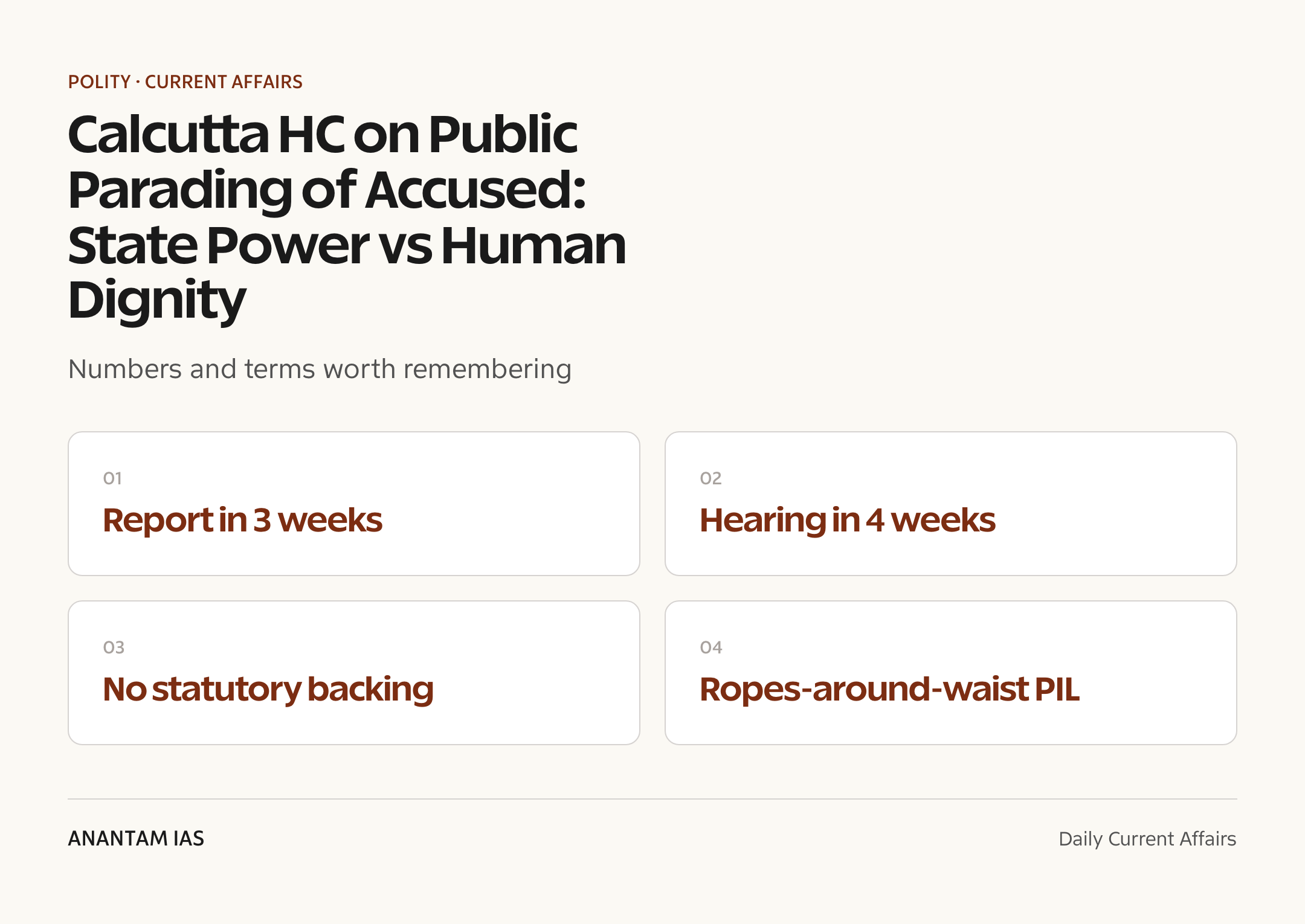
- A vacation bench of Justice Jay Sengupta and Justice Smita Das De heard the matter on Friday, 5 June 2026.
- Public interest petitions alleged that arrested persons were paraded with ropes tied around their waists, some in a state of partial undress.
- Videos of the parading were said to have been circulated on social media.
- The persons had been arrested on charges including extortion and intimidation.
- The bench remarked: “You may arrest them, you may prosecute them, but you cannot humiliate them.”
- The Court questioned the necessity of the practice, noting the absence of any clear risk of escape.
- The State was directed to file a detailed report within three weeks, with the next hearing after four weeks.
- Indian criminal law contains no provision authorising police to parade or publicly display an accused person.
- Sources: LiveLaw, Calcutta High Court proceedings and Millennium Post.
What Just Happened
The petitions before the Calcutta High Court flagged a pattern of police in West Bengal taking arrested persons through public places with ropes tied around their waists, at times in a partially undressed state, while recordings of these scenes spread on social media. The persons concerned had been arrested on charges including extortion and intimidation. The petitioners argued that this practice had no basis in law and amounted to punishment before trial, and that filming and sharing the parading compounded the harm by broadcasting it to an audience that no court had authorised. The choice of public interest litigation matters here, because it lets a systemic practice, not just one person’s grievance, be tested before a constitutional court.
The vacation bench of Justice Jay Sengupta and Justice Smita Das De was unambiguous on principle. The Court drew a clear line between the lawful powers of arrest and prosecution on one side, and humiliation on the other, observing that the State cannot subject a person to public shaming simply because it has the authority to detain and try them. The bench also questioned why a person already in custody and restraint would need to be paraded at all when there was no indicated risk of escape, a point that goes to necessity and proportionality rather than to the bare legality of the arrest. Importantly, the Court did not suggest that the underlying arrests were wrong. Its concern was the extra, gratuitous humiliation layered onto an otherwise lawful process.
Rather than deciding the matter finally at the vacation stage, the Court sought accountability through process. It directed the West Bengal government to file a detailed report on the allegations within three weeks and scheduled the next hearing after four weeks. The interim message was procedural restraint, that the burden now sits on the State to explain and justify, or end, a practice for which Indian criminal law supplies no authority. For students, the takeaway is that these were oral observations and an interim direction at a vacation hearing, persuasive in framing but not yet a final, citable judgment. The principle the bench invoked, however, is long settled, and that is what makes the case worth filing away.
Background and Context
The constitutional anchor is Article 21, which guarantees that no person shall be deprived of life or personal liberty except by procedure established by law. Since Maneka Gandhi v. Union of India (1978), that procedure must be fair, just and reasonable, not arbitrary. The Supreme Court has long read “life” in Article 21 to mean a life with dignity, not mere animal existence. Public parading of an unconvicted person attacks that dignity directly, and it does so to someone the law still treats as innocent. The presumption of innocence, that a person is innocent until proven guilty after a fair trial, is the bedrock of criminal justice and a facet of the fair-trial guarantee under Article 21. Crucially, the protection of Article 21 is not lost on arrest. A person in custody surrenders liberty to the extent the law allows, but not the right to be treated as a human being.
The treatment of arrested persons is already hedged by binding Supreme Court guidance. In D.K. Basu v. State of West Bengal (1997), the Court laid down detailed safeguards against custodial abuse, including the right to be informed of grounds of arrest, a memo of arrest signed by witnesses, the right to inform a relative or friend, and medical examination, with the larger aim of protecting the dignity and bodily integrity of the detained. In Prem Shankar Shukla v. Delhi Administration (1980), the Court held that routine handcuffing is degrading and unconstitutional, permissible only when clearly justified by a real risk, because restraining a person before the public without necessity offends Article 21 and the equality guarantee of Article 14. The Calcutta High Court’s concern over restraints used without any escape risk sits squarely in this line, extending the same logic from handcuffs to ropes and public display.
There is also a human-rights and oversight dimension. Custodial dignity is a recurring concern of the National Human Rights Commission (NHRC), the statutory body under the Protection of Human Rights Act, 1993, which treats public humiliation, unlawful restraint and custodial mistreatment as violations warranting inquiry and recommendation. Police conduct of this kind also runs against the spirit of police-reform jurisprudence, notably Prakash Singh v. Union of India (2006), which pressed for professional, accountable policing insulated from extraneous pressures. The wider current is the global recognition of dignity in instruments such as the Universal Declaration of Human Rights, which India has long endorsed. Read together, these strands show why parading an accused is not a minor procedural lapse but a structural rights problem, and why a constitutional court treats it as worth its time.
It helps to separate two roles the State plays. As prosecutor, the State accuses and tries; as guardian of constitutional order, it must also protect the rights of the very person it accuses. Public parading collapses that separation, letting the prosecuting arm act as judge, jury and informal punisher in the street. This is where the idea of constitutional morality enters, the expectation that public power restrains itself by the discipline of the Constitution rather than by popular mood. The presumption of innocence is not a technicality that shields the guilty. It is the structural assumption that forces the State to prove its case through evidence and process, and that protects the innocent who are, at the point of arrest, indistinguishable from the rest. Strip it away in public, and an acquittal later cannot return the reputation already destroyed.
Why Public Parading Fails the Constitutional Test
- No statutory backing: No provision of Indian criminal law authorises police to parade, display or publicly shame an accused person.
- Presumption of innocence: Parading treats an unconvicted person as guilty, inverting the burden the State must discharge at trial.
- Article 21 dignity: The right to life includes the right to live and be treated with dignity, which public humiliation violates.
- Punishment without trial: Shaming imposes a social sanction the court has not ordered, bypassing due process entirely.
- Disproportion: Restraint and exposure without any escape risk fail the necessity-and-proportionality test that limits coercive power.
- Irreversible harm: Once a video spreads online, reputational damage persists even if the person is later acquitted.
Why It Matters for UPSC
This is a high-yield topic because it ties a current development to durable syllabus themes.
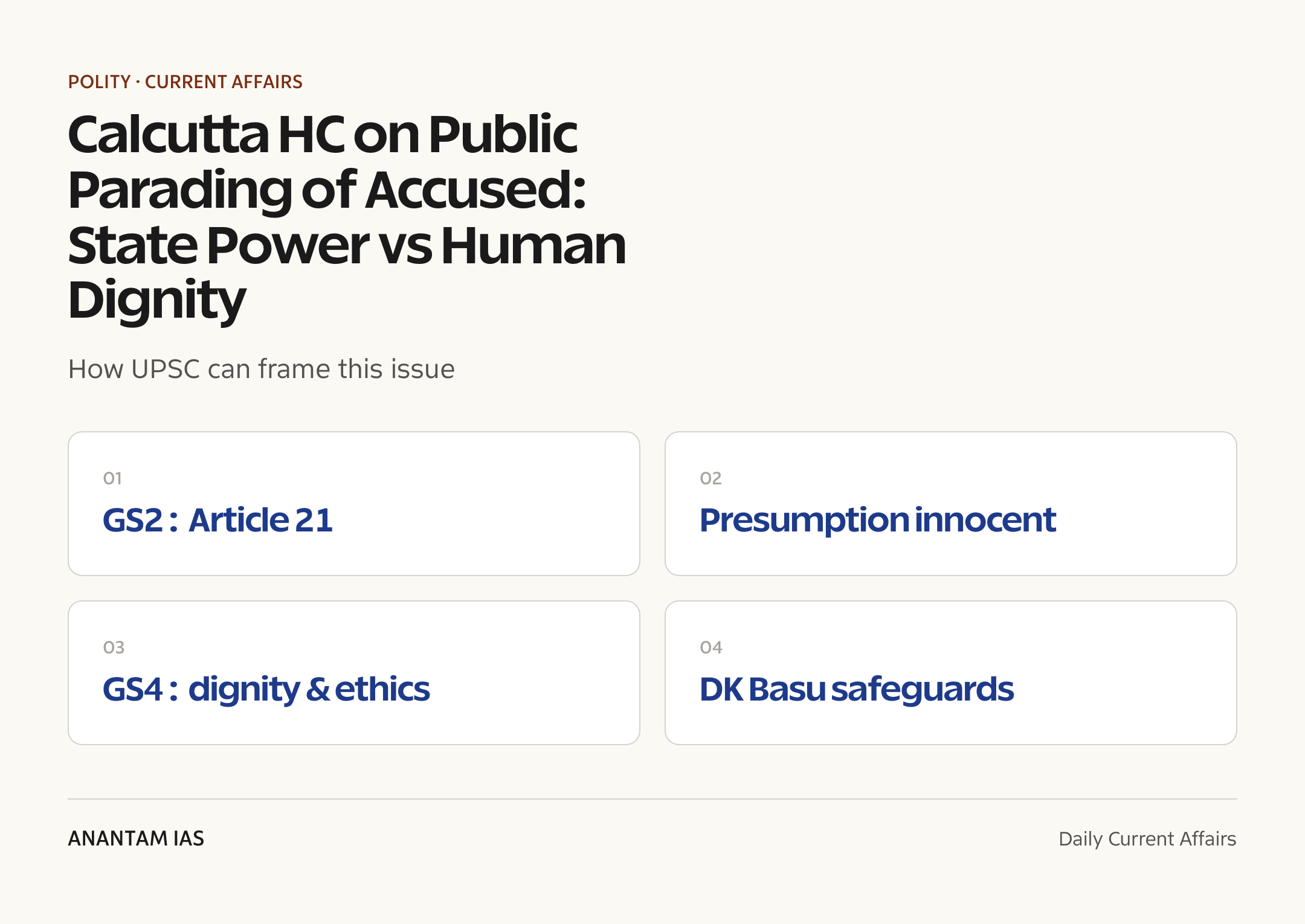
- GS2 Polity and Governance: a live illustration of fundamental rights (Article 21), the presumption of innocence and limits on executive and police power.
- Links the current event to the static core, D.K. Basu, Prem Shankar Shukla and the fair-trial reading of Article 21.
- Prelims angle: rights of the accused, D.K. Basu guidelines, handcuffing jurisprudence, and the role of the NHRC.
- GS4 Ethics: dignity, due process, public-administration restraint, and the contest between rule of law and mob-justice instincts.
What It Means: Polity Lens
The case is about restraint, not leniency. Nothing the Court said weakens the State’s power to arrest, investigate or prosecute. What it questions is the addition of humiliation to that lawful process. The distinction is the whole point of constitutional governance, that legitimate authority is bounded authority. When police convert an arrest into a public spectacle, they substitute social punishment for judicial determination, which is precisely the outcome due process exists to prevent. The bench’s framing, arrest yes, humiliation no, is a compact statement of the proportionality principle that governs every exercise of coercive power.
The harm is to the system, not only the individual. Public shaming of the accused corrodes the presumption of innocence as a working norm. It signals that guilt can be declared on the street before it is proved in court, and it invites the public to treat suspicion as conviction. That is the seedbed of mob justice, where rule of law gives way to a rule of sentiment. For administrators, the lesson is that the State must model the very restraint it expects from citizens. A police force that humiliates suspects teaches society that humiliation is an acceptable response to alleged wrongdoing.
This is where GS2 and GS4 meet. On the law side, the issue maps cleanly onto Article 21, fair trial and the D.K. Basu and Prem Shankar Shukla lineage. On the ethics side, it tests dignity as a non-negotiable value, the duty of public servants to act with objectivity and compassion, and the difference between enforcing the law and exacting revenge. The strongest answers will not treat these as separate. They will show that the constitutional rule and the ethical duty are the same commitment, that the dignity of even an accused person is part of the dignity of the whole justice system.
Process as remedy is itself instructive. By demanding a report rather than issuing a sweeping order at the vacation stage, the Court placed the onus of justification on the State. That is a model of institutional accountability, where the executive must give reasons for a contested practice and a court holds the space open until it does. For aspirants, it is a clean example of how rights are protected not only by dramatic verdicts but by steady judicial insistence that power explain itself.
The viral video changes the calculus. Older debates on custodial dignity assumed harm confined to a cell or a courtroom corridor. Filming and circulating a parading turns a private indignity into a permanent, searchable public record. Even an eventual acquittal cannot fully undo it, because the footage outlives the verdict. That is why dignity-based protections matter more, not less, in a networked age, and why administrators should treat the recording and sharing of an accused person’s humiliation as a distinct harm in its own right, separate from the arrest itself.
Restraint is strength, not weakness. A common public instinct holds that visible, harsh treatment of suspects shows the State is serious about crime. The opposite is closer to the truth. A justice system confident in its own processes does not need to perform punishment in advance, because it trusts that proof and trial will deliver the outcome. The parading impulse is a symptom of low institutional confidence, a temptation to substitute spectacle for the slower work of investigation and conviction. The most useful frame for an answer is this: the test of a constitutional State is not how it treats those it is sure are guilty, but how it treats those who are merely accused, including the ones who turn out to be innocent. Protecting their dignity is what keeps the line between policing and persecution from blurring.
Challenges and Concerns
- Oral remarks at a vacation hearing are not a final, citable judgment, so the binding precedent will depend on what the Court ultimately holds.
- Enforcement is the hard part, since informal parading and viral video can recur faster than any single order can police.
- A populist appetite for visible punishment can pressure both police and politicians toward spectacle over due process.
- Once footage circulates online, takedown and reputational repair are difficult even after an acquittal.
- Existing safeguards like the D.K. Basu guidelines depend on day-to-day compliance and supervision that is uneven across districts.
Prelims Pointers
- Article 21 guarantees the right to life and personal liberty and has been read to include the right to live with dignity.
- The presumption of innocence holds that a person is innocent until proven guilty after a fair trial.
- D.K. Basu v. State of West Bengal (1997) laid down safeguards against custodial torture and arbitrary arrest.
- Prem Shankar Shukla v. Delhi Administration (1980) held that routine handcuffing is unconstitutional and permissible only when justified.
- Indian criminal law contains no provision authorising the public parading or display of an accused person.
- The fair-trial guarantee is treated by the Supreme Court as a facet of Article 21.
- The National Human Rights Commission (NHRC) inquires into custodial abuse and violations of dignity in detention.
- Prakash Singh v. Union of India (2006) is the leading judgment on police reforms and accountability.
- A vacation bench of a High Court hears urgent matters during court vacations.
- Public interest litigation (PIL) allows issues of public concern to be raised before constitutional courts.
- Proportionality requires that a coercive measure be necessary and not excessive relative to its aim.
- Article 14 guarantees equality before law and equal protection of the laws.
Mains Practice Questions
- “The power to arrest is not a license to humiliate.” Examine, with reference to Article 21 and the presumption of innocence, the constitutional limits on police treatment of accused persons. (GS2, 15 marks, 250 words)
- Discuss how D.K. Basu and Prem Shankar Shukla together shape the rights of arrested and detained persons in India. How relevant are these safeguards to the public parading of the accused? (GS2, 15 marks, 250 words)
- Public shaming of an accused person before trial pits the dignity of the individual against popular demands for visible justice. As a district administrator, how would you uphold dignity and due process while maintaining public confidence in the law? (GS4, 20 marks, 250 words)
- “When the State humiliates a suspect, it teaches society that humiliation is justice.” Critically comment on this statement in the context of human dignity, rule of law and the ethics of public administration. (GS4, 10 marks, 150 words)
Way Forward
Clear standing instructions should bar the parading, public display or filming of accused persons, with accountability fixed on supervising officers for breaches.
Training must internalise the D.K. Basu and Prem Shankar Shukla principles so that restraint and dignity become routine practice, not exceptions ordered by a court.
Oversight bodies, from internal police inquiry to the NHRC, should treat public humiliation of the accused as a reportable rights violation with prompt remedial action.
The deeper shift is cultural, replacing the instinct for spectacle with confidence that due process, conducted quietly, is what justice actually looks like.
Frequently Asked Questions
What did the Calcutta High Court say?
A vacation bench of Justice Jay Sengupta and Justice Smita Das De criticised police for parading arrested persons with ropes around their waists. The bench remarked that the State may arrest and prosecute a person but cannot humiliate them, and asked the West Bengal government to file a report within three weeks. Arrest is power, humiliation is not.
Why is public parading unconstitutional?
It has no backing in Indian criminal law and it violates Article 21, which protects the right to live with dignity. It also breaches the presumption of innocence by treating an unconvicted person as guilty. In effect, the State imposes a punishment no court has ordered, which is the opposite of due process.
How does Article 21 protect the accused?
Article 21 guarantees life and personal liberty, and the Supreme Court has read “life” to mean a life with dignity. That protection does not switch off on arrest. An accused person retains the right to be treated with dignity and to a fair trial until guilt is proved, which is why public shaming offends the Constitution.
What are the D.K. Basu guidelines?
In D.K. Basu v. State of West Bengal (1997), the Supreme Court laid down safeguards against custodial abuse, including a memo of arrest, the right to inform a relative, and medical examination. The aim is to protect the dignity and bodily integrity of every detained person. The guidelines remain binding on the police.
What did Prem Shankar Shukla decide?
In Prem Shankar Shukla v. Delhi Administration (1980), the Supreme Court held that routine handcuffing is degrading and unconstitutional, allowed only when clearly justified. Restraining a person before the public without necessity offends Articles 14 and 21. The Calcutta High Court’s concern over restraints used without any escape risk follows the same reasoning.
Why does this matter for ethics?
It sets dignity and due process against the popular appetite for visible punishment. Public servants are expected to enforce the law without becoming instruments of humiliation, and to model the restraint that separates rule of law from mob justice. The case is a clean GS4 study in dignity, objectivity and administrative restraint.
Tell Google you want more of this.
Add Anantam IAS as a preferred sourceOne tap, and this site shows up more often in your own Top Stories, AI Overviews and AI Mode. Remove it any time.