Two science stories worth filing together as study notes sit at opposite ends of the technology spectrum but answer the same examiner question — how does a frontier advance translate into security, sovereignty and farm economics. The first is certified quantum randomness: a quantum computer that does not just produce random numbers but mathematically proves they are genuinely random and were generated freshly, a capability classical machines cannot honestly claim. The second is a herbicide-tolerant mustard line carrying tolerance to imidazolinone (IMI) herbicides, developed in India through mutation breeding rather than genetic modification — a distinction that decides which regulator clears it and how the public receives it. Both are GS3 science-and-technology material, and both reward a candidate who can explain the mechanism in plain prose.
On the quantum side, the landmark demonstration published in Nature on 26 March 2025 by JPMorganChase, Quantinuum, Argonne and Oak Ridge National Laboratories and the University of Texas at Austin ran a certified-randomness-expansion protocol on a 56-qubit trapped-ion machine and certified 71,313 bits of genuine entropy. On the agriculture side, an IMI-tolerant mustard rests on a single point mutation in the ALS enzyme and lands against India’s roughly 16-million-tonne edible-oil import bill of about Rs 1.6 lakh crore. The cross-paper relevance line is that the quantum story feeds GS3 cyber and emerging-tech (and India’s National Quantum Mission), while the mustard story feeds GS3 agri-biotech, biosafety and oilseed self-reliance — two durable syllabus anchors from a single day’s roundup.
An examiner will not test the bit count or the enzyme name in isolation — they will test whether you can separate certified randomness from ordinary random numbers, and non-GM mutation breeding from GM transgenics, and tie each to a policy debate.
Quick Facts
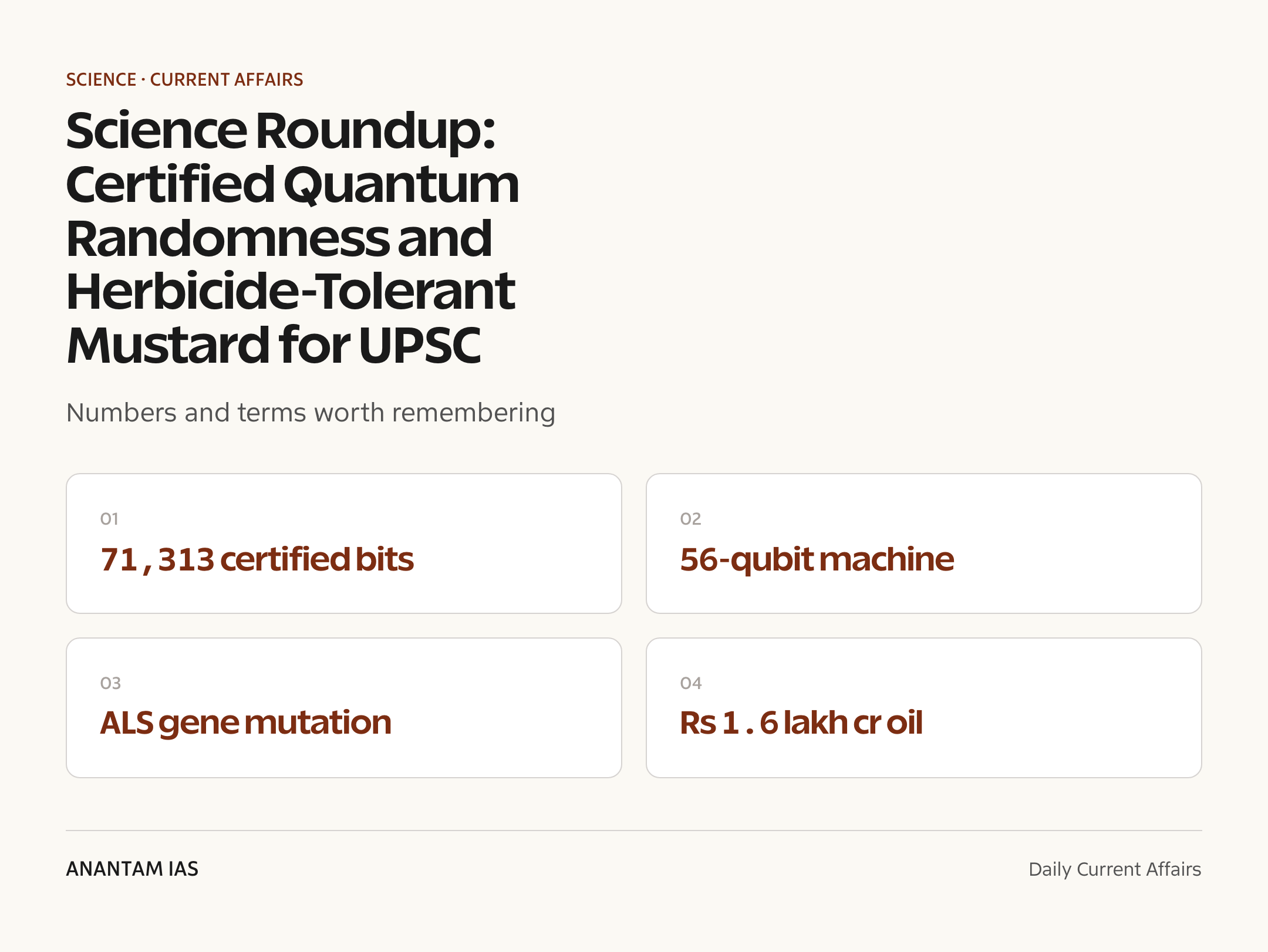
- Certified quantum randomness was demonstrated by JPMorganChase, Quantinuum, Argonne, Oak Ridge and UT Austin, published in Nature on 26 March 2025.
- The experiment used a 56-qubit Quantinuum System Model H2 trapped-ion quantum computer running a certified-randomness-expansion protocol via Random Circuit Sampling.
- Classical supercomputers delivering about 1.1 ExaFLOPS certified 71,313 bits of genuine entropy after verifying the output could not be classically pre-computed.
- Certified randomness underpins cryptographic keys, public randomness beacons, lotteries and audits where the numbers must be provably unpredictable and tamper-free.
- The herbicide-tolerant mustard line tolerates imidazolinone (IMI) herbicides through a single point mutation in the acetolactate synthase (ALS/AHAS) enzyme.
- The IMI trait is created by mutation breeding, a non-GM method, distinct from GM mustard hybrid DMH-11 cleared by GEAC for environmental release in 2022.
- IMI tolerance lets a farmer spray a broad-spectrum herbicide over the crop, controlling weeds including the parasitic Orobanche while sparing the mustard.
- India imported roughly 16 million tonnes of edible oil worth about Rs 1.6 lakh crore in 2024-25, making mustard a strategic oilseed for import substitution.
- Sources: The Hindu, Science and Nature / JPMorganChase Technology.
What Just Happened
The certified randomness milestone is the first time a quantum computer has been used to generate randomness that is then mathematically certified as genuine. Cryptographers at JPMorganChase designed a certified-randomness-expansion protocol, which is a procedure that takes a short seed of random input and returns a far larger string of output that is provably random. They ran it on Quantinuum’s 56-qubit System Model H2, a trapped-ion machine, using Random Circuit Sampling — sending the quantum computer a stream of randomly chosen circuits and demanding answers fast enough that no classical computer could have secretly pre-computed them. The US Department of Energy’s leadership-scale supercomputers, delivering about 1.1 ExaFLOPS combined, then verified the results and certified 71,313 bits of true entropy. The point is the certificate, not the speed: a sceptic can check the proof and be sure the numbers were fresh and unpredictable.
The logic of the protocol is worth spelling out because it is what makes the result trustworthy. The verifier picks circuits at random and times how quickly the quantum machine returns plausible answers; because faithfully simulating those circuits would take a classical supercomputer far longer than the machine’s response window, a correct and fast answer can only have come from genuine quantum behaviour. That speed gap is itself a form of proof. The work was run between May 2023 and May 2024, accessed remotely over the internet, and published in Nature on 26 March 2025 — a detail that matters because it shows the certificate survives even when the user does not physically control the quantum hardware. The headline is not a faster dice-roll; it is the first demonstration that a quantum computer can hand an outsider numbers they can independently confirm were impossible to fake.
A related strand of work, from a separate ETH Zurich team, certified randomness using a Bell test on entangled particles held about 30 metres apart, recording a Bell-violation score of 2.271 against the classical ceiling of 2 and distilling roughly 45 million certified-random bits. That approach is device-independent, meaning the certificate holds even if you do not trust the hardware, but its throughput is modest. Read together, both efforts show the same idea maturing — randomness whose authenticity can be proven to an outside party rather than merely asserted by the device that made it.
On the same science page, the agriculture development concerns a mustard line carrying tolerance to imidazolinone herbicides. The crop carries a single altered base in the gene coding for acetolactate synthase, the enzyme that imidazolinones normally block to starve the plant of branched-chain amino acids. The mutation reshapes the enzyme so the herbicide can no longer bind it, letting the mustard survive a spray that kills surrounding weeds. Crucially, breeders created this not by inserting foreign DNA but by selecting a naturally arising mutation — mutation breeding — so the line is not a genetically modified organism in the regulatory sense. The practical promise is cleaner weed control, including against the parasitic broomrape (Orobanche) that drains mustard yields, with far less hand-weeding during the crop’s narrow critical window.
The agronomy behind that promise explains why farmers care. Mustard is a slow starter, and weeds that emerge alongside it in the first few weeks rob the young crop of light, moisture and nutrients during the window when yield is decided. Conventional selective herbicides are limited, hand-weeding is expensive and increasingly hard to staff, and the soil-borne parasite Orobanche attaches directly to mustard roots and cannot be pulled out without damaging the crop. A line that tolerates a broad-spectrum imidazolinone lets a grower clear that whole spectrum of weeds with a single timed spray. The same enzyme target, ALS or AHAS, has already been used in India to breed imidazolinone-tolerant rice through identical mutation-breeding routes, so the science is not speculative — it is an established non-GM trait now being extended to the country’s most important oilseed.
Background and Context
Randomness is the silent foundation of digital security. Every encryption key, secure session, digital signature and lottery draw depends on numbers an attacker cannot guess. Classical computers cannot produce true randomness on their own — they run deterministic algorithms and so generate pseudo-random numbers, which are predictable to anyone who learns the seed. Hardware random generators tap physical noise but cannot prove to an outside auditor that their output was genuinely unpredictable and not quietly biased or backdoored. Certified randomness closes that trust gap: it pairs a quantum source, whose unpredictability follows from the laws of physics, with a mathematical certificate that a third party can independently verify. This is why India’s National Quantum Mission, approved in 2023 with an outlay of about Rs 6,000 crore, lists quantum communication and secure cryptography alongside quantum computing and sensing as priority verticals.
The agricultural anchor is the long-running debate over how India should raise oilseed output and control weeds. Weeds compete with crops for light, water and nutrients and can cut mustard yields sharply; manual weeding is costly and labour-scarce, while ordinary herbicides cannot be sprayed over a standing crop because they kill the crop too. Herbicide-tolerant crops solve this by surviving a specific herbicide. There are two routes to that trait, and the distinction is the heart of the exam answer. One is genetic modification, inserting a gene — often from a bacterium — that confers tolerance, as in transgenic crops. The other is mutation breeding, in which breeders induce or select small changes in the plant’s own DNA, with no foreign gene added; such lines are treated as non-GM and face a lighter regulatory path.
India’s flagship GM oilseed, mustard hybrid DMH-11, sharpens the contrast. Developed at Delhi University using the barnase-barstar-bar gene system from a soil bacterium to enable hybridisation, DMH-11 received environmental-release clearance from the Genetic Engineering Appraisal Committee (GEAC) in 2022, after which the matter went to the Supreme Court amid public and activist concern over the bar gene’s herbicide-tolerance implications. GEAC, under the Ministry of Environment, Forest and Climate Change, is the apex body that appraises and approves GMOs in India under the 1989 Rules of the Environment (Protection) Act. An IMI-tolerant line made by mutation breeding sidesteps that GM-appraisal pathway precisely because no foreign DNA is introduced — which is why the GM-versus-non-GM framing matters so much for both regulation and acceptance.
Both stories also sit inside larger self-reliance arguments. Quantum-secure randomness speaks to sovereign control over cryptography at a time when a future fault-tolerant quantum computer could break today’s public-key encryption, the reason the world is migrating to post-quantum algorithms. Herbicide-tolerant mustard speaks to the edible-oil import dependence that sees India buy well over half its cooking oil from abroad. Neither is a magic fix — certified randomness does not by itself defend against quantum attacks, and a single-herbicide trait can breed resistant weeds — but both are exactly the kind of frontier-meets-policy material UPSC likes to test.
Key Concepts in the Roundup
- Certified randomness: randomness that is mathematically proven genuine and fresh, verifiable by an outside party, unlike pseudo-random or unverifiable hardware output.
- Randomness-expansion protocol: takes a short random seed and returns a much larger provably-random string, run here via Random Circuit Sampling on a quantum computer.
- Trapped-ion qubit: the 56-qubit System Model H2 holds quantum bits as charged atoms in electromagnetic traps, valued for high fidelity and all-to-all connectivity.
- IMI tolerance via ALS mutation: a single change in the acetolactate synthase enzyme stops the imidazolinone herbicide from binding, so the crop survives the spray.
- Mutation breeding (non-GM): selecting or inducing changes in the plant’s own DNA with no foreign gene added, so the line is not treated as a GMO by regulators.
- GM mustard (DMH-11) contrast: a transgenic hybrid using the barnase-barstar-bar system, GEAC-cleared in 2022, faces the full GMO appraisal and litigation that the non-GM route avoids.
Why It Matters for UPSC
This is a high-yield topic because it ties a current development to durable syllabus themes.
- GS3 science and technology: certified randomness is a clean case study on quantum computing’s first real-world utility for cryptography, mapped to the National Quantum Mission.
- GS3 agriculture and biotech: the IMI-mustard story tests the GM-versus-non-GM mutation-breeding distinction, biosafety regulation and oilseed import substitution in one case.
- Prelims angle: trapped-ion qubits, ALS/AHAS enzyme, imidazolinone herbicides, GEAC’s mandate and the National Quantum Mission outlay are all crisp, testable facts.
- Essay and ethics angle: both raise the frontier-technology-versus-precaution tension — verifiable trust in cryptography, and weed-resistance and acceptance risks in herbicide-tolerant crops.
What It Means: Science Lens
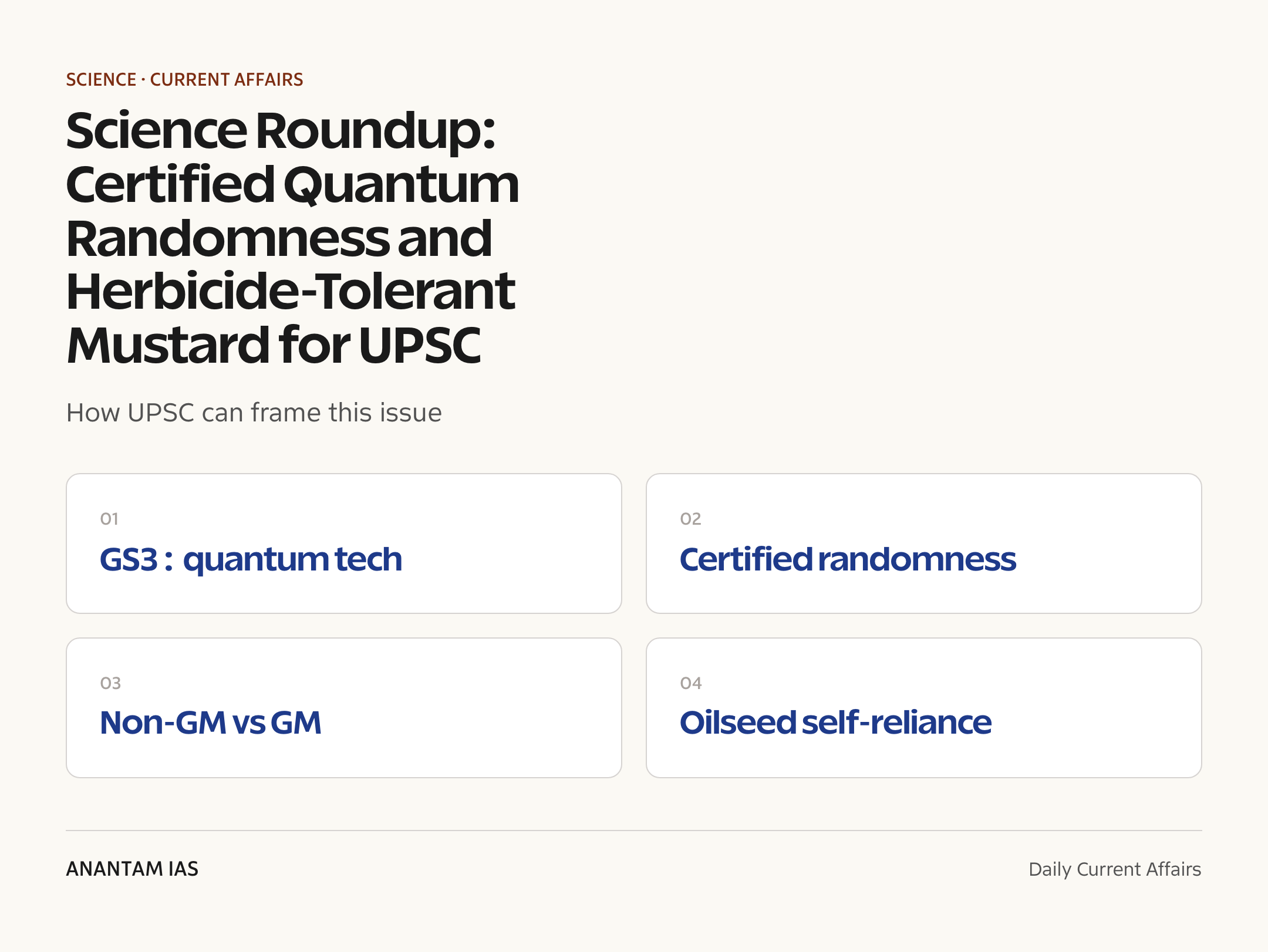
Certified randomness is the first quantum application where the proof matters more than the speed. Most quantum-advantage demonstrations chase raw computation. This one is different: a commercial random-number generator already spits out a billion bits a second, so the quantum machine’s modest throughput is beside the point. What it adds is a certificate — an outside auditor can verify the numbers were generated freshly and could not have been pre-computed or rigged. For high-stakes systems such as cryptographic key generation, public randomness beacons, financial audits and tamper-evident lotteries, that verifiable trust is the whole game. It is also a useful corrective to hype: this milestone does not protect anyone from a future quantum attack on encryption, which is a separate problem solved by migrating to post-quantum algorithms. The exam-grade insight is to distinguish quantum-enabled trust from quantum-enabled code-breaking.
The mustard story turns on a regulatory and biological fork that candidates routinely blur. Because the IMI trait comes from a point mutation in the plant’s own ALS gene rather than an inserted foreign gene, it is non-GM and avoids the GEAC appraisal, environmental-release litigation and labelling debates that have stalled transgenic crops like DMH-11. That lighter path is the trait’s biggest practical advantage — easier registration and wider public acceptance — but it does not erase the agronomic risk. Leaning on a single herbicide mode of action applies strong directional selection on weeds: the few that survive pass on resistance, and within a few seasons the spray can fail. The same trait that lets a farmer skip hand-weeding can, if used carelessly, breed an Orobanche or grass population that no longer responds to it.
Read against the edible-oil import bill, the policy case writes itself but needs a caveat. India spends roughly Rs 1.6 lakh crore importing about 16 million tonnes of edible oil a year, and mustard is the country’s most strategically important oilseed for closing that gap. A trait that cuts weeding costs and protects yield helps farm economics and import substitution at once. But the durable lesson — the one an examiner rewards — is that herbicide tolerance is a weed-management tool, not a weed-management strategy. It works only inside integrated weed management: rotating crops, alternating herbicide modes of action, and retaining mechanical and manual control. Stewardship, not the gene, decides whether the benefit lasts. Both halves of this roundup carry the same moral: a frontier technology delivers value only when paired with the discipline — verifiable proofs, or resistance stewardship — that keeps it honest.
Challenges and Concerns
- Certified randomness throughput is low compared with commercial generators, so its near-term role is high-assurance applications, not mass key generation.
- The randomness milestone does not defend against future quantum attacks on encryption; migration to post-quantum cryptography remains a separate, urgent task.
- Quantum hardware access for such protocols is concentrated in a few firms and labs, raising sovereignty and dependence concerns for countries without their own machines.
- Single-mode herbicide tolerance applies strong selection pressure and can breed resistant weeds within a few seasons if not paired with integrated weed management.
- Herbicide-tolerant traits can encourage heavier herbicide use and gene flow to weedy relatives, requiring stewardship even when the line is non-GM and lightly regulated.
Prelims Pointers
- Certified quantum randomness was demonstrated by JPMorganChase with Quantinuum, Argonne, Oak Ridge and UT Austin, published in Nature in March 2025.
- The experiment used a 56-qubit Quantinuum System Model H2 trapped-ion quantum computer.
- Random Circuit Sampling was used to run a certified-randomness-expansion protocol that outputs more randomness than it takes in.
- Classical supercomputers at about 1.1 ExaFLOPS certified 71,313 bits of genuine entropy.
- Trapped-ion qubits store quantum information in charged atoms held by electromagnetic fields, valued for high fidelity and all-to-all connectivity.
- India’s National Quantum Mission, approved in 2023, has an outlay of about Rs 6,000 crore and covers computing, communication, sensing and materials.
- Imidazolinone (IMI) herbicides act by inhibiting the acetolactate synthase (ALS/AHAS) enzyme in branched-chain amino acid biosynthesis.
- IMI tolerance is conferred by a single point mutation in the ALS gene, developed through non-GM mutation breeding.
- Mutation breeding adds no foreign gene, so the resulting line is not classified as a genetically modified organism.
- GM mustard hybrid DMH-11 uses the barnase-barstar-bar gene system and was cleared for environmental release by GEAC in 2022.
- GEAC, under the Ministry of Environment, Forest and Climate Change, is the apex body for approving GMOs under the 1989 Rules of the Environment (Protection) Act.
- India imported roughly 16 million tonnes of edible oil worth about Rs 1.6 lakh crore in 2024-25, with mustard a key oilseed for import substitution.
Mains Practice Questions
- Certified quantum randomness is being called the first real-world utility of quantum computing. Explain what certified randomness means and assess its significance for cryptography and India’s National Quantum Mission. (GS3, 15 marks)
- Distinguish between genetically modified crops and crops developed through mutation breeding. In this light, examine the regulatory and acceptance implications of herbicide-tolerant mustard in India. (GS3, 15 marks)
- Herbicide-tolerant crops can lower weeding costs yet accelerate weed resistance. Critically examine, with reference to integrated weed management and India’s edible-oil import dependence. (GS3, 10 marks)
- A future fault-tolerant quantum computer could break current public-key encryption. Discuss the threat and the steps India should take towards quantum-secure communication. (GS3, 10 marks)
Way Forward
On quantum security, India should pair National Quantum Mission investment in hardware and quantum communication with a clear roadmap to post-quantum cryptography, so certified randomness and quantum-safe encryption advance together.
On herbicide-tolerant mustard, any release should be embedded in mandatory integrated weed-management protocols — rotation, alternating herbicide modes and mechanical control — so the trait’s life is not cut short by resistant weeds.
Both technologies need transparent, science-led regulation and public communication: a verifiable certificate builds trust in randomness, and a clear non-GM versus GM distinction builds trust in agri-biotech.
Frequently Asked Questions
What is certified quantum randomness?
It is randomness produced by a quantum computer and then mathematically proven to be genuine and freshly generated, so an outside party can verify it was not pre-computed or rigged. Ordinary computers only make predictable pseudo-random numbers, and hardware generators cannot prove their output is honest. The certificate is what makes quantum randomness trustworthy.
Why does certified randomness matter for security?
Encryption keys, digital signatures, audits and lotteries all depend on numbers an attacker cannot guess or influence. Certified randomness gives a verifiable guarantee that the numbers are truly unpredictable and tamper-free, closing a trust gap that classical and hardware generators leave open. For high-stakes systems, provable randomness is worth far more than fast randomness.
How is herbicide-tolerant mustard different from GM mustard?
Herbicide-tolerant mustard here comes from mutation breeding — a small change in the plant’s own ALS gene, with no foreign DNA added — so it is non-GM. GM mustard DMH-11 inserts bacterial genes and is a transgenic crop appraised by GEAC. The difference decides the regulatory path and shapes public acceptance of the two lines.
What does imidazolinone tolerance let a farmer do?
It lets a farmer spray the broad-spectrum imidazolinone herbicide over a standing mustard crop. The herbicide kills surrounding weeds, including the parasitic Orobanche, but cannot harm the crop because a mutated ALS enzyme no longer binds it. This cuts costly hand-weeding during the crop’s narrow critical window and protects yield.
What is the risk in herbicide-tolerant crops?
Relying on one herbicide applies strong selection pressure on weeds: the few that survive pass on resistance, and within a few seasons the spray can fail. The trait also can encourage heavier herbicide use and gene flow to weedy relatives. It works only inside integrated weed management, so stewardship, not the gene, decides whether the benefit lasts.
Does certified randomness protect against quantum attacks?
No. Certified randomness proves numbers are genuinely random; it does not defend today’s encryption against a future fault-tolerant quantum computer. That threat is met separately by moving to post-quantum cryptography. The two are different problems, and conflating them is a common mistake worth avoiding in an answer.
Tell Google you want more of this.
Add Anantam IAS as a preferred sourceOne tap, and this site shows up more often in your own Top Stories, AI Overviews and AI Mode. Remove it any time.