On 27 May 2026 the Supreme Court of India upheld the legality of the Election Commission of India’s Special Intensive Revision (SIR) of electoral rolls, dismissing a batch of petitions that had challenged the exercise after it began in Bihar in mid-2025 and spread to other States. A bench led by Chief Justice Surya Kant, with Justices Joymalya Bagchi and Vipul M. Pancholi, held that the SIR fell within the Commission’s mandate under Article 324 of the Constitution, read with the Representation of the People Act and the Registration of Electors Rules, 1960. For a polity paper this is a clean GS2 set-piece: it pulls together the Election Commission, the right to vote, the machinery for preparing electoral rolls, and the limits of judicial review of a constitutional body, all in one judgment.
The Court’s framing was that an election does not begin on polling day. It rests, the bench observed, on the accuracy and credibility of the electoral roll, and a roll that had not been intensively revised for roughly four decades, across a period of heavy migration and urbanisation, had accumulated duplications and errors the Commission was entitled to correct. The cross-paper relevance is that The Hindu’s 9 June analysis and the constitutional-law commentary at Verfassungsblog read the same judgment in opposite registers: one as a reaffirmation of the ECI’s autonomy, the other as a caution about power exercised with thin oversight. The exam-useful skill is holding both readings at once without taking a side.
An examiner will read this as a test of whether you can separate the right to be enrolled from the right to vote, and connect a topical verdict to the static framework of Article 324, Article 326 and the Representation of the People Act, 1950.
Quick Facts
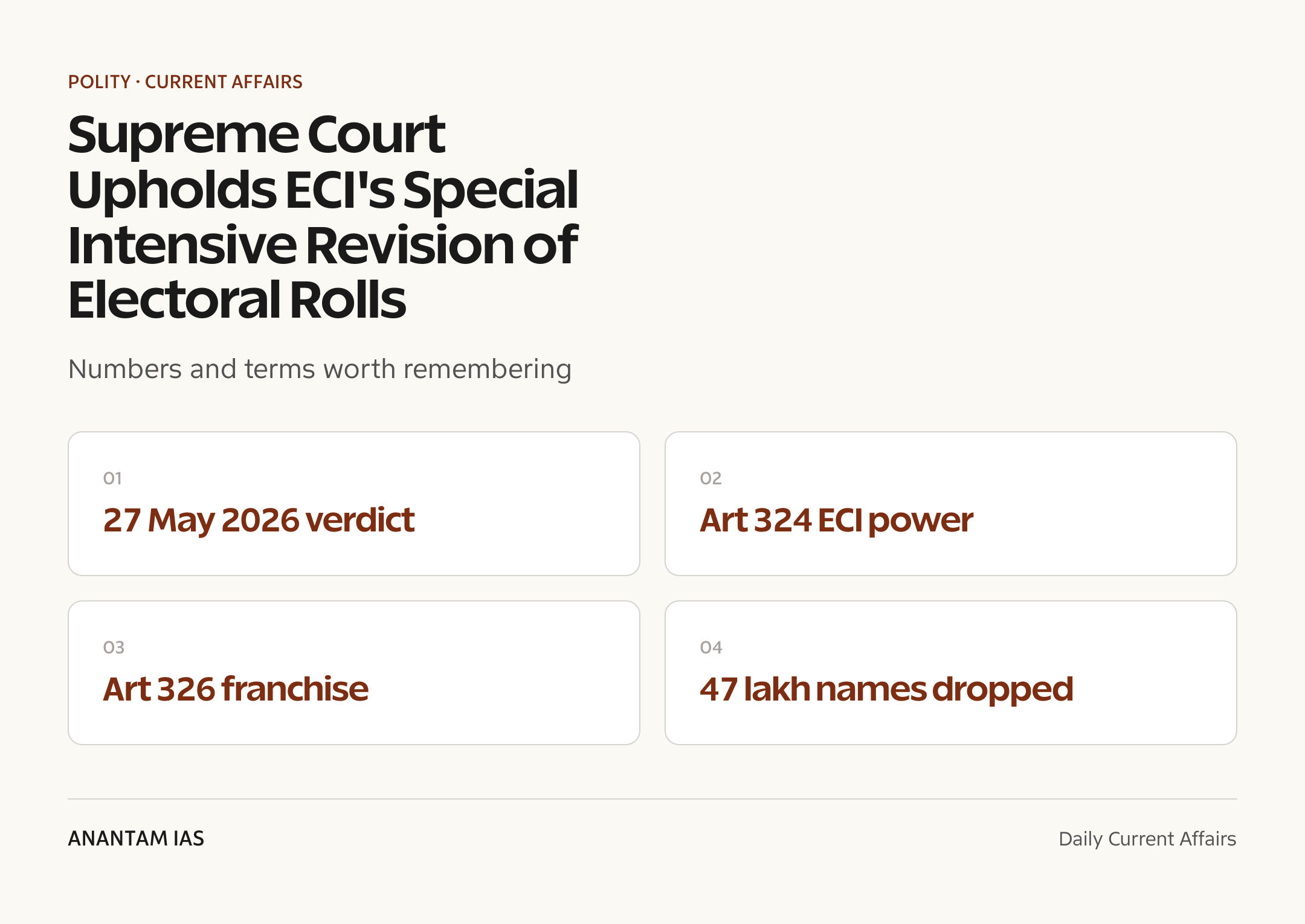
- Judgment delivered 27 May 2026 by the Supreme Court of India.
- Bench: CJI Surya Kant with Justices Joymalya Bagchi and Vipul M. Pancholi.
- SIR upheld as valid under Article 324 of the Constitution.
- Statutory anchor: Representation of the People Act, 1950 and Registration of Electors Rules, 1960.
- SIR began in Bihar in mid-2025; the first phase deleted around 47 lakh names from the draft roll.
- Article 326 confines the franchise to citizens aged 18 and above.
- Court read in safeguards: show-cause notice, claims and objections, and a right of appeal before deletion.
- Aadhaar and the voter ID card (EPIC) were held not to be conclusive proof of citizenship by themselves.
- Sources: The Hindu (UPSC analysis, 9 June 2026) and Verfassungsblog.
What Just Happened
The Special Intensive Revision is a door-to-door re-verification of the electoral roll in which the Commission distributes pre-filled enumeration forms, asks existing voters to confirm or update their entries, and in contested cases asks them to establish a link to an earlier roll. The first round ran in Bihar from mid-2025, where roughly 47 lakh names were dropped from the draft roll on grounds of death, migration, duplication or non-response, and the model was then extended to further States. Petitioners — political parties, civil-society groups and affected voters — argued that the timing, scale and documentary demands of the exercise risked disenfranchising genuine electors, especially the poor, the migrant and the undocumented, and that the Commission had strayed into deciding citizenship, a subject that belongs to the Union government under the Citizenship Act, 1955.
The Court rejected the challenge in full. It held that intensive revision is a recognised statutory tool, distinct from the lighter annual summary revision, and that the Commission’s decision to use it after four decades bore a reasonable nexus to the legitimate object of an accurate roll. On the most sensitive question, the bench accepted that verifying eligibility necessarily involves confirming that an applicant is a citizen, because Article 326 limits the vote to citizens; it framed this as the Commission examining eligibility for enrolment rather than conferring or cancelling citizenship as such. The judgment also recorded the Commission’s position that documents like Aadhaar and the EPIC card establish identity but are not, on their own, conclusive proof of citizenship.
Crucially, the Court did not give the Commission a blank cheque. It read the exercise as constitutional because, and to the extent that, it carried procedural protection: a show-cause notice before any deletion, a structured window for claims and objections, an opportunity to be heard, and an appeal to the designated electoral authority. The bench described the measures as not manifestly excessive and as accompanied by sufficient safeguards to prevent arbitrary exclusion. In other words, the validity of the SIR was tied to due process being followed, not merely to the Commission’s good intentions.
The petitioners had also pressed a statutory-design argument worth knowing for the answer. They contended that an intensive revision is meant for periods well before an election, because complete re-enumeration takes time, and that running it at scale close to polls inverts the scheme of the law and squeezes the window in which a wrongly deleted voter can seek restoration. They argued, further, that asking ordinary voters to produce ancestral-linkage documents effectively shifts the burden of proof onto the elector, when the working presumption for someone already on the roll should be inclusion unless there is specific reason to doubt it. The Court did not accept that these features rendered the SIR illegal; it treated the timing and documentary load as matters of administrative judgment that remained within bounds so long as the safeguards held. That is why the judgment can be read as both a vindication of the Commission’s power and an implicit warning that the same power, exercised without notice, hearing and appeal, would not survive the next challenge.
Background and Context
The body at the centre of the case is the Election Commission of India, created by Article 324, which vests in it the superintendence, direction and control of the preparation of electoral rolls and the conduct of elections to Parliament and the State legislatures. This is the constitutional source of the Commission’s authority to revise rolls, and it is deliberately broad: the Court has long read Article 324 as a reservoir of power to fill gaps where the statute is silent, provided the Commission acts fairly. The actual mechanics of who gets enrolled, though, sit in ordinary law, and the two main statutes must not be confused. The Representation of the People Act, 1950 deals with the allocation of seats, the delimitation machinery and, most relevant here, the preparation and revision of electoral rolls. The Representation of the People Act, 1951 deals with the actual conduct of elections, qualifications and disqualifications of candidates, and election disputes. Roll revision is a 1950-Act subject, operationalised through the Registration of Electors Rules, 1960.
Within roll-making, the syllabus distinction the examiner wants is summary revision versus intensive revision. A summary revision updates the existing roll by inviting additions, deletions and corrections, typically without a house-to-house enumeration; it is the routine, lower-cost mode used before most elections. An intensive revision is a fresh, ground-up enumeration in which officials visit households, re-verify every entry and effectively rebuild the roll, which is far more thorough but far more disruptive. The SIR is the intensive variety, applied at scale, which is why it became contentious: a deep re-verification carries a higher risk of wrongly dropping genuine voters even as it removes ghost and duplicate entries.
The deepest fault line is the citizenship-versus-eligibility distinction. Under Article 326 the franchise rests on universal adult suffrage but only for citizens aged 18 and above who are not otherwise disqualified, so a non-citizen has no right to be on the roll. Citizenship itself, however, is governed by the Citizenship Act, 1955 and administered by the Union government, not the Commission. The unresolved tension the petitioners pressed is that when the Commission asks a voter to prove ancestral linkage to an old roll, it can look, in practice, like an adjudication of citizenship by an authority designed to run elections. The Court’s answer was that confirming eligibility for the vote is part of preparing an accurate roll and does not amount to a determination of citizenship status for all purposes — a line that critics argue is finer in theory than in administration.
Two further static anchors complete the picture. First, the Commission’s broad Article 324 powers are not unreviewable: the courts have consistently held that the ECI must act fairly and within the law, and that its actions are open to judicial review on grounds of mala fides, arbitrariness or breach of natural justice — which is exactly the lens through which the SIR was tested. The Commission’s autonomy is structural too, since the Chief Election Commissioner can be removed only by the same process as a Supreme Court judge, insulating the office from executive pressure. Second, Article 325 supplies the equality backstop for the whole exercise: there is to be one general electoral roll for every constituency, and no person may be excluded on grounds of religion, race, caste or sex. Any revision, however intensive, has to respect that floor, which is why the fear of selective or community-specific deletions, rather than the idea of revision itself, was the heart of the petitioners’ case.
What the Court Actually Held
- Power affirmed: The SIR is valid under Article 324 read with the Representation of the People Act and the 1960 Rules.
- Roll accuracy as the object: A four-decade gap since the last intensive revision justified a thorough re-verification.
- Eligibility, not status: Verifying that an enrollee is a citizen under Article 326 is part of roll preparation, not a citizenship adjudication.
- Documents not conclusive: Aadhaar and the EPIC card prove identity but are not, alone, conclusive proof of citizenship.
- Safeguards read in: Validity is conditioned on show-cause notice, claims and objections, hearing and appeal before deletion.
- Proportionality test: The measures were held not manifestly excessive and accompanied by sufficient safeguards against arbitrary exclusion.
Why It Matters for UPSC
This is a high-yield topic because it ties a current development to durable syllabus themes.
- GS2 polity: a live application of Article 324 and the limits of the ECI’s powers, and of judicial review of a constitutional body.
- Links the current verdict to the static framework — Articles 324, 325, 326 and the Representation of the People Acts of 1950 and 1951.
- Prelims angle: the 1950 Act handles rolls, the 1951 Act handles conduct of elections; summary vs intensive revision is a classic distractor.
- Essay and ethics angle: balancing electoral integrity against the risk of disenfranchisement, and institutional autonomy against accountability.
What It Means: Polity Lens
The judgment is less a green light than a conditional permission. Read closely, the Court did not hold that the Commission can do whatever it likes with the roll. It held that this exercise survived because it was wrapped in due process — notice, an opportunity to be heard, claims and objections, and appeal. Strip those away and the same exercise would fail the proportionality test the bench applied. For an answer, the sharp formulation is that the SIR’s legality is procedural before it is substantive: the power to revise is settled, the manner of revising is where the constitutional action lies.
The harder structural question is institutional. The Commission sits at the intersection of two functions that pull in different directions — keeping the roll clean by removing ineligible entries, and keeping the roll inclusive so no eligible citizen is wrongly dropped. An intensive revision sharpens the first and stresses the second. The citizenship-versus-eligibility line is where this bites: the Constitution makes citizenship a precondition for the vote, yet hands the determination of citizenship to a different arm of the State. When a poll body asks for proof that resembles citizenship documentation, the boundary between verifying eligibility and adjudicating status becomes a question of administrative design, not just doctrine. The Court’s reasoning holds the line; whether field practice does is an empirical matter that future litigation will test.
There is also a federal and trust dimension. Electoral rolls are the shared foundation on which every party contests, so a large-scale revision close to elections inevitably reads through a political lens, whatever its administrative merit. The durable lesson for the exam is that the credibility of the outcome depends as much on perceived fairness and transparency of process as on the legality of the power. The verdict strengthens the Commission’s constitutional hand while making clear that the hand is only as strong as the safeguards it honours.
It is worth noting how the judgment positions judicial review itself. The Court did not substitute its own view of how the roll should have been revised; it asked the narrower question of whether the Commission had stayed within its powers and observed due process, and answered yes. That is the deferential posture courts typically adopt towards expert constitutional bodies — reviewing the legality and fairness of a decision rather than its wisdom. For an answer the useful framing is that the SIR verdict reinforces a settled division of labour: the Commission designs and runs the revision, the elector is owed notice and a hearing, and the Court polices the boundary between the two. The constitutional machinery works only when each part plays its assigned role, and the durable takeaway is that an electoral roll is not just an administrative list but the register of who counts as a member of the political community on polling day.
Challenges and Concerns
- Burden of proof can fall hardest on the poor, migrants and the undocumented, who are least able to produce legacy or ancestral-linkage records.
- The line between examining eligibility and adjudicating citizenship is thin in practice, raising overlap with the Union government’s role under the Citizenship Act, 1955.
- Large deletions just before elections can erode trust even where each deletion is individually lawful.
- Effective safeguards depend on field-level capacity — whether every notice is genuinely served and every appeal genuinely heard.
- Reliance on a decades-old base roll for linkage can disadvantage families that have moved, lost documents or were never well documented.
Prelims Pointers
- Article 324 vests superintendence, direction and control of elections and roll preparation in the Election Commission of India.
- Article 326 provides for elections on the basis of universal adult suffrage for citizens aged 18 and above.
- Article 325 mandates one general electoral roll per constituency and bars exclusion on grounds of religion, race, caste or sex.
- Article 327 empowers Parliament to make laws on elections, including the preparation of electoral rolls.
- The Representation of the People Act, 1950 governs the preparation and revision of electoral rolls.
- The Representation of the People Act, 1951 governs the conduct of elections and election disputes.
- The Registration of Electors Rules, 1960 operationalise enrolment and roll revision.
- Summary revision updates the roll without house-to-house enumeration; intensive revision rebuilds it through field enumeration.
- Citizenship is governed by the Citizenship Act, 1955 and administered by the Union government, not the Election Commission.
- The SIR verdict was delivered on 27 May 2026 by a bench led by CJI Surya Kant.
- The voting age was lowered from 21 to 18 by the 61st Constitutional Amendment Act, 1988.
- Aadhaar and the EPIC (voter ID) card establish identity but were held not to be conclusive proof of citizenship by themselves.
Mains Practice Questions
- The Special Intensive Revision verdict ties the legality of electoral-roll revision to procedural safeguards rather than to the power itself. Critically examine, with reference to Article 324 and the right to vote under Article 326. (GS2, 15 marks)
- Distinguish between summary and intensive revision of electoral rolls and discuss the conditions under which an intensive revision is justified. (GS2, 10 marks)
- The Constitution makes citizenship a precondition for the franchise but assigns its determination to a different authority. Discuss the tension this creates for the Election Commission in preparing electoral rolls. (GS2, 15 marks)
- Evaluate the scope and limits of judicial review of the Election Commission of India in light of recent decisions on electoral-roll revision. (GS2, 10 marks)
Way Forward
The operative takeaway is that an accurate roll and an inclusive roll are not rivals but joint objectives, and the safeguards the Court emphasised — notice, hearing, claims and objections, and appeal — are the mechanism that reconciles them.
Strengthening that mechanism means well-publicised timelines, accessible appeal channels, special facilitation for migrants and the undocumented, and transparent, auditable records of every deletion, so that the credibility of the exercise rests on demonstrable fairness and not on assurance alone.
Frequently Asked Questions
What did the Supreme Court decide on the SIR?
On 27 May 2026 the Court upheld the Election Commission’s Special Intensive Revision of electoral rolls as valid under Article 324 of the Constitution, read with the Representation of the People Act and the 1960 Rules. It dismissed the petitions but conditioned validity on procedural safeguards being followed before any voter is deleted.
What is the difference between summary and intensive revision?
A summary revision updates the existing roll by inviting additions, deletions and corrections, usually without house-to-house visits. An intensive revision is a fresh, ground-up enumeration in which officials visit homes and re-verify every entry. The SIR is the intensive type, which is more thorough but carries a higher risk of dropping genuine voters.
Can the Election Commission decide citizenship?
The Court held that verifying whether an enrollee is a citizen is part of preparing an accurate roll, because Article 326 limits the vote to citizens. But citizenship itself is governed by the Citizenship Act, 1955 and administered by the Union government. The Commission examines eligibility for enrolment; it does not confer or cancel citizenship.
Which law governs the preparation of electoral rolls?
The Representation of the People Act, 1950 governs the preparation and revision of electoral rolls, operationalised through the Registration of Electors Rules, 1960. The Representation of the People Act, 1951 is the separate statute that governs the conduct of elections and election disputes. Mixing up the two Acts is a common error.
What safeguards did the Court insist on?
The Court read the SIR as constitutional because it carried procedural protection: a show-cause notice before deletion, a structured window for claims and objections, an opportunity to be heard, and a right of appeal to the designated electoral authority. The validity of the exercise was tied to these safeguards being honoured in practice.
Are Aadhaar and the voter ID enough to stay on the roll?
The Court recorded the Commission’s position that Aadhaar and the EPIC voter ID card establish identity but are not, on their own, conclusive proof of citizenship. In contested cases the exercise asked voters to establish a link to an earlier roll, which is why documentation became the most disputed part of the SIR.
Tell Google you want more of this.
Add Anantam IAS as a preferred sourceOne tap, and this site shows up more often in your own Top Stories, AI Overviews and AI Mode. Remove it any time.