Why in News?
Myanmar President U Min Aung Hlaing paid an official visit to India from May 30 to June 3, 2026, beginning with a visit to Bodh Gaya before holding talks with the Prime Minister of India and the Indian President.
The visit was significant because Myanmar has remained internationally isolated after the 2021 military coup, while India has continued a policy of calibrated engagement driven by geography, security, connectivity and China-related strategic concerns.
| UPSC Relevance: GS-2 International Relations: Bilateral Relations, India and Neighbourhood Mains: India-Myanmar Bilateral Relations |
Why Myanmar Matters to India?
- India shares a 1,643-km land border with Myanmar across Arunachal Pradesh, Nagaland, Manipur and Mizoram, along with a maritime boundary in the Bay of Bengal.
- Instability in Myanmar directly affects India through refugee flows, insurgent sanctuaries, narcotics trafficking, arms movement and cybercrime networks.
- Myanmar is also India’s land bridge to Southeast Asia. Without a workable relationship with the country, India’s Act East Policy, its Northeast development strategy, and its ambition to connect with ASEAN through land corridors remain constrained.
This explains why India has avoided a purely isolationist approach despite democratic concerns.
Strategic Rationale behind India’s Engagement:
- Geography leaves India with limited choices:
- Unlike Western countries, India cannot afford complete disengagement because Myanmar’s conflict spills directly into India’s Northeast.
- Border communities in Manipur and Mizoram are affected by ethnic linkages, displacement and armed-group movements.
- India-Myanmar border lies close to the “Golden Triangle” region. This makes drug trafficking, arms smuggling and organised crime serious concerns for India’s internal security.
- Therefore, India’s Myanmar policy is shaped less by diplomatic preference and more by geographic compulsion.
- Countering China’s expanding influence: China has remained a major external actor in Myanmar through infrastructure projects, energy pipelines, arms supplies, diplomatic support and access to the Indian Ocean. If India vacates strategic space in Myanmar, China’s influence over India’s eastern flank and the Bay of Bengal neighbourhood could deepen further. Recent reporting also highlights India’s interest in Myanmar’s rare earth resources, an area where China has a strong presence.
- Protecting India’s Northeast: Myanmar’s Sagaing, Chin and Rakhine regions are crucial for India’s border security. Insurgent groups from India’s Northeast have historically used Myanmar’s difficult terrain for safe havens. During the 2026 talks, Myanmar reiterated that its territory would not be used against India’s security interests.
- Connectivity and economic integration: India sees Myanmar as essential for transforming the Northeast from a landlocked periphery into a regional gateway. This is where the Kaladan project and the India-Myanmar-Thailand Trilateral Highway become strategically important.
Connectivity Projects:
Kaladan Multi-Modal Transit Transport Project:
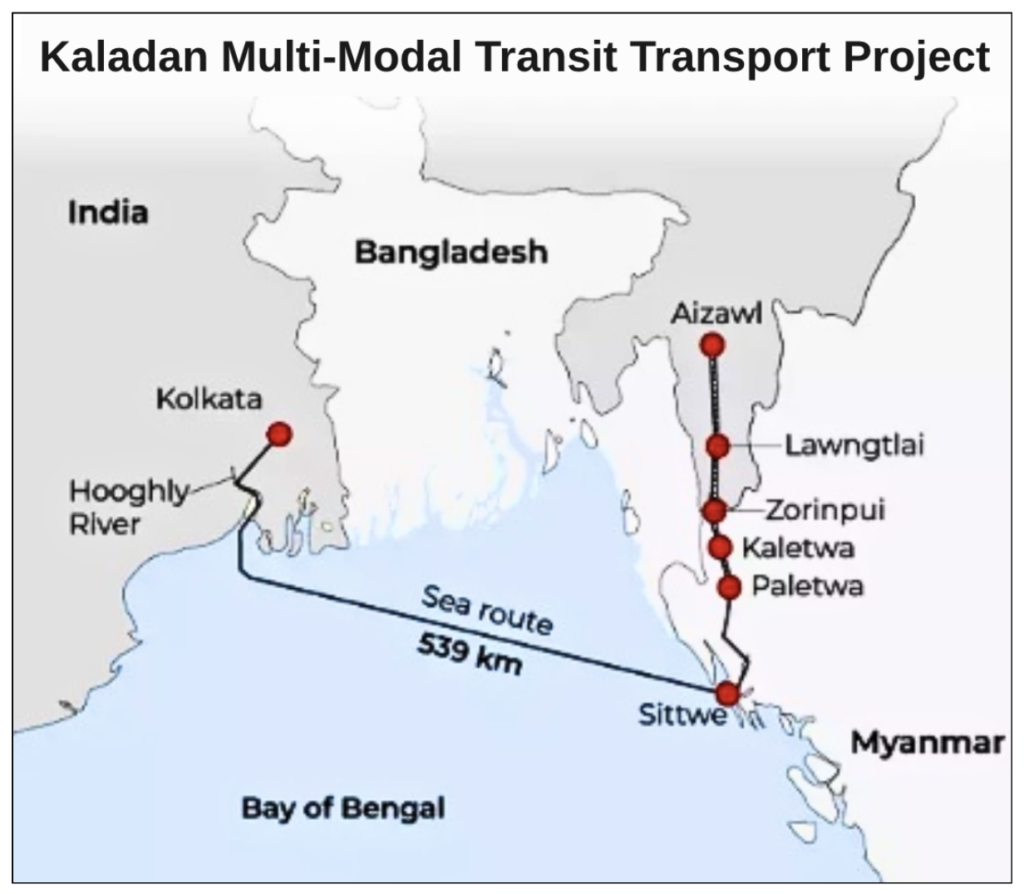
- The Kaladan project aims to connect Kolkata to Sittwe Port by sea, then to Paletwa through the Kaladan River, and finally to Zorinpui in Mizoram by road. The project includes a 158-km waterway component from Sittwe to Paletwa and a 109-km road component from Paletwa to the India-Myanmar border.
- The project is strategically important because it provides an alternative route to the Northeast, reducing dependence on the narrow Siliguri Corridor.
- However, the road component has faced delays because of difficult terrain, floods, security risks and Myanmar’s internal conflict.
India-Myanmar-Thailand Trilateral Highway:
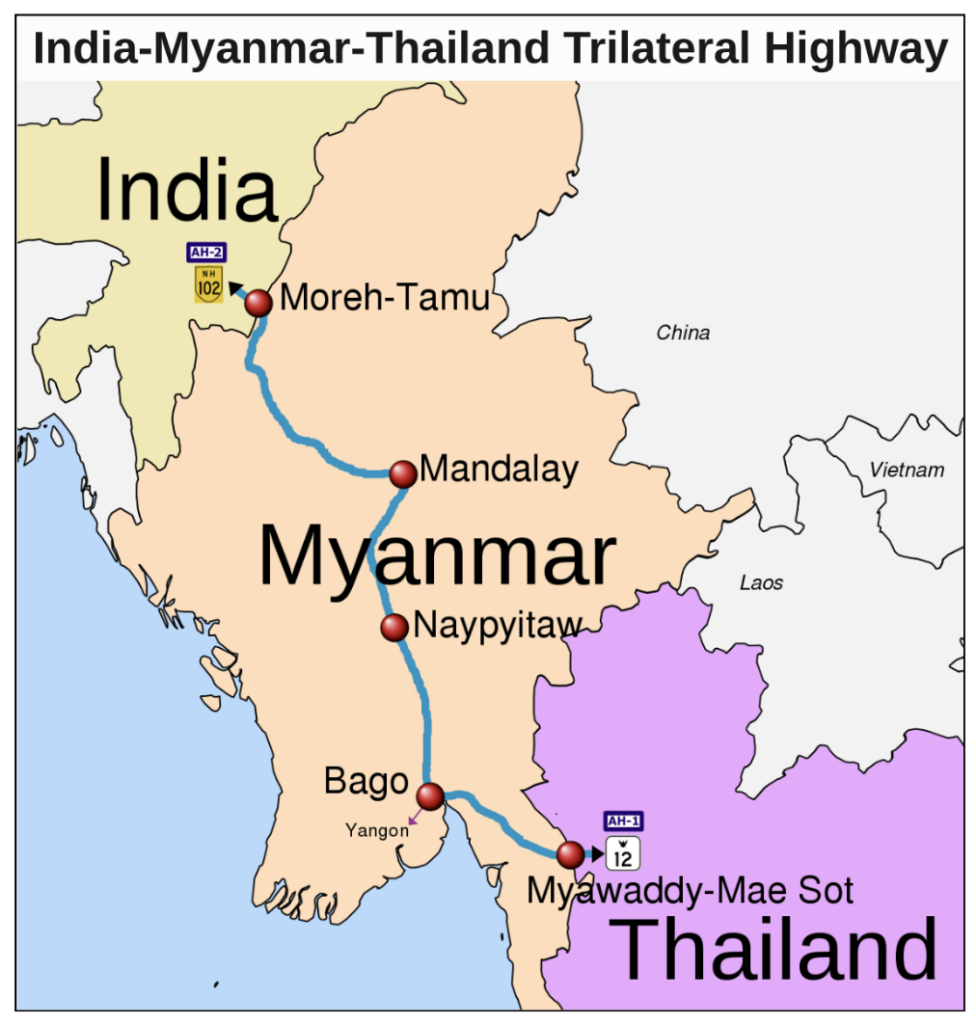
- The Trilateral Highway is designed to connect Moreh in Manipur to Mae Sot in Thailand through Myanmar, creating a land corridor between India and ASEAN. It supports India’s Act East Policy and could eventually link India to Cambodia, Laos and Vietnam.
- However, the highway has missed earlier deadlines. Armed conflict, weak administrative control, poor maintenance and political instability inside Myanmar have slowed implementation. The 2026 joint statement again emphasised the need to complete both the Kaladan project and the Trilateral Highway.
Trade and Economic Cooperation:
- India and Myanmar are natural trading partners, especially in pulses, pharmaceuticals, petroleum products, agro-processing and border trade.
- According to India’s official data, bilateral trade reached USD 2.15 billion in 2024-25, and both sides have discussed raising trade to USD 5 billion by 2030.
- During the 2026 visit, both sides agreed to promote trade through the Rupee-Kyat settlement mechanism, which became operational in 2024. This mechanism can reduce dependence on third-country currencies and ease trade payments amid sanctions-related financial complications.
Democratic and Ethical Dilemma:
- India’s engagement with Myanmar’s military-backed government raises a moral and diplomatic dilemma. Western countries have imposed sanctions and sought to isolate Myanmar’s military rulers after the 2021 coup. Human rights groups argue that hosting Min Aung Hlaing risks legitimising a regime accused of repression and abuses.
- However, India’s position is shaped by strategic realism. New Delhi argues that engagement is necessary to secure its border, protect Indian citizens, maintain connectivity projects and prevent Myanmar from falling completely into China’s strategic orbit. The challenge is to engage without appearing to endorse authoritarianism.
India’s Policy Approach:
India’s Myanmar policy can be described as principled pragmatism. It involves:
- Maintaining working relations with whoever controls state authority in Myanmar.
- Supporting Myanmar’s sovereignty and territorial integrity.
- Calling for peace, stability and national reconciliation.
- Continuing development assistance and connectivity projects.
- Securing Indian citizens and border communities.
- Avoiding a policy vacuum that China can exploit.
The 2026 joint statement reflected this balance by reaffirming India’s support for Myanmar-led peace, stability, national reconciliation and socio-economic development, while also deepening cooperation on security and connectivity.
Way Forward:
- Maintain engagement, but diversify channels: India should engage the authorities in Naypyidaw while also maintaining humanitarian, civil-society and ethnic-community channels wherever feasible.
- Fast-track realistic connectivity segments: Rather than treating Kaladan and the Trilateral Highway as symbolic mega-projects, India should prioritise secure, usable and phased completion.
- Strengthen border management with sensitivity: Border fencing, surveillance and policing must be combined with local consultation, livelihood support and humanitarian protocols.
- Expand economic cooperation in low-risk sectors: Pulses, pharmaceuticals, agro-processing, healthcare, education, energy and digital payments can build mutual dependence without excessive strategic exposure.
- Use Buddhism and education as soft-power bridges: The increase in Mekong-Ganga ICCR scholarships from 36 to 100 annually from 2026 is a useful step. Educational and cultural links can sustain long-term goodwill beyond regime-level ties.
- Coordinate with ASEAN and BIMSTEC: India should avoid unilateral overexposure and work with regional platforms for humanitarian assistance, connectivity and political stabilisation.
A policy of total isolation would reduce India’s leverage and enlarge China’s space. India need not adopt Western-style sanctions, but it should continue to support inclusive dialogue, peace, reconciliation and eventual democratic normalisation.
Tell Google you want more of this.
Add Anantam IAS as a preferred sourceOne tap, and this site shows up more often in your own Top Stories, AI Overviews and AI Mode. Remove it any time.