Daily Digest
UPSC · Civil Services Examination
Current Affairs · Tuesday, 14 July 2026
Current affairs curated and edited by Anantam IAS faculty — pulled from The Hindu, PIB, IDSA, Foreign Affairs and the ministries. Read, annotate, revise.
Old Rajinder Nagar · Delhi 110005 · anantamias.com
Retail inflation climbs to 4.38% in June, first breach of RBI’s 4% target under new series
Why in News?
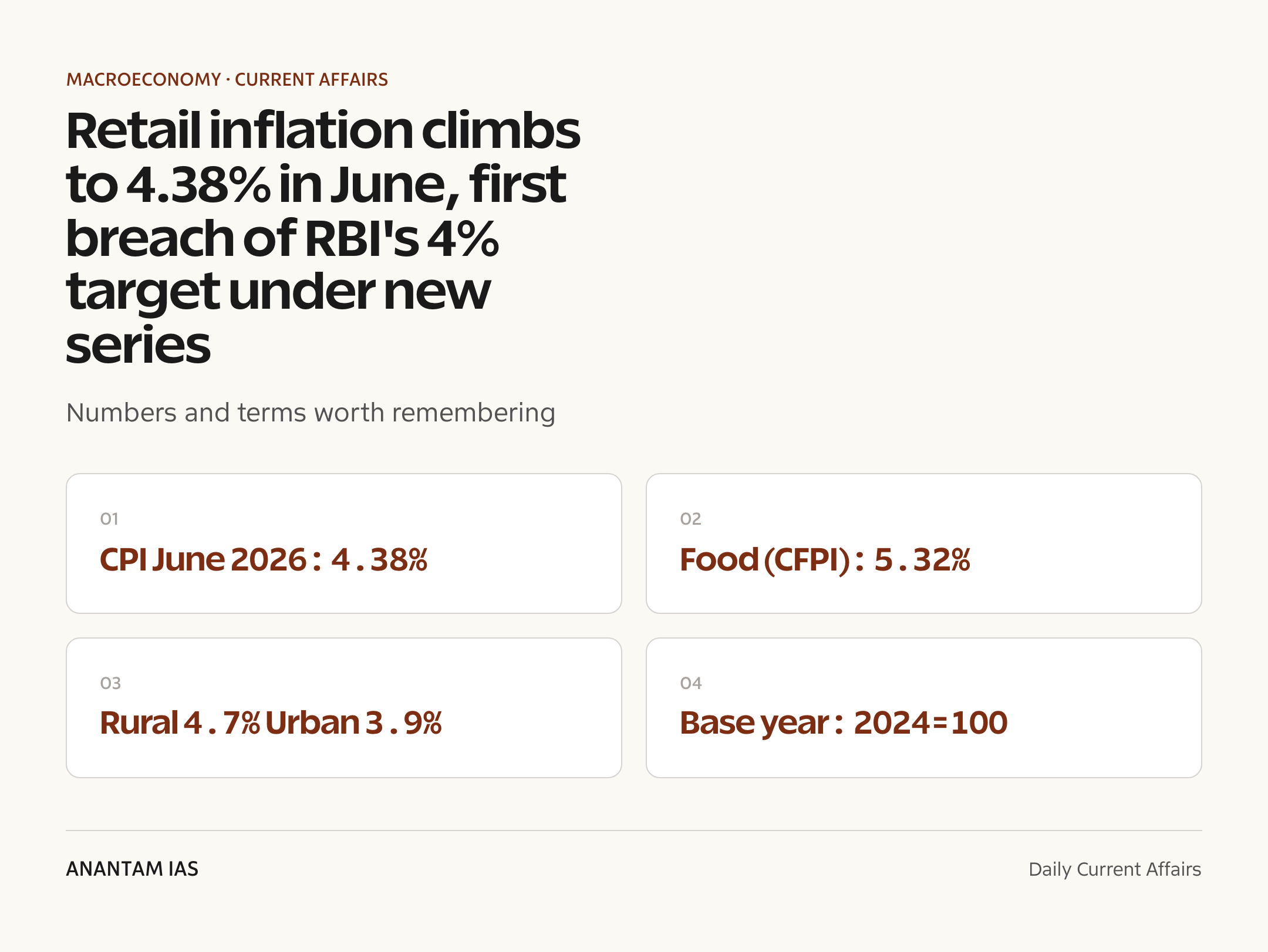
Data released by the Ministry of Statistics and Programme Implementation (MoSPI) showed India’s headline retail inflation, measured by the Consumer Price Index (CPI), climbed to 4.38% (provisional) in June 2026 over June 2025, up from 4.25% in May. It is a multi-month high and the first time the print has crossed the Reserve Bank of India’s (RBI) medium-term target of 4% under the rebased 2024=100 CPI series.
The reading still sits comfortably inside the 2%-6% tolerance band, so it does not amount to a formal failure of the inflation-targeting framework. The pressure was food-led: the Consumer Food Price Index (CFPI) rose to 5.32%, while rural inflation (4.74%) again outpaced urban (3.92%). The next CPI release, for July 2026, is scheduled for 12 August 2026, and will show whether the food-driven pressure is transient or sticky.
- All-India CPI (Combined) inflation for June 2026: 4.38% provisional; rural at 4.74% and urban at 3.92%.
- Food inflation, tracked by the Consumer Food Price Index (CFPI), rose to 5.32% (rural 5.45%, urban 5.09%), the main driver of the uptick.
- Housing inflation stood at 2.10%; the food and beverages group led the pressure across sectors.
- The reading is a multi-month high and the first 4%-plus print since MoSPI shifted the base year to 2024=100.
- Next CPI release (for July 2026) is scheduled for 12 August 2026.
The development matters in the context of:
- CPI is the RBI’s nominal anchor for setting the policy repo rate under flexible inflation targeting.
- A sustained rise toward the upper band narrows the space for rate cuts and shapes the Monetary Policy Committee’s stance.
UPSC Relevance
Prelims Relevance
- CPI headline June 2026: 4.38%; CFPI food inflation: 5.32%.
- New CPI base year: 2024=100 (revised from 2012=100).
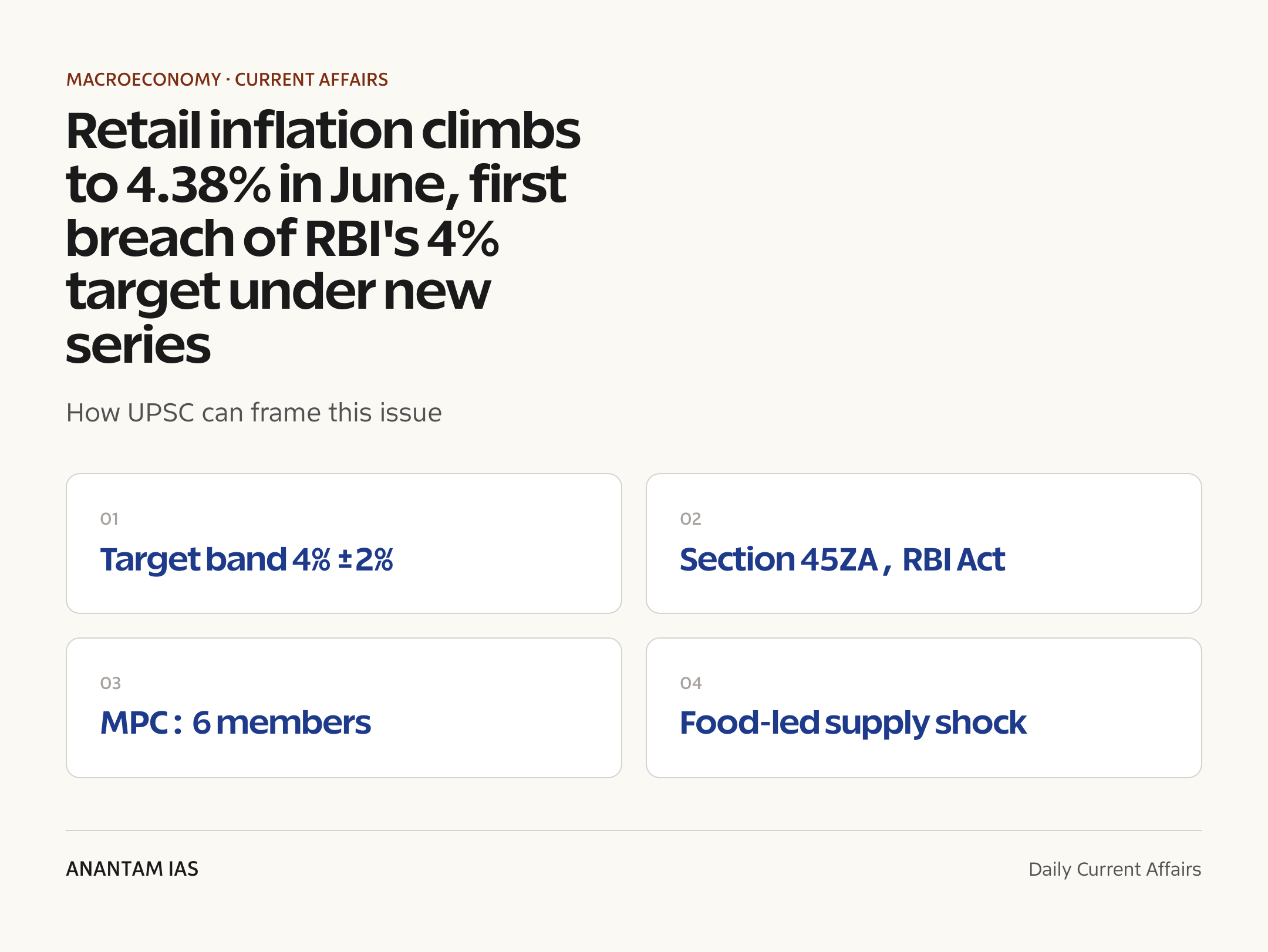
- RBI’s inflation target: 4% with a +/-2% band (2%-6%), set under the RBI Act.
- Legal basis: Section 45ZA of the RBI Act, 1934; target notified by the Central Government.
- CPI compiled by MoSPI (NSO); WPI by the Office of the Economic Adviser, DPIIT.
- Monetary Policy Committee (MPC): 6 members, chaired by the RBI Governor.
- CFPI is a sub-index of CPI capturing food and beverage prices.
- ‘Failure’ of monetary policy: CPI outside 2%-6% for three consecutive quarters.
- Flexible Inflation Targeting adopted via the 2016 RBI Act amendment.
Mains Relevance
GS Paper 3
- Inflation targeting framework: design, tolerance band, and the trade-off between price stability and growth.
- Food inflation drivers (supply shocks, monsoon, MSP, supply chains) and why headline CPI is food-heavy.
- Effectiveness and limits of monetary policy against supply-side, food-led inflation.
- Relevance of CPI base-year revision (2024=100) for accurate measurement of the cost of living.
Essay
- Price stability, growth, and the credibility of institutions in economic management.
Background and Context
What the June 2026 numbers show
The headline number crept above the target midpoint, with food doing most of the pushing.
- CPI (Combined) inflation: 4.38% (provisional) for June 2026, up from 4.25% in May and above the 4% target midpoint.
- Rural inflation (4.74%) ran well above urban (3.92%), a persistent rural-urban gap tied to the higher food share in rural budgets.
- CFPI food inflation at 5.32% was the single biggest contributor to the rise, with rural food at 5.45% and urban at 5.09%.
- Housing inflation, an urban-only category, stayed subdued at 2.10%, keeping non-food pressure contained.
- The print sits inside the 2%-6% band but above the 4% medium-term target for the first time under the new series.
- The month-on-month drift from 4.25% to 4.38% is modest, signalling a gradual uptick rather than a sharp spike.
How CPI is built
CPI measures the change in retail prices of a fixed basket of goods and services bought by households.
- Compiled and released monthly by the National Statistical Office (NSO) under MoSPI.
- Base year recently revised to 2024=100 from 2012=100 to reflect current consumption patterns and updated item weights.
- Covers broad groups such as food and beverages, housing, fuel and light, clothing and footwear, and miscellaneous services.
- Food and beverages carry a large weight, so CPI is highly sensitive to food-price swings compared with advanced-economy indices.
- Separate indices are published for rural, urban and combined sectors, with weights drawn from consumption-expenditure survey data.
- Indices are compiled from unrounded values, so headline figures rebuilt from rounded published sub-indices can differ marginally.
Base effect and why timing matters
A year-on-year inflation rate depends as much on last year’s price level as on this year’s.
- The base effect is the influence of the corresponding month a year earlier on the current inflation reading.
- A low price base in June 2025 can mechanically lift the June 2026 year-on-year rate even without fresh price rises.
- A high base in the comparison month can suppress the printed rate, masking underlying momentum.
- Analysts read the momentum (sequential month-on-month change) alongside the headline to separate genuine pressure from base arithmetic.
- The shift to the 2024=100 series resets weights, so year-on-year comparisons that straddle the base change must be read with care.
Core versus food inflation
Policymakers watch the durable, demand-driven part of inflation as closely as the volatile headline.
- Core inflation strips out food and fuel, the two most volatile components, to reveal underlying demand pressure.
- Subdued housing inflation at 2.10% and the food-led jump suggest the June uptick was driven by supply, not overheating demand.
- The RBI targets headline CPI, but leans on core trends to judge whether price pressure is broad-based or transient.
- A soft core with a rising headline typically points to a food or fuel shock that may ease as supply normalises.
- Persistent core inflation, by contrast, would signal demand-side pressure that monetary tightening can more effectively address.
CPI, CFPI and WPI compared
India tracks price pressure through more than one index, each with a distinct scope.
- CFPI is a sub-index of CPI, isolating the price movement of food and beverages.
- Wholesale Price Index (WPI) measures prices at the wholesale or producer stage, released by the Office of the Economic Adviser, DPIIT.
- CPI is the RBI’s policy anchor because it reflects prices actually faced by consumers.
- WPI has no services component and gives fuel and manufactured goods a larger weight, so it can diverge sharply from CPI.
- A WPI-CPI divergence often signals lags in the pass-through of wholesale price changes to retail shelves.
- Global commodity prices tend to show up in WPI first, then feed into CPI with a lag.
The inflation-targeting framework
India adopted a statutory, flexible inflation-targeting regime a decade ago.
- The 2016 amendment to the RBI Act, 1934 gave price stability a formal legal mandate.
- Under Section 45ZA, the Central Government, in consultation with the RBI, sets the CPI target every five years.
- The current target is 4% with a tolerance band of +/-2% (2% to 6%).
- ‘Flexible’ means the RBI weighs growth alongside inflation rather than pursuing price stability alone.
- Monetary policy is deemed to have ‘failed’ if CPI stays outside the band for three consecutive quarters, triggering a report to Parliament.
- The framework was designed to anchor inflation expectations and build institutional credibility.
Transmission to the MPC and the repo rate
The inflation print feeds directly into how the central bank sets the price of money.
- The Monetary Policy Committee (MPC) has six members, three from the RBI and three appointed by the government, chaired by the RBI Governor with a casting vote.
- The MPC sets the repo rate, the rate at which banks borrow from the RBI, to steer inflation toward the 4% target.
- A rising headline print, if judged persistent, limits room for rate cuts and can turn the policy stance more cautious.
- The real interest rate (repo rate minus expected inflation) matters more than the nominal rate for saving and investment decisions.
- Higher inflation erodes the real rate, and the RBI may hold or raise the repo rate to keep real returns positive.
- Rate changes transmit to lending and deposit rates with a lag, so the MPC acts pre-emptively on the inflation outlook.
Why food inflation is hard to tame
Food is the swing factor in India’s CPI and the least responsive to interest rates.
- High food weight means a CFPI of 5.32% can lift the whole index even when core inflation is soft.
- Food prices respond to monsoon performance, sowing, supply chains, storage and global commodity moves, not to the repo rate.
- Rural households spend a larger share on food, explaining the higher rural inflation reading.
- Supply-side food shocks blunt monetary tools, which act mainly on demand rather than on harvest or logistics.
- The policy response leans on buffer stocks, imports and open-market operations by agencies rather than rate action alone.
- A weak or delayed monsoon can keep food inflation elevated for several months, testing the durability of the target.
Way Forward
Manage supply-side food pressures
- Strengthen buffer-stock management, cold chains and market intelligence to smooth seasonal food spikes.
- Use calibrated trade measures (imports, export policy) to steady prices of pulses, edible oils and vegetables.
Keep the policy anchor credible
- Let the MPC weigh whether the uptick is transient and food-led before shifting stance.
- Sustain clear communication to keep household and market inflation expectations near the 4% target.
Improve measurement and data
- Embed the 2024=100 base revision fully so weights track current consumption.
- Expand high-frequency price monitoring to catch food-price turns early.
Conclusion
June 2026’s 4.38% print is a mild, food-driven move above the 4% target midpoint, not a breach of the wider 2%-6% tolerance band. With core inflation soft and housing subdued, the signal for the RBI is one of watchfulness rather than alarm, and the July reading due on 12 August will show whether the food pressure persists.
For exam purposes, the durable takeaways are the architecture itself: CPI construction on the new 2024=100 base, the statutory target under Section 45ZA, the role of the base effect and core inflation in reading the data, and the limits of monetary policy against supply-led food inflation.
UPSC Practice Questions
Prelims MCQ 1
With reference to inflation measurement and targeting in India, consider the following statements:
- The Consumer Price Index (CPI) in India is compiled and released by the Reserve Bank of India.
- The Consumer Food Price Index (CFPI) is a sub-index of the CPI.
- The medium-term CPI inflation target of 4% with a band of +/-2% is set under the RBI Act, 1934.
How many of the above statements are correct?
(a) Only one (b) Only two (c) All three (d) None
Answer: (b) Only two
Explanation:
CPI is compiled by the National Statistical Office under MoSPI, not the RBI, so statement 1 is wrong. The CFPI is a sub-index of the CPI, so statement 2 is correct. The 4% +/-2% target is notified under Section 45ZA of the RBI Act, 1934, so statement 3 is correct.
Prelims MCQ 2
Which of the following statements about India’s Monetary Policy Committee (MPC) is correct?
(a) It has four members, all nominated by the Reserve Bank of India. (b) It has six members and is chaired by the RBI Governor, who has a casting vote. (c) It sets the Wholesale Price Index target every year. (d) Its decisions require the prior approval of Parliament.
Answer: (b) It has six members and is chaired by the RBI Governor, who has a casting vote.
Explanation:
The MPC has six members, three from the RBI and three appointed by the government, chaired by the RBI Governor who holds a casting vote in a tie. It targets CPI inflation (not WPI) and does not need prior parliamentary approval for its rate decisions.
UPSC Mains Questions
- India’s retail inflation is heavily influenced by food prices, which respond mainly to supply-side factors. In this light, examine the effectiveness and limitations of monetary policy in achieving the RBI’s inflation target.
- Discuss the rationale for periodically revising the base year of the Consumer Price Index. How does the shift to a 2024=100 base improve the measurement of inflation and the cost of living in India?
Sources: PIB / Ministry of Statistics and Programme Implementation (MoSPI) and The Federal.
Frequently Asked Questions
What was India’s retail inflation in June 2026?
India’s Consumer Price Index (CPI) inflation was 4.38% (provisional) in June 2026 over June 2025, up from 4.25% in May. Rural inflation was 4.74% and urban 3.92%. The rise was driven mainly by food, with CFPI food inflation at 5.32%, as reported by MoSPI.
Did June inflation breach the RBI’s target?
It crossed the 4% medium-term target for the first time under the new 2024=100 series, but it stayed well inside the 2%-6% tolerance band. So it is above the midpoint the RBI aims for, yet not a breach of the outer limits that would formally concern the framework.
What is the RBI’s inflation target?
The Reserve Bank targets CPI inflation of 4% with a tolerance band of plus or minus 2 percentage points, meaning 2% to 6%. This target is set by the Central Government in consultation with the RBI under Section 45ZA of the RBI Act, 1934, and is reviewed every five years.
What is the CFPI and why does it matter?
The Consumer Food Price Index (CFPI) is a sub-index of the CPI that tracks retail prices of food and beverages. Because food carries a large weight in India’s CPI, movements in the CFPI strongly influence headline inflation, which is why food-price spikes can push the overall number up quickly.
Why was the CPI base year changed to 2024?
MoSPI revised the CPI base year from 2012=100 to 2024=100 so that the basket of goods, services, and their weights better reflect current household consumption patterns. Updated weights keep the index accurate as spending habits shift over time toward newer goods and services.
Who decides India’s interest rates?
The six-member Monetary Policy Committee (MPC), chaired by the RBI Governor, sets the benchmark repo rate. Three members are from the RBI and three are appointed by the government. The committee adjusts rates to steer CPI inflation toward the 4% target while supporting growth.
Source: https://anantamias.com/current-affairs/cpi-retail-inflation-june-2026-breaches-rbi-target/
Fair, reasoned process must decide citizenship: Supreme Court
Why in News?
The Supreme Court has ruled that a person’s status as a foreigner must be settled through a fair, lawful and reasoned process, striking down a batch of 27 Gauhati High Court judgments that had declared the appellants to be foreigners. A Bench of Justices Vikram Nath and Sandeep Mehta sent the matters back to the concerned Foreigners Tribunals for fresh adjudication.
The Court held that a declaration of foreigner status cannot stand if the procedure is mechanical, one-sided, or devoid of application of mind. The tribunals had earlier declared the appellants foreigners in their absence after they failed to appear despite notices, an approach the Bench found legally unsustainable.
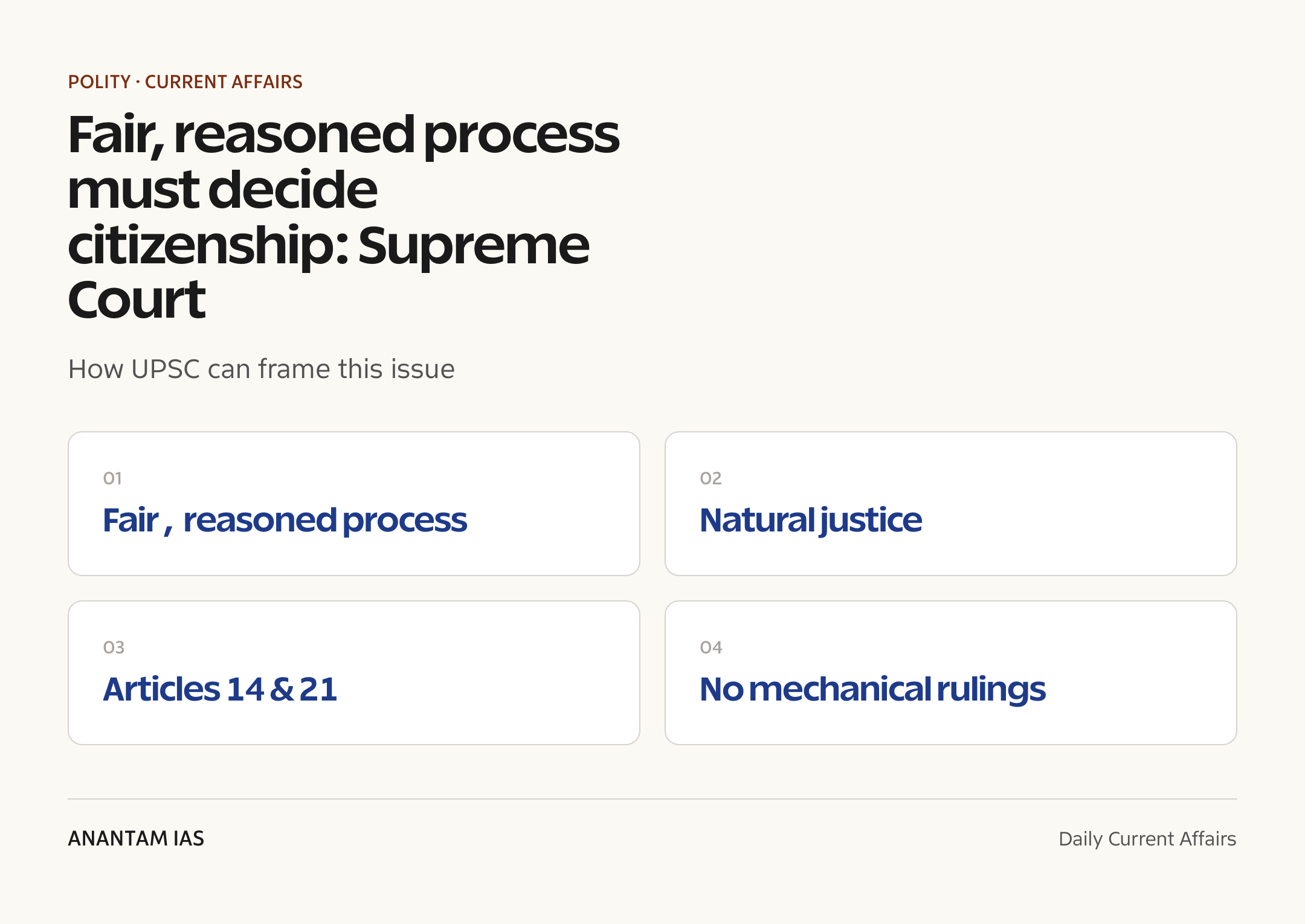
The Bench stressed that consequences of being declared a foreigner run far beyond an ordinary civil case, since they may lead to detention, deportation, separation from family, and even statelessness. For that reason, a foreigner finding must flow only from an adjudication that satisfies the Foreigners Act, 1946, the Foreigners (Tribunals) Order, 1964, and the constitutional mandate of fairness under Articles 14 and 21.
- SC set aside 27 Gauhati High Court judgments declaring the appellants to be foreigners.
- Bench of Justices Vikram Nath and Sandeep Mehta ordered the Foreigners Tribunals to decide afresh.
- The tribunals had passed ex-parte (one-sided) opinions after the appellants did not appear despite being served notices.
- Court held such declarations are unsustainable if the process is mechanical or lacks application of mind.
- Appellants directed to appear before the tribunals within four weeks, cooperate, and avoid unnecessary adjournments.
- Bench affirmed that Article 14 and Article 21 protections extend even to foreigners.
The development matters in the context of:
- Foreigners Tribunals are quasi-judicial bodies, concentrated in Assam, that decide whether a person is an Indian citizen or a foreigner.
- The ruling touches the sensitive intersection of citizenship, NRC, and due process in the North-East.

UPSC Relevance
Prelims Relevance
- Foreigners Act, 1946: places the burden of proving citizenship on the person accused of being a foreigner.
- Foreigners (Tribunals) Order, 1964: statutory basis on which Foreigners Tribunals are constituted and operate.
- Foreigners Tribunals are quasi-judicial bodies set up by the executive, not regular civil courts.
- Citizenship Act, 1955 and its Section 6A (special provision for Assam linked to the Assam Accord).
- Article 14 (equality before law) and Article 21 (life and liberty) apply to citizens and non-citizens alike.
- NRC (National Register of Citizens) updated in Assam under the monitoring of the Supreme Court.
- Assam Accord, 1985 fixed March 24, 1971 as the cut-off date for detecting foreigners in Assam.
- Ex-parte proceeding means a matter decided in the absence of, or without hearing, one party.
Mains Relevance
GS Paper 2
- Due process and natural justice: how Article 21 disciplines quasi-judicial bodies like Foreigners Tribunals.
- Citizenship determination in Assam, the NRC process, and the balance between state interest and individual rights.
- Role of the judiciary in checking mechanical, one-sided administrative adjudication.
- Statutory framework governing foreigners: Foreigners Act 1946, Foreigners (Tribunals) Order 1964, Citizenship Act 1955.
Essay
- Justice must not only be done but be seen to be done: fairness as the soul of due process.
- Belonging and the law: citizenship, identity, and the human cost of statelessness.
Background and Context
What the Supreme Court held
The Bench anchored citizenship determination firmly in constitutional fairness.
- A finding of foreigner status must flow from an adjudication that is legally sustainable and consistent with fairness.
- Such a finding cannot be sustained if the procedure is mechanical, one-sided, or devoid of application of mind.
- The tribunal must examine whether the person had a fair opportunity and must record reasons, even if briefly.
- Article 14 and Article 21 guarantees extend to foreigners, so the process must meet constitutional standards.
- A right and its consequences flow only from a legally sustainable adjudication, not from an assumed outcome.
- The Court set aside the 27 Gauhati High Court judgments and the corresponding tribunal opinions, ordering fresh adjudication.
- The tribunals must render fresh opinions uninfluenced by their earlier conclusions, restoring the appellants’ chance to be heard.
The problem of ex-parte declarations
The core defect was that people were branded foreigners without a real hearing.
- The tribunals had declared the appellants foreigners after none of them appeared despite notices being served.
- The Bench held that non-appearance does not absolve a tribunal of its obligation to conduct a lawful adjudication.
- An ex-parte (one-sided) opinion still has to satisfy the requirements of law and natural justice.
- Effective service of notice and a genuine opportunity to defend are pre-conditions before a case is treated as ex-parte.
- Many proceedees are poor, illiterate, or migrant workers who may not grasp legal notices, deepening the risk of unfair findings.
- Appellants were directed to appear within four weeks, cooperate, and avoid seeking unnecessary adjournments.
- A wrongful foreigner tag can strip a person of the right to vote and land them in a detention centre.
Foreigners Tribunals: the legal framework
These bodies sit at the heart of citizenship adjudication in Assam.
- Foreigners Tribunals are quasi-judicial bodies constituted under the Foreigners (Tribunals) Order, 1964.
- They derive authority from the Foreigners Act, 1946, which governs the entry, presence, and departure of foreigners.
- A distinctive feature is Section 9 of the 1946 Act: the burden of proof lies on the person to prove he or she is not a foreigner, reversing the usual rule.
- They decide references made by the border police or arising from doubts flagged during the NRC exercise.
- Persons marked D-voter (doubtful voter) by the Election Commission are also referred to the tribunals.
- Members are appointed by the state and need judicial or legal experience, but they are not part of the regular court hierarchy.
- Their opinions can lead to detention, deportation, and loss of the right to vote.
Why the stakes are 'high constitutional significance'
Justice Nath stressed that a foreigner tag carries consequences far beyond ordinary civil disputes.
- A declaration of foreigner status may result in detention, deportation, and separation from family and community.
- In some situations it can even push a person towards statelessness.
- Because of these consequences, the Court placed citizenship adjudication in a field of high constitutional and legal significance.
- The state has a legitimate interest in identifying persons ineligible for citizenship, but that interest cannot override fair procedure.
- The right outcome must emerge from a process, not be assumed in advance of one.
Citizenship, NRC, and the Assam context
The ruling lands in Assam’s long-running citizenship and migration debate.
- The Assam Accord, 1985 set March 24, 1971 as the cut-off for detecting and deporting illegal migrants.
- Section 6A of the Citizenship Act, 1955 gave statutory shape to this Assam-specific arrangement.
- The final NRC published in Assam in 2019 excluded over 19 lakh people, leaving many names disputed.
- Foreigners Tribunals are the forum where excluded persons and suspected foreigners contest their status.
- Section 6A treats those who entered before January 1, 1966 as citizens, and gives conditional rights to entrants up to March 24, 1971.
- In 2024 a Constitution Bench upheld the validity of Section 6A, underlining its centrality to the Assam settlement.
- Concerns over detention centres and arbitrary declarations have made procedural fairness a recurring theme.
Natural justice and Article 21
The judgment reads the audi alteram partem principle into tribunal practice.
- Natural justice requires that no one be condemned unheard (audi alteram partem) and that decisions be reasoned.
- The Maneka Gandhi (1978) line of cases established that Article 21 demands a fair, just and reasonable procedure.
- A speaking order that records reasons lets the person understand and challenge an adverse finding.
- The rule against bias (nemo judex in causa sua) is the second limb of natural justice binding all adjudicators.
- Comparative due-process jurisprudence treats a fair hearing before deprivation of liberty as a basic minimum.
- Fairness here is not a formality but a check against arbitrary loss of liberty and identity.
- The ruling reinforces that quasi-judicial bodies are bound by the same constitutional discipline as courts.
Way Forward
Strengthen tribunal procedure
- Ensure genuine, effective service of notice before treating a case as ex-parte.
- Mandate reasoned, speaking orders in every Foreigners Tribunal opinion, however brief.
- Provide legal aid and translation support to poor and vulnerable proceedees.
Systemic reform
- Standardise training for tribunal members on evidence and natural justice.
- Build transparent, digitised records to reduce arbitrary or mechanical findings.
- Reduce reliance on prolonged detention pending appeals and review, consistent with Article 21.
Conclusion
The ruling reframes citizenship determination as a question of process as much as outcome. A person may ultimately fail to prove citizenship, but the road to that finding must satisfy fairness, reasonableness, and the guarantees of Articles 14 and 21.
By setting aside 27 judgments and ordering fresh adjudication, the Supreme Court has signalled that quasi-judicial bodies cannot substitute mechanical convenience for constitutional duty. For UPSC aspirants, the case is a compact lesson in how due process disciplines the machinery of the state.
UPSC Practice Questions
Prelims MCQ 1
With reference to Foreigners Tribunals in India, consider the following statements:
- They are constituted under the Foreigners (Tribunals) Order, 1964.
- Under the Foreigners Act, 1946, the burden of proving citizenship lies on the person alleged to be a foreigner.
- They function as regular civil courts within the ordinary judicial hierarchy.
How many of the above statements are correct?
(a) Only one (b) Only two (c) All three (d) None
Answer: (b) Only two
Explanation:
Statements 1 and 2 are correct. Foreigners Tribunals are constituted under the Foreigners (Tribunals) Order, 1964, and the Foreigners Act, 1946 places the burden of proof on the person concerned. Statement 3 is wrong: they are quasi-judicial bodies, not regular civil courts.
Prelims MCQ 2
The Supreme Court’s ruling that foreigner status must be decided through a fair and reasoned process is most directly grounded in which of the following?
(a) Article 14 and Article 21 of the Constitution (b) Article 19 and Article 32 of the Constitution (c) Directive Principles of State Policy (d) Ninth Schedule of the Constitution
Answer: (a) Article 14 and Article 21 of the Constitution
Explanation:
The Bench held that equality before law (Article 14) and the right to life and personal liberty (Article 21) extend to foreigners, so a foreigner declaration must satisfy a fair, reasoned procedure and record reasons.
UPSC Mains Questions
- The Supreme Court has held that a person’s status as a foreigner must be settled through a fair, lawful and reasoned process. Examine how the principles of natural justice and Article 21 govern the working of quasi-judicial bodies such as Foreigners Tribunals. (250 words)
- Citizenship determination in Assam sits at the intersection of statutory law, the NRC, and constitutional rights. Critically analyse the challenges in ensuring fairness in Foreigners Tribunal adjudication and suggest reforms. (250 words)
Source: The Hindu.
Frequently Asked Questions
What did the Supreme Court rule?
The Supreme Court held that a person’s foreigner status must be decided through a fair, lawful and reasoned process. It set aside 27 Gauhati High Court judgments and directed the Foreigners Tribunals to re-adjudicate the matters afresh, holding that mechanical, one-sided declarations cannot be sustained.
What is a Foreigners Tribunal?
A Foreigners Tribunal is a quasi-judicial body constituted under the Foreigners (Tribunals) Order, 1964. It decides whether a person is an Indian citizen or a foreigner, largely in Assam, and its opinions can lead to detention, deportation, and loss of voting rights.
Why were the 27 judgments set aside?
The tribunals had declared the appellants foreigners in their absence after they failed to appear despite notices. The Court found these ex-parte, mechanical opinions legally unsustainable because they lacked application of mind and a fair opportunity of hearing.
How does Article 21 apply to foreigners?
The Bench affirmed that the right to life and personal liberty under Article 21, along with equality under Article 14, extend to foreigners. So any process that may lead to detention or deportation must be fair, just and reasonable, and must record reasons.
What is the Foreigners Act, 1946?
The Foreigners Act, 1946 governs the entry, presence, and departure of foreigners in India. A key feature is that the burden of proving that one is not a foreigner rests on the person concerned, not on the state.
What must tribunals do now?
The tribunals must decide the cases afresh without being influenced by their earlier opinions, ensure a fair hearing, and record reasons. The appellants were directed to appear within four weeks, cooperate, and avoid unnecessary adjournments.
Source: https://anantamias.com/current-affairs/sc-foreigners-tribunals-fair-reasoned-citizenship/
Can biogas aid India’s energy security?
Why in News?
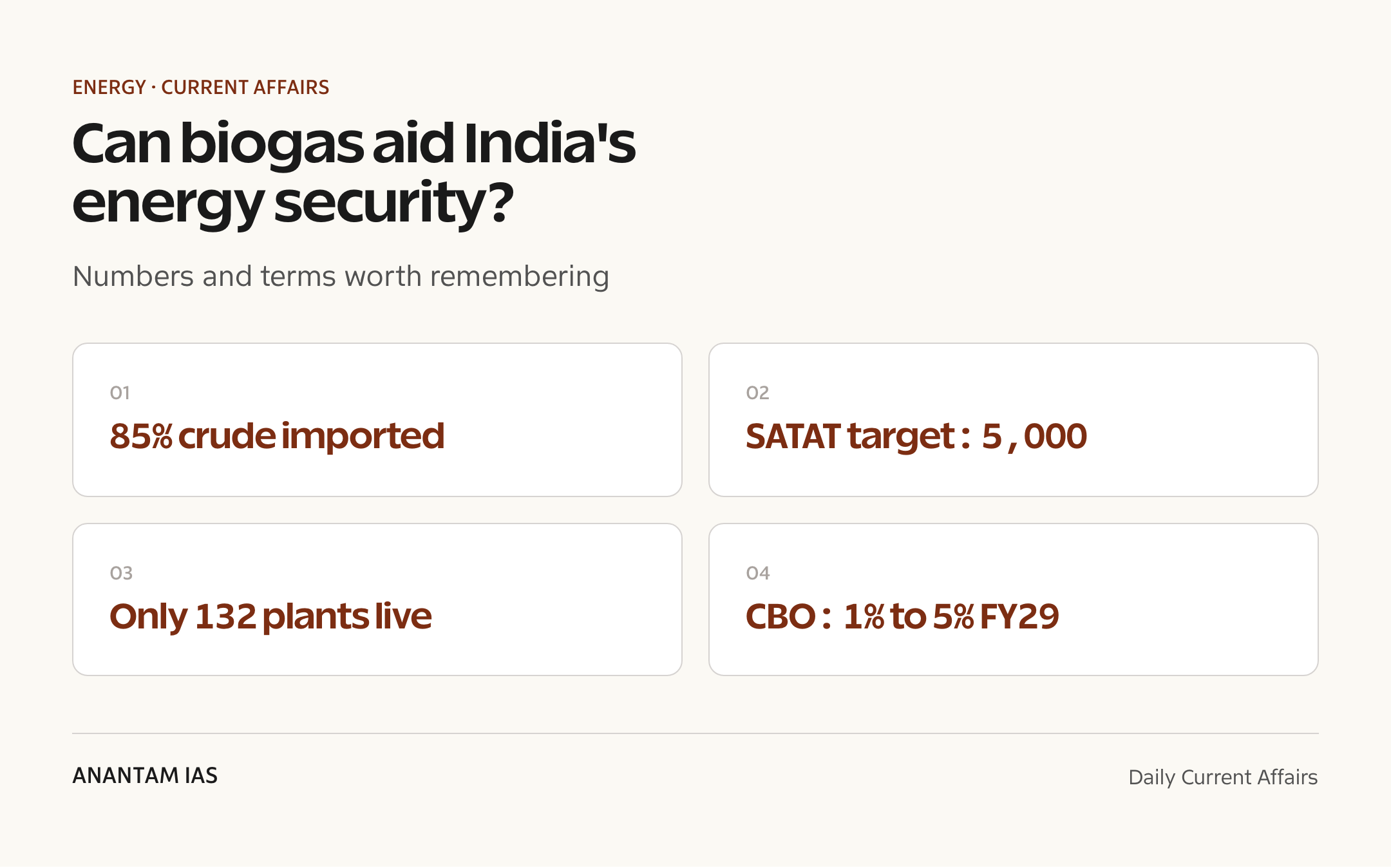
A recent explainer in The Hindu revisits whether compressed biogas can meaningfully strengthen India’s energy security, as tensions in West Asia keep global energy markets on edge. India imports nearly 85% of its crude oil, much of it from West Asia, and around 90% of its LPG imports transit the Strait of Hormuz, making the region a standing risk to supply. Any disruption there feeds directly into fuel prices, the import bill and the current-account balance, which is why domestic, waste-based fuels keep returning to the policy conversation.
The flagship SATAT scheme, launched in 2018, aimed for 5,000 Compressed Biogas (CBG) plants by 2023, but only 132 were completed as of June 3, 2026. The persistent gap between target and delivery has drawn fresh scrutiny of the finance, feedstock and off-take problems that hold the sector back.
The debate has sharpened because a mandatory CBG Blending Obligation (CBO) is now rolling out from FY26, starting at 1% and rising to 5% by FY29. Coupled with warnings in the Economic Survey 2026 about a maize-cultivation surge that echoes Germany’s biogas ‘corn mania’, the story has become a live GS3 debate on renewables, waste-to-energy, import substitution and the food-versus-fuel trade-off.
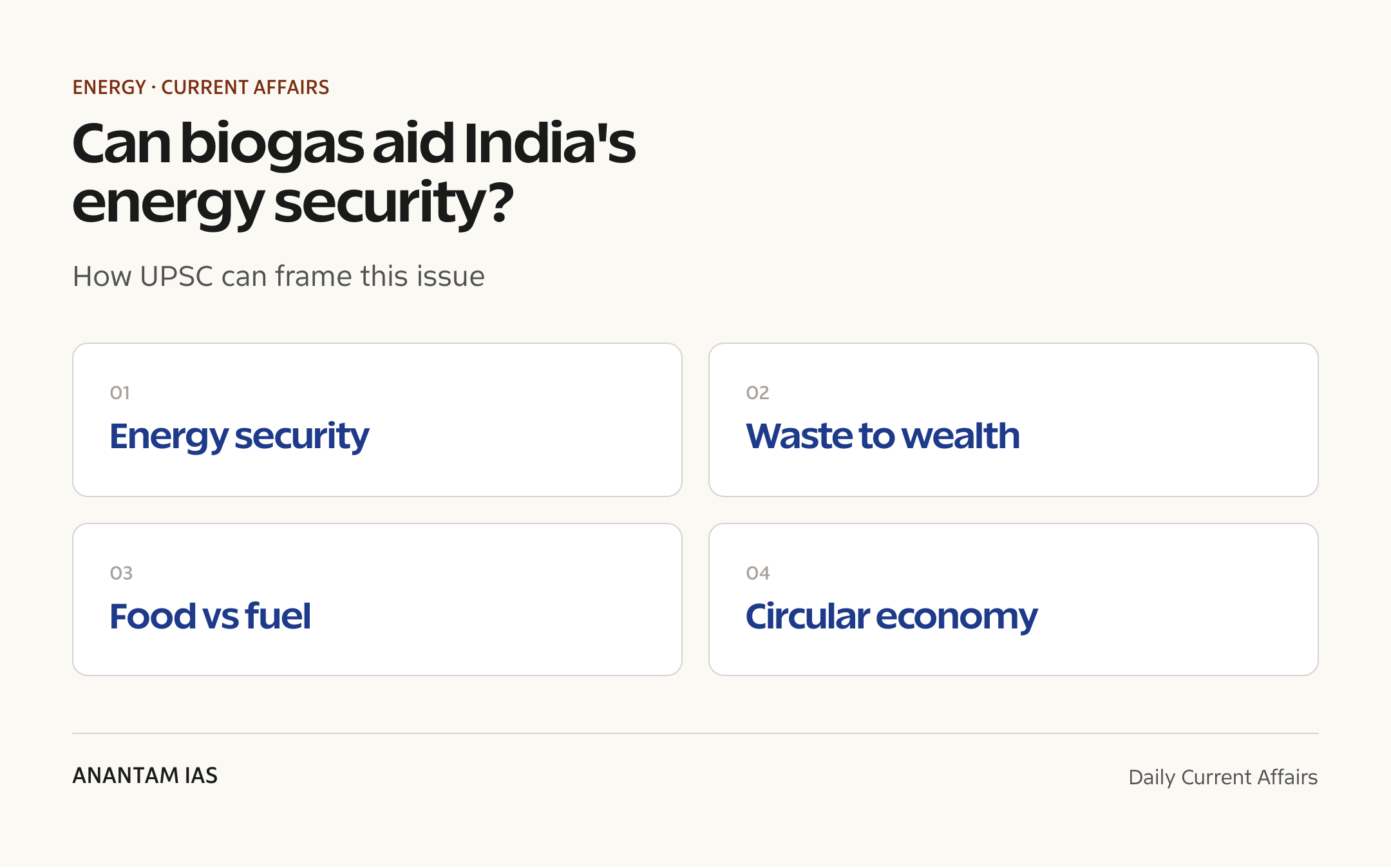
- West Asia instability threatens crude and LPG supply routes India depends on
- SATAT (2018) targeted 5,000 CBG plants by 2023; only 132 are operational (June 2026)
- Mandatory CBG Blending Obligation (CBO) begins FY26 at 1%, rising to 5% by FY29
- Economic Survey 2026 flags a maize-cultivation surge that could echo Germany’s biogas ‘corn mania’
The development matters in the context of:
- Biogas is methane plus CO2 from anaerobic digestion of organic waste; purified and compressed it becomes CBG, chemically identical to CNG
- CBG sits within the National Bioenergy Programme and India’s broader clean-fuel push alongside ethanol and green hydrogen
UPSC Relevance
Prelims Relevance
- SATAT = Sustainable Alternative Towards Affordable Transportation; launched 2018 by the Ministry of Petroleum and Natural Gas
- Compressed Biogas (CBG) is chemically identical to CNG (methane-rich, renewable, near carbon-neutral)
- GOBARdhan = Galvanising Organic Bio-Agro Resources Dhan (waste-to-wealth programme)
- National Bioenergy Programme is implemented by the MNRE (biogas, biomass, waste-to-energy sub-schemes)
- India imports about 85% of its crude oil and roughly 90% of LPG imports pass through the Strait of Hormuz
- Biogas is produced by anaerobic digestion (breakdown of organic matter without oxygen)
- CBG Blending Obligation starts FY26 at 1% and rises to 5% by FY29 (approved by the National Biofuels Coordination Committee, 2023)
- Ethanol blending in petrol rose from 1.5% (2014) to 20% (December 2025), five years ahead of the 2030 target
Mains Relevance
GS Paper 3
- Energy security and import substitution: can CBG and biofuels cut India’s crude and LPG import dependence?
- Waste-to-energy and the circular economy: converting agricultural residue and municipal waste into fuel and rural income
- Assess why SATAT has under-delivered (finance, infrastructure, off-take) and what policy corrections a blending mandate needs
- Food-versus-fuel trade-offs: feedstock choice, crop diversion and food security lessons from ethanol pricing
Essay
- Growth that does not cost the earth: fuel from waste and the circular economy
- When policy incentives distort the plate: food security in the age of biofuels
Background and Context
Why energy security frames the biogas debate
India’s exposure to imported fuel is the strategic backdrop to every clean-fuel push.
- India imports nearly 85% of its crude oil, much of it from West Asia, leaving the economy vulnerable to price and supply shocks
- About 90% of India’s LPG imports transit the Strait of Hormuz, a single chokepoint that regional conflict can disrupt
- Domestic, waste-based fuels like CBG promise import substitution while cutting the trade and current-account pressure that oil imports create
- The push also serves climate goals, since CBG is renewable and treated as near carbon-neutral when made from waste
What Compressed Biogas actually is
The chemistry explains why CBG can slot into existing gas infrastructure.
- Biogas is a mix of methane, carbon dioxide and trace gases produced by anaerobic digestion of organic matter (crop residue, cattle dung, food and municipal waste)
- Purifying and compressing biogas yields Compressed Biogas (CBG), which is chemically identical to CNG
- CBG can power vehicles, generate electricity, provide heating or serve as a cooking fuel, and can be injected into City Gas Distribution (CGD) piped networks
- Because it is made from waste, CBG doubles as a waste-management and circular-economy tool, not only an energy source
- Feedstock is diverse and largely low-value: press mud from sugar mills, paddy straw and other crop residue, cattle dung, food waste and the organic fraction of municipal solid waste (MSW)
- Digestion also yields Fermented Organic Manure (FOM) as a co-product, which can substitute chemical fertiliser and improve soil health, adding a second revenue stream for plant operators
- Using crop residue like paddy straw for CBG offers an alternative to stubble burning, linking the fuel to the North India air-pollution problem
SATAT and GOBARdhan: the policy scaffolding
India has layered several schemes to seed a CBG ecosystem.
- SATAT (Sustainable Alternative Towards Affordable Transportation), launched in 2018, targeted 5,000 CBG plants by 2023
- As of June 3, 2026, only 132 plants were completed, a fraction of the target
- GOBARdhan (Galvanising Organic Bio-Agro Resources Dhan) is a ‘waste to wealth’ programme offering grants of up to Rs 50 lakh per district for community biogas plants
- The Centre earmarked Rs 564 crore for biomass collection machinery and Rs 994 crore to build pipelines linking biogas plants to the gas grid
- Under SATAT, oil marketing companies act as the anchor buyers, offering off-take assurance so that producers have a guaranteed market for their CBG
- GOBARdhan operates a unified registration portal that registers biogas and CBG plants across the country, meant to ease monitoring, credit and investment tracking
- CBG also sits within the National Bioenergy Programme run by the Ministry of New and Renewable Energy (MNRE), which supports biogas, biomass and waste-to-energy plants through central financial assistance
Why scale-up has stalled
The gap between targets and completed plants points to structural bottlenecks.
- Weak infrastructure for feedstock collection and gas evacuation raises project risk
- Poor private investment and difficulty accessing formal credit starve projects of capital
- High upfront technology costs lengthen payback periods and deter developers, creating a viability-gap that grant support alone has not closed
- Uncertain and dispersed feedstock supply, plus the cost of aggregating crop residue and dung, makes plant economics fragile
- Gaps in City Gas Distribution pipeline connectivity mean many plants cannot easily inject or sell their gas, weakening off-take despite the SATAT assurance
- MNRE reported only 36 medium-size biogas plants installed under its Biogas Programme in the three years to August 2025, underscoring the slow pace
The blending mandate: learning from ethanol
A demand-side mandate is meant to guarantee off-take and pull in investment.
- In 2023 the National Biofuels Coordination Committee approved a mandatory CBG Blending Obligation (CBO)
- Gas distributors must blend CBG into supply from FY26, starting at 1% and rising to 5% by FY29 along a phased ramp
- The blending applies to CNG for transport and Piped Natural Gas for domestic use, as flagged by the Finance Minister in the 2024 Budget
- A demand-side mandate matters because it converts CBG from a subsidy-dependent product into one with assured, growing demand, which is what draws private capital
- The template is ethanol: petrol blending jumped from 1.5% (2014) to 20% by December 2025, five years ahead of the 2030 target, showing that a firm mandate plus assured procurement can move fast
The food-versus-fuel warning
Global and domestic evidence shows feedstock policy can distort farming.
- Germany’s Renewable Energy Sources Act (2000) sparked a biogas boom but also a ‘corn mania’, as maize displaced food crops until the government capped maize use
- The Economic Survey 2026 notes India’s maize cultivation has risen sharply, potentially hurting crop diversity and food security
- Administered ethanol prices favour maize-based ethanol (price CAGR of about 11.7% between FY22 and FY25), nudging farmers toward maize over pulses and oilseeds
- Denmark offers a cleaner model: targeting only biomethane in its gas system by 2030, it discourages food crops and relies on livestock manure and agricultural waste
Way Forward
Fix the finance and viability gap
- Provide upfront capital support, viability-gap funding and easier formal credit to de-risk CBG projects
- Offer accelerated depreciation and tax holidays to attract private developers
Build enabling infrastructure
- Complete grid-connectivity pipelines so plants have assured evacuation and off-take
- Strengthen feedstock aggregation and biomass collection logistics in rural clusters
Design feedstock policy to protect food security
- Prioritise waste and manure feedstock over food crops, following the Denmark approach
- Realign ethanol and CBG pricing so incentives do not divert land from pulses, oilseeds and millets
Use the mandate to build a market
- Enforce the CBG Blending Obligation transparently to guarantee demand and crowd in investment
- Replicate the ethanol programme’s monitoring and target discipline for CBG
Conclusion
Compressed biogas checks several boxes at once: it substitutes imported fuel, turns farm and municipal waste into value, and supports rural incomes while lowering emissions. With crude import dependence near 85% and LPG supply routes exposed, the strategic case for scaling CBG is strong.
The obstacle has never been the idea but the execution. SATAT’s 132 plants against a 5,000 target show that ambition without finance, infrastructure and off-take stalls. If the new blending mandate is enforced with the same discipline that took ethanol to 20%, and if feedstock policy avoids a food-versus-fuel trap, biogas can become a real, if partial, pillar of India’s energy security rather than a perpetual pilot.
UPSC Practice Questions
Prelims MCQ 1
With reference to Compressed Biogas (CBG) in India, consider the following statements:
- CBG is chemically identical to CNG and can be injected into the piped natural gas grid.
- The SATAT initiative was launched in 2018 with a target of 5,000 CBG plants by 2023.
- The CBG Blending Obligation makes it mandatory for gas distributors to blend CBG in their supply from FY26.
How many of the above statements are correct?
(a) Only one (b) Only two (c) All three (d) None
Answer: (c) All three
Explanation:
CBG is chemically identical to CNG and grid-injectable. SATAT (2018) set a 5,000-plant-by-2023 target. The CBG Blending Obligation, approved by the National Biofuels Coordination Committee in 2023, mandates blending from FY26, starting at 1% and rising to 5% by FY29. All three statements are correct.
Prelims MCQ 2
The GOBARdhan scheme, associated with biogas promotion, is best described as:
(a) A programme to convert organic and agricultural waste into biogas and organic manure under a ‘waste to wealth’ approach (b) A scheme to import liquefied natural gas through the Strait of Hormuz (c) A green hydrogen production mission under the Ministry of Power (d) A crude-oil strategic reserve programme
Answer: (a) A programme to convert organic and agricultural waste into biogas and organic manure under a 'waste to wealth' approach
Explanation:
GOBARdhan (Galvanising Organic Bio-Agro Resources Dhan) is a ‘waste to wealth’ programme that promotes converting cattle dung, agricultural residue and organic waste into biogas/CBG and organic manure, offering grants of up to Rs 50 lakh per district for community plants.
UPSC Mains Questions
- India imports nearly 85% of its crude oil, yet its Compressed Biogas programme has badly underperformed its targets. Examine the potential of CBG for India’s energy security and the structural reasons its scale-up has lagged. (GS3, 250 words)
- Biofuel promotion can strengthen energy security but risks distorting agriculture and food security. Discuss with reference to India’s ethanol and Compressed Biogas policies and the lessons from international experience. (GS3, 250 words)
Source: The Hindu.
Frequently Asked Questions
What is Compressed Biogas (CBG)?
CBG is biogas (mainly methane and CO2 from anaerobic digestion of organic waste) that has been purified and compressed. It is chemically identical to CNG, is renewable and near carbon-neutral, and can fuel vehicles, generate power or be injected into the piped gas grid.
What is the SATAT scheme and how has it performed?
SATAT (Sustainable Alternative Towards Affordable Transportation), launched in 2018, aimed to set up 5,000 CBG plants by 2023. Progress has been slow: only 132 plants were completed as of June 3, 2026, far short of the target.
How does CBG help India’s energy security?
India imports about 85% of its crude oil and roughly 90% of its LPG through the Strait of Hormuz. CBG is a domestic, waste-based fuel that can substitute some imported fuel, reduce the trade deficit and lower emissions while supporting rural incomes.
What is the CBG Blending Obligation?
Approved by the National Biofuels Coordination Committee in 2023, it mandates gas distributors to blend CBG into their supply from FY26. Blending starts at 1% and rises to 5% by FY29, applying to CNG for transport and Piped Natural Gas for domestic use.
What is the food-versus-fuel concern with biofuels?
Incentivising crop-based feedstock can pull land away from food crops. Germany’s biogas push triggered a ‘corn mania’, and the Economic Survey 2026 flags a maize surge in India as ethanol pricing favours maize over pulses and oilseeds, which could raise import dependence for food.
How is GOBARdhan different from SATAT?
SATAT focuses on procuring CBG for transport fuel through oil marketing companies. GOBARdhan is a broader ‘waste to wealth’ programme that promotes community and rural biogas plants, offering grants of up to Rs 50 lakh per district and converting organic waste into biogas and manure.
Source: https://anantamias.com/current-affairs/biogas-cbg-satat-india-energy-security/
India and Japan review defence ties, prepare ground for 2+2 dialogue
Why in News?
India and Japan held the 8th India-Japan Defence Policy Dialogue in Tokyo on Monday, reviewing the full range of their expanding defence cooperation and agreeing to deepen collaboration in defence industry, cyber security, space and advanced technologies. The dialogue was led by Defence Secretary Rajesh Kumar Singh and Japan’s Vice Minister of Defence for International Affairs, Kano Koji.
According to the Ministry of Defence, both sides assessed progress since the last round, reaffirmed the Special Strategic and Global Partnership, and reviewed military-to-military exchanges, joint-headquarters cooperation, maritime cooperation and joint exercises, particularly in the maritime domain.
As The Hindu reported, the talks were held ahead of the next 2+2 Foreign and Defence Ministers’ Dialogue scheduled later in 2026, with both sides discussing likely outcomes and reaffirming their shared vision of a free, open and rules-based Indo-Pacific. During the visit, Mr. Singh also called on Japan’s Defence Minister Shinjiro Koizumi and invited him to visit India.
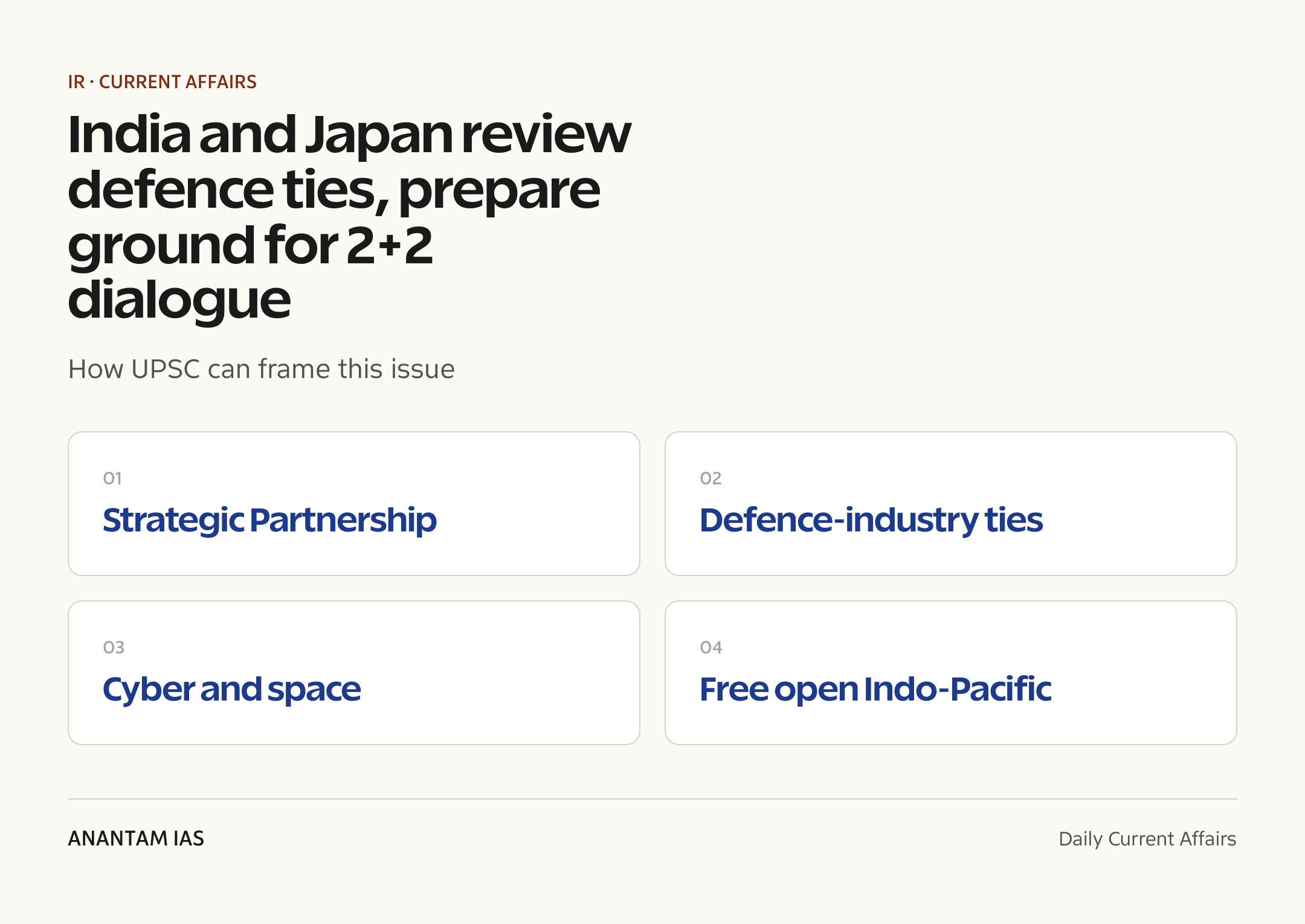
- Dialogue led by Defence Secretary Rajesh Kumar Singh and Japan’s Vice Minister of Defence for International Affairs, Kano Koji.
- Both sides assessed progress since the last round and reaffirmed the India-Japan Special Strategic and Global Partnership.
- Agreed to deepen cooperation in defence-industrial collaboration, cyber security, space and advanced technologies.
- Reviewed military-to-military exchanges, joint-headquarters cooperation, maritime cooperation and bilateral and multilateral exercises.
- Discussed preparations for the upcoming 2+2 ministerial dialogue later in 2026.
- Defence Secretary called on Japan’s Defence Minister Shinjiro Koizumi and invited him to visit India.
The development matters in the context of:
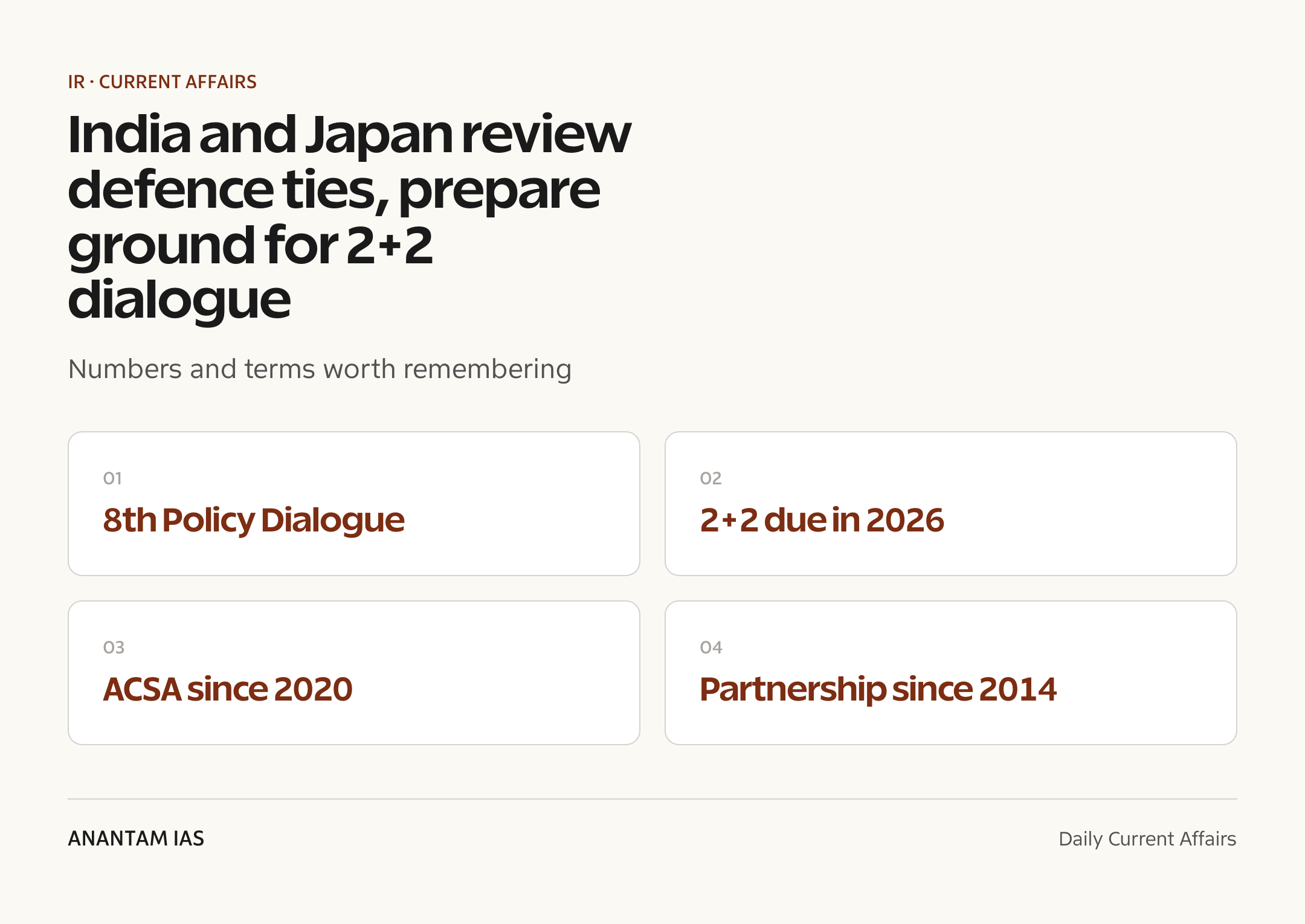
- India-Japan ties were upgraded to a Special Strategic and Global Partnership in 2014.
- The relationship is a core pillar of India’s Act East Policy and its Indo-Pacific engagement.
UPSC Relevance
Prelims Relevance
- India-Japan Special Strategic and Global Partnership (upgraded 2014).
- 2+2 Dialogue format: Foreign + Defence ministers; India’s 2+2 partners include the US, Japan, Australia and Russia.
- ACSA (Acquisition and Cross-Servicing Agreement) signed 2020 for reciprocal logistics support.
- Quadrilateral Security Dialogue (Quad): India, US, Japan, Australia.
- Malabar naval exercise now includes India, US, Japan and Australia.
- Dharma Guardian: India-Japan bilateral army exercise; JIMEX: bilateral naval exercise.
- Free and Open Indo-Pacific (FOIP): concept articulated by Japan.
- Defence Policy Dialogue is a Defence Secretary / Vice Minister level institutional mechanism.
Mains Relevance
GS Paper 2
- India-Japan defence and security cooperation as a stabilising factor in the Indo-Pacific.
- Role of 2+2 ministerial dialogues in deepening strategic partnerships.
- Bilateral defence-industrial and technology collaboration and Atmanirbharta in defence.
Essay
- Balance of power and cooperative security in a multipolar Asia.
Background and Context
The 8th Defence Policy Dialogue: what happened
The Tokyo meeting was an institutional stock-take of defence ties, not a treaty-signing event.
- Held on Monday in Tokyo, led by Defence Secretary Rajesh Kumar Singh and Vice Minister Kano Koji.
- As per the Ministry of Defence, both sides assessed progress since the last round and reaffirmed the Special Strategic and Global Partnership.
- Talks spanned the regional and global security environment and issues of mutual strategic interest.
- Reviewed military-to-military exchanges, cooperation between the two countries’ joint headquarters, maritime cooperation and bilateral and multilateral exercises.
- Also reviewed capacity building and defence equipment and technology collaboration, particularly in the maritime domain.
- Both sides stressed the importance of sustaining regular high-level exchanges and institutional dialogue.
- Defence Secretary Rajesh Kumar Singh called on Japan’s Defence Minister Shinjiro Koizumi and laid a wreath at the Self-Defense Forces Memorial in Tokyo.
- Both agreed to promote a free, open and rules-based regional order grounded in respect for international law.
India-Japan Special Strategic and Global Partnership
The partnership is the top tier of India’s bilateral relationships, upgraded in 2014.
- Elevated to a Special Strategic and Global Partnership during PM Modi’s 2014 visit to Japan.
- Anchored in shared democratic values, maritime interests and a stable, rules-based Indo-Pacific.
- Japan is a key partner in India’s Act East Policy and in high-speed rail, infrastructure and connectivity.
- Japan is financing the Mumbai-Ahmedabad High-Speed Rail (bullet train) project through low-interest yen loans.
- Regular annual summits between the two Prime Ministers guide the relationship.
- The two economies are linked through the India-Japan Comprehensive Economic Partnership Agreement (CEPA) of 2011.
- Development cooperation extends to India’s North East and to third-country projects in South Asia and Africa.
- Defence has moved from cautious engagement to institutionalised cooperation across the three services.
The 2+2 dialogue format
The 2+2 brings foreign and defence ministers together to align diplomacy with security.
- A 2+2 dialogue pairs the Foreign and Defence ministers of both countries in a single mechanism.
- India holds 2+2 dialogues with the United States, Japan, Australia and Russia.
- The India-Japan 2+2 was launched in 2019, upgrading an earlier foreign-and-defence secretary-level format; the next round is expected later in 2026.
- The format lets partners synchronise strategic messaging with concrete defence deliverables.
- It sits above working-level mechanisms such as the Defence Policy Dialogue and service-to-service staff talks.
- The 2+2 typically reviews maritime security, defence-technology cooperation and the regional security environment.
- The Tokyo policy dialogue was explicitly aimed at preparing outcomes for the coming ministerial 2+2.
Defence agreements and exercises
A web of pacts and drills gives the partnership operational depth.
- The ACSA (Acquisition and Cross-Servicing Agreement), signed in 2020, enables reciprocal provision of supplies and services between the two militaries, easing joint exercises and operations.
- An Agreement on Transfer of Defence Equipment and Technology (2015) underpins joint development efforts.
- Both are members of the Quad (with the US and Australia) and of the Malabar naval exercise, which Japan joined permanently.
- Bilateral drills include Dharma Guardian (army), JIMEX (navy) and the Shinyuu Maitri air-force exercise.
- Cooperation is expanding into Unmanned Ground Vehicles and other defence-technology projects.
- The two navies have collaborated on the UNICORN (Unified Complex Radio Antenna) mast for warships, an early India-Japan defence-industrial project.
- Fighter-pilot and staff-level exchanges add depth to service-to-service ties.
Emerging domains: cyber, space and industry
The new frontier of cooperation is technology and economic security, not just hardware.
- Both sides agreed to deepen ties in cyber security, space and advanced technologies.
- Defence-industrial collaboration aims to link Indian manufacturing with Japanese technology and capital.
- Cooperation supports India’s push for Atmanirbharta (self-reliance) in defence production.
- Economic security – resilient supply chains and critical technologies – is now a shared strategic concern.
- The two sides cooperate on semiconductors and critical and emerging technologies, including under an industry-competitiveness partnership.
- Critical minerals and rare-earth supply chains are a focus, given the drive to reduce dependence on a single supplier.
- Space cooperation includes potential collaboration on lunar exploration and satellite-based maritime domain awareness.
- Read more on India’s neighbourhood and strategic outreach in our international relations notes.
Strategic drivers in the Indo-Pacific
Shared anxieties about a changing regional balance push the two closer.
- Both back a Free and Open Indo-Pacific (FOIP), a concept first articulated by Japan.
- Concerns over China’s assertive maritime behaviour in the East and South China Seas shape the convergence.
- The partnership complements minilaterals such as the Quad and the India-Japan-Australia Supply Chain Resilience Initiative (SCRI).
- Maritime domain awareness, freedom of navigation and secure sea lanes of communication are recurring priorities.
- Japan’s evolving security posture, including higher defence spending, expands the scope for cooperation.
- Stability in the Indo-Pacific matters for India’s trade, energy imports and diaspora interests across the region.
- See our broader coverage of the Indo-Pacific and Quad for context.
Way Forward
Convert dialogue into deliverables
- Firm up concrete outcomes for the 2+2 ministerial, including new defence-technology projects.
- Operationalise ACSA through more frequent logistics support during joint exercises.
- Advance defence-industrial co-development, including Unmanned Ground Vehicle collaboration.
- Deepen cyber and space cooperation with clear working-level mechanisms.
- Strengthen economic-security coordination on critical technologies and supply chains, alongside the Quad.
Conclusion
The 8th Defence Policy Dialogue shows a maturing India-Japan partnership that is moving steadily from summit rhetoric to institutionalised, technology-led defence cooperation across the maritime, cyber and space domains.
With the 2+2 ministerial due later in 2026, the challenge for both capitals is to translate strategic convergence into concrete industrial, cyber and maritime deliverables that anchor a stable, rules-based Indo-Pacific and reinforce the wider Quad framework.
UPSC Practice Questions
Prelims MCQ 1
With reference to India-Japan defence cooperation, consider the following statements:
- India and Japan have signed an Acquisition and Cross-Servicing Agreement (ACSA) for reciprocal logistics support.
- India holds a 2+2 dialogue involving Foreign and Defence Ministers with Japan.
- Japan is a participant in the Malabar naval exercise.
How many of the above statements are correct?
(a) Only one (b) Only two (c) All three (d) None
Answer: (c) All three
Explanation:
All three are correct. India and Japan signed the ACSA in 2020. The India-Japan 2+2 (Foreign + Defence Ministers) was launched in 2019. Japan is a permanent participant in the Malabar exercise, which also includes the US and Australia.
Prelims MCQ 2
The 8th India-Japan Defence Policy Dialogue held in Tokyo was chaired on the Indian side by which official?
(a) The Defence Minister (b) The Defence Secretary (c) The Chief of Defence Staff (d) The National Security Adviser
Answer: (b) The Defence Secretary
Explanation:
The Defence Policy Dialogue is an institutional mechanism at the Defence Secretary / Vice Minister level. The 8th round was led by Defence Secretary Rajesh Kumar Singh and Japan’s Vice Minister of Defence for International Affairs, Kano Koji.
UPSC Mains Questions
- India-Japan defence cooperation has become a stabilising pillar of the Indo-Pacific order. Discuss the institutional mechanisms and emerging domains driving this partnership. (GS Paper 2)
- The 2+2 ministerial format has emerged as a key instrument of India’s strategic diplomacy. Examine its significance with reference to India-Japan relations. (GS Paper 2)
Sources: The Hindu and Ministry of Defence, Government of India.
Frequently Asked Questions
What is the India-Japan Defence Policy Dialogue?
It is an institutional mechanism at the Defence Secretary / Vice Minister level where India and Japan review the full spectrum of their defence cooperation. The 8th round was held in Tokyo, led by Defence Secretary Rajesh Kumar Singh and Vice Minister Kano Koji.
What is the 2+2 ministerial dialogue?
A 2+2 dialogue brings together the Foreign and Defence Ministers of both countries in a single mechanism, aligning diplomacy with security cooperation. India holds 2+2 dialogues with the US, Japan, Australia and Russia; the next India-Japan 2+2 is expected later in 2026.
What is the Special Strategic and Global Partnership?
It is the highest tier of the India-Japan relationship, upgraded to this status in 2014. It covers strategic, economic, technological and defence cooperation across a shared Indo-Pacific vision.
What is the ACSA between India and Japan?
The Acquisition and Cross-Servicing Agreement, signed in 2020, allows the militaries of both countries to provide each other supplies and services such as fuel and provisions on a reciprocal basis, easing joint exercises and operations.
Which exercises do India and Japan conduct together?
Bilaterally they hold Dharma Guardian (army) and JIMEX (navy). Japan also participates with India, the US and Australia in the multilateral Malabar naval exercise and the Quad framework.
Why does this partnership matter for the Indo-Pacific?
Both countries support a free, open and rules-based Indo-Pacific. Their defence-industrial, cyber and maritime cooperation, along with the Quad, helps balance regional power shifts and secure critical sea lanes and supply chains.
Source: https://anantamias.com/current-affairs/india-japan-defence-dialogue-2plus2-preparation/
Border States flag illegal migrants on voter rolls and rising drone smuggling
Why in News?
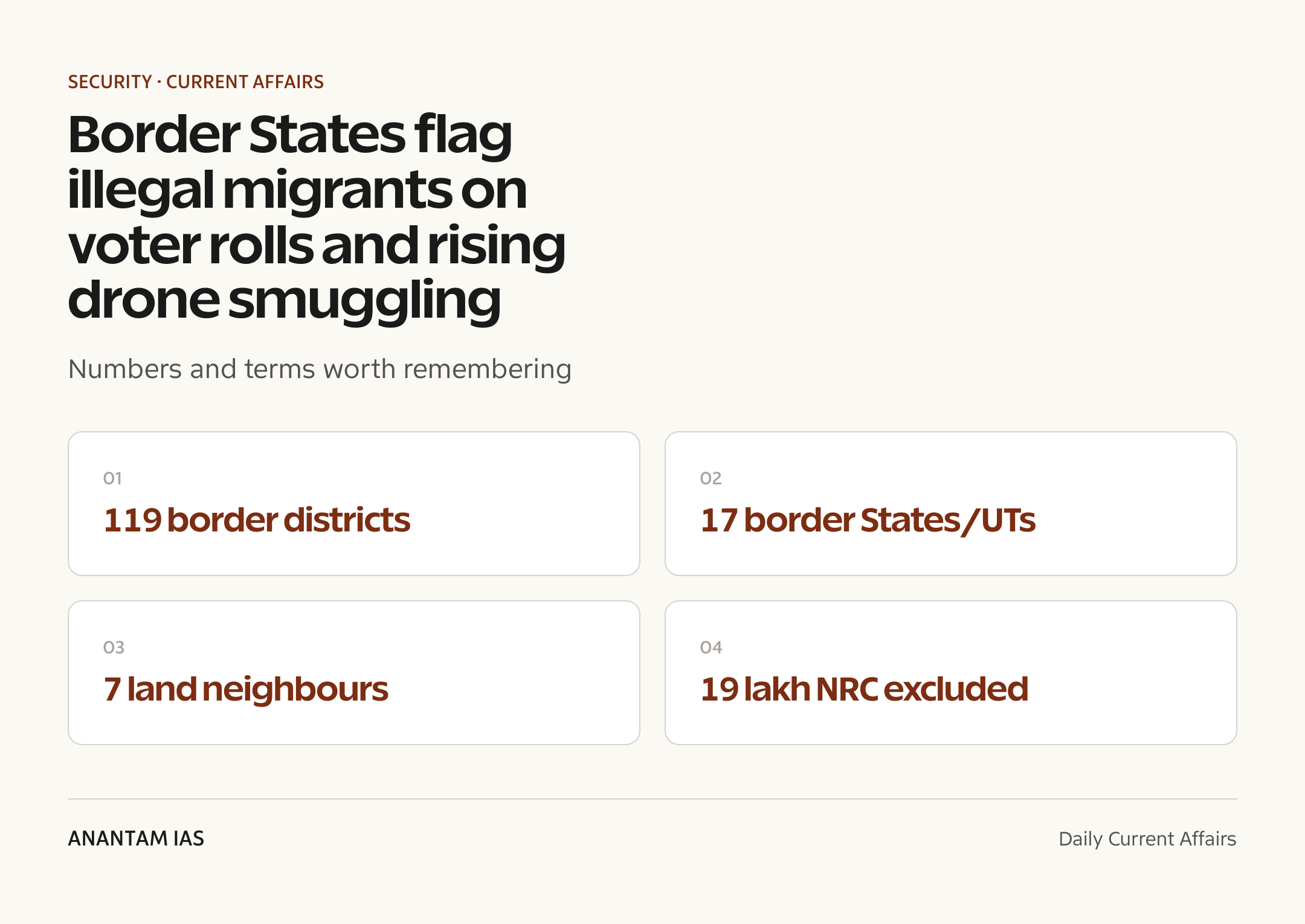
At the first-ever Land Border Districts’ Superintendents of Police Conference 2026, held on July 9 and addressed by the Home Minister, police chiefs from 119 border districts flagged a cluster of internal-security concerns along India’s land frontiers, according to The Hindu.
The states raised the presence of illegal migrants on electoral rolls, a sharp rise in drone-enabled smuggling of weapons and narcotics across the Pakistan border, misuse of encrypted apps by criminal and terror networks, and the emptying-out of border villages for want of infrastructure and jobs.
The conference marked a shift toward treating district police as a frontline layer of border management, sitting alongside the central armed police forces that actually man the fence, and toward feeding grassroots intelligence on demographic change up to national decision-makers.
Border management is a recurring GS Paper 3 theme, tying together infiltration, the narco-terror nexus, technology on the frontier, and border-area development, so the concerns discussed map directly onto the syllabus.
- First-ever conference of SPs of 119 border districts, held on July 9 in New Delhi.
- Attended by the Union Home Secretary, Director of the Intelligence Bureau, and DGPs of 17 States and Union Territories with land borders.
- Covers frontiers with Pakistan, Nepal, Bangladesh, Bhutan, China and Myanmar.
- Five sessions spanned transborder terrorism, organised crime, border-guarding challenges, financial crimes, demographic change and community engagement.
- States to submit suggestions by December; a quadrangular security grid linking border communities and local police to be finalised over the next one and a half years.
The development matters in the context of:
- India shares roughly 15,000 km of land borders with seven neighbours, guarded mainly by the BSF, SSB and ITBP.
- Border management sits squarely in GS Paper 3 internal security: infiltration, cross-border smuggling, technology on borders, and the linkages between organised crime and terrorism.
UPSC Relevance
Prelims Relevance
- Border-guarding forces: BSF (Pakistan and Bangladesh), SSB (Nepal and Bhutan), ITBP (China), Assam Rifles (Myanmar).
- Comprehensive Integrated Border Management System (CIBMS) and technology-led surveillance on the frontier.
- Vibrant Villages Programme for development of border villages.
- Anti-drone / Anti-Rogue Drone systems and drone-forensics laboratories.
- Constitutional and legal basis of the electoral roll and Special Intensive Revision (SIR).
- National Register of Citizens (NRC) in Assam and its exclusions.
- Intelligence and coordination bodies: Intelligence Bureau, MHA’s border-management division.
- Encrypted communication apps used for smuggling and the challenge of lawful interception.
Mains Relevance
GS Paper 3
- Security challenges and their management in border areas; linkages of organised crime with terrorism.
- Role of technology (drones, anti-drone systems, CIBMS) and border-area development in a comprehensive border-management strategy.
Essay
- Security and development are two sides of the same coin at the border.
Background and Context
The conference and who was in the room
The meeting brought district-level policing to the centre of border management for the first time, complementing the work of the central armed police forces.
- The Land Border Districts’ SP Conference 2026 was the first gathering of its kind, held on July 9 in New Delhi.
- It was attended by SPs of 119 border districts, the Union Home Secretary, the IB Director, and DGPs of 17 border States and UTs.
- Five sessions were held on transborder terrorism, insurgency and organised crime, challenges in border guarding, financial crimes and illegal flow of funds, changes in demography and habitation, and community engagement for border development.
- The Home Minister asked SPs to report abnormal population growth in border areas up the chain of command at the earliest.
Illegal migration and the electoral roll
The states raised how forged documents can let illegal migrants slip onto voter lists, a governance and security concern rather than a partisan one.
- Assam Police presented a case study of an illegal migrant from Bangladesh who obtained a forged school-leaving certificate, allotted parents to fake lineage, then a passport and voter card, and was not excluded from the roll.
- The Special Intensive Revision (SIR) of electoral rolls, carried out elsewhere, was not undertaken in Assam because the state’s National Register of Citizens (NRC), finalised in 2019, is yet to be published.
- More than 19 lakh of Assam’s 3.29 crore applicants were excluded from the register.
- The Chief Election Commissioner noted the revision is meant to include eligible voters and exclude the ineligible.
Drones and encrypted apps: the new smuggling toolkit
The frontier fight has moved into the air and into encrypted channels, stretching conventional border-guarding.
- A rise in drones along the Pakistan border to drop weapons and narcotics was flagged.
- Officers suggested making more drone laboratories operational to forensically study the flight path of unmanned aerial objects sent from across the border.
- Drone forensics aims to recover the flight log, launch coordinates and payload signature of a recovered craft, helping trace handlers and smuggling corridors.
- Criminals and terror groups were reported using encrypted apps such as WhatsApp, Skred and Zangi, which officers described as difficult to break into.
- The threat has pushed India toward Anti-Rogue Drone Technology and counter-UAS grids that use radar, radio-frequency jamming, spoofing and laser or net-based interception to detect and neutralise hostile drones.
- The narco-terror nexus in Punjab and Jammu shows the danger: drone drops feed drug trafficking, and the proceeds finance arms supply and terror modules, blurring the line between organised crime and terrorism.
Emptying border villages and demographic change
Depopulated border hamlets weaken the country’s first line of surveillance, which is why development is treated as a security measure.
- Officials warned that border villages cannot be left to border-guarding forces and police alone.
- Migration out of border villages, driven by a lack of infrastructure and jobs, was flagged as a security concern.
- The Vibrant Villages Programme (VVP) was listed among initiatives to reverse this hollowing-out.
- VVP is a centrally sponsored scheme to develop villages along the northern border with road connectivity, drinking water, electricity, mobile and internet links, tourism and livelihood support, so residents stay and act as the eyes and ears of the security grid.
- A second phase has been extended to cover villages along other international borders, widening the model beyond the China frontier.
- Concerns over shifting demography were raised for Murshidabad in West Bengal and a reported growth of mosques near the Pakistan border in Rajasthan; the open Nepal border was cited as a route misused by pro-Khalistani elements to enter Punjab.
India's border-management architecture
The concerns map onto an existing framework of forces, fencing and technology that GS3 aspirants must know, with one lead force designated for each frontier under the one-border-one-force principle.
- The Border Security Force (BSF) guards the borders with Pakistan (about 3,300 km) and Bangladesh (about 4,100 km), the two longest and most fenced stretches.
- The Sashastra Seema Bal (SSB) guards the open and largely un-fenced borders with Nepal (about 1,750 km) and Bhutan (about 700 km).
- The Indo-Tibetan Border Police (ITBP) guards the high-altitude border with China (about 3,488 km) along the Line of Actual Control.
- The Assam Rifles guards the border with Myanmar (about 1,640 km), the terrain of insurgency and the earlier Free Movement Regime.
- India’s land borders are of four broad types: fenced and settled (much of the Pakistan and Bangladesh borders), open (Nepal and Bhutan), high-altitude and disputed (China), and forested and porous (Myanmar), each needing a different mix of guarding.
- The Comprehensive Integrated Border Management System (CIBMS) layers thermal imagers, ground sensors, radars, cameras and command-and-control centres over riverine and unfenced gaps, backed by laser walls and smart-fencing pilots on stretches where physical fencing is hard.
- The Ministry of Home Affairs runs border-infrastructure and border-area development schemes, and anti-narcotics coordination bodies, to knit hard security with local welfare.
The road mapped at the meeting
The conference set a concrete follow-up mechanism rather than ending with a list of grievances.
- States were asked to submit their suggestions by December.
- A quadrangular security grid involving border communities and local police is to be finalised over the next one and a half years.
- The design reflects a shift toward bottom-up intelligence, feeding grassroots inputs to national decision-makers.
- It positions district police as an active partner alongside the central armed police forces on the frontier.
Way Forward
Close the document-fraud loop
- Tighten verification of birth and school certificates and link identity issuance to auditable trails so forged lineage cannot reach the electoral roll.
- Coordinate the Election Commission, police and civil registration so revisions add eligible voters and remove the ineligible without excluding genuine citizens.
Scale counter-drone and forensic capacity
- Make more drone laboratories operational and expand anti-rogue drone coverage on the most-hit stretches of the Pakistan border.
- Invest in lawful-interception and analytics capacity for encrypted-app abuse, within legal and privacy safeguards.
Make development a security tool
- Accelerate the Vibrant Villages Programme so roads, connectivity and livelihoods keep border populations rooted.
- Operationalise the quadrangular security grid to turn residents into partners in surveillance and early warning.
Conclusion
The concerns aired at the first Land Border Districts’ SP Conference, as reported by The Hindu, cut across identity fraud, air-borne smuggling, encrypted crime and the quiet hollowing-out of frontier villages.
A durable answer blends hard capability, better forces, drone forensics, tighter documents, with soft power at the border, roads, jobs and rooted communities, so that security and development reinforce each other rather than compete.
UPSC Practice Questions
Prelims MCQ 1
With reference to India’s border-guarding forces, consider the following statements:
- The Border Security Force guards India’s borders with both Pakistan and Bangladesh.
- The Sashastra Seema Bal guards the India-Nepal and India-Bhutan borders.
- The Indo-Tibetan Border Police guards the India-Myanmar border.
How many of the above statements are correct?
(a) Only one (b) Only two (c) All three (d) None
Answer: (b) Only two
Explanation:
The BSF guards the Pakistan and Bangladesh borders, and the SSB guards the Nepal and Bhutan borders, so statements 1 and 2 are correct. The ITBP guards the India-China border; the India-Myanmar border is guarded by the Assam Rifles, so statement 3 is wrong.
Prelims MCQ 2
The ‘Vibrant Villages Programme’, in the news in the context of border management, is primarily aimed at:
(a) Deploying anti-drone systems along the western border (b) Developing infrastructure and livelihoods in border villages to check out-migration (c) Revising electoral rolls in border districts (d) Setting up drone-forensics laboratories
Answer: (b) Developing infrastructure and livelihoods in border villages to check out-migration
Explanation:
The Vibrant Villages Programme is a Union scheme to provide roads, connectivity, livelihoods and amenities in border villages so that populations stay rooted, strengthening the first line of surveillance. Anti-drone systems, roll revisions and drone labs are separate measures.
UPSC Mains Questions
- Depopulating border villages weaken national security as much as any external threat. Examine, with reference to India’s border-area development initiatives.
- Drone-enabled smuggling and encrypted communication have redefined the challenge of border management. Discuss the technological and institutional responses India needs.
Source: The Hindu.
Frequently Asked Questions
What was the Land Border Districts’ SP Conference 2026?
It was the first-ever conference of Superintendents of Police from India’s land-border districts, held on July 9, 2026 and addressed by the Home Minister, to discuss border-security concerns. The Hindu reported that SPs of 119 border districts attended.
Why is illegal migration on electoral rolls a security concern?
When illegal migrants obtain forged documents and reach the voter list, it points to gaps in identity verification and can distort local demography and governance in sensitive border areas. Assam presented a case study of such document fraud at the conference.
How are drones used for smuggling across the Pakistan border?
Small unmanned aircraft are flown across to drop weapons and narcotics, feeding a narco-terror nexus. Officers suggested more drone laboratories to forensically trace the flight paths of these objects.
What is the Comprehensive Integrated Border Management System (CIBMS)?
CIBMS is a technology-led surveillance system that layers sensors, radars, cameras and command-and-control centres over vulnerable border stretches to detect intrusion, supplementing physical fencing and patrolling.
Which forces guard India’s different land borders?
The BSF guards the Pakistan and Bangladesh borders, the SSB the Nepal and Bhutan borders, the ITBP the China border, and the Assam Rifles the Myanmar border, all under the Ministry of Home Affairs.
What is the proposed quadrangular security grid?
It is a follow-up mechanism discussed at the conference that links border communities with local police, to be finalised over about a year and a half, aimed at bottom-up intelligence and community engagement in border security.
Source: https://anantamias.com/current-affairs/border-states-illegal-migrants-drones-voter-rolls/
Cyber fraud complaints cross 12.7 lakh in six months, with over Rs 10,000 crore lost
Why in News?
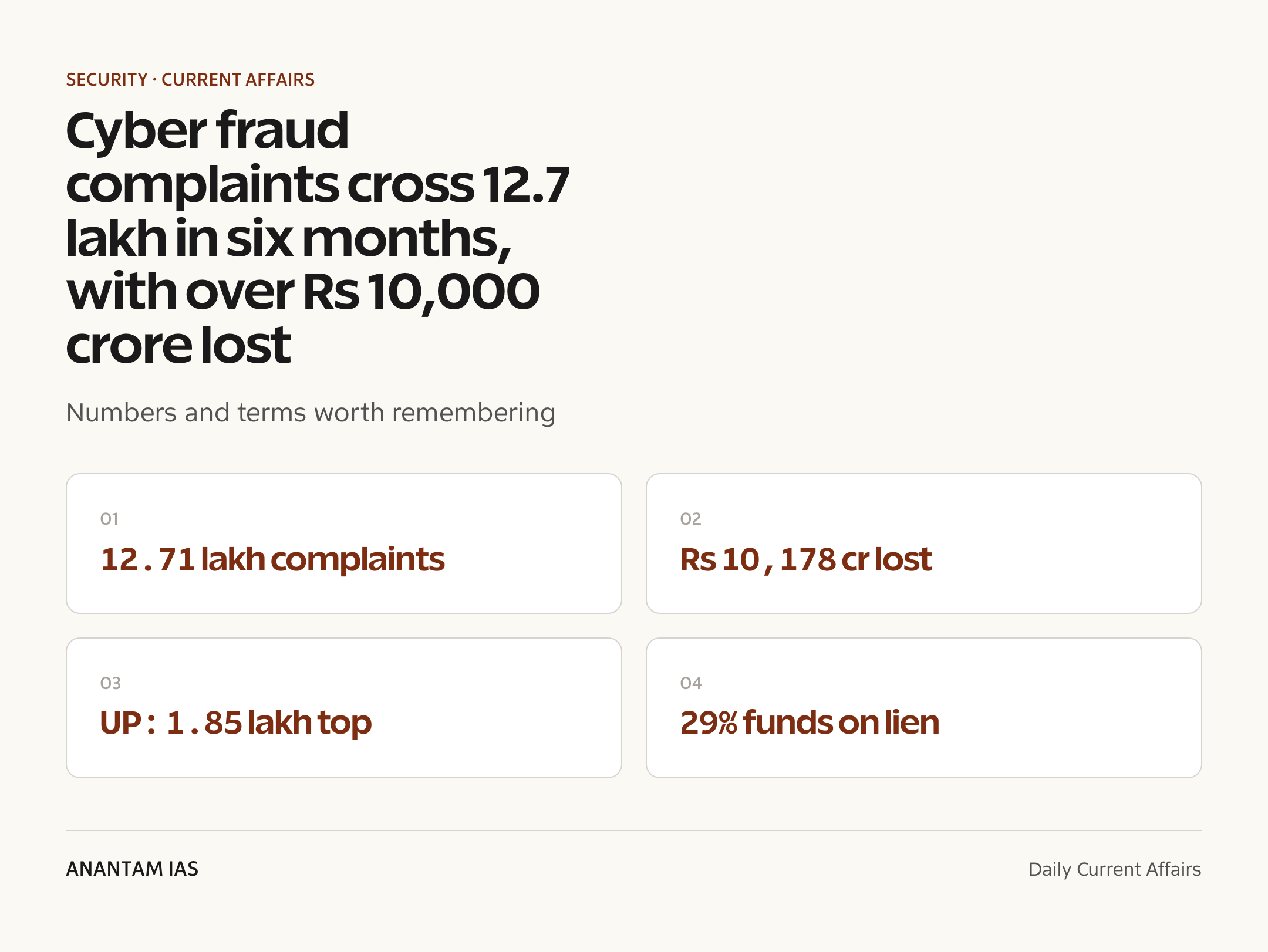
Data reviewed at a Union Ministry of Home Affairs meeting, reported by The Indian Express, shows India recorded more than 12.71 lakh financial cyber fraud complaints between 1 January and 30 June 2026, with victims reporting alleged fraudulent transactions worth over Rs 10,178 crore.
The half-yearly figure works out to roughly 7,000 complaints a day, or nearly Rs 56 crore reported lost each day, underlining how fast financial cybercrime is scaling across states.
The numbers put the spotlight back on India’s cybercrime-governance machinery, the reach of the National Cyber Crime Reporting Portal and 1930 helpline, and the persistent gap between money lost and money actually recovered.
For UPSC, the story sits squarely in GS Paper 3 internal security: it connects cyber threats, the role of the Indian Cyber Crime Coordination Centre (I4C), banking and RBI safeguards, and the legal frame of the IT Act, 2000 and the DPDP Act, 2023.
- 12.71 lakh complaints in six months (1 Jan to 30 Jun 2026); losses over Rs 10,178.97 crore.
- Uttar Pradesh led on complaint volume (1.85 lakh); Maharashtra saw the highest money lost (Rs 1,637.66 crore).
- Data discussed at a meeting chaired by senior MHA officials on cyber fraud and prevention.
- Only Rs 2,968.85 crore was placed under bank lien/hold, a lien rate of about 29 percent.
- Complaint drivers: online investment fraud, digital arrest scams, loan-app fraud, phishing, and impersonation.
The development matters in the context of:
- Financial cyber fraud complaints route through the Citizen Financial Cyber Fraud Reporting and Management System linked to the 1930 helpline.
- The nodal body is the Indian Cyber Crime Coordination Centre (I4C) under the Ministry of Home Affairs.
UPSC Relevance
Prelims Relevance
- I4C: nodal MHA body coordinating cybercrime response; runs the NCRP (cybercrime.gov.in).
- 1930: national cyber-fraud financial helpline for quick reporting of money loss.
- Citizen Financial Cyber Fraud Reporting and Management System: enables rapid freezing of defrauded funds.
- Digital arrest: scam where fraudsters impersonate police/agencies to extort victims via video call.
- Mule accounts: bank accounts used to layer and move stolen money.
- CERT-In: national nodal agency for cybersecurity incident response under MeitY.
- Chakshu / Sanchar Saathi: DoT platforms to report fraud communication and block suspect connections.
- IT Act 2000 and DPDP Act 2023: core statutes on cyber offences and personal-data protection.
- e-Zero FIR: converts high-value cyber-fraud complaints on NCRP into FIRs automatically.
- Lien/hold: temporary bank freeze on suspect funds pending investigation.
Mains Relevance
GS Paper 3
- Rising cybercrime as an internal-security and economic-security challenge; institutional response through I4C and NCRP.
- Money-recovery gap and the role of banks, RBI digital-payment safeguards, and mule-account crackdowns.
Essay
- Trust and technology: securing India’s digital public infrastructure
Background and Context
What the six-month data shows
The dataset, discussed at an MHA-chaired meeting, maps the scale and geography of financial cyber fraud in the first half of 2026.
- More than 12.71 lakh complaints between 1 January and 30 June 2026, with reported losses over Rs 10,178.97 crore.
- Uttar Pradesh topped complaint counts at 1.85 lakh, followed by Maharashtra (1.58 lakh), Karnataka (1.21 lakh), Gujarat (97,937), and Bihar (93,137).
- The next tier included Rajasthan (75,883), West Bengal (72,439), Delhi (64,496), Tamil Nadu (63,116), and Haryana (58,721).
- On money lost, Maharashtra led with Rs 1,637.66 crore, then Karnataka (Rs 1,097.37 crore), Tamil Nadu (Rs 897.79 crore), Uttar Pradesh (Rs 734.19 crore), and Gujarat (Rs 643.82 crore).
- Notably, Chandigarh (Rs 630.53 crore) and Telangana (Rs 614.18 crore) reported large losses despite smaller populations, hinting that high losses track digital-payment density, not just population size.
- Smaller units varied widely: Lakshadweep logged 37 complaints, Ladakh 174, Andaman and Nicobar 406, Mizoram 432, and Nagaland 455.
- The pattern shows financial cyber fraud is now a nationwide phenomenon, not confined to metros, cutting across large and small states alike.
Who investigates: I4C and the reporting portal
India’s cybercrime response is anchored in a dedicated coordination centre and a public reporting portal.
- The Indian Cyber Crime Coordination Centre (I4C), set up in 2018 under the Ministry of Home Affairs, is the nodal body coordinating cybercrime action across states and Union Territories.
- I4C works through seven verticals, including the National Cybercrime Threat Analytics Unit, the National Cybercrime Reporting Portal vertical, a forensic lab, a training and capacity-building arm, and an ecosystem-management unit.
- The National Cyber Crime Reporting Portal (NCRP) at cybercrime.gov.in lets citizens file complaints, especially on financial fraud and online offences against women and children.
- The 1930 helpline is the fast-response channel for reporting money loss so funds can be flagged before they are withdrawn.
- I4C also runs a Cyber Fraud Mitigation Centre and coordinates with banks, payment aggregators, telecom firms, and platforms to act on flagged accounts and numbers.
- Read more on how the state secures cyberspace in our note on internal security.
How money is frozen and recovered
Speed matters: the earlier a fraud is reported, the higher the chance banks can freeze the money in transit.
- Complaints on financial fraud flow through the Citizen Financial Cyber Fraud Reporting and Management System, which links the helpline to banks, wallets, and payment intermediaries in near-real time.
- When a victim calls 1930 or files on NCRP, a ticket flows to the relevant bank and beneficiary bank, which can place a lien or hold on the suspect amount before it is withdrawn.
- Of the 12.71 lakh complaints, 2.86 lakh were pushed for banking action and 2.70 lakh were taken up by banks under this system.
- Banks placed liens or holds on Rs 2,968.85 crore, an overall lien rate of about 29.17 percent of the reported loss, meaning roughly seven of every ten rupees escaped the freeze.
- The golden hour matters: the sooner a fraud is reported, the higher the chance of a successful freeze before money is layered onward.
- The rest often moves quickly through layers of mule accounts and is withdrawn via ATMs, wallets, or crypto, making recovery difficult once funds are cashed out.
The recovery gap over time
Longer-run figures show how little of the stolen money ever returns to victims.
- Between 2021 and May 2026, people reported cybercrime losses of about Rs 64,447 crore.
- Of this, roughly Rs 10,718 crore was frozen as a lien, but only about Rs 323 crore has been refunded to victims.
- The gap reflects delays in reporting, rapid fund layering, and the challenge of tracing money once it exits the formal banking rails.
- Officials have highlighted parallel wins, including funds saved through timely intervention and the rollout of e-Zero FIR for high-value cases.
Fraud types driving the surge
The complaint mix has shifted toward social-engineering scams that exploit fear and greed rather than technical hacking.
- Digital arrest scams: fraudsters posing as police, CBI, or customs keep victims on prolonged video calls, allege parcels or money-laundering, and extort payments under threat of arrest.
- Investment and trading fraud (often called pig-butchering): victims are groomed over weeks on fake apps and chat groups promising high returns before being drained.
- Loan-app fraud, phishing, and impersonation using fraudulent links circulated through messaging and social-media platforms.
- Many scams originate from organised networks, some operating from cross-border scam compounds in Southeast Asia, using trafficked workers to run the operations.
- Mule accounts and SIM fraud are central to the model: stolen money is routed through rented or fraudulently opened accounts before being cashed out.
- These are largely social-engineering crimes that exploit fear, greed, and urgency, which makes public awareness as important as technical defences.
The wider governance and legal frame
Cyber fraud sits at the intersection of policing, telecom regulation, banking safeguards, and data-protection law.
- The Information Technology Act, 2000 covers cyber offences (identity theft, cheating by impersonation, and hacking under Sections 66C, 66D, and 66), while cheating and forgery are also charged under the Bharatiya Nyaya Sanhita.
- The Digital Personal Data Protection Act, 2023 governs the handling of personal data, raising the stakes for institutions that leak data later used in targeted fraud.
- CERT-In under MeitY is the national nodal agency for cybersecurity incident response and issues directions on breach reporting.
- The Department of Telecommunications runs Sanchar Saathi and its Chakshu facility to report suspected fraud calls and messages and to block fraudulently obtained connections.
- The RBI has tightened digital-payment safeguards, including additional-factor authentication, transaction alerts, and cooling-off rules for new payees and beneficiaries.
- Regulators are also pushing banks to detect and freeze mule accounts faster through transaction-pattern monitoring and shared intelligence.
- See our related coverage of science and technology in governance.
Way Forward
Close the recovery gap
- Push faster bank action on 1930 alerts so liens are placed before funds are withdrawn.
- Strengthen the Citizen Financial Cyber Fraud Reporting and Management System with real-time bank coordination.
Choke the money trail
- Crack down on mule accounts through KYC audits, transaction-pattern monitoring, and quicker account freezes.
- Deepen RBI safeguards on digital payments and inter-bank data sharing on suspect accounts.
Prevention and awareness
- Scale public campaigns on digital arrest and investment scams, especially in high-volume states.
- Expand DoT tools like Chakshu and Sanchar Saathi to block fraud numbers and links early.
Capacity and coordination
- Build state cyber-cell capacity and forensic skills under I4C coordination.
- Improve cross-border cooperation to trace networks operating from outside India.
Conclusion
The six-month numbers are less a one-off spike than a signal that financial cyber fraud has become a structural internal-security and economic-security challenge for India.
With losses far outrunning recoveries, the real test is speed and coordination: faster reporting through 1930, quicker bank freezes, a sustained squeeze on mule accounts, and prevention that reaches citizens before the scam does.
UPSC Practice Questions
Prelims MCQ 1
With reference to India’s cybercrime framework, consider the following statements:
- The Indian Cyber Crime Coordination Centre (I4C) functions under the Ministry of Home Affairs.
- The National Cyber Crime Reporting Portal is operated at cybercrime.gov.in.
- The 1930 helpline is meant for reporting financial cyber fraud for quick action.
How many of the above statements are correct?
(a) Only one (b) Only two (c) All three (d) None
Answer: (c) All three
Explanation:
I4C is the nodal body under the MHA; the NCRP runs at cybercrime.gov.in; and 1930 is the dedicated financial cyber-fraud helpline enabling rapid freezing of funds. All three statements are correct.
Prelims MCQ 2
The term ‘mule account’, often seen in the context of cyber fraud, most appropriately refers to:
(a) A dormant bank account frozen by the RBI for KYC violations (b) An account used to receive and move fraudulently obtained money (c) A joint government account for refunding cyber-fraud victims (d) A test account maintained by banks for payment-system audits
Answer: (b) An account used to receive and move fraudulently obtained money
Explanation:
Mule accounts are used by fraud networks to layer and move stolen funds, making tracing and recovery harder. They are a key focus of cyber-fraud crackdowns.
UPSC Mains Questions
- Financial cyber fraud has emerged as a structural internal-security challenge in India. Examine the institutional response through I4C and the reporting portal, and suggest measures to close the wide gap between money lost and money recovered.
- Discuss how the rise of social-engineering scams such as digital arrest and investment fraud has changed the nature of cybercrime in India. What role can RBI digital-payment safeguards and DoT tools play in curbing them?
Source: The Indian Express.
Frequently Asked Questions
How many cyber fraud complaints did India record in the first half of 2026?
According to data reported by The Indian Express, more than 12.71 lakh financial cyber fraud complaints were recorded between 1 January and 30 June 2026, with reported losses of over Rs 10,178 crore.
Which state reported the most complaints and the most money lost?
Uttar Pradesh led on complaint volume with about 1.85 lakh, while Maharashtra recorded the highest money lost at around Rs 1,637.66 crore.
What is I4C?
The Indian Cyber Crime Coordination Centre is the nodal body under the Ministry of Home Affairs that coordinates India’s cybercrime response and runs the National Cyber Crime Reporting Portal at cybercrime.gov.in.
How does the 1930 helpline help fraud victims?
The 1930 helpline lets victims quickly report financial fraud so that banks, through the Citizen Financial Cyber Fraud Reporting and Management System, can place a lien or hold on the money before it is withdrawn.
Why is so little money recovered?
Fraudsters move money rapidly through layers of mule accounts. Between 2021 and May 2026, of about Rs 64,447 crore reported lost, only around Rs 323 crore was refunded to victims, showing how hard recovery is once funds exit the banking system.
What is a digital arrest scam?
It is a scam where fraudsters impersonate police or agencies, keep victims on a prolonged video call under threat of arrest, and extort money. It is among the fastest-growing cyber-fraud types in India.
Source: https://anantamias.com/current-affairs/cyber-fraud-complaints-12-7-lakh-six-months/
India registers over 99% of births and deaths: why the CRS data matters
Why in News?
India officially recorded more than 99% of its estimated births and deaths in 2024, according to the latest official data highlighted by The Indian Express in an Explained piece. For a country that historically undercounted vital events and leaned on surveys to estimate fertility and mortality, near-universal registration is a quiet but consequential governance milestone.
The gain is steep. Roughly a decade ago birth registration stood at about 86.6% and death registration at only about 72.5%. In 2024 birth registration reached 99.1% and death registration 99.4% – with death registration, historically the laggard, catching up rapidly. The numbers come from the Office of the Registrar General & Census Commissioner of India (ORGI) under the Ministry of Home Affairs.
- In 2024, birth registration reached 99.1% and death registration 99.4% of estimated events – coverage approaching 100%.
- About a decade earlier the figures were roughly 86.6% (births) and 72.5% (deaths), so death registration has closed the gap fastest.
- In 2024, 18 States/UTs achieved 100% birth registration and 21 States/UTs achieved 100% death registration.
- The Civil Registration System (CRS) has been legally operational since 1970 under the Registration of Births and Deaths Act, 1969, amended in 2023.
The development matters in the context of:
- A complete CRS lets India move from decadal Census snapshots and sample estimates toward continuous, near-real-time vital statistics.
- This is a classic GS2 story: registration as a governance service and a data backbone for welfare targeting, insurance, and public-health planning.
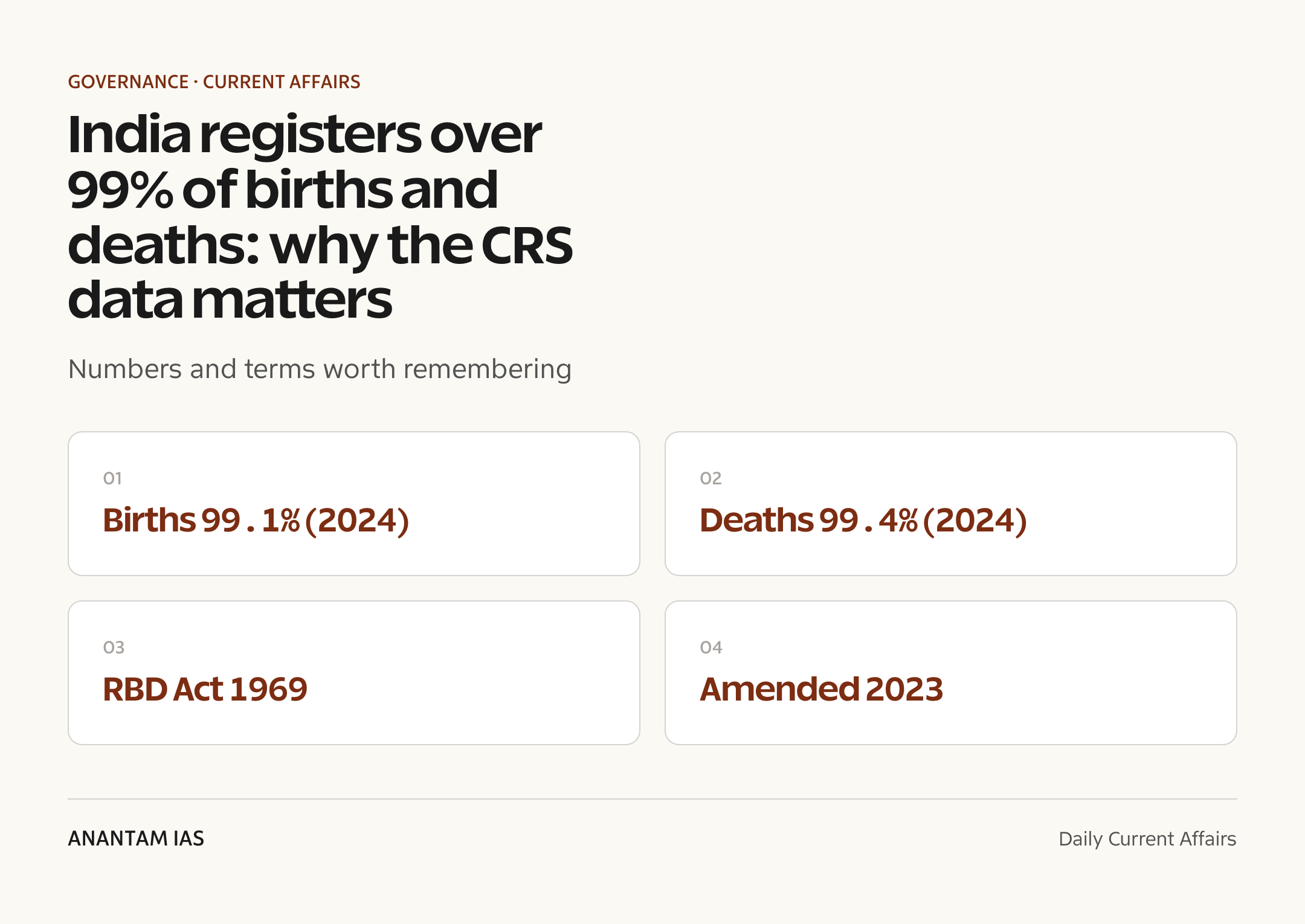
UPSC Relevance
Prelims Relevance
- Civil Registration System (CRS) – continuous, permanent, compulsory recording of vital events (births, deaths, stillbirths); operational since 1970.
- Registration of Births and Deaths Act, 1969 – the legal basis; events must ordinarily be reported within 21 days.
- RBD (Amendment) Act, 2023 – makes the digital birth certificate a single document to prove date and place of birth for admissions, jobs, and other uses.
- Registrar General of India (RGI) / Office of the Registrar General & Census Commissioner – coordinates CRS, Census, and the SRS, under the Ministry of Home Affairs.
- Sample Registration System (SRS) – large-scale sample survey giving reliable birth and death rates (IMR, TFR) at national and state level.
- CRVS – Civil Registration and Vital Statistics, the global term linking legal registration with statistical output.
- Level of registration vs completeness – registered events as a share of estimated events; completeness itself is estimated using SRS.
- Chief Registrar (State) and District/local registrars form the administrative chain under the Act.
- NPR (National Population Register) – the 2023 amendment allows sharing of registration data with the NPR database, which has fuelled debate.
Mains Relevance
GS Paper 2
- Civil registration as a governance and welfare-delivery tool: legal identity, entitlement targeting, and administrative simplification via a single birth document.
- Data governance and privacy: CRS-NPR linkage under the 2023 amendment, consent, and the balance between statistical utility and surveillance concerns.
Essay
- “Counting the citizen”: data, identity and the state’s capacity to see and serve its people.
Background and Context
What the Civil Registration System is
The CRS is the state’s continuous ledger of who is born and who dies – the foundation of legal identity and vital statistics.
- The CRS is the continuous, permanent and compulsory recording of vital events – births, deaths and stillbirths – as they occur.
- It runs under the Registration of Births and Deaths Act, 1969, and has been legally operational since 1970.
- Events must ordinarily be reported within 21 days; in hospitals the medical officer in charge is responsible, and households report events at home.
- The system is coordinated by the Registrar General of India, implemented through Chief Registrars in States and district and local registrars.
- Unlike the Census, the CRS produces a year-on-year flow of data rather than a once-a-decade stock.
The 2024 numbers and the long climb
Registration coverage has jumped from patchy to near-universal in about a decade, with death registration the standout gainer.
- In 2024, birth registration reached 99.1% and death registration 99.4% of estimated events.
- A decade earlier the figures were roughly 86.6% (births) and 72.5% (deaths) – death registration had long lagged.
- Deaths are harder to register than births because there is often no institution, document or clear incentive prompting families to report them.
- In 2024, 18 States/UTs hit 100% birth registration and 21 States/UTs hit 100% death registration.
- Coverage still varies by rural-urban location and across states, so the national average hides pockets of under-registration.
Why complete registration matters
Near-universal CRS turns births and deaths into usable data for policy, and turns certificates into keys that unlock rights.
- A complete CRS is one of the most important sources of vital statistics – fertility, mortality and their trends.
- It supports welfare targeting, evaluation of health and social policies, and demographic and public-health planning.
- Annual, granular data can reveal patterns a decadal Census cannot – for example seasonal mortality shifts linked to heat and pollution.
- A birth certificate is a gateway document for school admission, welfare schemes, and later for pensions, insurance and property.
- A death certificate settles inheritance, property transfer, bank accounts, insurance and pension claims – making prompt registration a real-world necessity.
How CRS relates to the Census and SRS
For decades India read its demography through periodic surveys because the CRS was too incomplete to trust.
- The Census is a full count but runs only once in ten years, so it cannot track year-to-year change.
- The Sample Registration System (SRS) is a large sample survey that yields reliable birth and death rates, IMR and TFR – but not district-level annual figures.
- A near-complete CRS can, over time, supply continuous, local-level estimates the Census and SRS cannot.
- Together, Census, SRS and CRS form India’s CRVS (Civil Registration and Vital Statistics) architecture.
- The goal is a shift from estimating vital events to directly counting them.
The 2023 amendment and digitisation
The Registration of Births and Deaths (Amendment) Act, 2023 pushed registration toward being fully digital, timely and rights-linked.
- The RBD (Amendment) Act, 2023 makes the digital birth certificate a single document to prove date and place of birth.
- It is intended as proof for school admission, driving licence, voter rolls, government jobs, marriage registration and other services.
- The amendment provides for a national and state-level database of registered births and deaths, easing verification.
- By making the certificate essential for education and employment, it builds a strong incentive to register – part of why coverage rose.
- The Act also enables sharing of CRS data with the National Population Register (NPR), electoral rolls and other databases – a provision that has drawn scrutiny.
Caveats: coverage is not the whole story
High registration is a genuine achievement, but the headline figure needs careful reading.
- Level of registration (events registered as a share of estimated events) is not the same as full data quality.
- The completeness of death registration is itself estimated using SRS figures – and the SRS is known to undercount births and deaths, which can overstate CRS coverage.
- Registering a death is not the same as recording a medically certified cause of death; many deaths still lack reliable certification.
- That limits the CRS’s usefulness for disease and mortality analysis even when registration is near-universal.
- The NPR linkage raises data-governance and privacy questions about consent and how registration data is used beyond statistics.
Way Forward
Strengthen cause-of-death certification
- Expand Medical Certification of Cause of Death (MCCD) coverage, especially for deaths outside hospitals, to make CRS clinically useful.
- Train and equip local registrars and health staff to record standardised causes.
Close the rural and inter-state gaps
- Target the remaining rural and under-registered pockets with mobile registration and awareness drives.
- Use panchayats and ASHA/anganwadi workers as last-mile reporting agents.
Guard data quality and privacy
- Publish CRS reports promptly and audit them against SRS to flag over- or under-counting.
- Frame clear data-protection safeguards for CRS-NPR sharing, with consent and purpose limitation.
Conclusion
Near-universal registration of births and deaths is one of India’s understated governance wins – the state can now see its citizens more completely, and citizens can more easily claim the rights that flow from being counted.
The next frontier is quality, not just coverage: certifying causes of death, closing rural gaps, and reconciling the push for integrated databases with credible privacy safeguards. Counting people well is the first step to serving them well.
UPSC Practice Questions
Prelims MCQ 1
With reference to the Civil Registration System (CRS) in India, consider the following statements:
- It functions under the Registration of Births and Deaths Act, 1969.
- It is coordinated at the national level by the Registrar General of India.
- It provides a continuous, year-on-year record of births and deaths, unlike the decennial Census.
How many of the above statements are correct?
(a) Only one (b) Only two (c) All three (d) None
Answer: (c) All three
Explanation:
The CRS operates under the RBD Act, 1969, is coordinated by the Registrar General of India (Office of the Registrar General & Census Commissioner, MHA), and records vital events continuously rather than once a decade like the Census. All three statements are correct.
Prelims MCQ 2
Which one of the following best distinguishes the Sample Registration System (SRS) from the Civil Registration System (CRS)?
(a) The SRS is a large-scale sample survey used to estimate birth and death rates, while the CRS is a continuous registration of individual vital events (b) The SRS registers every birth and death, while the CRS only samples them (c) The SRS is conducted once every ten years, while the CRS is annual (d) The SRS is run by State governments, while the CRS is run only by the Centre
Answer: (a) The SRS is a large-scale sample survey used to estimate birth and death rates, while the CRS is a continuous registration of individual vital events
Explanation:
The SRS is a sample-based demographic survey that yields reliable birth/death rates, IMR and TFR; the CRS is the continuous, compulsory registration of each vital event. The Census (not the SRS) is decadal, and both systems are implemented through State machinery under the Registrar General of India.
UPSC Mains Questions
- “Near-universal registration of births and deaths is a governance achievement, but coverage is not the same as data quality.” Examine, in the context of India’s Civil Registration System. (GS2)
- Discuss how the Registration of Births and Deaths (Amendment) Act, 2023 strengthens civil registration, and analyse the data-governance concerns raised by linking registration data with databases such as the NPR. (GS2)
Sources: The Indian Express (Explained) and Office of the Registrar General & Census Commissioner, India (crsorgi.gov.in).
Frequently Asked Questions
What is the Civil Registration System (CRS)?
The CRS is India’s continuous, permanent and compulsory system for recording vital events – births, deaths and stillbirths – as they occur, under the Registration of Births and Deaths Act, 1969. It is coordinated by the Registrar General of India.
What were India’s birth and death registration levels in 2024?
In 2024, birth registration reached about 99.1% and death registration about 99.4% of estimated events – coverage approaching 100%, up from roughly 86.6% and 72.5% about a decade earlier.
How is the CRS different from the Census and the SRS?
The Census is a full count taken once every ten years; the Sample Registration System (SRS) is a sample survey that estimates birth and death rates. The CRS records every individual event continuously, so it can eventually supply annual, local-level vital statistics.
What did the 2023 amendment change?
The Registration of Births and Deaths (Amendment) Act, 2023 makes the digital birth certificate a single document to prove date and place of birth for admissions, jobs and services, creates national and state databases, and allows sharing registration data with the NPR and electoral rolls.
Why is registration alone not enough?
High registration coverage does not guarantee data quality. Many deaths still lack medically certified causes, the completeness figure is itself estimated using the SRS (which undercounts), and CRS-NPR data sharing raises privacy questions.
Why does the CRS data matter for governance?
Complete vital statistics improve welfare targeting, health and social-policy evaluation, and demographic planning, while birth and death certificates unlock rights like school admission, inheritance, insurance and pensions.
Source: https://anantamias.com/current-affairs/civil-registration-system-99-percent-births-deaths/
India’s first hydrogen train set to roll out on the Jind-Sonipat route
Why in News?
Indian Railways is set to roll out the country’s first hydrogen-powered passenger train on the 89-km Jind-Sonipat section in Haryana, with a flag-off reported by The Indian Express for 17 July at Jind. The trainset runs on a zero-emission hydrogen fuel-cell and battery system instead of diesel or overhead electric wires.
The rollout is a visible marker of the National Green Hydrogen Mission (2023) and the Railways’ goal of net-zero carbon emissions by 2030. Business Standard notes the Railways describes it as among the world’s longest and most powerful hydrogen trainsets, at 2,400 kW.
- First indigenous hydrogen fuel-cell train on a real Indian passenger route, built by converting old diesel rakes.
- Runs on the non-electrified Jind-Sonipat section, showing hydrogen’s fit for routes without overhead wires.
- Ties directly to the National Green Hydrogen Mission and Railways’ net-zero-2030 pledge.
- One of the world’s largest hydrogen trainsets: 8 passenger cars + 2 power cars, 2,400 kW.
- Signals a shift in decarbonising transport, a recurring GS3 science-and-environment theme.
The development matters in the context of:
- Diesel traction still runs on non-electrified and last-mile stretches despite near-complete broad-gauge electrification.
- Hydrogen offers a clean substitute for diesel where electrification is costly, as on heritage and hilly lines.
UPSC Relevance
Prelims Relevance
- Hydrogen fuel cell: combines hydrogen + oxygen to produce electricity, water and heat, with no CO2 at point of use.
- Colour codes: green (electrolysis on renewables), grey (fossil fuels), blue (fossil fuels with carbon capture).
- Electrolysis splits water into hydrogen and oxygen using electricity.
- National Green Hydrogen Mission launched in January 2023, nodal ministry MNRE.
- Mission target: about 5 million tonnes of green hydrogen a year by 2030.
- Route facts: Jind-Sonipat, 89 km, at least 682 passengers, top speed 75 km/h.
- Hydrogen for Heritage: Railways scheme for hydrogen trains on heritage and hill routes.
- Alstom’s Coradia iLint (Germany, 2018) was the world’s first hydrogen passenger train.
- Indian Railways target: net-zero carbon emission by 2030.
Mains Relevance
GS Paper 3
- Green hydrogen and fuel-cell mobility as tools for decarbonising transport and energy security.
- Indigenisation versus import dependence: fuel cells still sourced abroad even as trainsets are built in India.
- Cost, safety and infrastructure barriers that keep clean-fuel rail technology from scaling.
Essay
- Technology and sustainable development: clean energy transitions in mobility.
Background and Context
What the Jind-Sonipat hydrogen train is
The Indian Express reports a full-length passenger trainset, not a lab prototype, built by retrofitting old diesel rakes.
- Route: the 89-km Jind-Sonipat section in Haryana, a non-electrified line with no overhead wires.
- Capacity: can carry at least 682 passengers at a maximum operational speed of 75 km/h.
- Configuration: eight passenger cars plus two driving power cars, which the Railways calls one of the world’s longest and most powerful (2,400 kW) hydrogen trainsets.
- Origin: created by replacing the diesel engines on old diesel-electric multiple unit (DEMU) rakes with a zero-emission hydrogen-electric propulsion system.
- Duty cycle: expected to make two round trips a day, covering about 356 km and consuming an estimated 300 kg of hydrogen.
How a hydrogen fuel-cell train works
A fuel cell makes electricity on board, so the train needs neither a diesel engine nor overhead electric wires.
- The fuel cell draws stored hydrogen (about 440 kg on board) and oxygen from outside air, combining them to release electrical energy; the only by-products are water and heat.
- Each of the two power cars carries four integrated power packs, each pairing a fuel cell with a lithium ferro-phosphate (LFP) battery.
- One power pack yields 300 kW – about 115 kW from the fuel cell and 185 kW from the battery; four packs give 1,200 kW per car.
- At start-up, surplus fuel-cell power charges the battery; as speed and power demand rise, the battery adds boost alongside the steady fuel-cell output.
- The imported fuel cell (from Canada’s Ballard) is of the proton-exchange-membrane family, the type common in transport applications.
Green, grey and blue hydrogen
Hydrogen is a clean fuel only if it is made cleanly; the colour code tells you how it was produced.
- Green hydrogen: made by electrolysis of water using renewable electricity, giving near-zero lifecycle emissions.
- Grey hydrogen: produced from fossil fuels such as natural gas or coal, releasing carbon dioxide.
- Blue hydrogen: same fossil-fuel route as grey but paired with carbon capture to trap much of the CO2.
- A fuel-cell train emits no CO2 while running, but its true climate value depends on the hydrogen being green, not grey.
- This is why India’s push links rail hydrogen to the wider green-hydrogen production drive rather than treating the train alone.
National Green Hydrogen Mission and Hydrogen for Heritage
The train sits inside two policy pushes – a national mission and a Railways-specific scheme.
- The National Green Hydrogen Mission, launched in January 2023 under the Ministry of New and Renewable Energy, aims to make India a global hub for green hydrogen production and use.
- Its headline target is roughly 5 million tonnes of green hydrogen a year by 2030, cutting fossil-fuel imports and emissions.
- The Railways’ Hydrogen for Heritage initiative envisages hydrogen trains on heritage and hilly routes where electrification is difficult or intrusive.
- Indian Railways has separately committed to net-zero carbon emissions by 2030, making clean traction a core goal.
- Official details on both the mission and railway plans are published by the Ministry of New and Renewable Energy and Indian Railways.
Project cost, fuelling and safety
Storing and handling hydrogen safely is the hard part, and it drives much of the cost.
- Northern Railway sanctioned the roughly Rs 136-crore project in 2020-21, with work starting in April 2022; the propulsion tender went to Hyderabad-based Medha.
- A 3,000-kg-capacity hydrogen fuelling facility has been set up at Jind to keep the service supplied.
- Hydrogen is highly flammable and must be stored at very high pressure (200-500 bar), against normal atmospheric pressure of one bar.
- A chiller plant holds hydrogen near minus 15 degrees Celsius during dispensing to ease safe fuelling.
- These handling demands are the main reason hydrogen rail remains costly and slow to spread.
Why hydrogen trains have not scaled globally
The technology works, but economics and logistics have kept it to short, niche routes so far.
- Alstom unveiled the technology in 2016 in Berlin; its Coradia iLint became the world’s first hydrogen passenger train in Germany (2018).
- Japan, China and the United States have since run their own hydrogen trains, mostly on short trips.
- Green hydrogen production is still limited and its transport is difficult, keeping fuel supply tight.
- High-pressure storage, flammability and refuelling infrastructure add cost and complexity versus diesel or overhead-wire electric.
- The Railways has not yet announced a second hydrogen train project, so India’s rollout stays a pilot for now.
Way Forward
Way Forward
- Scale green hydrogen supply so fuel-cell trains cut emissions across their full lifecycle, not just at the point of use.
- Push indigenous fuel-cell manufacturing to reduce reliance on imported cells and lower unit costs.
- Target hydrogen at non-electrified, heritage and hill routes where overhead electrification is impractical.
- Build safe, standardised hydrogen refuelling and storage norms before wider deployment.
- Pair the pilot with rigorous cost-per-km and reliability data to guide any national scale-up.
Conclusion
India’s first hydrogen train turns a global concept into a running Indian service, testing clean fuel-cell traction on a real passenger route rather than in a demonstration.
Its lasting value hinges on cheap green hydrogen, home-grown fuel cells and safe infrastructure; get those right, and hydrogen can decarbonise the corners of the rail network that wires and diesel serve poorly.
UPSC Practice Questions
Prelims MCQ 1
With reference to hydrogen as a fuel, consider the following statements:
- Green hydrogen is produced by the electrolysis of water using electricity from renewable sources.
- A hydrogen fuel cell generates electricity by combining hydrogen with oxygen.
- Grey hydrogen is produced from fossil fuels and releases carbon dioxide.
How many of the above statements are correct?
(a) Only one (b) Only two (c) All three (d) None
Answer: (c) All three
Explanation:
All three are correct. Green hydrogen uses electrolysis powered by renewables; a fuel cell combines hydrogen and oxygen to make electricity (with water and heat as by-products); grey hydrogen comes from fossil fuels and emits CO2. Blue hydrogen adds carbon capture to the fossil-fuel route.
Prelims MCQ 2
India’s first hydrogen-powered passenger train is set to run on which railway section?
(a) Kalka-Shimla (b) Jind-Sonipat (c) Matheran-Neral (d) Siliguri-Darjeeling
Answer: (b) Jind-Sonipat
Explanation:
The train is set to run on the roughly 89-km Jind-Sonipat section in Haryana, a non-electrified route. The other options are heritage or hill lines sometimes discussed for future hydrogen or green traction under the Railways’ Hydrogen for Heritage plan.
UPSC Mains Questions
- Green hydrogen is central to India’s clean-energy transition. Discuss the promise and the practical barriers of adopting hydrogen fuel-cell technology in Indian Railways.
- Decarbonising transport is essential to meeting India’s climate goals. Examine the role of the National Green Hydrogen Mission and fuel-cell mobility in this effort.
Sources: The Indian Express (Explained) and Business Standard.
Frequently Asked Questions
What is India’s first hydrogen train and where will it run?
It is a hydrogen fuel-cell passenger trainset set to run on the roughly 89-km Jind-Sonipat section in Haryana, built by converting old diesel rakes to zero-emission hydrogen-electric propulsion.
How does a hydrogen fuel-cell train work?
A fuel cell combines stored hydrogen with oxygen from the air to make electricity on board, giving off only water and heat. An onboard lithium ferro-phosphate battery adds power when demand rises.
What is green hydrogen and how is it different from grey?
Green hydrogen is made by electrolysis of water using renewable electricity, so it is near zero-emission. Grey hydrogen comes from fossil fuels and releases carbon dioxide; blue hydrogen adds carbon capture to that fossil route.
What is the National Green Hydrogen Mission?
Launched in January 2023 under the Ministry of New and Renewable Energy, it aims to make India a hub for green hydrogen, targeting about 5 million tonnes of annual production by 2030.
What is the Hydrogen for Heritage scheme?
It is an Indian Railways initiative to run hydrogen trains on heritage and hilly routes where overhead electrification is difficult or visually intrusive.
Why have hydrogen trains not spread widely?
Green hydrogen supply is still limited, transport is difficult, and high-pressure storage plus refuelling infrastructure add cost, so most countries run hydrogen trains only on short routes.
Source: https://anantamias.com/current-affairs/india-first-hydrogen-train-jind-sonipat/
Big Tech’s AI Race and Its Steep Environmental Cost
Why in News?
A report in The Hindu explains how the artificial-intelligence race among the world’s largest technology firms is driving a sharp rise in the energy and water consumed by data centres, the physical backbone of AI. The training and running of large AI models needs vast fleets of power-hungry computer chips, and this compute demand is now colliding with global climate goals.
The concern is not abstract. Several Big Tech companies that had made ambitious net-zero pledges are reporting that their emissions have climbed rather than fallen, as they build out AI infrastructure. This links the AI boom directly to questions of carbon accounting, energy transition and water stress that are central to the sustainability debate.
- AI compute demand is rapidly expanding the electricity and water footprint of data centres.
- Firms such as Google, Microsoft and Amazon have reported rising emissions despite green pledges.
- The IEA projects that data-centre electricity use could roughly double by 2030.
- Cooling AI hardware consumes large volumes of freshwater, straining local supplies.
- The issue tests the credibility of corporate net-zero and carbon-free-energy targets.
The development matters in the context of:
- A data centre is a facility housing servers, storage and networking hardware that powers cloud computing and AI.
- Generative AI models need far more computing power to train and run than earlier internet services.
UPSC Relevance
Prelims Relevance
- Power Usage Effectiveness (PUE) — meaning and ideal value for data centres.
- Scope 1, 2 and 3 emissions classification under the GHG Protocol.
- IEA — mandate and its work on energy and AI.
- India’s net-zero by 2070 target and 500 GW non-fossil capacity goal.
- E-Waste (Management) Rules, 2022 and Extended Producer Responsibility.
- Difference between carbon-neutral, carbon-negative and net-zero pledges.
- Infrastructure status for data centres in India.
- Concept of 24/7 carbon-free energy versus annual offsetting.
Mains Relevance
GS Paper 3
- Assess the environmental trade-offs of the AI boom, linking data-centre energy demand to India’s climate commitments.
- Examine how green data centres, energy-mix reform and water-efficient cooling can make digital growth sustainable.
Essay
- Technology must serve the planet, not consume it.
- Progress measured only in compute is progress that forgets the climate.
Background and Context
Why AI is so energy-hungry
The intelligence in modern AI is bought with electricity. Both training a model and answering user queries run on specialised chips that draw heavy, continuous power.
- Training a large model involves running thousands of chips for weeks, consuming megawatt-hours of electricity.
- Inference — every time a user asks an AI a question — also adds up across billions of daily queries.
- AI accelerators such as GPUs pack more power into each server rack, raising heat and cooling loads.
- A single AI query can use several times the energy of an ordinary web search, though exact figures vary and are debated.
- The result is a jump in the power density of data centres, straining local grids.
Data centres: the physical footprint
Data centres are the factories of the digital age. Two metrics capture their environmental cost — electricity and water.
- The IEA, in its 2025 Energy and AI analysis, estimates data centres used around 415 TWh of electricity in 2024, roughly 1.5% of the global total.
- It projects this could more than double to about 945 TWh by 2030, with AI the fastest-growing driver.
- Power Usage Effectiveness (PUE) measures efficiency: total facility energy divided by energy used by IT equipment. A perfect PUE is 1.0.
- Efficient hyperscale centres reach a PUE near 1.1-1.2, while older facilities run higher, wasting power on cooling.
- Cooling also needs water: many centres use evaporative systems that consume millions of litres, often drawn from stressed local sources.
Rising emissions despite green pledges
The headline worry is that companies which promised to cut carbon are reporting the opposite, as AI build-outs outpace their clean-energy purchases.
- Google, in its 2024 environmental report, said its total emissions had risen by roughly 48% since 2019, citing data-centre energy and supply-chain growth; it targets net-zero by 2030 with 24/7 carbon-free energy.
- Microsoft has reported that its emissions rose by around 30% since 2020, largely from Scope 3 value-chain sources tied to building AI infrastructure; it aims to be carbon-negative by 2030.
- Amazon, under its Climate Pledge, targets net-zero by 2040, but its scale of cloud and AI expansion keeps absolute emissions under scrutiny.
- These figures come from company sustainability reports; readers should treat them as reported disclosures, since methods and boundaries differ.
- The gap between pledges and outcomes fuels concern about greenwashing and the reliability of corporate carbon accounting.
Understanding Scope 1, 2 and 3 emissions
To read any company’s climate claim, one must know how emissions are classified under the widely used GHG Protocol.
- Scope 1 — direct emissions from sources a firm owns, such as on-site diesel backup generators.
- Scope 2 — indirect emissions from the electricity a firm buys to run its data centres.
- Scope 3 — all other value-chain emissions, including chip manufacturing, construction and hardware supply.
- For Big Tech, Scope 3 is often the largest and hardest slice to cut, as it lies outside direct control.
- Buying renewable power can lower Scope 2 on paper, yet real grid emissions depend on when and where clean power is available.
The India angle
India is emerging as a major data-centre hub, which makes the energy and water question a live domestic concern, not just a foreign one.
- India’s data-centre capacity has crossed the 1 GW mark and is expanding fast, drawing large global and domestic investment.
- Data centres enjoy infrastructure status in India, easing access to long-term finance.
- The strain is real because India’s electricity mix is still dominated by coal, so each new load can raise carbon intensity unless matched by clean power.
- Water-scarce states hosting clusters, such as Maharashtra and Tamil Nadu, face added pressure from evaporative cooling demand.
- India targets 500 GW of non-fossil capacity by 2030 and net-zero by 2070, so aligning digital growth with these goals is essential.
E-waste and the hidden hardware cost
Beyond running costs, the constant upgrade of AI chips and servers creates a fast-growing stream of electronic waste.
- Short hardware refresh cycles for AI accelerators shorten the useful life of expensive equipment.
- India is among the world’s largest generators of e-waste, much of it processed in the informal sector.
- The E-Waste (Management) Rules, 2022 introduced Extended Producer Responsibility to formalise recycling.
- Recovering critical minerals from discarded chips supports a circular economy and cuts fresh mining.
- Manufacturing new chips is itself carbon- and water-intensive, adding to the embodied emissions of AI.
Way Forward
Build green, efficient data centres
- Adopt renewable-powered and low-PUE designs, with liquid or free-air cooling to cut energy and water use.
- Locate centres in cooler regions or near clean-power sources to reduce cooling and grid strain.
Strengthen disclosure and accountability
- Mandate standardised, audited reporting of Scope 1, 2 and 3 emissions to curb greenwashing.
- Move corporate targets from annual offsetting toward genuine 24/7 carbon-free energy matching.
Align India's digital and climate goals
- Pair data-centre expansion with renewable procurement and water-recycling norms in state policies.
- Promote sustainable AI research on efficient models and reuse of waste heat.
Conclusion
The AI revolution rests on a physical foundation of chips, power and water, and that foundation carries a real environmental price. Rising emissions at firms that pledged to cut them show that clean-energy purchases have not kept pace with the speed of the AI build-out.
For India, the lesson is to grow its data-centre economy on a low-carbon, water-efficient path from the start. Efficient design, honest carbon accounting and a firm link between digital ambition and climate commitments can let the country reap AI’s gains without deepening its ecological stress.
UPSC Practice Questions
Prelims MCQ 1
With reference to data centres and their environmental footprint, consider the following statements:
- Power Usage Effectiveness (PUE) closer to 1.0 indicates a more energy-efficient data centre.
- Evaporative cooling systems in data centres consume freshwater.
- Emissions from the electricity a company purchases are classified as Scope 1 emissions.
How many of the above statements are correct?
(a) Only one (b) Only two (c) All three (d) None
Answer: (b) Only two
Explanation:
PUE near 1.0 means most energy powers IT equipment rather than overheads, so it is more efficient — statement 1 is correct. Evaporative cooling does consume freshwater — statement 2 is correct. Purchased-electricity emissions are Scope 2, not Scope 1 (which covers direct on-site sources) — statement 3 is wrong. So two statements are correct.
Prelims MCQ 2
The projection that global data-centre electricity demand could roughly double by 2030 is associated with which organisation?
(a) International Energy Agency (IEA) (b) World Trade Organization (WTO) (c) International Telecommunication Union (ITU) (d) Food and Agriculture Organization (FAO)
Answer: (a) International Energy Agency (IEA)
Explanation:
The IEA, in its 2025 analysis on energy and AI, estimated data centres used about 415 TWh in 2024 and projected this could more than double to roughly 945 TWh by 2030, with AI as a key driver. The other bodies do not produce such energy-demand projections.
UPSC Mains Questions
- The artificial-intelligence boom is deepening the energy and water footprint of data centres. Examine this trade-off and suggest how India can pursue digital growth without compromising its climate commitments. (GS Paper 3)
- “Corporate net-zero pledges are only as credible as their carbon accounting.” In light of rising Big Tech emissions, discuss the importance of standardised Scope 1, 2 and 3 disclosure. (GS Paper 3)
Sources: The Hindu and IEA – Energy and AI.
Frequently Asked Questions
What is a data centre and why does AI need it?
A data centre is a facility packed with servers, storage and networking hardware that powers cloud computing. AI models are trained and run on large fleets of power-hungry chips housed in these centres, making them the physical backbone of the AI economy.
What does Power Usage Effectiveness (PUE) measure?
PUE is the ratio of a data centre’s total energy use to the energy used only by its IT equipment. A perfect PUE is 1.0; efficient hyperscale centres reach around 1.1-1.2, while less efficient ones waste more power on cooling and overheads.
What are Scope 1, 2 and 3 emissions?
Scope 1 covers direct emissions from sources a firm owns, Scope 2 covers emissions from purchased electricity, and Scope 3 covers all other value-chain emissions such as chip manufacturing and construction. For Big Tech, Scope 3 is usually the largest share.
Why are Big Tech emissions rising despite net-zero pledges?
Companies such as Google and Microsoft have reported higher emissions as they rapidly build AI infrastructure, since data-centre energy and supply-chain growth have outpaced their clean-energy purchases. These figures come from their own sustainability reports and use differing methods.
Why does AI use so much water?
Many data centres use evaporative cooling to manage the heat from densely packed AI chips, consuming large volumes of freshwater, often from local sources already under stress. This adds a water dimension to AI’s environmental cost alongside electricity.
What is India’s stake in this issue?
India’s data-centre capacity is growing fast and enjoys infrastructure status, but its coal-heavy electricity mix and water-scarce host states raise sustainability concerns. Aligning this growth with the 500 GW non-fossil target and net-zero by 2070 is the key challenge.
Source: https://anantamias.com/current-affairs/big-tech-ai-race-environmental-cost/
Delhi High Court protects personality rights, orders removal of AI-generated fake content
Why in News?
The Delhi High Court has granted interim protection to a prominent public figure against the unauthorised commercial use of his name, image and likeness, restraining social-media accounts and online sellers from exploiting his identity through AI-generated content, deepfakes and unauthorised merchandise. The order was reported by The Hindu.
In an order passed on July 9, Justice Jyoti Singh held that the plaintiff had established a prima facie case for protection of his personality and publicity rights. The suit named several unidentified defendants along with named social-media accounts and online merchants, extending a growing line of Delhi High Court rulings on digital identity.
- Court restrained circulation of morphed and obscene AI-generated images and manipulated videos of the plaintiff.
- Interim relief covered online sellers of unauthorised T-shirts, jerseys, posters and merchandise using his likeness.
- Order relied on a prima facie case for personality and publicity rights, not a final adjudication.
- Follows earlier Delhi HC relief for actors, politicians and sportspersons on the same principle.
The development matters in the context of:
- Personality rights are not codified in a single Indian statute; courts derive them from privacy, passing-off and Article 21.
- The rise of generative AI and cheap deepfake tools has multiplied identity-theft and impersonation harms.
UPSC Relevance
Prelims Relevance
- Personality rights vs publicity rights – conceptual distinction.
- Justice K.S. Puttaswamy v. Union of India (2017) – privacy as a fundamental right under Article 21.
- John Doe / Ashok Kumar orders – injunctions against unknown defendants.
- IT Rules, 2021 – intermediary due-diligence obligations.
- Section 79, IT Act, 2000 – safe-harbour for intermediaries.
- DPDP Act, 2023 – consent-based processing of personal data.
- Delhi HC precedents: Anil Kapoor, Amitabh Bachchan, Jackie Shroff.
- Deepfakes and generative AI – synthetic media terminology.
Mains Relevance
GS Paper 2
- Emerging jurisprudence on digital identity, privacy and the limits of the right to publicity.
- Platform accountability and intermediary liability in an age of synthetic media.
GS Paper 3
- Regulating generative AI and deepfakes without stifling innovation or free speech.
- Cyber-security dimension of identity theft and non-consensual synthetic content.
Essay
- Technology and the self: who owns your face in the age of AI?
Background and Context
What are personality and publicity rights?
The case turns on two overlapping but distinct legal ideas that Indian courts have built largely through judgments rather than a dedicated statute.
- Personality rights protect the dignity, identity and private persona of an individual – name, image, voice and likeness – from unauthorised use.
- Publicity rights are the commercial arm – the right of a well-known person to control and profit from the exploitation of their identity.
- Both flow from a mix of the right to privacy under Article 21, the tort of passing-off, and protection against unjust enrichment.
- There is no single codified statute for personality rights in India; relief comes through civil suits, injunctions and trademark or copyright claims.
- Only celebrities and public figures typically hold enforceable publicity rights, since commercial value attaches to their recognition.
Why deepfakes and generative AI raise the stakes
Cheap, realistic synthetic media has turned identity misuse from a niche problem into a mass-scale threat.
- Deepfakes are AI-generated or AI-altered images, audio and video that convincingly depict a person doing or saying things they never did.
- The plaintiff alleged that accounts circulated morphed and obscene images and manipulated videos, causing reputational and dignitary harm.
- Generative tools lower the cost of impersonation, fraud and non-consensual sexual imagery to near zero.
- Harms extend beyond celebrities – ordinary citizens, women and children face blackmail, defamation and financial scams.
- Detection lags creation, so courts increasingly grant quia timet (anticipatory) and dynamic injunctions that cover future infringing links.
The Puttaswamy foundation and Article 21
The constitutional anchor for these disputes is the 2017 privacy verdict.
- In Justice K.S. Puttaswamy v. Union of India (2017), a nine-judge bench held privacy to be a fundamental right under Article 21.
- The judgment recognised informational privacy and control over one’s own personal data and identity.
- Personality-rights suits draw on this to argue that unauthorised use of likeness violates dignity and autonomy.
- Article 21 rights bind the State, but courts extend the underlying values into private civil disputes through common-law remedies.
- The Supreme Court has read privacy alongside free speech under Article 19(1)(a), requiring courts to balance both.
A growing line of Delhi High Court rulings
The July 9 order sits within a fast-expanding body of precedent from the same court.
- Anil Kapoor v. Simply Life India (2023) – restrained misuse of the actor’s name, image, voice and the phrase associated with him, including AI misuse.
- Amitabh Bachchan v. Rajat Nagi (2022) – protected the actor’s name, voice and image from unauthorised commercial exploitation.
- Jackie Shroff (2024) – shielded the actor’s persona, including his popular nickname, from AI and merchandising misuse.
- The court noted that figures such as actors, a spiritual leader, a journalist and a podcaster had earlier obtained similar interim relief.
- The trend shows courts using John Doe (Ashok Kumar) orders to bind unnamed and future infringers across platforms.
Platform accountability and intermediary law
Enforcement ultimately depends on the intermediaries that host the infringing content.
- Section 79 of the IT Act, 2000 gives intermediaries safe harbour from liability for third-party content, subject to due diligence.
- The IT (Intermediary Guidelines) Rules, 2021 require platforms to remove flagged unlawful content within set timelines and appoint grievance officers.
- Rules mandate faster takedown of non-consensual sexual imagery and morphed content once notified.
- Advisories from the Ministry of Electronics and IT (MeitY) have pushed platforms to label and act against deepfakes.
- Courts have directed platforms to disclose subscriber details of anonymous infringers and to de-index offending URLs.
The data-protection and regulatory gap
India still lacks a purpose-built law for AI-driven identity misuse, relying on a patchwork of provisions.
- The Digital Personal Data Protection (DPDP) Act, 2023 governs consent-based processing of personal data but is not tailored to deepfakes or publicity rights.
- Existing tools include defamation law, copyright and trademark claims, and IT Act provisions on obscenity and impersonation.
- There is no dedicated deepfake statute; a government committee has examined the need for one.
- Critics warn of a free-speech risk – overbroad takedowns could chill satire, parody and legitimate criticism of public figures.
- Comparative models include the EU AI Act transparency duties and US state right-of-publicity statutes.
Way Forward
Building a coherent response
- Consider a statutory framework for personality and publicity rights to reduce reliance on case-by-case injunctions.
- Mandate provenance and watermarking standards for AI-generated media so synthetic content is traceable.
- Strengthen intermediary takedown timelines for deepfakes while safeguarding satire and fair criticism.
- Expand grievance and redress mechanisms so ordinary citizens – not only celebrities – can act quickly.
- Invest in deepfake detection tools, digital-literacy campaigns and law-enforcement capacity.
- Align domestic rules with global standards on AI transparency to enable cross-border enforcement.
Conclusion
The Delhi High Court’s order is another step in a judicially driven effort to protect digital identity where legislation has yet to catch up. By treating personality and publicity rights as an extension of privacy and dignity, courts are filling a real gap left by the rapid spread of generative AI.
The durable challenge is balance – shielding individuals from deepfakes and commercial exploitation without eroding free speech, satire and the public’s right to comment on public figures. A clear statutory framework, robust platform accountability and technological safeguards will decide whether that balance holds.
UPSC Practice Questions
Prelims MCQ 1
With reference to personality and publicity rights in India, consider the following statements:
- They are protected by a single dedicated Act of Parliament.
- Courts derive them from the right to privacy and the tort of passing-off.
- Publicity rights primarily protect the commercial value of a well-known person’s identity.
How many of the above statements are correct?
(a) Only one (b) Only two (c) All three (d) None
Answer: (b) Only two
Explanation:
Statements 2 and 3 are correct. There is no single codified statute for personality rights in India; courts build them from privacy (Article 21), passing-off and unjust-enrichment principles, so statement 1 is wrong. Publicity rights protect the commercial exploitation of a famous person’s identity.
Prelims MCQ 2
The ‘safe harbour’ protection available to online intermediaries in India is provided under which of the following?
(a) Section 66A of the Information Technology Act, 2000 (b) Section 79 of the Information Technology Act, 2000 (c) The Digital Personal Data Protection Act, 2023 (d) Article 19(2) of the Constitution
Answer: (b) Section 79 of the Information Technology Act, 2000
Explanation:
Section 79 grants intermediaries conditional immunity from liability for third-party content, provided they observe due diligence and the IT Rules, 2021. Section 66A was struck down in Shreya Singhal (2015). The DPDP Act governs data processing, and Article 19(2) covers reasonable restrictions on free speech.
UPSC Mains Questions
- The spread of deepfakes has outpaced India’s legal framework for protecting digital identity. Critically examine the adequacy of existing laws and suggest reforms. (GS Paper 2)
- Balancing personality and publicity rights against the freedom of speech and expression is an increasingly complex task for the judiciary. Discuss with reference to recent High Court rulings. (GS Paper 2)
Source: The Hindu.
Frequently Asked Questions
What did the Delhi High Court order?
It granted interim protection to a prominent public figure, restraining social-media accounts and online sellers from using his name, image and likeness through AI-generated content, deepfakes and unauthorised merchandise. Justice Jyoti Singh passed the order on July 9, finding a prima facie case for his personality and publicity rights.
What is the difference between personality rights and publicity rights?
Personality rights protect an individual’s identity, dignity and private persona from unauthorised use. Publicity rights are the commercial arm – the right of a famous person to control and profit from the use of their name, image or likeness.
Are personality rights codified in Indian law?
No single statute codifies them. Courts derive them from the right to privacy under Article 21, the tort of passing-off, and protection against unjust enrichment, often granting injunctions in individual suits.
What are deepfakes and why are they a legal concern?
Deepfakes are AI-generated or AI-altered media that realistically depict a person doing or saying things they never did. They enable impersonation, fraud, defamation and non-consensual imagery, harming both celebrities and ordinary citizens.
How does intermediary law apply to such content?
Section 79 of the IT Act gives platforms conditional safe harbour, while the IT Rules, 2021 require due diligence and timely removal of flagged unlawful content, including morphed and non-consensual material.
What is a John Doe or Ashok Kumar order?
It is an injunction issued against unknown or unidentified defendants, allowing courts to restrain anonymous online infringers and, through dynamic injunctions, cover future infringing links and accounts.
Source: https://anantamias.com/current-affairs/delhi-hc-personality-rights-ai-deepfake-removal/