Why in News?
Indian Railways is set to roll out the country’s first hydrogen-powered passenger train on the 89-km Jind-Sonipat section in Haryana, with a flag-off reported by The Indian Express for 17 July at Jind. The trainset runs on a zero-emission hydrogen fuel-cell and battery system instead of diesel or overhead electric wires.
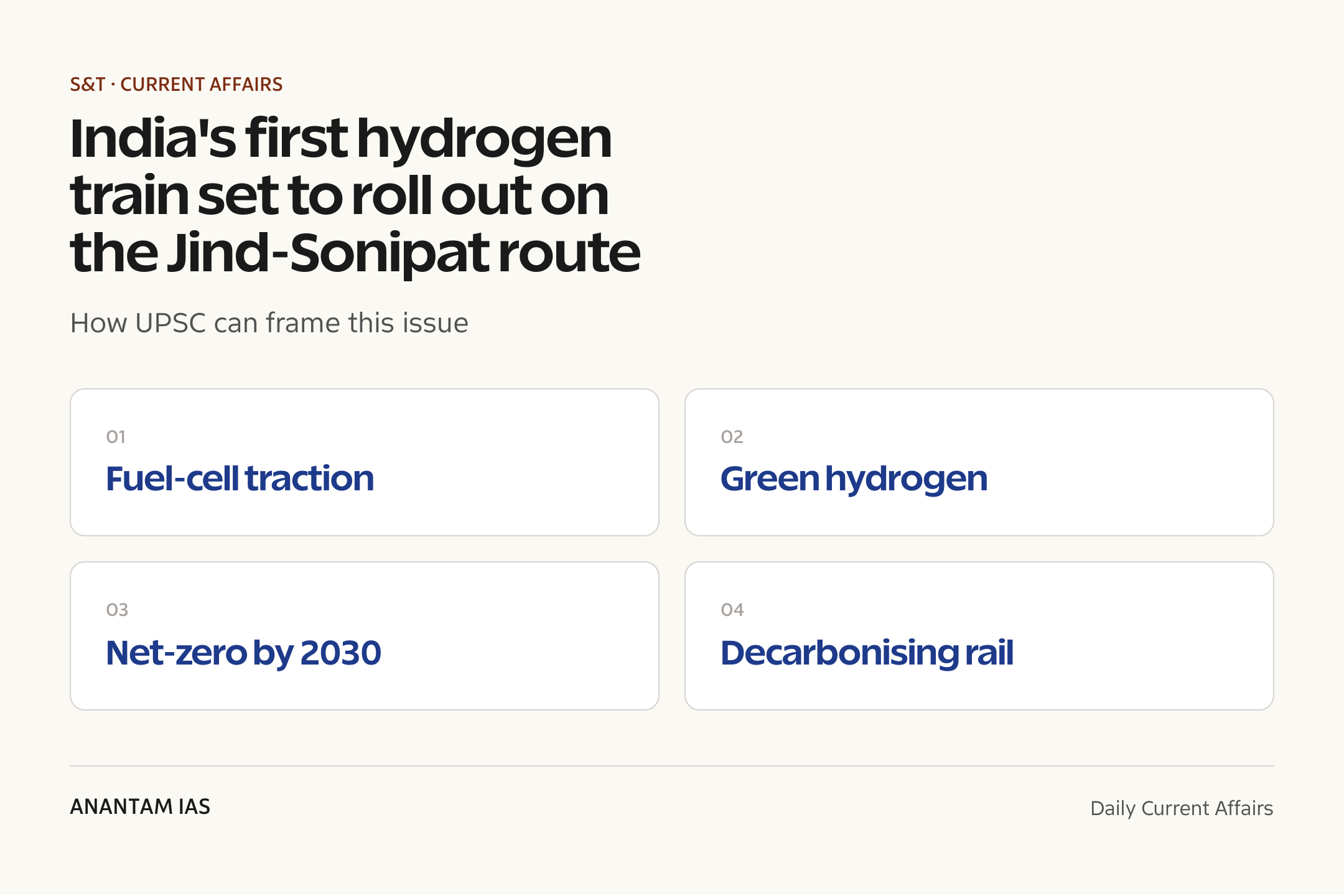
The rollout is a visible marker of the National Green Hydrogen Mission (2023) and the Railways’ goal of net-zero carbon emissions by 2030. Business Standard notes the Railways describes it as among the world’s longest and most powerful hydrogen trainsets, at 2,400 kW.
- First indigenous hydrogen fuel-cell train on a real Indian passenger route, built by converting old diesel rakes.
- Runs on the non-electrified Jind-Sonipat section, showing hydrogen’s fit for routes without overhead wires.
- Ties directly to the National Green Hydrogen Mission and Railways’ net-zero-2030 pledge.
- One of the world’s largest hydrogen trainsets: 8 passenger cars + 2 power cars, 2,400 kW.
- Signals a shift in decarbonising transport, a recurring GS3 science-and-environment theme.
The development matters in the context of:
- Diesel traction still runs on non-electrified and last-mile stretches despite near-complete broad-gauge electrification.
- Hydrogen offers a clean substitute for diesel where electrification is costly, as on heritage and hilly lines.
UPSC Relevance
Prelims Relevance
- Hydrogen fuel cell: combines hydrogen + oxygen to produce electricity, water and heat, with no CO2 at point of use.
- Colour codes: green (electrolysis on renewables), grey (fossil fuels), blue (fossil fuels with carbon capture).
- Electrolysis splits water into hydrogen and oxygen using electricity.
- National Green Hydrogen Mission launched in January 2023, nodal ministry MNRE.
- Mission target: about 5 million tonnes of green hydrogen a year by 2030.
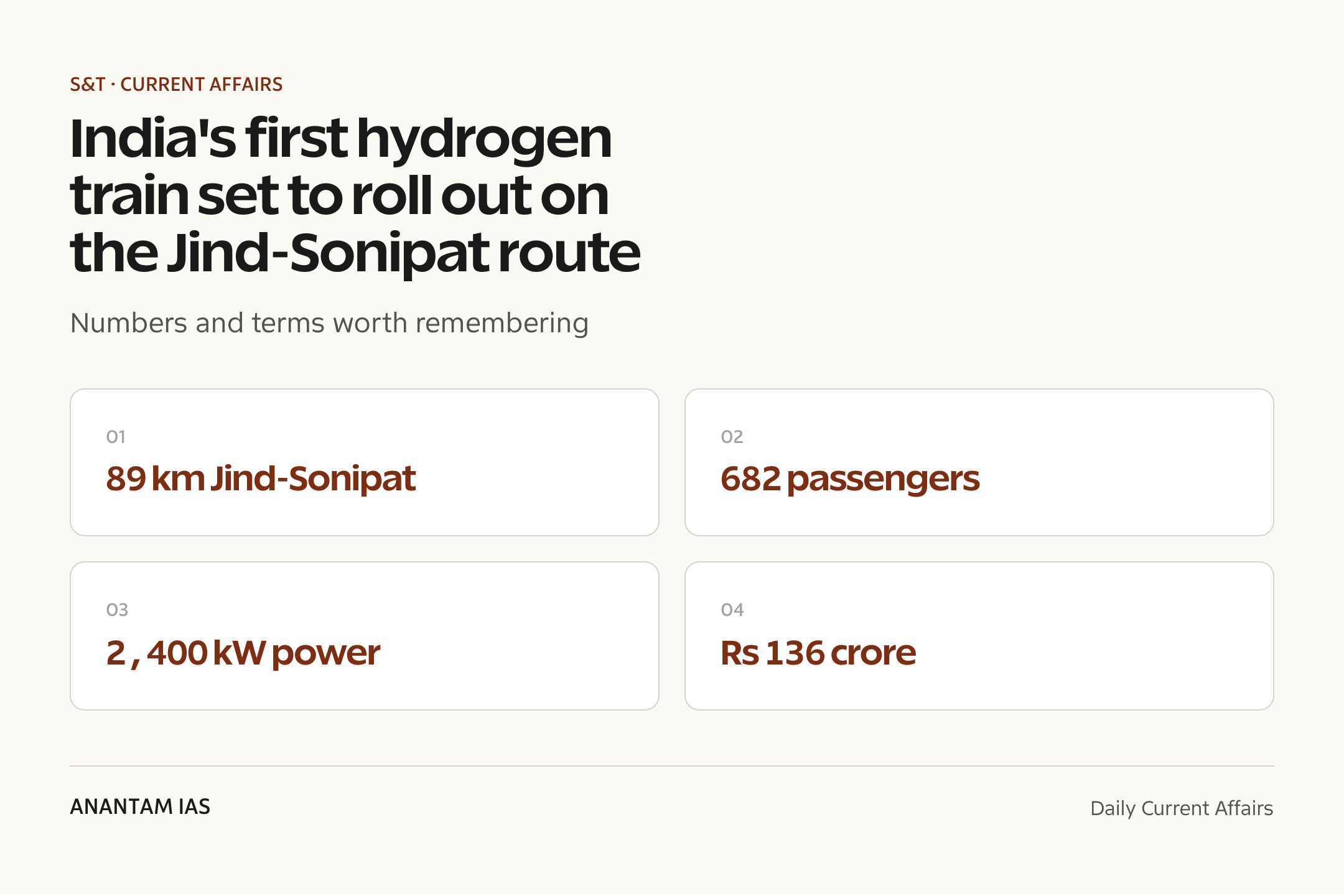
- Route facts: Jind-Sonipat, 89 km, at least 682 passengers, top speed 75 km/h.
- Hydrogen for Heritage: Railways scheme for hydrogen trains on heritage and hill routes.
- Alstom’s Coradia iLint (Germany, 2018) was the world’s first hydrogen passenger train.
- Indian Railways target: net-zero carbon emission by 2030.
Mains Relevance
GS Paper 3
- Green hydrogen and fuel-cell mobility as tools for decarbonising transport and energy security.
- Indigenisation versus import dependence: fuel cells still sourced abroad even as trainsets are built in India.
- Cost, safety and infrastructure barriers that keep clean-fuel rail technology from scaling.
Essay
- Technology and sustainable development: clean energy transitions in mobility.
Background and Context
What the Jind-Sonipat hydrogen train is
The Indian Express reports a full-length passenger trainset, not a lab prototype, built by retrofitting old diesel rakes.
- Route: the 89-km Jind-Sonipat section in Haryana, a non-electrified line with no overhead wires.
- Capacity: can carry at least 682 passengers at a maximum operational speed of 75 km/h.
- Configuration: eight passenger cars plus two driving power cars, which the Railways calls one of the world’s longest and most powerful (2,400 kW) hydrogen trainsets.
- Origin: created by replacing the diesel engines on old diesel-electric multiple unit (DEMU) rakes with a zero-emission hydrogen-electric propulsion system.
- Duty cycle: expected to make two round trips a day, covering about 356 km and consuming an estimated 300 kg of hydrogen.
How a hydrogen fuel-cell train works
A fuel cell makes electricity on board, so the train needs neither a diesel engine nor overhead electric wires.
- The fuel cell draws stored hydrogen (about 440 kg on board) and oxygen from outside air, combining them to release electrical energy; the only by-products are water and heat.
- Each of the two power cars carries four integrated power packs, each pairing a fuel cell with a lithium ferro-phosphate (LFP) battery.
- One power pack yields 300 kW – about 115 kW from the fuel cell and 185 kW from the battery; four packs give 1,200 kW per car.
- At start-up, surplus fuel-cell power charges the battery; as speed and power demand rise, the battery adds boost alongside the steady fuel-cell output.
- The imported fuel cell (from Canada’s Ballard) is of the proton-exchange-membrane family, the type common in transport applications.
Green, grey and blue hydrogen
Hydrogen is a clean fuel only if it is made cleanly; the colour code tells you how it was produced.
- Green hydrogen: made by electrolysis of water using renewable electricity, giving near-zero lifecycle emissions.
- Grey hydrogen: produced from fossil fuels such as natural gas or coal, releasing carbon dioxide.
- Blue hydrogen: same fossil-fuel route as grey but paired with carbon capture to trap much of the CO2.
- A fuel-cell train emits no CO2 while running, but its true climate value depends on the hydrogen being green, not grey.
- This is why India’s push links rail hydrogen to the wider green-hydrogen production drive rather than treating the train alone.
National Green Hydrogen Mission and Hydrogen for Heritage
The train sits inside two policy pushes – a national mission and a Railways-specific scheme.
- The National Green Hydrogen Mission, launched in January 2023 under the Ministry of New and Renewable Energy, aims to make India a global hub for green hydrogen production and use.
- Its headline target is roughly 5 million tonnes of green hydrogen a year by 2030, cutting fossil-fuel imports and emissions.
- The Railways’ Hydrogen for Heritage initiative envisages hydrogen trains on heritage and hilly routes where electrification is difficult or intrusive.
- Indian Railways has separately committed to net-zero carbon emissions by 2030, making clean traction a core goal.
- Official details on both the mission and railway plans are published by the Ministry of New and Renewable Energy and Indian Railways.
Project cost, fuelling and safety
Storing and handling hydrogen safely is the hard part, and it drives much of the cost.
- Northern Railway sanctioned the roughly Rs 136-crore project in 2020-21, with work starting in April 2022; the propulsion tender went to Hyderabad-based Medha.
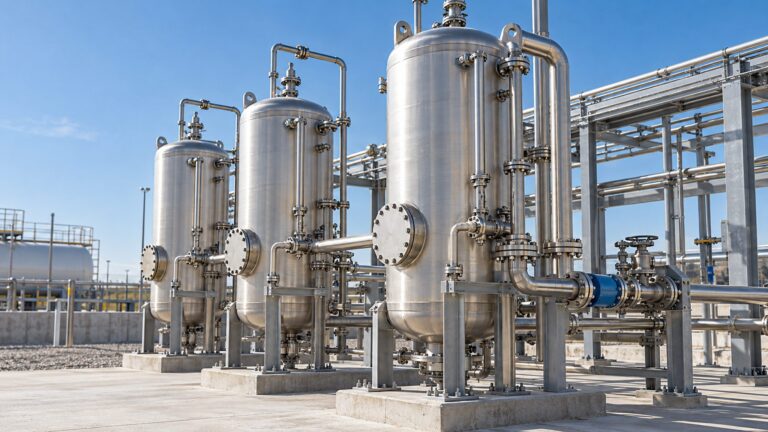
- A 3,000-kg-capacity hydrogen fuelling facility has been set up at Jind to keep the service supplied.
- Hydrogen is highly flammable and must be stored at very high pressure (200-500 bar), against normal atmospheric pressure of one bar.
- A chiller plant holds hydrogen near minus 15 degrees Celsius during dispensing to ease safe fuelling.
- These handling demands are the main reason hydrogen rail remains costly and slow to spread.
Why hydrogen trains have not scaled globally
The technology works, but economics and logistics have kept it to short, niche routes so far.
- Alstom unveiled the technology in 2016 in Berlin; its Coradia iLint became the world’s first hydrogen passenger train in Germany (2018).
- Japan, China and the United States have since run their own hydrogen trains, mostly on short trips.
- Green hydrogen production is still limited and its transport is difficult, keeping fuel supply tight.
- High-pressure storage, flammability and refuelling infrastructure add cost and complexity versus diesel or overhead-wire electric.
- The Railways has not yet announced a second hydrogen train project, so India’s rollout stays a pilot for now.
Way Forward
Way Forward
- Scale green hydrogen supply so fuel-cell trains cut emissions across their full lifecycle, not just at the point of use.
- Push indigenous fuel-cell manufacturing to reduce reliance on imported cells and lower unit costs.
- Target hydrogen at non-electrified, heritage and hill routes where overhead electrification is impractical.
- Build safe, standardised hydrogen refuelling and storage norms before wider deployment.
- Pair the pilot with rigorous cost-per-km and reliability data to guide any national scale-up.
Conclusion
India’s first hydrogen train turns a global concept into a running Indian service, testing clean fuel-cell traction on a real passenger route rather than in a demonstration.
Its lasting value hinges on cheap green hydrogen, home-grown fuel cells and safe infrastructure; get those right, and hydrogen can decarbonise the corners of the rail network that wires and diesel serve poorly.
UPSC Practice Questions
Prelims MCQ 1
With reference to hydrogen as a fuel, consider the following statements:
- Green hydrogen is produced by the electrolysis of water using electricity from renewable sources.
- A hydrogen fuel cell generates electricity by combining hydrogen with oxygen.
- Grey hydrogen is produced from fossil fuels and releases carbon dioxide.
How many of the above statements are correct?
(a) Only one (b) Only two (c) All three (d) None
Answer: (c) All three
Explanation:
All three are correct. Green hydrogen uses electrolysis powered by renewables; a fuel cell combines hydrogen and oxygen to make electricity (with water and heat as by-products); grey hydrogen comes from fossil fuels and emits CO2. Blue hydrogen adds carbon capture to the fossil-fuel route.
Prelims MCQ 2
India’s first hydrogen-powered passenger train is set to run on which railway section?
(a) Kalka-Shimla (b) Jind-Sonipat (c) Matheran-Neral (d) Siliguri-Darjeeling
Answer: (b) Jind-Sonipat
Explanation:
The train is set to run on the roughly 89-km Jind-Sonipat section in Haryana, a non-electrified route. The other options are heritage or hill lines sometimes discussed for future hydrogen or green traction under the Railways’ Hydrogen for Heritage plan.
UPSC Mains Questions
- Green hydrogen is central to India’s clean-energy transition. Discuss the promise and the practical barriers of adopting hydrogen fuel-cell technology in Indian Railways.
- Decarbonising transport is essential to meeting India’s climate goals. Examine the role of the National Green Hydrogen Mission and fuel-cell mobility in this effort.
Sources: The Indian Express (Explained) and Business Standard.
Frequently Asked Questions
What is India’s first hydrogen train and where will it run?
It is a hydrogen fuel-cell passenger trainset set to run on the roughly 89-km Jind-Sonipat section in Haryana, built by converting old diesel rakes to zero-emission hydrogen-electric propulsion.
How does a hydrogen fuel-cell train work?
A fuel cell combines stored hydrogen with oxygen from the air to make electricity on board, giving off only water and heat. An onboard lithium ferro-phosphate battery adds power when demand rises.
What is green hydrogen and how is it different from grey?
Green hydrogen is made by electrolysis of water using renewable electricity, so it is near zero-emission. Grey hydrogen comes from fossil fuels and releases carbon dioxide; blue hydrogen adds carbon capture to that fossil route.
What is the National Green Hydrogen Mission?
Launched in January 2023 under the Ministry of New and Renewable Energy, it aims to make India a hub for green hydrogen, targeting about 5 million tonnes of annual production by 2030.
What is the Hydrogen for Heritage scheme?
It is an Indian Railways initiative to run hydrogen trains on heritage and hilly routes where overhead electrification is difficult or visually intrusive.
Why have hydrogen trains not spread widely?
Green hydrogen supply is still limited, transport is difficult, and high-pressure storage plus refuelling infrastructure add cost, so most countries run hydrogen trains only on short routes.
Tell Google you want more of this.
Add Anantam IAS as a preferred sourceOne tap, and this site shows up more often in your own Top Stories, AI Overviews and AI Mode. Remove it any time.