Why in News?
The Delhi High Court has granted interim protection to a prominent public figure against the unauthorised commercial use of his name, image and likeness, restraining social-media accounts and online sellers from exploiting his identity through AI-generated content, deepfakes and unauthorised merchandise. The order was reported by The Hindu.
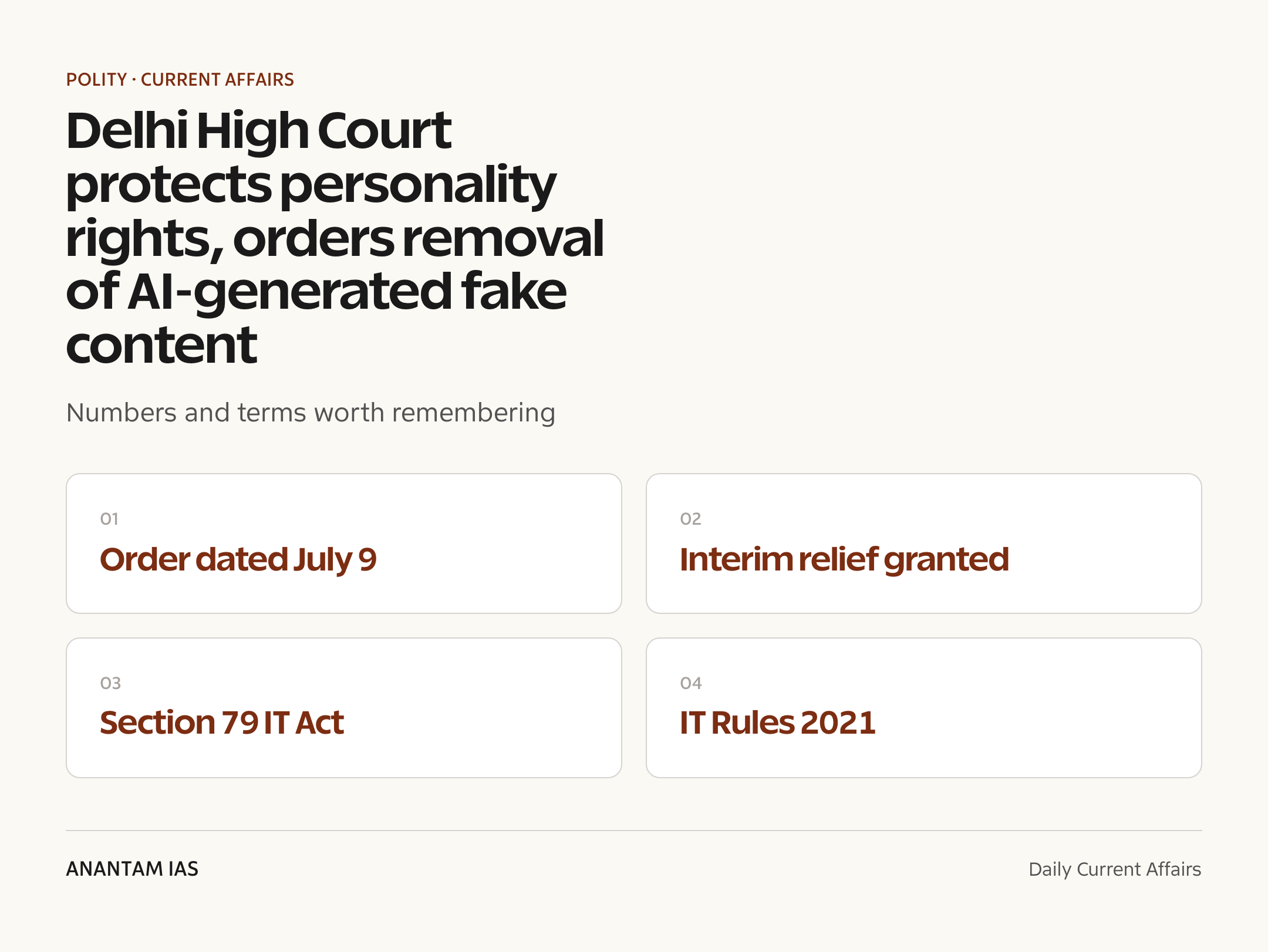
In an order passed on July 9, Justice Jyoti Singh held that the plaintiff had established a prima facie case for protection of his personality and publicity rights. The suit named several unidentified defendants along with named social-media accounts and online merchants, extending a growing line of Delhi High Court rulings on digital identity.
- Court restrained circulation of morphed and obscene AI-generated images and manipulated videos of the plaintiff.
- Interim relief covered online sellers of unauthorised T-shirts, jerseys, posters and merchandise using his likeness.
- Order relied on a prima facie case for personality and publicity rights, not a final adjudication.
- Follows earlier Delhi HC relief for actors, politicians and sportspersons on the same principle.
The development matters in the context of:
- Personality rights are not codified in a single Indian statute; courts derive them from privacy, passing-off and Article 21.
- The rise of generative AI and cheap deepfake tools has multiplied identity-theft and impersonation harms.
UPSC Relevance
Prelims Relevance
- Personality rights vs publicity rights – conceptual distinction.
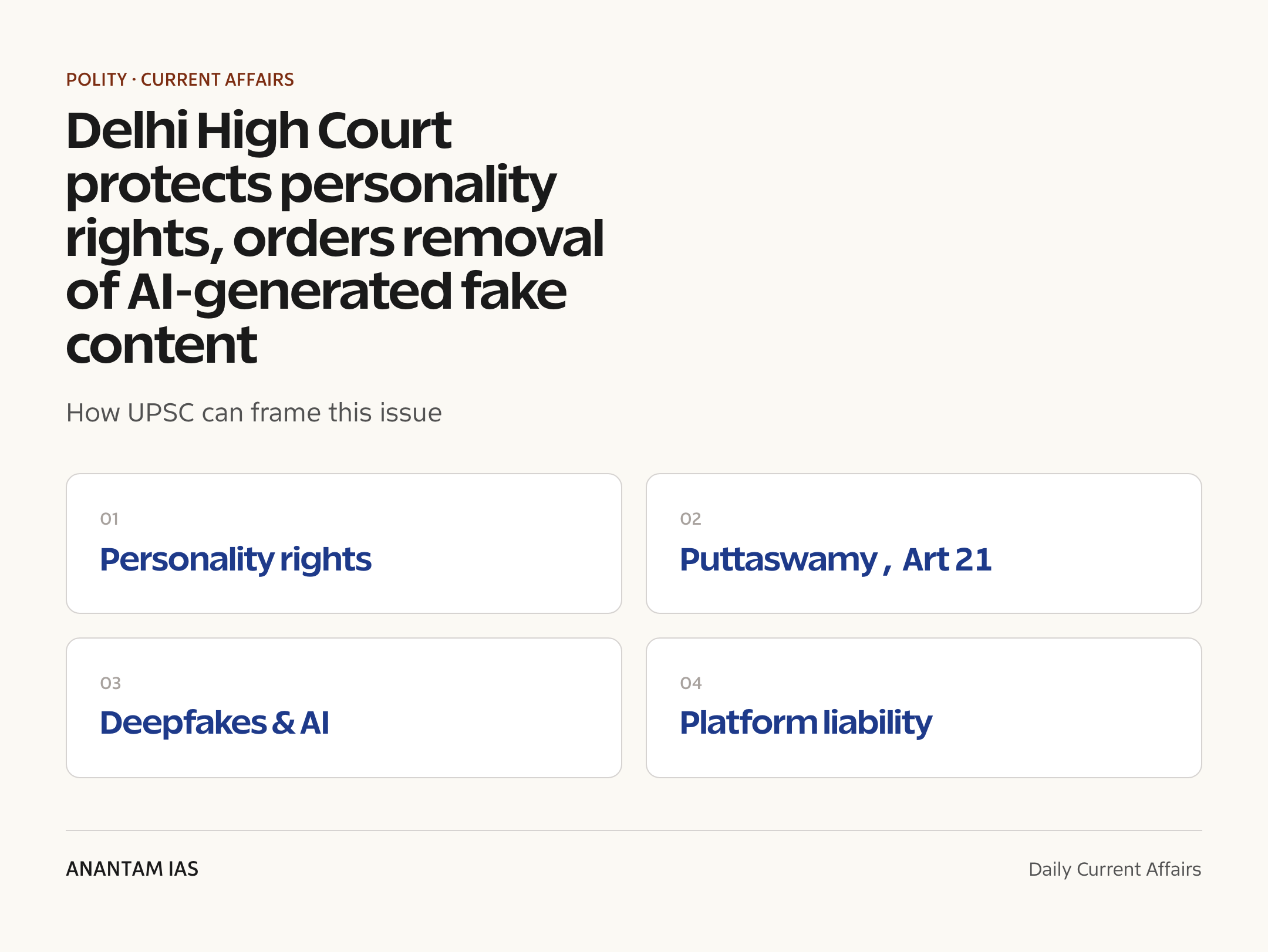
- Justice K.S. Puttaswamy v. Union of India (2017) – privacy as a fundamental right under Article 21.
- John Doe / Ashok Kumar orders – injunctions against unknown defendants.
- IT Rules, 2021 – intermediary due-diligence obligations.
- Section 79, IT Act, 2000 – safe-harbour for intermediaries.
- DPDP Act, 2023 – consent-based processing of personal data.
- Delhi HC precedents: Anil Kapoor, Amitabh Bachchan, Jackie Shroff.
- Deepfakes and generative AI – synthetic media terminology.
Mains Relevance
GS Paper 2
- Emerging jurisprudence on digital identity, privacy and the limits of the right to publicity.
- Platform accountability and intermediary liability in an age of synthetic media.
GS Paper 3
- Regulating generative AI and deepfakes without stifling innovation or free speech.
- Cyber-security dimension of identity theft and non-consensual synthetic content.
Essay
- Technology and the self: who owns your face in the age of AI?
Background and Context
What are personality and publicity rights?
The case turns on two overlapping but distinct legal ideas that Indian courts have built largely through judgments rather than a dedicated statute.
- Personality rights protect the dignity, identity and private persona of an individual – name, image, voice and likeness – from unauthorised use.
- Publicity rights are the commercial arm – the right of a well-known person to control and profit from the exploitation of their identity.
- Both flow from a mix of the right to privacy under Article 21, the tort of passing-off, and protection against unjust enrichment.
- There is no single codified statute for personality rights in India; relief comes through civil suits, injunctions and trademark or copyright claims.
- Only celebrities and public figures typically hold enforceable publicity rights, since commercial value attaches to their recognition.
Why deepfakes and generative AI raise the stakes
Cheap, realistic synthetic media has turned identity misuse from a niche problem into a mass-scale threat.
- Deepfakes are AI-generated or AI-altered images, audio and video that convincingly depict a person doing or saying things they never did.
- The plaintiff alleged that accounts circulated morphed and obscene images and manipulated videos, causing reputational and dignitary harm.
- Generative tools lower the cost of impersonation, fraud and non-consensual sexual imagery to near zero.
- Harms extend beyond celebrities – ordinary citizens, women and children face blackmail, defamation and financial scams.
- Detection lags creation, so courts increasingly grant quia timet (anticipatory) and dynamic injunctions that cover future infringing links.
The Puttaswamy foundation and Article 21
The constitutional anchor for these disputes is the 2017 privacy verdict.
- In Justice K.S. Puttaswamy v. Union of India (2017), a nine-judge bench held privacy to be a fundamental right under Article 21.
- The judgment recognised informational privacy and control over one’s own personal data and identity.
- Personality-rights suits draw on this to argue that unauthorised use of likeness violates dignity and autonomy.
- Article 21 rights bind the State, but courts extend the underlying values into private civil disputes through common-law remedies.
- The Supreme Court has read privacy alongside free speech under Article 19(1)(a), requiring courts to balance both.
A growing line of Delhi High Court rulings
The July 9 order sits within a fast-expanding body of precedent from the same court.
- Anil Kapoor v. Simply Life India (2023) – restrained misuse of the actor’s name, image, voice and the phrase associated with him, including AI misuse.
- Amitabh Bachchan v. Rajat Nagi (2022) – protected the actor’s name, voice and image from unauthorised commercial exploitation.
- Jackie Shroff (2024) – shielded the actor’s persona, including his popular nickname, from AI and merchandising misuse.
- The court noted that figures such as actors, a spiritual leader, a journalist and a podcaster had earlier obtained similar interim relief.
- The trend shows courts using John Doe (Ashok Kumar) orders to bind unnamed and future infringers across platforms.
Platform accountability and intermediary law
Enforcement ultimately depends on the intermediaries that host the infringing content.
- Section 79 of the IT Act, 2000 gives intermediaries safe harbour from liability for third-party content, subject to due diligence.
- The IT (Intermediary Guidelines) Rules, 2021 require platforms to remove flagged unlawful content within set timelines and appoint grievance officers.
- Rules mandate faster takedown of non-consensual sexual imagery and morphed content once notified.
- Advisories from the Ministry of Electronics and IT (MeitY) have pushed platforms to label and act against deepfakes.
- Courts have directed platforms to disclose subscriber details of anonymous infringers and to de-index offending URLs.
The data-protection and regulatory gap
India still lacks a purpose-built law for AI-driven identity misuse, relying on a patchwork of provisions.
- The Digital Personal Data Protection (DPDP) Act, 2023 governs consent-based processing of personal data but is not tailored to deepfakes or publicity rights.
- Existing tools include defamation law, copyright and trademark claims, and IT Act provisions on obscenity and impersonation.
- There is no dedicated deepfake statute; a government committee has examined the need for one.
- Critics warn of a free-speech risk – overbroad takedowns could chill satire, parody and legitimate criticism of public figures.
- Comparative models include the EU AI Act transparency duties and US state right-of-publicity statutes.
Way Forward
Building a coherent response
- Consider a statutory framework for personality and publicity rights to reduce reliance on case-by-case injunctions.
- Mandate provenance and watermarking standards for AI-generated media so synthetic content is traceable.
- Strengthen intermediary takedown timelines for deepfakes while safeguarding satire and fair criticism.
- Expand grievance and redress mechanisms so ordinary citizens – not only celebrities – can act quickly.
- Invest in deepfake detection tools, digital-literacy campaigns and law-enforcement capacity.
- Align domestic rules with global standards on AI transparency to enable cross-border enforcement.
Conclusion
The Delhi High Court’s order is another step in a judicially driven effort to protect digital identity where legislation has yet to catch up. By treating personality and publicity rights as an extension of privacy and dignity, courts are filling a real gap left by the rapid spread of generative AI.
The durable challenge is balance – shielding individuals from deepfakes and commercial exploitation without eroding free speech, satire and the public’s right to comment on public figures. A clear statutory framework, robust platform accountability and technological safeguards will decide whether that balance holds.
UPSC Practice Questions
Prelims MCQ 1
With reference to personality and publicity rights in India, consider the following statements:
- They are protected by a single dedicated Act of Parliament.
- Courts derive them from the right to privacy and the tort of passing-off.
- Publicity rights primarily protect the commercial value of a well-known person’s identity.
How many of the above statements are correct?
(a) Only one (b) Only two (c) All three (d) None
Answer: (b) Only two
Explanation:
Statements 2 and 3 are correct. There is no single codified statute for personality rights in India; courts build them from privacy (Article 21), passing-off and unjust-enrichment principles, so statement 1 is wrong. Publicity rights protect the commercial exploitation of a famous person’s identity.
Prelims MCQ 2
The ‘safe harbour’ protection available to online intermediaries in India is provided under which of the following?
(a) Section 66A of the Information Technology Act, 2000 (b) Section 79 of the Information Technology Act, 2000 (c) The Digital Personal Data Protection Act, 2023 (d) Article 19(2) of the Constitution
Answer: (b) Section 79 of the Information Technology Act, 2000
Explanation:
Section 79 grants intermediaries conditional immunity from liability for third-party content, provided they observe due diligence and the IT Rules, 2021. Section 66A was struck down in Shreya Singhal (2015). The DPDP Act governs data processing, and Article 19(2) covers reasonable restrictions on free speech.
UPSC Mains Questions
- The spread of deepfakes has outpaced India’s legal framework for protecting digital identity. Critically examine the adequacy of existing laws and suggest reforms. (GS Paper 2)
- Balancing personality and publicity rights against the freedom of speech and expression is an increasingly complex task for the judiciary. Discuss with reference to recent High Court rulings. (GS Paper 2)
Source: The Hindu.
Frequently Asked Questions
What did the Delhi High Court order?
It granted interim protection to a prominent public figure, restraining social-media accounts and online sellers from using his name, image and likeness through AI-generated content, deepfakes and unauthorised merchandise. Justice Jyoti Singh passed the order on July 9, finding a prima facie case for his personality and publicity rights.
What is the difference between personality rights and publicity rights?
Personality rights protect an individual’s identity, dignity and private persona from unauthorised use. Publicity rights are the commercial arm – the right of a famous person to control and profit from the use of their name, image or likeness.
Are personality rights codified in Indian law?
No single statute codifies them. Courts derive them from the right to privacy under Article 21, the tort of passing-off, and protection against unjust enrichment, often granting injunctions in individual suits.
What are deepfakes and why are they a legal concern?
Deepfakes are AI-generated or AI-altered media that realistically depict a person doing or saying things they never did. They enable impersonation, fraud, defamation and non-consensual imagery, harming both celebrities and ordinary citizens.
How does intermediary law apply to such content?
Section 79 of the IT Act gives platforms conditional safe harbour, while the IT Rules, 2021 require due diligence and timely removal of flagged unlawful content, including morphed and non-consensual material.
What is a John Doe or Ashok Kumar order?
It is an injunction issued against unknown or unidentified defendants, allowing courts to restrain anonymous online infringers and, through dynamic injunctions, cover future infringing links and accounts.
Tell Google you want more of this.
Add Anantam IAS as a preferred sourceOne tap, and this site shows up more often in your own Top Stories, AI Overviews and AI Mode. Remove it any time.