Why in News?
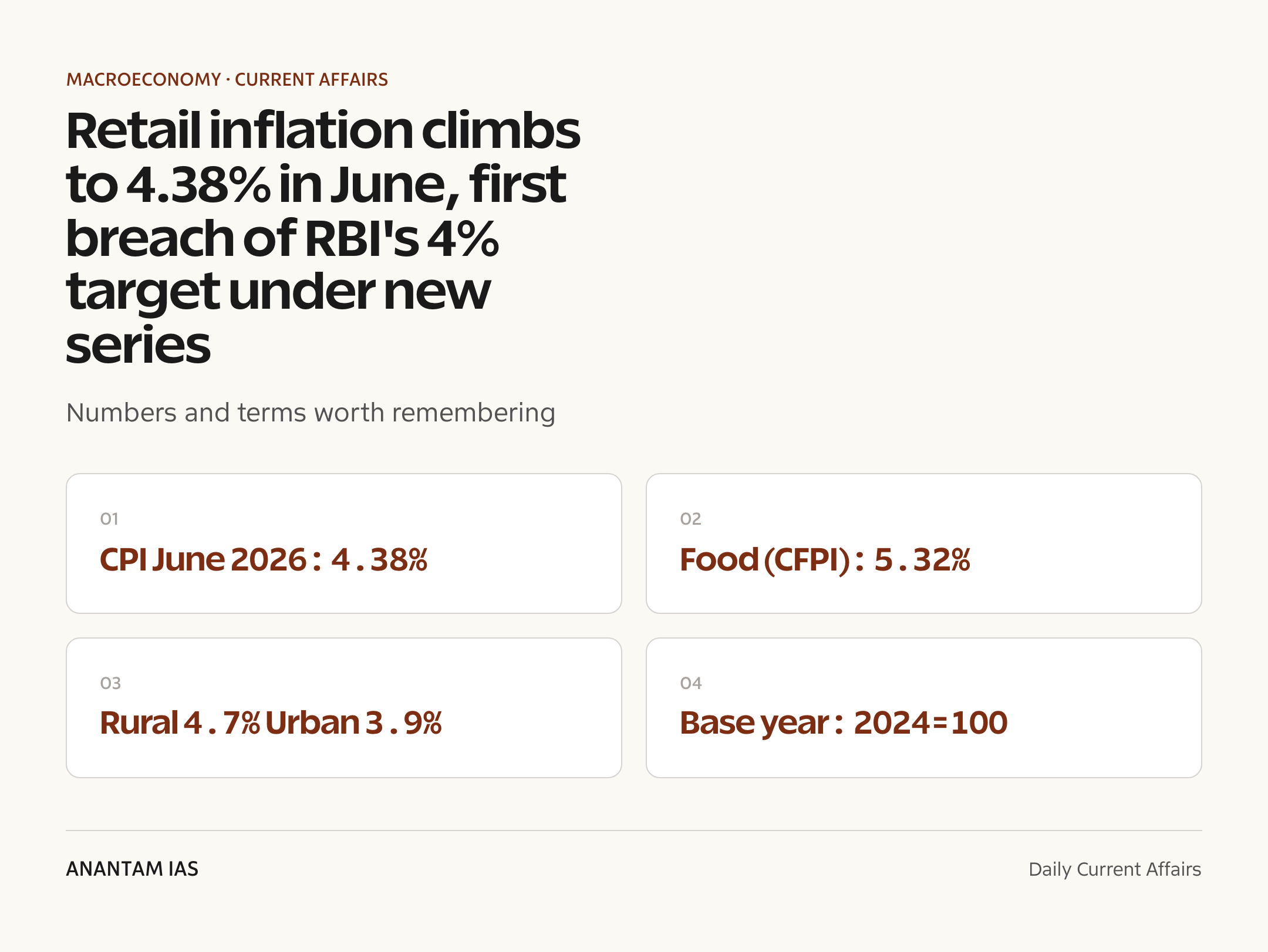
Data released by the Ministry of Statistics and Programme Implementation (MoSPI) showed India’s headline retail inflation, measured by the Consumer Price Index (CPI), climbed to 4.38% (provisional) in June 2026 over June 2025, up from 4.25% in May. It is a multi-month high and the first time the print has crossed the Reserve Bank of India’s (RBI) medium-term target of 4% under the rebased 2024=100 CPI series.
The reading still sits comfortably inside the 2%-6% tolerance band, so it does not amount to a formal failure of the inflation-targeting framework. The pressure was food-led: the Consumer Food Price Index (CFPI) rose to 5.32%, while rural inflation (4.74%) again outpaced urban (3.92%). The next CPI release, for July 2026, is scheduled for 12 August 2026, and will show whether the food-driven pressure is transient or sticky.
- All-India CPI (Combined) inflation for June 2026: 4.38% provisional; rural at 4.74% and urban at 3.92%.
- Food inflation, tracked by the Consumer Food Price Index (CFPI), rose to 5.32% (rural 5.45%, urban 5.09%), the main driver of the uptick.
- Housing inflation stood at 2.10%; the food and beverages group led the pressure across sectors.
- The reading is a multi-month high and the first 4%-plus print since MoSPI shifted the base year to 2024=100.
- Next CPI release (for July 2026) is scheduled for 12 August 2026.
The development matters in the context of:
- CPI is the RBI’s nominal anchor for setting the policy repo rate under flexible inflation targeting.
- A sustained rise toward the upper band narrows the space for rate cuts and shapes the Monetary Policy Committee’s stance.
UPSC Relevance
Prelims Relevance
- CPI headline June 2026: 4.38%; CFPI food inflation: 5.32%.
- New CPI base year: 2024=100 (revised from 2012=100).
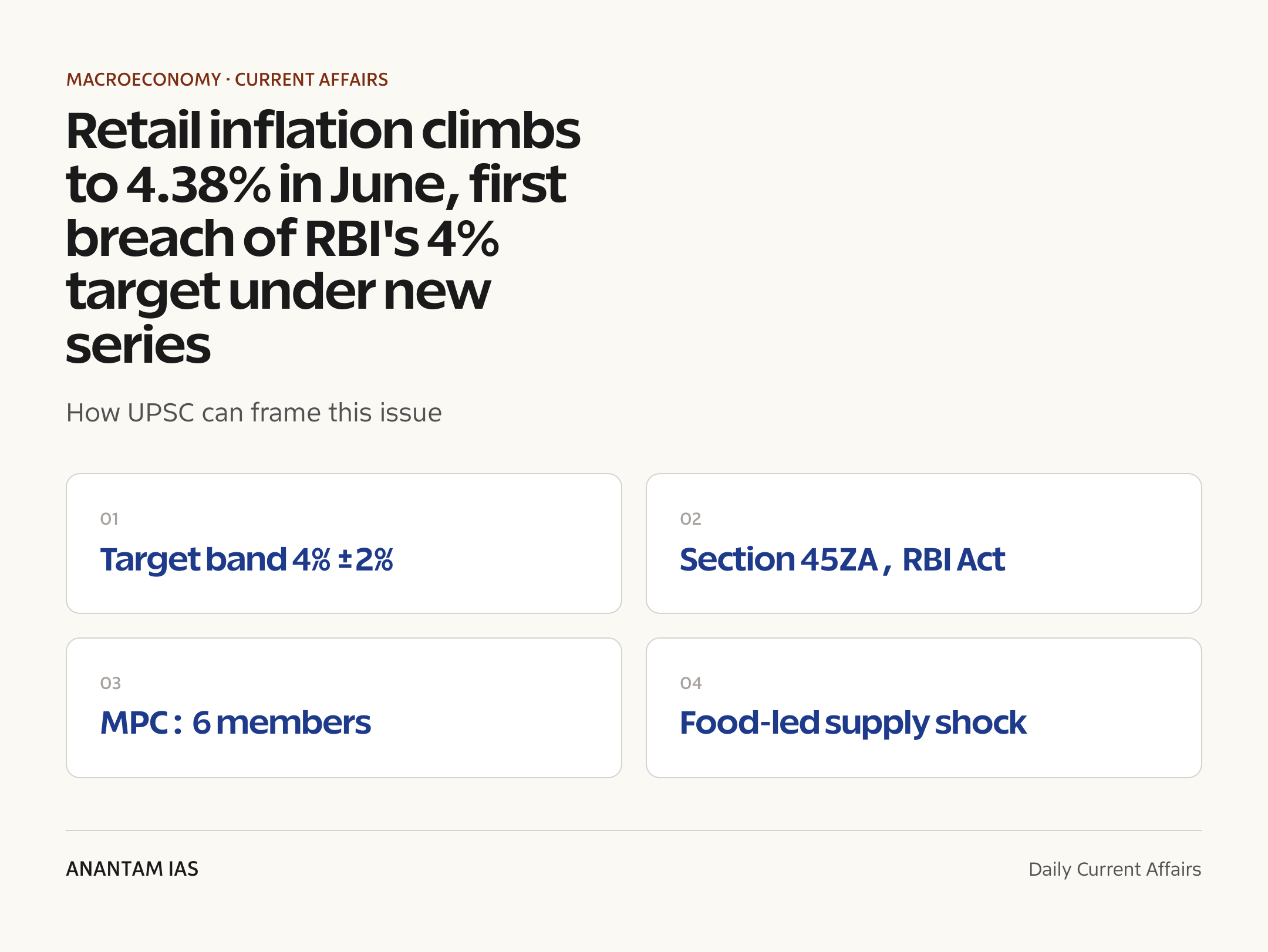
- RBI’s inflation target: 4% with a +/-2% band (2%-6%), set under the RBI Act.
- Legal basis: Section 45ZA of the RBI Act, 1934; target notified by the Central Government.
- CPI compiled by MoSPI (NSO); WPI by the Office of the Economic Adviser, DPIIT.
- Monetary Policy Committee (MPC): 6 members, chaired by the RBI Governor.
- CFPI is a sub-index of CPI capturing food and beverage prices.
- ‘Failure’ of monetary policy: CPI outside 2%-6% for three consecutive quarters.
- Flexible Inflation Targeting adopted via the 2016 RBI Act amendment.
Mains Relevance
GS Paper 3
- Inflation targeting framework: design, tolerance band, and the trade-off between price stability and growth.
- Food inflation drivers (supply shocks, monsoon, MSP, supply chains) and why headline CPI is food-heavy.
- Effectiveness and limits of monetary policy against supply-side, food-led inflation.
- Relevance of CPI base-year revision (2024=100) for accurate measurement of the cost of living.
Essay
- Price stability, growth, and the credibility of institutions in economic management.
Background and Context
What the June 2026 numbers show
The headline number crept above the target midpoint, with food doing most of the pushing.
- CPI (Combined) inflation: 4.38% (provisional) for June 2026, up from 4.25% in May and above the 4% target midpoint.
- Rural inflation (4.74%) ran well above urban (3.92%), a persistent rural-urban gap tied to the higher food share in rural budgets.
- CFPI food inflation at 5.32% was the single biggest contributor to the rise, with rural food at 5.45% and urban at 5.09%.
- Housing inflation, an urban-only category, stayed subdued at 2.10%, keeping non-food pressure contained.
- The print sits inside the 2%-6% band but above the 4% medium-term target for the first time under the new series.
- The month-on-month drift from 4.25% to 4.38% is modest, signalling a gradual uptick rather than a sharp spike.
How CPI is built
CPI measures the change in retail prices of a fixed basket of goods and services bought by households.
- Compiled and released monthly by the National Statistical Office (NSO) under MoSPI.
- Base year recently revised to 2024=100 from 2012=100 to reflect current consumption patterns and updated item weights.
- Covers broad groups such as food and beverages, housing, fuel and light, clothing and footwear, and miscellaneous services.
- Food and beverages carry a large weight, so CPI is highly sensitive to food-price swings compared with advanced-economy indices.
- Separate indices are published for rural, urban and combined sectors, with weights drawn from consumption-expenditure survey data.
- Indices are compiled from unrounded values, so headline figures rebuilt from rounded published sub-indices can differ marginally.
Base effect and why timing matters
A year-on-year inflation rate depends as much on last year’s price level as on this year’s.
- The base effect is the influence of the corresponding month a year earlier on the current inflation reading.
- A low price base in June 2025 can mechanically lift the June 2026 year-on-year rate even without fresh price rises.
- A high base in the comparison month can suppress the printed rate, masking underlying momentum.
- Analysts read the momentum (sequential month-on-month change) alongside the headline to separate genuine pressure from base arithmetic.
- The shift to the 2024=100 series resets weights, so year-on-year comparisons that straddle the base change must be read with care.
Core versus food inflation
Policymakers watch the durable, demand-driven part of inflation as closely as the volatile headline.
- Core inflation strips out food and fuel, the two most volatile components, to reveal underlying demand pressure.
- Subdued housing inflation at 2.10% and the food-led jump suggest the June uptick was driven by supply, not overheating demand.
- The RBI targets headline CPI, but leans on core trends to judge whether price pressure is broad-based or transient.
- A soft core with a rising headline typically points to a food or fuel shock that may ease as supply normalises.
- Persistent core inflation, by contrast, would signal demand-side pressure that monetary tightening can more effectively address.
CPI, CFPI and WPI compared
India tracks price pressure through more than one index, each with a distinct scope.
- CFPI is a sub-index of CPI, isolating the price movement of food and beverages.
- Wholesale Price Index (WPI) measures prices at the wholesale or producer stage, released by the Office of the Economic Adviser, DPIIT.
- CPI is the RBI’s policy anchor because it reflects prices actually faced by consumers.
- WPI has no services component and gives fuel and manufactured goods a larger weight, so it can diverge sharply from CPI.
- A WPI-CPI divergence often signals lags in the pass-through of wholesale price changes to retail shelves.
- Global commodity prices tend to show up in WPI first, then feed into CPI with a lag.
The inflation-targeting framework
India adopted a statutory, flexible inflation-targeting regime a decade ago.
- The 2016 amendment to the RBI Act, 1934 gave price stability a formal legal mandate.
- Under Section 45ZA, the Central Government, in consultation with the RBI, sets the CPI target every five years.
- The current target is 4% with a tolerance band of +/-2% (2% to 6%).
- ‘Flexible’ means the RBI weighs growth alongside inflation rather than pursuing price stability alone.
- Monetary policy is deemed to have ‘failed’ if CPI stays outside the band for three consecutive quarters, triggering a report to Parliament.
- The framework was designed to anchor inflation expectations and build institutional credibility.
Transmission to the MPC and the repo rate
The inflation print feeds directly into how the central bank sets the price of money.
- The Monetary Policy Committee (MPC) has six members, three from the RBI and three appointed by the government, chaired by the RBI Governor with a casting vote.
- The MPC sets the repo rate, the rate at which banks borrow from the RBI, to steer inflation toward the 4% target.
- A rising headline print, if judged persistent, limits room for rate cuts and can turn the policy stance more cautious.
- The real interest rate (repo rate minus expected inflation) matters more than the nominal rate for saving and investment decisions.
- Higher inflation erodes the real rate, and the RBI may hold or raise the repo rate to keep real returns positive.
- Rate changes transmit to lending and deposit rates with a lag, so the MPC acts pre-emptively on the inflation outlook.
Why food inflation is hard to tame
Food is the swing factor in India’s CPI and the least responsive to interest rates.
- High food weight means a CFPI of 5.32% can lift the whole index even when core inflation is soft.
- Food prices respond to monsoon performance, sowing, supply chains, storage and global commodity moves, not to the repo rate.
- Rural households spend a larger share on food, explaining the higher rural inflation reading.
- Supply-side food shocks blunt monetary tools, which act mainly on demand rather than on harvest or logistics.
- The policy response leans on buffer stocks, imports and open-market operations by agencies rather than rate action alone.
- A weak or delayed monsoon can keep food inflation elevated for several months, testing the durability of the target.
Way Forward
Manage supply-side food pressures
- Strengthen buffer-stock management, cold chains and market intelligence to smooth seasonal food spikes.
- Use calibrated trade measures (imports, export policy) to steady prices of pulses, edible oils and vegetables.
Keep the policy anchor credible
- Let the MPC weigh whether the uptick is transient and food-led before shifting stance.
- Sustain clear communication to keep household and market inflation expectations near the 4% target.
Improve measurement and data
- Embed the 2024=100 base revision fully so weights track current consumption.
- Expand high-frequency price monitoring to catch food-price turns early.
Conclusion
June 2026’s 4.38% print is a mild, food-driven move above the 4% target midpoint, not a breach of the wider 2%-6% tolerance band. With core inflation soft and housing subdued, the signal for the RBI is one of watchfulness rather than alarm, and the July reading due on 12 August will show whether the food pressure persists.
For exam purposes, the durable takeaways are the architecture itself: CPI construction on the new 2024=100 base, the statutory target under Section 45ZA, the role of the base effect and core inflation in reading the data, and the limits of monetary policy against supply-led food inflation.
UPSC Practice Questions
Prelims MCQ 1
With reference to inflation measurement and targeting in India, consider the following statements:
- The Consumer Price Index (CPI) in India is compiled and released by the Reserve Bank of India.
- The Consumer Food Price Index (CFPI) is a sub-index of the CPI.
- The medium-term CPI inflation target of 4% with a band of +/-2% is set under the RBI Act, 1934.
How many of the above statements are correct?
(a) Only one (b) Only two (c) All three (d) None
Answer: (b) Only two
Explanation:
CPI is compiled by the National Statistical Office under MoSPI, not the RBI, so statement 1 is wrong. The CFPI is a sub-index of the CPI, so statement 2 is correct. The 4% +/-2% target is notified under Section 45ZA of the RBI Act, 1934, so statement 3 is correct.
Prelims MCQ 2
Which of the following statements about India’s Monetary Policy Committee (MPC) is correct?
(a) It has four members, all nominated by the Reserve Bank of India. (b) It has six members and is chaired by the RBI Governor, who has a casting vote. (c) It sets the Wholesale Price Index target every year. (d) Its decisions require the prior approval of Parliament.
Answer: (b) It has six members and is chaired by the RBI Governor, who has a casting vote.
Explanation:
The MPC has six members, three from the RBI and three appointed by the government, chaired by the RBI Governor who holds a casting vote in a tie. It targets CPI inflation (not WPI) and does not need prior parliamentary approval for its rate decisions.
UPSC Mains Questions
- India’s retail inflation is heavily influenced by food prices, which respond mainly to supply-side factors. In this light, examine the effectiveness and limitations of monetary policy in achieving the RBI’s inflation target.
- Discuss the rationale for periodically revising the base year of the Consumer Price Index. How does the shift to a 2024=100 base improve the measurement of inflation and the cost of living in India?
Sources: PIB / Ministry of Statistics and Programme Implementation (MoSPI) and The Federal.
Frequently Asked Questions
What was India’s retail inflation in June 2026?
India’s Consumer Price Index (CPI) inflation was 4.38% (provisional) in June 2026 over June 2025, up from 4.25% in May. Rural inflation was 4.74% and urban 3.92%. The rise was driven mainly by food, with CFPI food inflation at 5.32%, as reported by MoSPI.
Did June inflation breach the RBI’s target?
It crossed the 4% medium-term target for the first time under the new 2024=100 series, but it stayed well inside the 2%-6% tolerance band. So it is above the midpoint the RBI aims for, yet not a breach of the outer limits that would formally concern the framework.
What is the RBI’s inflation target?
The Reserve Bank targets CPI inflation of 4% with a tolerance band of plus or minus 2 percentage points, meaning 2% to 6%. This target is set by the Central Government in consultation with the RBI under Section 45ZA of the RBI Act, 1934, and is reviewed every five years.
What is the CFPI and why does it matter?
The Consumer Food Price Index (CFPI) is a sub-index of the CPI that tracks retail prices of food and beverages. Because food carries a large weight in India’s CPI, movements in the CFPI strongly influence headline inflation, which is why food-price spikes can push the overall number up quickly.
Why was the CPI base year changed to 2024?
MoSPI revised the CPI base year from 2012=100 to 2024=100 so that the basket of goods, services, and their weights better reflect current household consumption patterns. Updated weights keep the index accurate as spending habits shift over time toward newer goods and services.
Who decides India’s interest rates?
The six-member Monetary Policy Committee (MPC), chaired by the RBI Governor, sets the benchmark repo rate. Three members are from the RBI and three are appointed by the government. The committee adjusts rates to steer CPI inflation toward the 4% target while supporting growth.
Tell Google you want more of this.
Add Anantam IAS as a preferred sourceOne tap, and this site shows up more often in your own Top Stories, AI Overviews and AI Mode. Remove it any time.