

Why in News?
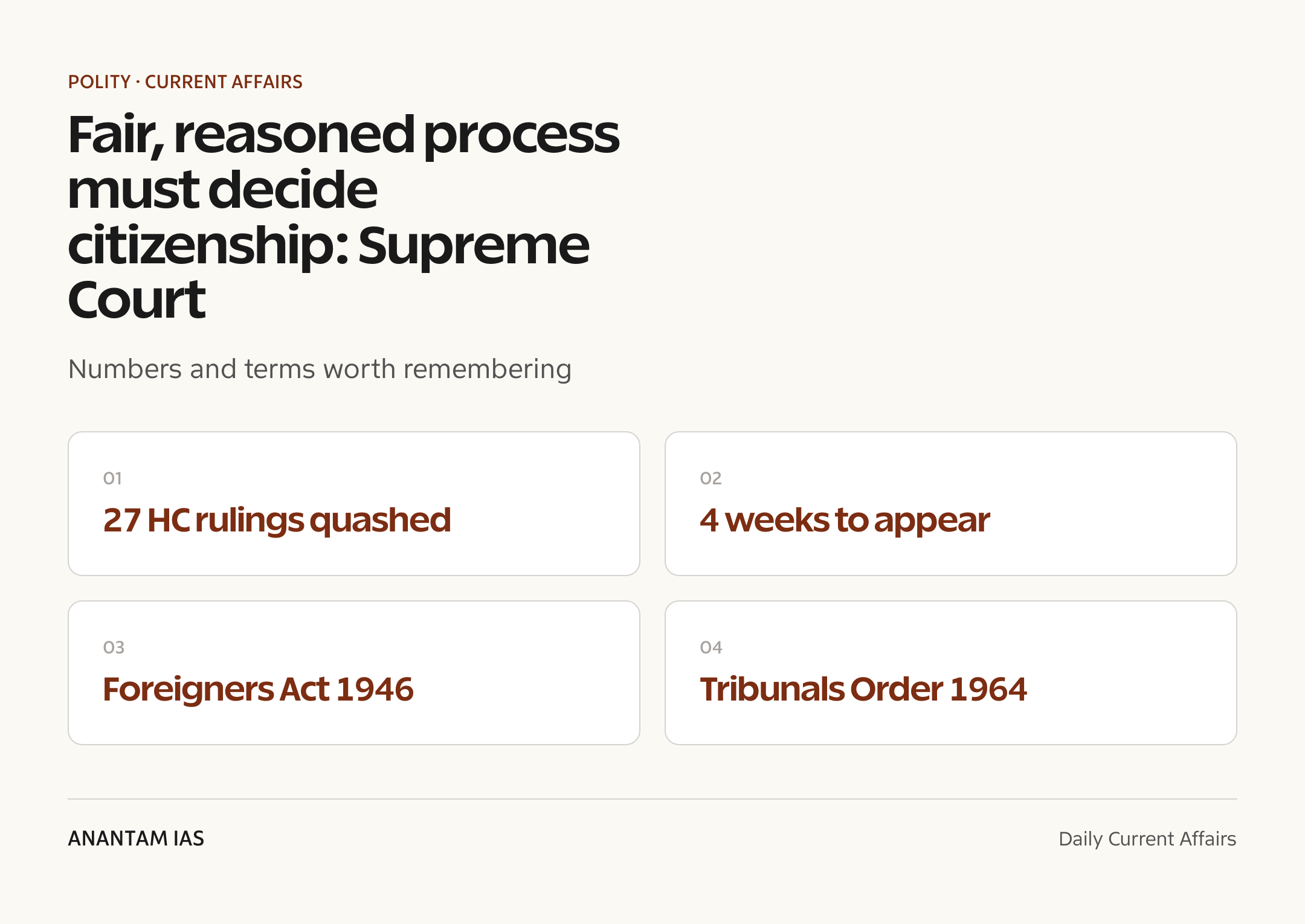
The Supreme Court has ruled that a person’s status as a foreigner must be settled through a fair, lawful and reasoned process, striking down a batch of 27 Gauhati High Court judgments that had declared the appellants to be foreigners. A Bench of Justices Vikram Nath and Sandeep Mehta sent the matters back to the concerned Foreigners Tribunals for fresh adjudication.
The Court held that a declaration of foreigner status cannot stand if the procedure is mechanical, one-sided, or devoid of application of mind. The tribunals had earlier declared the appellants foreigners in their absence after they failed to appear despite notices, an approach the Bench found legally unsustainable.
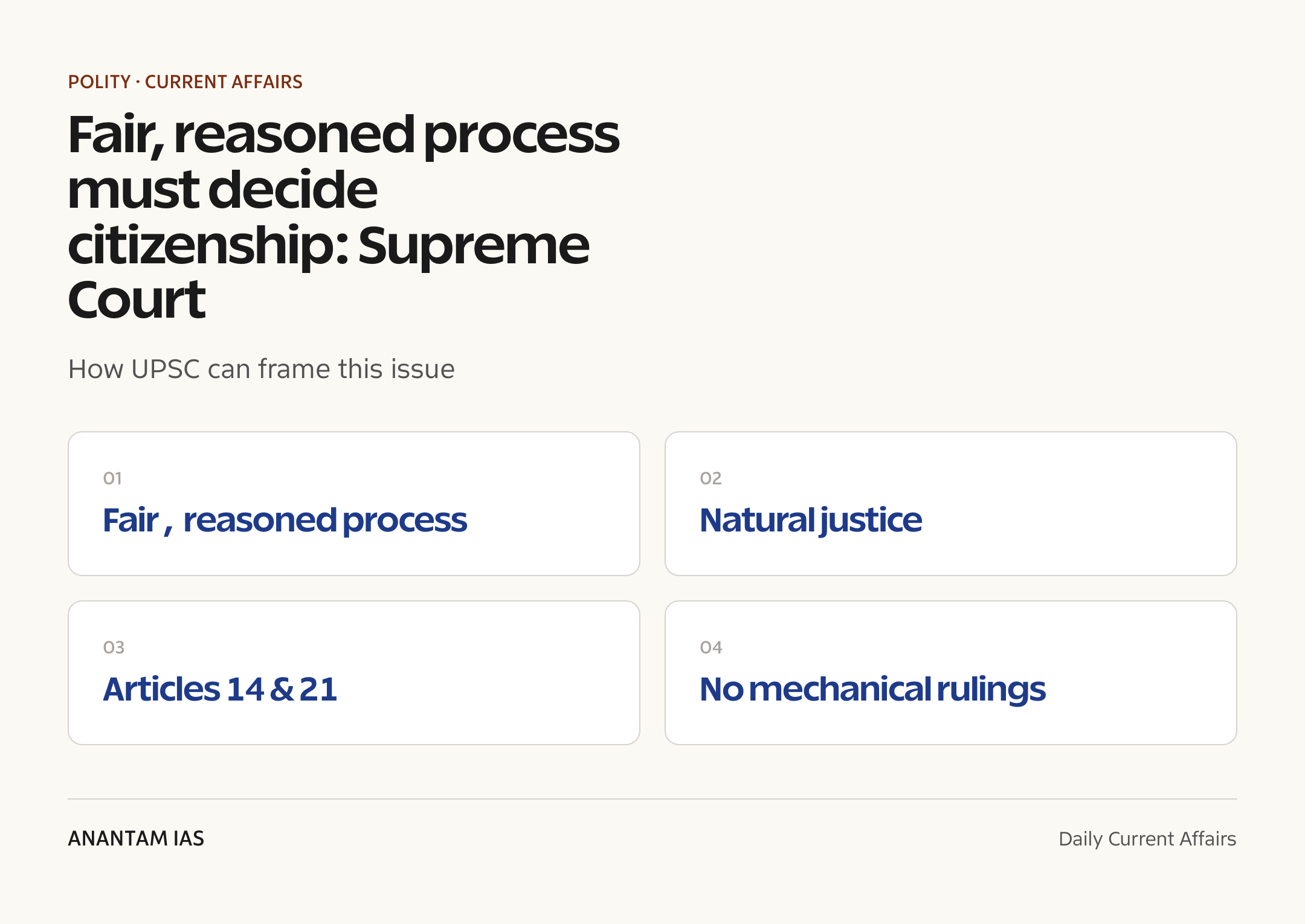
The Bench stressed that consequences of being declared a foreigner run far beyond an ordinary civil case, since they may lead to detention, deportation, separation from family, and even statelessness. For that reason, a foreigner finding must flow only from an adjudication that satisfies the Foreigners Act, 1946, the Foreigners (Tribunals) Order, 1964, and the constitutional mandate of fairness under Articles 14 and 21.
- SC set aside 27 Gauhati High Court judgments declaring the appellants to be foreigners.
- Bench of Justices Vikram Nath and Sandeep Mehta ordered the Foreigners Tribunals to decide afresh.
- The tribunals had passed ex-parte (one-sided) opinions after the appellants did not appear despite being served notices.
- Court held such declarations are unsustainable if the process is mechanical or lacks application of mind.
- Appellants directed to appear before the tribunals within four weeks, cooperate, and avoid unnecessary adjournments.
- Bench affirmed that Article 14 and Article 21 protections extend even to foreigners.
The development matters in the context of:
- Foreigners Tribunals are quasi-judicial bodies, concentrated in Assam, that decide whether a person is an Indian citizen or a foreigner.
- The ruling touches the sensitive intersection of citizenship, NRC, and due process in the North-East.
UPSC Relevance
Prelims Relevance
- Foreigners Act, 1946: places the burden of proving citizenship on the person accused of being a foreigner.
- Foreigners (Tribunals) Order, 1964: statutory basis on which Foreigners Tribunals are constituted and operate.
- Foreigners Tribunals are quasi-judicial bodies set up by the executive, not regular civil courts.
- Citizenship Act, 1955 and its Section 6A (special provision for Assam linked to the Assam Accord).
- Article 14 (equality before law) and Article 21 (life and liberty) apply to citizens and non-citizens alike.
- NRC (National Register of Citizens) updated in Assam under the monitoring of the Supreme Court.
- Assam Accord, 1985 fixed March 24, 1971 as the cut-off date for detecting foreigners in Assam.
- Ex-parte proceeding means a matter decided in the absence of, or without hearing, one party.
Mains Relevance
GS Paper 2
- Due process and natural justice: how Article 21 disciplines quasi-judicial bodies like Foreigners Tribunals.
- Citizenship determination in Assam, the NRC process, and the balance between state interest and individual rights.
- Role of the judiciary in checking mechanical, one-sided administrative adjudication.
- Statutory framework governing foreigners: Foreigners Act 1946, Foreigners (Tribunals) Order 1964, Citizenship Act 1955.
Essay
- Justice must not only be done but be seen to be done: fairness as the soul of due process.
- Belonging and the law: citizenship, identity, and the human cost of statelessness.
Background and Context
What the Supreme Court held
The Bench anchored citizenship determination firmly in constitutional fairness.
- A finding of foreigner status must flow from an adjudication that is legally sustainable and consistent with fairness.
- Such a finding cannot be sustained if the procedure is mechanical, one-sided, or devoid of application of mind.
- The tribunal must examine whether the person had a fair opportunity and must record reasons, even if briefly.
- Article 14 and Article 21 guarantees extend to foreigners, so the process must meet constitutional standards.
- A right and its consequences flow only from a legally sustainable adjudication, not from an assumed outcome.
- The Court set aside the 27 Gauhati High Court judgments and the corresponding tribunal opinions, ordering fresh adjudication.
- The tribunals must render fresh opinions uninfluenced by their earlier conclusions, restoring the appellants’ chance to be heard.
The problem of ex-parte declarations
The core defect was that people were branded foreigners without a real hearing.
- The tribunals had declared the appellants foreigners after none of them appeared despite notices being served.
- The Bench held that non-appearance does not absolve a tribunal of its obligation to conduct a lawful adjudication.
- An ex-parte (one-sided) opinion still has to satisfy the requirements of law and natural justice.
- Effective service of notice and a genuine opportunity to defend are pre-conditions before a case is treated as ex-parte.
- Many proceedees are poor, illiterate, or migrant workers who may not grasp legal notices, deepening the risk of unfair findings.
- Appellants were directed to appear within four weeks, cooperate, and avoid seeking unnecessary adjournments.
- A wrongful foreigner tag can strip a person of the right to vote and land them in a detention centre.
Foreigners Tribunals: the legal framework
These bodies sit at the heart of citizenship adjudication in Assam.
- Foreigners Tribunals are quasi-judicial bodies constituted under the Foreigners (Tribunals) Order, 1964.
- They derive authority from the Foreigners Act, 1946, which governs the entry, presence, and departure of foreigners.
- A distinctive feature is Section 9 of the 1946 Act: the burden of proof lies on the person to prove he or she is not a foreigner, reversing the usual rule.
- They decide references made by the border police or arising from doubts flagged during the NRC exercise.
- Persons marked D-voter (doubtful voter) by the Election Commission are also referred to the tribunals.
- Members are appointed by the state and need judicial or legal experience, but they are not part of the regular court hierarchy.
- Their opinions can lead to detention, deportation, and loss of the right to vote.
Why the stakes are 'high constitutional significance'
Justice Nath stressed that a foreigner tag carries consequences far beyond ordinary civil disputes.
- A declaration of foreigner status may result in detention, deportation, and separation from family and community.
- In some situations it can even push a person towards statelessness.
- Because of these consequences, the Court placed citizenship adjudication in a field of high constitutional and legal significance.
- The state has a legitimate interest in identifying persons ineligible for citizenship, but that interest cannot override fair procedure.
- The right outcome must emerge from a process, not be assumed in advance of one.
Citizenship, NRC, and the Assam context
The ruling lands in Assam’s long-running citizenship and migration debate.
- The Assam Accord, 1985 set March 24, 1971 as the cut-off for detecting and deporting illegal migrants.
- Section 6A of the Citizenship Act, 1955 gave statutory shape to this Assam-specific arrangement.
- The final NRC published in Assam in 2019 excluded over 19 lakh people, leaving many names disputed.
- Foreigners Tribunals are the forum where excluded persons and suspected foreigners contest their status.
- Section 6A treats those who entered before January 1, 1966 as citizens, and gives conditional rights to entrants up to March 24, 1971.
- In 2024 a Constitution Bench upheld the validity of Section 6A, underlining its centrality to the Assam settlement.
- Concerns over detention centres and arbitrary declarations have made procedural fairness a recurring theme.
Natural justice and Article 21
The judgment reads the audi alteram partem principle into tribunal practice.
- Natural justice requires that no one be condemned unheard (audi alteram partem) and that decisions be reasoned.
- The Maneka Gandhi (1978) line of cases established that Article 21 demands a fair, just and reasonable procedure.
- A speaking order that records reasons lets the person understand and challenge an adverse finding.
- The rule against bias (nemo judex in causa sua) is the second limb of natural justice binding all adjudicators.
- Comparative due-process jurisprudence treats a fair hearing before deprivation of liberty as a basic minimum.
- Fairness here is not a formality but a check against arbitrary loss of liberty and identity.
- The ruling reinforces that quasi-judicial bodies are bound by the same constitutional discipline as courts.
Way Forward
Strengthen tribunal procedure
- Ensure genuine, effective service of notice before treating a case as ex-parte.
- Mandate reasoned, speaking orders in every Foreigners Tribunal opinion, however brief.
- Provide legal aid and translation support to poor and vulnerable proceedees.
Systemic reform
- Standardise training for tribunal members on evidence and natural justice.
- Build transparent, digitised records to reduce arbitrary or mechanical findings.
- Reduce reliance on prolonged detention pending appeals and review, consistent with Article 21.
Conclusion
The ruling reframes citizenship determination as a question of process as much as outcome. A person may ultimately fail to prove citizenship, but the road to that finding must satisfy fairness, reasonableness, and the guarantees of Articles 14 and 21.
By setting aside 27 judgments and ordering fresh adjudication, the Supreme Court has signalled that quasi-judicial bodies cannot substitute mechanical convenience for constitutional duty. For UPSC aspirants, the case is a compact lesson in how due process disciplines the machinery of the state.
UPSC Practice Questions
Prelims MCQ 1
With reference to Foreigners Tribunals in India, consider the following statements:
- They are constituted under the Foreigners (Tribunals) Order, 1964.
- Under the Foreigners Act, 1946, the burden of proving citizenship lies on the person alleged to be a foreigner.
- They function as regular civil courts within the ordinary judicial hierarchy.
How many of the above statements are correct?
(a) Only one (b) Only two (c) All three (d) None
Answer: (b) Only two
Explanation:
Statements 1 and 2 are correct. Foreigners Tribunals are constituted under the Foreigners (Tribunals) Order, 1964, and the Foreigners Act, 1946 places the burden of proof on the person concerned. Statement 3 is wrong: they are quasi-judicial bodies, not regular civil courts.
Prelims MCQ 2
The Supreme Court’s ruling that foreigner status must be decided through a fair and reasoned process is most directly grounded in which of the following?
(a) Article 14 and Article 21 of the Constitution (b) Article 19 and Article 32 of the Constitution (c) Directive Principles of State Policy (d) Ninth Schedule of the Constitution
Answer: (a) Article 14 and Article 21 of the Constitution
Explanation:
The Bench held that equality before law (Article 14) and the right to life and personal liberty (Article 21) extend to foreigners, so a foreigner declaration must satisfy a fair, reasoned procedure and record reasons.
UPSC Mains Questions
- The Supreme Court has held that a person’s status as a foreigner must be settled through a fair, lawful and reasoned process. Examine how the principles of natural justice and Article 21 govern the working of quasi-judicial bodies such as Foreigners Tribunals. (250 words)
- Citizenship determination in Assam sits at the intersection of statutory law, the NRC, and constitutional rights. Critically analyse the challenges in ensuring fairness in Foreigners Tribunal adjudication and suggest reforms. (250 words)
Source: The Hindu.
Frequently Asked Questions
What did the Supreme Court rule?
The Supreme Court held that a person’s foreigner status must be decided through a fair, lawful and reasoned process. It set aside 27 Gauhati High Court judgments and directed the Foreigners Tribunals to re-adjudicate the matters afresh, holding that mechanical, one-sided declarations cannot be sustained.
What is a Foreigners Tribunal?
A Foreigners Tribunal is a quasi-judicial body constituted under the Foreigners (Tribunals) Order, 1964. It decides whether a person is an Indian citizen or a foreigner, largely in Assam, and its opinions can lead to detention, deportation, and loss of voting rights.
Why were the 27 judgments set aside?
The tribunals had declared the appellants foreigners in their absence after they failed to appear despite notices. The Court found these ex-parte, mechanical opinions legally unsustainable because they lacked application of mind and a fair opportunity of hearing.
How does Article 21 apply to foreigners?
The Bench affirmed that the right to life and personal liberty under Article 21, along with equality under Article 14, extend to foreigners. So any process that may lead to detention or deportation must be fair, just and reasonable, and must record reasons.
What is the Foreigners Act, 1946?
The Foreigners Act, 1946 governs the entry, presence, and departure of foreigners in India. A key feature is that the burden of proving that one is not a foreigner rests on the person concerned, not on the state.
What must tribunals do now?
The tribunals must decide the cases afresh without being influenced by their earlier opinions, ensure a fair hearing, and record reasons. The appellants were directed to appear within four weeks, cooperate, and avoid unnecessary adjournments.
Tell Google you want more of this.
Add Anantam IAS as a preferred sourceOne tap, and this site shows up more often in your own Top Stories, AI Overviews and AI Mode. Remove it any time.






