Why in News?
India officially recorded more than 99% of its estimated births and deaths in 2024, according to the latest official data highlighted by The Indian Express in an Explained piece. For a country that historically undercounted vital events and leaned on surveys to estimate fertility and mortality, near-universal registration is a quiet but consequential governance milestone.
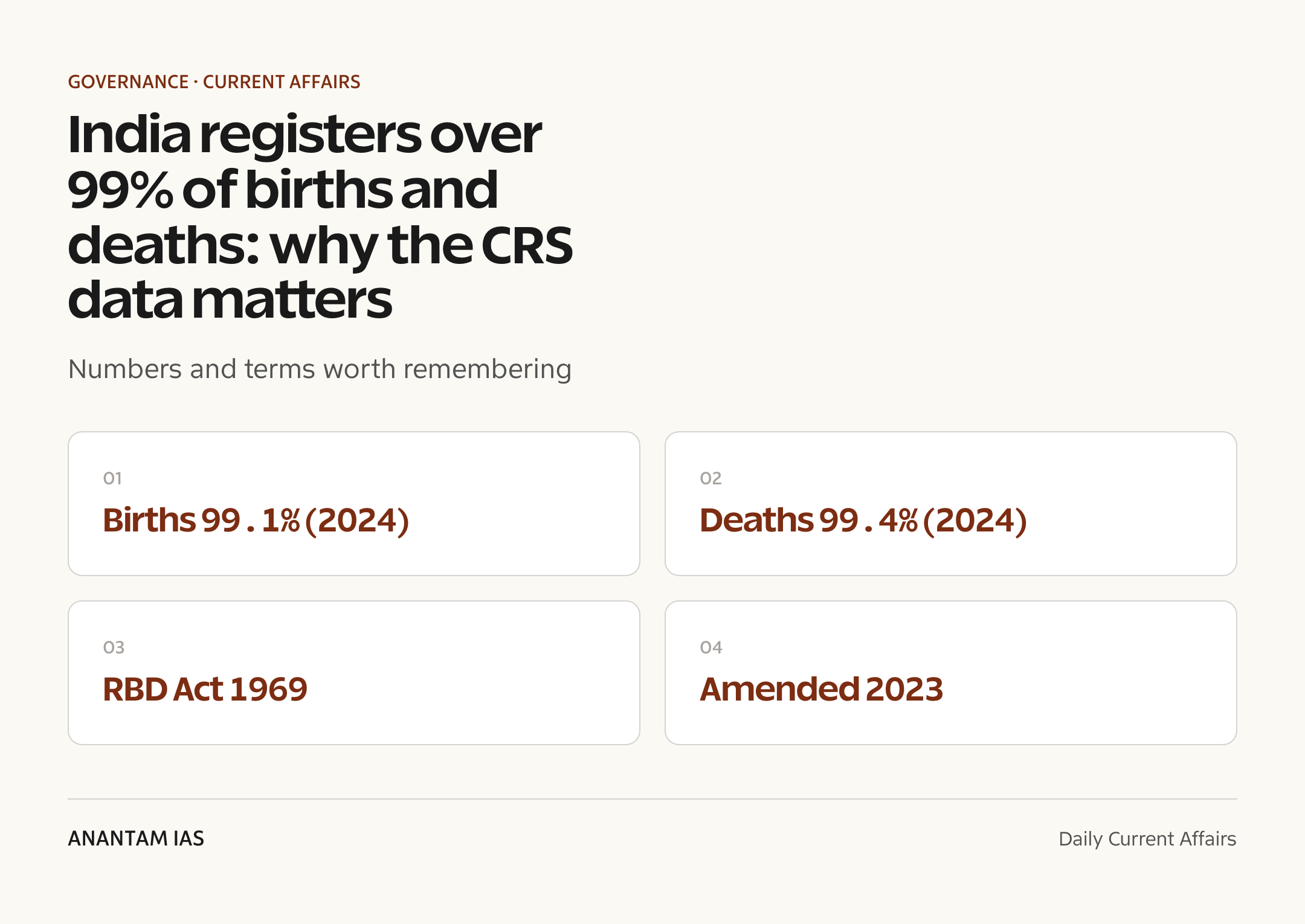
The gain is steep. Roughly a decade ago birth registration stood at about 86.6% and death registration at only about 72.5%. In 2024 birth registration reached 99.1% and death registration 99.4% – with death registration, historically the laggard, catching up rapidly. The numbers come from the Office of the Registrar General & Census Commissioner of India (ORGI) under the Ministry of Home Affairs.
- In 2024, birth registration reached 99.1% and death registration 99.4% of estimated events – coverage approaching 100%.
- About a decade earlier the figures were roughly 86.6% (births) and 72.5% (deaths), so death registration has closed the gap fastest.
- In 2024, 18 States/UTs achieved 100% birth registration and 21 States/UTs achieved 100% death registration.
- The Civil Registration System (CRS) has been legally operational since 1970 under the Registration of Births and Deaths Act, 1969, amended in 2023.
The development matters in the context of:
- A complete CRS lets India move from decadal Census snapshots and sample estimates toward continuous, near-real-time vital statistics.
- This is a classic GS2 story: registration as a governance service and a data backbone for welfare targeting, insurance, and public-health planning.
UPSC Relevance
Prelims Relevance
- Civil Registration System (CRS) – continuous, permanent, compulsory recording of vital events (births, deaths, stillbirths); operational since 1970.
- Registration of Births and Deaths Act, 1969 – the legal basis; events must ordinarily be reported within 21 days.
- RBD (Amendment) Act, 2023 – makes the digital birth certificate a single document to prove date and place of birth for admissions, jobs, and other uses.
- Registrar General of India (RGI) / Office of the Registrar General & Census Commissioner – coordinates CRS, Census, and the SRS, under the Ministry of Home Affairs.
- Sample Registration System (SRS) – large-scale sample survey giving reliable birth and death rates (IMR, TFR) at national and state level.
- CRVS – Civil Registration and Vital Statistics, the global term linking legal registration with statistical output.
- Level of registration vs completeness – registered events as a share of estimated events; completeness itself is estimated using SRS.
- Chief Registrar (State) and District/local registrars form the administrative chain under the Act.
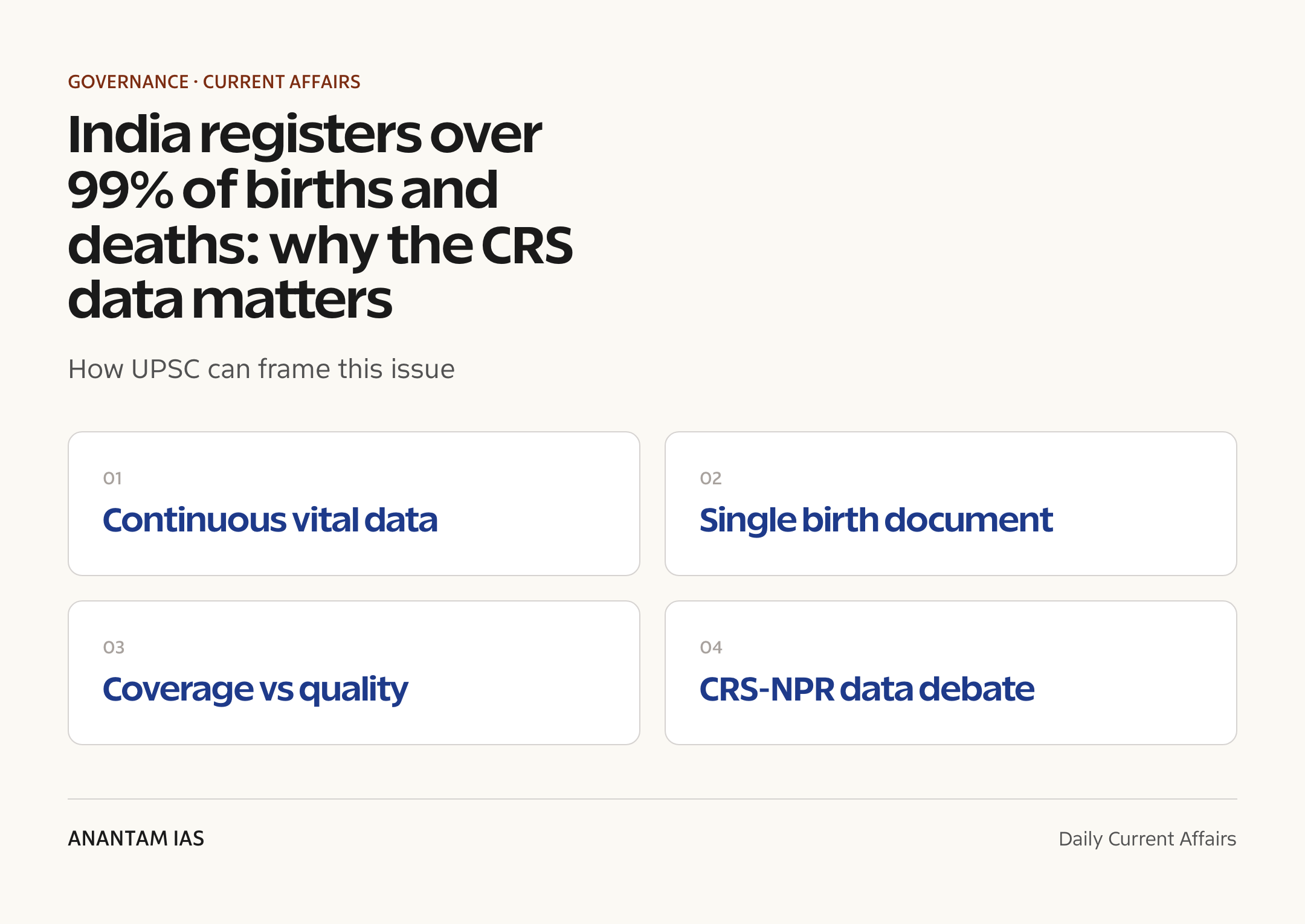
- NPR (National Population Register) – the 2023 amendment allows sharing of registration data with the NPR database, which has fuelled debate.
Mains Relevance
GS Paper 2
- Civil registration as a governance and welfare-delivery tool: legal identity, entitlement targeting, and administrative simplification via a single birth document.
- Data governance and privacy: CRS-NPR linkage under the 2023 amendment, consent, and the balance between statistical utility and surveillance concerns.
Essay
- “Counting the citizen”: data, identity and the state’s capacity to see and serve its people.
Background and Context
What the Civil Registration System is
The CRS is the state’s continuous ledger of who is born and who dies – the foundation of legal identity and vital statistics.
- The CRS is the continuous, permanent and compulsory recording of vital events – births, deaths and stillbirths – as they occur.
- It runs under the Registration of Births and Deaths Act, 1969, and has been legally operational since 1970.
- Events must ordinarily be reported within 21 days; in hospitals the medical officer in charge is responsible, and households report events at home.
- The system is coordinated by the Registrar General of India, implemented through Chief Registrars in States and district and local registrars.
- Unlike the Census, the CRS produces a year-on-year flow of data rather than a once-a-decade stock.
The 2024 numbers and the long climb
Registration coverage has jumped from patchy to near-universal in about a decade, with death registration the standout gainer.
- In 2024, birth registration reached 99.1% and death registration 99.4% of estimated events.
- A decade earlier the figures were roughly 86.6% (births) and 72.5% (deaths) – death registration had long lagged.
- Deaths are harder to register than births because there is often no institution, document or clear incentive prompting families to report them.
- In 2024, 18 States/UTs hit 100% birth registration and 21 States/UTs hit 100% death registration.
- Coverage still varies by rural-urban location and across states, so the national average hides pockets of under-registration.
Why complete registration matters
Near-universal CRS turns births and deaths into usable data for policy, and turns certificates into keys that unlock rights.
- A complete CRS is one of the most important sources of vital statistics – fertility, mortality and their trends.
- It supports welfare targeting, evaluation of health and social policies, and demographic and public-health planning.
- Annual, granular data can reveal patterns a decadal Census cannot – for example seasonal mortality shifts linked to heat and pollution.
- A birth certificate is a gateway document for school admission, welfare schemes, and later for pensions, insurance and property.
- A death certificate settles inheritance, property transfer, bank accounts, insurance and pension claims – making prompt registration a real-world necessity.
How CRS relates to the Census and SRS
For decades India read its demography through periodic surveys because the CRS was too incomplete to trust.
- The Census is a full count but runs only once in ten years, so it cannot track year-to-year change.
- The Sample Registration System (SRS) is a large sample survey that yields reliable birth and death rates, IMR and TFR – but not district-level annual figures.
- A near-complete CRS can, over time, supply continuous, local-level estimates the Census and SRS cannot.
- Together, Census, SRS and CRS form India’s CRVS (Civil Registration and Vital Statistics) architecture.
- The goal is a shift from estimating vital events to directly counting them.
The 2023 amendment and digitisation
The Registration of Births and Deaths (Amendment) Act, 2023 pushed registration toward being fully digital, timely and rights-linked.
- The RBD (Amendment) Act, 2023 makes the digital birth certificate a single document to prove date and place of birth.
- It is intended as proof for school admission, driving licence, voter rolls, government jobs, marriage registration and other services.
- The amendment provides for a national and state-level database of registered births and deaths, easing verification.
- By making the certificate essential for education and employment, it builds a strong incentive to register – part of why coverage rose.
- The Act also enables sharing of CRS data with the National Population Register (NPR), electoral rolls and other databases – a provision that has drawn scrutiny.
Caveats: coverage is not the whole story
High registration is a genuine achievement, but the headline figure needs careful reading.
- Level of registration (events registered as a share of estimated events) is not the same as full data quality.
- The completeness of death registration is itself estimated using SRS figures – and the SRS is known to undercount births and deaths, which can overstate CRS coverage.
- Registering a death is not the same as recording a medically certified cause of death; many deaths still lack reliable certification.
- That limits the CRS’s usefulness for disease and mortality analysis even when registration is near-universal.
- The NPR linkage raises data-governance and privacy questions about consent and how registration data is used beyond statistics.
Way Forward
Strengthen cause-of-death certification
- Expand Medical Certification of Cause of Death (MCCD) coverage, especially for deaths outside hospitals, to make CRS clinically useful.
- Train and equip local registrars and health staff to record standardised causes.
Close the rural and inter-state gaps
- Target the remaining rural and under-registered pockets with mobile registration and awareness drives.
- Use panchayats and ASHA/anganwadi workers as last-mile reporting agents.
Guard data quality and privacy
- Publish CRS reports promptly and audit them against SRS to flag over- or under-counting.
- Frame clear data-protection safeguards for CRS-NPR sharing, with consent and purpose limitation.
Conclusion
Near-universal registration of births and deaths is one of India’s understated governance wins – the state can now see its citizens more completely, and citizens can more easily claim the rights that flow from being counted.
The next frontier is quality, not just coverage: certifying causes of death, closing rural gaps, and reconciling the push for integrated databases with credible privacy safeguards. Counting people well is the first step to serving them well.
UPSC Practice Questions
Prelims MCQ 1
With reference to the Civil Registration System (CRS) in India, consider the following statements:
- It functions under the Registration of Births and Deaths Act, 1969.
- It is coordinated at the national level by the Registrar General of India.
- It provides a continuous, year-on-year record of births and deaths, unlike the decennial Census.
How many of the above statements are correct?
(a) Only one (b) Only two (c) All three (d) None
Answer: (c) All three
Explanation:
The CRS operates under the RBD Act, 1969, is coordinated by the Registrar General of India (Office of the Registrar General & Census Commissioner, MHA), and records vital events continuously rather than once a decade like the Census. All three statements are correct.
Prelims MCQ 2
Which one of the following best distinguishes the Sample Registration System (SRS) from the Civil Registration System (CRS)?
(a) The SRS is a large-scale sample survey used to estimate birth and death rates, while the CRS is a continuous registration of individual vital events (b) The SRS registers every birth and death, while the CRS only samples them (c) The SRS is conducted once every ten years, while the CRS is annual (d) The SRS is run by State governments, while the CRS is run only by the Centre
Answer: (a) The SRS is a large-scale sample survey used to estimate birth and death rates, while the CRS is a continuous registration of individual vital events
Explanation:
The SRS is a sample-based demographic survey that yields reliable birth/death rates, IMR and TFR; the CRS is the continuous, compulsory registration of each vital event. The Census (not the SRS) is decadal, and both systems are implemented through State machinery under the Registrar General of India.
UPSC Mains Questions
- “Near-universal registration of births and deaths is a governance achievement, but coverage is not the same as data quality.” Examine, in the context of India’s Civil Registration System. (GS2)
- Discuss how the Registration of Births and Deaths (Amendment) Act, 2023 strengthens civil registration, and analyse the data-governance concerns raised by linking registration data with databases such as the NPR. (GS2)
Sources: The Indian Express (Explained) and Office of the Registrar General & Census Commissioner, India (crsorgi.gov.in).
Frequently Asked Questions
What is the Civil Registration System (CRS)?
The CRS is India’s continuous, permanent and compulsory system for recording vital events – births, deaths and stillbirths – as they occur, under the Registration of Births and Deaths Act, 1969. It is coordinated by the Registrar General of India.
What were India’s birth and death registration levels in 2024?
In 2024, birth registration reached about 99.1% and death registration about 99.4% of estimated events – coverage approaching 100%, up from roughly 86.6% and 72.5% about a decade earlier.
How is the CRS different from the Census and the SRS?
The Census is a full count taken once every ten years; the Sample Registration System (SRS) is a sample survey that estimates birth and death rates. The CRS records every individual event continuously, so it can eventually supply annual, local-level vital statistics.
What did the 2023 amendment change?
The Registration of Births and Deaths (Amendment) Act, 2023 makes the digital birth certificate a single document to prove date and place of birth for admissions, jobs and services, creates national and state databases, and allows sharing registration data with the NPR and electoral rolls.
Why is registration alone not enough?
High registration coverage does not guarantee data quality. Many deaths still lack medically certified causes, the completeness figure is itself estimated using the SRS (which undercounts), and CRS-NPR data sharing raises privacy questions.
Why does the CRS data matter for governance?
Complete vital statistics improve welfare targeting, health and social-policy evaluation, and demographic planning, while birth and death certificates unlock rights like school admission, inheritance, insurance and pensions.
Tell Google you want more of this.
Add Anantam IAS as a preferred sourceOne tap, and this site shows up more often in your own Top Stories, AI Overviews and AI Mode. Remove it any time.